Saudi Arabia Railways (SAR) Partners With Alstom To Showcase The World’s First Passenger Hydrogen Train In The Kingdom Of Saudi Arabia
The title of this post, is the same as that as this press release from Alstom.
These are the three bullet points.
-
World’s first hydrogen-powered train demo in the Middle East and Africa
-
Alstom’s Coradia iLint train will be used for the demo in the Kingdom
-
Saudi Arabia Railways (SAR) and Alstom highlight their commitment to sustainable mobility and carbon emission reduction in the Kingdom
These are the first two paragraphs.
Saudi Arabia Railways (SAR), in partnership with Alstom, a global leader in smart and sustainable mobility, will operate and demonstrate the world’s first passenger hydrogen-powered train, the Coradia iLint in Riyadh in the month of October. This ground-breaking demonstration marks the first-ever introduction of a hydrogen-powered train in the Middle East and Africa. The collaboration between SAR and Alstom signifies a strong focus by the Kingdom to identify and test innovative sustainable mobility solutions to reduce carbon emissions from transport and meet Vision 2030 targets set by the Kingdom’s leadership.
The planned demonstration follows the memorandum of understanding signed by SAR and Alstom in September 2022 to develop or adapt hydrogen solutions for the needs of the Kingdom. Alstom’s Coradia iLint, a hydrogen-powered passenger train will embark on a first-of-its-kind journey in the Kingdom, travelling 10 to 20 kilometres on Riyadh’s East Network’s Line 1 or Line 2.
Note.
- Hopefully, this is not just green-washing?
- Will the train be powered by green hydrogen?
At least, Alstom will get their trains tested in an atmosphere full of sand.
Hydrogen Rail Project Collaboration Launched By Angel Trains And University of St Andrews
The title of this post, is the same as that of this article on Rail Technology Magazine.
This is the sub-heading.
Angel Trains, the UK’s largest rolling stock company, has partnered with the University of St Andrews to support an innovative hydrogen train project.
On Friday 29th September, an event was held to mark the donation of a hydrogen electrolyser to the university by Angel Trains. The electrolyser will form an integral part of the university’s ongoing, cutting-edge green hydrogen research.
This is the first paragraph.
The donation follows Angel Trains’ support for the delivery of Scotland’s first zero-emission hydrogen-powered train. The project entailed the conversion of a three-car Class 314 train to a hydrogen fuel cell electric powertrain. The electrolyser was key to enabling the trial to successfully demonstrate how a green-energy fuel cycle would work.
Hopefully, this initiative will lead to better use of hydrogen on the railways of the UK.
TransPennine Express To Stop Using Loco-Hauled Push-Pull Trains In December
The title of this post, is the same as that of this article on Railway Gazette.
This is the sub-heading.
TransPennine Express has confirmed that it will cease using its push-pull sets of Class 68 locomotives and MkVa coaches, previously designated Nova 3 sets, from the December 2023 timetable change.
These are my thoughts.
The Nova 3 Trains
Currently, the Nova 3 trains are made up from the following.
- 14 – Class 68 locomotives
- 52 – Mark 5a coaches
- 14 – Driving Van Trailers
Note.
- There have been complaints about the noise of the Class 68 locomotives at Scarborough and also at Marylebone with Chiltern Railways.
- The Class 68 locomotives could be switched to freight duties.
- The coaches are capable of 125 mph.
- A maximum of thirteen sets can be created.
- I suspect CAF wouldn’t object to being asked to build some more Mark 5a coaches and driving van trailers.
- The current fleet has a spare locomotive and a spare driving van trailer to allow for servicing.
All locomotives and coaches are a maximum of seven years old, so will have plenty of life left.
The Class 93 Locomotive
Rail Operations Group have ordered ten Class 93 locomotives, with twenty options, which have an impressive specification.
- Built by Stadler in Valencia.
- Same family as a Class 68 and 88 locomotive.
- Electric, diesel and battery power
- 110 mph operating speed
- Ability to pull passenger and freight trains.
- Delivery scheduled for 2023.
I believe that if the Class 68 diesel locomotive of a Nova 3 train, were to be replaced with a Class 93 locomotive, a very useful train would be created.
- It would be ten mph faster, than a Nova 3 train.
- It could use the diesel engine and the batteries to bridge gaps in electrification.
- By adding extra carriages it could be tailored to the needs of a route.
- In Vegetable Oil Fuelling Chiltern Railways Trains In UK First, I discuss how it might be possible to run all these locomotives on HVO to cut emissions.
- It could be quieter.
Could it be a simple way to reduce carbon emissions on a route?
The Successor To The Class 93 Locomotive
Stadler keep innovating in their designs for locomotives and are already building hydrogen-powered multiple units.
I can see Stadler coming up with a hydrogen-powered locomotive, with the following specification.
- In the same family as Class 68, 88 and 93 locomotives.
- Ability to do everything that Class 68, 88 and 93 locomotives can do.
- Ability to use 25 KVAC overhead electrification, where it exists.
- Ability to be able to be fitted with third-rail equipment, so it can use 750 VDC third-rail electrification, where it exists.
- At least a 110 mph operating speed.
- Range of at least 200 miles on hydrogen.
Stadler would sell a lot of these locomotives to decarbonise railways all over the world.
Possible Routes
These are possible routes for a rake of Mark 5a coaches hauled by a Class 93 locomotive or its zero-carbon successor.
Hull Trains
Consider.
- Hull Trains is an open access operator.
- Hull Trains currently have a fleet of five Class 802 trains, each of which have five-cars.
- A Class 93 locomotive has a power of 900 kW on diesel, whereas the Class 802 train has 2100 kW.
- The Class 802 train has nearly ten percent more capacity.
- In Ten-Car Hull Trains, I saw two Class 802 trains working as a pair. Does this indicate they have a capacity problem?
- Between Hull and the East Coast Main Line is only 36.1 miles and isn’t very challenging and I suspect could probably be easily handled by a Class 93-hauled rake of Mark 5a coaches.
- Adding extra coaches would not be difficult and would probably be less costly than with the more complex Class 802 trains.
- Hull Trains need to have a plan to decarbonise.
- HVO could be used to cut down emissions.
A Class 93-hauled rake of Mark 5a coaches could be an intermediate step to full decarbonisation with a hydrogen locomotive.
Would other operators of Class 802 trains like to increase their fleets, by adding Hull Trains’s five Class 802 trains?
TransPennine Express
Consider.
- TransPennine Express currently have four different fleets of trains, so it must cause problems with the allocation of drivers.
- The Class 397 trains are confined to the West Coast Main Line.
- So that leaves the bi-mode Class 802 trains and the diesel Class 185 trains to work the TransPennine routes.
The Wikipedia entry for the Class 802 train, gives more details of the plans for the Class 802 trains.
During October 2021, it was announced that TransPennine Express, Hitachi, and Angel Trains had agreed to convert one of the former’s Nova 1 trainsets into a battery hybrid train on a trial basis with the aim of supporting the technology’s further development. If successful, Hitachi and Angel Trains have proposed the retrofitting of the entire fleet. In January 2022, reports emerged that the Nova 1 fleet was operating under diesel power even when operating on entirely electrified sections of the East Coast Main Line on account of the insufficient power supplies present along the line; national railway infrastructure owner Network Rail is reportedly set to complete upgrades to the power supplies within two years.
The fleet is also set to benefit from the rollout of electrification under the Transpennine route upgrade scheme. The company’s management has noted that, in the event of largescale electrification being funded and implemented, the Class 802s could have some of their engines removed to reduce roughly 15% of their weight and thus raise their efficiency. Furthermore, Leo Goodwin, TPE’s managing director, has observed that while the Class 802s have an initial maximum speed of 125 mph (201 km/h), they have the capability of being modified for operating at 140 mph (230 km/h) if infrastructure upgrades were to permit such speeds at a future date.
Could an augmented fleet of battery-electric Class 802 trains handle the bulk of the TransPennine routes, with the shorter and unelectrified ones still being handled by the Class 185 trains?
These shorter routes are.
- Leeds and Huddersfield
- Manchester Piccadilly and Huddersfield
- York and Scarborough
Plans only exist to electrify Leeds and Huddersfield.
I suspect a few more battery-electric Class 802 trains would be needed.
Great Western Railway
Could a Class 93-hauled rake of Mark 5a coaches be used as a replacement for the GWR Castles or short-formation InterCity125s?
- They both have four passenger coaches.
- They are both 125 mph trains.
- A Class 68 locomotive could be used on routes without electrification.
- HVO could be used to cut down emissions.
- The Mark 5a coaches would probably be quieter, as they only have one diesel engine.
A Class 93-hauled rake of Mark 5a coaches could be an intermediate step to full decarbonisation with a hydrogen locomotive.
Alternatively, five-car Class 802 trains could be used as replacements for GWR Castles.
Great Western Railway also have the problem of decarbonising services between Bristol/Gloucester and Weymouth/Southampton/Portsmouth.
Great Western Railway look like they’re needing some innovative thinking.
I also suspect a few more battery-electric Class 802 trains would be needed for other routes.
Transport For Wales Rail
Transport for Wales Rail run a Premier Service between Holyhead and Cardiff using Class 67 locomotives and Mark 4 coaches.
According to the Wikipedia entry for Transport for Wales Rail, they have seven sets of 4/5 coaches to run this service.
If Transport for Wales Rail wanted to decarbonise this route, they would need to replace the locomotives for a zero-carbon unit.
Perhaps, their best solution, would be to wait until a suitable hydrogen-powered locomotive is available and buy seven rakes of new coaches with driving van trailers.
Grand Union
Grand Union has a detailed Wikipedia entry, where this is the first paragraph.
Grand Union is a prospective open access operator who are proposing to operate train services in the United Kingdom from England to Wales and Scotland. Grand Union is headed by Ian Yeowart, who founded previous open access operators Alliance Rail Holdings and Grand Central before selling both to Arriva.
That seems a sound foundation.
- They have permission to run trains between Paddington and Carmarthen starting in December 2024.
- They have also applied to run trains between Euston and Stirling.
- They are now backed by Spanish companies; Serena Industrial Partners and Renfe.
- They are proposing to use nine Mark 4 coaches hauled by Class 93 locomotives.
Consider.
- CAF has a factory in Wales.
- CAF has sold trains to Transport for Wales.
- The Mark 5a coaches will definitely be available by December 2024.
- Mark 5a coaches could easily be arranged as a rake of eight coaches and a driving van trailer.
- Grand Union is backed by Spanish companies.
I wouldn’t be surprised if Grand Union were to use sets of CAF-built Mark 5a coaches for their Carmarthen service. And later for their Stirling service.
A Class 93-hauled rake of Mark 5a coaches could be an intermediate step to full decarbonisation with a hydrogen locomotive.
Grand Central
Consider.
- Grand Central is another open access operator.
- Grand Central has a mixed fleet of twelve five-car diesel trains.
- These trains run under electrification on the East Coast Main Line.
- According to the Wikipedia entry for Grand Central trains, they have plans for expansion across the North and to and from London.
- Grand Central need to have a plan to decarbonise.
- HVO could be used to cut down emissions.
A Class 93-hauled rake of Mark 5a coaches could be an intermediate step to full decarbonisation with a hydrogen locomotive.
South Western Railway
South Western Railway have an excellent fleet of new or nearly new trains, with the exception of the diesel Class 158 and Class 159 trains, that work services between Waterloo and Exeter trains via Basingstoke and Salisbury.
- Waterloo and Exeter is 172 miles.
- Only the 47.7 miles between Waterloo and Basingstoke is electrified with 750 VDC third-rail electrification.
- Train lengths vary between five and eight cars.
- The current trains date from around 1990 and must need replacing soon.
I wouldn’t be surprised that if after a rebranding with new trains, this could be a popular route.
A version of Hitachi’s ubiquitous bi-mode Class 802 could be used.
But.
- They would need to be ordered and built.
- The third-rail gear, would need to be developed and tested.
- Passengers would be travelling for over two and a half hours with underfloor diesel engines.
An alternative could be a Class 68-hauled rake of Mark 5a coaches.
- These trains would be available after release from TransPennine Express.
- They would run in TransPennine Express formation.
- Length could be adjusted by adding or removing coaches, if required.
- The noise is all in the locomotive, which is isolated from the passengers.
At some point in the future, the route could be decarbonised by swapping the locomotive for a hydrogen-electric locomotive with the ability to handle third-rail electrification.
ScotRail
ScotRail have a similar problem to Great Western Railway with their short-formation InterCity125s.
- They have 52 Class 43 locomotives and 120 Mark 3 coaches, which is probably enough for 24 trains.
- Scotland has substantial amounts of electrification.
- I feel that a Class 68-hauled rake of Mark 5a coaches would be a more than adequate replacement.
- Class 93 locomotives could be used where routes are partially electrified.
- Scotland is not going to be short of green hydrogen.
When a suitable hydrogen-electric locomotive is available, these trains can be decarbonised.
CrossCountry
CrossCountry have a fleet consisting of the following trains.
- 5 – 2+7 InterCity125 trains
- 7 – two-car Class 170 trains
- 22 – three-car Class 170 trains
- 34 – four-car Class 220 trains
- 4 – four-car Class 221 trains
- 20 – five-car Class 221 trains
Note.
- The fleet is all diesel.
- I’ll ignore the Class 170 trains in this analysis.
- The Class 220 and 221 trains often work in pairs to provide the required capacity.
So how could these trains be decarbonised?
- The InterCity125s and the Class 220 and 221 trains could be replaced by a locomotive-hauled rake of Mark 5a coaches of an appropriate length.
- Motive power could be provided by an appropriate Class 68 or 93 locomotive.
When a suitable hydrogen-electric locomotive is available, these trains can be fully decarbonised.
Decarbonisation Of UK Main Line Services
It is generally assumed that the railways of the UK will need to fully decarbonise if the UK and the constituent nations are going to meet their decarbonisation targets.
I believe that my analysis shows that decarbonisation of main line passenger services can be achieved by the purchase of two types of trains.
- Five-car bi-mode Class 802 trains or similar.
- Locomotive-hauled rakes of Mark 5a coaches of an appropriate length.
Note.
- The Class 802 trains would be mainly to augment existing Hitachi fleets.
- Some Class 802 trains would be fitted with batteries instead of diesel generators to handle gaps in the electrification.
- The rakes of coaches would be powered by an appropriate locomotive.
- The lengths of the rakes of coaches would be adjusted to meet the demand of each service.
Initially, the following locomotives would be used.
- Class 68 locomotives would be used on unelectrified lines.
- Class 93 locomotives would be used on full or partially electrified lines.
When the hydrogen-electric locomotives become available, these would take over the routes, which couldn’t be decarbonised by full electrification or by using a Class 93 locomotive.
Chiltern Railways Seeks Proposals For Low-Emission Multiple-Unit Fleet
The title of this post, is the same as that of this article on Railway Gazette.
These are the first three paragraphs.
Chiltern Railways is seeking proposals for the supply of between 20 and 70 new or converted ‘low-emission’ multiple units.
The operator has called for ‘established’ rolling stock manufacturers, owners and modifiers to propose vehicles which would provide a ’meaningful’ reduction in the emissions and external noise compared to its existing diesel multiple-units, particularly in urban areas.
The envisaged five-year framework agreement has an estimated value of up to £400m, including supply and maintenance of the fleet, refuelling infrastructure and any depot modifications.
I have my thoughts.
Chiltern’s Rolling Stock
Chiltern Railways have two different types of rolling stock; diesel multiple units and rakes of coaches haled by diesel locomotives.
Chiltern’s Diesel Multiple Units
Chiltern has these diesel multiple units.
- Class 165 diesel trains – 28 x two-cars – 56 cars
- Class 165 diesel trains – 11 x three-cars – 33 cars
- Class 168 diesel trains – 9 x two-cars – 18 cars
- Class 168 diesel trains – 9 x three-cars – 27 cars
- Class 168 diesel trains – 10 x four-cars – 40 cars
Note.
- The trains were built between 1990 and 2004.
- The Class 165 trains are 75 mph units, whereas the Class 168 trains are 100 mph units.
- These total to 67 trains and 174 cars.
- This is an average train length of 2.6 cars.
Could a fleet of three-car low-emission 100 mph trains fit Chiltern’s requirements?
- They could work in pairs for six-car units for Birmingham Moor Street and Oxford.
- There may be a need for some four-car units.
But how will they be powered?
- Pure diesel will surely give out too many emissions!
- Would an mtu Hybrid PowerPack lower emissions enough?
- Could hydrogen-power be used, either with fuel-cells or a hydrogen internal combustion engine?
In Alstom And Eversholt Rail Sign An Agreement For The UK’s First Ever Brand-New Hydrogen Train Fleet, I wrote about Alstom’s proposed Hydrogen Aventra.
A version of these trains could be ideal, if Children could source the fuel economically.
Chiltern’s Diesel-Hauled Rakes Of Coaches
Chiltern have four rakes of Mark 3 coaches hauled by Class 68 locomotives.
These could be replaced by pairs of three-car low-emission’ multiple units.
Conclusion
A fleet of seventy three-car ‘low-emission’ multiple units, powered by hydrogen could be an innovative solution to the trains to run Chiltern’s services.
Hydrogen Trains Are To Roll Between Stade And Bremervörde
The title of this post is the same as part of the title of this article on Hydrogen Central.
The original title mentions Switzerland, but Bremervörde is in Germany to the North-West of Hamburg.
This map from OpenRailwayMap shows the route.
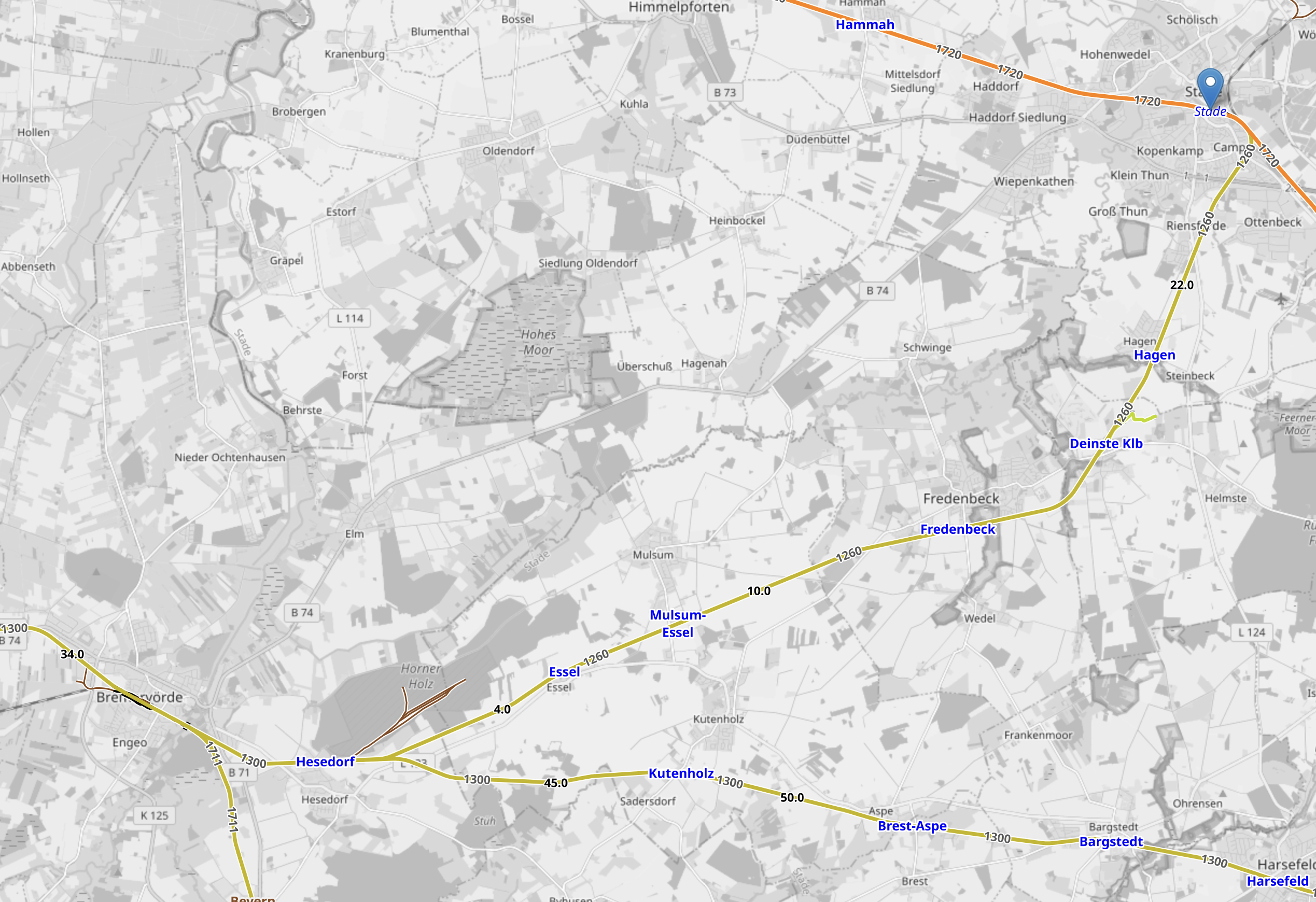
Note.
- Stade is in the North-East corner of the map and marked with a blue arrow.
- Stade station is on the Hamburg S-Bahn and has an hourly fast train between Hamburg and Cuxhaven.
- Bremervörde is in the South-West corner of the map, where the various routes converge.
- Bremervörde station is on the Buxtehude-Cuxhaven Line which is run by the hydrogen-powered Alstom Coradia iLint trains.
- Bremervörde appears to be, where the hydrogen-powered trains are serviced and refuelled.
- Currently, there are no passenger trains between Stade and Bremervörde, except at the weekends, when a heritage service called the Moor Express runs between Bremen Hauptbahnhof and Stade via Bremervörde.
- Freight trains also operate between Stade and Bremervörde.
At first sight it looks like the Stade and Bremervörde route, could be an ideal one to run with hydrogen-powered iLint trains.
- Servicing and refuelling of the trains could be shared with the existing Buxtehude-Cuxhaven service.
- The new service would probably need a few extra identical trains.
- The track is already in use, so probably wouldn’t need too much work.
- As some of the stations are in use by the Moor Express, there may not need to be too much work to bring them up to the required standard.
This re-opening, illustrates the advantage of having a fully-certified, independently-powered train, that can be deployed on non-electrified lines.
Key Mainline Testing Undertaken In Bi Modal Hydrogen Train Project
The title of this post, is the same as that of this article on Rail Technology Magazine.
This is a key paragraph.
In the test, lithium-titanate batteries and the hydrogen fuel cells have been retro-fitted to a CAF Civia Class 463 commuter electric unit train. This then has the ability to create a hybrid powertrain which can run on electrified lines alongside standard lines.
This paragraph describes some of the testing.
The new power system has been integrated into the existing vehicle’s traction system and the current tests on the mainline follow closed track testing and static testing at CAF’s plant in Zaragoza. The mainline testing has taken place across lines in Zaragoza, Madrid and Galicia but the crucial test run for the new unit was on the Zaragoza-Canfranc line where it ran in both electric mode on the electrified line before switching to hybrid mode, combining the fuel from hydrogen fuel cells and batteries where needed.
It sounds like this is a better specified hydrogen-powered train than Alstom’s iLint.
Could Hydrogen Trains Be Used As Pathfinders?
I must admit, I have a soft-spot for hydrogen transport, but I suppose most people look back on their first real job with a certain affection.
The only new hydrogen train under development for the UK Is the Alstom Hydrogen Aventra, which was announced in this press release in November 2021 and is entitled Alstom And Eversholt Rail Sign An Agreement For The UK’s First Ever Brand-New Hydrogen Train Fleet.
Little is known about these trains, except what is in the original press release.
- Ten trains have been ordered.
- Each will be three-cars.
- Contracts will be signed in 2022, which didn’t happen.
Nothing is said about the following important features.
- What will be the operating speed?
- What will be the range on a fill of hydrogen?
- Will the trains have a pantograph, so they can be run on electrified lines with 25 KVAC overhead electrification?
All are important to train operating companies, who along with the Department for Transport need to be able to plan.
What Do I Mean By A Pathfinder?
I will look at the service between Reading and Basingstoke.
- It is 15.4 miles long.
- There are four stops, which will soon be five, with the addition of Reading Green Park.
- The line is partly-electrified.
- The service is only hourly and probably needed to be two trains per hour (tph).
- It is currently run by diesel trains.
In a decarbonised railway, there are only two options for running this line.
- Use hydrogen trains.
- Electrify and use electric trains.
Note.
- The cost of the two options will be different.
- If the hydrogen and electric trains are both quality trains, the passenger experience will be similar.
- To run two tph, track and signalling modifications will be needed.
- These modifications would also allow a two tph diesel service.
- There is no way to accurately determine, how many passengers would use a two tph hydrogen and electric service.
So suppose the following plan were to be enacted.
- Upgrade the track and signalling to allow a two tph service.
- Run the two tph service with diesel trains.
- Install hydrogen infrastructure for the route. In this case, it would probably be at the nearby Reading depot.
- Run the two tph service with hydrogen trains.
Hopefully on the completion of some months of successful running of the hydrogen trains, the number of passengers to be expected will have been predicted to a better accuracy than UK railways normally manage.
Then the decision between hydrogen and electric trains can be taken.
If hydrogen trains are the decision, the trains could stay in service, but if electrification is the solution, then once the electric service is operating, the hydrogen trains would move on to the next line to be decarbonised.
Why The Alstom Hydrogen Aventra’s Need To Be Able To Use Electrification
If you look at routes, where hydrogen trains could be used as Pathfinders, they could include, some partially-electrified routes.
- Reading and Bedwyn
- Reading and Oxford
- Reading and Gatwick
- London Bridge and Uckfield
- Ashford and Eastbourne
- Preston and Blackpool South
- Wisbech and Cambridge
- Dereham and Norwich
- Basingstoke and Exeter
- Romsey and Salisbury
- York and Scarborough
This list includes both routes with both types of electrification; 25 KVAC overhead and 750 VDC third rail.
But if the electrification is there and not used, the exercise will be labelled as greenwashing, by some.
Chiltern Electrification Alternatives Studied
The title of this post, is the same as that of this article on Railway Gazette.
These are the first two paragraphs.
Chiltern Railways is working to present the Department for Transport with options for a fleet renewal programme, with London Marylebone being the only non-electrified London terminal and pressure for the withdrawal of diesel trains continuing to mount, particularly from local residents.
Industry insiders report that this could see at least the 39 two and three-car Class 165 diesel multiple-units replaced.
Note.
- The Class 165 trains were built in 1990-1992 and refurbished around the turn of the century.
- Chiltern Railways have 28 two-car and 11 three-car Class 165 trains.
- Chiltern Railways also have ten similar two-car, nine three-car and nine four-car Class 168 trains.
- In addition, Great Western Railway has 20 two-car and 16 three-car Class 165 trains, and 23 Class 166 trains.
- The Class 165 and Class 166 trains are 90 mph units, whereas the Class 168 trains are 100 mph units.
As Chiltern’s study would appear to rule out electrification, could all of these trains be replaced with an appropriate number of a new class of 100 mph zero-carbon independently-powered multiple units?
In Alstom And Eversholt Rail Sign An Agreement For The UK’s First Ever Brand-New Hydrogen Train Fleet, I talked about a proposed hydrogen train fleet.
These trains are described as three-car in Alstom’s press release.
- Most Aventras are 100 mph trains.
- They could easily be lengthened to four cars by the addition of an extra car.
- It may even be possible, that these trains could be fitted with a pantograph for working on electrified lines.
The only problem, I can envisage, is that a two-car version might not have enough space for the hydrogen and electrical gubbins.
Chiltern’s Locomotive-Hauled Mark III Stock
Greater Anglia have replaced locomotive-hauled Mark III stock with multiple units and it appears to have been successful.
Could Chiltern’s locomotive-hauled Mark III stock be replaced by six-car hydrogen-powered Aventras, with a long-distance interior?
Other Routes
Alstom and Eversholt Rail announced their agreement in November 2021.
Since then, I have written these posts, where the proposed Alstom Hydrogen Aventra could have an application.
- Adding Buxton And Manchester Piccadilly To The Bee Network
- ‘Castle’ HSTs To Be Withdrawn By Great Western Railway
- Proposals Submitted To Create Darlington To Dales Rail Link
- Alstom Hydrogen Aventras And Teesside
- Alstom Hydrogen Aventras And The Reopened Northumberland Line
- Alstom Hydrogen Aventras And Extension Of The Birmingham Cross-City Line
- Alstom Hydrogen Aventras And Great Western Branch Lines Between Paddington And Oxford
- Alstom Hydrogen Aventras And The Uckfield Branch
Note.
- A two-car version would surely increase the number of applications.
- A 110 mph capability would allow the trains to mix it with high speed trains on fast lines.
- Bombardier proposed a 125 mph bi-mode Aventra. Could this be achieved with hydrogen power?
I feel the eight applications, I listed, could be the start of something a lot bigger.
Conclusion
Alstom and Eversholt Rail Group appear to have done their research.
Could The Bombardier Voyagers Be Converted To Hydrogen Power?
Avanti West Coast, CrossCountry and East Midlands Trains all run versions of Bombardier Voyager trains.
- There are 103 sets in service.
- Lengths are four, five and seven cars.
- They are 125 mph trains.
- They are powered by one Cummins QSK19 diesel engine in each car.
Given Cummins’s enthusiasm for hydrogen could these diesel engines be converted to hydrogen power, so the trains could run long distance routes on zero-carbon power?
If there is no need for them in the UK, there are probably lots of places in the world that would like them!
Adding Buxton And Manchester Piccadilly To The Bee Network
This article on the Railway Gazette has a list of the lines, that will be transferred between Northern Rail and the Bee Network.
Included in the list is this line.
Buxton And Manchester Piccadilly
I think this route would be the following.
- The Southern terminus would be Buxton.
- The Northern terminus would be Manchester Piccadilly.
- Intermediate stations would be Dove Holes, Chapel-en-le-Frith, Whaley Bridge, Furness Vale, New Mills Newtown, Disley, Middlewood, Hazel Grove, Woodsmoor, Davenport, Stockport, Heaton Chapel and Levenshulme.
- he route is fully electrified with 25 KVAC overhead between Hazel Grove and Manchester Piccadilly.
- Most of the route has a range of operating speeds. up to 90 mph.
- The distance is 19 miles
- Trains take 62 minutes
- Trains are often two-car Class 150 trains working as a pair.
- The Buxton Line is one of the stiffest routes on the UK rail network.
The route is the same as the current Northern Trains service.
This is my thought.
Trains
I think there are three choices.
- Electrify the line fully and use 100 mph electric trains like Class 331 trains.
- Use 100 mph battery-electric trains, with large enough batteries to climb to Buxton.
- Use 100 mph hydrogen-electric trains, with enough power on hydrogen to climb to Buxton.
Note.
- The current diesel trains could be used until a zero-carbon solution is delivered.
- 100 mph trains would be needed because of the 90 mph section around Stockport.
- The stiffness of the line makes the choice difficult.
- Regenerative braking would allow trains to coast down the hill.
- Battery-electric trains would not need charging at Buxton.
I’m sure that the deal that will be setting up the Bee Network, would have a plan for the Buxton Line.
 The Anonymous Widower