New Hydrogen Refuelling Company To Drive A Greater Adoption Of Fuel-Cell Cars
The title of this post is the same as that of this article in the Telegraph.
This is the introductory paragraph.
Hydrogen delivery and fuel-cell power took a step forward this week with the announcement of a new hydrogen-gas refuelling company. ITM Motive will run its parent company ITM Power’s existing eight filling stations with plans for more. Time will tell how much of a step it is, but the creation of this new renewable refuelling subsidiary should have enough credentials to vastly improve the prospects for fuel-cell cars, trucks, trains and buses in the UK.
Does this move, explain the rise in the share price?
A Hydrogen Mobility Roadmap For North-West England
In the last few days, the North West Hydrogen Alliance has published a document entitled A Hydrogen Mobility Roadmap.
Some information from a well-written and very informative document.
Vehicle Types Covered In The Roadmap
A composite picture at the start of the document shows the following hydrogen-powered vehicles.
- A double-deck bus.
- A heavy goods vehicle.
- A passenger car.
- A passenger train.
Other vehicles, which exist or are under development, could have been added.
- A refuse truck.
- A high capacity fork lift or dump truck.
- A freight locomotive.
- The availability of hydrogen fuel in an area, must encourage the use of hydrogen-powered vehicles.
Comparison Of Electric And Hydrogen
The document gives a comparison between electric and hydrogen power.
Speed Of Refuelling
- Electric – The current long duration of battery recharges rules out many forms of transport
- Hydrogen – Hydrogen refuelling speed is largely similar to current petrol and diesel fuelling
Distance On Single Charge/Tank
- Electric – At the present time, cars will travel 150-250 miles per charge, but current battery weight means they are unsuitable for HGVs
- Hydrogen – Vehicles can travel 500+ miles on a single tank of hydrogen, which can be scaled up to suit vehicle size
Availability Of Fuel
- Electric – Growing network of charge points, but this is creating problems for power networks
- Hydrogen – Only 12 refuelling stations in the UK
Availability Of Vehicles
- Electric – Various cars to choose from, buses and trains readily available, with HGVs and ships in development
- Hydrogen – Cars, buses and trains largely available. HGVs and ships in development
Note.
- The speed of refuelling and the range for hydrogen.
- The need for more hydrogen refuelling stations.
- Both battery and hydrogen ships are in development.
I think their points are fair.
Road, Rail And Marine
The document discusses the various modes of transport and how hydrogen can help, with respect to both carbon-emissions and pollution.
The Alstom Breeze Trains
This picture is a visualisation of the Alston Breeze.
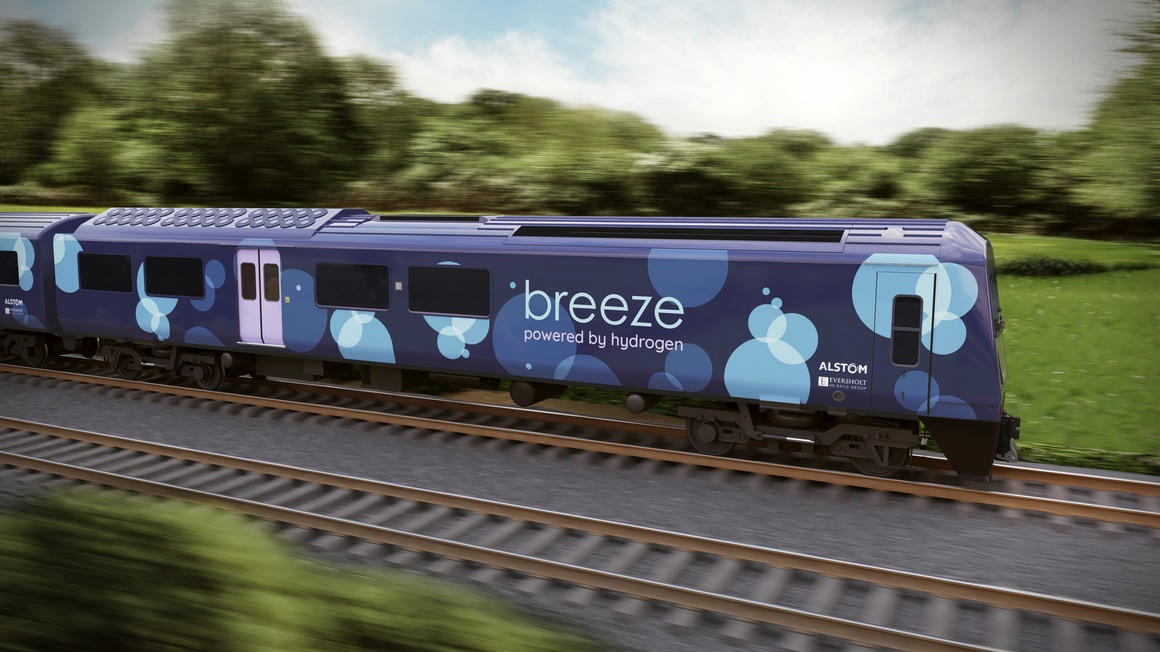
This is said about the Alstom Breeze trains.
Alstom in Widnes is ready to deploy its new Breeze trains and is working with Northern Rail to identify routes that are suitable for conversion to hydrogen.
A map also shows hydrogen train symbols on the Liverpool and Manchester Line, that goes via Widnes and Warrington and conveniently passes the Alstom factory at Widnes.
I wonder, if we’ll see an acceleration of this project?
Consider.
- Northern Rail is now directly controlled by the Government.
- Some Class 321 trains for conversion, will surely be available this summer.
- The updating of the trains, except for the hydrogen system has been developed in the Renatus project.
- Alstom have the experience of the successful hydrogen-powered Alstom Coradia iLint from Germany.
- Supplying the Alstom factory with hydrogen, shouldn’t be too difficult.
- I doubt any extra infrastructure is needed to run the trains.
- Alstom have sold two or three fleets of iLints on the back of a successful introduction into service of two prototype trains.
I don’t think, Alstom and all the various partners and stakeholders would object if the project were to be accelerated.
What’s Already Happening In The North West?
These hydrogen-powered projects are mentioned.
- Twenty double-deck buses for Liverpool City Centre.
- Alstom Breeze trains.
- storengy refuse trucks for Cheshire.
- ULEMCo are converting trucks and ferries.
- Port of Liverpool air quality.
It does seem to be that if you give an area a hydrogen network, possible users will find ways to use it to their advantage.
Rising To The Challenge
This section answers these questions.
Where Will The Hydrogen Come From?
Initially from INEOS at Runcorn, where I used to work around 1970 and BOC at St. Helens.
How Will It Be Transported?
Mainly by innovative use of new and existing pipelines.
How Do We Get To Critical Mass?
It looks like they’ll start slowly with hydrogen from Runcorn and St. Helens and build from there.
I would add a further question.
Will They Be Adding Hydrogen Filling Stations To The Network?
The North West needs them!
Hydrogen Storage
This is said about storing hydrogen.
Geologically, Cheshire is one of the few places in the UK where major underground gas storage in salt caverns has been delivered, paving the way for potential hydrogen storage, which is already done at scale elsewhere.
When I worked at ICI, I was given a tour of one of salt caverns. One is rumoured to be large enough to enable a full-size replica of Salisbury cathedral to be built inside.
Research
This is said about research.
Esteemed universities, and a wealth of innovative research companies, mean the region can deliver new hydrogen technologies. With academia working side-by-side with industry, the North West’s institutions can equip the next generation of skilled workers to support the hydrogen economy.
As a graduatev of one of those esteemed universities, how can I disagree?
Carbon Capture And Storage
This is said about carbon capture and storage.
Offshore reservoirs in the East Irish Sea can store carbon dioxide (CO2) produced from hydrogen production. Carbon Capture Utilisation and Storage (CCUS) is essential technology to help the UK in its fight against climate change. CCUS can capture up to 95% of the CO2 emissions associated with producing hydrogen from natural gas.
Whether you want to produce hydrogen this way is another matter. But the oil refineries and chemical plants along the Mersey are surely prime candidates for CCUS.
An Alliance
Not for nothing is the project called the North West Hydrogen Alliance!
Sixteen partners are mentioned at the end of the document.
Germany’s 83rd Hydrogen Station Opens
The title of this post, is the same as that of this article on H2 View.
This is the introductory paragraph.
H2 Mobility, along with its partners Shell and Air Liquide, has opened Germany’s 83rd hydrogen refuelling station in Dortmund in the North Rhine-Westphalia region.
The Germans now have eighteen hydrogen stations in Dortmund alone, which is more than we have in the whole of the UK.
Hydrogen House Is ‘Greenest In Europe’
The title of this post is the same as that of this article in The Times.
This is the introductory paragraph.
A hydrogen-powered house that is off-grid and said to be the first of its kind in Europe is being built by a family in Devon.
These are some features.
- Solar panels
- Hydrogen from electrolysis.
- Hydrogen storage
- Hydrogen boiler
- Water from a borehole
- Own sewage plant
- Air source heat pump.
The article says that “Any spare hydrogen can power the hydrogen cars they plan to buy”
This sounds like my ideal house!
Thirsty High-Rollers … Mining’s Heavy Haulers Prime Candidates For Hydrogen Conversion
The title of this post, is the same as that of this article on ecogeneration.
You understand, what the author means about mining’s heavy haulers, when you open the article.
This paragraph describes their carbon emissions.
One large scale dump truck, depending on the haul road it is using, will use between 100 and 140 litres of diesel per 100km. These vehicles operate all day every day except for maintenance down time. That’s between 260kg and 360kg of CO2 per 100km per truck.
Large open pit mines have tens of these vehicles operating continuously, so the numbers build up very quickly.
The author then goes on to say why, that converting these vehicles to green hydrogen makes a lot of sense.
The dump trucks are already diesel/electric, which means that the diesel generator can be replaced with a hydrogen fuel cell and a battery.
Mining giant; Anglo-American will be introducing a prototype hydrogen-powered dump truck at a platinum mine in South Africa this year.
These paragraphs describe the transmission.
The vehicle, which is called a fuel cell electric vehicle (FCEV) haul truck, will be powered by a hydrogen fuel cell module paired with Williams Advanced Engineering’s scalable high-power modular lithium-ion battery system. Williams provides batteries for FIA’s E-Formula motorsport.
This arrangement will replace the existing vehicle’s diesel engine, delivering in excess of 1MWh of energy storage. The battery system will be capable of recovering energy through regenerative braking as the haul truck travels downhill.
Note that the truck has more energy storage than is proposed for a four-car battery-electric train, like the Class 756 train, which has only 600 kWh.
The author finishes with this concluding paragraph.
With the major mining companies focusing on making significant strides in decarbonisation by 2030 expect there to be more announcements such as this focusing this “low hanging fruit” for the mining industry’s to materially reduce its carbon foot print.
Reading this, I can’t help feeling that replacement of a Class 66 locomotive with a zero-carbon hydrogen-battery-electric hybrid unit could be possible.
Climate Change: ‘Bath Sponge’ Breakthrough Could Boost Cleaner Cars
The title of this post is the same as that of this article on the BBC.
This is the introductory paragraph.
A new material developed, by scientists could give a significant boost to a new generation of hydrogen-powered cars.
The article is a must read and the development could make it a lot easy to store hydrogen in vehicles.
The problem is that hydrogen is extremely light and the article says this about storage.
In normal atmospheric pressure, to carry 1kg of hydrogen which might power your car for over 100km, you’d need a tank capable of holding around 11,000 litres.
That is rather large. This extract from the article describes the solution.
To get around this problem, the gas is stored at high pressure, around 700 bar, so cars can carry 4-5kg of the gas and travel up to 500km before refilling.
That level of pressure is around 300 times greater than in a car’s tyres, and necessitates specially made tanks, all of which add to the cost of the vehicles.
Now researchers believe they have developed an alternative method that would allow the storage of high volumes of hydrogen under much lower pressure.
The team have designed a highly porous new material, described as a metal-organic framework.
As ITM Power’s hydrogen filling stations can provide hydrogen at up to 350-700 bar, I’m sure that there could be a useful coming together, that will make hydrogen-powered vehicles more common.
Could for instance, the new material mean, that hydrogen becomes the fuel of choice for heavy trucks and railway locomotives?
Big London Hospital Was Close To Running Out Of Oxygen
The title of this post is the same as this article on The Times.
With COVID-19 and all those ventilators and CPAP devices, this sounds like a tragedy about to unfold.
I also remembered a story told to me by a friend, who used to be the Chief Pharmacist at a London hospital.
Oxygen was one of their problems, as the tanks were in a small yard with gates opening on to a busy street, about two hundred metres, away from the hospital.
The problem was that illegal parkers would block the gates, so that delivery couldn’t be made.
Knowing my physics and the reliability of deliveries in parts of London, I thought on-site electrolysis might be a better idea. So I consulted my bible.

There on page 760, it is all described how water can be split into two molecules of hydrogen and one of oxygen by electrolysis.
ITM Power are the experts on electrolysis, so I sent them an e-mail and asked if they could make an electrolyser, that produced oxygen instead of hydrogen.
The reply came swiftly and confirmed, that they could make an electrolyser that supplied oxygen. They also said, that the oxygen was of a high purity.
Just Connect Electricity And Tap Water
All these electrolysers would need is supplies of electricity and tap water to create hydrogen and/or oxygen.
No trucks would be needed to deliver tonnes of liquid gases, which can be rather dangerous to move around city streets.
ITM Power’s hydrogen electrolysers are starting to appear in filling stations, so they can refuel hydrogen-powered vehicles.
One could be installed in a hospital to provide a continuous stream of pure oxygen, which could be piped into the current oxygen delivery system.
What To Do With The Hydrogen
The hydrogen electrolysers produce oxygen as a by-product, which I suspect is just vented to the atmosphere!
But you can’t vent large amounts of hydrogen to the atmosphere, as it is an inflammable gas!
However, you could do either of the following options.
- Connect it to a hydrogen fuel pump to refuel hydrogen vehicles.
- Inject the hydrogen into the gas main, as is regularly done with hydrogen produced by surplus renewable electricity.
I prefer the first option, as it could mean that health-care could start to use hydrogen-powered ambulances, that are zero carbon and pollution-free.
Perhaps not an appropriate saying for the industry, but it would genuinely kill two birds with one stone.
Batteries Come Of Age In Railway Construction
The title of this post is the same as that of this article on Rail Engineer.
It is very much a must-read article on the subject of constructing and repairing railways in a zero-carbon manner.
These are some extra comments of mine!
Smaller And Lighter First
This is a paragraph from the article.
Smaller and lighter equipment is getting the treatment first – the batteries and motors can be smaller. Volvo Construction Equipment has already supplied its first electric compact loader, to a customer in Germany.
Volvo seems to be busy creating electric loaders.
Size Appears To Be No Limit
This extract shows how a large dump truck can go electric.
If a 25-tonne excavator is not big enough, how about a Komatsu HD605-7 off-highway truck, which weighs 51 tonnes unladen and has a payload of 63 tonnes? Kuhn Switzerland, working with Lithium Storage and the Swiss Federal Office of Energy (SFOE), has converted this 111-tonne gross vehicle weight monster into an electric vehicle.
Out came the 23-litre, 778hp (578kW) diesel engine and in went a synchronous electric motor rated at 789hp (588kW) electric motors. An additional 120kW motor is fitted just to power the hydraulic systems. The battery was a challenge – the four large packs have a combined rating of 700kWh and weigh 4.5 tonnes.
Do you get much bigger than 111 tonne, nearly 600 kW and a 700 kWh battery pack?
Regenerative Braking
The article also says that in some applications, vehicles go up and down a route and can charge the batteries using regenerative braking on the downhill run. In one application batteries only need charging every three days.
Rail Application Of Off-Road Equipment
The article says this.
While an eDumper may be too large to use on the railway, it does show what can now be done. Between JCB’s mini-excavator and eMining’s dump truck, there is room to battery-power almost any item used on the railway today.
I would suspect that there are a lot of companies, including giants like Caterpillar, JCB, Komatsu. Volvo and others working to produce electric versions of their successful products.
What About The Workers
The article says this.
These new machines are only the tip of the ‘electric’ iceberg. As pressure mounts to cut carbon emissions and to protect workers from harmful fumes, there will be more to come.
Health and safety will lead to a big push towards electric, as electric vehicles are pollution, carbon and fume-free, with a substantial noise reduction.
Hydrogen Will Have A Part To Play
This statement is from the Wikipedia entry for ITM Power.
In March 2015 JCB made a strategic investment of £4.9M in ITM Power.
Why would a construction equipment company invest in a company, that makes equipment that generates hydrogen to power vehicles?
- It is known, that the Bamford heir has purchased Wrightbus and intend to make hydrogen-powered buses for the world.
- JCB have built their own diesel engines, so are they building their own hydrogen engine?
- JCB make tractors and I believe a hydrogen-powered tractor may be more than a niche market.
- Is it possible to build a hydrogen-powered JCB?
Buy any of these products and you get a gas station in the price.
To deliver hydrogen, all you need to do is connect it to the water and electricity mains and switch on.
If you’re using it to power rail or site construction equipment, the gas station could be on wheels, so it can be moved from site to site.
Conclusion
This is the writer’s conclusion.
It seems that ‘battery is the new diesel’. It will be fascinating to see how this sector develops over the next few years.
I don’t disagree, but would add, that I feel that JCB are the elephant in this room!
EU Announces ‘Clean Hydrogen Alliance’ For Launch In The Summer
The total of this post is the same as this article on Euractiv.
The title is probably fairly clear, but the article is well worth a read.
Hydrogen Mobility: Coming Soon to a Bus or Truck Near You?
The title of this post is the same as that as this article on Green Tech Media.
The article is a must-read and makes these points.
- Hydrogen could have a significant impact on the transportation sector, even though sales of fuel-cell cars have been minuscule to date.
- More than nine million passenger fuel-cell vehicles could be built.
- In the short term hydrogen could be used for buses and heavy trucks.
- There are only 17,000 hydrogen vehicles worldwide.
- In 2019, there was a 246 percent increase in hydrogen vehicles.
- Hydrogen-powered garbage trucks are being tested in Germany, The Netherlands and the UK.
Overall there seems to be a lot of growth and enthusiasm for hydrogen-powered vehicles.

