Disused Oil Wells Could Enhance Compressed Air Storage
The title of this post, is the same as that of this article on The Engineer.
This is the sub-heading.
A new study has shown how geothermal energy in abandoned oil and gas wells can boost the efficiency of compressed air energy storage by nearly 10 per cent.
These are the first two paragraphs.
Developed by researchers at Penn State University, the geothermal-assisted compressed air energy storage (GA-CAES) system harnesses the existing infrastructure of abandoned oil and gas wells (AOGWs). Compressed air is pumped into the wells, where geothermal heat raises its temperature and compresses it further. Published in the Journal of Energy Storage, the study showed how geothermal energy could increase round-trip efficiency by 9.5 per cent.
“This improvement in efficiency can be a game changer to justify the economics of compressed-air energy storage projects,” said corresponding author Arash Dahi Taleghani, Professor of Petroleum and Natural Gas Engineering at Penn State.
The Professor also says it could be a “win win situation!”
Trump must have nightmares about stories like this, especially, when the scientists have a name, that labels them as an immigrant.
Could A Mega-Station Be Built For The Channel Tunnel?
This article on Railway Gazette International, is entitled Start-Up Announces Amsterdam To London And Paris High Speed Train Ambitions.
It talks about how Dutch start-up; Heuro wants to run fifteen trains per day (tpg) between London and Amsterdam.
The article then has this paragraph, which details other operators, who are wanting to run services between London and the near Continent.
Heuro’s announcement comes after Spanish start-up Evolyn announced plans in October for a Paris – London service, while on November 11 British newspaper The Daily Telegraph reported that Sir Richard Branson and Phil Whittingham, former head of Virgin Trains and Avanti West Coast, were also drawing up plans to compete with Eurostar and had held discussions with infrastructure managers.
This leads me to the conclusion, that there will be a need for more capacity for trains and/or passengers at some time in the future.
- There are six International platforms at St. Panvcras International station, which can each probably handle four trains per hour (tph), so I suspect the station could handle 24 International tph.
- As a modern high speed train can carry over 500 passengers, that is 12000 passengers per hour.
- Visit St. Pancras station in the morning and it is often crammed with travellers coming from and going to Europe.
I suspect that the number of trains may not be a problem, but the number of passengers will.
We could always join Shengen, but then that would be an open door to all the would-be migrants to the UK.
This Google Map shows Stratford International station.
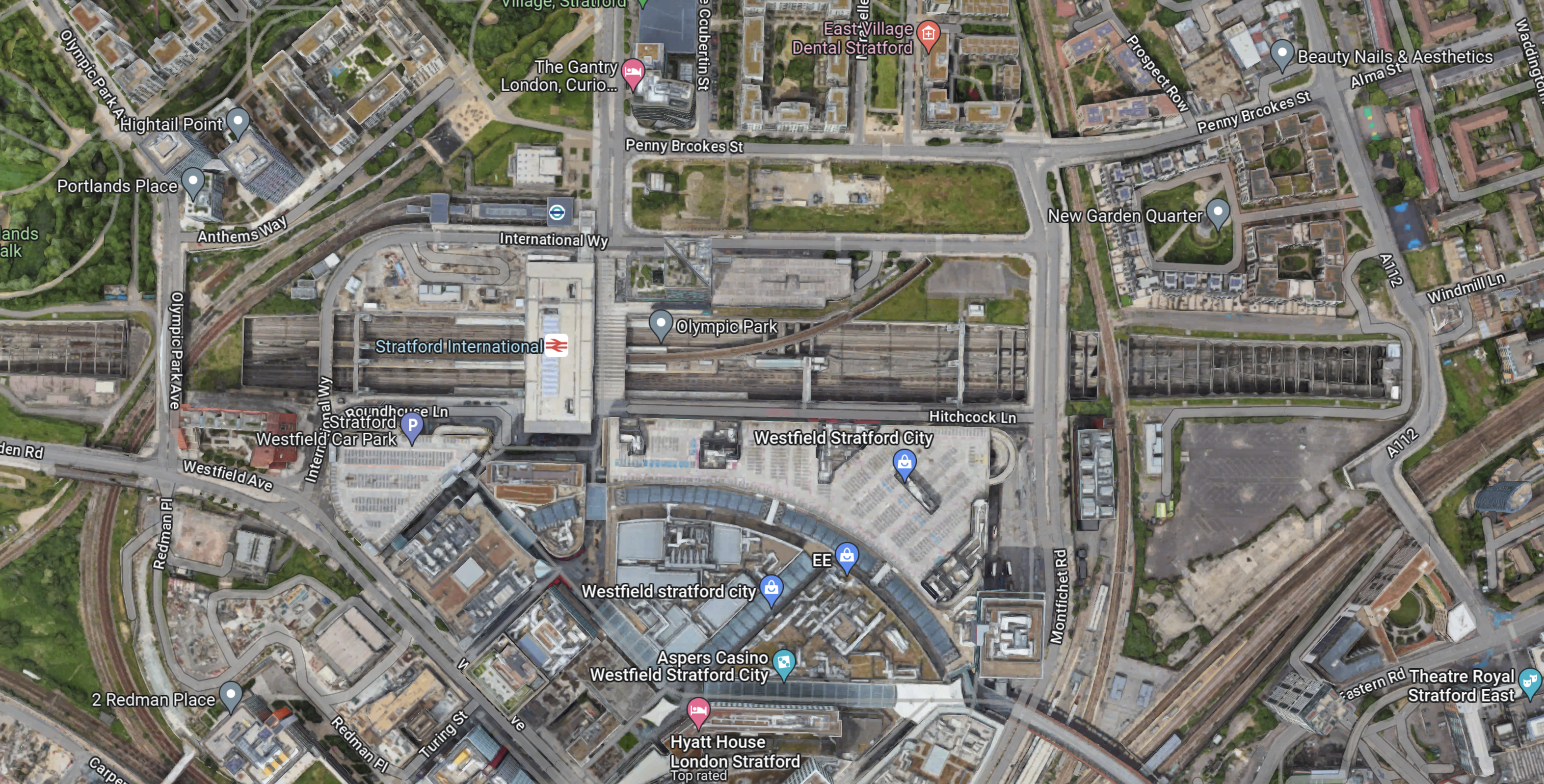
Stratford International station is in a soulless concrete cavern, that lies across the middle of the map.
In Platforms 1 And 4 At Stratford International Station, there are a lot of pictures of the station.
I think it would be extremely difficult to add extra platforms and passenger facilities to the station.
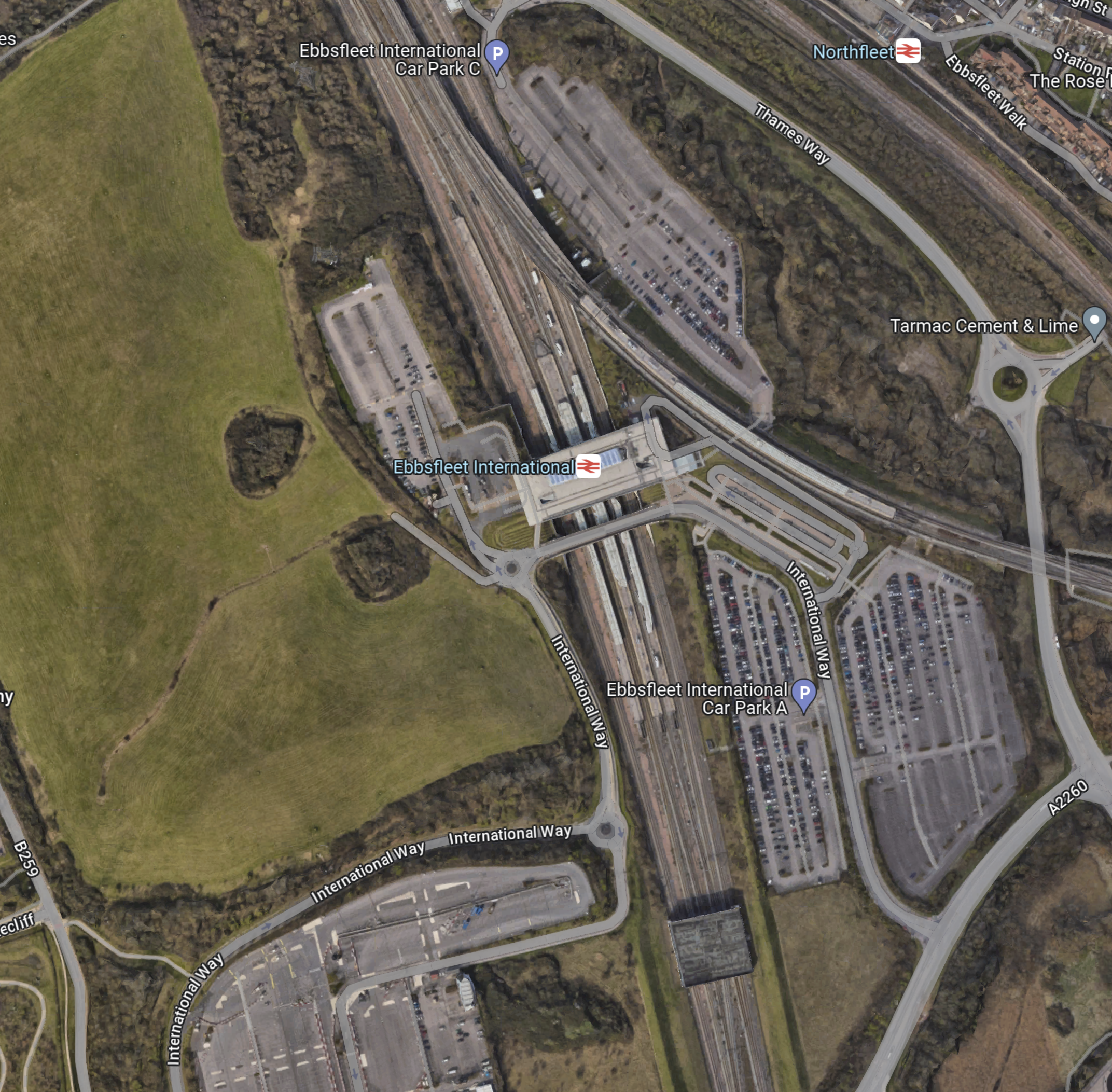
This Google Map shows Ebbsfleet International station.
Note.
- Ebbsfleet International station, with its two International and four domestic platforms is in the middle of the map.
- The station is surrounded by car parks with a total of 5,000 spaces.
- Northfleet station is in the North-East corner of the map.
There is a lot of land, without any buildings on it.
These are my thoughts.
Enough Extra Bay Platforms To Handle The Additional Trains
There would appear to be space for perhaps two bay platforms to terminate trains.
But would passengers we happy being dumped outside Central London?
Would An Elizabeth Line Extension To Ebbsfleet Be Needed?
There are various plans to link the Elizabeth Line tp Ebbsfleet International.
In Elizabeth Line To Ebbsfleet Extension Could Cost £3.2 Billion, I showed this map from the Abbeywood2Ebbsfleet consultation.
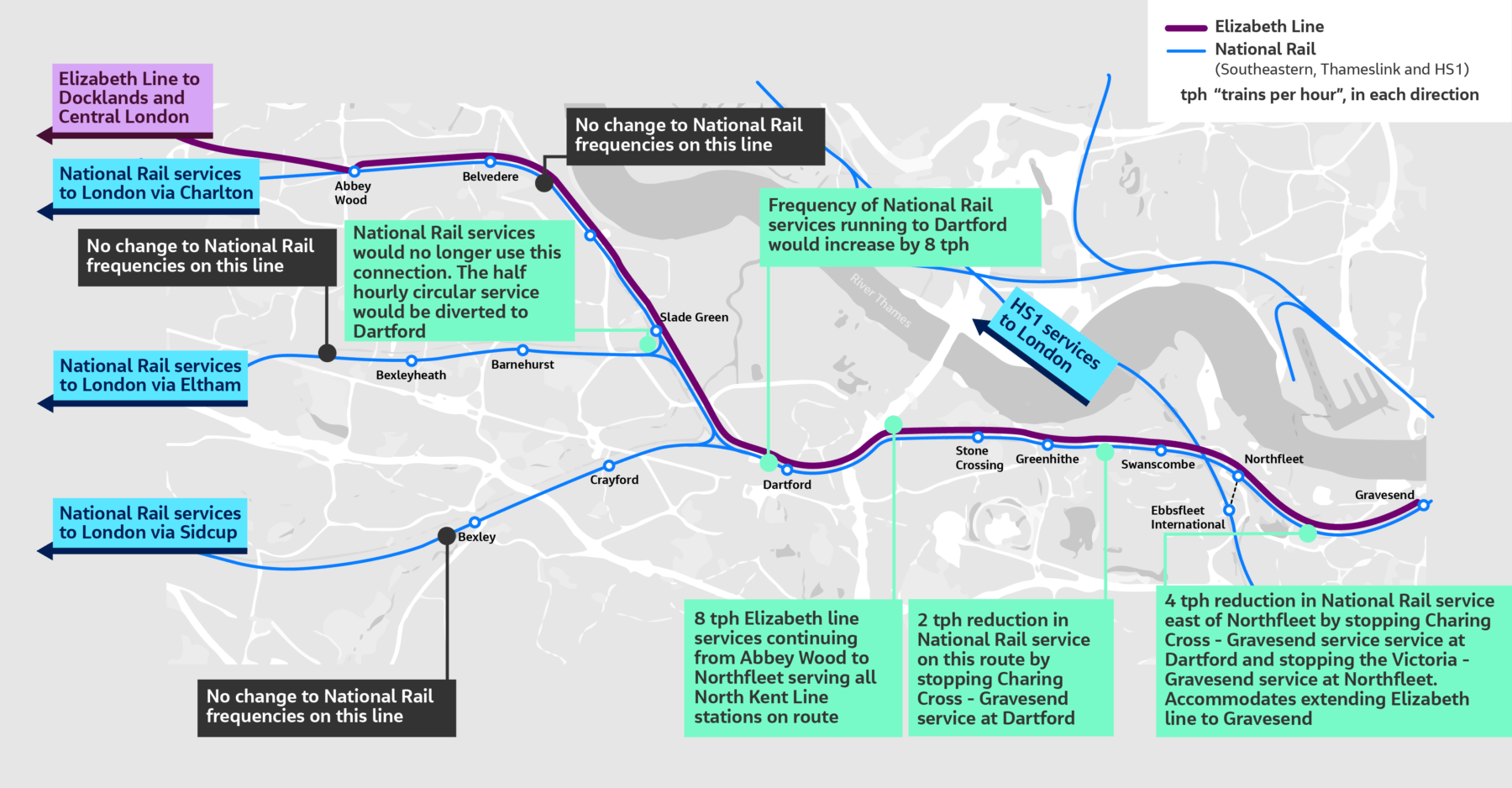
There doesn’t appear to be too much new infrastructure, except for a proper connection between Northfleet and Ebbsfleet stations. References on the Internet, say that the similar-sized Luton DART connection at Luton Airport, cost around £225 million.
The Elizabeth Line connects to the following.
- Bond Street
- Canary Wharf
- City of London
- Farringdon for Thameslink
- Heathrow Airport
- Old Oak Common for High Speed Two
- Liverpool Street station
- Oxford Street
- Paddington station
- Slough for Windsor
- Tottenham Court Road for the British Museum, Oxford Street, Soho, Theatreland and the Underground.
- West End of London
- Whitechapel for the Overground and Underground
For many people like me, the Elizabeth Line at Ebbsfleet will provide one of the quickest ways to get to and from European trains.
Ebbsfleet Has Space For A Bus Station
A bus station with comprehensive routes could be built at Ebbsfleet station, which I don’t think will be possible at St. Pancras.
It would also be possible to provide an easy route to Gatwick Airport along the M25.
Hotel Accommodation
This is surely necessary.
It would make an ideal base for tourists and business people, who wanted to visit several of the large cities connected to Ebbsfleet.
A Very Large Car Park
Consider.
- Heathrow Airport is looking at providing upwards of 50,000 car parking spaces.
- Some travellers are seriously allergic to public transport and will always use their car.
- Many travellers these days want to take a severely outside case with them, when they’re only having a weekend in Paris.
I feel that a mega-station for Europe will need upwards of 10,000 car parking spaces. All of them with vehicle-to-grid chargers.
A Very Large Storage Battery
According to this page on the E-on web site, the average size of the battery in an electric vehicle is 40 kWh.
If 5,000 car parking spaces were to be fitted with vehicle-to-grid charging (V2G), that would be 2 MWh of energy storage, that could be used by National Grid, to store surplus electricity.
Get V2G right and it could make a serious contribution to your parking costs.
Pictures Of Ebbsfleet Station
These are some pictures I took at Ebbsfleet station today.















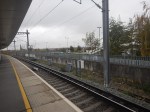







Note.
- The station is a fairly boring concrete, glass and steel construction.
- The SouthEastern HighSpeed services also go to St. Pancras, so they don’t offer any different connectivity towards the capital.
In addition, the SouthEastern HighSpeed Class 395 trains aren’t step-free at the platforms, as these pictures shows.




As I came back into St. Pancras International station, staff were struggling to load a wheelchair onto a train using a ramp.
Would A Two-Station Solution Increase Capacity?
High Speed Rail lines have high capacity trains and there are examples of more than one station at the end of a route.
- The London end of High Speed Two will have stations at Old Oak Common and Euston.
- The Manchester end of High Speed Two will have stations at Manchester Airport and Manchester Piccadilly.
- The Edinburgh end of the East Coast Main Line has stations at Waverley and Haymarket.
- The Amsterdam end of Eurostar and Thalys has stations at Rotterdam, Schipol Airport and Amsterdam.
A selection of stations gives choice and convenience for travellers.
Conclusion
I believe that selective development of Ebbsfleet International station could be used to take the pressure away from St. Pancras International station.
These developments could include.
- A comprehensive bus station
- Elizabeth Line to Northfleet
- Hotel Accommodation
- Lots Of Car Parking
What Will Israel Do Next? Military Options In Gaza Explained
The title of this post, is the same as that of this article in The Times.
Like many, I worry about what is going on in Israel and Gaza.
This is a paragraph from the article.
So the more likely scenario is a full-frontal invasion of Gaza, similar to what happened in Lebanon in 1982, when Ariel Sharon, the defence minister at the time, earned worldwide notoriety for the brutality of his tactics but appreciation at home for extirpating the Palestine Liberation Organisation from Israel’s northern neighbour. Yasser Arafat and his men were simply put on boats.
It is probably a solution, that would appeal to many Israelis and expulsion is certainly a policy that has been applied to Jews themselves in the past.
In 1290, Edward I issued the Edict of Expulsion, which is outlined in the first paragraph of its Wikipedia entry.
The Edict of Expulsion was a royal decree issued by Edward I of England on 18 July 1290 expelling all Jews from the Kingdom of England. Edward told the sheriffs of all counties he wanted all Jews expelled by no later than All Saints’ Day (1 November) that year. The expulsion edict remained in force for the rest of the Middle Ages. The edict was not an isolated incident, but the culmination of over 200 years of increasing antisemitism in England. The edict was eventually overturned more than 365 years later, during the Protectorate when Oliver Cromwell permitted the resettlement of the Jews in England in 1656.
I am not in any way religious, but my great-great-great-grandfather; Robert, was a Jewish tailor from Konigsberg in East Prussia, which is now Kaliningrad in Russia.
He left Konigsberg, as the law said, that if you were Jewish, male and eighteen, you had to leave. So he embarked on a ship and ended up in London around 1800.
I have one indirect memory of Robert. My father told me, how his grandfather had met him in his later years and he was a small man, who only spoke German and no English. My father’s grandfather was born in 1853 and died at some date after 1911. So as my father was born in 1904, this tale is possible.
And surely, the Nazis’ policies were the ultimate expulsion.
I worry if the Israelis were to repeat the Palestine Liberation Organisation solution for Hamas.
Would some join the queues of migrants trying to get to the UK?
Conclusion
I can see Israel’s actions having repercussions for the UK.
Don’t Call Them illegal Immigrants, Sadiq Khan Tells Civil Servants
The title of this post, is the same as that of this article in The Times.
These three paragraphs outline Khan’s new instructions to civil servants.
Sadiq Khan has told civil servants not to use the term “illegal migrants” but instead use “undocumented” migrants or those “with insecure immigration status”, according to internal guidance.
Produced for City Hall workers, the leaked inclusivity guide tells employees that instead of using “men and women’” they should say “people” or “Londoners”. It also advises the estimated 1,300 people who work for the Greater London Authority that the terms “male” and “female” are “dated and medicalised”.
“Similarly, instead of ‘ladies and gentlemen’ say something that doesn’t exclude non-binary people,” it reads.
In the 1970s, I can remember C and myself listening to a magnificent play on BBC Radio 4, by Václav Havel called The Memorandum.
The Wikipedia entry says this about the play.
The play is a black comedy that parodies bureaucracy and conformity. Havel wrote it prior to the Prague Spring of 1968 as an ironic satire dissenting against communist rule. Despite its veiled themes, the play was approved by government censors and published. The Memorandum centers on the introduction of a new language, “Ptydepe”, that is meant to make work more efficient despite having the opposite effect. Sam Walters considers The Memorandum to be Havel’s masterpiece.
Khan has obviously seen the play and feels he should sharpen up his act.
The Purfleet Ro-Ro Terminal
This article on the BBC is entitled Essex Lorry Deaths: 39 Found Dead Were Chinese Nationals.
The tragedy has got me wondering, where did the lorry enter the UK.
So I drew this Google Map of Purfleet.
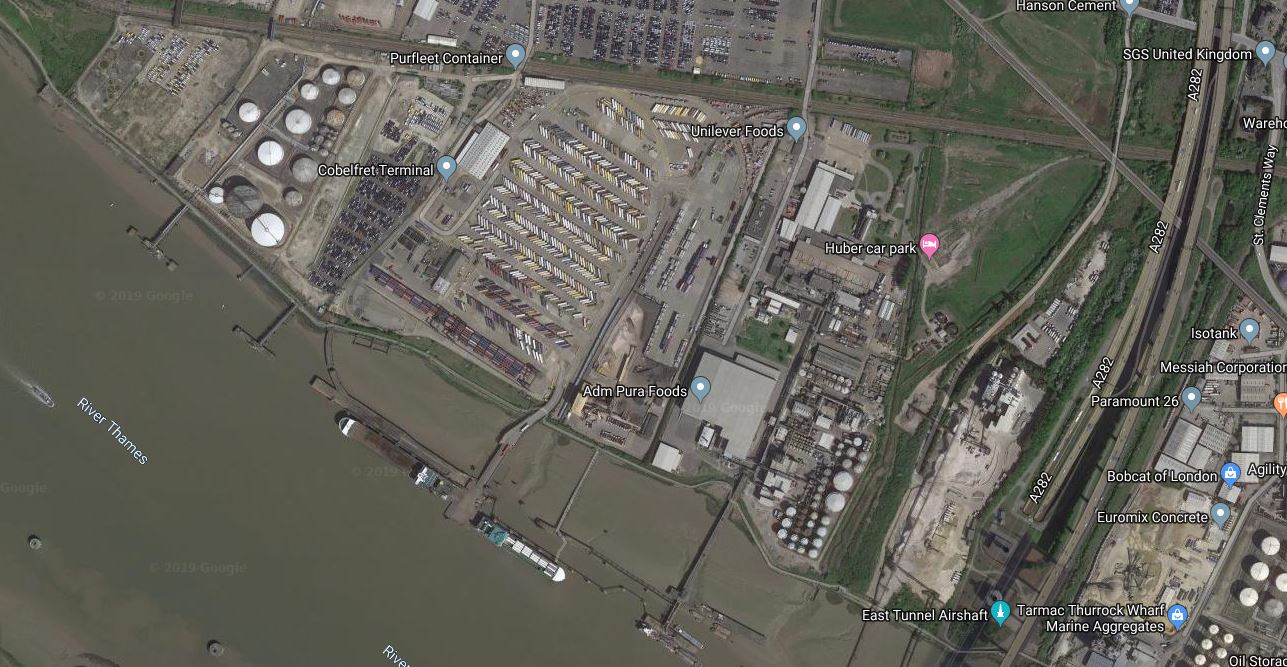
Note.
- The c2c rail line between Fenchurch Street and Southend via Grays, that runs West-East across the top of the map.
- The Channel Tunnel Rail Link runs diagonally across the corner of the map.
- The approach roads to the Dartford Crossing running North-South at the East of the map.
The Purfleet Ro-Ro Terminal lies to the South-west of these railways and road, with piers for the ships strewtching out into the River Thames.
If you enlarge the map by clickjing on it, you’ll see rows of trailers parked ready to cross the Channel or having just arrived.
You canm also see it from Eurostar and other high speed trains or when going South on the Dartford Bridge.
Immigration
Illegal or legal, there is always a lot of strong views about immgration.
- In Did The Tailor Of Bexley Come From Koningsberg?, I discuss how my paternal great-great-great-grandfather came to the UK from Konigsberg in Germany, which is now Kaliningrad in Russia!!
- On my mother’s side my family were French Huguenot and probably came over some decades earlier.
So I tend to have a variety of views about immigration depending on the point being discussed.
- For instance, is it right to deny those who were persecuted like my ancestors for religious reasons, the right to come to the UK. I’d be a hypocrite.
- On the other hand, those who want t come for criminal reasons should be turned away.
The Chinese, a number of whom perished in the Purfleet trgedy are a difficult group to think about. China is a place, where I would not want to live and if I had the money to get out, I would want to leave, as many have over the years. Twenty years ago, I met a Chinese lady of my age, who’d escaped by swimming into Hong Kong.
Darwin talked of natural selection and in some way immigration is natural selection at work.
The intelligent, ambitious and resourceful ones, are the immigrants who tend to get to their preferred destination. The ones who lack these character traits either stay put or don’t make it.
I often think of my Jewish great-great-grandfather, who at eighteen had just qualified as a tailor after serving his apprenticeship. The law in the City was that if you were a Jewish male of eighteen and not one of the privileged families you had to leave.
So he jumped on a ship and ended up Bexley. No doubt, being a tailor, he was able to find a small space for his tools.
I certainly, think I inherited some of his good genes along with those for coeliac disease.
But was my ancestor any different to the skilled Iraqis, Brazilians or Ethiopians today?
Thalys-Eurostar Merger Planned Under Green Speed Initiative
The title of this post is the same as that of this article on Railway Gazette.
This is the first paragraph.
SNCF, SNCB and the Patina Rail investment vehicle announced on September 27 their intention to combine the Eurostar and Thalys high speed rail operations, reporting that outline proposals were being presented to their respective boards.
Eurostar runs or has ambition to run these services.
- London and Paris Nord via Calais and Lille
- London and Marne-la-Vallée–Chessy
- London and Bordeaux via Marne-la-Vallée–Chessy and Tours
- London and Amsterdam via Calais, Lille, Brussels, Antwerp, Ritterdam and Schipol Airport
- London and Frankfurt via Calais, Lille, Brussels, Liege, Aachen and Cologne.
- In Winter services run to skiing resorts.
- In Summer services run to the sun.
Thalys runs these services.
- Paris Nord and Amsterdam via Brussels, Antwerp, Ritterdam and Schipol Airport
- Paris Nord and Cologne via Brussels, Liege and Aachen.
- Marne-la-Vallée–Chessy and Amsterdam via Brussels, Antwerp, Ritterdam and Schipol Airport
- In Winter services run to skiing resorts.
- In Summer services run to the sun.
Eurostar and Thalys seem to have a good fit of routes.
- Both have two Northern terminals; Amsterdam and Cologne or Frankfurt.
- Both serve Schipol Airport
- Both serve Brussels Midi, which is in the city centre.
- Both serve Paris Nord, which is a large well-connected station just to the North of the city centre.
- Both serve Marne-la-Vallée–Chessy, which is in Disneyland Paris, has a connect to Charles de Gaulle airport and is a major hub for French TGV services.
- Both have winter and summer holiday services.
You could almost consider the combined networks to be the following.
- A high-frequency Paris and Brussels service.
- Northern branches to Amsterdam and Cologne or Frankfurt.
- A branch to London via Lille, Calais and the Channel Tunnel.
- A Southern branch to Marne-la-Vallée–Chessy for Disneyland Paris, Charles de Gaulle airport and onward travel to much of France.
It’s all very simple really and as they say Simple is Efficient.
A few thoughts.
London And Amsterdam Services
As an example, suppose you are going from London to Amsterdam at the present time..
- There are three direct services taking around four hours.
- There are four services with a change at Brusseks Midi to Thalys taking ten minutes short of five hours.
You could catch a direct train, but sometimes, you might have to change at Brussels Midi.
There is no problem with immigration control, as that has been done in London.
Going from Amsterdam to London, services are as follows.
- There seems to be eight daily services, taking ten minutes short of five hours.
- They also seem to be very heavily booked.
There is no problem with immigration control, as that is done in a forty-five minute stopover in Brussels.
Experienced travellers, and some following a more relaxed schedule, might appreciate the stopover in Brussels, but most travellers would prefer a direct service through Brussels.
I suspect too that Eurostar or the future joint operator would prefer direct services.
- It would increase capacity between Brussels and Amsterdam via Antwerp, Rotterdam and Schipol Airport.
- It would increase domestic capacity.
- The organisation of the trains and onboard staff would surely be easier.
The only problem, is doing the immigration control on the journey to London.
Solutions have been suggested, where Amsterdam and London services are two half trains; one for domestic passengers and one for those going to London, but I’m sure there is a solution out there.
London And Cologne Or Frankfurt Services
The same rules will apply.
Going out will be easy, but coming back will probably need a change of train at Brussels.
Was There A German Solution?
Some years ago, I remember reading that Deurche Bahn were intending to run services from Amsterdam and Cologne to London, where the two trains divided and combined at Brussels.
Using current Thalys and Eurostar times and assuming a fifteen minute stop at Brussels, would probably have meant these times.
- London to Amsterdam – four hours and thirty minutes.
- London to Cologne – four hours and twenty minutes.
- London to Frankfurt- five hours and forty minutes.
Note.
- Amsterdam and Cologne services are fairly similar times, which must improve the utilisation of the trains.
- Like Amsterdam, the station in Cologne is in the heart of the historic city.
- You can get a train to virtually anywhere in Germany from Cologne. But note that Berlin will be a six-hour journey.
As the London to Amsterdam service has been successful, I’m sure London to Cologne would attract passengers.
Were the Germans going to organise Amsterdam and Cologne services, like this?
- Each service could be a double-train, which could be joined and split quickly, as some operators do.
- This train would meet all the Channel Tunnel regulations.
- Going out from London, the double-train would arrive in Brussels and split with one train going to Amsterdam and the other to Cologne.
- Going into London,, the two trains would join at Brussels and be just another Brussels to London service.
But as with the Amsterdam service, the major problem is immigration control.
There is also the problem of utilising the spare capacity North of Brussels for inbound services to London, which could increase the cash-flow generated by the services.
Or were the Germans thinking in a more innovative manner?
I do wonder if using double trains from Amsterdam and Cologne, with one train for London and the other for Paris or Marne-la-Vallée–Chessy could have been in the German’s minds.
With some creative joining amd splitting in a long platform at Brussels Midi, could it be made to work?
If Eurostar and Thalys were two parts of the same operator, I suspect that it is more likely that a service pattern will be found, that delivers the following.
- More direct services between London and Amsterdam and Cologne.
- Extra capacity between Amsterdam and Cologne and Paris and Marne-la-Vallée–Chessy.
- More efficient utilisation of trains and oboard staff.
It would surely attract more passengers.
Brussels Midi
Brussels Midi station can be considered to be a prototype for the ideal station on both the main network and the London branch.
It will have to do the following.
- Handle through services between Landon and Amsterdam and London and Cologne or Frankfurt.
- Terminate some services between London and Brussels.
- Allow local passengers to use through services to and from London to access other stations on the route.
- Handle through services between Paris or Marne-la-Vallée–Chessy and Amsterdam and Paris or Marne-la-Vallée–Chessy and Cologne or Frankfurt.
- Allow Passengers to and from London to use the other services.
- Handle immigration for passengers to and from London.
- Allow a passenger from London to connect to any onward services at the station.
- Allow a passenger to London to arrive on any train and after checking through immigration catch the train to London.
- The station has full UK Border Control.
It’s complicated, but I suspect that it’s more of an architectural and train design problem than anything else.
Marne-la-Vallée–Chessy
If Brussels Midi can be made to work efficiently, the same thing can be organised at Marne-la-Vallée–Chessy.
- It is very close to Disneyland Paris.
- It has good connection to Charles-de-Gaulle Airport
- There are ten TGV services to other parts of France.
- There are two Oiugo low cost high-speed services to other parts of France.
- There are also some international services.
- The station has full UK Border Control.
Could the plan be to develop this hub close to the airport, with train services to destinations in Belgium, Germany, Italy, Luxembourg, Spain, Switzerland, The Netherlands and the United Kingdom?
London To Marne-la-Vallée–Chessy
Eurostar already has direct services between London and Marne-la-Vallée–Chessy.
- Some services going to destinations further South use this route.
- London to Marne-la-Vallée–Chessy takes two hours forty-nine minutes.
Will the proposed London and Bordeaux service stop at Marne-la-Vallée–Chessy?
- This would give Marne-la-Vallée–Chessy, will all its connections and attractions another service.
- If the service stopped at Lille Europe, this would double the High Speed service between Lille and Bordeaux.
Could it be that the London and Bordeaux service will also improve internal French High Speed services?
If SNCF control Eurostar, Thalys and the French TGVs, this must give scope for the services to compliment each other and run economically.
The UK Immigration Control Problem
I can see UK Immigration Control being centred on the following stations.
- Brussels Midi
- Lille Europe
- Marne-la-Vallée–Chessy
- Paris Nord
These would work as they do now.
Outbound services are not a problem, as it is all handled in London. I have travelled from London to Amsterdam a couple of times and notice how seats vacated in Brussels are used by other passengers between Brussels and The Netherlands.
I believe that it would be possible to develop an efficient system to handle incoming passengers to the UK.
Consider the following.
- Passengers to and from the UK could be asked for passport details when checking in on-line.
- Passengers for the UK would use an automatic passport gate, as is common at airports and on Eurostar.
- Passengers for the UK would sit in a separate part of the train, isolated from the domestic passengers, except in an emergency.
- If a train stopped at say Marne-la-Vallée–Chessy and Lille Europe, UK Border Force could check passengers on the train between these two stations.
These and other ideas can surely be developed.into a system that would satisfy the most xenophobic of polticians and their supporters.
Conclusion
This proposed merger could be good for High Speed rail in Europe and the UK.
The French government also hopes it could be good for France.
High Speed Two And Brexit
This article on the BBC, is entitled HS2: High-Speed Line Cost ‘could Rise By £30bn’.
Brexiteers like Boris Johnson and Nigel Farage have said in the past, that they are minded to cancel the project.
But surely Boris and Nigel believe that we’ll all be better off under Brexit, so we will have the money for the NHS, kicking the foreigners out of the UK, building a wall to stop the emigrants walking across the Irish Border and High Speed Two.
They can’t have it both ways!
Or is it that both wouldn’t be seen dead on a train?
The Irony Of Brexit
According to Wikipedia, the third of Newton’s Laws of Motion, states this.
When one body exerts a force on a second body, the second body simultaneously exerts a force equal in magnitude and opposite in direction on the first body.
It doesn’t just apply to mechanics, but to life in general.
If a Government introduces a policy that the electorate don’t like, then the electorate reacts.
We have had marches against the Poll Tax, the War in Iraq and Universal Credit in recent decades.
At least in the UK, protests don’t get as violent as they do in some countries like France.
Over the last few weeks, we have seen a number of illegal immigrants arrive in this country in small boats sailing across the English Channel.
People aren’t stupid and these mainly Iranian nationals, are thinking that after the March 2019, it will be more or less impossible to get into the UK.
So their reaction is to cross the Channel now!
The smugglers react in the obvious way, by buying boats capable of making the journey.
In The Times today, there is an news story about an English smuggler buying a boat from a Frenchman called Pierre.
- All the legal details are carried out.
- Money changed hands (probably literally!)
- The Englishman removed the boat.
The Englishman also said he’d come back later for the trailer, but never did. Surprise Surprise! He wouldn’t need it would he!
We have the irony, that the electorate of the UK voted for Brexit partly to keep foreigners and especially those not like them out of the UK.
But because of the laws of action and reaction, they will actually increase the number of immigrants, as we’re seeing in the Channel.
Trump’s Executive Order: Amateur Hour At The White House?
The title of this post is the title of this article on the BBC.
The article compares President Bush’s reaction to Hurricane Katrina, with Trummkopf’s immigration executive order.
It says this.
History will judge the long-term impact of Mr Trump’s Friday afternoon immigration order, but his early praise for its implementation will not easily be forgotten.
I don’t think we’ll even need to wait until the history is long enough to judge.
I suspect the BBC article will be denounced as fake news.
But I do wonder, if his immigration policy will be good for the nice holiday places to visit in the rest of the world.
If say, you were thinking of going to Florida for a holiday, will you now be thinking about Greece or Spain?
Disappointing Cologne
Cologne and its station disappointed me.
I was hungry and the hotel wasn’t exactly brimming with gluten-free food options. Or guests for that matter.
In fact, the whole city centre was dead.
Was everybody tucked up in bed watching the vEurovision Song Contest or because of the attacks in the city centre in the New Year, does everybody not go there any more.
In the end, I got supper in an Argentinian steak house, where the food was a lot better than the service.
In the morning, I didn’t have a ticket, so I arrived at the station a bit early, only to find that the machines didn’t seem to see the ticket I wanted and the ticket office wasn’t open.
It was a repeat of the customer service of the night before.












There are a couple of things to note in the pictures.
- I had to go through all the rigmarole of getting a number to buy a ticket.
- I had masses of paper for my ticket compared to what I get in the UK.
- Comfortable seats were thin on the ground.
- There was a smoking area on the platform.
- Lots of trains seemed to be locomotive-hauled.
Eventually, I arrived in Brussels with plenty of time to spare.
But surely the biggest disappointment about Cologne is why the Germans haven’t developed it as a gateway for Cross-Channel passengers.
Consider.
- Cologne has very good connections to major German cities like Berlin, Frankfurt and Munich, which are much better than those from Brussels or Paris.
- A lot of visitors to Germany from the UK, may be going to Cologne anyway, so why force them to change trains in Brussels?
- According to the Demographics of Cologne, the city has around a million inhabitants and is in a region of three million.
- Cologne is about the same size as Birmingham, Glasgow or Liverpool/Manchester, so it could probably sustain a direct service.
- If you need to waste an hour or so in Cologne, whilst changing trains, you are by the cathedral and the Rhine.
- Cologne to London by train must be around four hours, which must be very competitive with flying.
- A Sleeper train between London and Cologne would probably work. I’d use it!
I think the Germans can’t be bothered, as they’d have more passengers to cater for, who knew about customer service.
I know there’s the problem of Customs and Immigration, but if Deutsche Bahn were serious about running a service, I’m sure the problems are solvable.
I’ve been through small airports where excellent, efficient and probably very thorough systems had been setup to encourage traffic.
The problem could of course be the UK Border Force, who in my experience don’t seem to be the best in the world.
But then, the world needs to develop fast, efficient, automatic border checks, that I’m certain if we got right, would actually discourage illegal immigration.
As it is, we set up such weak checks, that they encourage criminals to encourage and fleece, those that might want to come to countries, where work might be available.
 The Anonymous Widower