Hybrid Regional Train To Be Tested
The title of this post is the same as that of this article on Railway Gazette.
This is the first two paragraphs.
Plans to convert a TER regional multiple-unit into a prototype overhead electric, battery and diesel hybrid unit were announced by SNCF and Alstom on September 17.
The Grand Est, Nouvelle-Aquitaine and Occitanie regions and Alstom are to spend €16.6m converting and testing the Régiolis unit, which will be taken from the Occitanie region’s fleet. Two of the four diesel engines will be replaced with high-capacity lithium-ion batteries able to store regenerated braking energy.
It looks to me, that each Régiolis train has four slots in which to put a diesel engine. So are they doing what Stadler are doing with the tri-mode Flirts for the South Wales Metro and allowing operators to fill each slot with a diesel engine and generator or a lithium-ion battery.
Hopefully, the modules are designed, so they are just Plug-and Play.
The train’s computer would decide what power is best and swap between electric/diesel and battery power automatically or under the control of the driver.
The concept is simple and it could have some interesting outcomes.
- The ability to use regenerative braking on an electrified line, that can’t handle the reverse currents.
- Extending routes efficiently on non-electrified lines, where noise and pollution could be a problem.
- As battery technology gets better and can hold more energy, all diesel engines might be replaced with batteries.
It does seem that Alstom are taking battery trains seriously.
It also appears that the number of existing trains, that are being improved by the addition of batteries is growing.
Thoughts On A Hydrogen-Powered Class 321 Train
A hundred and seventeen Class 321 trains were built around 1990 and a hundred and four, which are currently in service with Greater Anglia, are due to be replaced by new Class 720 trains.
Alstom and the trains owners; the Eversholt Rail Group, plan to convert some of these trains to hydrogen power.
The Class 321 Train
The basic characteristics of these trains are as follows.
- They have a 100 mph operating speed.
- They are built for operation on 25 KVAC overhead electrification.
- The closely-related Class 456 trains can run on 750 VDC third-rail electrification.
- They have a formation of DTCO+TSO+MSO+DTSO.
- Note that only the third car is powered.
- Thirty of the trains have been refurbished in the Renatus project, which includes an upgraded interior and a new traction package, which includes regenerative braking.
This picture shows on of the driving trailers of a Class 321 train.
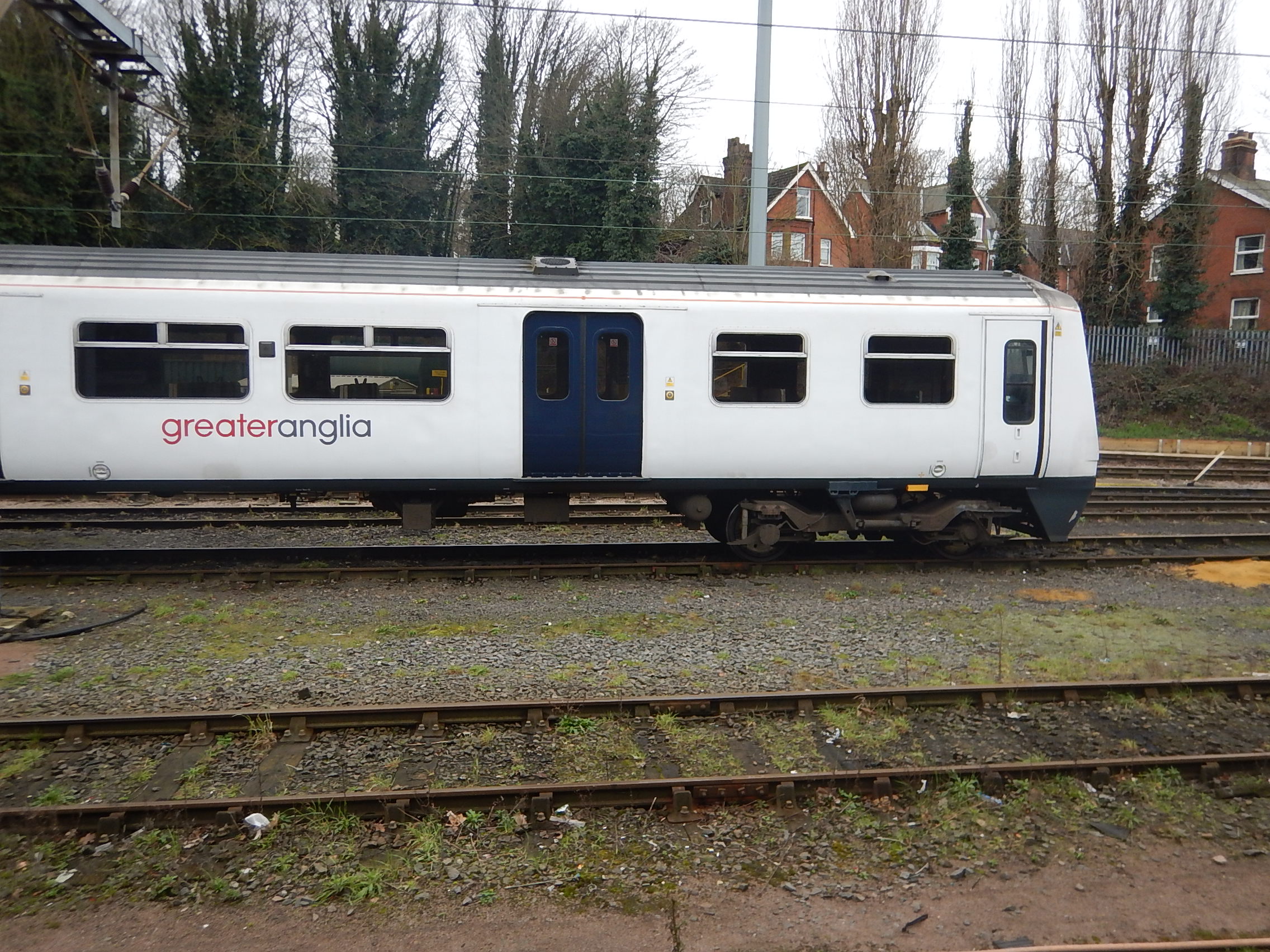
Note the large amount of space underneath.
If the Class 321 train has a problem, when converted to a modern efficient train, it is that the front end of the train has the aerodynamics of a large brick outhouse.
The Electrical System Of A Class 321 Train
I don’t know the electrical system of a Class 321 train, but I do know that of the Class 319 trains, which were built a couple of years earlier in the same factory at York These trains have a 750 VDC bus from one end of the train to the other.
As Class 321 and Class 319 trains have a similar train formation and a common Mark 3 heritage, I suspect that the electrical systems are the same and both have this 750 VDC bus.
Regenerative Braking
Regenerative braking is an important part of any modern train, as it saves energy.
Normally, the energy generated as a train stops, is returned through the electrification to power other nearby trains.
But with a hydrogen-powered train, that may not be connected to the electrification, the energy has to be stored on the train to avoid being wasted.
The Alstom Coradia iLint Train
Alstom have developed a hydrogen-powered version of the Coradia Lint train, which they call an iLint.
This promotional video shows how Alsthom’s hydrogen-powered Coradia iLint works.
<span class=”embed-youtube”></span>
Summarising, Alstom’s video the Coradia iLint works in the following way.
- The hydrogen fuel cell turns hydrogen gas into electricity.
- The electricity is used to power the train or is stored in a lithium-ion battery.
- The computer on the train monitors the system and controls it in an intelligent manner.
I wouldn’t be surprised to find out the system works in the same way as a serial hybrid vehicle like a New Routemaster bus.
- The power source; hydrogen fuel cell in the train or small diesel generator in the New Routemaster, charges the battery directly.
- The power source shuts down automatically, when the charge in the battery reaches a certain high level.
- The power source starts up automatically, when the charge in the battery reaches a certain low level.
- The battery moves the vehicle using one or more electric traction motors.
- The battery powers all the other systems in the vehicle.
- When the vehicle brakes, the traction motors generate electricity, which is stored in the battery.
The great advantage of this system is its simplicity, as the vehicle is effectively powered from a single source; the battery.
There is also an independently-controlled charging system for the battery.
A Possible Layout For A Hydrogen Powered Class 321 Train
Hydrogen powered trains need the following components.
- Hydrogen tank.
- Fuel cell to convert hydrogen to electricity.
- Battery to store energy from both the fuel cell and regenerative braking.
- Intelligent control system to control everything.
Positioning the last item shouldn’t be a problem, but could the other three larger components be placed under the train?
There’s certainly plenty of space under the two driving cars.
The battery would be connected to the following.
- The 750 VDC bus to power the train.
- The regenerative braking system.
- The hydrogen fuel cell.
The train’s computer would control the systems intelligently.
Powering The Class 321 Train From Electrification
Class 321 trains were designed as electric trains and I’m certain they could be made to run on 25 KVAC overhead or 750 VDC third rail electrification.
The electrically similar Class 319 trains are being converted into bi-mode Class 769 trains, so I wouldn’t be surprised to see the hydrogen-powered Class 321 trains being able to use electrification directly.
The Battery Size
How large would a battery need to be to store energy from both the fuel cell and regenerative braking?
I will start by calculating the kinetic energy of a Class 321 train, as the battery must be able to store all the energy generated by regenerative braking, when the train stops in a station from an operating speed of up to 100 mph.
- A Class 321 train weighs 137.9 tonnes
- A train can accommodate a total of about 320 seated and standing passengers.
- With bags, buggies and the other things passengers bring on, let’s assume an average passenger weight of 90 kg, which gives an extra 28.8 tonnes.
- I will assume a total weight of ten tonnes for the battery, hydrogen fuel cell and hydrogen tank
- So I will assume that an in service Class 321 train weighs 176.7 tonnes.
Calculating the kinetic energy of the train for various speeds gives.
- 50 mph – 12.3 kWh
- 75 mph – 28 kWh
- 90 mph – 40 kWh
- 100 mph – 49 kWh
Note that speed increases the kinetic energy much more than weight. This is because kinetic energy is proportional to the square of the speed and only proportional to the weight.
Even if the extra equipment weighed twenty tonnes, the kinetic energy at 100 mph only increases to 51.8 kWh.
As the battery will have to store this energy after a stop from 100 mph, I suspect that the battery will have a capacity somewhere between 50 and 100 kWh.
A Bombardier Primove 50 kWh battery, which is built to power trams and trains, has the following characteristics.
- A weight of under a tonne.
- Dimensions of under two x one x half metres.
- The height is the smallest dimension, which must help installation under the train floor or on the roof.
I conclude that Alstom won’t have any problems designing a battery with sufficient capacity, that can be fitted under the floor of a Class 321 train.
The Train Will Need An Intelligent Computer System
The hydrogen-powered Class 321 train could have up to four methods of charging the battery.
- From 25 KVAC overhead electrification
- From 750 VDC third rail electrification
- From the hydrogen fuel cell.
- From regenerative braking.
The computer would try to ensure the following.
- There was always spare capacity in the battery to accept the energy from regenerative braking.
- Trains stop in a station with a full battery.
- Hydrogen consumption is minimised.
The computer might even be programmed with the route and use GPS or digital signalling to optimise the train to that route.
It’s all very basic Control Engineering.
Alstom’s Marketing Philosophy
Watch Alstom’s video embedded in this post and they stress the environmental credentials of hydrogen power and particularly the Cordadia iLint.
They also show a caption which states that 195 states have made a commitment to zero carbon emissions.
That could be a very big market
The Coradia iLint will probably be a good train, but I suspect it may have a few problems satisfying a large market.
- It is only two cars.
- The current design can’t work on overhead electric power.
- It is based on a Lint 54, which has only 160 seats.
- Operating speed is 140 kph.
- They are new trains and manufacturing may be expensive.
On the other hand, Class 321 trains have the following characteristics.
- They are four car trains.
- The trains can work from 25 KVAC overhead electrification.
- The trains are built to a smaller loading gauge than the iLint.
- I suspect that they could be easily converted to other overhead and third-rail electrification voltages.
- Each train has 309 seats.
- Operating speed is 160 kph.
- They are existing trains and manufacturing may be more affordable.
It should also be said, that there is a massive amount of knowledge accumulated in the UK over thirty and more years, about how to refurbish, modify and update Mark 3-based rolling stock.
Once the concept of a hydrogen-powered Class 321 train is proven and certified, Alstom would probably be able to produce four-car hydrogen-powered trains at a fair rate, as they become available from Greater Anglia.
Conclusion
I have come to the following conclusions.
- The Class 321 train will make a good hydrogen-powered train.
- Alstom would not have looked at converting a thirty-year-old train to hydrogen power, if they thought it would be less than good.
- British Rail’s design of a 750 VDC bus makes a lot of the engineering easier and enables the train to be tailored for world-wide markets, with different electrification systems and voltages.
- Having two different trains will give Alstom better coverage of an emerging market.
I suspect in a few years time, if the hydrogen project is successful, Alstom will design and manufacture, a whole family of hydrogen-powered trains, with different gauges, capacities and operating speeds.
Report: Gravity-Based Energy Storage Could Prove Cheaper Than Batteries
The title of this post, is the same as this article on Business Green.
This is said.
Storing energy by suspending weights in disused mine shafts could be cheaper than batteries for balancing the grid, new research has found.
According to a report by analysts at Imperial College London and seen by BusinessGreen, gravity-fed energy storage systems can provide frequency response at a cost cheaper than most other storage solutions.
This was the conclusions of the Imperial College report.
According to the paper, gravity-fed storage providing frequency response costs $141 per kW, compared to $154 for a lithium-ion battery, $187 for lead acid batteries and $312 for flywheel.
Despite its high upfront cost, the paper argued that unlike battery-based storage systems, gravity-fed solutions have a long lifespan of more than 50 years and aren’t subject to degradation. This means they could cycle several times a day – allowing them to ‘stack revenues’ from different sources.
I always puzzle why this idea hasn’t been seriously tried before.
Bombardier Bi-Mode Aventra To Feature Battery Power
The title of this post is the same as this article in Rail Magazine.
A few points from the article.
- Development has already started.
- Battery power could be used for Last-Mile applications.
- The bi-mode would have a maximum speed of 125 mph under both electric and diesel power.
- The trains will be built at Derby.
- Bombardier’s spokesman said that the ambience will be better, than other bi-modes.
- Export of trains is a possibility.
Bombardier’s spokesman also said, that they have offered the train to three new franchises. East Midlands, West Coast Partnership and CrossCountry.
In some ways, I am not surprised about what is said in this article.
Another article on Christian Wolmar’s web site, is entitled Bombardier’s Survival Was The Right Kind Of Politics.
This is said.
Bombardier is not resting on its laurels. Interestingly, the company has been watching the problems over electrification and the fact that more of Hitachi’s new trains will now be bi-mode because the wires have not been put up in time. McKeon has a team looking at whether Bombardier will go into the bi-mode market: ‘The Hitachi bi-mode trains can only go 110 mph when using diesel. Based on Aventra designs, we could build one that went 125 mph. This would help Network Rail as it would not have to electrify everywhere.’ He cites East Midlands, CrossCountry and Wales as potential users of this technology.
The article was published in February 2017 and mentions, 125 mph on diesel and two of the companies in the recent article.
The Design Of The Trains
My thoughts are as follows.
The Starting Point
I’m pretty certain that if you wanmt to create a 125 mph bi-mode train, you start with a 125 mph electric train, if you want a high degree of commonality between the two trains.
Bombardier haven’t yet built any of their Aventras for West Midland Trains, but as they will use the West Coast Main Line extensively, will they be 125 mph trains and not 110 mph trains, as is said in Wikipedia?
Aventras And Battery Power
I will believe until Bombardier say I’m wrong, that Crossrail’s Class 345 trains, which are Aventras, use batteries for the following purposes.
- To handle regenerative braking.
- To limp the train out of the tunnel or to the next station or safe exit point, if there should be a catastrophic power failure.
- To lessen the amount of electricity fed to the trains in the tunnels.
- To allow features like remote wake-up, which need a train to have some form of power at all times.
- To move trains in sidings and depots without having live electrification.
- To run passenger features, when the power fails.
Effectively, the Class 345 trains have electricity as a main power source and batteries for energy storage and a secondary or emergency power source.
I talked to one of their staff, who was training drivers on Crossrail’s Aventras. The conversation went something like this.
- Me: “What happens, when the Russians hack the power supply?”
- Driver-Trainer: “We switch the train to emergency power!”
- Me: “You mean batteries?”
- Driver-Trainer: (Pause, then something like) “Might be!”
Can anybody think of another way to have emergency power on the train?
Electric Traction, Regenerative Braking and Batteries
Bi-mode trains and Alstom’s hydrogen-powered Coradia iLint are electrically powered at all times.
This means that under electric, diesel or hydrogen power, the traction motors can generate electricity to brake the train.
On an electric train, this electricity is returned through the overhead wire or third rail to power other nearby trains. This electricity could also be stored in an onboard battery, just as it is in a hybrid or battery-electric vehicle.
Driving A Bi-Mode Train With Batteries
The bi-mode Aventra could have electricity from one of four power sources.
- 25 KVAC overhead electrification.
- 750 VDC third-rail electrification.
- An onboard electricity generator powered by diesel fuel or hydrogen.
- Batteries
So will the driver need to keep switching power sources?
I am a Control Engineer by training and optimising the best power to use is a typical problem for someone with my training and experience.
The train’s computer would take all the information about the route, timetable, signal settings, battery charge level, train loading, weather and other factors and drive the train automatically, with the driver monitoring everything thoroughly.
Aircraft have been flown in a similar fashion for decades.
I look in detail, at the mathematics of a bi-mode Aventra with batteries in Mathematics Of A Bi-Mode Aventra With Batteries.
I came to the following conclusions.
I am rapidly coming to the conclusion, that a 125 mph bi-mode train is a practical proposition.
- It would need a controllable hydrogen or diesel power-pack, that could deliver up to 200 kW
- Only one power-pack would be needed for a five-car train.
- For a five-car train a battery capacity of 300 kWh would probably be sufficent.
From my past professional experience, I know that a computer model can be built, that would show the best onboard generator and battery sizes, and possibly a better operating strategy, for both individual routes and train operating companies.
Obviously, Bombardier have better data and more sophisticated calculations than I do.
Note, that everything I proposed, is well within the scope of modern engineering, so other companies like CAF and Stadler, who are actively involved in rail application of battery technology, could join the party.
This picture is a visualisation of a Stadler Class 755 train, which they are building for Greater Anglia.
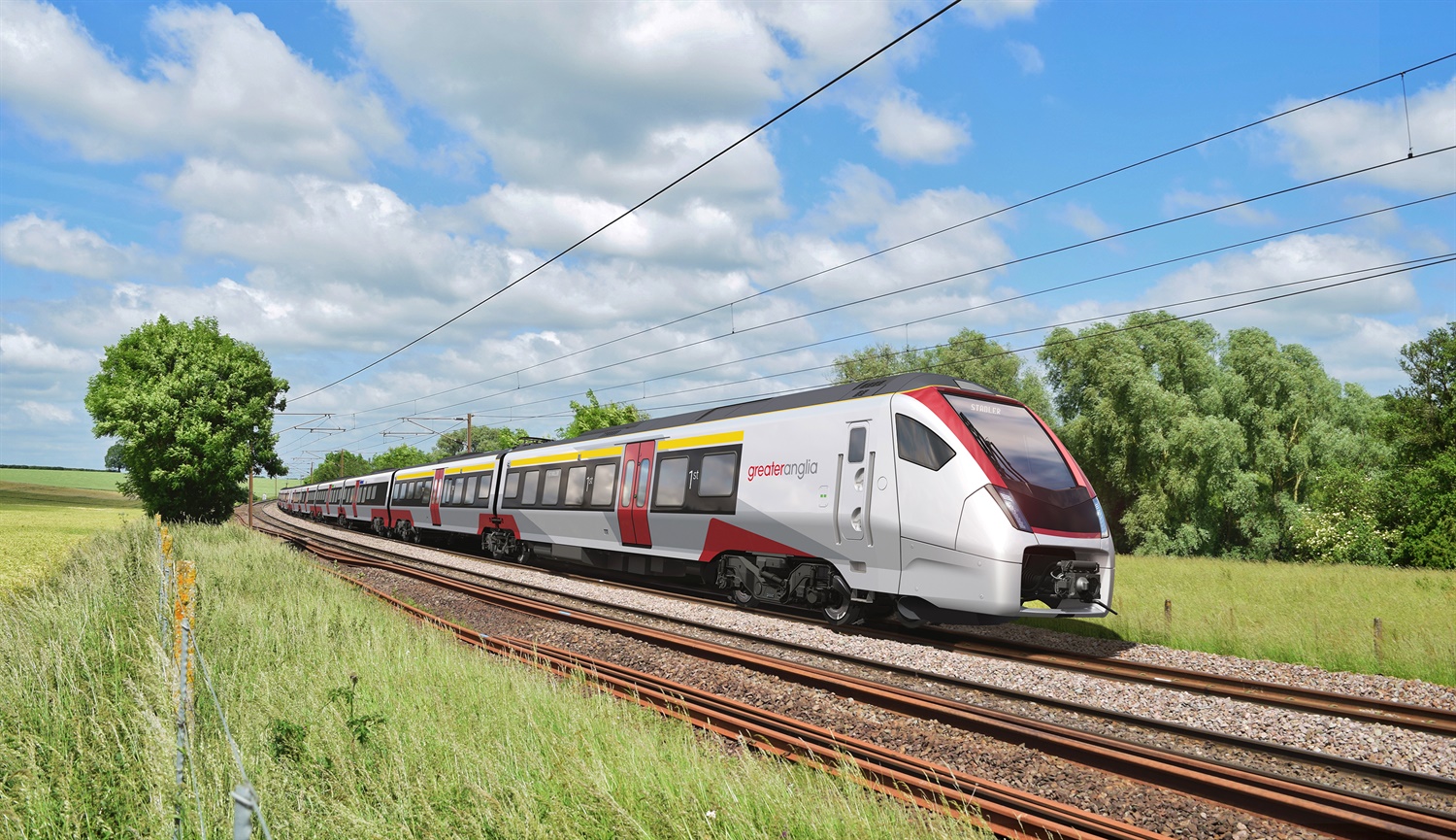
Note the smaller third car, which contains the diesel engine of this hybrid train. Is there room for batteries as well?
I can’t find any information on the web about the power train of the Class 755 train, but this article in the Railway Gazette, describes another Stadler bi-mode Flirt, that Stadler are building for Italy.
This is said.
The units will be rated at 2 600 kW with a maximum speed of 160 km/h when operating from 3 kV DC electrification, and 700 kW with a maximum speed of 140 km/h when powered by the two Stage IIIB compliant Deutz TCD 16.0 V8 diesel engines.
There is provision to add up to two more cars if required to meet an increase in ridership. Two more engines could be added, or the diesel module removed if only electric operation is needed.
Note.
- The Deutz diesel engines are rated at 520 kW.
- As 700 kW is the power of the train, I suspect each engine generator creates 350 kW of power.
- 160 km/h would be ideal for the Great Eastern Main Line
- 140 km/h would be more than adequate for roaming around East Anglia
I suspect that if batteries were used on this train, that the engines would be smaller.
We will see in May 2019, when the trains enter service.
Diesel Or Hydrogen Generator
Electricity generation using a diesel generator and electricity generator from a hydrogen fuel cell, each have their own advantages.
- Diesel fuel has a higher energy density than hydrogen
- Diesel engines create a lot of noise and vibration and emit carbon dioxide, noxious gases and particulates.
- Hydrogen fuel cells can be silent and only emit water and steam.
- Ballard who are a Canadian company and a leading manufacturer of hydrogen fuel-cells, manufacture one for use in rail applications which has an output of 100 kW, that weighs 385 Kg.
- MTU make the diesel engine for a Class 800 train, which has an output of over 600 kW, that weighs 5000 Kg.
- Hydrogen storage is probably heavier and more complicated than diesel storage.
- Both generators can be fitted into convenient rectangular power packs.
I would envisage that in the future, hydrogen electricity generators will get more efficient, lighter in weight and smaller in size for a given power output.
I don’t think it is unreasonable to believe, that within a reasonable number of years, hydrogen generators and their hydrogen storage tank, will be comparable in weight and size to current diesel generators and fuel tanks.
Accelerating A Bi-Mode Train With Batteries
The major use of electricity on a 125 mph train, will be in accelerating the train up to line speed. The energy needed will be.
- Proportional to the mass of the train. This is why your car accelerates better, when it’s just you in the car and you don’t have your overweight mother-in-law in the back.
- Proportional to the square of the velocity.
I have calculated that a five-car bi-mode Aventra, carrying 430 passengers and travelling at 125 mph, will have a kinetic energy of 91.9 kWh.
Obviously, using electricity from electrification is the best way to accelerate a train.
- Electricity from electrification is probably cheaper and more convenient, than that from an onboard electricity generator.
- If diesel is not used to power the train, there is no noise and vibration from an onboard diesel generator.
- A route with a lot of running on onboard fuel, means more fuel has to be carried.
Using electricity stored in batteries on the train, is also a good way to accelerate a train, but the batteries must have enough charge.
The onboard electricity generator will be used, when there is no electrification and the power stored in the batteries is approaching a low level.
|When Bombardier’s spokesman says, that the ambience will be good, control of the train’s power sources has a lot to do with it.
Could he have been hinting at hydrogen, as hydrogen fuel cells do not have high noise and vibration levels?
Cruising A Bi-Mode Train With Batteries
Newton’s First Law states.
Every body continues in its state of rest or uniform motion in a straight line, unless impressed forces act on it.
If you have a train on a railway track moving at a constant speed, the following forces are acting to slow the train.
- Aerodynamic forces, particularly on the front of the train.
- Rolling friction of the steel wheel on a steel rail.
- Bends and gradients in the track.
- Speed limits and signals.
So the driver and his control system will have to feed in power to maintain the vrequired spreed.
I have sat on the platform at Stratford, whilst an Aventra has gone past at speed. I wrote about it in Class 345 Trains Really Are Quiet!
This was my conclusion.
Bombardier have applied world class aviation aerodynamics to these trains. Particularly in the areas of body shape, door design, car-to-car interfaces, bogies and pantographs.
Remember too, that low noise means less wasted energy and greater energy efficiency.
In addition steel wheel on steel rails is a very efficient way of moving heavy weights. Bombardier have a reputation for good running gear.
Once a train has reached its cruising speed, appropriate amounts of power will be fed to the train to maintain speed.
But compared to the power needed to accelerate the train, they could be quite small.
For small amounts of power away from electrification, the control system will use battery power if it is available and can be used.
The onboard electricity generator would only be switched in, when larger amounts of power are needed or the battery power is low.
Slowing A Bi-Mode Train With Batteries
The regenerative braking will always be used, with the energy being stored in the batteries, if there is free capacity.
Imagine the following.
- A bi-mode making a stop at Leicester station on the Midland Main Line.
- It is doing 100 mph before the stop on the main line.
- It will be doing 100 mph after the stop on the main line.
The energy of the train after Leicester will be roughly the same as before, unless the mass of the train has changed, by perhaps a large number of passengers leaving or joining the train.
Let’s assume that the energy at 100 mph in the train is X kWh
- When the train brakes for Leicester this energy will be transferred to the train’s batteries, if there is capacity.
- On accelerating the train, it will need to acquire X kWh. It couldn’t get all of this from the batteries, as for various reasons the overall efficiency of this sort of system is about seventy to ninety percent.
- The onboard electricity generator will have to supply a proportion of the energy to get the train back up to 100 mph.
But in a diesel train it will have to supply all the energy to get back to 100 mph.
Where Would I Put The Batteries?
Aventras seem to have a lot of powered-bogies, so to keep cable runs short to minimise losses and maximise the efficiency of the regenerative braking, I would put a battery in each car of the train.
This would also distribute the weight evenly.
Where Would I Put The Electricity Generators?
Diesel engines always seem to be noisy, when they are installed under the floor of a train. I’ve travelled a lot in Bombardier’s Turbostars and although they are better than the previous generation, they are still not perfect.
I’ve also travelled in the cab of a Class 43 locomotive, with a 2,250 hp diesel engine close behind me. It was very well insulated and not very noisy.
As I said earlier, the most intensive use of the onboard generators will come in accelerating a train to operating speed, where no electrification or battery power is available. There is only so much you can do with insulation!
Stadler, who are building the Class 755 train for Greater Anglia, have opted to put a short diesel generator car in the middle of the train.
This was an earlier train, where Stadler used the technique.
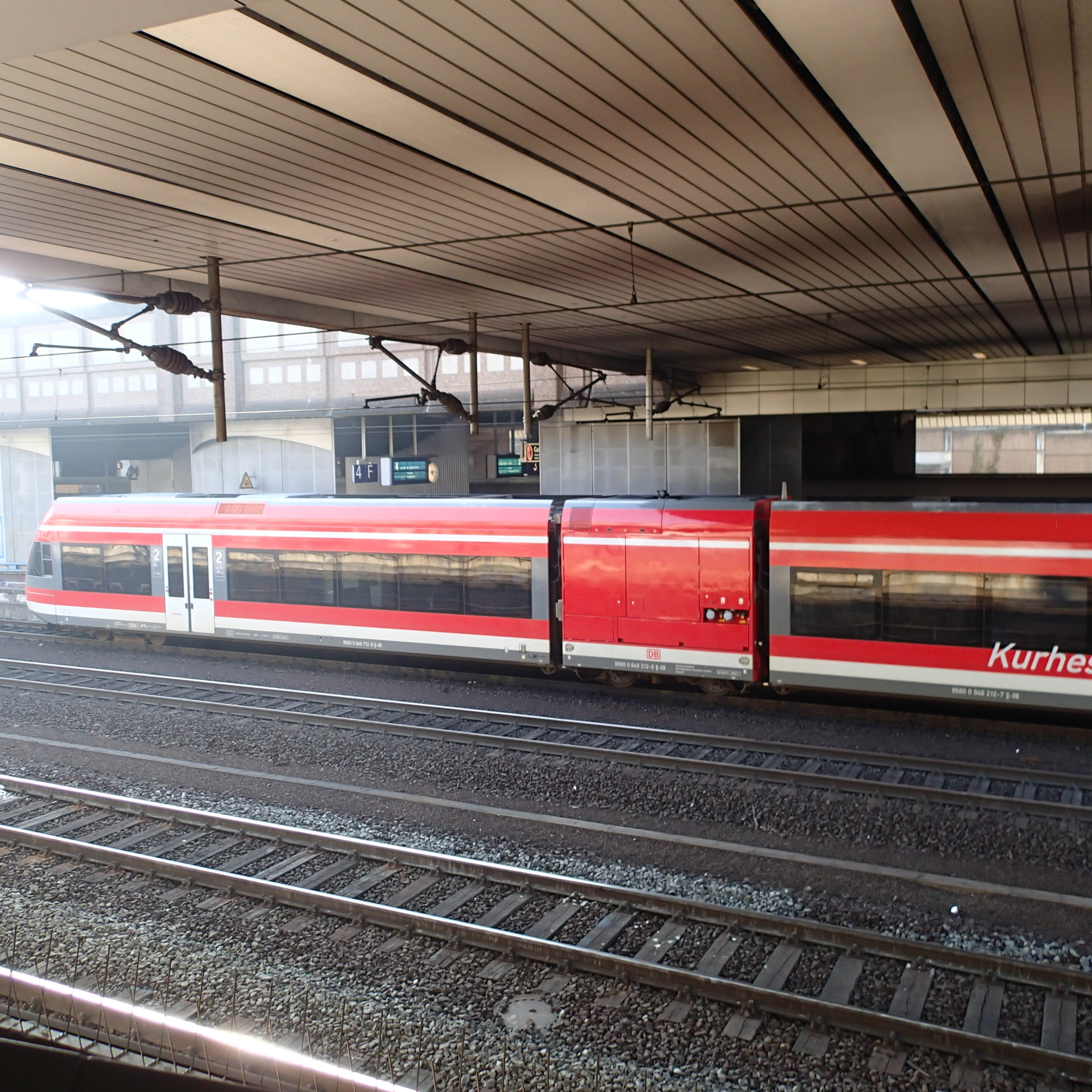
There are reports in Wikipedia, that the ride wasn’t good, but I’m sure Stadler has cracked it for their new 100 mph bi-mode trains.
Creating a bi-mode by adding an extra motor car into the middle of an electric train could be a serious way to go.
- The dynamics are probably better understood now
- A powerful diesel engine could be fitted.
- Batteries could be added.
- Insulating passengers and staff from the noise and vibration would surely be easier.
- There could be a passage through the car, to allow passengers and staff to circulate.
In an ideal world, a four-car electric train could be changed into a five-car bi-mode train, by adding the motor car and updating the train software.
In Mathematics Of A Bi-Mode Aventra With Batteries, I came to the conclusion, that if the batteries are used in conjunction with the power-pack, that a single power-pack of about 200 kW could be sufficient to power the train. This would be smaller and lighter in weight, which would probably mean it could be tucked away under the floor and well-insulated to keep noise and vibration from passengers and staff.
In this article in Global Rail News from 2011, which is entitled Bombardier’s AVENTRA – A new era in train performance, gives some details of the Aventra’s electrical systems. This is said.
AVENTRA can run on both 25kV AC and 750V DC power – the high-efficiency transformers being another area where a heavier component was chosen because, in the long term, it’s cheaper to run. Pairs of cars will run off a common power bus with a converter on one car powering both. The other car can be fitted with power storage devices such as super-capacitors or Lithium-ion batteries if required.
This was published six years ago, so I suspect Bombardier have refined the concept.
So could it be that Bombardier have designed a secondary power car, that can be fitted with a battery and a diesel engine of appropriate size?
- Using a diesel engine with batteries means that a smaller engine can be used.
- The diesel engine could also be replaced with a 200 kW hydrogen fuel cell.
I won’t speculate, but Bombardier have a very serious idea. And it’s all down to the mathematics.
What Would Be The Length Of A 125 Mph Bi-Mode Aventra?
Long distance Aventras, like those for Greater Anglia and West Midlands Trains, seem to be five and ten car trains.
This would fit well with the offerngs from other companies, so I suspect five- and ten-cars will be the standard lengths.
Could There Be A Bi-Mode Aventra for Commuter Routes?
The London Overground has ordered a fleet of four-car Class 710 trains.
The Gospel Oak to Barking Line is being extended to a new Barking Riverside station.
In an article in the October 2017 Edition of Modern Railways, which is entitled Celling England By The Pound, Ian Walmsley says this in relation to trains running on the Uckfield Branch, which probably has a terrain not much different to the lines to London.
A modern EMU needs between 3 and 5 kWh per vehicle mile for this sort of service.
The new extension is about a mile, so this would need 20 kWh each way.
This could easily be done with a battery, but supposing a small diesel engine was also fitted under the floor. Would anybody notice the same 138 kW Cummins ISBe diesel engine that is used in a New Routemaster hybrid bus?
I doubt it.
It is a revealing to calculate the kinetic energy of a fully-loaded Class 710 train. I estimate that it under 50 kWh, if it was travelling at 90 mph, which would rarely be achieved on the Gospel Oak to Barking Line.
Could Bombardier Be Serious About Exporting Bi-Mode Aventras?
In my opinion, the Aventra is a good train an it seems to sell well in its electric form to train operating companies in the UK.
But would it sell well in overseas markets like the United States and Canada, India and Australia?
They obviously know better than I do, so we should take their statements at face value.
The Prospective Customers
The Rail Magazine article mentions three prospective customers.
I deal with them and other possiblilities in Routes For Bombardier’s 125 Mph Bi-Mode Aventra.
This was my conclusion.
If Bombardier build a 125 mph bi-mode Aventra with batteries, there is a large market.
It looks like the company has done a lot of research.
Conclusion
Bombardier are designing a serious train.
Calculating Kinetic And Potential Energies
I used to be able to do this and convert the units, manually and easily, but now I use web calculators.
Kinetic Energy Calculation
I use this kinetic energy calculator from omni.
Suppose you have a nine-car Crossrail Class 345 train.
- It will weigh 328.40 tonnes, according to my detective work in Weight And Dimensions Of A Class 345 Train.
- There will be 1,500 passengers at 90 Kg. each or 135 tonnes.
- So there is a total weight of 463.4 yonnes.
- The train has a maximum speed of 90 mph.
Put this in the calculator and a full train going at maximum speed has a kinetic energy of 104.184 kWh.
The lithium-ion battery in a typical hybrid bus, like a New Routemaster has a capacity of 75 kWh.
So if a full Class 345 train, were to brake from maximum speed using regenerative braking, the energy generated by the traction motors could be stored in just two bus-sized batteries.
This stored energy can then be used to restart the train or power it iin an emergency.
Out of curiosity, these figures apply to an Inter City 125.
- Locomotive weight – 2 x 70.25 tonnes
- Carriage weight – 8 x 34 tonnes.
- Train weight – 412.5 tonnes
- Passengers – appromiximately 700 = 63 tonnes
- Speed – 125 mph
This gives a kinetic energy of 206.22 kWh
And then there’s Eurostar’s original Class 373 trains.
- Weight- 752 tonnes
- Speed 300 kph
This gives a kinetic energy of 725 kWh.
If a 75 kWh battery were to be put in each of the twenty cars, this would be more than adequate to handle all the regenerative braking energy for the train.
There would probably be enough stored energy in the batteries for a train to extricate itself from the Channel Tunnel in the case of a complete power failure.
Potential Energy Calculation
I use this potential energy calcultor from omni.
Suppose you have the typical cartoon scene, where a ten tonne weight is dropped on a poor mouse from perhaps five metres.
The energy of the weight is just 0.136 kWh.
I’ve used kWhs for the answers as these are easily visualised. One kWh is the energy used by a one-bar electric fire in an hour.
Rail Engineer On Hydrogen Trains
This article on Rail Engineer is entitled Hydrail Comes Of Age.
It is a serious look at hydrogen-powered trains.
This is typical information-packed paragraph.
Instead of diesel engines, the iLint has underframe-mounted traction motors driven by a traction inverter. Also mounted on the underframe is a lithium-ion battery pack supplied by Akasol and an auxiliary converter to power the train’s systems. On the roof is a Hydrogenics HD200-AT power pack which packages six HyPMTM HD30 fuel cells, with common manifolds and controls, and X-STORE hydrogen tanks supplied by Hexagon xperion which store 89kg of hydrogen on each car at 350 bar. These lightweight tanks have a polymer inner liner, covered with carbon fibres soaked in resin and wrapped in fibreglass.
They have interesting things to say about the trains and the production and delivery of the hydrogen, which can be what they call green hydrogen produced by electricity generated by wind power.
This is said about supplying the hydrogen.
It takes 15 minutes to refuel the iLint, which holds 178kg of hydrogen supplied at a pressure 350 bar. It consumes this at the rate of 0.3kg per kilometre. Thus, Lower Saxony’s fleet of 14 trains, covering, say, 600 kilometres a day, will require 2.5 tonnes of hydrogen per day. If this was produced by electrolysis, a wind farm of 10MW generating capacity would be required to power the required electrolysis plant with suitable back up. This, and sufficient hydrogen storage, will be required to ensure resilience of supply.
These are the concluding paragraphs.
With all these benefits, a long-term future in which all DMUs have been replaced by HMUs is a realistic goal. However, the replacement, or retrofitting, of 3,000 DMUs and the provision of the required hydrogen infrastructure would be a costly investment taking many years.
Germany has already taken its first steps towards this goal.
For myself, I am not sceptical about the technology that creates electricity from pure hydrogen, but I think there are design issues with hydrogen-powered trains in the UK.
The German trains, which are built by Alsthom and should start test runs in 2018, take advantage of the space above the train in the loading gauge to place the tanks for the hydrogen.
Our smaller loading gauge would probably preclude this and the tanks might need to take up some of the passenger space.
But in my view, we have another much more serious problem.
Over the last twenty years, a large number of high quality trains like electric Desiros, Electrostars and Junipers, and diesel Turbostars have been delivered and are still running on the UK network.
It could be that these trains couldn’t be converted to hydrogen, without perhaps devoting a carriage to the hydrogen tank, the electricity generator and the battery needed to support the hydrogen power.
It is for this reason, that I believe that if we use hydrogen power, it should be used with traditional electrification and virtually unmodified trains.
A Typical Modern Electric Train
Well! Perhaps not yet, but my view of what a typical electric multiple unit, will look like in ten years is as follows.
- Ability to work with 25 KVAC overhead or 750 VDC third-rail electrification or onboard battery power.
- Ability to switch power source automatically.
- Batteries would handle regenerative braking.
- Energy-efficient train design.
- Good aerodynamics.
- Most axles would be powered for fast acceleration and smooth braking.
- Efficient interior design to maximise passenger numbers that can be carried in comfort.
- A sophisticated computer with route and weather profiles, passenger numbers would optimise the train.
The battery would be sized, such that it gave a range, that was appropriate to the route.
In an article in the October 2017 Edition of Modern Railways, which is entitled Celling England By The Pound, Ian Walmsley says this in relation to trains running on the Uckfield Branch.
A modern EMU needs between 3 and 5 kWh per vehicle mile for this sort of service.
As I’m talking about a train that has taken energy efficiency to the ultimate, I think it would be reasonable to assume that 3 kWh per vehicle mile is attainable.
As I believe that most axles would be powered, I feel that it would be electrically efficient for a battery to be fitted into each car.
Suppose we had a five-car train with a 30 kWh battery in each car.
This would give a total installed battery capacity of 150 kWh. Divide by five and three and this gives a useful emergency range of ten miles.
These facts put the battery size into perspective.
- , 30 kWh is the size of the larger battery available for a Nissan Leaf.
- A New Routemaster bus has a battery of 75 kWh.
Where will improved battery technology take us in the next decade?
Use Of Hydrogen Power With 750 VDC Third-Rail Electrification
This extract from the Wikipedia entry for third-rail, explains the working of third-rail electrification.
The trains have metal contact blocks called shoes (or contact shoes or pickup shoes) which make contact with the conductor rail. The traction current is returned to the generating station through the running rails. The conductor rail is usually made of high conductivity steel, and the running rails are electrically connected using wire bonds or other devices, to minimize resistance in the electric circuit. Contact shoes can be positioned below, above, or beside the third rail, depending on the type of third rail used; these third rails are referred to as bottom-contact, top-contact, or side-contact, respectively.
If a line is powered by third-rail electrification, it needs to be fed with power every two miles or so, due to the losses incurred in electricity passing along the steel conductor rail.
I suspect that Network Rail and our world-leading rail manufacturers have done as much as they can to reduce electrical losses.
Or have they? Wikipedia says this.
One method for reducing current losses (and thus increase the spacing of feeder/sub stations, a major cost in third rail electrification) is to use a composite conductor rail of a hybrid aluminium/steel design. The aluminium is a better conductor of electricity, and a running face of stainless steel gives better wear.
Suppose instead of having continuous third-rail electrification, lengths of electrification with the following characteristic were to be installed.
- Hybrid aluminium/steel rails.
- Power is supplied at the middle.
- Power is only supplied when a train is in contact with the rail.
All trains would need to have batteries to run between electrified sections.
The length and frequency of the electrified sections would vary.
- If a section was centred on a station, then the length must be such, that a train accelerating away can use third-rail power to get to operating speed.
- Sections could be installed on uphill parts of the line.
- On long level sections of line without junctions, the electrified sections could be more widely spaced.
- Battery power could be used to take trains through complicated junctions and crossovers, to cut costs and the difficulties of electrification.
- Electrified section woulds generally be placed , where power was easy to provide.
So where does hydrogen-power come in?
Obtaining the power for the track will not always be easy, so some form of distributed power will be needed.
- A small solar farm could be used.
- A couple of wind turbines might be appropriate.
- In some places, small-scale hydro-electric power could even be used.
Hydrogen power and especially green hydrogen power could be a viable alternative.
- It would comprise a hydrogen tank, an electricity generator and a battery to store energy.
- The tank could be buried for safety reasons.
- The installation would be placed at trackside to allow easy replenishment by tanker-train.
- It could also be used in conjunction with intermittent solar and wind power.
The tanker-train would have these characteristics.
- It could be a converted electrical multiple unit like a four-car Class 319 train.
- Both 750 VDC and 25 KVAC operating capability would be retained.
- One car would have a large hydrogen tank.
- A hydrogen-powered electricity generator would be fitted to allow running on non-electrified lines and give a go-anywhere capability.
- A battery would probably be needed, to handle discontinuous electrification efficiently.
- It might even have facilities for a workshop, so checks could be performed on the trackside power system
Modern digital signalling, which is being installed across the UK, may will certainly have a part to play in the operation of the trackside power systems.
The position of all trains will be accurately known, so the trackside power system would switch itself on, as the train approached, if it was a train that could use the power.
Use Of Hydrogen Power With 25 KVAC Overhead |Electrification
The big difference between installation of 25 KVAC overhead electrification and 750 VDC third-rail electrification, is that the the overhead installation is more complicated.
- Installing the piling for the gantries seems to have a tremendous propensity to go wrong.
- Documentation of what lies around tracks installed in the Victorian Age can be scant.
- The Victorians used to like digging tunnels.
- Bridges and other structures need to be raised to give clearance for the overhead wires.
- There are also those, who don’t like the visual impact of overhead electrification.
On the plus side though, getting power to 25 KVAC overhead electrification often needs just a connection at one or both ends.
The electrification in the Crossrail tunnel for instance, is only fed with electricity from the ends.
So how could hydrogen help with overhead electrification?
Electrifying some routes like those through the Pennines are challenging to say the least.
- Long tunnels are common.
- There are stations like Hebden Bridge in remote locations, that are Listed Victorian gems.
- There are also those, who object to the wires and gantries.
- Some areas have severe weather in the winter that is capable of bringing down the wires.
In some ways, the Government’s decision not to electrify, but use bi-mode trains is not only a cost-saving one, but a prudent one too.
Bi-mode trains across the Pennines would have the advantage, that they could use short lengths of electrification to avoid the use of environmentally-unfriendly diesel.
I have read and lost an article, where Greater Anglia have said, that they would take advantage of short lengths of electrification with their new Class 755 trains.
Electrifying Tunnels
If there is one place, where Network Rail have not had any electrification problems, it is in tunnels, where Crossrail and the Severn Tunnel have been electrified without any major problems being reported.
Tunnels could be developed as islands of electrification, that allow the next generation of trains to run on electricity and charge their batteries.
But they would need to have a reliable power source.
As with third-rail electrification, wind and solar power, backed by hydrogen could be a reliable source of power.
Electrifying Stations With Third Rail
It should be noted, that the current generation of new trains like Aventra, Desiro Cities and Hitachi’s A-trains can all work on both 25 KVAC overhead or 750 VDC third-rail systems, when the appropriate methods of current collection are fitted.
Network Rail have shown recently over Christmas, where they installed several short lengths of new third-rail electrification South of London, that installing third-rail electrification, is not a challenging process, provided you can find the power.
If the power supply to the third-rail is intelligent and is only switched on, when a train is on top, the railway will be no more a safety risk, than a route run by diesel.
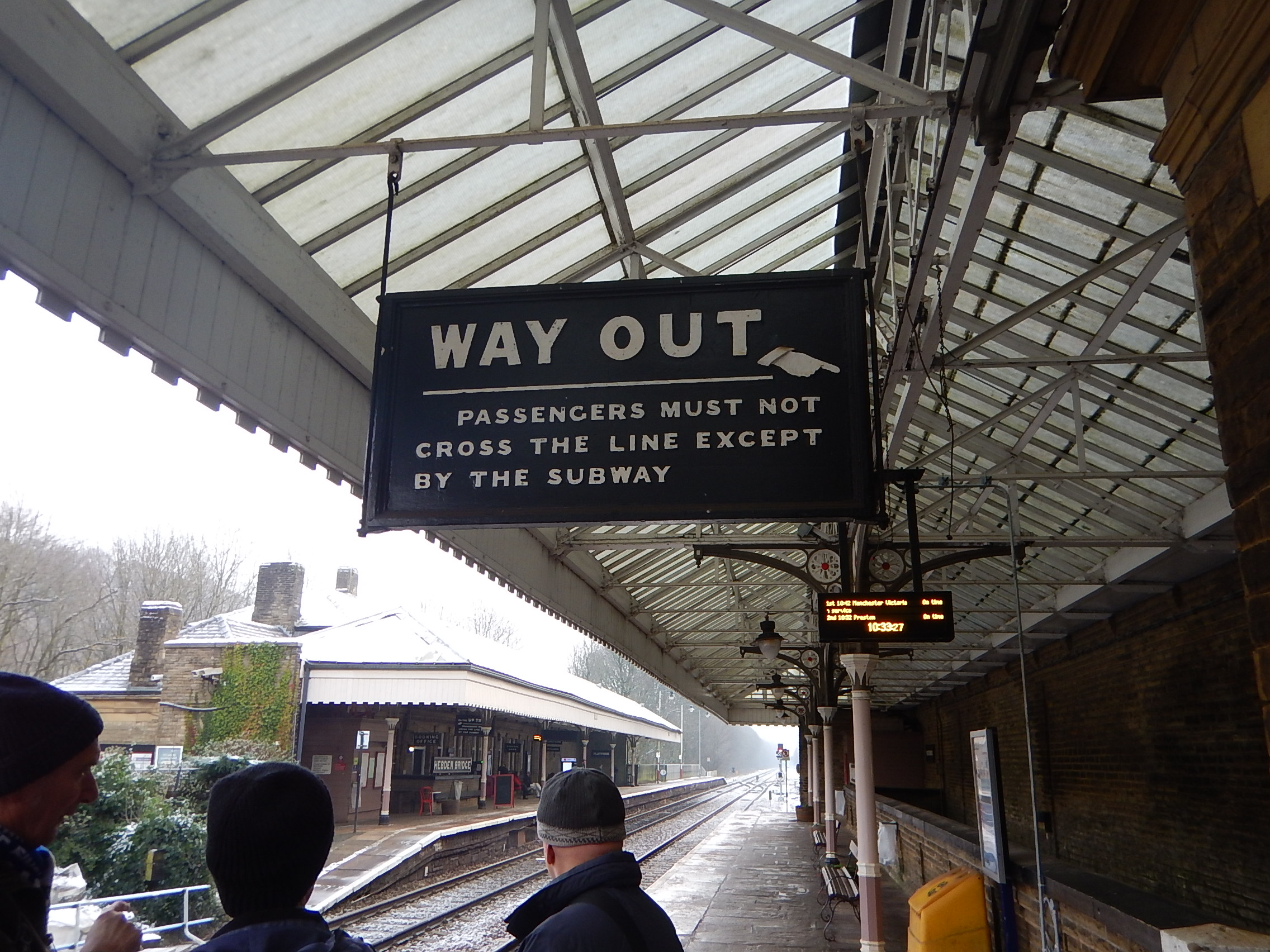
The picture shows the Grade II Listed Hebden Bridge station.
Third-rail electrification with an independent reliable power supply could be a way of speeding hybrid trains on their way.
Power Supply In Remote Places
Communications are essential to the modern railway.
Trains and train operators need to be able to have good radio connections to signalling and control systems.
Passengers want to access wi-fi and 4G mobile phone networks.
More base stations for communication networks will be needed in remote locations.
Wind, solar and hydrogen will all play their part.
I believe in the future, that remote routes in places like Wales, Scotland and parts of England, will see increasing numbers of trains and consequently passengers., many of whom will be walking in the countryside.
Could this lead to upgrading of remote stations and the need for reliable independent power supplies?
Conclusion
I am very much coming to the conclusion, that because of the small UK loading gauge, hydrogen-powered trains would only have limited applications in the UK. Unless the train manufacturers come up with a really special design.
But using hydrogen as an environmentally-friendly power source for UK railways to power electrification, perhaps in combination with wind and solar is a definite possibility!
.
Hitachi’s Thoughts On Battery Trains
On page 79 of the January 2018 Edition of Modern Railways, Nick Hughes, who is the Sales Director of Hitachi Rail Europe outlines how the manufacturer is embracing the development of battery technology.
He is remarkably open.
Hitachi’s Battery Development
Nick Hughes says this.
Hitachi has for many years seen great potential in battery technology.
We began studying on train storage energy systems in 2003. Working jointly qith operational partners in Japan and in the UK, we developed a realistic solution based on a lithium-ion battery, that could store the braking energy and reuse it for the traction.
Then came our V-train 2 (nicknamed the Hayabusa), which was tested on the Great Central Railway in 2007, using hybrid battery/diesel power and regenerative charging. This was the world’s first high-speed hybrid train.
This picture show the Hayabusa running in the UK.
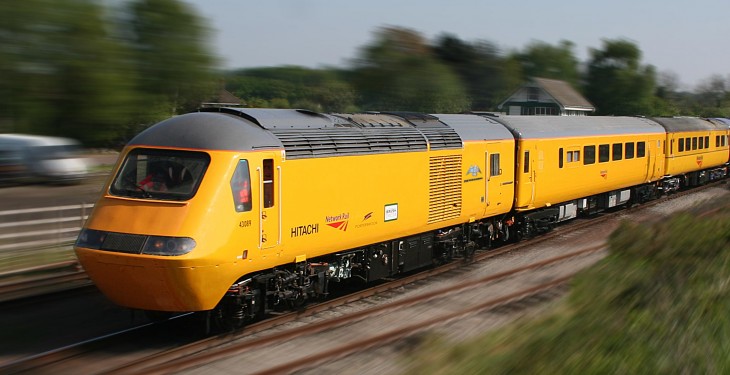
If you think it looks familiar, you are right! It’s a modified Class 43 locomotive from an InterCity 125. The locomotive; 43089, is still in service with East Midlands Trains. But without the batteries!
When the remaining members of the team, who had developed the InterCity 125 in the 1970s, saw these pictures, I suspect it was celebrated with a call for a few swift halves!
BEMU In Japan
Nick Hughes goes on to outline the status of Battery Electric Multiple Units (BEMUs) in Japan, where Hitachi launched a train called the DENCHA in 2016, on the Chikuhi line.
- The train has a range of up to 50 km on batteries.
- DENCHA is popular with passengers.
- The train won a prestigious award.
I don’t know what it is with battery trains, but the Bombardier/Network Rail BEMU Trial was also liked by those who rode the train. As was I!
Nick Hughes Prediction
Nick Hughes follows his description of the DENCHA, with this.
I can picture a future when these sorts of trains are carrying out similar types of journeys in the UK, perhaps by installing battery technology in our Class 395s to connect to Hastings via the non-electrified Marshlink Line from Ashford for example.
This would massively slice the journey time and heklp overcome the issue of electrification and infrastructure cases not stacking up. There are a large number of similar routes like this all across the country.
It is a prediction, with which I could agree.
Renewable Energy And Automotive Systems
Nick Hughes finishied by saying that he believes storing power from renewable energy and the development of automotive systems will drive battery technology and its use.
Conclusion
It is the most positive article about battery trains, that I have read so far!
What Will Happen To The Class 379 Trains?
Greater Anglia’s fleet of thirty Class 379 trains are being replaced by by a brand new fleet of Class 745 Stadler FLIRT EMUs which will be fixed 12-car trains on Stansted Express services and Class 720 Bombardier Aventra EMUs on Cambridge services.
These trains have a high specification.
- Four-car trainsets.
- Ability to work as four, eight and twelve-car trains.
- 2+2 seating in Standard Class.
- 2+1 seating in First Class.
- Plenty of luggage space.
- Wi-fi and power sockets.
- Full compliance with all Persons of Reduced Mobility rules.
- 100 mph capability.
- Regenerative braking.
I also suspect the following is true about the trains.
- The ability to run on 750 VDC third rail electrification could be added reasonably easily.
- Lithium-ion batteries to give a limited range, can be fitted.
- The top speed could be upgraded to the 110 mph of the closely-related Class 387 trains.
- The trains have end gangways and could be certified to run through the core route of Thameslink, like the Class 387 trains.
So they would appear to be a very useful train.
So what will happen to the trains?
This is my speculative list of possible uses.
Continued Use By Greater Anglia
In some ways it’s strange that these reasonably new trains are being replaced on Stansted and Cambridge services.
They are being replaced by Stadler Class 745 trains, which like the Class 379 trains are 100 mph trains.
In the next decade or so, the West Anglia Main Line is to be upgraded.
- There will be four tracks at least between Tottenham Hale and Broxbourne stations.
- Cambridge South station and the East West Rail Link will have been completed.
- Line speed will have been improved to at least 100 mph along its full length.
- The High Meads Loop will be developed to allow more trains from the West Anglia Main Line to use Stratford instead of the overcrowded Liverpool Street as a London terminal.
I suspect the number of fast services between London and Cambridge along the West Anglia Main Line will be increased.
So are performance upgrades available for the Class 745 trains, which will deliver these improved services?
If Stadler are late with their delivery of the Class 745 trains, the Class 379 trains will continue to be used on Stansted and Cambridge services.
This is discussed in this article in Rail Magazine, which is entitled Contingency Plans In Place For Greater Anglia’s Main Line Fleet.
But surely, this would only delay their cascade to other operators.
According to Wikipedia, all of the replacement Class 745 trains, are scheduled to enter service in 2019, which should mean that the Class 379 trains should be available for cascade to other operators, sometime in 2020.
St. Pancras to Corby
Under Future in the Wikipedia entry for Corby station, this is said.
It is planned that a half-hourly London St Pancras to Corby service will operate from December 2019 using new Class 387 trains, once the Midland Main Line has been electrified beyond Bedford as part of the Electric Spine project. Network Rail has also announced that it plans to re-double the currently singled Glendon Junction to Corby section as part of this scheme.
In the December 2017 Edition of Modern Railways there is an article, which is entitled Wires To Corby Now in 2020.
This is the first paragraph.
Carillion is to deliver electrification of the Midland Main Line to Corby, but electric services will not start until December 2020, a year later than previously envisaged.
The article also states the following.
- A fourth track is to be installed between Bedford and Kettering.
- Track and wires are to be updated so that new 125 mph bi-mode trains can run between St. Pancras and Derby, Nottingham and Sheffield.
- Improvements to the current electrification South of Bedford.
Everything should be completed, so that the new bi-mode trains could enter service from 2022.
It should be noted that Wikipedia says this about the Future of the East Midlands Trains franchise.
The franchise is due to end in August 2019. The Invitation to Tender is due to be issued in April 2018, which will detail what improvements bidders for the franchise must make. The contract will then be awarded in April 2019.
This could give the following project schedule on the Midland Main Line.
- April 2019 – Award of new East Midlands franchise.
- August 2019 – New East Midlands franchise starts.
- December 2020 – Electric services to Corby start.
- December 2022 – Bi-mode services to Derby, Nottingham and Sheffield start.
These dates would fit well with the retirement of the Class 379 trains by Greater Anglia in 2020.
Current timings between Corby and London are 71 minutes with four stops. I don’t think it would be unreasonable to assume that the improved track and new trains would be designed so that the timings between Corby and London would be reduced to under an hour, with a round trip of two hours.
If this can be achieved, then just four trains of an appropriate length will be needed to meet the required two tph timetable.
- Four-car services would need four trains.
- Eight-car services would need eight trains.
- Twelve-car services would need twelve trains.
It might not be possible to run eight and twelve car services due to platform length restrictions.
If the two hour round trip could be achieved by an existing Class 387 or an uprated Class 379 trains, then either of these trains would be a shoe-in for the route.
Otherwise we’ll be seeing something faster like a Class 801 train.
But if services are to start in 2020, there would be a problem to manufacture the trains in the available time, as the contract will only have been awarded in April 2019.
I think that St. Pancras to Corby is a possibility for Class 379 trains, which may need to be uprated to 110 mph. On the other hand, Class 387 trains wouldn’t need to be uprated.
West Midlands Trains, who have a similar need for their Euston to West Midlands services, have ordered 110 mph Aventras.
- So perhaps the new East Midlands franchise will do the same.
- This would be more likely, if Bombardier come up with the rumoured 125 mph bi-mode Aventra.
- Or they could buy a mixture of Class 800 and 801 trains.
I don’t think the Class 379 trains will work St. Pancras to Corby.
Battery Services
A Class 379 train was used for the BEMU trial, where a battery was fitted to the train and it ran for a couple of months between Manningtree and Harwich, using overhead power one way and battery power to return.
Was this class of train chosen, as it was one of the easiest to fit with a battery? After all it was one of the later Electrostars.
This article on the Railway Gazette from July 2007 is entitled Hybrid Technology Enters The Real World. It describes the experimental conversion of a Class 43 power-car from a High Speed Train into a battery-assisted diesel-electric power-car.
A second article in the Railway Gazette from October 2010 is entitled First New Stansted Express Train Rolls Out. It describes the Class 379 train in detail. This is an extract.
Although part of the Electrostar family, the Class 379 incorporates a number of technical changes from the original design developed in the late 1990s, making use of technologies which would be used on the Aventra next-generation Electrostar which Bombardier is proposing for the major Thameslink fleet renewal contract.
The body structure has been revised to meet European crashworthiness requirements. The window spacing has changed, with the glass bolted rather than glued in place to enable faster repairs. The couplers are from Dellner, and the gangways from Hübner. Top speed is 160 km/h, and the 25 kV 50 Hz trains will use regenerative braking at all times.
The last statement about regenerative braking is the most interesting.
To my knowledge electric trains that use regenerative braking had never run on the West Anglia Main Line before and that to handle the return currents with 25 KVAC needs special and more expensive transformers. The obvious way to handle regenerative braking at all times without using the electrification is to put an appropriately sized battery on the train.
If Bombardier have done this on the Class 379 train, then it might be a lot easier to fit a large battery to power the train. This would explain why the trains were chosen for the trial rather than a train from a more numerous variant.
The result was a trial of which few, if any,negative reports can be found.

The result was a trial of which few, if any,negative reports can be found.
Class 379 Train Performance On Batteries
Little has been said about the performance of the train.
However, in this document on the Network Rail web site, which is entitled Kent Area Route Study, this is said.
In 2015, industry partners worked together to investigate
battery-electric traction and this culminated with a
practical demonstration of the Independently Powered
Electric Multiple Unit IPEMU concept on the Harwich
Branch line in Anglia Route. At the industry launch event,
the train manufacturers explained that battery
technology is being developed to enable trains to run
further, at line speeds, on battery power, indeed, some
tram lines use this technology in the city centres and many
London buses are completely electric powered.The IPEMU project looked at the feasibility of battery power
on the Marshlink service and found that battery was
sufficient for the train to run from Brighton to Ashford
International and back but there was insufficient charge to
return to Ashford International on a second round trip. A
solution to this could be that the unit arrives from Ashford
International at Brighton and forms a service to Seaford and
back before returning to Ashford International with a
charged battery.The IPEMU demonstration train was a Class 379, a similar
type to the Class 377 units currently operated by Southern, it
was found that the best use of the battery power was to
restrict the acceleration rate to that of a modern diesel
multiple unit, such as a Class 171 (the current unit type
operating the line) when in battery mode and normal
acceleration on electrified lines.
|Ashford to Brighton is 62 miles, so a round trip would be 124 miles.
The document doesn’t say anything about how many stops were made in the tests, but I’m sure that Bombardier, Greater Anglia and Network Rail have all the data to convert a Class 379 into a viable IPEMU or Independently Powered Electric Multiple Unit.
As to how long it takes to charge the battery, there is an interesting insight in this article from Rail Magazine, which is entitled Battery-Powered Electrostar Enters Traffic. This is said.
It is fitted with six battery rafts, and uses Lithium Ion Magnesium Phosphate battery technology. The IPEMU can hold a charge for 60 miles and requires two hours of charging for every hour running. The batteries charge from the overhead wires when the pantograph is raised, and from regenerative braking.
The two-one ratio between charging and running could be an interesting factor in choice of routes.
What About The Aventra?
I quoted from this article in the Railway Gazette from October 2010 earlier. This is said.
Although part of the Electrostar family, the Class 379 incorporates a number of technical changes from the original design developed in the late 1990s, making use of technologies which would be used on the Aventra next-generation Electrostar.
So would it be a reasonable assumption to assume, that if batteries can be fitted to a Class 379 train, then they could also be fitted to an Aventra?
This article in Global Rail News from 2011, which is entitled Bombardier’s AVENTRA – A new era in train performance, gives some details of the Aventra’s electrical systems. This is said.
AVENTRA can run on both 25kV AC and 750V DC power – the high-efficiency transformers being another area where a heavier component was chosen because, in the long term, it’s cheaper to run. Pairs of cars will run off a common power bus with a converter on one car powering both. The other car can be fitted with power storage devices such as super-capacitors or Lithium-ion batteries if required.
This was published in 2011, so I suspect Bombardier have refined the concept.
But it does look that both battery variants of both Class 379 trains and Aventras are possible.
Routes For Battery Trains
What important lines could be run by either a Class 379 train or an Aventra with an appropriate battery capability?
I will refer to these trains as IPEMUs in the remainder of this post.
I feel that one condition should apply to all routes run by IPEMUs.
The 2:1 charging time to running time on battery ratio must be satisfied.
East Coastway And Marshlink Lines
As Network Rail are prepared to write the three paragraphs in the Kent Area Route Study, that I quoted earlier, then the East Coastway and Marshlink Lines, which connect Brighton and Ashford International stations, must be high on the list to be run by IPEMUs.
Consider.
- All the route, except for about twenty-four miles of the Marshlink Line is electrified.
- Brighton and Ashford International stations are electrified.
- Some sections have an operating speed of up to 90 mph.
- Brighton to Hastings takes 66 minutes
- Ashford International to Hastings takes 40 minutes
- There is a roughly fifteen minute turnround at the two end stations.
The last three points, when added together, show that in each round trip, the train has access to third-rail power for 162 minutes and runs on batteries for 80 minutes.
Does that mean the 2:1 charging to running ratio is satisfied?
I would also feel that if third-rail were to be installed at Rye station, then in perhaps a two minute stop, some extra charge could be taken on board. The third-rail would only need to be switched on, when a train was connected.
It looks to me, that even the 2015 test train could have run this route, with just shoe gear to use the third-rail electrification. Perhaps it did do a few test runs! Or at least simulated ones!
After all, with a pantograph ready to be raised to rescue a train with a flat battery, they could have run it up and down the test route of the Mayflower Line at a quiet time and see how far the train went with a full battery!
Currently, many of the train services along the South Coast are run by a fleet of Class 313 trains, with the following characteristics.
- There are a total of nineteen trains.
- They were built in the late 1970s.
- They are only three cars, which is inadequate at times.
- They are 75 mph trains.
- They don’t have toilets.
- The trains are used on both the East Coastway and West Coastway Lines.
Replacing the trains with an appropriate number of Class 379 trains or Aventras would most certainly be welcomed by passengers, staff and the train companies.
- Diesel passenger trains could be removed from the route.
- There could be direct services between Ashford International and Southampton via Brighton.
- One type of train would be providing most services along the South Coast.
- There would be a 33% increase in train capacity.
- Services would be a few minutes quicker.
- For Brighton’s home matches, it might be possible to provide eight-car trains.
- The forty-year-old Class 313 trains would be scrapped.
The service could even be extended on the fully-electrified line to Bournemouth to create a South Coast Seaside Special.
London Bridge To Uckfield
I looked at Chris Gibb’s recommendation for this line in Will Innovative Electrification Be Used On The Uckfield Line?
These actions were recommended.
- Electrification of the branch using 25 KVAC overhead.
- Electrification of tunnels with overhead conductor rail.
- Dual-voltage trains.
- Stabling sidings at Crowborough.
How would this be affected if IPEMUs were to be used?
The simplest way to run IPEMUs would be to install third-rail at Uckfield to charge the train.
Current timings on the route are as follows.
- London Bridge to Hurst Green – electrified – 32 minutes
- Hurst Green to Uckfield – non-electrified – 41 minutes
- Turnaround at London Bridge – 16 minutes
- Turnaround at Uckfield – 11 minutes
Hurst Green station is the limit of the current electrification.
Adding these times together, show that in each round trip, the train has access to third-rail power for 91 minutes and needs to on batteries for 82 minutes.
It looks like the 2:1 charging to running ratio is not met.
To meet that, as the round trip is three hours, that means that there probably needs to be two hours on electrification and an hour on batteries.
So this means that at least eleven minutes of the journey between Hurst Green and Uckfield station needs to be electrified, to obtain the 2:1 ratio.
It takes about this time to go between Crowborough and Uckfield stations.
- Crowborough will have the new sidings, which will have to be electrified.
- The spare land for the sidings would appear to be to the South of Crowborough station in an area of builders yards and industrial premises.
- Crowborough Tunnel is on the route and is nearly a kilometre long.
- The route is double-track from Crowborough station through Crowborough Tunnel and perhaps for another kilometre to a viaduct over a valley.
- The viaduct and the remainder of the line to Uckfield is single track.
- The single track section appears to have space to put the gantries for overhead electrification on the bed of the original second track.
If you apply Chris Gibb’s original recommendation of 25 KVAC, then electrification between Crowborough and Uckfield station, might just be enough to allow IPEMUs to work the line.
- The sidings at Crowborough would be electrified.
- About half of the electrification will be single-track.
- Crowborough Tunnel would use overhead rails.
- Power could probably be fed from Crowborough.
- The regenerative braking would be handled by the batteries on the trains.
- Changeover between overhead power and batteries would be in Crowborough station.
- Buxted and Uckfield stations wouldn’t be complicated to electrify, as they are single-platform stations.
I very much feel that running IPEMUs between London Bridge and Uckfield is possible.
Preston to Windermere
The Windermere Branch Line is not electrified and Northern are proposing to use Class 769 bi-mode trains on services to Windermere station.
Current timings on the line are as follows.
- Windermere to Oxenholme Lake District – non-electrified – 20 minutes
- Oxenholme Lake District to Preston – electrified – 40 minutes
If you add in perhaps ten minutes charging during a turnaround at Preston, the timings are just within the 2:1 charging ratio.
So services from Windermere to at least Preston would appear to be possible using an IPEMU.
These trains might be ideal for the Windermere to Manchester Airport service. However, the Class 379 trains are only 100 mph units, which might be too slow for the West Coast Main Line.
The IPEMU’s green credentials would be welcome in the Lakes!
The Harrogate Line
This is said under Services in the Wikipedia entry for Harrogate station, which is served by the Harrogate Line from Leeds.
The Monday to Saturday daytime service is generally a half-hourly to Leeds (southbound) calling at all stations and to Knaresborough (eastbound) on the Harrogate Line with an hourly service onwards to York also calling at all stations en route.
Services double in frequency at peak time to Leeds, resulting in 4 trains per hour (tph) with 1tph running fast to Horsforth. There are 4 tph in the opposite direction between 16:29 and 18:00 from Leeds with one running fast from Horsforth to Harrogate.
Evenings and Sundays an hourly service operates from Leeds through Harrogate towards Knaresborough and York (some early morning trains to Leeds start from here and terminate here from Leeds in the late evening).
Proposals have been made to create a station between Harrogate and Starbeck at Bilton, whilst the new Northern franchise operator Arriva Rail North plans to improve service frequencies towards Leeds to 4 tph from 7am to 7pm once the new franchise agreement starts in April 2016.
I believe that the easiest way to achieve this level of service would be to electrify between Leeds and Harrogate.
- IPEMUs might be able to go between Harrogate and York on battery power.
- Leeds and York are both fully electrified stations.
- If a link was built to Leeds-Bradford Airport, it could be worked on battery power and the link could be built without electrification.
- The electrification could be fed with power from Leeds.
- There is also the two-mile long Bramhope Tunnel.
Full electrification between Leeds and Harrogate would allow Virgin’s Class 801 trains to reach Harrogate.
I’m fairly certain that there’s a scheme in there that with minimal electrification would enable IPEMUsy to reach both a new station at Leeds-Bradford Airport and York.
Conclusion
These routes show that it is possible to use IPEMUs to run services on partially-electrified routes.
As I said earlier, the 2:1 ratio of charging to running time could be important.
Airport Services
Class 379 trains were built to provide fast, comfortable and suitable services between London Liverpool Street and Stansted Airport.
Because of this, the Class 379 trains have a First Class section and lots of space for large bags.
Surely, these trains could be found a use to provide high-class services to an Airport or a station on a high-speed International line.
But there are only a limited number of UK airports served by an electrified railway.
- Ashford International for Eurostar.
- Birmingham
- Gatwick
- Heathrow
- Luton
- Manchester
- Southampton
- Southend
- Stansted
Most of these airports already have well-developed networks of airport services, but Class 379 trains could provide an upgrade in standard.
In addition, the following airports, may be served by an electrified heavy rail railway.
All except Doncaster Sheffield would need new electrification. For that airport, a proposal to divert the East Coast Main Line exists.
Possibilities for airport services using IPEMUs, based on Class 379 trains with a battery capability would include.
Ashford International
The completion of the Ashford Spurs project at Ashford International station will surely create more travellers between Southampton, Portsmouth and Brighton to Ashford, as not every Continental traveller will prefer to go via London.
Class 379 IPEMUs,with a battery capability to handle the Marshlink Line would be ideal for a service along the South Coast, possibly going as far West as Bournemouth.
Birmingham
Birmingham Airport is well connected by rail.
I think that as train companies serving the Airport, have new trains on order, I doubt we’ll see many Class 379 trains serving the Airport.
Bristol
Various routes have been proposed for the Bristol Airport Rail Link.
In my view, the routes, which are short could be served by light rail, tram-train or heavy rail.
As the proposed city terminus at Bristol Temple Meads station would be electrified and the route is not a long one, I’m pretty sure that a Class 379 IPEMU could work the route.
But light rail or tram-train may be a better option.
Gatwick
Gatwick Airport station is well served by trains on the Brighton Main Line, running to and from Brighton, Clapham Junction, East Croydon, London Bridge, St. Pancras and Victoria, to name just a few.
Gatwick also has an hourly service to Reading via the North Downs Line, which is only partly electrified.
In my view, the North Downs route would be a classic one for running using Class 379 IPEMUs.
- The Class 379 trains were built for an Airport service.
- Four cars would be an adequate capacity.
- No infrastructure work would be needed. But operating speed increases would probably be welcomed.
- Third-rail shoes could be easily added.
- Several sections of the route are electrified.
- Gatwick Airport and Reading stations are electrified.
Currently, trains take just over an hour between Reading and Gatwick Airport.
Would the faster Class 379 IPEMUs bring the round trip comfortably under two hours?
If this were possible, it would mean two trains would be needed for the hourly service and four trains for a half-hourly service.
There may be other possibilities for the use of Class 379 trains to and from Gatwick Airport.
- Luton Airport keep agitating for a better service. So would a direct link to Gatwick using Class 379 trains be worthwhile?
- Class 379 IPEMUs could provide a Gatwick to Heathrow service using Thameslink and the Dudding Hill Line.
- Class 379 IPEMUs could provide a Gatwick to Ashford International service for connection to Eurostar.
I also feel that, as the trains are closely-related to the Class 387/2 trains used on Gatwick Express, using the Class 379 trains on Gatwick services would be a good operational move.
Also, if Class 379 IPEMUs were to be used to create a South Coast Express, as I indicated earlier, two sub-fleets would be close together.
Leeds-Bradford
Earlier I said that the Harrogate Line could be a route for IPEMUs, where services could run to York, if the Leeds to Harrogate section was electrified.
A spur without electrification could be built to Leeds-Bradford Airport.
Based on current timings, I estimate that a Bradford Interchange to Leeds-Bradford Airport service via Leeds station would enable a two-hour round trip.
An hourly service would need two trains, with a half-hourly service needing four trains.
Manchester
Manchester Airport is well connected by rail and although the Class 379 trains would be a quality upgrade on the current trains, I think that as Northern and TransPennine have new trains on order, I doubt we’ll see many Class 379 trains serving the Airport.
Conclusion
Looking at these notes, it seems to me that the trains will find a use.
Some things stand out.
- As the trains are only capable of 100 mph, they may not be suitable for doing longer distances on electrified main lines, unless they are uprated to the 110 mph operating speed of the Class 387 trains.
- The main line where they would be most useful would probably be the East and West Coastway Lines along the South Coast.
- Converting some into IPEMUs would probably be useful along the Marshlink and Uckfield Lines, in providing services to Gatwick and in a few other places.
I also feel, that Aventras and other trains could probably be designed specifically for a lot of the routes, where Class 379 trains, with or without batteries, could be used.
Hybrid Trains Proposed To Ease HS1 Capacity Issues
The title of this post is the same as an article in Issue 840 of Rail Magazine.
This is the first paragraph.
Battery-powered hybrid trains could be running on High Speed 1, offering a solution to capacity problems and giving the Marshlink route a direct connection to London.
Hitachi Rail Europe CEO Jack Commandeur is quoted as saying.
We see benefit for a battery hybrid train, that is being developed in Japan, so that is an option for the electrification problem.
I found this article on the Hitachi web site, which is entitled Energy-Saving Hybrid Propulsion System Using Storage–Battery Technology.
It is certainly an article worth reading.
This is an extract.
Hitachi has developed this hybrid propulsion system jointly with East Japan Railway Company (JR-East) for the application to next-generation diesel cars. Hitachi and JR-East have carried out the performance trials of the experimental vehicles with this hybrid propulsion system, which is known as NE@train.
Based on the successful results of this performance trial, Ki-Ha E200 type vehicle entered into the world’s first commercial operation of a train installed with the hybrid propulsion system in July 2007.
The trains are running on the Koumi Line in Japan. This is Wikipedia’s description of the line.
Some of the stations along the Koumi Line are among the highest in Japan, with Nobeyama Station reaching 1,345 meters above sea level. Because of the frequent stops and winding route the full 78.9 kilometre journey often takes as long as two and a half hours to traverse, however the journey is well known for its beautiful scenery.
The engineers, who chose this line for a trial of battery trains had obviously heard Barnes Wallis‘s quote.
There is no greater thrill in life than proving something is impossible and then showing how it can be done.
But then all good engineers love a challenge.
In some ways the attitude of the Japanese engineers is mirrored by those at Porterbrook and Northern, who decided that the Class 769 train, should be able to handle Northern’s stiffest line, which is the Buxton Line. But Buxton is nowhere near 1,345 metres above sea level.
The KiHa E200 train used on the Koumi Line are described like this in Wikipedia.
The KiHa E200 is a single-car hybrid diesel multiple unit (DMU) train type operated by East Japan Railway Company (JR East) on the Koumi Line in Japan. Three cars were delivered in April 2007, entering revenue service from 31 July 2007.
Note that the railway company involved is JR East, who have recently been involved in bidding for rail franchises in the UK and are often paired with Abellio.
The Wikipedia entry for the train has a section called Hybrid Operation Cycle. This is said.
On starting from standstill, energy stored in lithium-ion batteries is used to drive the motors, with the engine cut out. The engine then cuts in for further acceleration and running on gradients. When running down gradients, the motor acts as a generator, recharging the batteries. The engine is also used for braking.
I think that Hitachi can probably feel confident that they can build a train, that can handle the following.
- High Speed One on 25 KVAC overhead electrification.
- Ore to Hastings on 750 VDC third-rail electrification.
- The Marshlink Line on stored energy in lithium-ion batteries.
The Marshlink Line has a big advantage as a trial line for battery trains.
Most proposals say that services will call at Rye, which is conveniently around halfway along the part of the route without electrification.
I believe that it would be possible to put third-rail electrification in Rye station, that could be used to charge the batteries, when the train is in the station.
The power would only be switched on, when a train is stopped in the station, which should deal with any third-rail safety problems.
Effectively, the battery-powered leg would be split into two shorter ones.
The Intelligent Multi-Mode Train And Affordable Electrification
Some would say we are at a crisis point in electrification, but I would prefer to call it a crossroads, where new techniques and clever automation will bring the benefits of electric traction to many more rail lines in the UK.
Lines That Need Electric Passenger Services
I could have said lines that need to be electrified, but that is probably a different question, as some lines like the Felixstowe Branch Line need to be electrified for freight purposes, but electric passenger services can be provided without full electrification.
Lines include.
- Ashford to Hastings.
- Borderlands Line.
- Caldervale Line from Preston to Leeds
- Camp Hill Line across Birmingham.
- Huddersfield Line from Manchester to Leeds via Huddersfield.
- Midland Main Line from Kettering to Derby, Nottingham and Sheffield.
- Uckfield Branch Line
There are many others, too numerous to mention.
What Is A Multi-Mode Train?
If a bi-mode train is both electric and diesel-powered, a multi-mode train will have at least three ways of moving.
The Intelligent Multi-Mode Train
The intelligent multi-mode train in its simplest form would be an electric train with these characteristics.
- Electric drive with regenerative braking.
- Diesel or hydrogen power-pack.
- Onboard energy storage to handle the energy generated by braking.
- 25 KVAC and/or 750 VDC operation.
- Automatic pantograph and third-rail shoe deployment.
- Automatic power source selection.
- The train would be designed for low energy use.
- Driver assistance system, so the train was driven safely, economically and to the timetable.
Note the amount of automation to ease the workload for the driver and run the train efficiently.
Onboard Energy Storage
I am sure that both the current Hitachi and Bombardier trains have been designed around energy storage. Certainly, there are several quotes from Bombardier executives that say so.
The first application will be to handle regenerative braking, so that energy can be stored on the train, rather than returned to the electrification.
Onboard energy storage is also important in modern electric trains for other reasons.
- Features like remote train wake-up can be enabled.
- Moving the train short distances in case of power failure.
- When Bombardier started developing the use of onboard energy storage, they stated that one reason was to reduce electrification in depots for reasons of safety.
Onboard energy storage will improve in several ways.
- The energy density will get higher, meaning lighter and smaller storage.
- The energy storage capacity will get higher, meaning greater range.
- The cost of energy storage will become more affordable.
- Energy storage will last longer before needing replacement.
- CAF use a supercapacitor to get fast response and a lithium-ion battery for good capacity.
We underestimate how energy storage will improve over the next few years at our peril.
Automatic Onboard Storage Management
The use of the energy storage will also be optimised for route, passenger load, performance and battery life by the trains automatic power source selection system.
Diesel Power Pack
A conventional diesel power pack to drive the train on lines without electrification.
As the train is electrically-driven, when running under diesel, regenerative braking can still be used, with the generated energy being stored onboard the train.
Hydrogen Power Pack
I believe that hydrogen could be used to generate the electricity required, as it is in some buses.
Operation Of The Multi-Mode Train
I’ve read somewhere that Greater Anglia intend to run their Class 755 trains using electricity, where electrification is available, even if it only for a short distance. This is enabled, by the ability of the train to be able to raise and lower the pantograph quickly and at line speed.
The train’s automatic power source selection will choose the most appropriate power source, from perhaps electrification, stored energy and diesel, based on route, load and the timetable.
Do Any Multi-Mode Trains Exist?
The nearest is probably the Class 800 train, which I believe uses onboard energy storage to handle regenerative braking, as I outlined in Do Class 800/801/802 Trains Use Batteries For Regenerative Braking?.
This article in RailNews is entitled Greater Anglia unveils the future with Stadler mock-up and says this.
The bi-mode Class 755s will offer three or four passenger vehicles, but will also include a short ‘power pack’ car to generate electricity when the trains are not under the wires. This vehicle will include a central aisle so that the cars on either side are not isolated. Greater Anglia said there are no plans to include batteries as a secondary back-up.
So does that mean that Class 755 trains don’t use onboard energy storage to handle regenerative braking?
At the present time, there is no bi-mode Bombardier Aventra.
But in Is A Bi-Mode Aventra A Silly Idea?, I link to an article on Christian Wolmar’s web site, which says that Bombardier are looking into a 125 mph bi-mode Aventra.
My technical brochure for the new Class 769 train, states that onboard energy storage is a possibility for that rebuild of a Class 319 train.
I don’t think it is a wild claim to say that within the next few years, a train will be launched that can run on electric, diesel and onboard stored power.
The Pause Of Electrification
Obviously, for many reasons, electrification of all railway lines is an ideal.
But there are problems.
- Some object to electrification gantries marching across the countryside and through historic stations.
- Network Rail seem to have a knack of delivering electrification late and over budget.
- The cost of raising bridges and other structures can make electrification very bad value for money.
It is for these and other reasons, that the Government is having second thoughts about the direction of electrification.
Is There A Plan?
I ask this question deliberately, as nothing has been disclosed.
But I suspect that not for the first time, the rolling stock engineers and designers seem to be getting the permanent way and electrification engineers out of trouble.
As far as anybody knows, the plan seems to be to do no more electrification and use bi-mode trains that can run under both electrification and diesel-power to provide new and improved services.
Use Of Bi-Mode Trains
Taking a Liverpool to Newcastle service, this would use the electrification to Manchester, around Leeds and on the East Coast Main Line, with diesel power on the unelectrified sections.
If we take a modern bi-mode train like a Class 800 train, some features of the train will help on this route.
- The pantograph can raise or lower as required at line speed.
- It is probably efficient to use the pantograph for short sections of electrification.
- Whether to use the pantograph is probably or certainly should be controlled automatically.
On this route the bi-mode will also be a great help on the fragile East Coast Main Line electrification.
Improving Bi-Mode Train Efficiency
Bi-mode trains may seem to be a solution.
However, as an electrical engineer, I believe that what we have at the moment is rather primitive compared to how the current crop of trains will develop.
Onboard Energy Storage
I said this earlier.
- I am sure that both the current Hitachi and Bombardier trains have been designed to use energy storage.
- CAF use a supercapacitor to get fast response and a lithium-ion battery for good capacity.
This is an extract from the the Wikipedia entry for supercapacitor.
They typically store 10 to 100 times more energy per unit volume or mass than electrolytic capacitors, can accept and deliver charge much faster than batteries, and tolerate many more charge and discharge cycles than rechargeable batteries.
Supercapacitors are used in applications requiring many rapid charge/discharge cycles rather than long term compact energy storage: within cars, buses, trains, cranes and elevators, where they are used for regenerative braking.
Pairing them with a traditional lithium-ion battery seems to be good engineering.
The most common large lithium-ion batteries in public transport use are those in hybrid buses. In London, there are a thousand New Routemaster buses each with a 75 kWh battery.
In the past, there has have been problems with the batteries on New Routemasters and other hybrid buses, but things have improved and I suspect there is a mountain of knowledge both in the UK and worldwide on how to build a reliable, affordable and safe lithium-ion battery in the 75-100 kWh range.
As on the New Routemaster the battery is squeezed under the stairs, these batteries are not massive and I suspect one or more could easily be fitted underneath the average passenger train.
Look at this picture of a Class 321 train.
The space underneath is typical of many electrical multiple units.
How Far Could A Train Travel On Stored Energy?
In an article in the October 2017 Edition of Modern Railways, which is entitled Celling England By The Pound, Ian Walmsley says this in relation to trains running on the Uckfield Branch.
A modern EMU needs between 3 and 5 kWh per vehicle mile for this sort of service.
So if we take a battery from a New Routemaster bus, which is rated at 75 kWh, this would propel a five-car electric multiple unit between three and five miles.
Suppose though you put a battery of this size in every car of the train. This may seem expensive, but a typical car in a multiple unit and a double-deck bus carry about the same number of passengers.
A battery in each car would give advantages, especially in a Bombardier Aventra.
- Most cars in an appear to be powered, so each traction motor would be close to a battery, which must reduce electrical transmission losses and ease regenerative braking.
- Each car would have its own power supply, in case the main supply failed.
- The weight of the batteries is spread along the train.
If you take any Aventra, with a 75 kWh battery in each car, using Ian’s figures, they would be able to run between fifteen and twenty-five miles on battery power alone.
Quotes by Bombardier executives of a fifty mile range don’t look so fanciful.
What Onboard Energy Storage Capacity Would Be Needed For Fifty Miles?
This article in Rail Engineer, which is entitled An Exciting New Aventra, quotes Jon Shaw of Bombardier on onboard energy storage.
As part of these discussions, another need was identified. Aventra will be an electric train, but how would it serve stations set off the electrified network? Would a diesel version be needed as well?
So plans were made for an Aventra that could run away from the wires, using batteries or other forms of energy storage. “We call it an independently powered EMU, but it’s effectively an EMU that you could put the pantograph down and it will run on the energy storage to a point say 50 miles away. There it can recharge by putting the pantograph back up briefly in a terminus before it comes back.
What onboard energy storage capacity would be needed for the quoted fifty miles?
I will use these parameters.
- Ian Walmsley said a modern EMU consumes between 3 and 5 kWh for each vehicle mile.
- All vehicles are powered and there is one battery per vehicle.
This will result in the following battery sizes for different EMU consumption rates.
- 3 kWh/vehicle-mile – 150 kWh
- 4 kWh/vehicle-mile – 200 kWh
- 5 kWh/vehicle-mile – 250 kWh
These figures show that to get a smaller size of battery, you need a very energy-efficient train. At least lighting, air-conditioning and other electrical equipment is getting more efficient.
The 379 IPEMU Experiment On The Mayflower Line
In 2015, I rode the battery-powered Class 379 train on the 11.2 mile long Mayflower Line.
I was told by the engineer monitoring the train on a laptop, that they generally went to Harwich using the overhead electrification, charging the battery and then returned on battery power.
Ian Walmsley in his Modern Railways article says that the batteries on that train had a capacity of 500 kWh.
This works out at just over 11 kWh per vehicle per mile.
Considering this was an experiment conducted on a scheduled passenger service, it fits well with the conssumption quoted in Ian Walmsley’s article.
Crossrail’s Emergency Power
If you look at Crossrail’s Class 345 trains, they are nine cars, with a formation of
DMSO+PMSO+MSO+MSO+TSO+MSO+MSO+PMSO+DMSO
All the Ms mean that eight cars are motored.
Suppose each of the motored cars have a battery of 75 kWh.
- This means a total installed battery size of 600 kWh.
- Suppose the nine-car train needs Ian’s Walmsley’s high value of 5 kWh per vehicle mile to proceed through Crossrail.
- Thus 45 kWh will be needed to move the train for a mile.
- Dividing this into the battery capacity gives the range of 13.3 miles.
If this were Crossrail’s emergency range on stored energy, it would be more than enough to move the train to the next station or place of safety in case of a complete power failure.
Trains Suitable For Onboard Energy Storage
I have a feeling that for any train to run efficiently with batteries, there needs to be a lot of powered axles and batteries distributed along the train.
Aventras certainly have a lot of powered axles and I think Hitachi trains are similar.
Perhaps this explains, why after the successful trial of battery technology on a Class 379 train, it has not been retrofitted to any other Electrostars.
There might not be enough powered axles!
Topping Up The Onboard Energy Storage
There are three main ways to top up the onboard energy storage.
- From regenerative braking.
- From the diesel or hydrogen powerpack.
- From the electrification, where it is available.
The latter is probably the most efficient and is ideal, where a route is partly electrified.
Affordable Electrification
Although the Government has said that there will be no more electrification, I think there will be selective affordable electrification to improve the efficiency of multi-mode trains.
Why Is Electrification Often Late And Over Budget?
The reasons I have found or been told are varied.
- Electrification seems regularly to hit unexpected infrastructure like sewers and cables on older routes.
- There have been examples of poor engineering.
- There is a large amount of Victorian infrastructure like bridges and stations that need to be rebuilt.
- There is a certain amount of opposition from the Heritage lobby.
- Connecting the electrification to the National Grid can be a large cost.
My experience in Project Management, also leads me to believe that although Network Rail seems to plan large station and track projects well, they tend to get in rather a mess with large electrification projects.
Electrification Of New Track
It may only be a personal feeling, but where new track has been laid and it is electrified Network Rail don’t seem to have the same level of problems.
These projects are generally smaller, but also I suspect the track-bed has been well-surveyed and well-built, to give a good foundation for the electrification.
It was interesting to note a few weeks ago at Blackpool, where they are electrifying the line, that Network Rail appeared to be relaying all of the track as well.
I know they were also re-signalling the area, but have Network Rail decided that the best way to electrify the line was a complete rebuild?
Short Lengths Of New Electrification
Short lengths of new electrification could make all the difference on routes using multi-mode trains with onboard energy storage.
As a simple example, I’ll take the Felixstowe Branch Line, that I know well. Ipswwich to Felixstowe is about sixteen miles, which is probably too far for a train running on onboard energy storage. But there are places, where short lengths of electrification would be beneficial to both the Class 755 trains and trains with onboard energy storage.
- Ipswich to Westerfield
- On the section of double-track to be built in 2019.
- Felixstowe station
There is also the large number of diesel-hauled freight trains passing through the area, quite a few of which change to and from electric haulage at Ipswich.
So would some selective short lengths of electrification enable the route to be run by trains using onboard energy storage?
Electrification Of Tunnels
Over the last few years, there has been some very successful electrification of tunnels like the seven kilometre long Severn Tunnel. This is said about the problems of electrification in Wikipedia.
As part of the 21st-century modernisation of the Great Western Main Line, the tunnel was prepared for electrification. It has good clearances and was relatively easy to electrify, although due to its age, the seepage of water from above in some areas provided an engineering challenge. The options of using either normal tunnel electrification equipment or a covered solid beam technology were considered and the decision was made to use a solid beam. Over the length of the tunnel, an aluminium conductor rail holds the copper cable, which is not under tension. A six-week closure of the tunnel started on 12 September 2016. During that time, alternative means of travel were either a longer train journey via Gloucester, or a bus service between Severn Tunnel Junction and Bristol Parkway stations. Also during that time, and possibly later, there were direct flights between Cardiff and London City Airport. The tunnel was reopened on 22 October 2016.
It appears to have been a challenging but successful project.
This type of solid beam electrification has been used successfully by Crossrail and Chris Gibb has suggested using overhead beam to electrify the three tunnels on the Uckfield Branch Line.
In the North of England, there are quite a few long tunnels.
Could these become islands of electrification to both speed the trains and charge the onbosrd energy storage?
Third-Rail Electrification Of Stations
Ian Walmsley in his Modern Railways article proposes using third rail electrification at Uckfield station to charge the onboard energy storage of the trains. He also says this.
This would need only one substation and the third rail could energise only when there is a train on it, like a Bordeaux tram, hence minimal safety risk.
There needs to be some serious thought about how you create a safe, affordable installation for a station.
I also feel there is no need to limit the use of short lengths of third-rail electrification to terminal stations. On the Uckfield Branch, some stations are very rural, but others are in centres of population and/or industry, where electricity to power a short length of third-rail might be available.
Overhead Beams In Stations
This picture shows the Seville trams, which use an overhead beam at stops to charge their onboard energy storage.
Surely devices like these can be used in selective stations, like Hull, Scarborough and Uckfield.
Third-Rail Electrification On Bridges And Viaducts
Some bridges and high rail viaducts like the Chappel Viaduct on the Gainsborough Line, present unique electrification problems.
- It is Grade II Listed.
- Would overhead electrification gantries be welcomed by the heritage lobby?
- It is 23 metres high.
- Would this height present severe Health and Safety problems for work on the line?
- The viaduct is 320 metres long.
Could structures like this be electrified using third-rail methods?
- The technology is proven.
- As in stations, it could only be switched on when needed.
- The electrification would not be generally visible.
The only minor disadvantage is that dual-voltage trains would be needed. But most trains destined for the UK market are designed to work on both systems.
Getting Power To Short Lengths Of Electrification
One thing that is probably needed is innovation in powering these short sections of electrification.
Conclusion
There are a very large number of techniques that can enable a multi-mode train to roam freely over large parts of the UK.
It is also a team effort, with every design element of the train, track, signalling and stations contributing to an efficient low-energy train, that is not too heavy.
?
 The Anonymous Widower