How Will The UK Power All These Proposed Data Centres?
On Wednesday, a cardiologist friend asked me if we have enough power to do Trump’s UK AI, so I felt this post might be a good idea.
Artificial Intelligence Gave This Answer
I first asked Google AI, the title of this post and received this reply.
The UK will power proposed data centres using a mix of grid-supplied low-carbon electricity from sources like offshore wind and through on-site renewable generation, such as rooftop solar panels. Data centre operators are also exploring behind-the-meter options, including battery storage and potential future nuclear power, to meet their significant and growing energy demands. However, the UK’s grid infrastructure and high energy prices present challenges, with industry calls for grid reform and inclusion in energy-intensive industry support schemes to facilitate sustainable growth.
Google also pointed me at the article on the BBC, which is entitled Data Centres To Be Expanded Across UK As Concerns Mount.
This is the sub-heading.
The number of data centres in the UK is set to increase by almost a fifth, according to figures shared with BBC News.
These are the first three paragraphs.
Data centres are giant warehouses full of powerful computers used to run digital services from movie streaming to online banking – there are currently an estimated 477 of them in the UK.
Construction researchers Barbour ABI have analysed planning documents and say that number is set to jump by almost 100, as the growth in artificial intelligence (AI) increases the need for processing power.
The majority are due to be built in the next five years. However, there are concerns about the huge amount of energy and water the new data centres will consume.
Where Are The Data Centres To Be Built?
The BBC article gives this summary of the locations.
More than half of the new data centres would be in London and neighbouring counties.
Many are privately funded by US tech giants such as Google and Microsoft and major investment firms.
A further nine are planned in Wales, one in Scotland, five in Greater Manchester and a handful in other parts of the UK, the data shows.
While the new data centres are mostly due for completion by 2030, the biggest single one planned would come later – a £10bn AI data centre in Blyth, near Newcastle, for the American private investment and wealth management company Blackstone Group.
It would involve building 10 giant buildings covering 540,000 square metres – the size of several large shopping centres – on the site of the former Blyth Power Station.
Work is set to begin in 2031 and last for more than three years.
Microsoft is planning four new data centres in the UK at a total cost of £330m, with an estimated completion between 2027 and 2029 – two in the Leeds area, one near Newport in Wales, and a five-storey site in Acton, north-west London.
And Google is building a data centre in Hertfordshire, an investment worth £740m, which it says will use air to cool its servers rather than water.
There is a map of the UK, with dots showing data centres everywhere.
One will certainly be coming to a suitable space near you.
Concerns Over Energy Needs
These three paragraphs from the BBC article, talk about the concerns about energy needs.
According to the National Energy System Operator, NESO, the projected growth of data centres in Great Britain could “add up to 71 TWh of electricity demand” in the next 25 years, which it says redoubles the need for clean power – such as offshore wind.
Bruce Owen, regional president of data centre operator Equinix, said the UK’s high energy costs, as well as concerns around lengthy planning processes, were prompting some operators to consider building elsewhere.
“If I want to build a new data centre here within the UK, we’re talking five to seven years before I even have planning permission or access to power in order to do that,” he told BBC Radio 4’s Today programme.
But in Renewable Power By 2030 In The UK, I calculated that by 2030 we will add these yearly additions of offshore wind power.
- 2025 – 1,235 MW
- 2026 – 4,807 MW
- 2027 – 5,350 MW
- 2028 – 4,998 MW
- 2029 – 9,631 MW
- 2030 – 15,263 MW
Note.
- I have used pessimistic dates.
- There are likely to be more announcements of offshore wind power in the sea around the UK, in the coming months.
- As an example in Cerulean Winds Submits 1 GW Aspen Offshore Wind Project In Scotland (UK), I talk about 3 GW of offshore wind, that is not included in my yearly totals.
- The yearly totals add up to a total of 58,897 MW.
For solar power, I just asked Google AI and received this answer.
The UK government aims to have between 45 and 47 gigawatts (GW) of solar power capacity by 2030. This goal is set out in the Solar Roadmap and aims to reduce energy bills and support the UK’s clean power objectives. The roadmap includes measures like installing solar on new homes and buildings, exploring solar carports, and improving access to rooftop solar for renters.
Let’s assume that we only achieve the lowest value of 45 GW.
But that will still give us at least 100 GW of renewable zero-carbon power.
What will happen if the wind doesn’t blow and the sun doesn’t shine?
I have also written about nuclear developments, that were announced during Trump’s visit.
- Centrica And X-energy Agree To Deploy UK’s First Advanced Modular Reactors
- Is Last Energy The Artemis Of Energy?
- National Grid And Emerald AI Announce Strategic Partnership To Demonstrate AI Power Flexibility In The UK
- Nuclear Plan For Decommissioned Coal Power Station
- Raft Of US-UK Nuclear Deals Ahead Of Trump Visit
- Rolls-Royce Welcomes Action From UK And US Governments To Usher In New ‘Golden Age’ Of Nuclear Energy
This is an impressive array of nuclear power, that should be able to fill in most of the weather-induced gaps.
In Renewable Power By 2030 In The UK, I also summarise energy storage.
For pumped storage hydro, I asked Google AI and received this answer.
The UK’s pumped storage hydro (PSH) capacity is projected to more than double by 2030, with six projects in Scotland, including Coire Glas and Cruachan 2, potentially increasing capacity to around 7.7 GW from the current approximately 3 GW. This would be a significant step towards meeting the National Grid’s required 13 GW of new energy storage by 2030, though achieving this depends on policy support and investment.
There will also be smaller lithium-ion batteries and long duration energy storage from companies like Highview Power.
But I believe there will be another source of energy that will ensure that the UK achieves energy security.
SSE’s Next Generation Power Stations
So far two of these power stations have been proposed.
Note.
- Both power stations are being designed so they can run on natural gas, 100 % hydrogen or a blend of natural gas and hydrogen.
- Keadby will share a site with three natural gas-powered power stations and be connected to the hydrogen storage at Aldbrough, so both fuels will be available.
- Ferrybridge will be the first gas/hydrogen power station on the Ferrybridge site and will have its own natural gas connection.
- How Ferrybridge will receive hydrogen has still to be decided.
- In Hydrogen Milestone: UK’s First Hydrogen-to-Power Trial At Brigg Energy Park, I describe how Centrica tested Brigg gas-fired power station on a hydrogen blend.
- The power stations will initially run on natural gas and then gradually switch over to lower carbon fuels, once delivery of the hydrogen has been solved for each site.
On Thursday, I went to see SSE’s consultation at Knottingley for the Ferrybridge power station, which I wrote about in Visiting The Consultation For Ferrybridge Next Generation Power Station At Knottingley.
In the related post, I proposed using special trains to deliver the hydrogen from where it is produced to where it is needed.
Could HiiROC Be Used At Ferrybridge?
Consider.
- HiiROC use a process called thermal plasma electrolysis to split any hydrocarbon gas into hydrogen and carbon black.
- Typical input gases are chemical plant off gas, biomethane and natural gas.
- Carbon black has uses in manufacturing and agriculture.
- HiiROC uses less energy than traditional electrolysis.
- There is an independent power source at Ferrybridge from burning waste, which could be used to ower a HiiROC system to generate the hydrogen.
It might be possible to not have a separate hydrogen feed and still get worthwhile carbon emission savings.
Conclusion
I believe we will have enough electricity to power all the data centres, that will be built in the next few years in the UK.
Some of the new power stations, that are proposed to be built, like some of the SMRs and SSE’s Next Generation power stations could even be co-located with data centres or other high energy users.
In Nuclear Plan For Decommissioned Coal Power Station, I describe how at the former site of Cottam coal-fired power station, it is proposed that two Holtec SMR-300 SMRs will be installed to power advanced data centres. If the locals are objecting to nuclear stations, I’m sure that an SSE Next Generation power station, that was burning clean hydrogen, would be more acceptable.
I’ve Just Been Microsofted
Without my permission, my computer changed itself to Windows 11.
I should be in charge not some nameless idiot in Trumpland.
I now can’t preview my pictures on the SD cards my Nikon camera uses.
Why is it, they never do upwards compatibility right?
The bastards!
Could Liverpool Develop A Massive Zero-Carbon Data Centre?
There is an article in The Sunday Times today, which is entitled Google Signs Nuclear Deal To Power AI Data Centres.
These are the first three paragraphs of the article.
Google has struck a deal with a nuclear power start-up to provide low-carbon energy for its data centres and AI operations, marking a world-first in the tech industry.
The California-based company said the agreement to buy energy from multiple small modular reactors developed by Kairos Power could help spur a nuclear revival in America.
The first reactor is scheduled to come online in America by 2030, followed by additional deployments through 2035.
I am not against nuclear-powered data centres, but could Liverpool build a massive zero-carbon data centre?
This Google Map shows Liverpool Bay, which is a vast expanse of water that stretches along the North Wales coast to Anglesey and all the way to the Isle of Man.
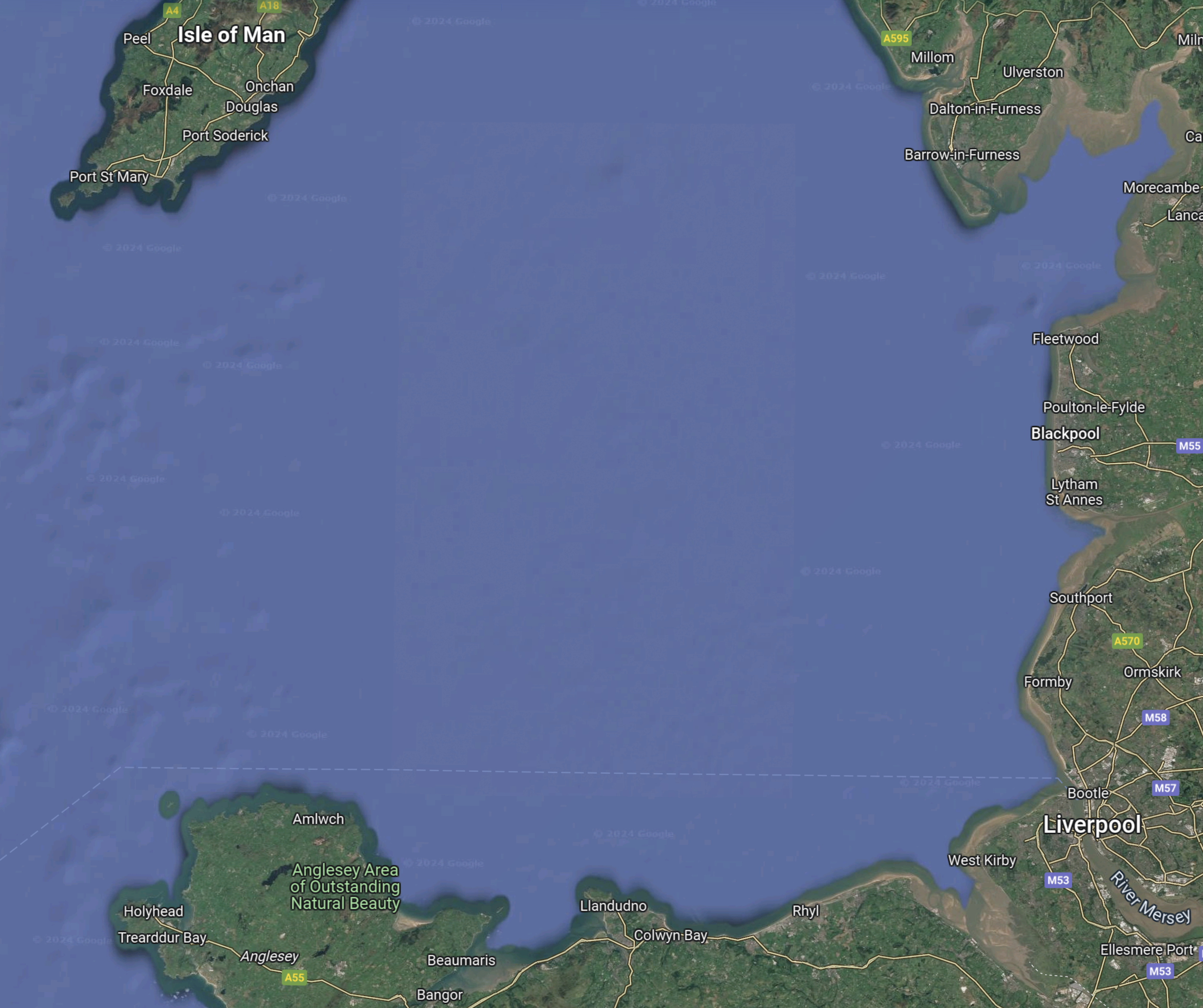
Note.
- The Isle of Man in the North-West corner.
- Liverpool, Birkenhead and the River Mersey in the South-East corner.
- Anglesey in the South-West corner.
- Blackpool with Morecambe Bay to its North in the North-East corner.
Liverpool Bay could be one of Europe’s zero-carbon energy powerhouses.
Wind Farms In Liverpool Bay
At the present time, these wind farms are producing electricity or planned in Liverpool Bay.
- Barrow – 90 MW – Commissioned in 2006
- Burbo Bank – 90 MW – Commissioned in 2007
- Burbo Bank Extension – 258 MW – Commissioned in 2017
- Gwynt y Môr – 576 MW – Commissioned in 2015
- North Hoyle – 60 MW – Commissioned in 2003
- Ormonde – 150 MW – Commissioned in 2012
- Rhyl Flats – 90 MW – Commissioned in 2009
- Walney – 367 MW – Commissioned in 2010
- Walney Extension – 659 MW – Commissioned in 2018
- West if Duddon Sands – 389 MW – Commissioned in 2014
- Awel y Môr – 500 MW – Planned
- Morecambe – 480 MW – Planned
- Mona – 1500 MW – Planned
- Morgan – 1500 MW – Planned
Note.
- 2509 MW has been commissioned.
- 3980 MW is being planned.
- That is a total of 6489 MW
I suspect more space in Liverpool Bay could be developed with wind farms.
Mersey Tidal Power
The Mersey Tidal Power project has a web site.
If it is built, it will probably be built by the South Korean company; K-Water and use some of the design principles of the Sihwa Lake Tidal Power Station.
It will likely have an output of around 1 GW and take ten years to build.
In the 1970s, I did some project management consultancy for Frederick Snow and Partners, and they showed me their plans for a Severn Barrage.
Their futuristic vision for the Severn Estuary was never built, as the Prime Minister of the time; Harold Wilson, felt coal was the future. See Last Of The Many!
I suspect that the Mersey Tidal Power project will be another variation on a proven theme.
Morecambe Bay Bridge And Tidal Barrage Proposal
In the Wikipedia entry for Morecambe Bay, there is a proposal for a bridge and tidal barrage across the bay, where this is said.
In 2004, a proposal was made to build a bridge across the bay flanked by wind turbines and using tidal power. Proposals from Northern Tidal Power Gateways in 2019 outlined a tidal barrage with a road running along on top.
If the Mersey Tidal Power project is a success, then why wouldn’t one across Morecambe Bay, be one too?
500 MW of zero-carbon tidal power would do nicely!
Nuclear Sites At Calder Hall, Heysham And Wylfa
These three nuclear stations have supplied electricity to the North-West of England.
- Calder Hall was the original Magnox site, which the Wikipedia entry says had a nameplate capacity of 240 MW and was decommissioned in 2003, after running for 47 years.
- Heysham is a powerful site which the Wikipedia entry says has a nameplate capacity of 2452 MW and will be decommissioned in 2028.
- Wylfa is an older, smaller Magnox site which the Wikipedia entry says had a nameplate capacity of 1190MW and was decommissioned in 2015.
As the sites are cleared, I am sure that we’ll see more nuclear power stations built on the sites.
How Much Electricity Does A Data Centre Use?
I found this paragraph in an NESO document.
Regardless of this, if we were to use existing market data and modelling projections, this could point to annual data centre electricity consumptions of between 3.6 TWh in 2020 to as much as 35 TWh by 2050.
Dividing by the hours in a year, indicates that an individual data centre could use between 0.4 and 4 GW of electricity.
Using my rough figures here from wind, tidal and nuclear, I suspect that the power on the Mersey will generate enough power for at least one data centre.
Liverpool Is On The Right Side Of The Country For Cables To North America
Cables will go straight out of Liverpool Bay, pass to the North of Ireland and across the Atlantic to somewhere like Puget Sound.
Liverpool has a superb location for a Transatlantic data centre, that connects to networks on both sides of the pond.
Could Underwater Data Centres Be Developed In Liverpool Bay?
This page on the Microsoft web site is entitled Microsoft Finds Underwater Datacenters Are Reliable, Practical And Use Energy Sustainably
These three paragraphs detail the research.
Earlier this summer, marine specialists reeled up a shipping-container-size datacenter coated in algae, barnacles and sea anemones from the seafloor off Scotland’s Orkney Islands.
The retrieval launched the final phase of a years-long effort that proved the concept of underwater datacenters is feasible, as well as logistically, environmentally and economically practical.
Microsoft’s Project Natick team deployed the Northern Isles datacenter 117 feet deep to the seafloor in spring 2018. For the next two years, team members tested and monitored the performance and reliability of the datacenter’s servers.
I would assume that Microsoft have continued the research, as with something like this you can’t be too careful.
But it would appear, that data centres and their servers could be submerged under the waters of Liverpool Bay.
London And Liverpool Will Be Under Two Hours By Train Within A Year
New Class 807 trains, which will be delivered within a year, will improve the train service between the two cities.
- Train times will be brought to around or even below two hours.
- , The extra trains will allow a second hourly service to be added.
- The extra service will additionally stop at Liverpool South Parkway station, for the airport.
- High Speed Two is claiming one hour and fifty minutes, between London and Liverpool.
Liverpool already has one of the best rail terminals in the North of England, as these pictures show.
































































With these service improvements, it will have a service to London and the South, that will be second to no other Northern station.
Liverpool Has A Refurbished Partly-Underground Suburban Railway With New Trains
Liverpool’s Metro is one of the best in Europe for a medium-sized city.
The Metro is also expanding with new routes and stations.















These pictures show the new Headbolt Lane station, which is swerved by the UK’s first battery-electric trains.
Liverpool Has Easy Access To Two International Airports
There are two international airports close by; Liverpool John Lennon and Manchester International.
- For Liverpool Airport, it’s a bus from Liverpool South Parkway station or an express bus from Liverpool city centre.
- For Manchester Airport, it’s a train from Lime Street station.
I am fairly sure, that a hydrofoil could connect Liverpool’s Waterfront and the Tidal Barrier to the airport.
North-West England Has A Rich University Tradition
Liverpool, Manchester and the surrounding area has several world-class universities and research establishments.
Some like The Pandemic Institute would be able to find uses for all the computing power and artificial intelligence on offer at a powerful data centre.
Liverpool Is A World City
Liverpool is a World City, where there is plenty of sport, entertainment and things to do.
Conclusion
Liverpool is installing the power infrastructure for a very large data centre, that will be able to handle the world’s largest and most difficult problems.
ORE Catapult, ABP, Microsoft & Co To Create World’s Biggest Offshore Wind ‘Living Lab’ In UK
The title of this post, is the same as that of this article on offshoreWIND.biz.
This is the sub-heading.
A consortium led by the Offshore Renewable Energy (ORE) Catapult has launched a project that will create the biggest offshore wind “living lab” in the world in the UK through the development of a 5G Testbed that includes Grimsby Port and the Lynn and Inner Dowsing offshore wind farm.
These two paragraphs outline the project, its aims and partners.
The GBP 2.8 million (approximately EUR 3.2 million) project, which will run until March 2024, involves setting up a 5G Testbed to allow technology providers to test and demonstrate their equipment in real-world conditions, with access to reliable, high-speed communications.
The aim is to kickstart a digital revolution in offshore wind operations and maintenance (O&M) and accelerate the development of a new generation of digital technologies essential for the expansion of offshore wind generation, according to ORE Catapult, which partnered with Microsoft, Vilicom, JET Connectivity, XceCo, Associated British Ports (ABP), Acceleran and Satellite Applications Catapult to realise the project.
This seems to me to be a very good idea and it is certainly well-backed.
Caterpillar To Launch Demonstration Project Using Hydrogen Fuel Cell Technology For Backup Power At Microsoft Data Center
The title of this post, is the same as that of this press release on the Caterpillar web site.
This is the first two paragraphs.
Caterpillar Inc. today announced a three-year project through a collaboration with Microsoft and Ballard Power Systems to demonstrate a power system incorporating large-format hydrogen fuel cells to produce reliable and sustainable backup power for Microsoft data centers. The project is supported and partially funded by the U.S. Department of Energy (DOE) under the H2@Scale initiative and backed by the National Renewable Energy Lab (NREL).
“At Caterpillar, we focus on supporting our customers with reliable, resilient and economical power solutions while achieving their climate-related goals,” said Jason Kaiser, vice president for Caterpillar’s Electric Power Division. “This hydrogen fuel cell demonstration project enables us to collaborate with industry leaders to take a large step toward commercially viable power solutions that also support our customers in making their operations more sustainable.”
It certainly looks like Caterpillar are turning to the use of hydrogen to keep their existing markets.
This press release explains the cooperation in a paragraph.
Caterpillar experts in advanced power technologies, controls and system integration are working alongside Microsoft experts in data center design and Ballard experts in fuel cell design to demonstrate a 1.5 MW backup power delivery and control system that would meet or exceed the expectations set by current diesel engine systems.
Elsewhere the press release says that Caterpillar aims to be carbon negative by 2030.
Conclusion
We will see lots of systems like this providing reliable and sustainable power systems for entities like airports, city centres, data centres, hospitals, ports, shopping malls and other large users of electricity.
Inner Eye AI Identifies Tumours To Speed Up Treatment Of Cancer
The title of this post is the same as that of this article on The Times.
This is the introductory paragraph.
A hospital in Cambridge is the first to use artificial intelligence technology developed by Microsoft to treat cancer patients faster, helping to cut the treatment backlog and save lives.
There is only one NHS hospital in Cambridge and that is Addenbrooke’s, who probably saved my life, by diagnosing me as coeliac in 1997.
This paragraph explains the development of the software and how it will be deployed across the NHS.
Inner Eye is the result of an eight-year project with Microsoft and Addenbrooke’s and is being introduced in other NHS trusts. It is easy to access and free to use. When the AI tool is in place, hospitals will be able to use their own data to improve accuracy.
This paragraph sums up the usefulness of the system.
Pat Price, a professor at Imperial College London and chairwoman of Action Radiotherapy, a charity, said: “This is just one brilliant example of the quiet but amazing technological revolution that has unfolded in radiotherapy in recent years and could dramatically improve cancer survival rates.”
It really is amazing how since my wife died of a squamous cell carcinoma of the heart, treatment of cancer has improved.
I can envisage a time, when a rare cancer like that, which killed her in three months, will be survivable!
BP And Microsoft Form Strategic Partnership To Drive Digital Energy Innovation And Advance Net Zero Goals
The title of this post, is the same as that of this article on Authority.
This is the introductory paragraph.
The companies intend to work together to develop new technology innovations and digital solutions to help meet their sustainability aims, including reducing energy use and carbon emissions.
I find this an interesting and possibly very important partnership.
It is an article that is well worth a read.
Conclusion
Strategic partnerships like this might be one of the moves, that will improve the world.
Google Going “Carbon Free” By 2030
The title of this post, is the same as that of this article on the Houston Chronicle.
This is the introductory paragraph.
Tech giant Google is committing to using no form of energy that emits carbon dioxide by the end of this decade, ramping up its commitment to fighting climate change.
This looks like a good thing to me, as all those servers use a lot of electricity.
There have also been similar pledges from Microsoft and Apple.
I Apologise For The Quality Of My Latest Posts
Since swapping to a Microsoft Surface Studio Pro 2 and Windows 10, the quality of my posts has got worse.
This is because they seem to be incompatible with WordPress.
It annoys me terribly, as I was brought up in a letterpress print works, where nothing less than perfect pages were tolerated.
I suspect I need to return to Windows 7!
I have improved them by reediting them in Windows 7 on my old laptop.
I certainly couldn’t recommend a Microsoft Surface Pro and Windows 10 to a blogger, who uses WordPress.
 The Anonymous Widower