The UK’s New High Speed Line Being Built By Stealth
Wikipedia has a section called High Speed Rail. This is the first paragraph.
High-speed rail is a type of rail transport that operates significantly faster than traditional rail traffic, using an integrated system of specialised rolling stock and dedicated tracks. While there is no single standard that applies worldwide, new lines in excess of 250 kilometres per hour (160 miles per hour) and existing lines in excess of 200 kilometres per hour (120 miles per hour) are widely considered to be high-speed.
In the UK we have both types of high speed line mentioned in this definition.
High Speed One and High Speed Two have or will have operating speeds of 300 kph and 400 kph respectively and by any definition are true high speed lines.
There is also the East Coast Main Line and Great Western Main Line and West Coast Main Line, which are lines with long stretches, where continuous running at 200 kph is possible.
These lines certainly meet the 200 kph definition now and will likely exceed it, as digital in-cab signalling is deployed in the future and allows running at up to 225 kph in certain places.
Electrification Between Sheffield And Clay Cross On The Midland Main Line
This article on Rail Technology Magazine is entitled Grayling Asks HS2 To Prepare For Electrification Of 25km Midland Main Line Route.
If this electrification happens on the Midland Main Line between Sheffield and Clay Cross North Junction, it will be another project in turning the line into a high speed route with a 200 kph operating speed, between London and Sheffield.
Currently, the electrified section of the line South of Bedford is being upgraded and the electrification and quadruple tracks are being extended to Glendon Junction, where the branch to Corby leaves the main line.
The proposed electrification will probably involve the following.
- Upgrading the line to a higher speed of perhaps 225 kph, with provision to increase the speed of the line further.
- Rebuilding of Chesterfield station in readiness for High Speed Two.
- Full electrification between Sheffield and Clay Cross.
Clay Cross is significant, as it is where the Midland Main Line splits into two Southbound routes.
- The main route through the Derwent Valley Mills World Heritage Site and Derby station.
- The secondary route of the Erewash Valley Line to the East Midlands Hub station.
Note.
- Some of the tunnel portals in the Derwent Valley are Listed.
- Trying to electrify the line through the World Heritage Site will be a legal and engineering nightmare.
- Network Rail has spent or is spending £250million on upgrading the Erewash Valley Line.
- High Speed Two will reach The East Midlands Hub station in 2032.
When High Speed Two, is extended North from the East Midlands Hub station, it will take a route roughly following the M1. A spur will link High Speed Two to the Erewash Valley line in the Clay Cross area, to enable services to Chesterfield and Sheffield.
But until High Speed Two is built North of the East Midlands Hub station, the Erewash Valley Line looks from my helicopter to be capable of supporting 200 kph services.
- It is mainly double track, with sections where extra lines have been added.
- It is reasonably straight.
- There seem to be generous margins on either side.
- There is only one tunnel at Alfreton, which is 770 metres long.
- There is only three stations at Ilkeston, Langley Mill and Alfreton.
As many of the bridges seem new, has the Erewash Valley Line been prepared for electrification?
Electrification Around East Midlands Hub Station
I wouldn’t be surprised to see that by the opening of the East Midlands Hub station in 2032, that the following will have happened.
- The route between East Midlands Hub station and Sheffield via the Erewash Valley Line and Chesterfield has been fully electrified.
- A higher proportion of services between London and Sheffield will use the Erewash Valley Line, with times under two hours.
- From 2022, the trains running on the Midland Main Line will be 200 kph bi-mode trains.
As the East Midlands Hub Station and High Speed Two is developed, various electrified routes will open through the area, thus grdually reducing journey times between London and Sheffield.
Once the station is fully open, I suspect there will be services between London and Sheffield via High Speed Two and the Erewash Valley Line.
But when the High Speed 2 spur towards Sheffield is opened, the trains will take the high speed route.
Electrification From London To Kettering, Glendon Junction And Corby
Currently, the electrified section of the line South of Bedford is being upgraded and the electrification and quadruple tracks are being extended to Glendon Junction, where the branch to Corby leaves the main line.
When completed, this electrification will enable the following.
- Two electric trains per hour (tph) between London and Corby.
- Much of the route between London and Glendon Junction will be improved to allow 200 kph running.
- Much of the route between London and Glendon Junction will be quadruple tracks.
It will be a quality high speed line to a similar standard to that of much of the East Coast Main Line.
The True 200 kph (125 mph) Bi-Mode Train
In the Wikipedia entry for Leicester station, this is said about electrification of the Midland Main Line.
From 2022, services will be operated using bi-mode electro-diesel trains running in electro-pantograph mode between London St Pancras and Kettering North Junction, switching to electro-accumulator/diesel-electric mode northwards from there.
Bombardier have been quoted as developing a 200 kph bi-mode Aventra with batteries.
- 200 kph on 25 KVAC overhead electrification.
- 200 kph on diesel.
- Batteries for Last Mile operation.
- Better ambience than current bi-modes.
- Low and level floors.
If Bombardier can produce such a train, surely other train manufacturers can?
Electrification Between Glendon Junction And Market Harborough
I talked about this in MML Wires Could Reach Market Harborough, where I said this.
It appears that Network Rail have a problem.
- Electrification of the Midland Main Line (MML) is to run as far as Kettering and Corby stations.
- The power feed is to be located at Braybrooke, which is just South of Market Harborough station.
So Network Rail are now looking for a twelve mile long extension lead.
A Network Rail spokesman, says they are looking at various options, including an underground cable or extending the Overhead Line Equipment.
Since I wrote that post a few weeks ago, I have looked at that section of line and have had various messages, which lead me to the belief, that all bridges and structures have been raised to allow electrification to be added to the line.
These points are in favour of electrification!
- The only station is Market Harborough, where the track is s being realigned to increase linespeed.
- Bridges, structures and track appear to have been upgraded for electrification.
- There are only two tracks.
- Network Rail need a power connection.
It will be a matter of heads and tails, as to whether Glendon Junction and Market Harborough station will be electrified.
The Electrification Gap Between Market Harborough And East Midlands Hub Stations
These are my thoughts on various sections going North from Market Harborough station.
Between Market Harborough And Leicester
This doesn’t appear to be too difficult to electrify, if that were to be decided, until approaching Leicester station, where there are several bridges over the track.
A driver also told me, that under one bridge the track can’t be lowered, due to the presence of a large sewer.
If the proposed bi-mode trains have a Last Mile battery capability, discontinuous electrification as proposed for South Wales could be used on these bridges.
But the track is fairly straight and the speed limits could be fairly high enabling the proposed bi-mode trains to be cruising near to 200 kph.
Whatever is done, I suspect that the track improvements and the electrification work South of Kettering will enable the new bi-mode trains to go between Leicester and London in comfortably under an hour.
Leicester Station
I think Leicester station is both a problem and a solution.
I don’t think it is possible to electrify the current station without a lot of disruption and major works because of the number of bridges South of the station.
But according to Wikipedia, plans exist to regerenate the station, which could be a big opportunity to create the most cost-effective solution to powering the trains.
Northwards From Leicester
This section looks an ideal one for the proposed 200 kph bi-mode train, with fairly straight tracks.
Operation Of The Bi-Mode Trains
Battery Use
I believe that Bombardier’s design for a 200 kph bi-mode train, doesn’t just use batteries for Last Mile operation.
Using discontinuous electrification on the bridges South of Leicester, which would be the sensible way to electrify that section, but would need the new trains to have a battery capability to jump the gaps.
I also believe that Aventras use batteries to handle regenerative braking, as do Hitachi on their Class 800 trains.
Bombardier Aventras seem to have lots of powered axles and Bombardier have stated that the bi-mode will have distributed power.
As an Electrical and Control Engineer, I believe that the most efficient battery strategy with distributed power, would be to distribute the batteries to each car.
- Batteries would be close to the traction motors, which is electrically efficient.
- Batteries would be smaller and easier to install on the train.
- Battery power could be used to power the train’s systems, as Hitachi do!
- Battery power could be used to move the train and assist in acceleration
Each car would have its own computer to use the most efficient strategy.
I would also put an appropriately sized diesel generator in each car.
In the mathematical modelling of systems consisting of several identical units working together, it is a common technique to look at an individual car.
Consider the following, where I estimate the weight of a car in a proposed bi-mode Aventra.
- A motor car for a Class 345 train, which is another Aventra variant, weighs 36.47 tonnes.
- I estimate that a typical car in the proposed bi-mode train will accommodate a total of about 70 seated and standing passengers.
- With bags, buggies and other things passengers bring on, let’s assume an average passenger weight of 90 kg, this gives an extra 6.3 tonnes.
- Suppose the battery and the diesel were to weigh a tonne each
So I will assume that a typical car weighs 44.77 tonnes.
When running at 200 kph, the car will have a kinetic energy of around 19.5 kWh.
The 30 kWh battery in a Nissan Leaf could handle that amount of energy.
The kinetic energy of a passenger train is surprisingly small.
I suspect that each car has a battery size of about 50 kWh, so that it can adequately power the train in all modes.
Acceleration
Acceleration of a train, is the part of the journey that uses most power.
These trains will need to have the same or better acceleration to the Class 222 trains, that currently work the route, as otherwise timings would be slower and a marketing disaster.
In Have Bombardier Got A Cunning Plan For Voyagers?, I did the calculation of the kinetic energy for a four-car Class 220 train, which is in the same Voyager family as the Class 222 train.
Voyagers are an interesting train, as they cruise at 200 kph and have a diesel engine in each car, which generates electricity to power the train.
Consider these facts for a four-car Class 220 train.
- The train has a weight of 185.6 tonnes, so the average car weight is 46.4 tonnes
- The train has seats for two hundred passengers or 50 per car.
- If we assume that each passenger weighs 90 Kg. with their baggage this gives a total car weight of 50.9 tonnes.
This one car of a Class 222 train running at 200 kph has a kinetic energy of 22 kWh.
As both trains are assumed to be travelling at the same speed, the difference in kinetic energy is down to the weight of the car and the number of passengers.
I have assumed more passengers in the Aventra, as I suspect modern design will improve the figure.
Consider each of these trains doing a stop from 200 kph on the Midland Main Line.
The Aventra will convert the train’s kinetic energy into electricity in the batteries, so if I assume that the efficiency of the regenerative braking is eighty percent, this would mean that 19.5 * 0.8 or 15.6 kWh will be stored in the battery in each car. To accelerate back to 200 kph, the onboard diesel engines will have to supply 3.9 kWh for each car.
The Class 222 train will convert the train’s kinetic energy into heat. To accelerate back to 200 kph, the onboard diesel engines will have to supply 22 kWh for each car.
Bombadier have said that their design for a bi-mode Aventra will have distributed power. So if this includes the batteries and the diesel engines, I wouldn’t be surprised if each car has a battery and a diesel engine.
On the Class 222 train a 560 kW diesel is used in each car to provide the 22 kWh to accelerate the train.
So what size of diesel engine would be needed to supply the 3.9 kWh needed to accelerate the train?
Assuming the diesel is as efficient as that in the Class 222 train, the diesel engine would only be in the region of 100 kW.
Which seems very small!
But suppose something like the quiet Cummins ISBe engine, that is used in a New Routemaster bus is installed.
- This engine has a capacity of 4.5 litres and a rating of 185 bhp/138 kW.
- It is a quarter the size of the engine in the Class 222 train.
- One of the major uses of a larger 5.9 litre version of this engine is in a Dodge Ram pickup.
The engine would only run when the power in the battery was below a certain level.
Cruising At 200 kph
Once at 200 kph, I suspect that most of the power required would come from the batteries.
These would be topped up as required by the diesel engine.
Charging The Batteries
Expecting a small diesel engine to charge the batteries sufficiently between London and Sheffield is probably a big ask, especially if the new franchise wanted to run a train that stopped everywhere North of Kettering.
South of Kettering the train would use the electrification and I suspect trains going North will say good-bye to the electrification with full batteries.
So this is why Chris Grayling’s statement of possible electrification between Sheffield and Clay Cross is important.
Southbound trains from Sheffield would leave Clay Cross junction with full batteries, whether they are going via Derby or the Erewash Valley Line.
Between London And Sheffield
Trains between London and Sheffield would only be relying on the diesel engines to top up the batteries between Glendon Junction and Clay Cross.
This is probably about eighty miles. Trains currently take an hour with stops at Leicester and Derby.
It’s a tough ask!
But it might be possible, if an efficient, aerodynamically slippery train is launched with full batteries at full speed at Clay Cross and Glendon Junctions into a route without electrification, which is as straight and level as possible with only gentle curves.
Between London And Nottingham
The distance on the related route between Glendon Junction and Nottingham is about sixty miles with a couple of stops.
This could be an even tougher ask! A charging system at Nottingham might make all the difference.
Bombardier
Obviously Bombardier have done extensive simulations and they wouldn’t be offering the train for the new East Midlands Franchise, if they knew it wasn’t a viable solution!
If they can develop a train that can jump an eighty mile electrification gap at 200 kph, they’ll have a train, that will be a serious export possibility.
The following would also help.
- Any extra electrification.
- Launching the train at a higher speed into the gap. 225 kph would be the equivalent of an extra 5kWh in the battery.
- Batteries with a higher energy density will emerge.
- More efficient regenerative braking.
- Better aerodynamics.
I also believe that big improvements could come from a more sophisticated train control system.
Bombardier are developing a totally different philosophy of train design.
Conclusion
It looks like the reality of mathematics and dynamics will be able to satisfy the seemingly impossible dreams of Chris Grayling!
A Reconnaissance To Market Harborough
This morning, I took trains between St. Pancras and Market Harborough stations, and then came back with a pit-stop at Wellingborough station.
These were my observations.
Electrification Between Bedford And Kettering/Corby
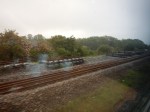
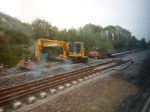
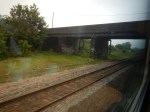
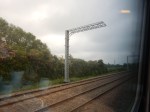
The electrification seems to be progressing, as these pictures show.

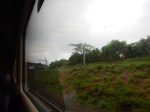
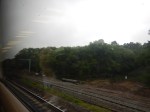
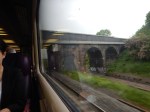
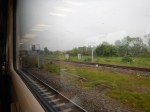

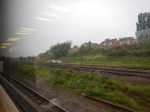

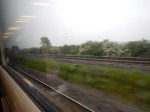
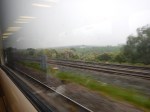


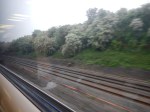



Note.
- Quite a few orange-capped piles have been installed.
- The gantries are going up.
- Extra tracks are being added.
One difference between this electrification project and others I have seen lately in the UK, is the aura of tidiness.
Electrifying From Glendon Junction To Market Harborough Station
One of the objectives of my reconnaissance was to see how much work needed to be done to the bridges between Glendon Junction and Market Harborough station, so that the overhead lines could be installed.
I counted nine bridges over the tracks and all seemed to offer sufficient clearance for freight trains and overhead wires.
It appeared that some bridges had been rebuilt and I suspect that Network Rail have completed their gauge clearance on this section of the Midland Main Line.
Line Speed From St. Pancras To Market Harborough
I chose to ride North in an InterCity 125, as having ridden in the cab of one of these iconic trains, I know a bit more about their capabilities.
What surprised me was how much of the journey was spent running at a speed in excess of 120 mph. There was one section where we were limited to about 90 mph, but I got the impression that Network Rail and their predecessors have created a high quality high speed line.
I would think it would be highly unlikely that by the time new bi-mode trains come into service in a few years time, that much of the route will be able to handle 125 mph running.
The train was almost at this speed between Glendon Junction and Market Harborough, so when the track through the station is straightened, it looks to me that journey times will be reduced.
Market Harborough Station
The station is a typical smaller main line station.
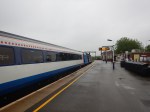

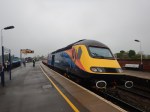
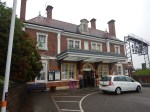


Note.
- Access to the London-bound platform is not step-free.
- Shelters are rather basic.
- The lines through the station will be straightened soon, to increase line speed.
Overall, it is a station with a good building, that should be improved.
Surely, if the tracks are being remodelled, then the foundations for electrification gantries should be installed.
Wellingborough Station
On the way back, I stopped off at Wellingborough station.
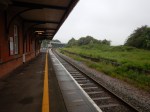
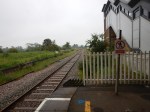
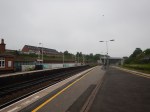
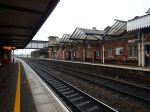

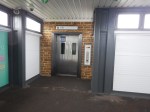

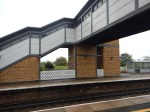
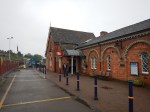
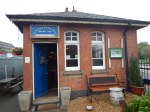
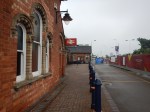
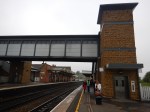
Note.
- Wellingborough station is being improved.
- All trains seem to stop at the two main platform 1 and 2.
- The bay platform 3 seems to have been rebuilt as a through platform to serve the new track being created through the station.
- There is rather a nice real ale and cider bar on the entrance side of the station.
- The station has a footbridge with lifts, which is better designed than many.
All of the improvements are to support the new housing being built around the station.
This Google Map shows the area around the station.
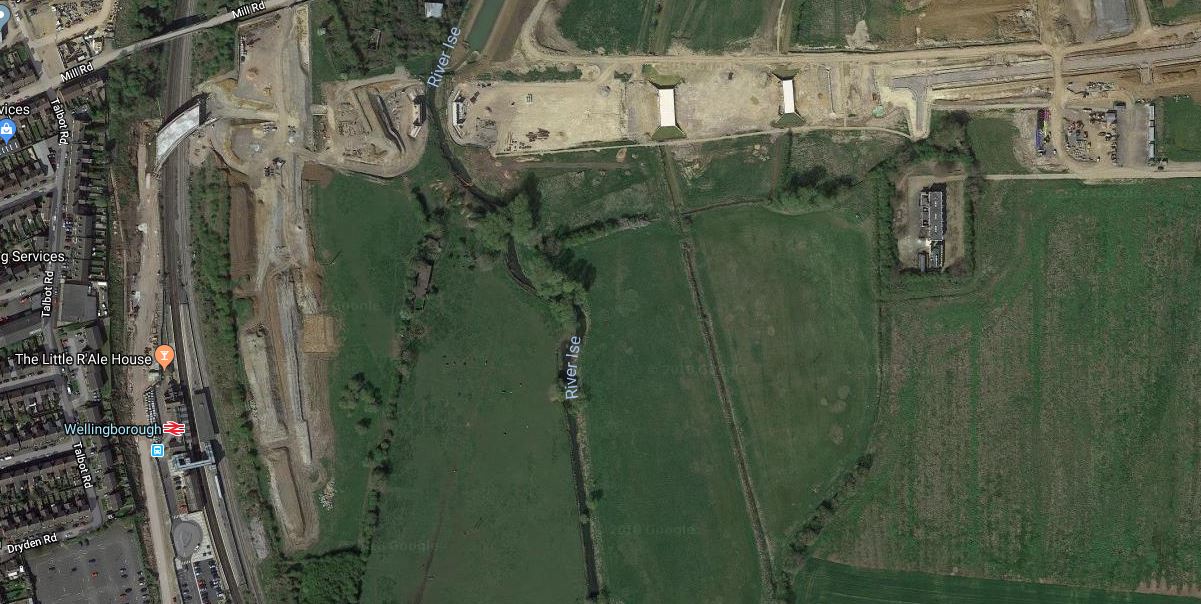
Note the new road crossing the railway to the North of the station.
It certainly looks like the upgraded station will be needed.
Views Of Drivers
I travelled back to London, with a group of drivers.
Two specific points emerged.
Electrification at Leicester could be difficult, as there are sewers under the track, which might mean the whole station and bridges would need to be substantially rebuilt.
South of Bedford, the Thameslink’s new Class 700 trains get in the way as they are too slow at 100 mph.
It is interesting to note the following.
- Class 387 trains working the East Coast Main Line and Great Western Main Line are 110 mph trains.
- Class 350 trains working the West Coast Main Line are 110 mph trains.
Are the Class 700 trains reducing the capcity of the Midland Main Line?
MML Wires Could Reach Market Harborough
The title of this post is the same as that of an article in the June 2018 Edition of Modern Railways.
It appears that Network Rail have a problem.
- Electrification of the Midland Main Line (MML) is to run as far as Kettering and Corby stations.
- The power feed is to be located at Braybrooke, which is just South of Market Harborough station.
So Network Rail are now looking for a twelve mile long extension lead.
A Network Rail spokesman, says they are looking at various options, including an underground cable or extending the Overhead Line Equipment.
Extending The Electrification To Market Harborough
There must be a scenario, where extending the electrification as far as Market Harborough, is a feasible and cost-effective engineering solution.
Consider, the MML between Market Harborough station and Glendon Junction, where the Corby Branch Line joins.
- The distance is less than twelve miles.
- There are no stations, which can be a pain to electrify.
- The track through Market Harborough station is being re-aligned, so the station should be easy to electrify.
- Glendon Junction is the only junction.
- The electrification will reach as far as Glendon Junction from St. Pancras.
- The route is is a double-track railway, which appears to be over fairly level terrain.
- There appears to be wide margins on either side of the railway.
- There are about half-a-dozen bridges over the railway, some of which could have been fairly recently built or rebuilt.
I doubt, it would be one of the most difficult of electrification projects.
I also suspect, that after their electrification fiascoes of the last few years, Network Rail might have learned enough to do this at an affordable cost.
For example, if the bridges are a problem, they might be able to use the technique I described in Novel Solution Cuts Cardiff Bridge Wiring Cost.
East Midlands Trains Services To And From London
If you look at the current long distance service of East Midlands Trains, there are the following four services between St. Pancras and Derby, Nottingham and Sheffield stations.
- Nottingham (stopping) – Stops at Luton Airport Parkway, Bedford, Wellingborough, Kettering, Market Harborough, Leicester, Loughborough and Beeston.
- Sheffield (semi-fast) – Stops at Leicester, Loughborough, East Midlands Parkway, Long Eaton, Derby and Chesterfield
- Nottingham (fast) – Stops at Market Harborough, Leicester and East Midlands Parkway
- Sheffield (fast) – Stops at Leicester, Derby and Chesterfield.
Note.
- Market Harborough, Leicester, Loughborough, East Midlands Psrkway, Derby, Nottingham, Chesterfield and Sheffield stations, all get at least two trains per hour (tph) to and from London.
- Include the Corby service and Bedford, Wellingborough and Kettering have two tph to and from London.
- All trains stop at Leicester station, which gives the city four tph to and from London.
- Market Harborough to Leicester is only sixteen miles.
Bi-Mode Trains
From 2021, it is expected that these services will be run by 125 mph bi-mode trains.
So how will electrification help these bi-mode trains?
Class 802 Trains
Suppose the services were to be run by a Class 802 train, which can do at least 125 mph using electric power.
An article on Christian Wolmar’s web site, is entitled Bombardier’s Survival Was The Right Kind Of Politics.
This is said.
The Hitachi bi-mode trains can only go 110 mph when using diesel.
The article was written a year ago, so this figure may be higher now!
So a Hitachi bi-mode will be able to go to the end of the electrification at either Glendon Junction or Market Harborough, as fast as the track allows and then at 110 mph on diesel.
Currently, services between St. Pancras and London take around seventy to eighty minutes.
What difference would the planned electrification to Glendon Junction make to this time?
Consider.
- Electrification to Glendon Junction or Market Harborough station could save more time, through faster running.
- Electrification to Market Harborough would mean only sixteen miles to Leicester would be on diesel.
- Electrification at Market Harborough station would cut time for those services stopping at the station.
- Track improvement could allow more 125 mph running using electric power.
- Modern in-cab digital signalling might allow sections of even faster running under electric power.
- Modern trains should save time at stations.
I’m certain that the right combination of improvements to track, stations and trains, will mean all services between St. Pancras and Leicester would be around an hour with Class 802 trains.
Bombardier’s Proposed 125 mph Aventra Bi-Mode
Bmbardier have announced a 125 mph bi-mode Aventra, which I wrote about in Bombardier Bi-Mode Aventra To Feature Battery Power.
I said this about the train.
- Development has already started.
- Battery power could be used for Last-Mile applications.
- The bi-mode would have a maximum speed of 125 mph under both electric and diesel power.
- Bombardier’s spokesman said that the ambience will be better, than other bi-modes.
This train with its faster speed on diesel would certainly achieve a time between St. Pancras and Leicester of under an hour.
I also think that this time will be achieved, whether or not, the wires are extended to Market Harborough.
Improving The Track
Many politicians, union leaders and environmentalists, see electrification as the main answer to better train services.
But before you can electrify a route, the track must be in a state, so that trains can run at a high speed, with long gentle curves and as few junctions as possible.
In the Wikipedia entry for Market Harborough station, there is a section called Future. This is said.
Market Harborough station is located on a large curve on the Midland Main Line, as a result of this line speeds through the station have always been relatively slow, at around 60 mph (100 km/h). The track layout is set to change significantly over the next couple of years as Network Rail engineers set about straightening the line, as part of their overall plan to increase overall line speeds.
How many other sections between Glendon Junction and Leicester could benefit from this type of improvement?
Should Market Harborough To Leicester Be Electrified?
As Market Harborough and Leicester stations are only about sixteen miles apart, surely it would be sensible to electrify this section, if Glendon Junction to Market Harborough is electrified?
I have flown my helicopter from Market Harborough to Leicester and the whole route has the following characteristics.
- Double-track
- Fairly level
- Wide margins.
- Market Harborough is the only station.
- There are junctions South of Leicester.
It would be fairly easy to electrify, but for one thing.
Although, there are only half-a-dozen bridges South of Market Harborough, it would appear there to be up to twenty bridges on the Northern section, some of which look like they would need serious work to get the wires underneath.
I have a feeling that electrifying between Market Harborough and Leicester would cause massive disruption to road traffic, if some bridges needed to be demolished and rebuilt.
A bi-mode travelling at upwards of 110 mph would probably achieve the same times on this section, without the disruption of installing the electrification.
Could Discontinuous Electrification Be Used Between Market Harborough And Leicester?
This is an additional section, that has been added after the announcement of March 5th 2019, that stated that the Midland Main Line would be electrified as far as Market Harborough.
Discontinuous electrification is to be used on the South Wales Metro and the difficult section, South of Leicester, which has lots of road bridges, might be a section, where the technique could be used to advantage.
Conclusion
I think that electrification between Glendon Junction and Market Harborough station will happen.
- The section wouldn’t be the most difficult to electrify.
- As there needs to be an electrical connection between Market Harborough and Glendon Junction, electrification of that section of the railway, might be a cost-effective solution to provide the connection.
- Electrification of Market Harborough station would cut the time to make a call at the station.
- It would offer enough time reduction on the Midland Main Line, that to give Leicester a four tph service to and from St. Pancras, with a journey time of under an hour, using existing train designs.
However, electrifying from Market Harborough to Leicester would be more difficult and I can’t see it offering any substantial benefits over a modern bi-mode train.
A Hydrogen-Powered Locomotive
If Alstom’s ventures in Germany and the UK with hydrogen-powered trains, are successful, I don’t think it will be long before engineers start thinking about a hydrogen-powered locomotive.
Consider some of the various locomotives used in the UK.
- Class 66 – Diesel – 2,500 kW – Over 400 in service
- Class 67 – Diesel – 2,400 kW – 30 in service
- Class 68 – Diesel – 2,800 kW – 34 in service
- Class 70 – Diesel – 2,800 kW – 37 in service
- Class 88 – Diesel – 700 kW – Electric – 4,000 kW – 10 in service
- Class 90 – Electric – 3,700 kW – 50 produced.
- Class 91 – Electric – 4,800 kW – 31 produced
- Class 92 – Electric – 5.000 kW – 46 produced.
Note.
- Many of the diesel locomotives, like the Class 66, don’t meet the latest emission regulations.
- Class 66 locomotives spent a lot of time pulling freight trains on electrified lines.
- The Class 90 electric locomotives are getting old and need careful maintenance.
- The Rail Minister, Jo Johnson, would like to see diesel power on UK railways gone by 2040.
I have not included some of the heritage locomotives, that are regularly seen on the UK rail network pulling freight.
This picture shows a pair of Class 86 locomotives hauling a freight train through Hackney Wick station.
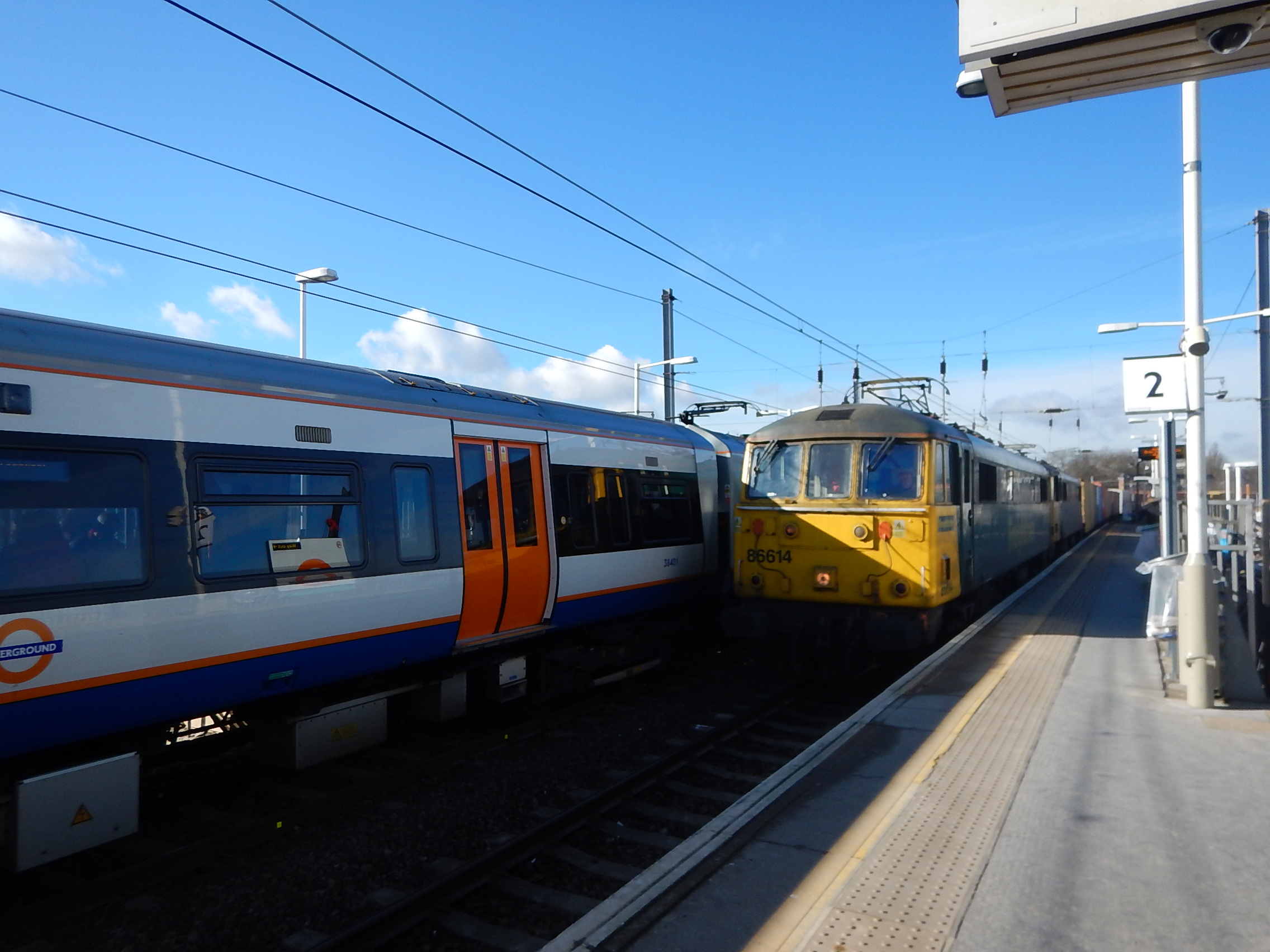
These two Class 86 locomotives date from the mid-1960s. But they do have 2,700 kW of power. Each!
According to Wikipedia, fourteen of Freightliner‘s thirty Class 86 locomotives are still in regular use.
Not only is this a tribute to 1960s engineering, but it does show that there is a shortage of suitable locomotives in the UK.
So could a modern environmentally-friendly locomotive be developed to fill the gap?
A Look At The Class 88 Locomotive
There could be a clue as to what could be a useful power output in the design of the Class 88 locomotive.
- These are a modern design from Shadler that entered service in 2017.
- They have a power output of 4,000 kW from electricity.
- They have a power output of 700kW from diesel.
- They can switch between power sources automatically.
- They can haul passenger trains, as well as heavy freight trains.
- They comply with Euro III B emission limits.
Did Direct Rail Services make sure they got a correctly-sized locomotive with the right capabilities?
They obviously find the diesel Class 68 locomotive to their liking, as they have bought over thirty.
So they probably knew very well, the sort of power that they would need from a dual-mode electro-diesel locomotive.
On electricity, the Class 88 locomotive is more powerful than a Class 90 electric locomotive, which commonly haul heavy freight trains on the electrified network.
In this article in Rail Magazine, the following is said about Class 88 locomotives, operating from Preston to Glasgow.
When hauling the maximum permitted load of 1,536 tonnes on the 1 in 75 banks on this route, Class 88 has a balancing speed of 34mph in electric mode or 5mph in diesel mode.
This shows how a well-delivered 700 kW, isn’t that inadequate.
I suspect that there is sufficient power to bring a heavy freight train out of Felixstowe and the other ports without electrification.
So perhaps, we should take the specification of a Class 88 train, as a starting point for the specification of a proposed hydrogen locomotive?
Possible Routes And Duties
There are also some specific problems associated with various routes and duties, where the current UK fleet of locomotives are used.
InterCity 225 Trains
There are currently thirty-one InterCity 225 trains, running on the East Coast Main Line.
- They are hauled by a 4,800 kW Class 91 electric locomotive.
- The trains consist of nine Mark 4 coaches and a driving van trailer.
- The trains were designed for 140 mph, but normally run at 125 mph.
- The trains have a capacity of over five hundred passengers.
- The trains could be made to meet all proposed access regulations for those with reduced mobility, with not a great deal of expensive work.
- Most of the trains will be replaced by Class 800 trains in the next couple of years.
- The trains are owned by Eversholt Rail Group, who are gaining a reputation for innovation.
The trains could probably give a few more years of service.
One suggestion, that has been made, would be to run the trains on the Midland Main Line.
- Sections of the route allow running at 125 mph.
- The route needs an urgent replacement for InterCity 125 trains.
- The route is only to be electrified as far as Kettering and Corby.
So an alternative and powerful locomotive would be needed, that could run on both lines with and without electrification.
The Class 91 locomotives are powerful beasts running on electricity, but with careful calculations, I’m sure that the power needed on lines with and without wires should be known.
The trains might also be formed of less coaches and selective electrification could be used in stations to accelerate the trains.
Note that accelerating the train to 125 mph, will be the major use of electricity. Hence, electrified stations would be welcome.
Expect some innovative proposals to use Mark 4 coaches from the InterCity 225 on the Midland Main Line.
Initially, could two Class 88 locomotives working in push-pull mode, handle say six Mark 4 coaches between London and Derby, Nottingham and Sheffield?
Who knows? But there are probably teams of engineers working away to create plausible solutions for the bidders for the new East Midlands Franchise, which will be awarded in April 2019.
Class 66 Locomotive Replacement
Because of their number, you see Class 66 locomotives everywhere on the UK network.
- They haul long inter-modal freight trains.
- They haul freight into and out of docks like Felixstowe, that are without electrification.
- They haul engineering trains.
- They are often seen hauling trains using diesel power on electrified lines.
But they are one of the most environmentally-unfriendly of diesel trains, which don’t meet the latest emission regulations.
How long before residents and rail passengers, start to complain about these locomotives, where electric haulage is possible?
I believe there is an increasingly urgent need for a go-anywhere replacement for the Class 66 locomotive.
It would appear, that the Class 88 locomotive, was specified so it can take over some of the duties of a Class 66 locomotive,
Could this see more orders for the Stadler locomotive?
I also believe that we could see other types of locomotive built to replace the Class 66 locomotive.
We might even see a locomotive with a lower power rating able to use electric or hydrogen power for work with all the smaller trains, that Class 66 locomotives haul.
Hydrogen Instead Of Diesel
The 700 kW diesel engine in a Class 88 locomotive is a Caterpillar C27, which drives an ABB alternator.
The engine alone weighs three tonnes.
By comparison Ballard make a hydrogen fuel cell that has an output of 100 kW, for a weight of 385 Kg.
This gives a weight of 2.7 tonnes for an output of 700 kW.
There will need to be a substantial battery. I estimate that a 500 kWh battery will weigh about eight tonnes.
On balance, the hydrogen-powered locomotive will probably be heavier than a diesel one, but it will have environmental advantages.
But with good design, I do think that a locomotive with similar performance to a Class 88 can be produced.
It might need to be longer or articulated and have more axles, to cope with extra weight.
Conclusion
I am led to the belief that a hydrogen-powered locomotive with sufficient power is possible.
They may be able to handle a lot of the duties of Class 66 locomotives, but I doubt they would be powerful enough for hauling full rakes of Mark 4 coaches.
It will be interesting to see, what solutions are proposed to solve the forthcoming rolling stock shortage on the Midland Main Line.
MK-Bedford New Line Mooted
The title of this post, is the same as the title of an article in the April 2018 Edition of Modern Railways.
This is the first paragraph.
A new railway between Milton Keynes and Bedford for the East West Rail project has been suggested as a way of avoiding problems with the Marston Vale Line, where the hourly stopping service and numerous level crossings limit capacity for through regional trains.
Another aim is that the next phase of the project should be completed by the end 2022, which is between a one and two years earlier than the existing target.The Chairman of the East West Rail Company, then said he’d like the the railway to open in 2027.
The article says a new route will be expensive, but innovative ways of doing things could help.
Consider these points about the Marston Vale Line
- The stations need development.
- There are at least thirteen level crossings.
- New houses are being built near some stations.
- The operating speed is just 50 mph.
- Finding a new route at Fenny Stratford, Woburn Sands, Aspley Guise, Ridgmont and Lidlington could be difficult.
- The railway passes under the M1 and the A421, so moving these crossing points could be difficult.
It’s all a complicated design problem.
East West Rail could borrow a trick from the Heathrow Southern Railway, which is planned to run alongside the M25 to get to Heathrow. The new railway could be routed alongside the A421 in the Bedford area.
This Google Map shows the A421 to the South of Bedford.
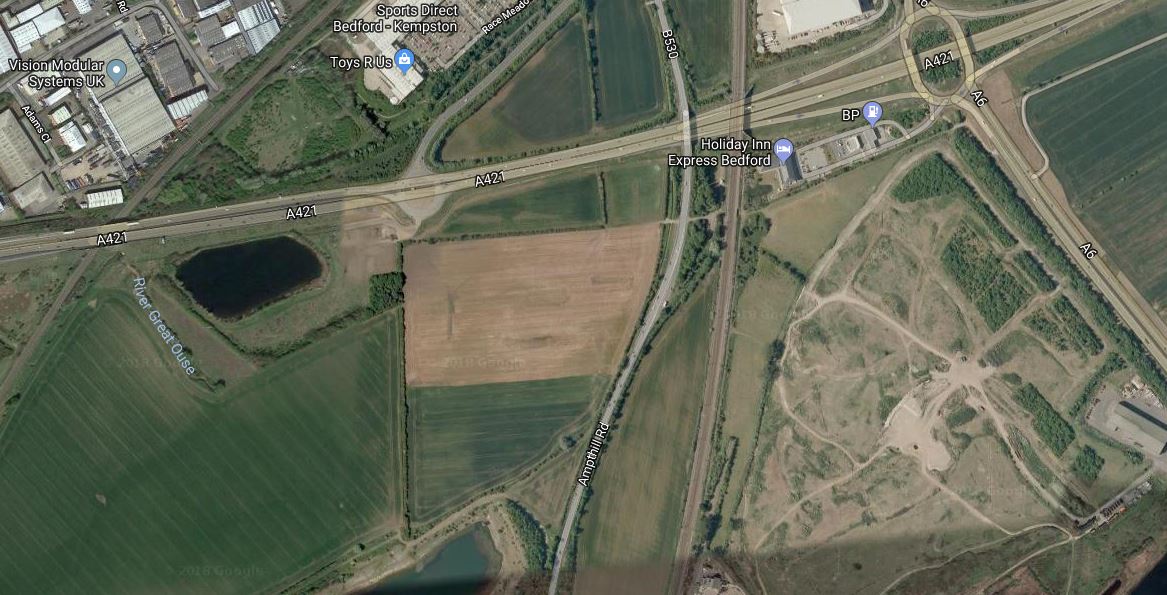
Note.
- The Marston Vale Line goes across the North West corner of the map.
- The Midland Main Line goes across the map in a North-South direction.
- The roundabout at the North East connects the A421 to the A6.
- The building by the roundabout is a hotel.
If the East West Rail Link was routed alongside the by-pass a station could be built where the two lines cross.
- The Midland Main Line and Thameslink would be linked to the East West Rail Link.
- Passengers for Bedford would be able to use the frequent Thameslink service to get to the town.
- A big Park-and-Ride could be built.
- Marston Vale Line services would take the same route as they do now, via Bedford St. Johns station.
If it was desired, chords could be built to enable services on the East West Rail Link to serve Bedford with a reverse in Bedford station.
Oxford has a Parkway station, Milton Keynes has a Milton Keynes South station at Bletchley, Cambridge will probably have a Cambridge South station, so why shouldn’t Bedford have a Bedford South station?
Midland Mark 4
The title of this post is the same as an article by Ian Walmsley in the March 2018 Edition of Modern Railways.
Ian builds on what he said in an article in the August 2017 Edition of the same magazine. I wrote about that article in We Should All Think Radically!
He proposes using Mark 4 coaches with two Class 43 power cars to create trains that meet the PRM-TSI regulations deadline, which will mean the replacement of the East Midland Franchise’s twelve InterCity 125s.
He suspects various technical solutions can be borrowed to make it all possible and because of the extra weight of the Mark 4 coaches, the trains may become 2+7 sets instead of the current 2+8.
The trains could be rather nice.
- The Mark 4 coaches have been extensively refurbished in the last two decades and have full wi-fi and power socket fitment.
- The Mark 4 coaches meet all the PRM-TSI regulations.
- 125 mph running would be possible, where the track allowed.
- The East Midland Franchise already has the Class 43 power-cars.
- If the electrification of the Midland Main Line is ever electrified, then the Class 43 power cars could be swapped for electric locomotives.
I would assume that three extra sets, that the franchise is acquiring from Grand Central could also be converted., giving the East Midlands Franchise, fifteen sets with a life of at least ten years.
A quick calculation would indicate that this reorganisation could see the current 132 Mark 3 coaches replaced by perhaps 120 Mark 4 coaches. I’ve just applied 7/8 to the Mark 3 coach total after the Grand Central trains have been added to the fleet.
What Will Happen To The Remaining Mark 4 Coaches?
Currently, there are 302 Mark 4 coaches in service on the East Coast Main Line with Virgin Trains East Coast.
In the Wikipedia entry for the Mark 4 coach, there is a section named Future.
This is said.
The Mark 4s are scheduled to be replaced on the East Coast Main Line by Class 801s in 2018. Some may be redeployed to Midland Main Line services.[19] Virgin Trains East Coast will retain seven or eight nine-carriage sets to operate extra services to Edinburgh.
In 2017, Alliance Rail Holdings announced that, owing to it being unable to source new build Class 390 EMUs for its intended service between London and Blackpool, it was revising its proposal to use the Class 91/Mark 4 combination instead
So it looks like seventy-two coaches will be retained for the East Coast Main Line.
As to how many trains will be needed between London and Blackpool, that’s the old question of how long is a piece of string.
Consider.
- I don’t think that the platforms at Blackpool will accept full-length sets.
- Class 180 trains used by various operators are five cars in length.
- There are fourteen Class 180 trains, running to Bradford, Hull and Sunderland.
- TransPennine Express has ordered several multiple units and rakes of coaches, that are five-cars long.
So perhaps three sets of five carriages, which seem adequate for Sunderland, would be a rough estimate.
This gives the following totals.
- East Midlands Franchise – 120
- East Coast Main Line – 72
- Euston-Blackpool – 15
Which gives a total of 207.
This leaves ninety-five coaches for other purposes. Or dare I say it, nineteen sets of five coaches?
Motive Power
The rakes of coaches will need to be powered.
These are a few possibilities.
Class 91 Locomotive And A Mark 4 Driving Van Trailer
Currently, Mark 4 coaches are powered and driven by a Class 91 locomotive with a Mark 4 Driving Van Trailer, at the other end of the train.
Total numbers available are
- 31 – Class 91 Locomotive
- 32 – Mark 4 Driving Van Trailer
If eight sets are retained for the East Coast Main Line, this means that a maximum of twenty-three trains could be created.
But except for limited use by Open Access Operators from London on fully-electrified lines, I can’t see all Class 91 locomotives being required.
Mark 4 Coaches Topped And Tailed With Class 43 Locomotives
This is Ian Walmsley’s plan for the Midland Main Line, as he outlined in the March 2018 Edition of Modern Railways.
Consider.
- There are quite a few Class 43 locomotives available. There are thirty-two on the East Coast Main line for a start.
- Ian feels that creating 2+7 sets is possible, but many needed would be shorter.
- According to the article, Mark 4 coaches would be more affordable than making Mark 3 coaches PRM-TSI compliant.
The trains would share the iconic appearance of the InterCity 125, which passengers seem to love so much!
Class 68 Locomotive And A Mark 4 Driving Van Trailer
Chiltern use Class 68 locomotives and Mark 3 Driving Van Trailers, with Mark 3 coaches, so it is likely perhaps after some modification, these locomotives could be used with Mark 4 coaches and an appropriate Driving Van Trailer.
If a Class 68 locomotive would work, surely the closely-related Class 88 locomotive could also be used.
Mark 4 Coaches Topped And Tailed With Class 68 Locomotives
This arrangement has been used between Norwich, Lowestoft and Yarmouth with an elderly rake of Mark 2 coaches for some time.
It is a method that could be surely be used with Mark 4 coaches after a few modifications.
A New Class Of Electro-Diesel Locomotive And A Mark 4 Driving Van Trailer
I very much feel we need a new electro-diesel locomotive for both freight and passenger purposes.
Mark 4 Coaches Topped And Tailed With A Class 68 And A Class 88 Locomotive
I have often wondered, if instead of using two Class 68 locomotives, whether a Class 68 and a Class 88 locomotive could be used at opposite ends, to create the ultimate hybrid train, with a powerful diesel locomotive on one end and a powerful electric locomotive on the other.
Summing Up Motive Power
With a bit of ingenuity, I’m sure that uses could be found for most of the Mark 4 coaches.
Possible Routes
These routes need good quality rolling stock and innovatively-hauled Mark 4 coaches could be a solution.
Wales
Scotland has decided that the best way of serving some of its long routes, is to use shortened InterCity 125s.
Surely, if the concept works in Scotland, it is likely to work in Wales.
These could use Mark 4 coaches or more likely updated Mark 3 coaches.
Liverpool and Manchester To Holyhead
Once the Halton Curve is open, the possibility of a Liverpool to Holyhead service must exist.
A quality service along the North Wales Coast, must surely be beneficial to residents, business and tourism.
London Waterloo To Exeter Via Basingstoke
This service is currently served by Class 158 or Class 159 trains.
- Trains generally work as six-car units.
- The route is electrified between London Waterloo and Basingstoke.
- Time could be saved by partial electric haulage.
The problem of this route might be solved by converting the Class 158/159 trains in bi-modes, as I wrote about in Class 158/159 Bi-Modes?
Cross-Country Routes
Cross Country routes and I don’t just mean those run by the company of the same name are often very-well pastronised, as often these routes are the only way to get between two provincial cities.
Take Norwich to Liverpool, which has a route, that definitely needs more coaches than those offered by a two-car Class 158 train.
Scenic Routes
Scotland is to run short-formation InterCity 125s between major cities.
IMany of these routes also fall into the category of scenic routes.
If this Scottish innovation is successful, will we see pressure for similar trains to work routes like Settle-Carlisle in England?
Summing Up Possible Routes
I don’t think there will be a shortage of routes to run Mark 4 coach-based services.
Conclusion
Don’t underestimate how the retired Mark 4 coaches will be used.
Thoughts On A Hydrogen-Powered Bi-Mode High Speed Train
My stockbroker and pension fund manager keeps contacting me about hydrogen power. There seems to be a lot of money chasing few good investments.
What I find surprising is that two of the leading fuel cell companies are Canadian; Ballard and Hydrogenics, with one supplying Alstom with fuel cells for their hydrogen powered train.
Bombardier at Derby, who are another Canadian company, have been very quiet on hydrogen.
These are my thoughts.
The Aventra Is A Plug-And-Play Train
I believe that the control system on an Aventra looks at the train and determines what cars make up the train. Hitachi certainly do this with their A-trains like Class 800 trains and I suspect that the control systems of most modern trains can do it, as it allows trains to be lengthened and shortened as required.
Electric Multiple Units Have An Electrical Power Bus
I believe that most electric multiple units have an electrical power bus that connects all cars to the electrical supply from the pantograph or third rail shoes.
On a Btoitish Rail-era Class 319 train, which has DC traction motors, this is 750 VDC, but on modern trains, which generally have AC traction motors, it is probably something more appropriate.
The Design Trend In Electrical Multiple Units Is To Have More Powered Axles
Bombardier are certainly going this route with the new Class 345 trains for Crossrail.
I found this snippet on the Internet which gives the formation of the new Class 345 trains.
When operating as nine-car trains, the Class 345 trains will have two Driving Motor Standard Opens (DMSO), two Pantograph Motor Standard Opens (PMSO), four Motor Standard Opens (MSO) and one Trailer Standard Open (TSO). They will be formed as DMSO+PMSO+MSO+MSO+TSO+MSO+MSO+PMSO+DMSO.
So as both PMSO cars are there, I would assume that the current seven-car trains are two MSO cars or an MSO and a TSO car short of a full-train.
The power cars/total cars ratio will be as follow.
- Seven-car train – 0.86
- Nine-car train – 0.89
In The Formation Of A Class 707 Train, I showed that the ratio for Class 707 trains is just 0.40, whereas Greater Anglia’s siomilar five-car Class 720 train appears to have five cars with motors.
Could this increase in the number of powered axles mean the following?
- Better acceleration for the same electrical power.
- More, but smaller and lighter traction motors.
- Less wheel-slip in some rail conditions.
- Each axle could be controlled individually, to minimise wheel-slip, which leads to extra maintenance costs.
- Smoother regenerative braking, as effectively every axle is braked without the use of inefficient friction brakes.
- If batteries are used for regenerative braking, then one smaller battery can be fitted to each car with motors.
But the extra traction motors could cost more.
Only Bombardier seem to have gone all the way. Perhaps, they have found that modern manufacturing methods can produce more affordable traction motors.
One consequence of distributed power, is that each car will have a high electrical load, so there will be a need for a sophisticated electrical power bus going to every can on the train.
A Car With A Diesel-Powered Electricity Generator
I have ridden in the cab of a Class 43 locomotive. Admittedly, it was one that had been modified with a new diesel engine, I was surprised how quiet 2,250 hp can be, just a few feet away.
Obviously, the sound-proofing was of the highest quality.
This picture shows a Stadler train, which has a diesel-powered car in the middle of the train.
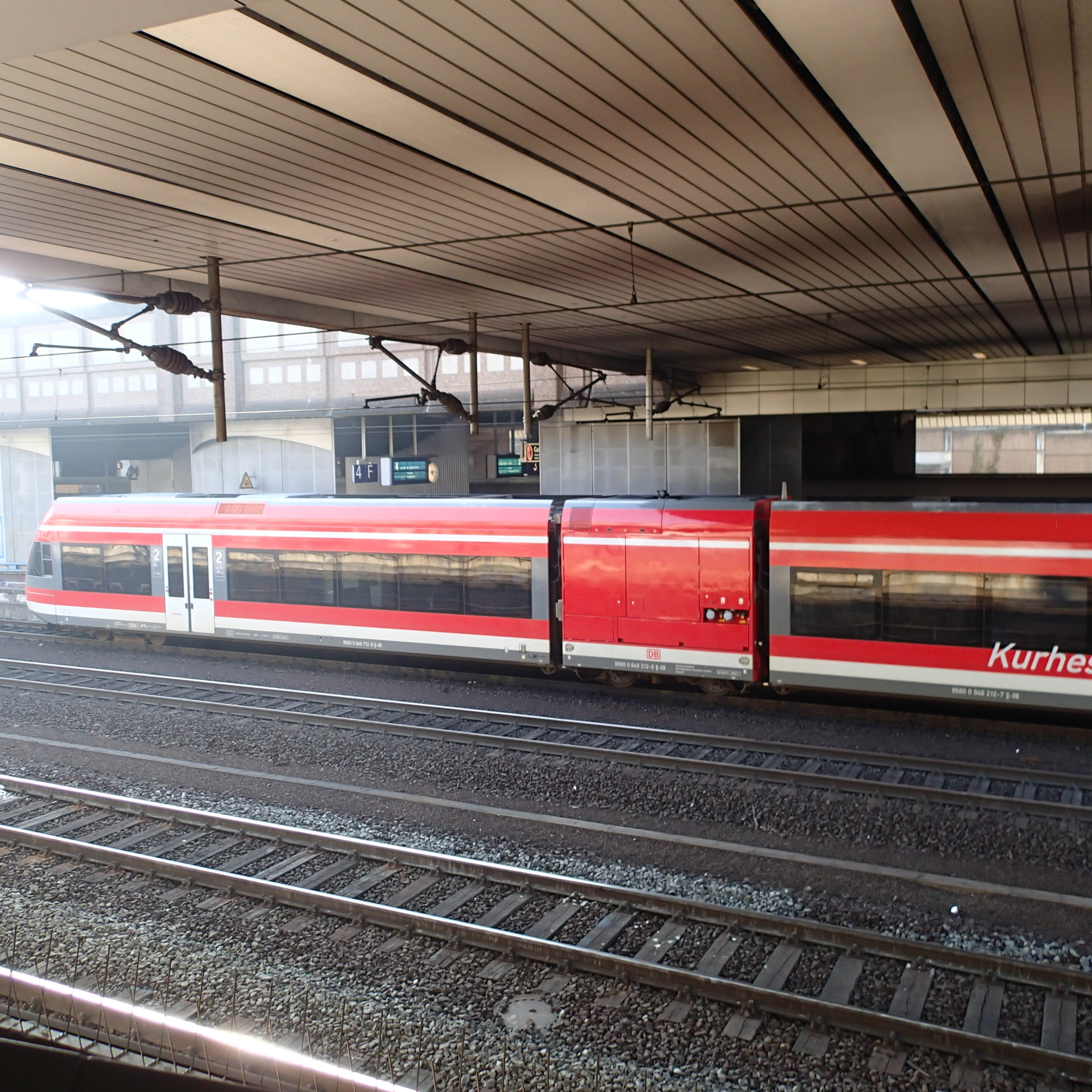
Greater Anglia’s new Class 755 trains will use this technique.
Intriguingly, British Rail designed the record-braking Class 442 train, with all the electrical equipment and traction motors in the middle car of a five-car set.
I suspect because of the design of an Aventra, Bombardier could put a diesel engine in one the middle cars to create a bi-mode Aventra.
Bombardier have said in this article on Christian Wolmar’s web site, that they are working on a 125 mph bi-mode Aventra.
In the Class 172 train, each car has a 360 kW diesel engine, so a five car 125 mph bi-mode train could need a substantial amount of power.
A Car With A Hydrogen-Powered Electricity Generator
In Alstom’s Coradia iLint, the hydrogen tanks and generators are mounted on the roof, thus taking advantage of the larger Continental loading gauge. Wikipedia says this about the train.
The Coradia iLint is a version of the Coradia Lint 54 powered by a hydrogen fuel cell. Announced at InnoTrans 2016, the new model will be the world’s first production hydrogen-powered trainset. The Coradia iLint will be able to reach 140 kilometres per hour (87 mph) and travel 600–800 kilometres (370–500 mi) on a full tank of hydrogen. The first Coradia iLint is expected to enter service in December 2017 on the Buxtehude-Bremervörde-Bremerhaven-Cuxhaven line in Lower Saxony, Germany.
In the UK, there isn’t the space, but I believe that a car could be built with a hydrogen tank and the appropriate size of hydrogen-powered electricity generator.
Bear in mind, that a hydrogen power system will be is a lot quieter and vibrate less, that a diesel one.
The Plug-and-Play nature of an Aventra or other modern trains, would mean that after the train software has been modified, it could detect that the train has a car with a hydrogen-powered electricity generator.
The car would deliver its electricity, when it is require, through the electrical bus.
The train’s computer system would control the generator, so that the level of power needed to move the train was available.
Batteries
Batteries are an integral part of Alstom’s Coradia iLint as this promotional video shows.
I believe that Bombardier make extensive use of batteries in the Aventra for regenerative braking, running for short distances without electrification and electrification failure.
Why Do I Think A Hydrogen-Powered High Speed Train Is Possible?
By High Speed Train, I mean one that can travel at 200 kph or 125 mph.
Most energy is needed to accelerate the train, not to maintain the high cruising speed.
So if you take a train running along a line with only a few stops, that is fairly level with no long climbs, there will be a minimal power requirement, except where accelerating from a stop.
Energy requirement can be reduced by the following.
- Design the line as straight as possible.
- Remove as many gradients as possible.
- Have separate tracks for stopping and high-speed traffic.
- Install a modern signalling system, so that trains run efficiently.
- Remove flat junctions and level crossings
- Have a very efficient train with low rolling resistance and good aerodynamics.
- Have as few stops as possible.
Network Rail seem to be improving the tracks all over the UK to this standard and Point 6 is satisfied by modern trains like Aventras.
Point 7 depends on getting the timetable right.
Adding all these factors together and you can see why I believe a hydrogen-powered High Speed Train is a possibility.
Development
The great advantage of developing a hydrogen-powered train, is that a lot of the initial testing can be done in a lab, as all you need to develop is a power module, that can fit in the train, that can generate the required number of kilowatts.
Independently, the train company would need to develop an electric train capable of 125 mph running.
Deployment
Hydrogen-powered High Speed Trains could run on several lines in the UK.
Midland Main Line
The Midland Main Line is the obvious line for a hydrogen-powered High Speed Train.
- A lot of the route is already capable of 125 mph running.
- Large sections are three or four tracks.,
- The Southern section from Bedford to St. Pancras is electrified, so hydrogen power would only be needed North of Bedford.
- The new East Midlands Franchise will streamline the intermediate stops.
- Parts of the line go through the World Heritage Site of the Derwent Valley and would be difficult to electrify. Quiet hydrogen-powered trains would be acceptable to all.
- Selective electrification could be applied at Derby, Leicester, Nottingham and Sheffield, to charge batteries and accelerate trains.
There is a lot of work going on =North of Bedford as far as Kettering and Corby.
- The Corby branch is being made double track.
- Bedford to Glendon Junction, where trains to Corby leave the Midland Main Line, will become four tracks.
- Tracks will be electrified to Kettering and Corby.
- 125 mph running will be possible as far as Glendon Junction and Corby.
Will the two fast lines be electrified between Kettering and Glendon Junction?
This would enable trains going North from Kettering to accelerate to 125 mph using the electrification, rather than hydrogen or battery power.
The electrification would catapult them the nearly thirty miles to Leicester at 125 mph, with speed maintained by using small amounts of hydrogen or battery power.
Coming South, the train would get to 125 mph leaving Leicester, either using a short length of electrification through the station or by use of the onboard power.
Small amounts of hydrogen or battery power would keep the train at 125 mph, until it could connect to the electrification at Glendon Junction.
I’m assuming that the signalling can keep the fast lines free of slow traffic. But even if they are slowed by a crossing train, regenerative braking using the battery will enable speed to be recovered quickly.
This article on Rail Technology Magazine is entitled DfT Deal Means East Midlands HS2 Station Could Open Early.
East Midlands Hub station would obviously be electrified for HS2 services from Birmingham and London.
So perhaps a few miles of electrification could be added to the Midland Main Line to get trains to operating speed, after a stop at the station.
In addition, could selective electrification be applied at other stations like Derby, East Midlands Parkway, Leicester, Nottingham and Sheffield.
It could be a bit like a game of 125 mph Pass-the-Parcel.
Trains could be at 125 mph for most of the way from St. Pancras to Sheffield, giving a journey time somewhere in the region of ninety minutes.
North Wales Coast Line
I’ve never travelled on the North Wales Coast Line.
- It is around ninety miles long.
- It has an operating speed of 90 mph
- As it’s a coastal line, I suspect that the route is fairly level.
- No-one would complain about the noise reduction of a hydrogen-powered train.
- Virgin’s Class 221 trains take about a hundred minutes from Holyhead to Chester with six stops.
It is a route, where a bi-mode train could probably save some minutes, as they could use the electrification South of Crewe.
Alstom have already set up a base in Widnes and are interested in demonstrating hydrogen trains between Chester and Liverpool via the Halton Curve when it reopens.
But a train with a slightly better performance to the Coradia iLint could be ideal for Liverpool to Chester and along the North Wales Coast.
Basingstoke To Exeter
The West Of England Line goes from Waterloo to Exeter and has the following characteristics.
- The Waterloo to Basingstoke section is forty-eight miles long and electrified.
- The Basingstoke to Exeter section is 124 miles long and not-electrified.
- The route is fairly level.
- The operating speed is 90 mph.
- The route is served by 90 mph Class 159 trains.
This is one of those lines, where a bi-mode train would be ideal.
The route might be suitable for a hydrogen-powered train.
Ashford To Southampton
Between Ashford and Southampton, there is only one section that is not electrified and that is the Marshlink Line, which is just 26 miles long.
Other Routes
I suspect there are other routes, but I do think gentle lines without too many gradients are probably the best lines for hydrogen-powered trains.
Other Trains
As Hitachi’s IEP and Stadler Flirts have similar electrical layouts and design, a similar technique involving hydrogen poower could probably be used.
A Walk Down The Finchley Road
Aleks2cv made this comment on my long post about the West London Orbital Railway, which was entitled New Railway Line For West London Proposed.
West London’s version of Goblin, an available resource with potential. All urban London so suitable for Overground 4 car metro service.
I would add extensions to your outline.There is space at the former Midland Finchley Road station for a single terminating platform with existing street facade. Interchange with North London, Metropolitan, and Jubilee and coaches on Finchley Road such as Stansted AirLink.
It got me thinking.
This is only part of the comment and I’ll deal with the rest after Christmas, if I renmember.
This is a Google Map of the area along the Finchley Road, between Finchley Road and Frognal station in the North and Finchley Road station in the South.
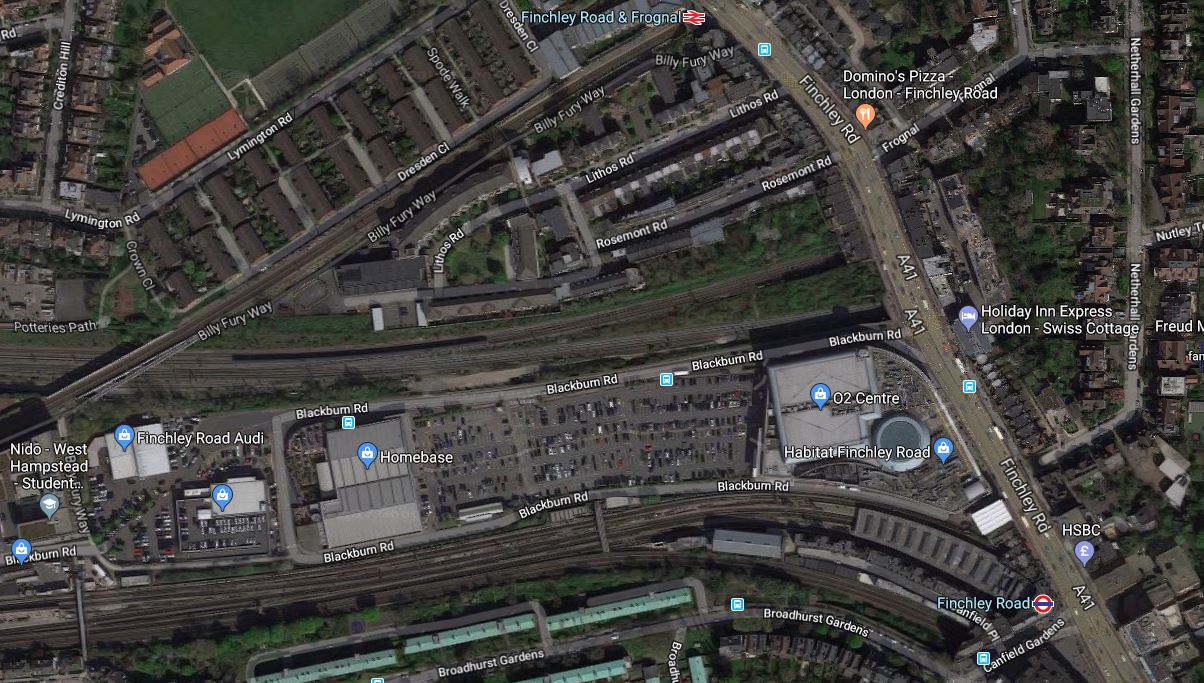
It is one of those interchanges, you might do in a North to South direction, as you have gravity assistance.
This second map from carto.metro.free.fr shows the various rail lines.

Note, the following lines can be seen in both maps.
- The Midland Main Line through West Hampstead Thameslink station, which crosses Finchley Road between Finchley Road and Frognal and Finchley Road stations.
- The Metropolitan and Jubilee Lines going through West Hampstead and Finchley Road stations.
- The North London Line going through West Hampstead and Finchley Road and Frognal stations.
I took these pictures as I walked down Finchley Road.


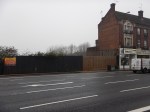
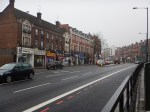

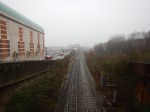


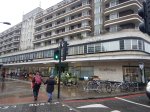

My thoughts on various parts of the area.
Finchley Road And Frognal Station
The station is a very poor example.
- There is no step-free access.
- Station buildings are minimal.
- There is a ruin next door.
- There is a need for perhaps a light-controlled crossing outside the station, as the road is very busy.
Improvement wouldn’t be helped, by the fact that the station is at the end of Hampstead Heath tunnel.
This Google Map shows a close-up of the station.
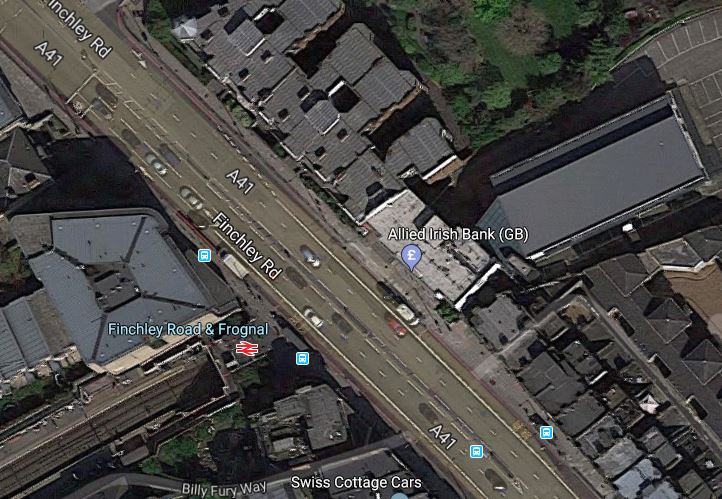
The only solution is probably a full rebuilding with perhaps a block of housing or offices on the top of a modern station.
The Midland Main Line
This Google Map shows the Midland Main Line as it passes under Finchley Road, to the North of the O2 Centre.
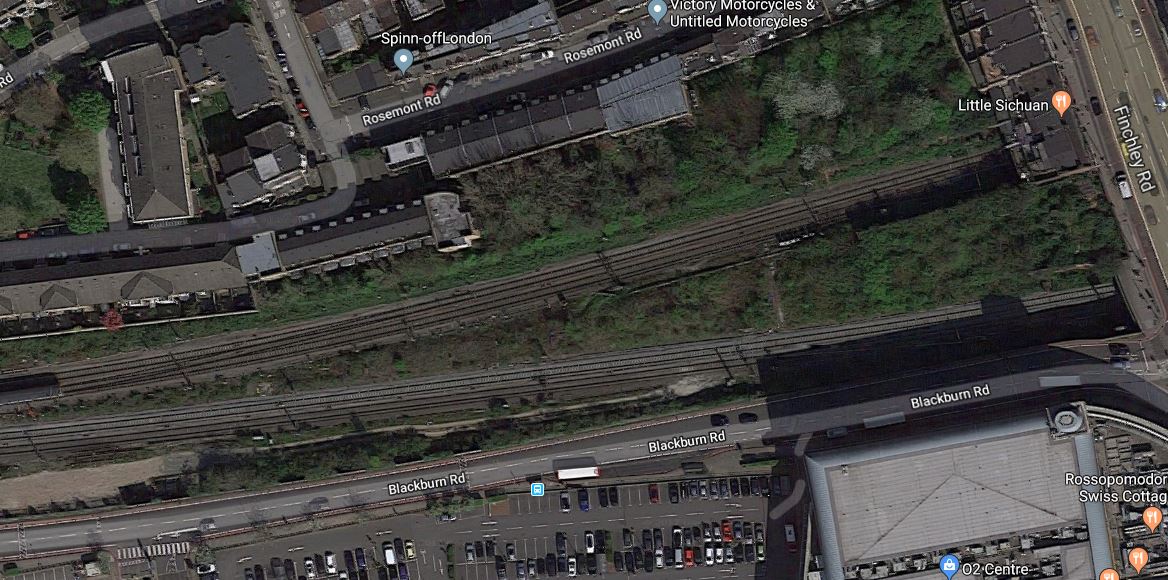
Note.
- There is not much space between the railway and the service road for the O2 Centre.
- The large surface-level car park of the O2 Centre is visible.
- The two slow lines are the Northern pair of lines, with the two fast lines to the South.
At least there is space in the middle of the lines.
A Terminus For The West London Orbital Railway
Aleks2cv in his comment, felt that the West London Orbital Railway can be extended to Finchley Road.
I think this could be very difficult, as the West London Orbital Railway will probably be a single track railway sneaking up the South side of the Midland Main Line.
- There is very little space.
- Passengers would still have to walk about a hundred metres to connect to the Underground.
- Connecting to the Overground would require a stiff walk up the hill.
This Google Map shows the limit of the freight line, that could possibly be turned into the West London Orbital Railway.
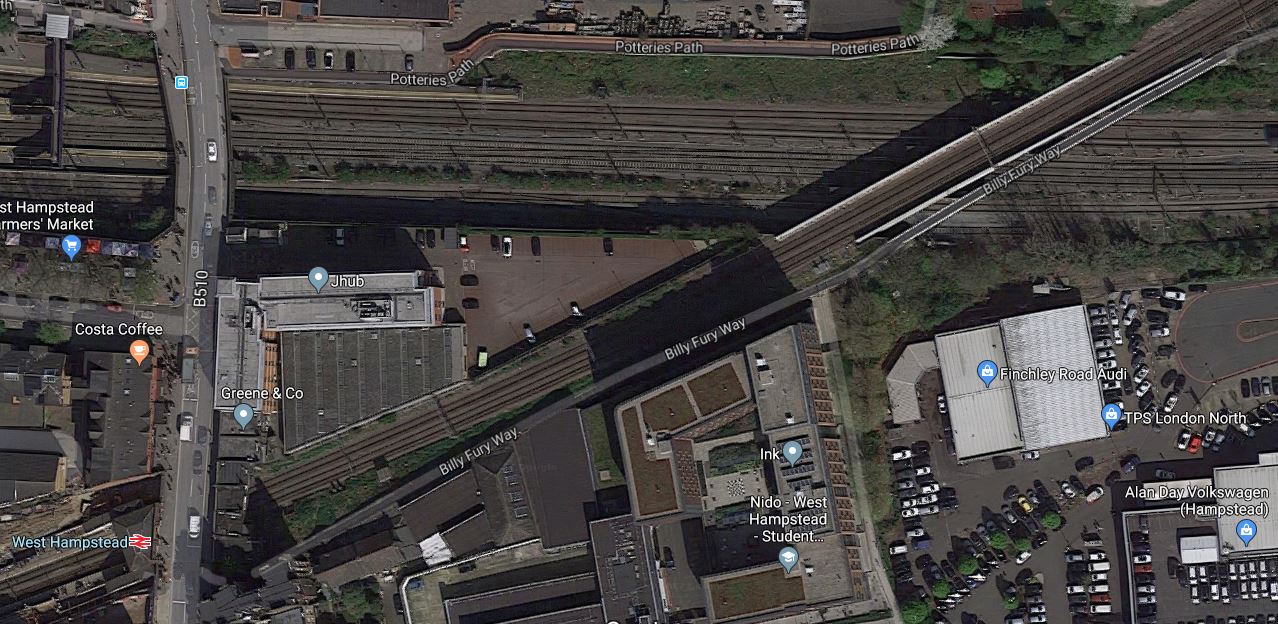
Note.
- The railway going East-West is the Midland Main Line.
- The diagonal railway is the North London Line through West Hampstead station.
In the shadows on the South side of the Midland Main Line, you can just see tyhe freight line, which connects to the Down Fast of the Midland Main Line to the East of the bridge.
It looks to me, that years ago, the land now occupied by the O2 Centre was some form of railway yard or factory premises.
Finchley Road Underground Station
Finchley Road Underground station is a station in need of a degree of refurbishment.
- It is not step-free.
- Pedestrian access to the O2 Centre is not good.
But it is a cross-platform interchange between the Jubilee and Metropolitan Lines.
This Google Map shows the station.
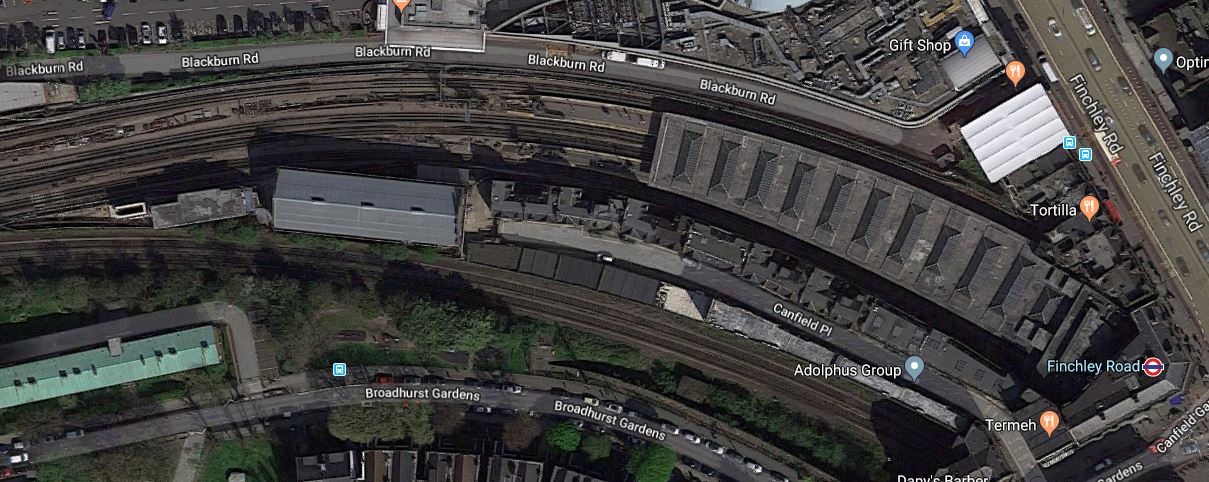
Note.
- The two Chiltern tracks to the South of the station.
- The closeness of the Western end of the station to the Car Park of the O2 Centre.
- There is space to the South of the Chiltern tracks.
I feel very much that this station could be developed sympathetically to be a very good station, that could be paid for by housing on the top.
The O2 Centre
I think the O2 Centre could be the key to Aleks2cv’s idea for the West London Orbital Railway.
- The O2 Centre appears tired.
- Public transport can take people easily to the shopping at Oxford Street or Brent Cross.
- Surface car parking is so Twentieth Century.
As the O2 Centre is owned by British Land, who are one of the UK’s biggest property companies, I think that it is likely the site could be redeveloped.
Suppose the site was developed as follows.
- It extended over and connected to the Western ends of the platforms at Finchley Road Underground station.
- A two-platform terminal station for the West London Orbital Railway could probably be fitted in reasonably close to the Underground station.
- A small bus station.
Over the top would be shops, offices, housing or whatever was desired.
Conclusion
I believe that something will be done to redevelop this site.
Whether it has the terminal for the West London Orbital Railway underneath, will only be made clear, when planning permissio is given.
OLE Changes To Boost Midland Main Line Speeds
The title of this post is the same as that of an article in Issue 840 of Rail Magazine.
Currently, the overhead line equipment (OLE) between St. Pancras and Bedford is rated at 100 mph.
But the new OLE between Bedford and Corby via Kettering is going to be built to a standard that will allow 125 mph running.
The article goes on to say that to make the best use of 125 mph bi-mode trains, the possibility of upgrading the St. Pancras to Bedford electrification to the 125 mph standard.
This must give advantages.
Should Thameslink Be Extended To Corby?
I ask this question as someone who created his pension pot from writing the algorithms to allocate resources in the planning of projects and because I know that the number of train paths on the Midland Main Line is very tight for the number of services required.
This document on the Network Rail web site has this paragraph.
Electrification of the MML north of Bedford to Kettering and Corby is scheduled to be completed by December 2019.
The Wikipedia entry for Corby station has a section entitled Future, where this is said.
It is planned that a half-hourly London St Pancras to Corby service will operate from December 2019 using new Class 387 trains, once the Midland Main Line has been electrified beyond Bedford as part of the Electric Spine project. Network Rail has also announced that it plans to re-double the currently singled Glendon Junction to Corby section as part of this scheme.
So how will the second service in each hour be provided?
Bedford To St. Pancras
Looking at Bedford, it would appear the following trains run to London.
- East Midlands Trains in 39-40 minutes
- Thameslink in 57-59 minutes at a frequency of four trains per hour (tph).
- A Limited-Stop Thameslink in 52 minutes.
As Thameslink has now fully introduced an all-Class 700 train service, could we be seeing a faster service?
Bedford To Corby
The current hourly service between St. Pancras and Corby stops at Bedford and takes thirty-four minutes between Bedford and Corby with stops at Wellingborough and Kettering.
A modern electric train like a Class 700 train, might be able to do the return trip from Bedford to Corby in under an hour. If a Class 700 train can’t do it, then a Class 387 train certainly could.
This would mean that one way to provide the extra service between St. Pancras and Corby would be to extend one of the four tph Bedford to Brighton services to Corby.
This approach would give the following advantages
- No extra train path is needed South of Bedford.
- Corby, Kettering and Wellingborough would get a choice of service.
- Corby, Kettering and Wellingborough would have a direct link to Crossrail.
But there would be disadvantages.
- The Thameslink service would be a few minutes slower.
- The Class 700 trains don’t have tables, cup-holders, wi-fi and power sockets.
- The Class 700 trains are only 100 mph trains and probably not fast enough.
The obvious solution is to run the service with a faster electric train, which addresses the deficiencies of the Class 700 trains.
The Ultimate Solution
The Midland Main Line between Bedford and Glendon Junction for Corby is at least three tracks, with in most places space for a fourth.
I believe the following improvements should be made to the route between Bedford and Glendon Junction.
- All the tracks between Bedford and Corby should be upgraded to be as fast as possible, so that 110 or 125 mph trains to Corby could make full use of their speed, without using the two Fast Lines.
- Wellingborough station should have the fourth platform restored.
- Extra stations, including a Parkway station, could be added if required.
Thameslink would acquire a number of 110 or 125 trains and replace the four tph service between Brighton and Bedford, with a four tph service between Brighton and Corby.
Class 387 trains would probably be acceptable. Especially, as Govia Thameslink Railway uses these trains on Cambridge services.
The consequences of doing this would be.
- The current one tph path between St. Pancras and Corby on the Fast Lines would be released.
- Platform needs at St. Pancras would be reduced.
- No extra Slow Line paths would be needed.
- Bedford would get the same four tph service to London all day.
- Corby, Kettering and Wellingborough would get four tph to St. Pancras.
Twelve faster trains would be needed to provide a full four tph service between Corby and St. Pancras.
Alternatively, you could extend just two opf the four tph from Brighton tom Bedford to Corby!
This would mean.
- Bedford would get the same four tph service to London all day.
- Corby, Kettering and Wellingborough would get two tph to St. Pancras.
Six faster trains would be needed.
Conclusion
I am led to the conclusion, that by providing some extra 110 or 125 mph trains for Thameslink, that the service on the Midland Main Line can be improved significantly.
It also leads me to believe that the specification of the Class 700 trains was created by someone with worse vision than George Shearing.
The trains lack a lot of features like wi-fi and power sockets.
But more importantly, they lack the 110 mph capability of trains like the |Class 350, Class 387 and Class 379 trains, which enables them to run efficiently with express services cruising at 125 mph.
 The Anonymous Widower