New Baltic Sea Interconnector On Horizon As Lithuania, Latvia, and Germany Plan Cross-Border Link
The title of this post, is the same as that of this article on offshoreWIND.biz.
This is the sub-heading.
Lithuania, Latvia, and Germany are planning a joint offshore interconnector that would enable electricity trading between the Baltic countries and Germany and allow for the integration of up to 2 GW of offshore wind capacity in Lithuania and Latvia
These first two paragraphs add more detail to the article.
The energy ministers of the three countries signed a joint declaration of intent on 18 February, paving the way for the development of the Baltic-German PowerLink interconnector, which would, in addition to electricity trading and offshore wind capacity integration, also enable the expansion of onshore renewable energy capacity.
The Lithuanian, Latvian, and German transmission system operators (TSOs) – Litgrid, Augstsprieguma tīkls and 50Hertz – agreed to assess the feasibility of the hybrid electricity interconnection.
As Germany, has the following connections under development in the West.
- AquaVentus to Aberdeen, Humberside, Denmark, Norway and The Netherlands.
- NeuConnect to the Isle of Grain In England.
- GriffinLink, which is an offshore link to England.
The Germans seem to be putting themselves at the centre of an energy distribution system, that has the capability to stabilise European and UK electricity for thousands of years. Especially, if the network grows to include more countries.
This paragraph says this about the Baltic-German PowerLink project.
The Baltic-German PowerLink project concept developed by Litgrid, Augstsprieguma tīkls, and 50Hertz includes a 2 GW, approximately 600 kilometres long hybrid offshore connection, with the connection point in the Baltic States planned to be on the border between Lithuania and Latvia. The exact location is to be determined after technical studies.
Note.
- The interconnectors may be long, but they are not longer than anything built successfully before in European waters.
- The UK and the Island of Ireland are well-linked.
- There would appear to be no need for challenging projects like the Morocco-UK Power Project
I suspect that Germany will get the energy it needs and the British Isles will get a nice little earner.
If Europe is generating large amounts of wind and solar energy with its variable output it will need lots of energy storage.
What Countries Have The Terrain For Pumped Storage Hydro In Europe?
I asked Google AI and received this answer.
Key countries with ideal, high-elevation terrain and significant existing or planned capacity include:
Alpine Region (The Heart of European Pumped Storage):
Switzerland: Extremely high capacity due to steep, mountainous landscapes and significant water sources, hosting the world’s oldest working pumped storage plant.
Austria: Heavily mountainous, it is a major player in PSH expansion and modernization.
France: Home to one of Europe’s largest, the Grand Maison hydroelectric power station.
Italy: Holds high capacity with numerous planned projects.
Germany: Strong existing infrastructure.
Southern Europe:
Spain: Features some of Europe’s largest plants (e.g., La Muela/Cortes-La Muela).
Portugal: Significant recent investment in large-scale projects like the Tâmega complex.
Other Potential Areas:
Norway: High potential due to its mountainous, water-rich terrain.
United Kingdom: High project volume currently under construction.
Balkans & Central Europe:
Countries like Bulgaria, Romania, and the Czech Republic have suitable terrain for further development.
These countries benefit from significant hydraulic head (steep drop) and natural or artificial reservoir potential, making them ideal for storing energy for peak consumption hours.
Note.
- As expected, the Alpine region is Top of the League.
- The UK is holding its own despite its small mountains.
- There is a lot of potential to be developed.
But then Electric Mountain in Snowdonia is certainly at the top table of pumped storage systems despite being built in the 1980s.
What Countries Have The Terrain For Hydrogen Storage In Europe?
I asked Google AI and received this answer.
Key European countries with suitable geological terrain—specifically salt caverns and depleted gas fields—for large-scale, underground hydrogen storage include Germany, the Netherlands, Denmark, the United Kingdom, and France. Other significant regions for storage potential include Spain, Hungary, and Austria, which are developing porous storage facilities.
Key Regions & Terrain Types:
Salt Caverns (North-Western Europe): Germany, the Netherlands, Denmark, France, and the UK have substantial salt deposits suitable for creating caverns, identified as cost-efficient for large-scale storage.
Depleted Gas Fields (Porous Rock): The Netherlands, Germany, and parts of Central/Southern Europe (Spain, Hungary) have significant capacity in existing porous storage, particularly in the North Sea region.
Specific Projects: Germany (Uniper’s Krummhörn project), Netherlands (HyStock), and France (HYPSTER at Etrez) are active, with Spain and Denmark emerging as major hydrogen hubs.
Capacity Potential: The Netherlands, for instance, holds massive potential (35-60 TWh) due to its offshore and onshore depleted fields.
Salt cavern projects, which offer high-deliverability storage, are heavily concentrated in the North-Western European industrial corridor.
I was lucky enough have a tour of ICI’s salt mine in Cheshire, when I worked there in the 1960s and I remember these facts from those days.
- There was enough salt in the ground under Cheshire to last several thousand years.
- Most salt was extracted from boreholes, for making chlorine using electrolysis and the Castner-Kellner process.
- Hydrogen was a by-product and much of it was mixed with coal gas to raise steam for the works.
The same technique used to make boreholes to extract the salt, is used to hollow caverns in the salt to store gases like hydrogen.
Once, when they were digging salt out of the salt mine at Winsford, a worker broke into an unmarked borehole and ICI nearly lost the mine because of the water rushing in.
Two stories stand out from the rescue of the mine.
- There was a need for dry clothes for all the workers, so ICI took a truck to Marks & Spencer in Northwich and emptied it of anything they might need. I was told the story enriched with plagues of locusts.
- A Ford Transit was found to have travelled a few thousand miles underground in axle deep salt slurry. Rather, than scrap it and buy another, it was offered back to Ford, who were delighted to swap it for a new one. I heard that Ford said, that the accelerated corrosion research would have taken many years, if done on the roads.
Always think out of the box.
UK ESO Unveils GBP 58 Billion Grid Investment Plan To Reach 86 GW of Offshore Wind By 2035
The title of this post, is the same as that of this article on offshoreWIND.biz.
This is the sub-heading.
Great Britain’s electricity system operator (ESO) has proposed a GBP 58 billion (approximately EUR 68 billion) investment in the electricity grid. The proposal outlines a vision for incorporating an additional 21 GW of offshore wind into the grid by 2035, which would bring the country’s total offshore wind capacity to a potential 86 GW.
These three paragraphs add more details to what the investment in the grid means for offshore wind.
The ESO released on 19 March the first Beyond 2030 report. The plan sets up the necessary infrastructure to transfer power to and from future industries, as electricity demand is expected to rise by 64 per cent by 2035, according to the ESO.
The grid operator said that the plan connects a further 21 GW of offshore wind in development off the coast of Scotland to the grid in an efficient and coordinated way which would bring the country’s total offshore wind capacity to a potential 86 GW.
The proposals could assist the UK government in meeting the sixth Carbon Budget and allow for the connection of Crown Estate Scotland’s ScotWind leasing round.
These are my thoughts.
How Much Offshore Wind Is In The Pipeline?
This Wikipedia entry is a List Of Offshore Wind Farms In The United Kingdom.
It gives these figures for wind farms in various operational an development states.
- Operational – 14,703 MW
- Under Construction – 5,202 MW
- Pre-Construction – 6,522 MW
- Contracts for Difference – Round 3 – 12 MW
- Contracts for Difference – Round 4 – 1,428 MW
- Early Planning – England – 18,423 MW
- Early Planning – Wales – 700 MW
- Early Planning – Scotland – 30,326 MW
Note.
- These add up to a total of 77,316 MW.
- If all the wind farms in the Wikipedia entry are commissioned, the UK will be short of the 86,000 MW total by 8,664 MW.
- Some wind farms like Ossian could be increased in size by a few GW, as I reported in Ossian Floating Wind Farm Could Have Capacity Of 3.6 GW.
It looks like only another 7,164 MW of offshore wind needs to be proposed to meet the required total.
This article on offshoreWIND.biz is entitled The Crown Estate Opens 4.5 GW Celtic Sea Floating Wind Seabed Leasing Round, will add another 4,500 MW to the total, which will raise the total to 81,816 MW.
The article also finishes with this paragraph.
Round 5 is expected to be the first phase of development in the Celtic Sea. In November 2023, the UK Government confirmed its intention to unlock space for up to a further 12 GW of capacity in the Celtic Sea.
A further 12 GW of capacity will take the total to 93,816 MW.
In Three Shetland ScotWind Projects Announced, I talked about three extra Scotwind wind farms, that were to be developed to the East of Shetland.
These will add 2.8 GW, bringing the total to 96,616 MW.
I don’t think the UK has a problem with installing 86 GW of offshore wind by 2035, so we must create the electricity network to support it.
The Electricity Network In 2024
I clipped this map from this article in The Telegraph, which is entitled Britain’s Energy System Will Not Hit Net Zero Until 2035, National Grid Tells Labour.
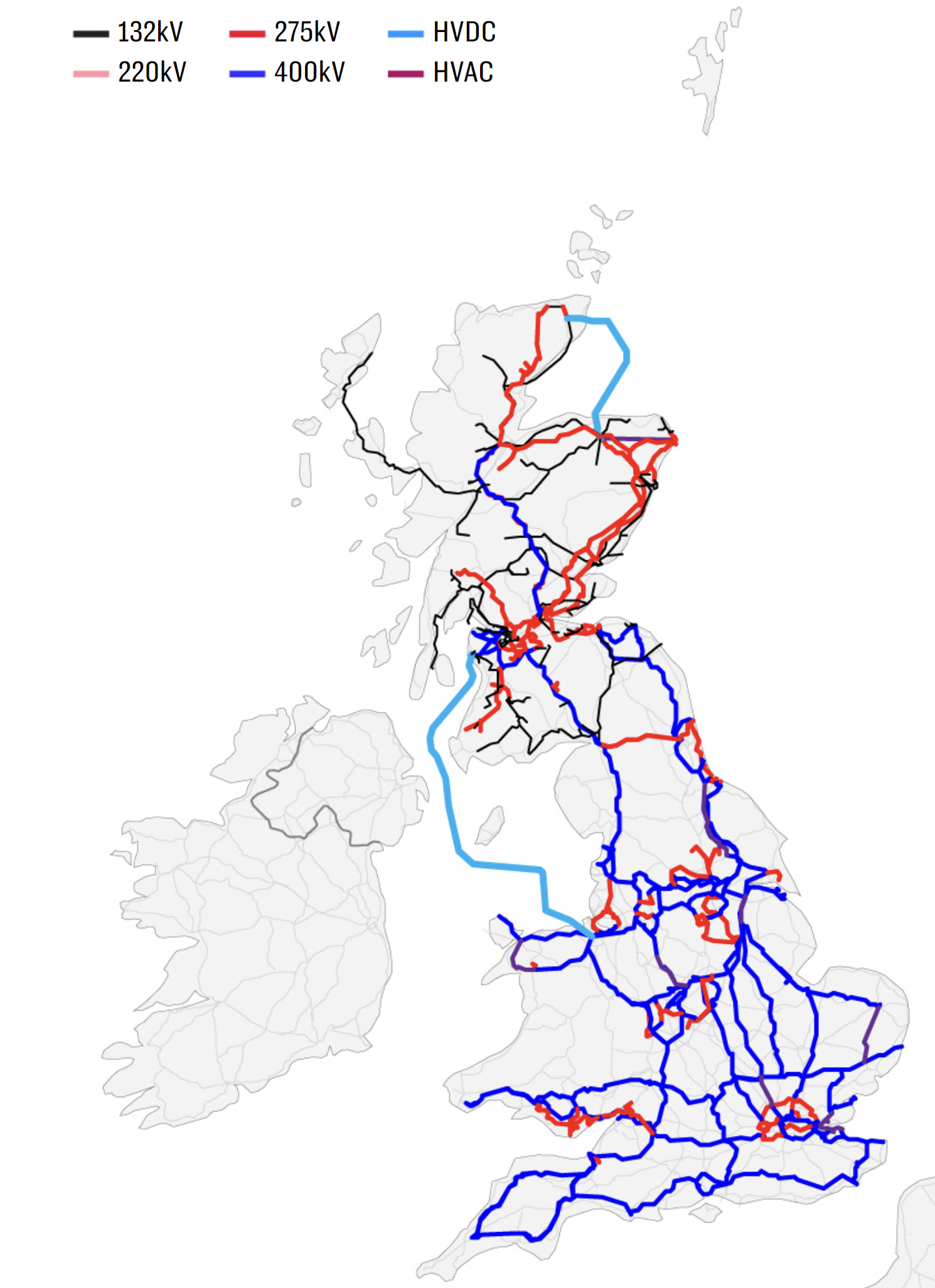
The dark blue lines are the 400 kV transmission lines.
- The one furthest East in East Anglia serves the Sizewell site, which hosts the Sizewell B nuclear power station and will be the home of Sizewell C nuclear power station, unless the Green or LibDem Parties are a member of a coalition government.
- Kent and Sussex seem to be encircled by 400 kV lines, with small spurs to the interconnectors to Europe.
- Two 400 kV lines appear to serve the South-West peninsular, with one going along the South Coast and the other further North. I suspect these two motorways for electricity explain, why the Morocco-UK Power Project terminates in Devon.
- London seems to have its own M25 for electricity.
- There also appears to be an East-West link to the North of London linking Sizewell in the East and Pembroke in the West. Both ends have large power stations.
- There also appear to be two 400 kV lines from Keadby by the Humber Estuary to North Wales with the pumped storage hydro power station at Dinorwig.
- Two more 400 kV lines link Yorkshire to the South of Scotland.
- A lonely Northern cable connects Edinburgh and the North of Scotland.
The red lines, like the one encircling central London are the 275 kV transmission lines.
- Think of these as the A roads of the electricity network.
- They encircle London often deep underground or under canal towpaths.
- They reinforce the electricity network in South Wales.
- Liverpool appears to have its own local network.
- They also seem to provide most of the capacity North of and between Edinburgh and Glasgow.
Newer cables are starting to appear on this map.
There are two light blue cables and these are HVDC cables that run underwater.
- The 1.2 GW Caithness – Moray Link does what it says in the name and it connects the far North of Scotland direct towards Aberdeen.
- The much larger 2.25 GW Western HVDC Link connects Hunterston near Glasgow to Flintshire Bridge near Liverpool. Note how it passes to the West of the Isle of Man.
Not shown on the map are the smaller 500 MW Moyle Interconnector and the recently-opened 600 MW Shetland HVDC Connection.
The Electricity Network In 2050
This second map shows how the network will look in 2050.

Note.
- The colours are the same, as the previous map.
- Although, I do think there are some errors in which have been used.
- There are a lot more cables.
There are several more light blue cables and these are HVDC cables that run underwater.
- Shetland is now linked to the North of Scotland by the Shetland HVDC Connection.
- There appears to be a cluster of HVDC interconnectors at Caithness HVDC switching station, near Wick, including a new one to Orkney, to go with the others to Moray and Shetland.
- The 2 GW Scotland England Green Link 1 will run from Torness in Southeast Scotland to Hawthorn Pit substation in Northeast England.
- The 2 GW Eastern Green Link 2 will run from Sandford Bay, at Peterhead in Scotland, to the Drax Power Station in Yorkshire, England.
- There also appear to be two or possibly three other offshore cables linking the East Coast of Scotland with the East Coast of England.
- If the Eastern cables are all 2 GW, that means there is a trunk route for at least 8 GW between Scotland’s wind farms in the North-East and Eastern England, which has the high capacity wind farms of Dogger Bank, Hornsea and around the Lincolnshire and East Angliam coasts.
- Turning to the Western side of Scotland, there appears to be a HVDC connection between the Scottish mainland and the Outer Hebrides.
- South-West of Glasgow, the Western HVDC Link appears to have been duplicated, with a second branch connecting Anglesey and North-West Wales to Scotland.
- The Moyle Interconnector must be in there somewhere.
- Finally, in the South a link is shown between Sizewell and Kent. It’s shown as 400 kV link but surely it would be a HVDC underwater cable.
There are also seven stubs reaching out into the sea, which are probably the power cables to the wind farms.
- The red one leading from South Wales could connect the wind farms of the Celtic Sea.
- The blue link North of Northern Ireland could link the MachairWind wind farm to the grid.
- The other two red links on the West Coast of Scotland could link to other ScotWind wind farms.
- The red link to the North of East Anglia could link RWE’s Norfolk wind farms to the grid.
- The other stubs in the East could either connect wind farms to the grid or be multi-purpose interconnectors linking to Germany and the Netherlands.
It looks to me, that National Grid ESO will be taking tight control of the grid and the connected wind farms, as an integrated entity.
As a Graduate Control Engineer, I can’t disagree with that philosophy.
Hydrogen Production
In How Germany Is Dominating Hydrogen Market, I talked about how Germany’s plans to use a lot of hydrogen, will create a large world-wide demand, that the UK because of geography and large amounts of renewable energy is in an ideal place to fulfil.
I can see several large electrolysers being built around the UK coastline and I would expect that National Grid ESO have made provision to ensure that the electrolysers have enough electricity.
Would I Do Anything Different?
Consider.
- If it is built the Morocco-UK Power Project will terminates in Devon.
- There could be more wind farms in the Celtic Sea.
- It is likely, that the wind farms in the Celtic Sea will connect to both Pembroke and Devon.
- Kent has interconnectors to the Continent.
Would a Southern HVDC link along the South Coast between Devon and Kent be a good idea?
Conclusion
Looking at the proposed list of wind farms, a total in excess of 96 GW could be possible, which is ten GW more than needed.
The network not only serves the UK in a comprehensive manner, but also tees up electricity for export to Europe.
Giant Solar Farm Project In Doubt After Disagreement Between Mike Cannon-Brookes And Andrew Forrest
The title of this post, is the same as that of this article on the Guardian.
This is the sub-heading.
Australian billionaires had backed $30bn Sun Cable venture designed to help power Darwin, Indonesia and Singapore but the company has gone into voluntary administration.
It does look like the administrators will be able to continue the project and look for more funding.
Qatar must be in the frame, as this link will probably cut some of their gas sales.
I wrote about this monster project in Sun Cable’s Australia-Asia PowerLink.
I wonder if this administration will have any effects on the prospects of the other giant intercontinental interconnectors?
- EuroAfrica Interconnector – See The EuroAfrica Interconnector
- EuroAsia Interconnector – See The EuroAsia Interconnector
- Morroco-UK Power Project – See Moroccan Solar-Plus-Wind To Be Linked To GB In ‘Ground-Breaking’ Xlinks Project
- TransPacific Interconnector – See Chile Wants To Export Solar Energy To Asia Via 15,000km Submarine Cable
The economics will decide. But I do think, the last one could be a bit ambitious.
How Is The XLinks Project Progressing?
The Wikipedia entry for the XLinks project has this introductory paragraph.
The Xlinks Morocco-UK Power Project is a proposal to create 10.5 GW of renewable generation, 20 GWh of battery storage and a 3.6 GW high-voltage direct current interconnector to carry solar and wind-generated electricity from Morocco to the United Kingdom. Morocco has far more consistent weather, and so should provide consistent solar power even in midwinter.
I ask the question in the title of this post, as there are two articles about the XLinks project in The Times today.
This article is optimistic and is entitled Xlinks Morocco Project Could Throw Britain A Renewable Energy Lifeline.
On the other hand this article is more pessimistic and is entitled Britain ‘Risks Losing Out’ On Green Energy From The Sahara.
This is the first paragraph of the second article.
Sir Dave Lewis has complained of “frustratingly slow” talks with the government over an £18 billion plan to generate power in the Sahara and cable it to Britain. The former Tesco chief executive has warned that the energy could be routed elsewhere unless ministers commit to the scheme.
It appears there have been little agreement on the price.
I have some thoughts.
Will XLinks Get Funding?
Xlinks is going to be privately funded, but I have doubts about whether the funding will be made available.
As an engineer, who was involved in many of the major offshore projects of the last forty years of the last century, I believe that the XLinks project is feasible, but it is only 3.6 GW.
These wind farm projects are also likely to be privately funded.
- SSE’s Berwick Bank project opposite Berwick is 4.1 GW
- Aker’s Northern Horizon off Shetland is 10 GW.
- The Scotwind Leasing Round is 25 GW.
- There is talk of 10 GW being possible off East Anglia.
- 50 GW may be being possible in the Celtic Sea.
- BP is planning 3 GW in Morecambe Bay.
Many of these enormous wind power projects are looking for completion on or before 2030, which is the date given for the Morocco cable.
I do wonder, if those financing these energy projects will find these and other projects better value than a link to Morocco.
Is the Project Bold Enough?
Consider.
- Spain has high levels of solar, wind and hydro power.
- France is developing wind to go with their nuclear.
- Both countries and Portugal, also have mountains for sensibly-sized pumped-storage hydroelectric power stations.
- France, Spain, Portugal and Ireland also have the Atlantic for wind, tidal and wave power.
Perhaps, the solution, is an Atlantic interconnector linking the UK, Ireland, France, Spain, Portugal and Gibraltar to West Africa.
Any excess power would be stored in the pumped-storage hydroelectric power stations and withdrawn as required.
In the UK, the National Grid are already using the huge 7800 GWh Ulla-Førre pumped-storage hydroelectric power station to store excess wind-generated energy using the North Sea Link from Blyth.
To my mind XLinks is just a UK-Morocco project.
BP’s Project In Mauretania
In bp And Mauritania To Explore Green Hydrogen At Scale, I discussed BP’s deal to create green hydrogen in Mauretania.
Is this a better plan, as hydrogen can be taken by tanker to where it is needed And for the best price.
Conclusion
I wouldn’t be surprised to see the XLinks project change direction.
Is The Morocco-UK Power Project Just A Taste Of The Future?
After writing WSP Lends Hand On Morocco-UK Power Link, about WSP’s involvement in the ambitious project to create a 3.6 GW interconnector to bring power from Morocco to the UK, I’m now certain, that this major project will come to fruition.
Out of curiosity, I created this Google Map of North-West Africa.
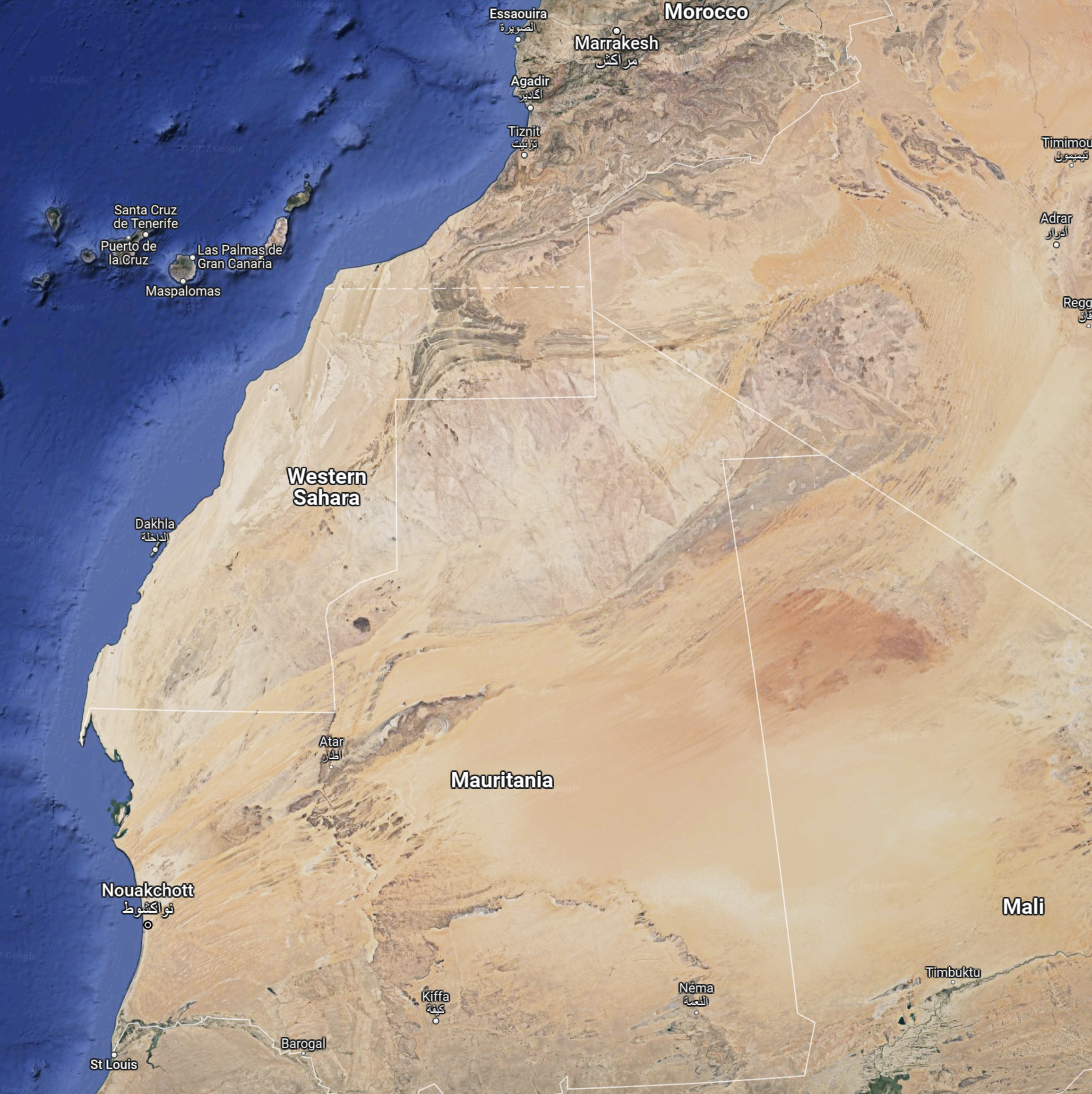
Note.
- Morocco is at the North edge of the map.
- The map is filled with the Sahara Desert.
- The Caqnary Islands are off the coast of Africa.
- Three of the least developed countries in the world; Western Sahara, Mauritania and Mali, circle the desert to the South-West and South.
I do wonder if the Morocco-UK Power Project is a success, if other developers and countries will decide to developer their renewable energy resources.
- France, Portugal and Spain may want to get involved.
- High-Temperature Electrolysis boosted by solar energy, could be used to generate hydrogen for shipment to Europe.
- The interconnectors to Europe will be upgraded.
Given the size of the desert, I’m sure that several GW of electricity could be delivered to Europe.
WSP Lends Hand On Morocco-UK Power Link
The title of this post, is the same as that of this article on renews.biz.
These introductory paragraphs detail WSP’s role.
Xlinks has appointed engineering consultancy WSP to provide technical advisory services for the tendering process for converter stations for its Morocco-UK power link.
WSP will support the procurement process for four HVDC converter stations in the UK and also Morocco, as well as UK grid connection works, connection to the generation assets in Morocco, and an interface between the converter stations and the HVDC cable systems in the UK and Morocco.
When I wrote my first post on this project in September 2021, which was entitled Moroccan Solar-Plus-Wind To Be Linked To GB In ‘Ground-Breaking’ Xlinks Project, I was a bit sceptical that this project would be completed.
With the appointment of WSP, I am now very much happier that this project will be carried through to a successful conclusion.
Will We See More Multi-Country Renewable Energy Deals?
In this blog, I have talked about various deals, where two or more countries and/or companies are getting together to generate electricity in one country and transfer it to another, either as electricity or as hydrogen
Examples include.
- The Asian Renewable Energy Hub, which I first wrote about in Vast Australian Renewable Energy Site Powers BP’s Ambitions.
- The Australia-Asia PowerLink, which I first wrote about in Sun Cable’s Australia-Asia PowerLink.
- Fortescue Future Industries will convert cattle stations in Western Australia into renewable power stations.
- The EuroAfrica Interconnector is a HVDC interconnector and submarine power cable between the Greek, Cypriot, and Egypt power grids, which I first wrote about in The EuroAfrica Interconnector.
- The EuroAsia Interconnector is a proposed HVDC interconnector between the Greek, Cypriot, and Israeli power grids via the world’s longest submarine power cable, which I first wrote about in The EuroAsia Interconnector.
- Icelink is a proposed electricity interconnector between Iceland and Great Britain, which I first wrote about in Is Iceland Part Of The Solution To The Problem Of Russia?
- The Morocco-UK Power Project, which I first wrote about in Moroccan Solar-Plus-Wind To Be Linked To GB In ‘Ground-Breaking’ Xlinks Project.
- Namibian Green Hydrogen, which I first wrote about in Namibia Is Building A Reputation For The Cheapest Green Hydrogen.
There are also all the hydrogen deals done by Fortescue Future Industries.
Where Are There Possibilities Of More Multi-Country Renewable Energy Deals?
These are a few serious possibilities.
Argentina
This is an extract from this page on Wind Energy International, which is entitled Argentina.
Argentina has an estimated technical wind energy potential of 300 GW. In southern Patagonia (Chubut and Santa Cruz provinces), average wind speeds range between 9.0 and 11.2 m/s, whereas in the north (Neuquén and Río Negro provinces), wind speeds range from 7.2 to 8.4 m/s. The general average capacity factor for Argentina is 35% and in the Patagonia region it ranges between as much as 47% and 59%. Especially in Northwest Patagonia, locally known as the Comahue region, hydro and wind may seasonally complement each other and.benefit both technologies. One other promising region for wind power development is the Atlantic sea coast.
As I wrote in Australia’s FFI Plans $8.4 Billion Green Hydrogen Project In Argentina, it appears that Andrew Forrest and FFI are already on the ground.
Australia
There are already three major schemes based on Australia and I am certain they will be more. Especially, as Japan, Korea, Malaysia and Singapore will need the zero-carbon energy.
It would appear that except for the Australia-Asia PowerLink, the energy will be transferred as liquid hydrogen or liquid ammonia.
Bangladesh
Bangladesh wouldn’t be on the lists of many, where ideal countries for renewable energy are being discussed.
But, this report on Energy Tracker Asia is entitled The Renewable Energy Potential of Bangladesh, where this is said.
A report investigating the renewable energy technical capacity of Bangladesh found that the country could deploy up to 156 GW of utility-scale solar on 6,250 km2 of land and 150 GW of wind. Offshore wind power would account for 134 GW of this total capacity.
I wouldn’t be surprised to see Bangladesh, supplying renewable energy to the East, with international companies and organisations developing the renewable infrastructure.
I think it should be noted that international companies flock to countries, where the investment opportunities are good. That has happened in the UK, with offshore wind, where many wind farms have been developed by companies such as Equinor, Iberola, RWE and Wattenfall.
Chile
Chile has started to develop the 100,000 square kilometres of the Atacama Desert for solar power and I wrote about this in The Power Of Solar With A Large Battery.
This sentence in the Wikipedia entry for Energy In Chile, illustrates the potential of solar power in the Atacama Desert.
In 2013, Total S.A. announced the world’s largest unsubsidised solar farm would be installed with assistance from SunPower Corp into Chile’s Atacama desert.
I also wrote Chile Wants To Export Solar Energy To Asia Via 15,000km Submarine Cable, about Chile’s ambitions to supply Asia with energy.
Ethiopia
Andrew Forrest of Fortescue Future Industries is on the case, as I wrote in Fortescue Future Industries Enters Ethiopia to Produce Green Energy.
North Africa
Consider.
- The major North African countries of Morocco, Algeria, Tunisia, Libya and Egypt, all have and depend on to a certain extent on fossil fuels.
- There are gas pipelines to Spain and Italy.
- Morocco will be the Southern end of the Morocco-UK Power Project, if it gets developed.
- All five countries have some nuclear power stations.
- All five countries have lots of sun for solar power.
- Some Saharan countries to the South of Morocco, Algeria and Libya could also provide energy from the sun.
- Egypt has substantial hydro-electric power on the River Nile.
- Egypt will be connected to Greece through the EuroAfrica Interconnector.
I believe that a well-designed and co-ordinated project could generate a lot of electricity and hydrogen for Europe and bring much-needed income and employment to North Africa.
I feel that if the Morocco-UK Power Project can be successfully built, then this could create a flurry of activity all over North Africa.
Saudi Arabia
Saudi Arabia has a problem. As the rest of the world moves away from fossil fuels in the next few decades, they will see the revenues from oil and natural gas come under pressure.
But as a rich country, with 2.15 million km² of land and lots of sun, they must have some potential to generate solar electricity.
In the Wikipedia entry for Solar Power In Saudi Arabia, this is said.
The Saudi agency in charge of developing the nations renewable energy sector, Ka-care, announced in May 2012 that the nation would install 41 gigawatts (GW) of solar capacity by 2032.[2] It was projected to be composed of 25 GW of solar thermal, and 16 GW of photovoltaics. At the time of this announcement, Saudi Arabia had only 0.003 gigawatts of installed solar energy capacity. A total of 24 GW of renewable energy was expected by 2020, and 54 GW by 2032.
Wikipedia also says that Saudi Arabia also has nuclear ambitions.
I can see that Saudi Arabia will replace some of their oil and gas exports with green hydrogen.
XLCC Obtains Planning Approval To Build UK’s First HVDC Cable Factory In North Ayrshire
The title of this post, is the same as that of this press release from XLCC.
These are the first three paragraphs.
On 29th June 2022, the North Ayrshire Council Planning Committee resolved to grant planning permission for XLCC’s HVDC subsea cable manufacturing operations in Hunterston, Scotland.
Breaking ground in the coming months, the brownfield site will create a new UK industry to support global decarbonisation targets. Once fully operational, the facility will support 900 jobs in the area, with thousands more in the wider supply chain.
XLCC’s first order is for four 3,800km long cables to connect solar and wind renewable power generation in the Sahara to the UK for the Xlinks Morocco-UK power project.
XLCC have also issued two other important press releases.
XLCC To Build New Cable Laying Vessel To Address Increase In Future Demand For HVDC Cable
These are the first paragraphs.
XLCC, the new HVDC, renewable energy focused business in the UK, has completed the concept design of an advanced, first-of-a-kind Cable Laying Vessel to be delivered in the first half of 2025.
As the world strives for Net Zero, the UK, EU and other world economies have set themselves ambitious targets for decarbonisation. The UK, for example, has stated that it will be powered entirely by clean energy by 2035 and that it will fully decarbonise the power system in the same time frame. This ambition is driving an exponential growth in high voltage cable demand as the increase in installation of offshore wind and interconnectors drive a forecast six times increase (2020 – 2027 over 2014 – 2020) for HVDC cable.
The planned delivery of the XLCC CLV will support the Morocco – UK Power Project, the first client project, through the delivery of four 3,800km subsea HVDC cables from a wind and solar generation site in Morocco to the UK.
This press release can be read in full here.
XLCC Signs UK Steel Charter For New Export-Led Cable Industry
These are the first paragraphs.
XLCC signed the UK Steel Charter at an event in Parliament on 19 April 2022, alongside representatives from politics, business and the trade union movement.
XLCC will create a new export-led HVDC cable manufacturing industry for the UK, nearly doubling the world’s current production. It aims to support renewable energy projects with the first factory planned for Hunterston, Scotland. XLCC will deliver its first project for the Xlinks Morocco-UK Power Project, consisting of four 3,800km long subsea cables, with the first phase between 2025-2027 connecting wind and solar power generated in Morocco exclusively to the UK in Devon.
Signing the UK Steel Charter shows a commitment to supporting existing and future jobs within the sector and the supply chain. Along with strengthening UK-based business, sourcing steel locally will cut transport emissions and seek to support decarbonisation in a sector dedicated to finding ways to minimise environmental impact of steel use.
This press release can be read in full here.
I have a few thoughts.
You Wait For A Large Interconnector Project To Come Along And Then Two Arrive Holding Hands
This paragraph introduces the Morocco-UK Power Project.
The Xlinks Morocco-UK Power Project will be a new electricity generation facility entirely powered by solar and wind energy combined with a battery storage facility. Located in Morocco’s renewable energy rich region of Guelmim Oued Noun, it will cover an approximate area of 1,500km2 and will be connected exclusively to Great Britain via 3,800km HVDC sub-sea cables.
XLCC have this mission statement on their home page.
XLCC will establish a new, export-led, green industry in the UK: world class HVDC subsea cable manufacturing.
Our mission is to provide the connectivity required for renewable power to meet future global energy needs.
Xlinks Morocco-UK Power Project and XLCC appear to be made for each other.
In some ways it takes me back to the 1970s, where large oil and gas projects in the North Sea were paired with platform building in Scottish lochs.
There Are Several Interconnector Projects Under Development
We will see a lot of undersea interconnectors in the next few years.
- Country-to-country interconnectors
- Interconnectors along the coast of the UK.
- Connections to offshore wind farms.
This capacity, with a ship to lay it, is being created at the right time.
Icelink
Icelink is a proposed interconnector between Iceland and the UK.
- It would be up to 1200 km long.
- It would have a capacity of around 1 GW
XLCC could spur the development of this project.
Floating Wind Farms Hundreds Of Miles Out To Sea
The developer of a floating wind farm, say a hundred miles out to sea, is not going to develop it, if there isn’t a secure supply of cable.
Where Will Finance Come From?
Wind farms have proven to be good investments for finance giants such as Aviva.
See World’s Largest Wind Farm Attracts Huge Backing From Insurance Giant, for Aviva’s philosophy.
As mathematical modelling for electrical systems get better, the estimates of the finance needed and the returns to be made, will indicate whether these mega-projects can be funded.
It was done with North Sea oil and gas and it can be done with offshore wind power and its interconnectors.
In The Times on the 4th of July 2022, there is this article, which is entitled Schroders Chief Buzzing To Take Finance Offshore Wind Farms.
It is a must-read!
Conclusion
XLCC and its cable factory will spur the expansion of zero-carbon electricity in the UK.
Octopus Energy On Xlinks
Today, Octopus Energy published a web page, which is entitled Backing Cheaper, Greener Energy Globally, giving more details of the Xlinks project.
I first wrote about the tie-up between Octopus Energy and Xlinks in Xlinks Welcomes New Investor Octopus Energy In Providing Cheap Green Power To Over 7 Million Homes.
Points made in the page on the Octopus web page include.
- The project will cover over 570 square miles in Morocco with 7GW of solar and 3.5GW of wind generation alongside a 20GWh battery storage facility.
- This green energy powerhouse will be connected to the UK via 2,361 miles of HVDC subsea cables.
- The cables will be built with British steel in a new factory in Hunterton, Scotland.
- It also appears that the site of the project has been chosen to optimise energy collection.
This project appears to be excellently-thought out to bring large benefits to all stakeholders.
Xlinks Welcomes New Investor Octopus Energy In Providing Cheap Green Power To Over 7 Million Homes
The title of this post, is the same as that of this press release from Xlinks.
These are the first three paragraphs.
Xlinks is pleased to announce a financial and strategic partnership with energy tech pioneer Octopus Energy Group.
The Morocco – UK Power Project will speed up the UK’s transition to net zero by laying four 3,800km-long subsea cables to connect a huge renewable energy farm in the Moroccan desert with Devon in South West England. Morocco is setting its sights on becoming a world leader in solar energy, already boasting some of the world’s largest solar arrays, and meeting two-fifths of its electricity demand with renewables. There will be huge economic benefits to both countries involved, with Xlinks bringing green energy and engineering jobs to both the UK and Morocco.
The project will diversify UK supply routes and boost energy security through the supply of 3.6 GW of reliable, clean power to the UK for an average of 20 hours a day, enough green energy to power about 7 million homes.
Note.
- The cables will be nearly 2,400 miles
- It is scheduled to be operational in 2027.
- Xlinks is expected to deliver power at £48/MWh, which is comparable with offshore wind.
- Wikipedia talks of a Hinkley Point C strike price of £92.50/MWh (in 2012 prices).
- Greg Jackson, founder of Octopus Energy Group, is also a personal investor in the project.
- Greg Jackson is interviewed in this article in today’s Sunday Times.
I wrote more about this project in Moroccan Solar-Plus-Wind To Be Linked To GB In ‘Ground-Breaking’ Xlinks Project.
Conclusion
This mega-project could be approaching the point, where the starting gun is fired.
 The Anonymous Widower