Do British And German Offshore Wind Farm Generate Maximum Power At Different Times
In National Grid, TenneT Germany Launch GriffinLink, A First Of A Find Project To Maximise Offshore Wind, I discussed GriffinLink, which will be an offshore link between British and German offshore wind farms.
Somebody has asked me if wind farms are in phase with each other, as obviously this would effect how they perform and are are controlled.
So I asked Google AI, the question in the title of this post and received this reply.
Yes, British and German offshore wind farms often generate their maximum power at different times, although they are both located in the North Sea and share similar peak seasons. The variations in generation are driven by localized weather patterns, specifically the movement of low-pressure systems.
Key Differences in Generation Times:
Regional Weather Patterns: While North Sea wind farms are often closely correlated, significant differences arise when weather systems move from west to east. Wind often hits the UK’s North Sea sites first, meaning they may hit maximum generation capacity hours before German or Danish sites, which are further east.
Time of Day (Diurnal Differences): Because UK wind farms are located in the Irish Sea, the Scottish coast, and the North Sea, they can exhibit different diurnal (daily) peak times compared to German sites in the North Sea and Baltic Sea.
Seasonal Peaks: Both countries experience the highest output during winter months (e.g., December). However, during specific, localized, long-lasting high-pressure systems (“Dunkelflaute”), one country might experience a complete drop in wind while the other continues to produce, or vice versa.
Why They Differ:
Geography: The UK’s extensive, spread-out coastline (Irish Sea, Atlantic coast, North Sea) offers a different wind profile than the more concentrated German offshore projects in the North Sea and Baltic Sea.
Correlation Challenges: Research shows that while North Sea countries have similar wind profiles, there is not 100% correlation. Meteorological differences in how wind speeds behave across the North Sea allow for complementary production.
This difference is highly advantageous for European energy security, as it allows for the balancing of intermittent wind power across the region.
The conclusion from Google AI, is almost predicting that GriffinLink will be developed. From my experience of mathematical modelling the cost and financial benefits should be fairly easy to predict.
Will The UK And The Republic Of Ireland Link Their Offshore Wind Farms To Improve Efficiency?
This may seem an obvious idea, especially as UK and Republic of Ireland are heavily interconnected.
So I asked Google AI, the question in the title of this section and received this reply.
Yes, the United Kingdom and the Republic of Ireland are taking significant, active steps to link their offshore wind farms and electricity grids to improve efficiency, increase renewable energy production, and enhance energy security. Following a Memorandum of Understanding (MoU) signed in September 2023, the two countries are collaborating on developing subsea energy infrastructure in the Irish and Celtic Seas.
Here are the key details regarding this cooperation:
Deepened Collaboration: As of March 2025, the UK and Ireland are working on a new data-sharing arrangement to lay the groundwork for directly connecting offshore wind farms to each other’s national energy networks.
Offshore Hybrid Assets (OHAs): The plans include developing offshore hybrid assets, which are subsea cables that directly link offshore wind farms to both countries’ grids, reducing infrastructure costs and maximizing efficiency.
Subsea Mapping & Interconnection: Both nations are mapping the Celtic Sea to identify optimal locations for interconnectors and to improve the interoperability of their grids.
Existing & New Projects: While Ireland’s current interconnection to the UK is limited (approx. 500MW), capacity is planned to increase significantly. Specific projects like Mares Connect (linking North Wales and Ireland) are being developed to provide750MW of additional capacity.
Regional Cooperation: Ireland is also participating in the “Hamburg Declaration” (signed Jan 2026), joining the UK and other North Sea countries to commit to 300GW of offshore wind by 2050 through shared, regional infrastructure.
This cooperation aims to allow Ireland to export its surplus renewable energy during high generation, while benefiting from the UK’s robust grid during lower wind conditions.
Will The UK AndNorway Link Their Offshore Wind Farms To Improve Efficiency?
As we have interconnectors with Norway, I asked Google AI, the question in the title of this section and received this reply.
Yes, the UK and Norway are actively planning and implementing initiatives to link their offshore wind farms and electricity grids to improve efficiency, energy security, and grid balancing. Following a series of agreements, including a major pact in January 2026, the two countries are collaborating on “hybrid” projects that connect offshore wind sites directly to multiple countries.
It does look like that the co-operations between the UK and Germany, Norway and the Republic of Ireland are setting examples that should be copied all over the world.
But then, you should always follow the mathematics.
But somehow, I can’t see President Trump signing any windmill co-operation with his neighbours.
National Grid, TenneT Germany Launch GriffinLink, A First Of A Find Project To Maximise Offshore Wind
The title of this post is the sane as that of this press release from National Grid.
These three bullet points serve as sub headings.
-
National Grid and TenneT Germany announce our cooperation on GriffinLink, a planned GB-Germany multi-purpose interconnector (MPI).
-
GriffinLink would support energy security, accelerate the connection of offshore wind and mark a coordinated approach on supply chains and infrastructure.
-
Announced at the North Sea Summit in Hamburg, the project could maximise shared offshore wind resources in the most efficient way.
These two paragraphs add more detail.
National Grid will partner with TenneT Germany to develop GriffinLink, a new multi-purpose interconnector (MPI) project, which could connect British and German offshore wind to both countries. It marks a step towards a more integrated, flexible, and efficient energy system for both Great Britain and Germany which delivers secure, affordable energy for consumers.
GriffinLink could make an important contribution to security of supply and market integration in northwestern Europe. Cross-border hybrid energy systems such as GriffinLink make it possible to feed cleaner electricity into the grid where it can be generated and transport it exactly where it is needed.
Note this integrated approach means.
- Better utilisation of the grids and is a more efficient use of renewable energy across national borders;
- Lowering the costs involved, and the supply chain materials required and;
- A reduced impact on coastal communities and the environment.
As a ‘multi-purpose’ interconnector connecting wind in two countries, GriffinLink would be the first project of its kind in Europe and a milestone for cross-border energy security and stability.
It will also connect the UK’s offshore wind power to someone someone who needs it and will pay good money for it.
I asked Google AI, “How much energy we will be exporting to Europe in 2030” and received this reply.
By 2030, the UK is expected to be exporting significant amounts of electricity to Germany, largely enabled by the NeuConnect interconnector, which is set to become operational around 2028 and will have a capacity of 1.4 GW. While precise, definitive figures for 2030 are subject to market conditions, key data suggests:
NeuConnect Capacity: The 725km subsea link between Kent (UK) and Wilhelmshaven (Germany) will allow 1.4 GW of electricity to flow in either direction.
Net Export Position: The UK is positioned to become a net exporter of electricity to Europe by the 2030s, fueled by a massive expansion in offshore wind capacity, aiming for up to 50GW by 2030.
Grid Interconnection: By 2030, the UK’s total interconnection capacity to Europe is planned to increase to 18GW, up from 8GW.
Hydrogen Focus: In addition to electricity, the UK is exploring the potential to export up to 35 TWh of hydrogen to Germany by 2030.
That will do nicely!
Britain’s Biggest Clean Power Projects Among 2.4GW Of Transmission Connections National Grid Delivers In 2025
The title of this post, is the same as that of this press release from National Grid.
This is the sub-heading.
Record-breaking renewable power projects are among the 2.4GW of new generation connections we plugged into our transmission network during 2025, in another key step in the UK’s clean energy transition.
This first paragraph adds some detail to the headlines.
This year’s works build on the 3GW of connections we delivered in 2024 – which included a new interconnector between Wales and Ireland – and is part of 12.6GW of generation capacity we’ve connected in England and Wales over the past five years.
The rate of connections appear to have been fairly steady over the last five years, at about 2.5 GW/year.
Three projects are highlighted.
- In April the 373MW Cleve Hill Solar Park, Britain’s largest solar array, began exporting power across the network following work to connect it at our Cleve Hill substation in Kent.
- Over summer Statera Energy’s Thurrock Storage project, the country’s biggest battery energy storage system (BESS), connected at our Tilbury substation in Essex to add 300MW of flexible capacity across London and the south east.
- And in September we completed upgrades and commissioning activity at our Lackenby substation in North Yorkshire in readiness for RWE’s Sofia offshore wind farm – one of the world’s biggest – to complete construction.
They also completed works for more than 400MW of additional BESS connections during the year, including a 150MW scheme connecting at Ferrybridge substation in West Yorkshire, a 100MW facility plugging in at Thornton substation in North Yorkshire, and further projects at our substations in Enderby (Leicestershire), Rainhill (Merseyside) and Bredbury (Greater Manchester).
I think that adds up to ten projects in total.
It looks like National Grid had a good year.
£1.5 billion Enables UK-US Pair To Get Their Hands On Europe’s Giant LNG Terminal
The title of this post, is the same as that of this article on Offshore Energy.
This is the sub-heading.
UK-based energy player Centrica and U.S. investment firm Energy Capital Partners (ECP), part of Bridgeport Group, have brought into their fold a liquefied natural gas (LNG) terminal in Kent County, United Kingdom.
This paragraph gives Centrica’s view of the Grain LNG Terminal.
The UK firm portrays the terminal as Europe’s largest LNG regasification facility, with a capacity of 15 million tonnes of LNG a year. Located on the UK’s Isle of Grain, the terminal features unloading infrastructure, regasification equipment, and truck-loading facilities.
In a press release, which is entitled Investment in Grain LNG, that was published in August 2025, Centrica said this.
Opportunities for efficiencies to create additional near-term value, and future development options including a combined heat and power plant, bunkering, hydrogen and ammonia.
The tone of the article in Offshore Energy and the press release is unmistakable. – Centrica intend to make good use of their investment.
I suggest you read both documents fully.
- Europe’s largest LNG regasification facility, with a capacity of 15 million tonnes of LNG a year, will certainly need a large combined heat and power plant.
- Will any spare power from the CHP plant, be sent to Germany, through the 1.4 GW NeuConnect interconnector, which should be commissioned by 2028?
- Hydrogen, ammonia and LNG are the three low-carbon fuels used by modern ships, so I suspect hydrogen and ammonia will be produced on the island.
- Centrica are investors in the efficient hydrogen-generation process ; HiiROC.
- Hydrogen and nitrogen are the two feedstocks for ammonia.
Centrica certainly have big plans for the Grain LNG Terminal.
I shall be following Centrica closely.
National Grid And Emerald AI Announce Strategic Partnership To Demonstrate AI Power Flexibility In The UK
The title of this post, is the same as that of this press release from National Grid.
This is the sub-heading.
National Grid and Emerald AI are partnering to show how AI data centres can support a smarter, more flexible grid.
A UK-first live trial is planned for late 2025 on a grid connected data centre using Emerald AI’s platform.
Targeted for late 2025, the demonstration will use cutting-edge NVIDIA GPUs, to dynamically adjust energy consumption
Increased flexibility of data centre consumption can unlock capacity and accelerate connections to the electricity network.
These three introductory paragraphs indicate how the strategy partnership will work.
National Grid and Emerald AI today announced a strategic partnership to demonstrate how AI data centres can work with the transmission network to adjust their energy use in real time, making better use of existing capacity to support the UK’s growing digital needs.
The partners will deliver a live demonstration in the United Kingdom showcasing Emerald Conductor, an AI-powered system that acts as a smart mediator between the grid and a data centre, supporting flexible management of energy demand. Targeted for late 2025, the demonstration will use cutting-edge NVIDIA GPUs, dynamically adjust energy consumption, and support grid stability.
The electricity transmission network is designed with built-in redundancy to deliver world-class reliability and keep the lights on for customers. Capacity is typically available outside of peak events like hot summer days or cold winter storms, when there’s high demand for cooling and heating. That means, in many cases, there’s room on the existing grid to connect new data centres, if they can temporarily dial down energy usage during periods of peak demand.
Yesterday, there was an article in The Times which was entitled Octopus Energy Prepares Kraken Software Arm for Potential IPO.
I asked Google AI what Octopus Energy’s Kraken software does and received this answer.
Launched as part of the Octopus Energy Group in 2016, Kraken now serves 70 million household and business energy accounts worldwide through an operating system that processes 15 billion new data points each day. The software underpins Octopus Energy’s customer management and increasingly sophisticated smart tariffs.
I wouldn’t be surprised that similar methodology is used by both Emerald IT and Kraken.
As I have written at least four scheduling algorithms to best allocate available resources to tasks that need to be done for project management and other similar fields, I would have my ideas about the methods used by the two companies.
I am also sure, that the generic algorithm, that I have used in the past, could step up to the plate one more time, if anybody were to be interested.
National Grid Has Awarded £12bn In HVDC Supply Chain Agreements
The title of this post, is the same as that of this press release from National Grid.
These are the first three paragraphs.
National Grid has completed the award of its High Voltage Direct Current (HVDC) civil works supply chain framework, with £12bn worth of agreements confirmed. This announcement marks the third and final stage of our £59bn supply chain framework awards and underlines the commitment to delivering the energy infrastructure needed to support the Great Grid Upgrade and the UK’s energy transition.
A total of six HVDC converter civil works suppliers have been awarded positions on Lot 1 of the Framework Agreement totalling approximately £9.07bn. In addition, three HVDC onshore cable civil works suppliers being awarded places on Lot 2 of the Framework, worth an estimated £3.7bn. The successful HVDC converter civils suppliers are Balfour Beatty, BAM Nuttall, Galliford Try, Laing O’Rourke, Skanska and Taylor Woodrow. The HVDC onshore cable civils Framework has been awarded to Balfour Beatty, Murphy, and VolkerFitzpatrick.
Contracts have been secured for a five-year period, with the potential to extend for a further three years. Both Frameworks cover confirmed and anticipated projects, including Eastern Green Link 4, in partnership with SP Energy Networks and LionLink in partnership with TenneT .
These are a lot of money allocated to projects, that will be delivered in the next few years.
Where’s the consolidated plan for capital expenditure from the Water Industry?
Water is also simpler, than electricity, as you are only dealing with one country. If you go through the paragraphs above, you’ll find TenneT, who do a similar job to National Grid in the Netherlands and parts of Germany.
I also found this advert from Thames Water, in a Southeastern train last week.
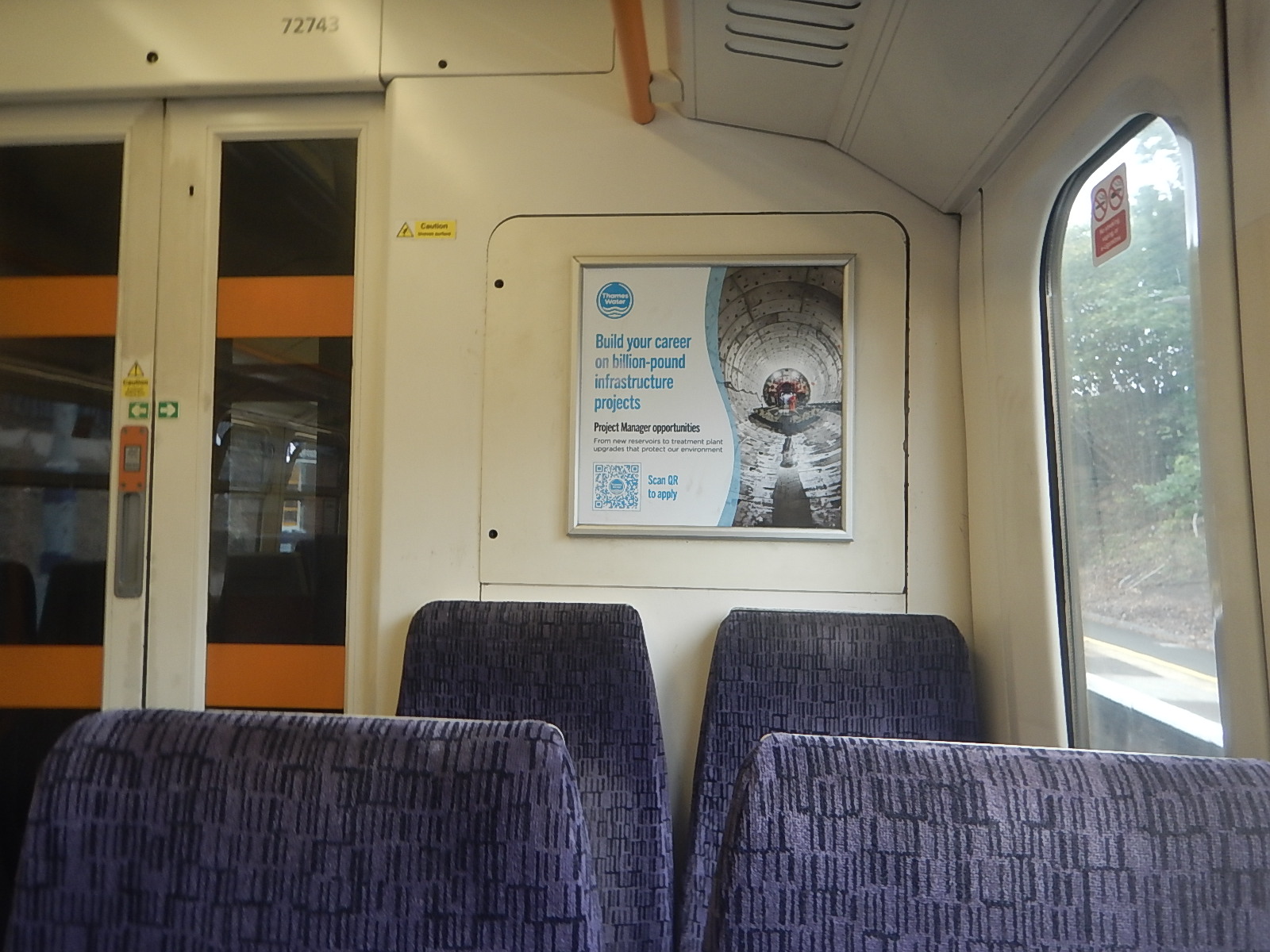
Does this indicate that Thames Water has project management problems?
Centrica Enters Into Long Term Natural Gas Sale & Purchase Agreement
The title of this post, is the same as this press release from Centrica.
This is the sub-heading,
Centrica plc today confirmed that its trading arm, Centrica Energy, has entered into a natural gas sale and purchase agreement with US-based Devon Energy Corporation.
This first paragraph adds a few more details.
Under the agreement, Devon Energy will supply 50,000 (MMBtu) per day of natural gas over a 10‑year term starting in 2028. This is equivalent to five LNG cargoes per year. The volumes will be indexed to European gas hub price (TTF). This sale and purchase agreement supports Centrica’s objective of managing market price risk in its LNG portfolio by aligning feed gas pricing with European gas prices whilst providing Devon Energy with international price exposure.
At a first look, it looks a lot of gas.
In Investment In Grain LNG, I talk about Centrica’s purchase of the Grain LNG Terminal from National Grid. But the Grain LNG Terminal comes with several things that Centrica might need for gas from Devon.
- A large amount of gas storage.
- The ability to convert liquid natural gas (LNG) into gas suitable for consumers.
- Space to build more storage if required.
- The ability to store LNG for other companies.
- Two jetties for delivering the LNG to the Grain LNG Terminal.
- The ability to load tankers with LNG, so that it can be sold on to third parties like say the Germans or the Poles.
Centrica also say this about their use of the Grain LNG Terminal in this press release, that describes the purchase of the terminal.
Aligned with Centrica’s strategy of investing in regulated and contracted assets supporting the energy transition, delivering predictable long-term, inflation-linked cash flows, with 100% of capacity contracted until 2029, >70% until 2038 and >50% until 2045.
Centrica have obviously modelled their gas supply and delivery and I believe they have come up with a simple strategy, that will work.
How Will Centrica Use The Gas From The Grain LNG Terminal?
The Wikipedia entry for the Grain LNG Terminal says this about the terminal delivering gas into the gas grid.
The terminal can handle up to 15 million tonnes per annum of LNG, has a storage capacity for one million cubic metres of LNG, and is able to regasify up to 645 GWh per day (58 million cubic metres per day) for delivery into the high pressure gas National Transmission System (NTS).
Note.
- This will be one of the major uses of the gas.
- I wouldn’t be surprised if these capacities will be increased significantly, so that more gas can be stored and processed.
In Investment in Grain LNG, I outlined how I believe that hydrogen and ammonia will be produced for the bunkering of ships on one of busiest sea lanes in Europe, if not the world.
Some LNG will be used to create these zero-carbon fuels.
Some modern ships, also run on natural gas, so I asked Google AI about their operation and received this answer.
Ships can run on natural gas, specifically liquefied natural gas (LNG), by using it as a fuel source in specially designed engines. LNG is natural gas that has been cooled to a liquid state at -162°C, making it easier to store and transport. This liquid form is then used to power the ship’s engines, either directly or by burning the boil-off gas (BOG) that naturally occurs when LNG warms up.
This means that some LNG could be used to directly fuel these ships.
What Is The Gas Capacity Of The Grain LNG Terminal?
I asked Google AI this question and received this answer.
The Grain LNG Terminal, the largest LNG import terminal in Europe, has a storage capacity of 1,000,000 cubic meters (m³) and an annual throughput capacity of 15 million tonnes of LNG. This is equivalent to about 20% of the UK’s total gas demand. The terminal also has the capacity to deliver 25% of the UK’s daily gas demand.
As the space is there, I wouldn’t be surprised to see Centrica increase the capacity of the terminal, as in cold weather, emergency gas for Germany can be delivered quicker from Kent than the United States.
Could The Grain LNG Terminal Accept Gas Deliveries From The United States?
I’m certain that it already does.
Could The Grain LNG Terminal Accept Gas Deliveries From The UK?
If we start extracting gas again from under the seas around the UK, could the Grain LNG Terminal be used to store it?
Yes, but it would have to be liquified first.
It would be more energy efficient to process the extracted gas, so it could be used directly and gasify enough gas at Grain LNG Terminal from storage to make up any shortfall.
Conclusion
Centrica have done some very deep joined up thinking, by doing a long term gas deal and the Grain LNG Terminal purchase so that they have the gas to supply and somewhere to keep it, until it is needed.
Investment in Grain LNG
The title of this post, is the same as that of this press release from Centrica.
This sub-heading outlines the deal.
Centrica plc (the “Company”, “Centrica”) is pleased to announce the acquisition of the Isle of Grain liquified natural gas terminal (“Grain LNG”) in partnership1 with Energy Capital Partners LLP (“ECP”) from National Grid group (“National Grid”) for an enterprise value of £1.5 billion. After taking into account approximately £1.1 billion of new non-recourse project finance debt, Centrica’s 50% share of the equity investment is approximately £200 million.
The press release lists these key points.
- Grain LNG delivers vital energy security for the UK, providing critical LNG import/export, regasification and rapid response gas storage capacity to balance the energy system.
- Aligned with Centrica’s strategy of investing in regulated and contracted assets supporting the energy transition, delivering predictable long-term, inflation-linked cash flows, with 100% of capacity contracted until 2029, >70% until 2038 and >50% until 2045.
- Opportunities for efficiencies to create additional near-term value, and future development options including a combined heat and power plant, bunkering, hydrogen and ammonia.
- Highly efficient funding structure, with Centrica’s equity investment of approximately £200 million alongside non-recourse project financing.
- Strong life of asset returns aligned with Centrica’s financial framework, with an expected unlevered IRR2 of around 9% and an equity IRR2 of around 14%+
Underpins delivery of £1.6 billion end-2028 EBITDA target3 – Centrica’s share of EBITDA expected to be approximately £100 million per annum and cash distributions expected to be around £20 million on average per annum for 2026-2028, representing an attractive yield on Centrica’s equity investment - Partnership with ECP (part of Bridgepoint Group plc), one of the largest private owners of natural gas generation and infrastructure assets in the U.S. with direct experience in supporting grid reliability.
This Google Map shows the various energy assets on the Isle of Grain.
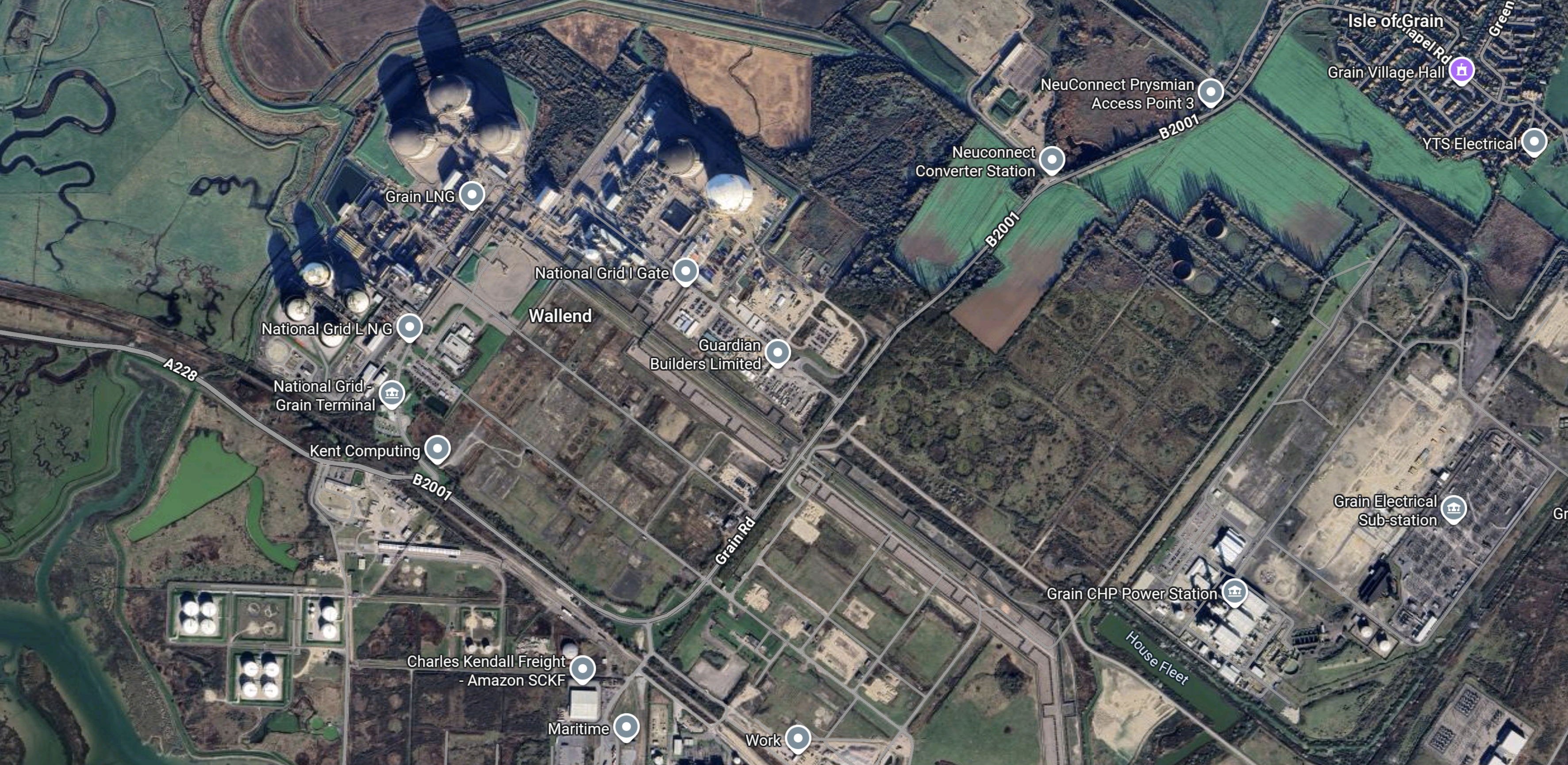
Note.
- It appears that works for the 1, 400 MW NeuConnect interconnector to Wilhelmshaven in Germany, are taking place in the North-East corner of the map.
- Grain CHP powerstation is a 1,275MW CCGT power station, which is owned by German company; Uniper, that is in the South-East corner of the map, which can also supply up to 340MW of heat energy recovered from the steam condensation to run the vapourisers in the nearby liquefied natural gas terminal.
- The Grain LNG terminal is at the Western side of the map.
- In the Thames Estuary to the East of the Isle of Grain, I estimate that there are about 1,500 MW of wind turbines.
I find it interesting that two of the assets are German owned.
I have some thoughts.
It Is A Large Site With Space For Expansion
This Google Map shows the whole of the Isle of Grain.
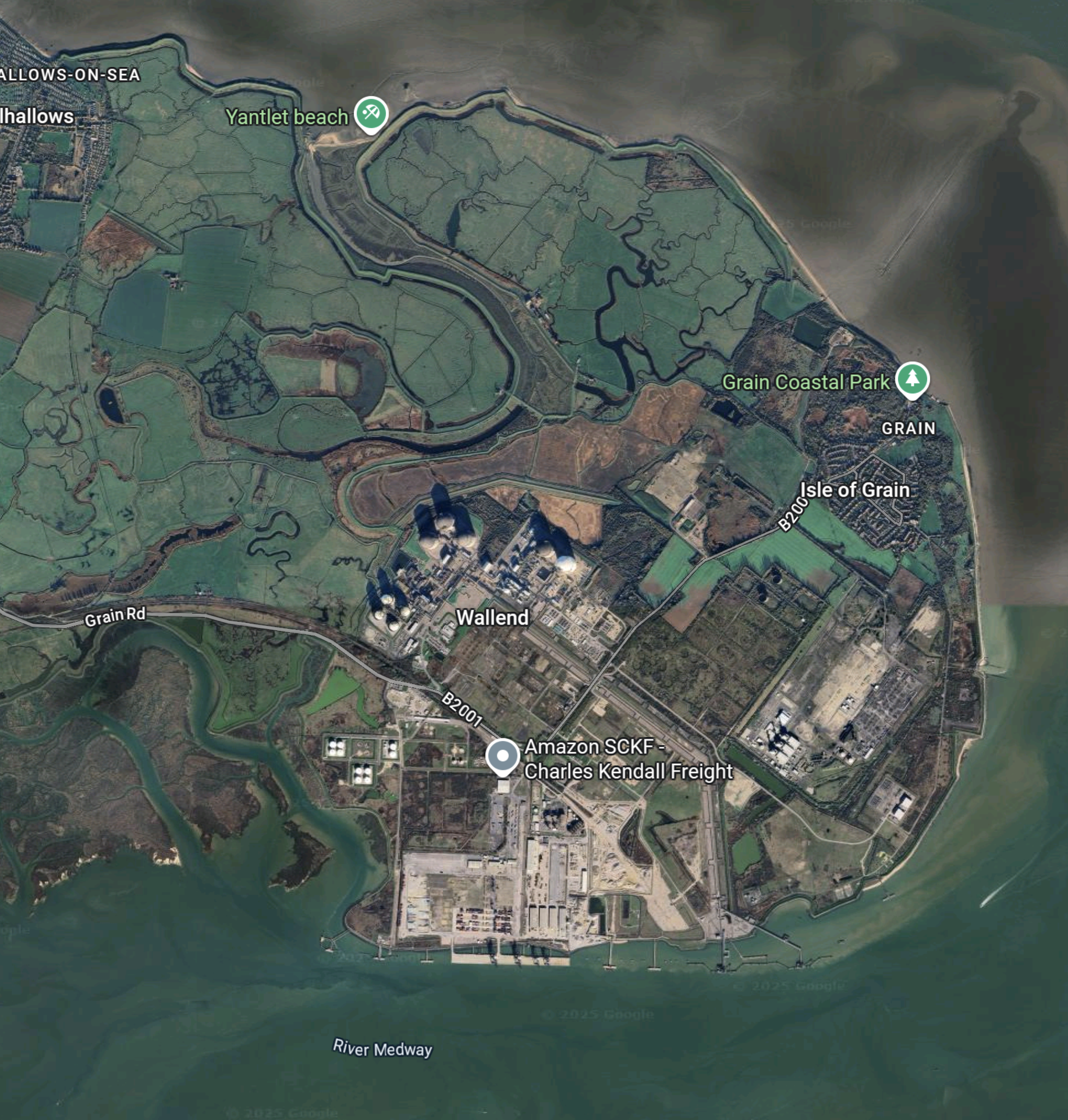
Note.
- The Grain LNG terminal is around the label Wallend.
- The River Medway runs East-West at the bottom of the map.
- Gas tankers deliver and take on gas at jetties on the North Bank of the Medway.
There could be space to expand the terminal, if the RSPB would allow it.
As an example, I asked Google AI, if peregrine falcons nest on chemical plants and got this reply.
Yes, peregrine falcons do nest on chemical plants. They have adapted to using various urban and industrial structures, including chemical plants, for nesting. This is particularly true in areas where natural cliff habitats are scarce.
Peregrine falcons are known for their adaptability, and their population has seen a resurgence in recent decades, partly due to their ability to utilize man-made structures. These structures often mimic their natural cliffside nesting
Cliffs do seem scarce on the Isle of Grain. I also asked Google AI, if peregrine falcons ate small rodents, as several chemical and other plants, where I’ve worked, had a rodent problem. One plant had a cat problem, as there had been so many rats. This was the reply.
Yes, peregrine falcons do eat small rodents, though they primarily consume birds. While their diet mainly consists of other birds like pigeons, doves, and waterfowl, they will also hunt and eat small mammals, including rodents such as mice, rats, and voles. They are opportunistic hunters and will take advantage of readily available prey, including insects, amphibians, and even fish.
I’m sure if Centrica wanted to expand, they’d employ the best experts.
Who Are ECP?
One of the key points of the press release is that this deal is a partnership with ECP (part of Bridgepoint Group plc), one of the largest private owners of natural gas generation and infrastructure assets in the U.S. with direct experience in supporting grid reliability.
The Wikipedia entry for ECP or Energy Capital Partners has this first section.
Energy Capital Partners Management, LP (ECP) is an American investment firm headquartered in Summit, New Jersey. It focuses on investments in the energy sector. The firm has additional offices in New York City, Houston, San Diego, Fort Lauderdale and Seoul.
In August 2024, ECP merged with Bridgepoint Group to form a private assets investment platform.
The Wikipedia entry for the Bridgepoint Group has this first paragraph.
Bridgepoint Group plc is a British private investment company listed on the London Stock Exchange and is a constituent of the FTSE 250 Index.
The company had started as part of NatWest.
Are The Germans Going To Take Away Some Of Our Electricity?
Consider.
- Germany has a big need to replace Russian gas and indigenous coal, and to decarbonise.
- Neuconnect is a 1.4 GW interconnector between the Isle of Grain and Wilhelmshaven in Germany. It is scheduled to be completed in 2028.
- The Grain CHP powerstation is a 1,275MW CCGT power station, which is owned by German company; Uniper, could almost keep NeuConnect working at full power on its own.
- I said earlier, in the Thames Estuary to the East of the Isle of Grain, I estimate that there are about 1,500 MW of wind turbines. One of which is part German-owned.
The Germans are also building a large electrolyser at Wilhelshaven, which is described by Google AI like this.
The Wilhelmshaven Green Energy Hub will initially feature a 500MW electrolyzer, with plans to potentially expand to 1GW, according to Energy Monitor. The hub, a joint project between Tree Energy Solutions (TES) and EWE, aims to produce green hydrogen using renewable energy sources like offshore wind. The 500MW electrolyzer is scheduled to be operational by 2028.
I wouldn’t be surprised to see that the Wilhelmshaven electrolyser were to be powered by British-generated electricity flowing down NeuConnect.
Centrica Says Their Future Development Options Include A Combined Heat And Power Plant
This objective was set in one of the key points.
This is the first paragraph of the Wikipedia entry for the Grain LNG Terminal.
Grain LNG Terminal is a Liquefied Natural Gas (LNG) terminal on the Isle of Grain, 37 miles (60 km) east of London. It has facilities for the offloading and reloading of LNG from ships at two jetties on the River Medway; for storing and blending LNG; for truck loading; and regasifying and blending natural gas to meet UK specifications. The terminal can handle up to 15 million tonnes per annum of LNG, has a storage capacity for one million cubic metres of LNG, and is able to regasify up to 645 GWh per day (58 million cubic metres per day) for delivery into the high pressure gas National Transmission System (NTS). The facility is owned and operated by National Grid Grain LNG Ltd, a wholly owned subsidiary of National Grid.
Note.
- This paragraph was written before the Centrica takeover.
- The terminal also converts liquid natural gas into gas to be distributed around the UK.
The heat needed to convert the liquid natural gas to gas is provided by the Grain CHP power station.
- Currently 340 MW of heat is provided.
- If the Grain LNG terminal is expanded, it will probably need more heat.
I can see Centrica building a combined heat and power (CHP) power station, that can be expanded to meet the current and future needs of gasification at the Grain LNG terminal.
I wouldn’t be surprised to see the CHP power station fitted with carbon capture, as Kent is surely one county, where carbon dioxide can be used in food production, so we can generate our carbon dioxide and eat it.
Centrica Says Their Future Development Options Include Hydrogen
This objective was set in one of the key points.
Consider.
- Centrica are an investor in HiiROC, who have a unique method of generating affordable zero-carbon hydrogen called thermal plasma electrolysis, which uses a fifth of the electricity, that traditional electrolysis does.
- HiiROC can use natural gas as a feedstock. Centrica won’t be short of that at Grain.
- There is space to build a large HiiROC system at the Isle of Grain site.
- The hydrogen could be taken away by tanker ships.
Like the electricity , which will use the 450 mile NeuConnect interconnector, the hydrogen could even be exported to Wilhelmshaven in Germany by pipeline.
Wilhelmshaven is being setup to be a major German hub to both generate, import and distribute hydrogen.
I asked Google AI, how much hydrogen a GWh would produce and received this answer.
A GWh of electricity can produce approximately 20-22 tonnes of hydrogen through electrolysis, depending on the efficiency of the electrolyzer. Modern commercial electrolyzers operate at an efficiency of roughly 70-80%, meaning they require about 50-55 kWh of electricity to produce 1 kg of hydrogen. A GWh (1 gigawatt-hour) is equal to 1,000,000 kWh, and 1 tonne of hydrogen contains roughly 33.33 MWh of energy.
As it is claimed on the web that HiiROC is five times more efficient than traditional electrolysis, it could need around 10-11 kWh to produce one kg. of hydrogen.
1 GWh would produce between 90-100 tonnes of hydrogen.
Centrica Says Their Future Development Options Include Ammonia
This objective was set in one of the key points.
I asked Google AI if ammonia can be produced from hydrogen and received this answer.
Yes, ammonia (NH3) can be produced from hydrogen (H2) through a process called the Haber-Bosch process. This process involves combining hydrogen with nitrogen (N2) from the air, under high temperature and pressure, in the presence of a catalyst.
Ammonia has a large number of uses, including making fertiliser and the powering of large ships.
I asked Google AI, if there are small Haber-Bosch processes to make ammonia from hydrogen and nitrogen and received this answer.
Yes, there are efforts to develop smaller-scale Haber-Bosch processes for ammonia production. While the traditional Haber-Bosch process is typically associated with large industrial plants, research and development are exploring ways to adapt it for smaller, distributed production, particularly for localized fertilizer or fuel applications.
I wondered if Centrica are involved in the efforts to develop smaller-scale Haber-Bosch processes for ammonia production.
Google AI gave me this quick answer.
Centrica is involved in research related to the Haber-Bosch process, particularly in the context of transitioning to a low-carbon energy future. They are exploring how to adapt the Haber-Bosch process, which is crucial for fertilizer production but also a significant source of CO2 emissions, to utilize renewable energy sources. This includes investigating the use of green hydrogen produced from water electrolysis and renewable electricity. Centrica is also involved in research related to using ammonia as a fuel, including potentially for power generation
That looks to be a very positive answer. Especially, as local low-carbon fertiliser production could be a very powerful concept.
Centrica Says Their Future Development Options Include Bunkering
This objective was set in one of the key points.
Bunkering is the process of refuelling ships.
I didn’t know much about bunkering, when I started to read Centrica’s press release, but the Wikipedia entry, was a good way to get some information.
This section in the Wikipedia entry is entitled Two Types Of Bunkering, where this is said.
The two most common types of bunkering procedure at sea are “ship to ship bunkering” (STSB), in which one ship acts as a terminal, while the other moors. The second type is “stern line bunkering” (SLB), which is the easiest method of transferring oil but can be risky during bad weather.
Over the years, I have found, that two zero-carbon fuels are under development, for powering ships; hydrogen and ammonia. Others are developing ships powered by naturalo gas.
I asked Google AI if hydrogen can power ships and received this answer.
Yes, hydrogen can power ships. It can be used as a fuel for fuel cells, which generate electricity to power the ship’s propulsion and other systems, or it can be burned in modified combustion engines. Hydrogen offers a zero-emission solution for shipping, with water vapor being the only byproduct when used in fuel cells.
Google AI also told me this.
The world’s first hydrogen-powered cruise ship, the “Viking Libra”, is currently under construction and is scheduled for delivery in late 2026. This innovative vessel, a collaboration between Viking Cruises and Italian shipbuilder Fincantieri, will utilize hydrogen for both propulsion and electricity generation, aiming for zero-emission operation.
I also asked Google AI if ammonia can power ships and received this answer.
Yes, ammonia can be used to power ships and is considered a promising alternative fuel for the maritime industry. Several companies and organizations are actively developing ammonia-powered ship designs and technologies. While challenges remain, particularly around safety and infrastructure, ammonia is seen as a key potential fuel for decarbonizing shipping.
Finally, I asked I asked Google AI if natural gas can power ships and received this answer.
Yes, ships can be powered by natural gas, specifically in the form of liquefied natural gas (LNG). LNG is increasingly used as a marine fuel, offering environmental benefits over traditional fuels like diesel.
It would seem to be a case of you pays your money and makes a choice between one of four technologies; ammonia, hydrogen fuel-cell, hydrogen-ICE and LNG.
I looks to me, that if Centrica provide bunkering services for ships, they have the means to cover most of the market by providing hydrogen and ammonia, in addition to natural gas.
Although, I don’t know much about bunkering, I do feel that the two current methods, that work for oil, could be made to work for these fuels.
This Google Map shows the Thames Estuary.
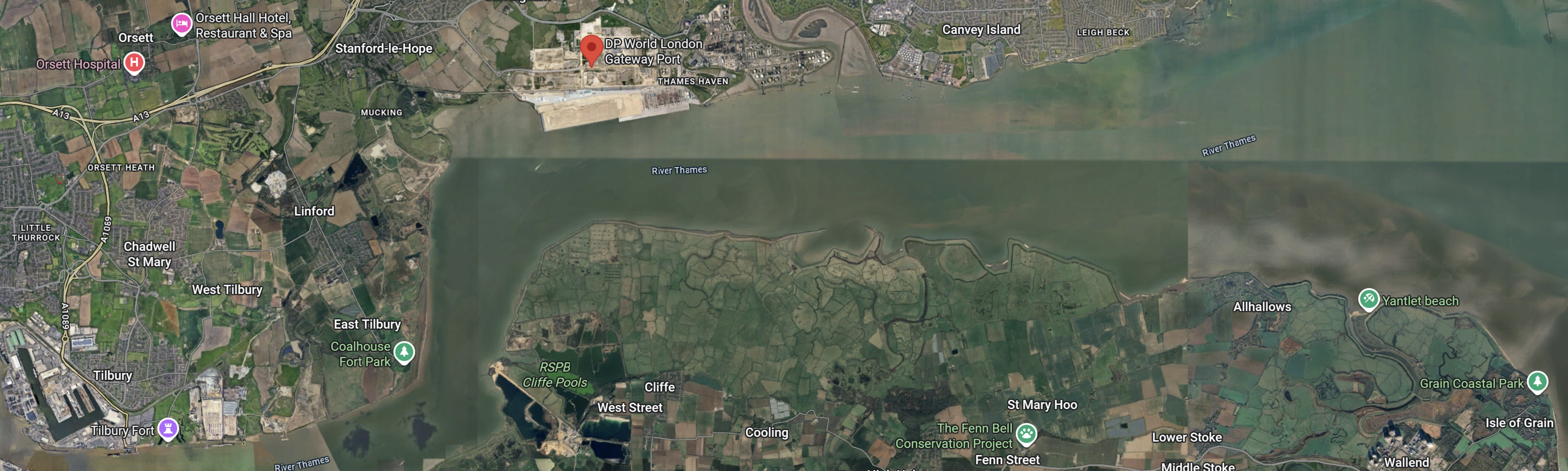
Note.
- The Port of Tilbury is in the South-West corner of the map.
- London Gateway is indicated by the red arrow.
- The Isle of Grain is in the South-East corner of the map.
- Other ports between Tilbury and the Isle of Grain include Barking, Dagenham, Dartford, Erith, Greenwich, Northfleet, Purfleet, Silvertown and Thurrock.
There was never a more true phrase than – “Location, Location and Location”. And the Isle of Grain would appear to be in the right place to send out a bunkering tanker to a passing ship, that was calling at a port in London or just passing through the Strait of Dover.
This Google Map shows the Thames between London Gateway and the Isle of Grain.
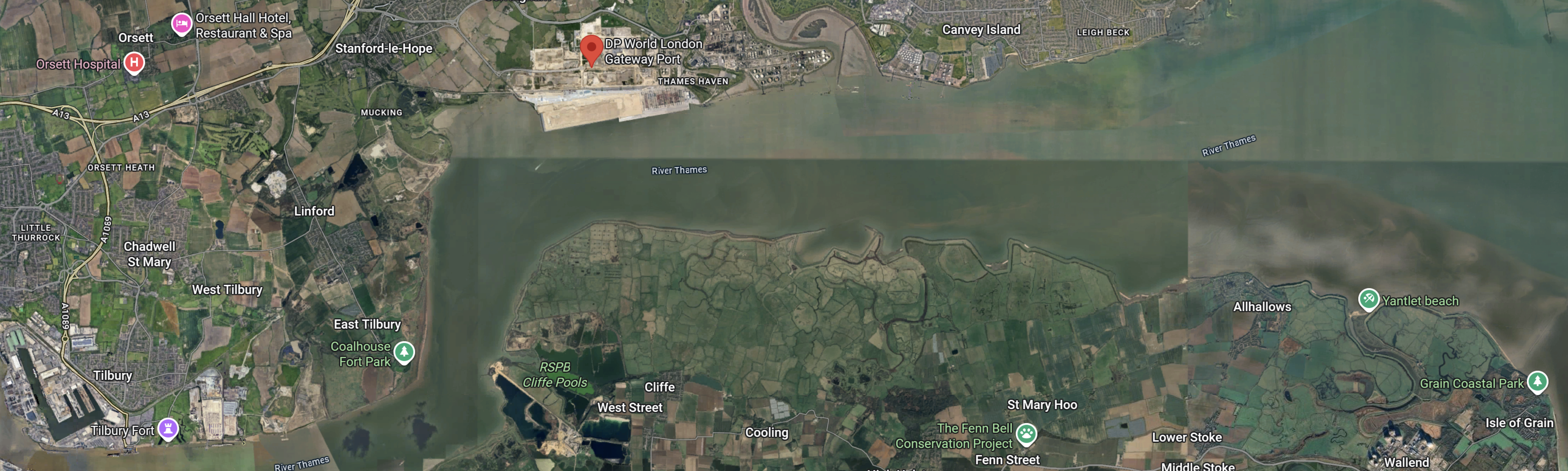
Note.
- London Gateway is indicated by the red arrow.
- The Isle of Grain is in the South-East corner of the map.
It seems to me, that a refuelling philosophy could easily be worked out.
How Large is The Bunkering Market?
I asked Google AI this question and received this answer.
The world bunker fuel market is a multi-billion dollar industry, with the market size valued at USD 150.93 billion in 2023. It is projected to reach USD 242.29 billion by 2032, growing at a CAGR of 5.4% according to SkyQuest Technology. In terms of volume, the global bunker demand was estimated at 233.1 million metric tons in 2023 according to the IMO.
The market is not small!
Did I Have A Funny Turn Caused By Dehydration This Morning?
I followed my usual Sunday morning routine today
- I took my drugs with a large mug of tea.
- I had a deep bath with emollient in the water.
- I put my head under the water and opened my eyes, to clear the massive amount of sleep, I get overnight in my eyes.
- I then went to Leon in Hanover Square for a good Full English gluten-free breakfast.
Unusually, Leon made a mistake and didn’t put any milk in my tea, so I didn’t drink it. So was I low on fluids?
A Transformer Is Being Moved Tonight
This press release from National Grid is entitled National Grid Prepares For Two Major Supergrid Transformer Deliveries In London.
The first one is to be moved into Redbridge substation tonight, so I went to have a look after breakfast.
- It was easy to get to the site, as it is close to Redbridge station on the Central Line.
- Out of the Underground, it was quite hot.
- By the time, I got to Redbridge station, I was feeling slightly unwell and felt my balance was poor.
- So I immediately turned around and came home using the Central and Lizzie Lines to Moorgate, where I took a bus home.
- I was certainly feeling better in the air-conditioned atmosphere of the Lizzie Line.
Since I’ve been home, I have been continuously drinking Adnams 0.5 % Alcohol Ghost Ship and I feel that I am now back to normal.
I asked Google AI “Can being dehydrated affect your balance?” and got this answer.
Yes, dehydration can definitely affect balance. It can lead to dizziness and a feeling of unsteadiness, which can make it harder to maintain balance. This is because dehydration can disrupt the fluid balance in the inner ear, which plays a vital role in balance.
I can remember an incident in my thirties, when I fell down the escalator at Oxford Circus station and went round to the Middlesex Hospital to be cleaned up.
Did Dehydration Play A Part In My Serious Stroke?
I had my stroke during breakfast in the Mandarin Oriental Hotel in Hong Kong. I’d had two or possibly three very small strokes early in the morning before and I know from measuring my weight, that I can lose up to a kilo overnight.
So I asked Google AI “Can dehydration cause strokes?” and got this answer.
Yes, dehydration can increase the risk of stroke. When the body lacks sufficient fluids, blood volume decreases, potentially leading to thicker blood and reduced blood flow to the brain. This can exacerbate existing blockages in blood vessels or make it more difficult for blood to reach the brain, potentially causing an ischemic stroke.
My late wife drunk a lot more fluids that I do and perhaps, I should have followed her example more, of always having water handy?
Heathrow Shutdown Caused By Problem Found Seven Years Ago
The title of this post, is the same as that of this article on the BBC.
This is the sub-heading.
Issues at an electrical substation which caused a fire that resulted in Heathrow Airport closing were first detected seven years ago but not fixed, a report has found.
These two paragraphs, explain the problem.
The National Energy System Operator (NESO) said moisture entering electrical components at the North Hyde substation caused the blaze at the site that supplies the UK’s biggest airport with power.
It revealed an elevated moisture reading had been first detected in July 2018, but that “mitigating actions appropriate to its severity were not implemented”, with basic maintenance cancelled.
This was a failure of National Grid’s management and I suspect the company will received a severe punishment.
But what worries me, is that power networks are built from a series of standard components.
So how many other North Hydes are waiting to happen?
 The Anonymous Widower