Wrightbus To Build 1,000 Zero-Emission Buses
The title of this post, is the same as that of this article on The Times.
This is the sub-heading.
Northern Ireland company to ramp up production by 40% and recruit hundreds more employees as it also develops the UK’’s first long-distance hydrogen coach
These are the first two paragraphs, which add more detail.
Wrightbus, the Northern Ireland bus manufacturer, could be supplying as many as 1,000 zero-emission vehicles to depots around the UK as it increases production by 40 per cent over a two-year period and takes on hundreds more workers.
The company, best known for the redesigned 21st century take on the Routemaster ordered by the former mayor of London Boris Johnson, also announced it is to spend £5 million developing the UK’s first long-distance hydrogen coach capable of travelling 1,000km (621 miles) on a single recharging of its fuel cells.
These two paragraphs describe their production and employment plans.
Jean-Marc Gales, the former senior Peugeot director who is Wrightbus’s chief executive, said production at its Northern Ireland plant would go from 1,000 vehicles last year to 1,200 this year and 1,400 in 2026.
Over the same period the company’s workforce will grow from 1,500 to 2,500.
Peter Kyle, the secretary of state for science, innovation and technology, said this.
The level of innovation at Wrightbus and their quality standards have been recognised.
That is surely rare praise for a private company from a Labour Minster.
I first wrote about Wrightbus’s new hydrogen coach in early March, when I wrote Wrightbus Goes Back To The Future As It Relaunches The Contour Coach, which was based on this Wrightbus press release, which has the same title.
I said this in my post.
Wrightbus is entering the coach market for the first time in more than 30 years with the launch of two new vehicles in the next 18 months.
The first vehicle to hit the market is the Contour, a low-emission 55-seater coach that was launched at a customer showcase event today (March 5).
It’s a case of back to the future for Wrightbus, which last produced a Contour coach in 1987 before retiring the vehicle.
The second vehicle, a zero-emission hydrogen coach – which is under development in Ballymena, Northern Ireland – will be added to the Wrightbus coach range within the next 18 months to help drive decarbonisation of the sector.
The low emission Contour has a lead time of just six months from order, which is considerably faster than the current one-to-two-year average wait customers have come to expect from the sector. Featuring a Cummins Euro 6 400BHP X11 engine and a ZF automatic gearbox, the modern-day Contour has been built with comfort in mind, with up to 55 reclining seats – each with its own USB port – alongside other modern safety features. Competitively priced and available with or without PSVAR compliance, there is also the option of the vehicle being ‘pre-prepared’, protecting the vehicle’s ‘second life’ and flexibility.
The coach has a range of bespoke options for customers to choose from and is designed to maximise luggage space and functionality.
The low emission Contour coach was to have been built in China.
But events have moved on fast in the last month, with Trump and China trading insults on tariffs almost daily.
From today’s article in The Times and a press release from the Government, which is entitled Science Secretary Hails Wrightbus As Company Pledges £25 million To Bolster UK’s Green Transport Revolution And Drive Growth, it appears that the Chinese coach has been dropped.
Could the plan now be something like this?
- The low emission Contour coach will either be dropped, built in Ballymena or perhaps even built on JCB’s site in Texas.
- It might possibly be advantageous to build the coach in the United States to balance the tariffs and target the North American market.
- I would feel, that North America could be a lucrative market for the larger thousand kilometre coach.
- With the low emission Contour coach, Cummins get a chance to show the United States their excellent hydrogen technology.
- Trump can claim, that he’s brought jobs back to the United States.
- If Wrightbus and/or JCB build the low emission Contour coach, they could probably create a better product and get it to market earlier.
I suspect we’ll learn more of Wrightbus’s plans in the next few weeks.
Wrightbus Goes Back To The Future As It Relaunches The Contour Coach
The title of this post, is the same as that of this press release from Wrightbus.
This is the detail of the press release.
Wrightbus is entering the coach market for the first time in more than 30 years with the launch of two new vehicles in the next 18 months.
The first vehicle to hit the market is the Contour, a low-emission 55-seater coach that was launched at a customer showcase event today (March 5).
It’s a case of back to the future for Wrightbus, which last produced a Contour coach in 1987 before retiring the vehicle.
The second vehicle, a zero-emission hydrogen coach – which is under development in Ballymena, Northern Ireland – will be added to the Wrightbus coach range within the next 18 months to help drive decarbonisation of the sector.
The low emission Contour has a lead time of just six months from order, which is considerably faster than the current one-to-two-year average wait customers have come to expect from the sector. Featuring a Cummins Euro 6 400BHP X11 engine and a ZF automatic gearbox, the modern-day Contour has been built with comfort in mind, with up to 55 reclining seats – each with its own USB port – alongside other modern safety features. Competitively priced and available with or without PSVAR compliance, there is also the option of the vehicle being ‘pre-prepared’, protecting the vehicle’s ‘second life’ and flexibility.
The coach has a range of bespoke options for customers to choose from and is designed to maximise luggage space and functionality.
It will be supported by a full Wrightbus warranty, alongside an unparalleled service and maintenance package from AllServiceOne, the Wrightbus repair and maintenance arm.
With the largest fleet of mobile technicians throughout the UK and Northern Ireland, AllServiceOne is the ultimate one-stop-shop for fleet support and service.
Wrightbus CEO, Jean-Marc Gales, said bringing the Contour to market was a pivotal move.
“The coach market has changed over the last few years and it’s the right time for a new player to come to the market.
We have long spoken about broadening our portfolio to offer customers an even greater range of Wrightbus vehicles.
Our first entry into the coach sector after an absence of more than three decades is another significant step in our expansion plans,” said Mr Gales.
“We know there are gaps in the market and the demand for coaches is growing.
This partnership allows us to bring high-quality low-emission vehicles to market almost immediately.
Throughout the process of readying the vehicle for our UK market, we have worked alongside our partner closely to ensure the Contour meets the exacting Wrightbus high quality standards that customers have come to expect.
Our AllServiceOne technicians have embarked on an extensive training programme and have a full working knowledge of the coach to ensure excellent fleet support. “At the same time as the launch of the Contour, our world-leading engineers are continuing to develop our own zero-emission hydrogen coach from our factory in Northern Ireland. We expect the hydrogen coach to be ready for launch in the next 18 months, which is a hugely exciting prospect.” The hydrogen coach concept was first revealed in 2024 as a prototype vehicle.
When launched, it will be a tri-axle hydrogen fuel cell electric coach capable of a 1,000km range, putting it on a par with traditional diesel-fuelled coaches.
These are my thoughts.
The Coach Has A Cummins Engine
Cummins will probably build the engines in their UK factory in Darlington.
Thirty years ago, I did a small data analysis consultancy for Cummins in Darlington and I was impressed by the operation and the company’s attitude.
One of their policies was that if the customer wants a special engine, then the company, is prepared to give the customer what they need.
So you can be sure, that the Cummins X11 engine to be supplied for the Contour coach, will be exactly what Wrightbus want.
The Cummins X15 Engine Is Convertible To A X15 Hydrogen Engine
Some of Cummins diesel engines are convertible to hydrogenfuel, by changing the cylinder head and the fuel system.
This can be done with a Cummins X15 engine and I wouldn’t be surprised if the X11 engine fitted to the Contour coach can be converted to hydrogen.
So an operator can buy a diesel coach and if they need, they could convert it to hydrogen.
USB Ports
This is stated in the press release.
Contour has been built with comfort in mind, with up to 55 reclining seats – each with its own USB port.
When I rode recently in a Irizar coach, there were no USB ports.
There Is A Promised Delivery Time Of Six Months
In the 1990s, I used to part-own a finance company, that leased vehicles.
One of the vehicles we used to loan money for was upmarket coaches like the Wrightbus Contour.
- They were a relatively large loan of about £50,000.
- The borrower was often very reputable with a good credit history.
- The repossession rate was very low.
The press release says, that a two-year delivery time is normal for coaches and, I can remember that we could have financed more coaches, if they had been available.
So it would appear to me, that if Wrightbus can deliver a new coach in six months, they will sell a lot of coaches and I believe from past experience, that finance will be available from trusted sources.
The Hydrogen Coach Will Be A Hydrogen Fuel Cell Electric Tri-Axle Coach
This is stated in the press release.
When launched, it will be a tri-axle hydrogen fuel cell electric coach capable of a 1,000km range, putting it on a par with traditional diesel-fuelled coaches.
I suspect to get the 1,000 km range of the diesel coach and to protect the hydrogen tank, means some extra weight and an extra axle.
But I wouldn’t be surprised to see a reduced range hydrogen coach without the third axle.
Wrightbus Are The Company Who Launched Ballard Hydrogen Fuel Cells In London
I wrote London’s Hydrogen Buses in July 2013 and all Wrightbus buses hydrogen buses have used hydrogen full cells from Ballard Power Systems in Canada.
But there could be a complication in that Cummins make fuel cells in Germany and we are approaching Trumpian Tariff War Territory.
On the other hand in Australian Volgren Rolls Out First Hydrogen Bus Based On Wrightbus Chassis Technology, it shows how Wrightbus are prepared to licence their technology to reputable companies.
So any country, like Australia, Brazil, Canada, India, Mexico, Singapore or the United States, who can build coaches, can licence Wrightbus’s designs and fit the appropriate components to make a complete coach.
Note.
- Wrightbus is owned by the Bamford family, who own JCB.
- Wrightbus have licenced designs to Australia, Hong Kong and Singapore in the past.
- JCB have large manufacturing facilities in India.
I’m certain that the Bamfords and their advisors can work it out!
Iarnród Éireann Looks At Diesel Loco Replacement Options
The title of this post, is the same as that of this article on Railway Gazette.
These three paragraphs introduce the article.
The Stadler Class 99 electro-diesel locomotive for UK operator GB Railfreight was receiving close scrutiny from Iarnród Éireann at InnoTrans in Berlin, with the Irish national operator confirming to Railway Gazette International that it had discussed with the manufacturer how the type might be adapted for operation in Ireland.
Iarnród Éireann Chief Executive Jim Meade told Railway Gazette International ‘we will eventually need to replace our aging diesel fleet with dual-mode locomotives because our freight strategy will take us down that direction after we complete our electrification programme.
‘The replacement for the class 071s and 201s eventually will have to be a bi-mode electric with some form of HVO [renewable diesel fuel] traction in the long term; even the Class 201s are beyond mid-life already.
The Class 99 locomotive is a version of the Stadler Eurodual locomotive, which is described in this Stadler data sheet.
The Wikipedia entry for the Stadler Euro Dual is also informative and lists a dozen different versions of the locomotive, that have been sold to various countries and operators.
This paragraph summarises how the design can handle different gauges and electrical voltages.
The Euro Dual was designed from the onset as a highly modular platform, allowing it to be offered to customers in various different configurations, covering various gauges and voltage systems.
I doubt Stadler would have great difficulty producing an Irish gauge locomotive capable of running on whatever electrification, the Irish erect.
Will The Irish Class 99 Have Enough Power?
The power of the various diesel locomotives are as follows.
- Current Irish Class 071 – 1.68 MW
- Current Irish Class 201 – 2.4 MW
- UK Class 66 – 2.4 MW
- UK Class 99 – 1.79 MW
It would appear that the Class 99 is less powerful than the Irish Class 201 and the UK Class 66, but the Wikipedia entry for the Class 99 says this.
The chief executive of GBRf, John Smith, reports that the Class 99, despite having a less powerful diesel engine than the Class 66, will outperform the Class 66 at low speeds. The greater tractive effort means that the Class 99 on diesel power can deliver more power at the rail than the 66.
But as the Class 99 has 6.17 MW in electric mode, the solution must be to electrify the difficult sections.
I have just looked at the Felixstowe Branch Line, which will be very much Class 99 territory. I am fairly sure, that with some short lengths of electrification on the single-track sections, any performance problems with the Class 99 on the branch could be solved.
Could The Irish Class 99 Use Hydrogen As Secondary Power?
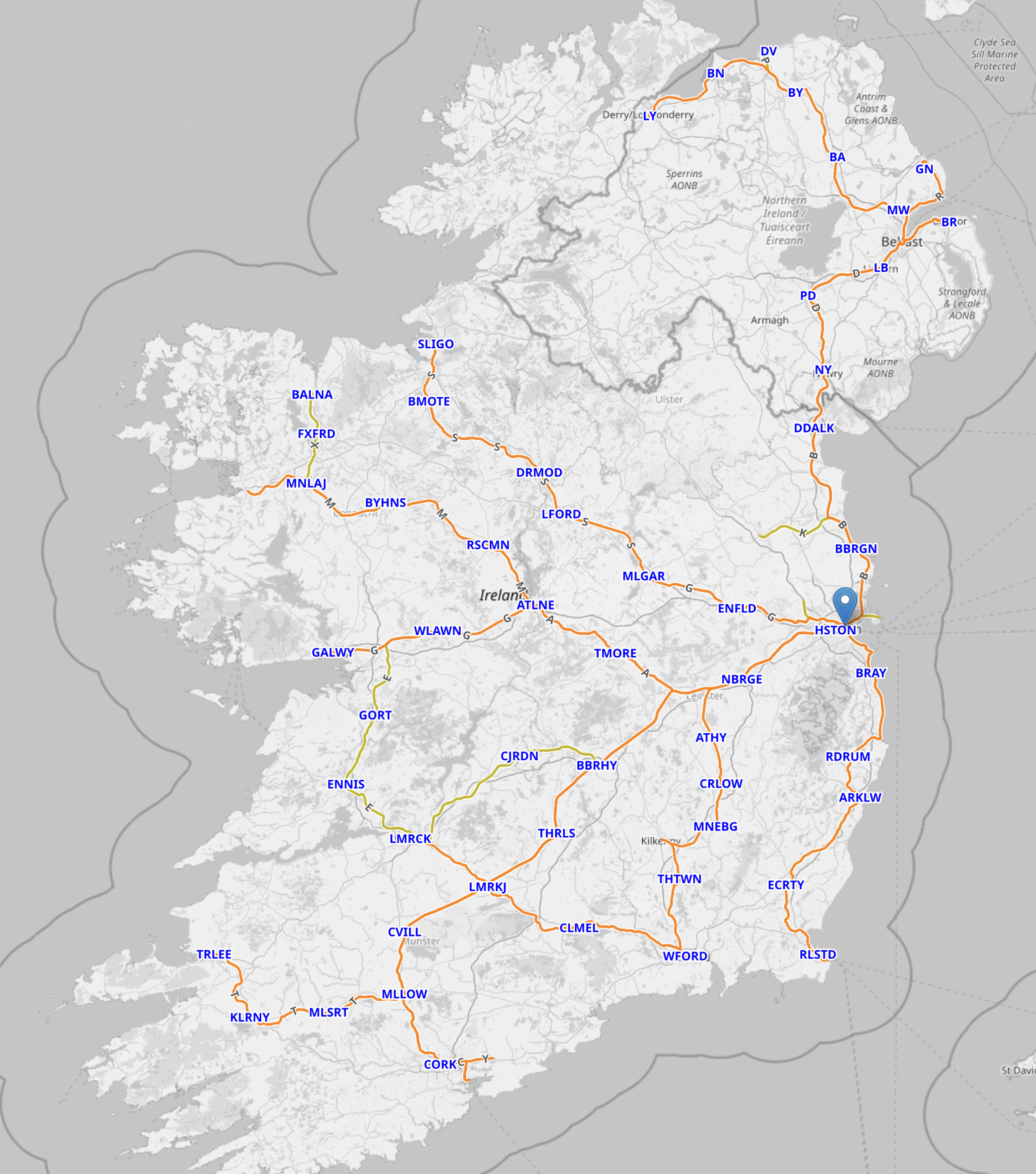
This OpenRailwayMap shows all the railways on the island of Ireland.
Note.
- All railways on the island of Ireland have an Irish gauge of 1.6 m.
- Only the DART in Dublin is electrified with 1,500 VDC overhead.
- There are 2,733 km. of track.
- New lines are still being added and old ones have been reopened in recent years.
- There will surely be pressure for the Irish to decarbonise their railways, both North and South of the Northern Irish border.
- There are no rail connections to another country, except for the link between Northern Ireland and the Republic of Ireland, which is between two similar systems.
- It is unlikely, that there will ever be a rail link between the Irish gauge railways on the island of Ireland and the standard gauge railways of Europe.
Effectively, the island of Ireland has an isolated network of tracks on which they could build a zero-carbon railway system.
- Signalling could be an off-the-shelf digital system.
- Zero-carbon traction power could be trains powered by either electricity and/or hydrogen.
- Both electricity and hydrogen would need substantial amounts of new rolling stock.
- Electricity would require electrification at €1,000,000 per single track kilometer, which could be around €5.5 billion for the electrification alone.
- Electrification would also need many bridges, stations and tunnels to be modified or rebuilt.
- Hydrogen would need a refuelling infrastructure and could go anywhere that diesel can.
- Hydrogen locomotives and trains, would be one-to-one replacements for diesel locomotives and trains.
It would appear that because of their geographic isolation, hydrogen could be an ideal zero-carbon fuel for the railways of Ireland.
In Do Cummins And Stadler Have a Cunning Plan?, I speculated that the electro-diesel Class 99 locomotive could be converted into an electro-hydrogen Class 99 locomotive, as Cummins are building diesel engines that can be converted into hydrogen ones.
Ireland with its unusual network could change to a zero-carbon railway in the following way.
- Purchase a fleet of diesel locomotives and trains that can run on Hydrotreated Vegetable Oil (HVO) and be convertible to hydrogen.
- A version of the Class 99 with or without the electrical gubbins would satisfy the locomotive replacement.
- A version of the tri-mode Stadler FLIRT like a Class 745 train, would satisfy the train replacement.
- All new trains and locomotives would replace the current stock and run on HVO.
- The hydrogen infrastructure would be built.
- The new trains and locomotives would be gradually converted to run on green hydrogen.
Within a few years, the island of Ireland would have a zero-carbon railway.
Advantages Of A Fully-Hydrogen Railway
These are a few advantages.
- One fuel for all trains.
- All trains and locomotives would be one manufacturer.
- No expensive electrification.
- Hydrogen trains and locomotives have a long range.
- No infrastructure modification for gauge clearance.
- Ireland has plenty of onshore and offshore wind for hydrogen.
- Standard fuelling systems are being developed.
- There would be no disruption as the trains changed to HVO and little disruption as they changed to hydrogen.
I believe that there would be a large increase in train usage both from locals and visitors, which can only be good for the Irish economy.
Managing The Project
This could be one of those rare projects that flows well.
- The changeover to hydrogen could involve very little rail infrastructure work.
- The hydrogen filling stations could be more-or-less independent of the rail infrastructure.
- Trains and locomotives could go into service, when they are accepted and the staff have been trained.
- Trains and locomotives would only be converted to hydrogen, as routes are made hydrogen-capable.
- There should be no gauging problems with the new trains and locomotives.
- There is only one train manufacturer.
Hopefully, it will all be delivered on time and on budget.
Ireland Joins Forces With EIB For Offshore Wind Port Upgrades
The title of this post, is the same as that of this article on offshoreWIND.biz.
This is the sub-heading.
The European Investment Bank (EIB) and the Irish Department of Transport have established an advisory cooperation to assess capacity, demand and financing strategies for the development of port infrastructure for offshore wind projects in Irish waters.
These are the first two paragraphs.
Signed by the Irish Minister for the Environment, Climate, Communications and Transport, Eamon Ryan, and EIB Vice President Ioannis, the advisory cooperation aims to evaluate the scale and nature of investment needed to upgrade Irish ports.
The initiative is said to unlock an estimated EUR 30 billion in investment in offshore wind projects in the country which plans to have 20 GW of capacity installed by 2040 and 37 GW by 2050.
It looks to me, that the Republic of Ireland will become a big player in the production of electricity from offshore wind.
I also suspect that Northern Ireland will play its part too!
SSE Renewables Buys 100MW/200MWh Northern Ireland BESS Project
The title of this post, is the same as that of this article on Energy Storage News.
These five paragraphs describe the acquisition and SSE Renewables progress as they build a portfolio of Battery Energy Storage Systems.
A 100MW/200MWh BESS project in Northern Ireland has been acquired by the renewable energy development subsidiary of UK-headquartered power generator and developer SSE.
The 2-hour duration Derrymeen battery in Dungannon, County Tyrone was bought from developer Heron Energy and would be the largest installed BESS facility in Northern Ireland when online.
Subject to a final investment decision by SSE Renewables, the shovel-ready project will be constructed on a greenfield site located outside Coalisland, around five miles from Dungannon.
If approved for final delivery, construction could commence early next year and the BESS would be operational by the end of 2026. It will connect to the grid via an underground cable to the nearby existing Tamnamore substation.
This is SSE Renewables’ first battery storage development in Northern Ireland, having already an established green portfolio in Britain. The firm launched its first operational BESS in the GB market on 15 April in the form of a 50MW/100MWh asset located in Salisbury, Wiltshire.
This battery is a two-hour battery, as are the other two batteries, that are mentioned in the article, that are being developed by SSE Renewables.
Is this a standard for SSE Renewables?
Enterprise: Belfast-Dublin Rail To Receive Multi-Million Investment
The title of this post, is the same as that of this article on the BBC.
This is the sub-heading.
Cross-border rail services between Belfast and Dublin are set to benefit from a £141.9m investment.
These are points from the rest of the article.
- The investment is part of the Peace Plus initiative which funds projects in Northern Ireland and border counties.
- The funding will support a major programme aimed at providing an hourly service between Belfast and Dublin.
- All existing Enterprise trains are to be replaced with brand new trains by the end of this decade leading to faster journey times.
- Ian Campbell from transport company Translink said that the announcement was “good news” and “very much needed”.
- Mr Campbell said the funding would allow the current fleet of four enterprise trains to be replaced by eight new trains.
- He said that these trains would allow a “step up in accessibility and passenger experience”, as well as reducing the journey times by “about 15 minutes”.
- He added that the trains would be “designed ultimately to operate as a net zero service using sustainable technology”.
- Mr Campbell said that the hourly service was “very much needed” as Translink expected there to be demand for two million passenger journeys on the service by 2030.
- Funding is also being provided by the Department for Infrastructure (DfI) in Northern Ireland and the Department of Transport in the Republic of Ireland.
These are my thoughts.
The Enterprise Service
The BBC article describes the service like this.
Jointly operated by Northern Ireland Railways and Iarnród Éireann, the Enterprise train service has provided a transport link between Belfast and Dublin for over 75 years.
These are some points about the tracks and the trains.
- The Northern terminal is Belfast Lanyon Place station.
- The Southern terminal is Dublin Connolly station.
- The Wikipedia entry for the Belfast and Dublin line says the distance is 112 miles, with an operating speed of 90 mph.
The fastest services take two hours and five minutes, which is an average speed of 54 mph.
Electrification Between Dublin And Belfast
Currently, only the nine miles at the Southern end between Dublin Connolly and Malahide stations is electrified using 1,500 V DC overhead.
But there is a program being planned called Dart+, which could see electrification extended by 23 miles to Drogheda station.
New Trains For The Enterprise Service
The BBC article made these points about the new trains.
- Ian Campbell from transport company Translink said that the announcement was “good news” and “very much needed”.
- Mr Campbell said the funding would allow the current fleet of four enterprise trains to be replaced by eight new trains.
- He said that these trains would allow a “step up in accessibility and passenger experience”, as well as reducing the journey times by “about 15 minutes”.
- He added that the trains would be “designed ultimately to operate as a net zero service using sustainable technology”.
This article on Rail Technology Magazine is entitled Multi-Million Pound Transformation For Belfast-Dublin Rail Services.
The last two paragraphs of the article give more details of the trains.
This funding will finance the replacement of the current Enterprise fleet of four train-sets with eight new, modern and sustainable train-sets. Enterprise is jointly operated by Northern Ireland Railways and Iarnród Éireann, and the new trains are designed to evolve as both jurisdictions work towards a fully electrified cross-border rail corridor over the coming decades.
The procurement process for the new train-sets is set to be completed in the coming year, with the fleet expected to be in operation by 2029. The trains will be designed initially to run on electric and battery power, with the possibility to be converted into fully electric operation in the future.
After the DART reaches Drogheda, 32 miles of the Enterprise route will be electrified, with 80 miles unelectrified.
If it is assumed that the Dublin Connolly and Drogheda electrification, means that all trains leave Drogheda for Belfast with a full battery, then it looks to me, that there are three ways, this route could be operated.
- Trains would have a range on excess of 80 miles and would be charged by a short length of overhead wire in or near Belfast Lanyon Place station.
- Trains would have a range on excess of 160 miles and would be charged, whilst running South of Drogheda.
- Trains would be tri-mode trains, with diesel power.
Note.
- Battery-electric multiple units have already been ordered for the Dublin DART from Alstom.
- There are several charging systems available from companies like Furrer+Frey, Hitachi and others.
- The Guinness World Record for a battery-electric train is around 140 miles, but battery technology is improving.
- I suspect range will rule out the second option.
- The first option would be zero-carbon from day one.
Choosing the first option would seem to be the most likely option.
When electrification between Belfast Lanyon Place and Dublin Connolly is completed, all trains could be converted to either all-electric or battery-electric trains.
Could Similar Techniques Be Used To Decarbonise Other Irish Routes?
Just as the Belfast service uses a branch of the electrified DART, as a route out of Dublin, it appears that other Irish routes share tracks with the DART to access stations in the centre of Dublin.
- Cork services share the DART branch to Hazelhatch and Celbridge station.
- Sligo services share the DART branch to Maynooth station.
- Rosslare services share the DART branch to Greystones station.
- Waterford services share the DART branch to Hazelhatch and Celbridge station.
I can see similar trains, that will be used between Dublin and Belfast, being used on other routes to and from Dublin.
Conclusion
Decarbonisation of Dublin and Belfast could be the start of something big and green in the island of Ireland.
I suspect train manufacturers, like Alstom, CAF and Stadler will use all their skills to secure the contract to build the trains for the Enterprise service.
Ireland To Develop National Industrial Strategy For Offshore Wind
The title of this post, is the same as that of this article on offshoreWIND.biz.
This is the sub-heading.
Ireland’s Minister for Enterprise, Trade and Employment, Simon Coveney, has announced plans to develop a National Industrial Strategy for Offshore Wind which will set out how Ireland can maximise the economic opportunity arising from the production of offshore wind energy
Ireland’s current objectives for offshore wind are.
- To deliver 5 GW of offshore wind by 2030.
- A further 2 GW of floating wind to be in development by 2030.
- The target for offshore wind could rise to at least 37 GW by 2050.
- There is a target to provide 80 per cent of the country’s electricity to be from renewable sources by 2030.
The government appears to recognise collaborative approach between state and industry is needed.
Nothing is said about co-operation with Northern Ireland or the UK.
This is despite.
- UK and Irish companies like ESB, Flotation Energy, Simply Blue Group and SSE have projects in both countries.
- Irish company; ESB is developing the Malin Sea Wind wind farm in Scottish waters and landing the electricity near Derry City.
- Scottish company; SSE is building biomass power stations in Ireland.
- Some promising waters for wind power are shared between the two countries.
- There are three interconnectors between the two main islands.
I would expect that there could be some multi-purpose interconnectors across the Irish and Celtic Seas.
These would connect windfarms between the islands to both the UK and Ireland. National Grid and TenneT are building the LionLink between England and The Netherlands, which I wrote about in World’s Largest-Of-Its-Kind Power Line To Deliver Clean Power To 1.8m UK Homes And Boost Energy Security.
I very much feel, that there will be a lot of co-operation between the UK and Irish governments as if they work together, the development of Ireland’s offshore wind and that of the West Coast of the UK could be more efficient.
NI Green Hydrogen Projects Win Government Grants
The title of this post, is the same as that of this article on the BBC.
This is the sub-heading.
Two green hydrogen projects in Northern Ireland have won government grants in the first round of the UK Net Zero Hydrogen Fund.
These three paragraphs outline the projects.
Green hydrogen is made by using renewable electricity to separate water into oxygen and hydrogen – a process called electrolysis.
The grants will be used to help fund the construction of electrolysers.
One will be at the Mannok cement plant in Fermanagh, the other at Wrightbus in Ballymena.
I talked about the Wrightbus project in Ballymena: Wrightbus To Develop Hydrogen Production Facility.
Ballymena: Wrightbus To Develop Hydrogen Production Facility
The title of this post, is the same as that of this article on the BBC.
This is the sub-heading.
Wrightbus is planning to develop a green hydrogen production facility at its factory in Ballymena.
And these first three paragraphs outline the project.
The proposal is being made in partnership with a sister company, Hygen Energy.
Part of the Wrightbus business is the manufacturing of hydrogen-powered buses, some of which are operated by Translink.
The new facility would help create a reliable source of fuel for those buses and other hydrogen-powered vehicles.
It seems a well-designed project and it appears Hygen are building a similar facility in Bradford.
Some months ago, I had a drink in my house, with three senior London bus company executives.
One has had problems with electric buses, as getting the required power to charge a fleet in some Central London garages is not easy.
I showed them these figures, from the Wrightbus web site.
- A Wrightbus electric double-decker takes 2.5 hours to charge for a 200 mile range.
- A hydrogen double-decker takes 8 minutes to refuel with up to a 280 miles range.
They were impressed. Especially, as a typical duty for a bus in London is almost 200 miles. A hydrogen bus seemed to make a lot more sense.
So why isn’t London preparing for scores of hydrogen buses?
Ask the Mayor!
Landmark Levelling Up Fund To Spark Transformational Change Across The UK
The title of this post, is the same as that of this press release from the UK Government.
These are the four bullet points.
- More than 100 projects awarded share of £2.1 billion from Round 2 of government’s flagship Levelling Up Fund.
- Projects will benefit millions of people across England, Scotland, Wales and Northern Ireland and create jobs and boost economic growth.
- £672 million to develop better transport links, £821 million to kick-start community regeneration and £594 million to restore local heritage sites.
- Successful bids include Eden Project North in Morecambe, a new AI campus in Blackpool, regeneration in Gateshead, and rail improvements in Cornwall
The press release expands the last bullet point.
Projects awarded Levelling Up Fund money today include:
Eden Project North
Eden Project North will receive £50 million to transform a derelict site on Morecambe’s seafront into a world class visitor attraction. It will also kick-start regeneration more widely in Morecambe, creating jobs, supporting tourism and encouraging investment in the seaside town.
Note.
- Because of its closeness to the West Coast Main Line, it will have excellent rail connections to all over the North of England and Central and Southern Scotland, through Lancaster, which will only be a shuttle train away.
- One of High Speed Two’s direct destinations will be Lancaster, which will be served by High Speed Two by hourly trains to Birmingham, Carlisle, Crewe, London, Preston, Warrington and Wigan and by two-hourly trains to Edinburgh, Glasgow, Lockerbie and Motherwell.
- London and Lancaster will be a journey of just two hours and three minutes.
I believe that this high quality rail access will ensure the success of the Eden Project North.
Cardiff Crossrail
Cardiff Crossrail has been allocated £50 million from the fund to improve the journey to and from the city and raise the economic performance of the wider region.
The Cardiff Crossrail is obviously a good project from the little that I’ve read about it. But it does need a web site to explain the reasoning behind it.
Blackpool Multiversity
Blackpool Council and Wyre Council will receive £40 million to deliver a new Multiversity, a carbon-neutral, education campus in Blackpool’s Talbot Gateway Central Business District. This historic funding allows Blackpool and The Fylde College to replace their ageing out-of-town centre facilities with world-class state-of-the-art ones in the heart of the town centre. The Multiversity will promote higher-level skills, including automation and artificial intelligence, helping young people secure jobs of the future.
Blackpool certainly needs something.
My suggestion in Blackpool Needs A Diamond, was to build a second Diamond Light Source in the North to complement the successful facility at Harwell.
I don’t think the two proposals are incompatible.
Fair Isle Ferry
Nearly £27 million has been guaranteed for a new roll-on, roll-off ferry for Fair Isle in the Shetland Islands. The service is a lifeline for the island, supporting its residents, visitors and supply chains, and without its replacement the community will become further isolated.
Note.
- Will it be a British-built ferry?
- Will it be hydrogen-powered? After all by the time it is built, the Northern Scottish islands will be providing enough of the gas to power a quarter of Germany.
- Surely, a hydrogen-powered roll-on, roll-off ferry will be a tourist attraction in its own right.
I hope the Government and the islanders have a good ship-yard lined up
Gateshead Quays And The Sage
A total of £20 million is going towards the regeneration of Gateshead Quays and the Sage, which will include a new arena, exhibition centre, hotels, and other hospitality. The development will attract nearly 800,000 visitors a year and will create more than 1,150 new jobs.
I don’t know much about the Sage, but this project seems very reasonable.
Mid-Cornwall Metro
A £50 million grant will help create a new direct train service, linking 4 of Cornwall’s largest urban areas: Newquay, St Austell, Truro, and Falmouth/Penryn. This will level up access to jobs, skills, education, and amenities in one of the most economically disadvantaged areas in the UK.
I wrote about this scheme in The Proposed Mid-Cornwall Metro, where I came to this conclusion.
I believe that a small fleet of Hitachi Regional Battery Trains could create an iconic Metro for Cornwall, that would appeal to both visitors and tourists alike.
Judging by the recent success of reopening the Dartmoor Railway to Okehampton in Devon, I think this scheme could be a big success. But it must be zero-carbon!
Female Changing Rooms For Northern Ireland Rugby
There is £5.1 million to build new female changing rooms in 20 rugby clubs across Northern Ireland.
Given the popularity of the female version of the sport in England, Scotland and Wales, perhaps this is a sensible way to level it up in Northern Ireland. As rugby is an all-Ireland sport, perhaps the Irish have already sorted the South?
 The Anonymous Widower