Deadly ‘Climate Change’ Fungus Targeted In Drug Project
The title of this post, is the same as that of this article in The Times.
This is the sub-heading.
Dundee University team leading fight against Candida auris, a type of yeast that causes severe illness and spreads easily among hospital and care home patients.
These are the first two paragraphs.
A rapidly growing deadly fungus, thought to have emerged in humans due to climate change, is one of the targets of a £17.9 million drug project.
Candida auris is a type of yeast that can cause severe illness and spreads easily among patients in healthcare facilities. It was first seen in Japan in 2009 and has spread worldwide, with outbreaks in hospitals in the UK, South Africa, India and parts of North and South America.
These are points from the rest of a must-read article.
- The first cases in the UK were recorded in 2014 and numbers have been rising yearly since 2020.
- Found particularly in hospitals and care homes.
- Many infections occur when medical devices such as catheters or ventilators are fitted to patients.
- I’ve had my fill of catheters, when I had my stroke in Hong Kong.
- Immunocompromised people are most at risk.
I may be coeliac, but I tend to believe my immune system is like a platoon of SAS soldiers on steroids. It certainly gave the AstraZeneca viral vector Covid-19 vaccine a good kicking. But it welcomed the second dose, like a long-lost friend.
I asked Google if there was any interaction and got this reply.
While Candida auris is a serious fungal infection, it is not directly linked to celiac disease. However, Candida albicans, another type of yeast, has been implicated in the development or exacerbation of celiac disease through mechanisms like cross-reactivity and molecular mimicry.
I shall act responsibly and hope for the best.
But.
- Research at the University of Padua has shown, that diagnosed coeliacs sticking to their gluten-free diet, don’t get serious doses of Covid-19.
- Research at the University of Nottingham has shown, that diagnosed coeliacs sticking to their gluten-free diet, have a lower cancer rate, than the general population.
- I’ve very rarely had colds, flu and other infection, since my diagnosis as a coeliac and going gluten-free in 1997.
- I’ve never had Covid-19.
A Floridian restauranteur once called me one of the Devil’s children, as I was a coeliac. If that is true, she certainly looks after her own!
‘Breakthrough’ Blood Test For Sepsis To Save Lives
The title of this post, is the same as that of this article in the Sunday Times.
This is the sub-heading.
If the trial is a success it could allow speedy diagnosis for a condition that kills 48,000 people a year
These two paragraphs introduce the story.
A blood test is being trialled that can rapidly detect whether a patient has sepsis, in what could be a breakthrough for a condition that is notoriously difficult to diagnose.
Sepsis, which occurs when the immune system overreacts to an infection, kills about 48,000 people each year in the UK. More people die of it annually than of breast, prostate and bowel cancer put together. In severe cases, it can kill within hours.
A friend had sepsis and it nearly killed her. A test like this would probably have shortened her time in hospital.
I am coeliac and also a mathematical modeller and statistician.
- If you are coeliac and stick to your gluten-free diet, which now includes delicious real ale, you are 25 % less likely to suffer from cancer than the general population, according to research at Nottingham University.
- The reverse of this means that an undiagnosed coeliac living a rock ‘n’ roll lifestyle with lots of smoking, cannabis and a diet of gluten-rich junk food, you will have a higher chance of contracting cancer. Just as my undiagnosed coeliac son did, who died of pancreatic cancer at just 37.
- Coeliac testing was difficult until around 1960, when a method using endoscopy was developed. Then in the 1990s, a general test using blood was developed.
I have analysed NHS cancer statistics and there is a step-reduction in cancer rate for those born after 1960 and 1990.
A simple blood test for coeliac disease has found a lot more coeliacs and saved a lot of lives.
My analysis is shown in detail in Hospital Pioneers Cancer Service For Over 70s That Saves Lives And Money.
For that reason, I believe that this new sepsis test could also save a lot of lives.
Coeliac Disease And Risk Of Sepsis
The title of this section, is the same as that of this paper on the British Medical Journal.
This is the conclusion of the paper.
This study showed a modestly increased risk of sepsis in patients with coeliac disease with the highest risk for pneumococcal sepsis. This risk increase was limited to those with coeliac disease diagnosed in adulthood. Potential explanations include hyposplenism, increased mucosal permeability and an altered composition of the intestinal glycocalyx in individuals with coeliac disease.
Perhaps anyone, who goes into hospital, should also be tested for coeliac disease?
Asbestos In M&S Killed My Wife — Gove’s Ruling Is A Disgrace
The title of this post, is the same as that of this article in The Sunday Times.
It is in a section of the paper, which is entitled Act Now In Asbestos, where the paper has a campaign.
These are the first three paragraphs.
Janice Allen met and fell in love with her husband, Stuart, when they worked together at Marks & Spencer’s flagship store in London’s Marble Arch.
The shop would end up killing her.
Janice died of mesothelioma, a cancer she got from exposure to asbestos. The M&S store was constructed using the toxic building material and it was found in several locations where she worked. The department store would award her substantial damages before she died at a hospice in Kent in June 2018.
I have only worked with asbestos once.
This picture shows my father’s printing works in Station Road, Wood Green.
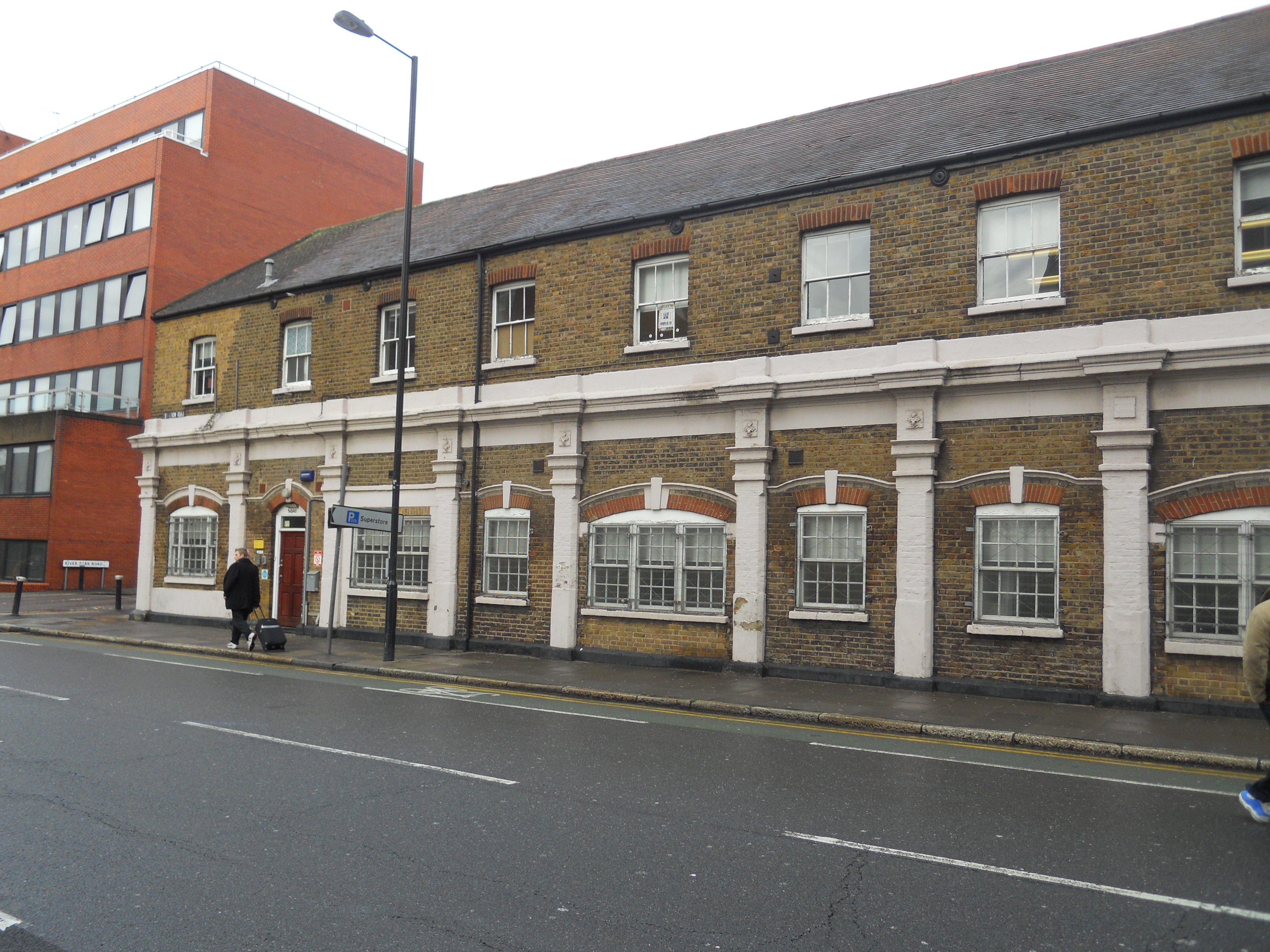
They were not the most salubrious of premises and my father was always making improvements.
My father was a very good practical carpenter and an accomplished painter and decorator.
The back wall of the building was covered on the inside with damp and mould, which even in the 1950s, he thought could be a health hazard, so he decided to do something about it.
- Above a certain height he cleaned the wall and painted it with a standard magnolia paint.
- About two metres above the ground, he fixed a two-by-two batten piece of wood to the wall.
- He also fixed another one to the wall, perhaps halfway up.
- To cover all the damp and mould, he then fixed corrugated asbestos cement sheeting to the two battens with galvanised roofing nails.
- To finish it off he screwed a piece of slatting to the top batten, which he painted a fetching blue colour.
The damp and mould was now out of sight and out of mind.
I remember how this construction was done, as I was my father’s ten-year-old assistant.
Although we’d used asbestos cement sheeting, I don’t think either my father or myself inhaled any asbestos dust, although we weren’t wearing masks, as no-one did in those days.
ICI And Asbestos
My next encounter with asbestos was at ICI in the late 1960s.
- A lot of chemical plants, built before the Second World War were riddled with it.
- But ICI, knew of the problems, and I was given strong warnings about asbestos.
- As I was only putting instruments on plants, with experienced plant fitters, I didn’t have an real encounters with it.
But why if ICI were so anti, were builders still using it and otherwise sensible companies not removing it from their buildings?
This is the large paragraph in The Times article.
An M&S spokesman said: “Like many older buildings, Marble Arch dates back to the interwar era when asbestos was commonly used in construction, and sadly our former colleague Janice Allen worked in the store over 40 years ago, before the consequences of asbestos use were known. Today we rigorously manage asbestos where it is present and ensure the store is safe for every colleague and customer.”
If ICI were worried about asbestos in the late 1960s, why weren’t Marks & Spencer worried about asbestos in the late 1970s.
A Barn In Suffolk
In the 1980s, I put up a new barn, where we lived.
Often, in those days, asbestos was still used for roofing, but I was recommended to use a new British Steel product, where steel was covered in a coloured weatherproof coating.
I Sneeze A Lot
These days, I sneeze a lot, but I didn’t sneeze this much before I was diagnosed as coeliac and went gluten-free.
Could it be that my immune system is so much stronger and when there is something in the air, it is only giving it a good kicking?
I’ve been sneezing a lot for the past few days, as the Council removed a dead tree from outside my house.
But we do know, that Nottingham University have shown, coeliacs on a gluten-free diet have a 25 % lower cancer rate than the general population.
Could this be due to a stronger immune system?
My Coeliac Son Died From Cancer
I believe my youngest son was an undiagnosed coeliac and he lived the rock-n-roll lifestyle on a diet of ciggies, cannabis and Subways, as he was a sound engineer in the music business. He died virtually out of the blue of pancreatic cancer at just thirty-seven.
So on the one hand being a diagnosed coeliac on a gluten-free diet gives you a certain immunity to cancer and other diseases and on the other hand undiagnosed coeliacs are prey to all the nasties we have to live with.
To return to the tragic story in The Times, which gives Stuart’s age as 62, so that places him as being born around 1960 and his late wife; Janice looks about the same age.
I think it is true to say, that in the 1960s, medicine started to change dramatically.
- Serious heart operations and kidney transplants became commonplace.
- The first heart transplant was performed in 1967.
- Drugs were improving.
- Vaccination was stopping polio and other diseases.
- The first test for coeliac disease in children was developed. Sadly, it wasn’t used on me.
But we had little inkling of the role of genes in diseases.
Incidentally, I didn’t come across my first coeliac, until 1972, when a neighbour had a coeliac baby son called Nicholas.
So was the poor lady in The Times story, in some ways a victim of her time?
- Asbestos was wrongly ignored by Marks & Spencer.
- Medicine hadn’t advanced enough to be able to identify, those susceptible to cancer.
- I have heard so many stories of bad use of asbestos.
Sadly, the dangers of asbestos are still ignored by many companies and organisations today and that includes the NHS.
One of my colleagues at ICI in 1968 will be livid at how we are ignoring asbestos.
Is This A Possible Scenario?
Consider.
- Someone is born coeliac and they are not diagnosed.
- If they were born before 1960, there was no test for coeliac disease in children.
- The simple genetic blood test came in around the turn of the century.
- They work with asbestos in their twenties.
- Their immune system is not good enough to protect them.
Just like my son, will they get a serious cancer?
Coeliac Disease And Covid-19
In Risk Of COVID-19 In Celiac Disease Patients, I look at a pier-reviewed paper from the University of Padua.
This sentence, sums up the study.
In this analysis we report a real life “snapshot” of a cohort of CeD patients during the SARS-CoV-2 outbreak in Italy, all followed in one tertiary centre in a red area of Northern Italy. Our data show, in accordance with Emmi et al., the absolute absence of COVID-19 diagnosis in our population, although 18 subjects experienced flu-like symptoms with only one having undergone naso-pharyngeal swab.
There were 138 coeliac disease subjects in the study and they had been gluten-free for an average of 6.6 years.
The downside of this, is how many undiagnosed coeliacs, suffered a severe dose of Covid-19.
Conclusion
Given the pain coeliac disease has inflicted on my family over the years, I believe that all children should be tested for coeliac disease.
I would also recommend, that anybody thinking of working with asbestos or taking a job with a high cancer risk, should get themselves tested for coeliac disease.
Being found to suffer from coeliac disease will not in itself kill you, and with the right diet, it might even prolong your life.
Cheesecake Energy Collects £9.4m Government Funding
The title of this post, is the same as that of this article on UKTN.
These two paragraphs outline how they will use the grant.
Cheesecake Energy will use the government funding to install its energy storage solution as a microgrid in Colchester to help with local grid limitations.
University of Nottingham spinout Cheesecake Energy’s installation will collect energy made by a solar farm with a capacity of 8MW and a central heat pump that supplies a district heat pump network.
Cheesecake Energy have been on my list of possible successful energy storage systems for some time and this sounds like a very neat application for energy storage.
Cheesecake Energy bill themselves on their web site as The World’s Greenest Battery, which is a big claim to make.
This outline of their technology is given on their Our Technology page.
Cheesecake Energy’s eTanker energy storage system is a stationary, medium to long-duration energy storage solution which delivers cheap, reliable, efficient energy storage in a modular, containerised package.
The technology stores energy in the form of heat and pressurised air, re-tasking ex-service truck engines to become zero-emission electrical power-conversion machines for putting energy into storage and recovering it from storage. The resulting system does not use diesel or any fuel. It is safe, straightforward to operate, has a lifetime of up to 25 years and can deliver turnaround efficiencies of around 70%.
I like the idea of using recycled truck engines at the heart of the system.
Conclusion
The World’s Greenest Battery could be right!
SSE Thermal Outlines Its Vision For The UK’s Net Zero Transition
The title of this post is the same as that of this news item from SSE Thermal.
This is the opening statement.
SSE Thermal, part of SSE plc, is calling on government to turbocharge the delivery of low-carbon technologies to help deliver a net zero power system by 2035.
Two paragraphs then outline what the company is doing.
The low-carbon developer is bringing forward multiple low-carbon projects across the UK. This includes Keadby 3 Carbon Capture Power Station in the Humber – which is being developed in collaboration with Equinor and recently became the first power CCS project in the country to receive planning permission – and Aldbrough Hydrogen Pathfinder, which would unite hydrogen production, storage and power generation in one location by the middle of this decade.
These projects would form part of SSE’s £24bn investment programme in the UK, and in addition to supporting the decarbonisation of industrial heartlands and powering a low-carbon future, they would also help to secure a just transition for workers and communities.
The news item then talks about the future.
Now, SSE Thermal has published ‘A vision for the UK’s net zero transition’ which outlines the need for these low-carbon technologies and the potential of carbon capture and hydrogen in providing flexible back-up to renewables.
It also outlines the steps Government should take to facilitate this:
- Progress the deployment of carbon capture and storage (CCS) and hydrogen infrastructure in a minimum of four industrial areas by 2030.
- Support first-of-a-kind carbon capture and storage and hydrogen projects to investment decisions before the end of next year.
- Increase its ambition for power CCS to 7-9GW by 2030, with regular auctions for Dispatchable Power Agreements.
- Set out a policy ambition for hydrogen in the power sector and a strategy for delivering at least 8GW of hydrogen-capable power stations by 2030.
- Accelerate the delivery of business models for hydrogen transport and storage infrastructure, to kickstart the hydrogen economy.
These are my thoughts.
Carbon Capture And Use
There is no mention of Carbon Capture And Use, which in my view, should go hand in hand with Carbon Capture And Storage.
- Sensible uses for carbon dioxide include.
- Feeding it to plants like tomatoes, flowers, salad vegetables, soft fruit and herbs in greenhouses.
- Mineral Carbonation International can convert a dirty carbon dioxide stream into building products like blocks and plasterboard.
- Deep Branch, which is a spin-out from Nottingham University, can use the carbon dioxide to make animal feed.
- Companies like CarbonCure add controlled amounts of carbon dioxide to ready-mixed concrete to make better concrete and bury carbon dioxide for ever.
Surely, the more carbon dioxide that can be used, the less that needs to be moved to expensive storage.
Note.
- There is a lot of carbon dioxide produced in Lincolnshire, where there are a lot of greenhouses.
- At least three of these ideas have been developed by quality research in Universities, in the UK, Australia and Canada.
- I believe that in the future more uses for carbon dioxide will be developed.
The Government should do the following.
- Support research on carbon capture.
- Support Research on finding more uses for carbon dioxide.
Should there be a disposal premium or tax credit paid to companies, for every tonne of carbon dioxide used in their processes? It might accelerate some innovative ideas!
Can We Increase Power CCS to 7-9GW by 2030?
That figure of 7-9 GW, means that around a GW of CCS must be added to power stations every year.
Consider.
- It is probably easier to add CCS to a new-build power station, than one that is a couple of decades old.
- Better and more affordable methods of CCS would probably help.
- In Drax To Pilot More Pioneering New Carbon Capture Technology, I wrote about a promising spin-out from Nottingham University
- In Drax Secures £500,000 For Innovative Fuel Cell Carbon Capture Study, I wrote about another system at Drax, that captures carbon dioxide from the flue gases at Drax.
If we develop more ways of using the carbon dioxide, this will at least cut the cost of storage.
Can We Deliver At Least 8GW Of Hydrogen-Capable Power Stations By 2030?
Do SSE Thermal mean that these power stations will always run on hydrogen, or that they are gas-fired power stations, that can run on either natural gas of hydrogen?
In ‘A vision for the UK’s net zero transition’, this is said about the hydrogen power stations.
Using low-carbon hydrogen with zero carbon emissions at point of combustion, or blending hydrogen into existing stations.
So if these power stations were fitted with carbon capture and could run on any blend of fuel composed of hydrogen and/or natural gas, they would satisfy our needs for baseload gas-fired power generation.
Hydrogen Production And Storage
SSE’s vision document says this about Hydrogen Production.
Using excess renewables to create carbon-free hydrogen, alongside other forms of low-carbon hydrogen, which can then be stored and used to provide energy when needed.
SSE’s vision document also says this about Hydrogen Storage.
Converting existing underground salt caverns or creating new purpose-built caverns to store hydrogen and underpin the hydrogen economy.
This page on the SSE Thermal web site is entitled Aldbrough Has Storage, where this is said about storing hydrogen at Aldbrough.
In July 2021, SSE Thermal and Equinor announced plans to develop one of the world’s largest hydrogen storage facilities at the Aldbrough site. The facility could be storing low-carbon hydrogen as early as 2028.
With an initial expected capacity of at least 320GWh, Aldbrough Hydrogen Storage would be significantly larger than any hydrogen storage facility in operation in the world today. The Aldbrough site is ideally located to store the low-carbon hydrogen set to be produced and used in the Humber region.
From my own experience, I know there is a similar salt structure in Cheshire, which has also been used to store gas.
Earlier, I said, that one of the things, that SSE would like the Government to do is.
Progress the deployment of carbon capture and storage (CCS) and hydrogen infrastructure in a minimum of four industrial areas by 2030.
If Cheshire and Humberside are two sites, where are the other two?
Deciding What Fuel To Use
If you take the Humberside site, it can provide electricity to the grid in three ways.
- Direct from the offshore and onshore wind farms.
- Using natural gas in the gas-fired power stations.
- Using hydrogen in the gas-fired power stations.
SSE might even add a battery to give them a fourth source of power.
In the 1970s, I used dynamic programming with Allied Mills to get the flour mix right in their bread, with respect to quality, cost and what flour was available.
Finance For SSE Thermal Plans
The news item says this.
These projects would form part of SSE’s £24bn investment programme in the UK.
£24bn is not the sort of money you can realise solely from profits or in sock drawers or down sofas, but provided the numbers add up, these sorts of sums can be raised from City institutions.
Conclusion
I like SSE Thermal’s plans.
Why A Lucky Few May Help The Rest Of Us Beat Disease
The title of this post, is the same as that of this article in The Times.
This is the sub-title.
A British biotech firm believes patients who defy odds could hold the key in their blood.
These three paragraphs introduce the article.
Patient 82 should be dead. At the age of 63 he was diagnosed with pancreatic cancer. In most cases, he would not have lasted a year. But seven years on, patient 82 is alive. Not merely alive — thriving.
He enjoys gardening. He likes seeing his grandchildren. He enjoys life.
How? The answer, a British biotech company believes, could lie in his blood. Now, with the help of dozens of other anonymous patients, all of whom have defied their cancer prognoses, they hope to find it.
Note, that the company is Alchemab Therapeutics.
The article got me thinking about myself.
I belong to a group of people, who are twenty-five percent less likely to suffer from cancer according to peer-reviewed research at Nottingham University.
I am coeliac and adhere to a strict gluten-free diet.
There may be other benefits too!
I have not had a serious dose of the covids, although I may have had a very mild case at the beginning of 2020 after I shared a train with a large number of exuberant Chinese students, who had recently arrived at Manchester Airport and were going to their new University across the Pennines.
I have also since found at least another seventy coeliacs, who have avoided serious doses of the covids.
Research From The University Of Padua
This paper on the US National Library of Medicine, which is from the University of Padua in Italy.
The University followed a group of 138 patients with coeliac disease, who had been on a gluten-free diet for at least six years, through the first wave of the Covid-19 pandemic in Padua.
This sentence, sums up the study.
In this analysis we report a real life “snapshot” of a cohort of CeD patients during the SARS-CoV-2 outbreak in Italy, all followed in one tertiary centre in a red area of Northern Italy. Our data show, in accordance with Emmi et al., the absolute absence of COVID-19 diagnosis in our population, although 18 subjects experienced flu-like symptoms with only one having undergone naso-pharyngeal swab.
It says that no test subject caught Covid-19, in an admittedly smallish number of patients.
But it reinforces my call for more research into whether if you are a diagnosed coeliac on a long-term gluten-free diet, you have an immune system, that gives you a degree of protection from the Covids.
The Times article mentions the immune system.
I believe my immune system to be strong after the reaction I had to the Astra Zeneca vaccine. I didn’t feel well to say the least after my Astra Zeneca vaccine and my GP and other doctors felt that it could be due to my immune system, thinking that the chimpanzee virus-based vaccine was a danger and attacking it.
Significantly, I had no reaction to the second dose. So had my immune system recognised the vaccine as a friend not a foe?
My son, who my late wife was sure was an undiagnosed coeliac, died of pancreatic cancer at just 37.
How did my late wife know? Don’t question her intuition and also she felt that my son and myself felt the same to her touch.
It should be noted that my son’s daughter was born with a Congenital hernia of the Diaphragm. Congenital defects can happen to people, who have a coeliac father.
At the age of 20, my granddaughter is fine now, after heroic surgery at the Royal London Hospital, at just a few days old.
Making Carbon Dioxide Into Protein For Innovative Animal Feed
The title of this post, is the same as that of this article on Horizon.
These are the first three paragraphs.
It’s common knowledge that proteins, a key component of human nutrition, are also essential for making animal feeds. Less well known is the uncomfortable fact that much of the protein we feed animals in Europe leads to deforestation and overfishing worldwide.
Biotechnology start-up Deep Branch have designed a biochemical transformation process that turns carbon dioxide (CO2) into a protein-rich powder for animals to eat.
The Deep Branch process converts carbon dioxide into a powder, called Proton, which has around 70% protein content. This is much higher than natural soy, which has around 40%.
Note.
- The technology is the brainchild of Peter Rowe, a PhD graduate in molecular biology of Nottingham University in the UK.
- Deep Branch appears to be a well-backed Anglo-Dutch company.
- Their backers are European and British household names and institutions.
- Drax, who have plenty of carbon dioxide, are also backers.
I believe that even if Deep Branch doesn’t succeed, then someone else will, with this technology.
Coeliac Disease And Atrial Fibrillation
I am 75 and coeliac and I had or have atrial fibrillation. Cardiologists tell me that, the atrial fibrillation led to my stroke in 2011.
I should also say, that my father was an undiagnosed coeliac and he died from a stroke younger than I am now.
I typed the title of this post into Doctor Google.
I found this paper on Cureus, which is entitled Celiac Disease and Risk of Atrial Fibrillation: A Meta-Analysis and Systematic Review.
I will show two paragraphs from the Abstract,
This is the Introduction.
Several studies have found celiac disease may be associated with a variety of cardiac manifestations. Atrial fibrillation (AF) is one of the most common arrhythmias that can cause significant morbidity. However, the risk of atrial fibrillation in patients with celiac disease according to epidemiological studies remains unclear. The aim of this meta-analysis study is to assess the risk of atrial fibrillation in patients diagnosed with celiac disease compared to controls.
And this is the Conclusion.
A significant association between celiac disease and risk of atrial fibrillation was reported in this study. There is a 38% increased risk of atrial fibrillation. Additional studies are needed to clarify the mechanistic link between atrial fibrillation and celiac disease. Some of the limitations of this study are that all were observational studies, some were medical registry-based and there was high heterogeneity between studies.
One of the paper’s conclusions is more research needs to be done.
I know that I have a supercharged immune system, in that it seems to protect me from flu and the dreaded covids and it gave the AstraZeneca vaccine a good kicking. Research from Nottingham University has also shown, that coeliacs on a gluten-free diet have a 25 % lower risk of cancer compared to the general population.
So I asked Doctor Google if there was any link between the immune system and atrial fibrillation.
I found this paper on PubMed, which is entitled The Role Of Immune Cells In Atrial Fibrillation.
This was the Abstract.
Atrial fibrillation (AF) is the most common sustained arrhythmia, but its mechanisms are poorly understood. Recently, accumulating evidence indicates a link between immune response and AF, but the precise mechanism remains unclear. It should be noticed that the relationship between immune response and AF is complex. Whether immune response is a cause or a result of AF is unclear. As the functional unit of the immune system, immune cells may play a vital role in the immunological pathogenesis of AF. In this review, we briefly highlight the evidence on relationships between immune cells and AF, and discuss their potential roles in AF pathogenesis. We hope this review could provide new orientation and enlightenment for further research on AF mechanism.
One of the paper’s conclusions is more research needs to be done.
Conclusion
I feel a lot of research concerning coeliacs, their immune systems and atrial fibrillation should be done and this could lead to a better understanding of atrial fibrillation.
Drax To Pilot More Pioneering New Carbon Capture Technology
The title of this post, is the same as that of this press release from Drax.
This is the first paragraph.
Renewable energy pioneer Drax has partnered with the University of Nottingham and Promethean Particles to trial a pioneering new bioenergy with carbon capture and storage (BECCS) process at its North Yorkshire power station.
Normally, carbon capture from the flue gas of a power station uses a liquid solvent, which dissolves the carbon dioxide.
However, the process that Drax are trialling, uses porous compounds called metal–organic frameworks (MOFs) to absorb the carbon dioxide.
This page on the Promethean Particles web site described how their carbon-capture works.
Traditional solvent-based carbon capture systems require a significant amount of energy to regenerate the carbon-capturing material. In power generation applications, estimates put this energy penalty at up to 35% of the power station’s output. Metal-organic frameworks (MOFs) capture carbon mainly through physical, not chemical means. This “trapping” process requires lower energy inputs to regenerate the MOFs and can therefore help achieve more energy-efficient carbon capture. By using MOF-based carbon capture, more of the power generated can go where it was intended, lowering the price of energy for consumers and CAPEX for the power generators.
Note.
- It is a physical rather than a chemical process.
- It is more energy efficient than traditional carbon-capture.
This Drax graphic from the press release, shows how this process can be incorporated into a power plant..
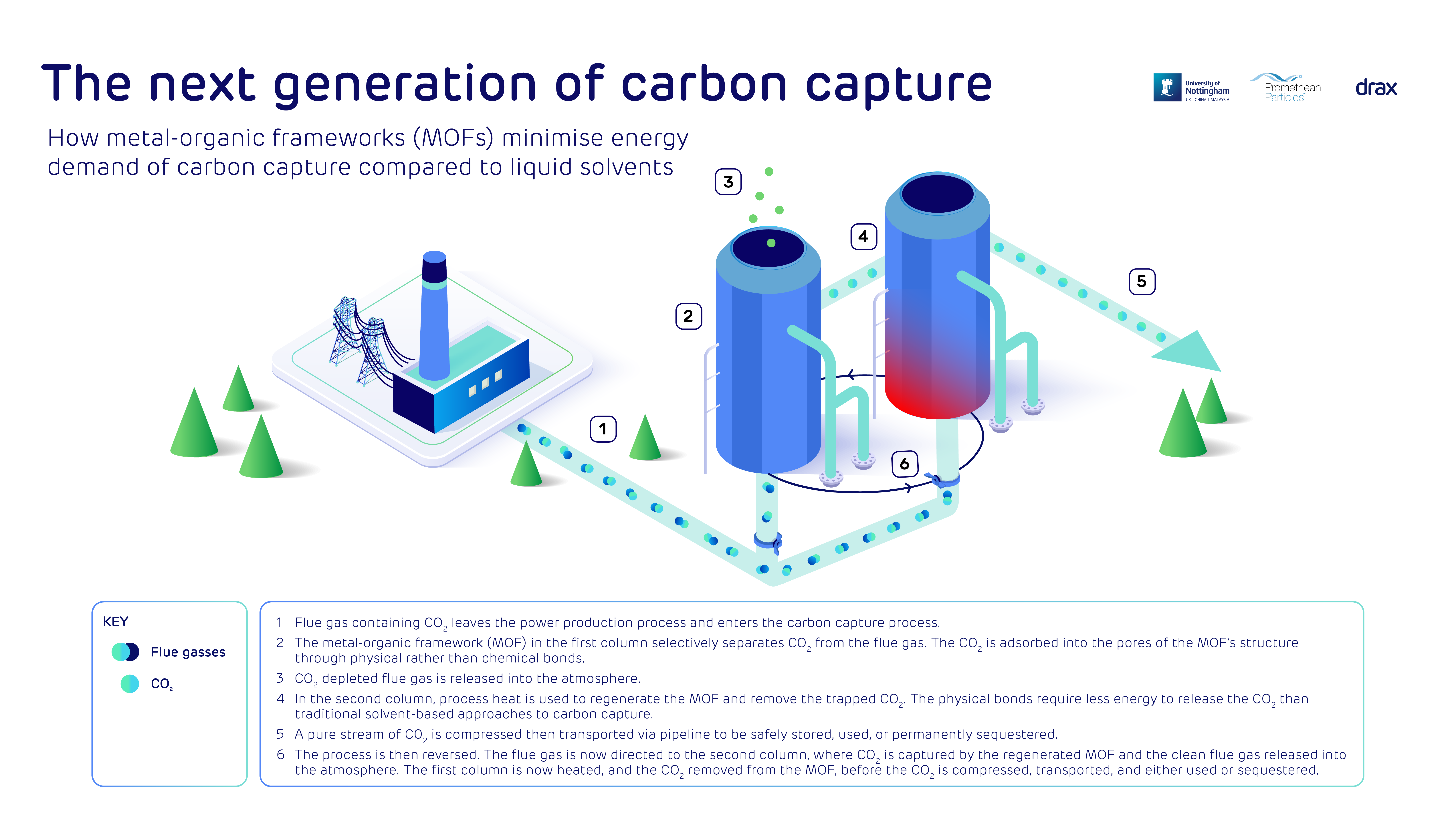
Note.
- The trial will last for two months and will be hosted within Drax’s BECCS incubation hub at its North Yorkshire Power Station.
- Metal Organic Frameworks are a unique class of solid sorbents offering lower operational costs and reducing potential environmental impacts.
Work to build BECCS at Drax could get underway as soon as 2024, with the creation of thousands of jobs.
Fifty years ago, I spent several months at ICI looking at the mathematics of different numbers and sizes of vessels of in a proposed chemical plant, to optimise the cost of the plant.
- I suspect a similar analysis could be applied to this process.
- It would surely be very suitable for Drax, whose main power station has four units fuelled by biomass and another fuelled by natural gas.
- Are two columns containing MOF, the optimum number?
- The calculation could involve a lot of permutations and combinations, which I’ve used to advantage for over fifty years.
I will follow this trial with interest.
Conclusion
This is another application of advanced physics and chemistry.
If Promethean Particles ever decide to go the crowdfunding route, I would look seriously at a small investment.
Cheesecake Energy Secures £1M Seed Investment
The title of this post, is the same as that of this Press Release from Cheesecake Energy.
This is the first paragraph.
Cheesecake Energy Ltd (CEL), a Nottingham, UK-based energy storage startup today announced it has raised £1M in Seed funding to fuel the development of its manufacturing capabilities and support product development of its eTanker storage system. The round was led by Imperial College Innovation Fund alongside prominent investors including Perivoli Innovations, former Jaguar Chairman, Sir John Egan and other angel investors.
And the third and fourth paragraphs describe the technology.
The company’s unique technology, dubbed eTanker, takes established compressed air energy storage concepts and revolutionises them by storing two-thirds of the electricity in the form of heat which can be stored at far lower cost. To store the energy, electric motors are used to drive compressors, which deliver high pressure air & heat into storage units. When the electricity is required, the high-pressure air and heat is passed back through the same compressor (but now working as a turbine), which turns a generator to produce electricity. The company believes its system will cut the cost of storing energy by 30-40% and offers a solution that can be used in several sectors including electric vehicle (EV) charging, heavy industry and renewable energy generation.
The startup has filed 10 patents for stationary, medium-long-duration, long-lifetime energy storage technology. It is based on innovative design work by CEL, a spin-out from over a decade of research at University of Nottingham. Employing circular economy principles, truck engines are converted into zero-emission electrical power-conversion machines for putting energy into and out of storage. Its technology brings together the low cost of thermal storage, the turnaround efficiencies of compressed air energy storage, together with the long life and robustness of a mechanical system, making a game-changing technology in a modular containerised package.
It all sounds feasible to me and if I’d have been asked, I’d have chipped in some of my pension.
The system in some ways can almost be considered a hybrid system that merges some of the principles of Highview Power’s CRYOBattery and Siemens Gamesa’s ETES system of heating large quantity of rock. Although, Cheesecake’s main storage medium is comptressed air, as opposed to the liquid air of the CRYOBattery.
One market they are targeting is the charging of fleets of electric vehicles like buses and from tales I have heard about operators of large numbers of electric buses, this could be a valuable market.
I also noted that the Press Release mentions a National Grid report, that says we will need 23 GW of energy storage by 2030. Assuming we will need to store enough electricity to provide 23 GW for five hours, that will be 115 GWh of energy storage.
At present, pumped storage is the only proven way of storing tens of GWh of energy. In 1984, after ten years of construction, Dinorwig power station (Electric Mountain) opened to provide 9.1 GWh of storage with an output of 1.8 GW.
So ideally we will need another thirteen Electric Mountains. But we don’t have the geography for conventional pumped storage! And as Electric Mountain showed, pumped storage systems are like Rome and can’t be built in a day.
Energy storage funds, like Gresham House and Gore Street are adding a large number of lithium-ion batteries to the grid, but they will only be scratching the surface of the massive amount of storage needed.
Note that at the end of 2020, Gresham House Energy Storage Fund had a fleet of 380 MWh of batteries under management, which was an increase of 200 MWh on 2019. At this rate of growth, this one fund will add 2GWh of storage by 2030. But I estimate we need 115 GWh based on National Grid’s figures.
So I can see a small number of GWh provided by the likes of Gresham House, Gore Street and other City funds going the same route.
But what these energy storage funds have proved, is that you have reliable energy storage technology, you can attract serious investment for those with millions in the piggy-bank.
I believe the outlook for energy storage will change, when a technology or engineering company proves they have a battery with a capacity of upwards of 250 MWh, with an output of 50 MW, that works reliably twenty-four hours per day and seven days per week.
I believe that if these systems are as reliable as lithium-ion, I can see no reason why City and savvy private investors money will not fund these new technology batteries, as the returns will be better than putting the money in a deposit account, with even the most reputable of banks.
At the present time, I would rate Highview Power’s CRYOBattery and Siemens Gamesa’s ETES system as the only two battery systems anywhere near to a reliable investment, that is as safe as lithium-ion batteries.
- Both score high on being environmentally-friendly.
- Both rely on techniques, proven over many years.
- Both don’t need massive sites.
- Both systems can probably be maintained and serviced in nearly all places in the world.
- Highview Power have sold nearly a dozen systems.
- Highview Power are building a 50 MW/250 MWh plant in Manchester.
- Siemens Gamesa are one of the leaders in renewable energy.
- Siemens Gamesa have what I estimate is a 130 MWh pilot plant working in Hamburg, which I wrote about in Siemens Gamesa Begins Operation Of Its Innovative Electrothermal Energy Storage System.
Other companies are also targeting this market between lithium-ion and pumped storage. Cheesecake Energy is one of them.
I believe they could be one of the winners, as they have designed a system, that stores both compressed air and the heat generated in compressing it. Simple but efficient.
I estimate that of the 115 GWh of energy storage we need before 2030, that up to 5 GWh could be provided by lithium-ion, based on the growth of installations over the last few years.
So we will need another 110 GWh of storage.
Based on 50 MW/250 MWh systems, that means we will need around 440 storage batteries of this size.
This picture from a Google Map shows Siemens Gamesa’s pilot plant in Hamburg.
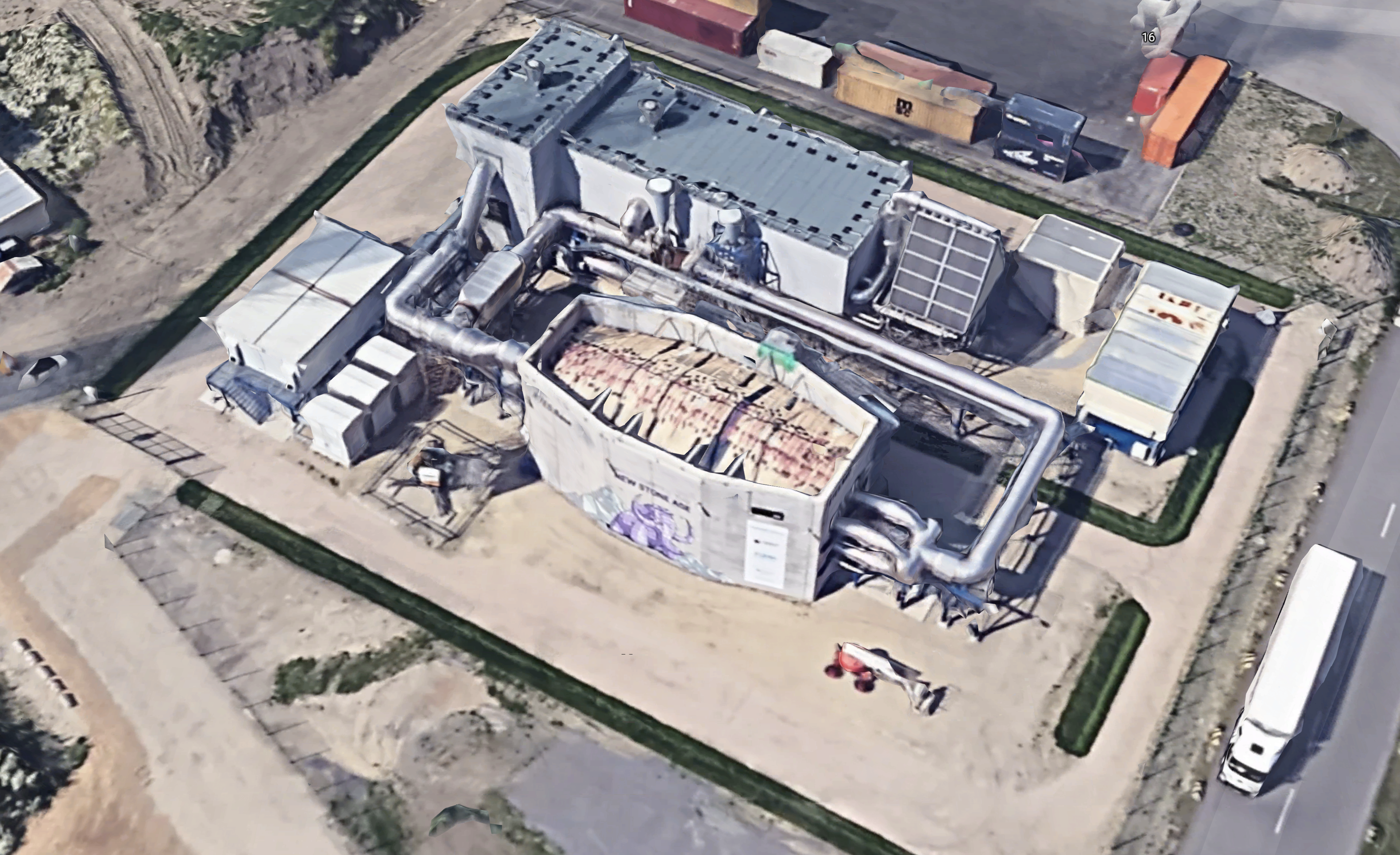
I estimate that this plant is around 130 MWh of storage and occupies a site of about a football pitch, which is one hectare.
I know farmers in Suffolk, who own more land to grow wheat, than would be needed to accommodate all the batteries required.
Conclusion
I believe that National Grid will get their 23 GW of energy storage.
 The Anonymous Widower