Ørsted Greenlights 2.9 GW Hornsea 3 Offshore Wind Farm
The title of this post, is the same as that of this article on offshoreWIND.biz.
This is the sub-heading.
Ørsted has taken the final investment decision (FID) on what the company says is the world’s single largest offshore wind farm, the 2.9 GW Hornsea 3, which is expected to be completed around the end of 2027.
These are the two introductory paragraphs.
In July 2022, Ørsted was awarded a contract for difference (CfD) for Hornsea 3 at an inflation-indexed strike price of GBP 37.35 per MWh in 2012 prices.
The CfD framework permits a reduction of the awarded CfD capacity. The company said it will use this flexibility to submit a share of Hornsea 3’s capacity into the UK’s upcoming allocation round 6.
With all the work, that Ørsted have done to protect kittiwakes, which I wrote about in Kittiwake Compensation, the company seems to have been taking the development of this wind farm carefully and this statement from the wonderfully-named Mads Nipper, Group President and CEO of Ørsted indicates that the UK Government has been persuasive in times, that are not totally favourable to wind farm developers.
Offshore wind is an extremely competitive global market, so we also welcome the attractive policy regime in the UK which has helped secure this investment. We look forward to constructing this landmark project, which will deliver massive amounts of green energy to UK households and businesses and will be a significant addition to the world’s largest offshore wind cluster.
But the article also has this paragraph.
According to Ørsted, most of Hornsea 3’s capital expenditure was contracted before recent inflationary pressures, securing competitive prices from the supply chain, adding that the larger wind turbines and the synergies with Hornsea 1 and 2 lead to lower operating costs.
It looks like Ørsted, may have taken advantage of Siemens well-publicised financial woes and got a good price for the over two hundred turbines.
This page on the Hitachi web site, describes their part in Hornsea 3, where this is said.
Hitachi Energy has supported Ørsted with the grid connection of Hornsea One and Hornsea Two, but Hornsea 3 will be the first phase to use HVDC application in the Hornsea cluster.
The overall HVDC system, including the offshore platform, is delivered in partnership with Aibel. Hitachi Energy will supply two HVDC Light® converter systems, while Aibel will deliver two HVDC offshore converter platforms. The platform is based on Hitachi Energy’s modular HVDC system including its advanced control and protection system, MACH™. As the HVDC offshore market grows and becomes more complex, Hitachi Energy will continue to develop solutions with its customers and partners to enable a more flexible offshore grid of the future.
Hitachi Energy is supplying four HVDC converter stations, which convert AC power to DC for transmission in the subsea cables, then reconvert it to AC for integration into the onshore grid. Two of the converter stations will be installed on offshore platforms and two at mainland grid connections.
Note.
- Hitachi are pushing their electrical innovation hard.
- Hitachi and Ørsted have worked together on Hornsea 1 and 2.
- What better place is there for Hitachi to test their new modular HVDC system, than on one of the world’s largest wind farms?
- Hitachi appear to say, they like to develop with customers and partners.
It looks to me, that Ørsted may well have got new improved technology at an advantageous price.
This is the last paragraph of the article.
The Hornsea zone will also include the Hornsea 4 project, which could have a capacity of up to 2.6 GW. The wind farm received its development consent order from the UK government earlier in 2023 and is now eligible for forthcoming CfD allocation rounds.
So will Hornsea 4 be a slightly smaller version of Hornsea 3 using the same suppliers?
- There could be savings in the design and manufacturing of the electrical systems, foundations, sub-stations and turbines.
- Could for instance, Hitachi’s modular HVDC result in savings in converters and sub-stations, if the two wind farms shared infrastructure?
- I’m sure that Siemens, Hitachi and the other suppliers will be happy to just keep rolling.
- It would be an ideal follow-on.
It looks to me, that by using good design and management, and established suppliers, Ørsted have managed to get the costs of Hornsea 3 and Hornsea 4 to a level, where the venture is profitable.
Vestas and Vattenfall Sign 1.4 GW Preferred Supplier Agreement For UK Offshore Wind Project And Exclusivity Agreements For 2.8 GW For Two Other UK Projects
The title of this post, is the same as that of this press release from Vestas.
These are the first two paragraphs.
Vattenfall, one of Europe’s largest producers and retailers of electricity and heat, and Vestas have signed agreements to elevate the partnership between the two companies and their offshore wind business towards 2030. The agreements are another step in the right direction for offshore wind energy in the UK and follow the UK Government’s recent announcement about the parameters for the next Contracts for Difference Auction round, which sent a very positive signal to renewable energy investors.
The agreements for the three projects include a preferred supplier agreement (PSA) for the 1,380 MW Norfolk Vanguard West project, comprising 92 of Vestas’ V236-15 MW offshore wind turbine. Vattenfall and Vestas have further signed exclusivity agreements for the Norfolk Vanguard East and Norfolk Boreas projects with a total installed capacity of 2,760 MW. The two latter projects will potentially feature up to 184 V236-15 MW turbines. Once installed, the agreements also include that Vestas will service the projects under long-term Operations and Maintenance (O&M) service contracts. The agreements are another step forward for what will be one of the largest offshore wind zones in the world, with a capacity to power over 4 million UK homes.
It looks like Norfolk Boreas is back on Vattenfall’s list of active projects.
Vattenfall’s Norfolk zone now includes the following.
- Norfolk Vanguard West – 92 x V236-15 MW – 1380 MW
- Norfolk Vanguard East – 92 x V236-15 MW – 1380 MW
- Norfolk Boreas – 92 x V236-15 MW – 1380 MW
Note.
- All turbines appear identical.
- The deal includes long-term Operations and Maintenance (O&M) service contracts.
- 276 identical turbines plus service contracts looks like a good deal for Vestas.
Since I wrote Vattenfall Stops Developing Major Wind Farm Offshore UK, Will Review Entire 4.2 GW Zone in July 2023, which has this sub-heading.
Vattenfall has stopped the development of the Norfolk Boreas offshore wind power project in the UK and will review the way forward for the entire 4.2 GW Norfolk Zone, the Swedish energy company revealed in its interim report.
I have written the following posts.
- November 2023 – Aker Solutions Gets Vattenfall Nod To Start Norfolk Vanguard West Offshore Platform
- November 2023 – Norfolk Boreas Windfarm Work Could Resume After Energy Price Rise
- December 2023 – SeAH To Deliver Monopiles For Vattenfall’s 2.8 GW Norfolk Vanguard Offshore Wind Project
- Earlier in March 2023, I wrote Vattenfall Selects Norfolk Offshore Wind Zone O&M Base
It appears that with the deal announced with Vestas, Vattenfall now have everything they need to develop 4.2 GW of offshore wind.
- The O & M base will be Great Yarmouth.
- SeAH will build the monopile foundations on Teesside. Will all monopiles be identical?
- An energy price rise could change the cash flow of the project.
- Aker Solutions will build the offshore substations.Will all sub-stations be identical?
- Vestas will build the wind turbines.Will all turbines be identical?
Nothing has been said since July 2023 about how the power will be brought ashore.
In February 2022, I wrote Norfolk Wind Farms Offer ‘Significant Benefit’ For Local Economy, where I published this map from Vattenfall, which shows the position of the farms and the route of the cable to the shore.
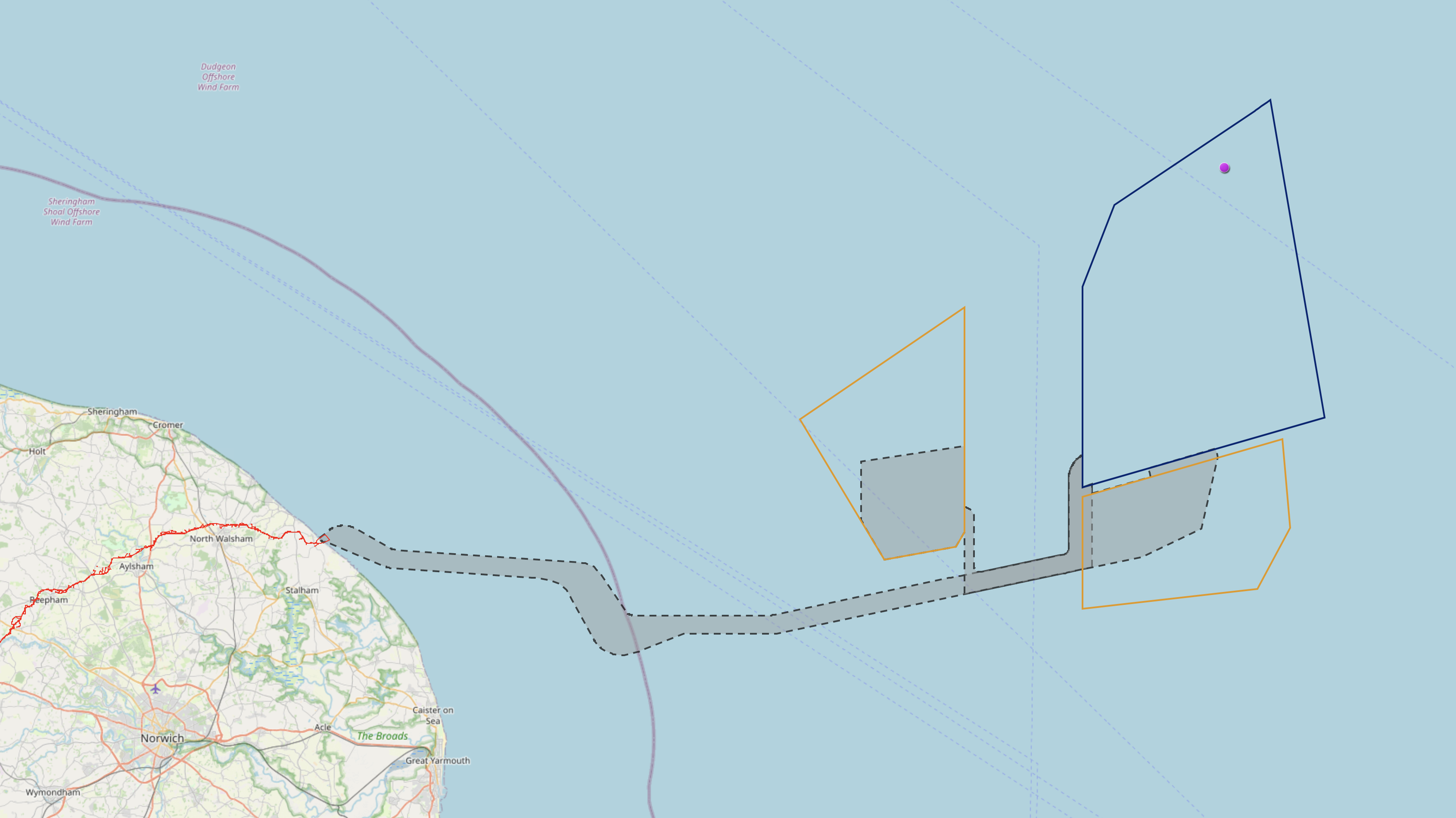
Note.
- The purple line appears to be the UK’s ten mile limit.
- Norfolk Boreas is outlined in blue.
- Norfolk Vanguard West and Norfolk Vanguard East are outlined in orange.
- Cables will be run in the grey areas.
- Cables to deliver 4.1 GW across Norfolk to the National Grid, will bring out the Nimbys in droves.
Landfall of the cables will be just a few miles to the South of the Bacton gas terminal.
In SeAH To Deliver Monopiles For Vattenfall’s 2.8 GW Norfolk Vanguard Offshore Wind Project, I asked if there could be an alternative approach.
Consider.
- If Vattenfall develop all three wind farms; Boreas, Vanguard East and Vanguard West, they will have 4.2 GW of capacity, when the wind co-operates.
- But East Norfolk is not noted for industries that need a large amount of electricity.
- I also feel, that the locals would object to a steelworks or an aluminium smelter, just like they object to electricity cables.
But would they object to a 4 GW electrolyser?
Could this be Vattenfall’s alternative approach?
- A giant electrolyser is built close to the landfall of the cable to the wind farms.
- The hydrogen could be piped to Bacton, where it could be blended with the UK’s natural gas.
- Bacton also has gas interconnectors to Balgzand in the Netherlands and Zeebrugge in Belgium. Could these interconnectors be used to export hydrogen to Europe?
- The hydrogen could be piped to Yarmouth, where it could be exported by tanker to Europe.
There would be only a small amount of onshore development and no overhead transmission lines to connect the wind farms to the National Grid.
There would be even less onshore development, if the electrolyser was offshore.
From their decisions, Vattenfall seem to have a new plan.
Thousands Pay More Tax In ‘Chaotic’ Yousaf Budget
The title of this post, is the same as that of this article in The Times.
It has this sub-heading.
Efforts to plug £1.5bn funding hole put Scotland at a disadvantage, say business leaders
I have a feeling that the rise in income tax will have unintended consequences.
The UK’s Current Hydrogen Plans
Last week, the UK Government announced grants for eleven big hydrogen projects, around the UK, with two in Scotland. The new Scottish electrolysers will be playing a large part in decarbonising the Scotch whisky industry and HGVs.
I wrote Major Boost For Hydrogen As UK Unlocks New Investment And Jobs to describe the investments scope and benefits.
The Government estimated that these grants will create 700 jobs, across the UK.
How many quality high-paid jobs will this funding create in Scotland? As two of the eleven projects are based in Scotland, it could be around 127 quality jobs.
More UK Hydrogen Plans Are On The Way
The Government also indicated that this was only the first stage of bringing hydrogen production to the UK, so I will expect more high-paid quality jobs will be created.
Projected UK Offshore Wind Power
This Wikipedia entry is a list of all installed, under-construction and proposed offshore wind farms in the UK.
Aggregating the new unbuilt wind farms says the following capacity will very likely be installed in the UK in the next few years.
- Scotland – 32, 750 MW.
- England – 25,558 MW
- Wales – 700 MW
As more proposals have been called for, particularly in the Celtic Sea, I don’t think it would be unreasonable to add perhaps another 10,000 MW.
Wind farms are also proposed for around the island of Ireland and in the waters of the Channel Islands.
Upgrading Of The National Grid
These three posts could well be forerunners of other posts, I will write in the next few months.
- National Grid Fast-Tracks Overhead Line Upgrade Project To Help Accelerate Connection Dates Of 175 Clean Energy Projects
- National Grid To Accelerate Up To 20GW Of Grid Connections Across Its Transmission And Distribution Networks
- National Grid’s London Power Tunnels Breakthrough Completes £1 Billion Project’s Tunnelling Activity
National Grid is increasing its capacity at a fast pace and will need a large number of quality engineers.
Crossrail And Electrical Engineers/Electricians
I suspect we’ll find, that when a report on the late delivery of Crossrail is published, an electrician shortage will get some of the blame.
I have friends, who are electricians. Because of the shortage of trained electricians, they were offered fortunes to work on Crossrail.
Do We Have Enough Engineers?
For all the reasons I have outlined, our path to net-zero will need a lot of trained electrical engineers and electricians and just as Crossrail showed, when there is a shortage of labour in a particular area, remuneration rises.
Electrical engineers and electricians in the British Isles will be able to pick and choose the jobs they take, just as they did with Crossrail and the other major projects being built at the same time.
Effects On Scotland
If you were an engineer, who had skills and could work on these projects, would you prefer to work on a project, where the tax rate was lower?
Scotland’s tax rise will harm their decarbonisation ambitions.
Surely, the Greens should have vetoed a tax increase, which will inevitably slow their progress to net-zero?
Or are Greens a tad short of the grey matter?
Conclusion
I believe the Scottish government has shot itself in the foot.
Airport Of The Future
I am fairly sure, that in ten years, there will be a lot of zero-carbon aircraft flying short haul routes. I have been particularly impressed by some of the ideas from Airbus, although Boeing seem to be very quiet on the subject. Perhaps it’s the difference between visionaries and engineers, and accountants.
But you rarely read anything about how airports are preparing for even a low-carbon future.
- Some long-stay car-parks could be made electric vehicles only, so they would become massive grid batteries, whilst owners are travelling.
- Airside vehicles can all be made zero-carbon.
- Sustainable aviation fuel (SAF) shouldn’t be a problem, as it would be handled like jet fuel.
- Do airports have a large enough grid connection for all the electrification of vehicles and some planes?
- Do airports have a plan for hydrogen?
The last two points, probably mean we should have built Maplin.
- It could have a cable and a hydrogen pipeline from wind farms and co-located hydrogen electrolysers in the Thames Estuary.
- The Elizabeth Line or a new line could easily be extended or built to the airport, to give a 125 mph connection.
But that enemy of the planet; Harold Wilson cancelled it.
GE’s Recently Unveiled 18 MW Wind Turbine To Spin Offshore Japan
The title of this post, is the same as that of this article on offshoreWIND.biz.
This is the sub-heading.
The three consortia that Japan’s Ministry of Economy, Trade, and Industry (METI) selected in the country’s second round of offshore wind auctions will use some of the biggest and most powerful wind turbines on/coming to the market – Vestas V236-15 MW and GE’s 18 MW Haliade-X.
Wind farms under construction or in pre-construction in the UK, as I write this post, include.
- Neart Na Gaoithe – 8 MW x 54 – 450 MW
- Sofia Offshore Wind Farm – 14 MW x 100 – 1400 MW
- Dogger Bank A – 13 MW x 95 – 1235 MW
- Moray West – 15 MW x 60 – 882 MW
- Dogger Bank B – 13 MW x 95 – 1235 MW
- Dogger Bank C – 14 MW x 87 – 1218 MW
- East Anglia Three – 14 MW x 95 – 1372 MW
- Hornsea Three – xx MW x 231 – 2852 MW
Note.
- I can’t find the turbine size for Hornsea Three.
- This article on The Telgraph is entitled Ørsted Asks For More Government Cash Amid Doubts Over Flagship Wind Farm Project, says that Ørsted and Claire Coutinho are talking.
- The total power is 10644 MW.
- There are a total of 817 turbines.
- This is an average turbine size of almost exactly 13 MW.
There would appear to be scope to increase the size of these wind farms by using the new larger turbines.
Just uprating the turbines to 15 MW would increase capacity by 15 %.
The frequency of stories like these are increasing.
Crown Estate Mulls Adding 4 GW Of Capacity From Existing Offshore Wind Projects
Vattenfall Boosts Capacity For Norfolk Offshore Wind Zone
Three Steps To Unlocking The Potential Of High-Power Wind Turbines
Ossian Floating Wind Farm Could Have Capacity Of 3.6 GW
Developers are seriously thinking of building or upgrading wind farms with larger turbines and other capacity-increasing technology.
Floating Solar Not Yet Up to Par To Be Brought Into Offshore Wind Tenders, Says BP’s Benelux Head Of Offshore Wind
The title of this post, is the same as that of this article on offshoreWIND.biz.
This is the sub-heading.
System integration is what is needed for the next leap in offshore wind, however, not all technologies that can integrate with offshore wind farms have the same starting point. Floating solar still has some way to go in becoming more resilient to harsh offshore conditions. On the other hand, hydrogen is a more ready option with plenty of support from the industry, but it needs to be included and clearly defined in offshore wind tenders.
These two paragraphs describe the views of Frank Oomen, Head of Offshore Wind Benelux at BP.
This is according to Frank Oomen, Head of Offshore Wind Benelux at BP, who discussed financial and qualitative criteria in offshore wind auctions during the Offshore Energy Exhibition & Conference 2023 (OEEC 2023).
Speaking about recently joining BP from the renewables industry, Oomen pointed out that, with offshore wind becoming larger scale, it needs to move in the direction of system integration and become an integrated energy business itself.
I had a lot of my engineering education, in ICI’s world of integrated chemical plants and I believe that Frank Oomen’s views are heading in the right direction.
If we take Frank Oomen’s views to their logical conclusion, we will see the following.
- Clusters of wind farms far from land in productive wind power areas.
- A nearby electrolyser will be producing hydrogen.
- The hydrogen will be taken to the shore by pipeline or tanker.
- BP with their oil and gas heritage, have been doing this for decades.
BP might even have some redundant gas infrastructure they can repurpose.
Siemens Gamesa And Vestas Collaborate To Standardise Equipment For Transportation Of Wind Turbine Towers
The title of this post, is the same as that of this article on offshoreWIND.biz.
This is the sub-heading.
Building on a previous collaboration focused on tower foundations and lifting guidelines, Siemens Gamesa and Vestas, facilitated by Energy Cluster Denmark, have signed a new partnership agreement to increase standardisation within the wind industry.
Surely standard sizes and similar designs will help any industry. Look at how containerisation has helped freight transportation.
These four paragraphs illustrate the problem and detail the solution.
Initially, the partners will standardise equipment for the transportation of wind turbine towers.
“Currently, whenever a wind turbine tower is shipped out for offshore installation, the manufacturer welds a box onto the installation vessel to which the tower is then clamped. The process is costly in terms of tons of iron and labour on the quayside. Once installation offshore is completed, all the equipment is removed from the vessel, which is again costly in terms of hours, money and the green transition,” said Jesper Møller, Chief Engineer in Offshore Execution at Siemens Gamesa.
The new partnership agreement comprises a series of projects involving equipment for and the storage of huge components produced by wind turbine manufacturers.
The first project focuses on sea fastening, involving securing towers, blades, and nacelles to installation vessels.
The article finished with statements about why standardisation is important.
First German Zero-Subsidy Offshore Wind Farm Starts Taking Shape
The title of this post, is the same as that of this article on offshoreWIND.biz.
This is the sub-heading.
Offshore installation work has started at the 913 MW Borkum Riffgrund 3, the first subsidy-free offshore wind farm in Germany to reach this development phase, Ørsted, the developer of the project, said.
These two paragraphs introduce the project.
The first of the 83 monopile foundations have now been installed at the site some 53 kilometres off the island of Borkum in the German North Sea by Jan De Nul’s Lez Alizés.
The installation directly follows the foundation work in the adjacent 253 MW Gode Wind 3 project, which is being built in parallel by Ørsted in the North Sea.
Ørsted’s web site gives this history of Borkum Riffgrund 3.
Borkum Riffgrund 3 is expected to be fully commissioned in 2025. It comprises three offshore wind projects which were originally awarded to Ørsted in auctions in 2017 and 2018 under the names of Borkum Riffgrund West 1, Borkum Riffgrund West 2 and OWP West. The three projects were renamed in September 2019 and will be built as one joint project under the name of Borkum Riffgrund 3.
Borkum Riffgrund 3 was awarded without subsidies to Ørsted. A number of companies across IT, retail and the chemicals industry have signed corporate power purchase agreements for Borkum Riffgrund 3.
If Ørsted is doing this in Germany, how come, we are not seeing more subsidy-free wind farms in Europe?
These two paragraphs from the article give a partial explanation.
After commissioning in 2025, a large part of the electricity generated by the wind farm will be used for the decarbonization of the industry – through the so-called Corporate Power Purchase Agreements (CPPAs). For the project, long-term power purchase agreements were concluded with the companies Covestro, Amazon, the Energie-Handels-Gesellschaft/REWE Group, as well as BASF and Google.
Shares for Borkum Riffgrund 3 were also sold to an institutional investor well before construction. In October 2021, Nuveen signed an agreement with Glennmont Partners to sell 50 percent of the shares in Borkum Riffgrund 3.
The article also states that Borkum Riffgrund 3 will be the largest offshore wind farm in Germany to date.
This Google Map shows the location of the German Borkum island to the North of the Dutch city of Groningen.
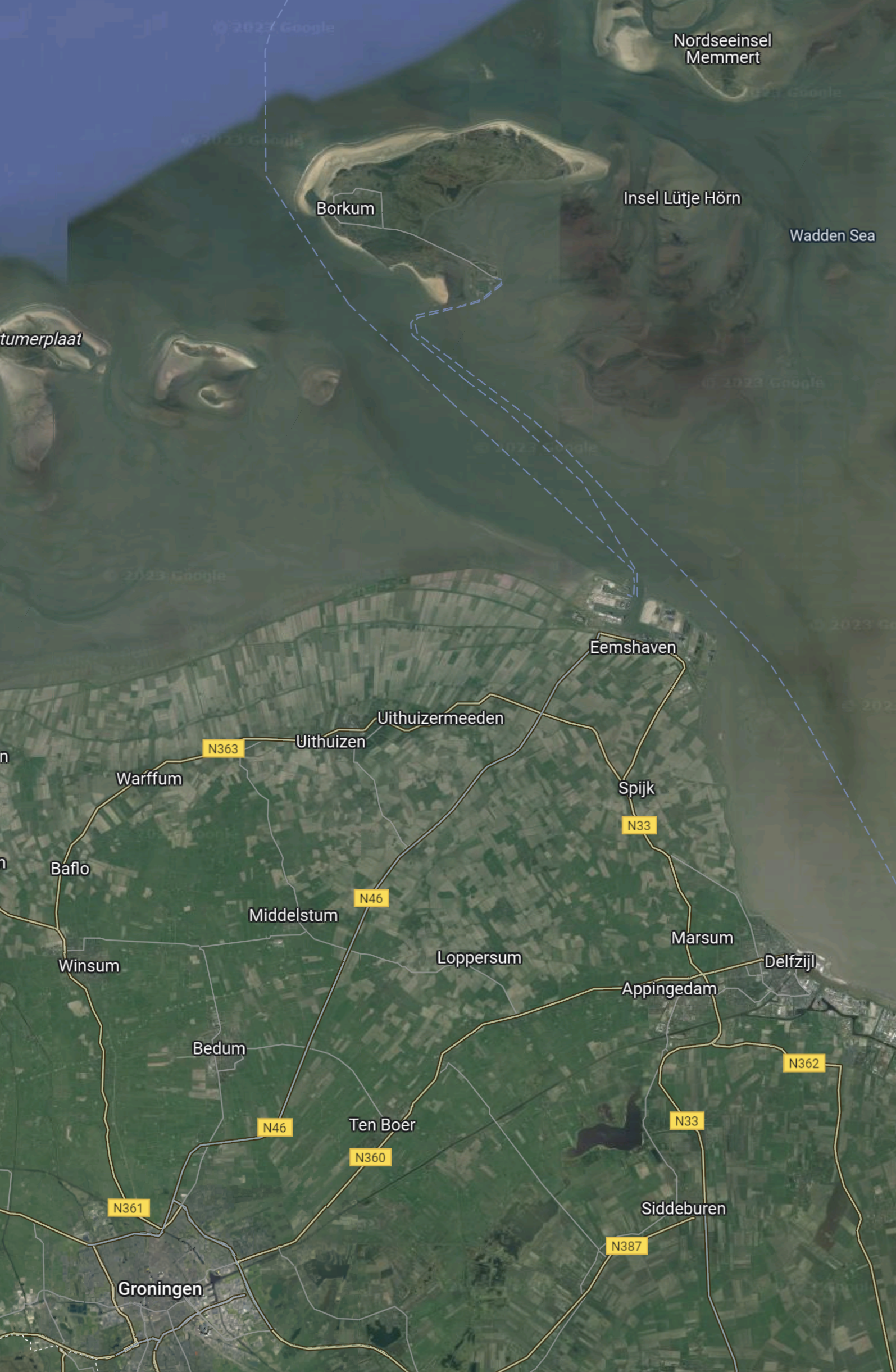
Note.
- Groningen is the city in the South-West corner of the map.
- Borkum is the horseshoe-shaped island at the top of the map.
There are a cluster of wind farms to the North of Borkum, which includes Borkum Riffgrund 1, 2 and 3.
BW Ideol, ABP To Explore Serial Production Of Floating Wind Foundations At Port Talbot
The title of this post, is the same as that of this article on offshoreWIND.biz.
This is the sub-heading.
BW Ideol and Associated British Ports (ABP) have signed a memorandum of understanding (MOU) that will see the manufacturer of concrete floating wind foundations and ABP investigating the feasibility of serial production at Port Talbot. The MOU has been signed in preparation for the Celtic Sea leasing round, BW Ideol said on Monday (11 December).
These two paragraphs outline the plans of BW Ideol and ABP have for Port Talbot.
According to the company, Port Talbot is the only Celtic Sea port with the scale and technical capabilities to fully maximise the Celtic Sea supply chain opportunity and is ideally located as a manufacturing base since it lies 120-140 kilometres from the floating offshore wind areas outlined by The Crown Estate for the upcoming leasing round.
The news on the MOU between ABP and BW Ideol comes shortly after ABP announced plans to invest around GBP 500 million (approximately EUR 573 million) to upgrade a site in Port Talbot and turn it into a major floating offshore wind hub.
This Google Map shows Port Talbot Port.

Note.
- It also looks like there is a Heidelberg Cement facility at the South side of the port.
- Port Talbot also has a Tata steelworks.
- The railway and the M4 Motorway are nearby.
- There’s certainly a lot of water.
The port appears well-placed for raw materials and there is quite a bit of free space to build and launch the concrete floaters.
This page on the BW Ideol web site describes their Floatgen demonstrator.
The first section is headed by BW Ideol’s First Floater In Operation, where this is said.
Built around a European consortium of 7 partners, Floatgen is a 2MW floating wind turbine demonstrator installed off the coast of Le Croisic on the offshore experimentation site of the Ecole Centrale de Nantes (SEM-REV). This project is being supported by the European Union as part of the FP7 programme. Floatgen is France’s first offshore wind turbine. 5 000 inhabitants are supplied with its electricity.
It looks like it is or almost is a proven system.
The page talks of two large benefits.
- Innovation at all levels.
- The highest local content of any floating wind turbine.
For the second, the following is said
In comparison to other steel floating foundations, which are imported from abroad, the use of concrete for BW Ideol’s floating foundation allows the construction to be located as close as possible to the deployment site. Construction at the Saint-Nazaire port was therefore a natural and optimal solution and has created a lot of local content. Additionally, the mooring system was manufactured by LeBéon Manufacturing in Brittany. For the majority of all other components or logistical activities, the Floatgen partners have also opted for suppliers within the Saint-Nazaire region.
Note.
- Will ABP and BW Ideol use a similar philosophy at Port Talbot?
- Will low-carbon concrete be used to construct the floaters?
I can certainly see the logic of BW Ideol and ABP getting together at Port Talbot.
Crown Estate Details Round 5 Plans
The title of this post, is the same as that of this article on offshoreWIND.biz.
This is the sub-heading.
The Crown Estate has revealed details of a new leasing round, known as Round 5, for three commercial-scale floating wind projects in the Celtic Sea.
These are the first two paragraphs, which outline the three initial projects.
Located off the coast of South Wales and South West England, the sites will have a combined capacity of up to 4.5 GW, enough to supply four million homes with renewable energy.
The new wind farms are expected to be the first phase of commercial development in the region, with the UK Government confirming as part of its Autumn Statement in November its intention to unlock space for up to a further 12 GW of capacity in the Celtic Sea.
It looks like there could be another 7.5 GW available.
These four paragraphs indicate that the Crown Estate. expect the developers to to develop the local infratructure.
New details about the Round 5 auction include upfront investment in important workstreams to de-risk the process for developers and accelerate the deployment of projects.
This includes a multi-million-pound programme of marine surveys to better understand the physical and environmental properties around the locations of the new wind farms, as well as carrying out a Plan-Level Habitats Regulations Assessment early on in the process.
An Information Memorandum published today, on 7th December, also includes details of a series of contractual commitments for developers to create positive social and environmental impacts, focused on skills and training, tackling inequalities in employment, environmental benefits, and working with local communities.
In addition, bidders will be required to demonstrate commitments for the timely access to the port infrastructure needed to develop their projects, the Crown Estate said.
But it also appears that the Crown Estate are doing their bit by carrying out marine surveys.
Conclusion
It looks like the Crown Estate are making thing easier for developers, so that they increase the interest in Celtic Sea wind farms.
We’ll see if the strategy is successful, when contracts are awarded.
 The Anonymous Widower