Shine On – Centrica Opens Its First UK Solar Farm
The title of this post is the same as that of this press release from Centrica.
These are the bullet points.
- 18MW Codford Solar Farm in Wiltshire is Centrica’s first major solar asset
- Part of plans to build a material portfolio of low carbon assets
- Vodafone supports development with long term Power Purchase Agreement for 50% of the output over 10 years
- Additional renewable power supports the UK government’s ‘green grid’ ambitions
I have some thoughts.
Centrica’s First Major Solar Asset
These two paragraphs from the press release outline the project and indicate where it fits in Centrica’s overall philosophy.
Construction began at the site in Wiltshire in April 2022, after the consent was acquired by Centrica Business Solutions in 2021. Made up of 33,000 panels, the project has a total capacity of 18MW and should produce 19GWh of green electricity every year, enough to power some 4,850 homes.
The deal not only brings additional renewable power provision to the UK grid but supports the UK government’s ambition to focus on home-grown renewable energy to boost long-term energy independence and security.
My only reservation is at 18 MW it isn’t that large and the sun doesn’t always shine in the UK.
Centrica’s Portfolio Of Low Carbon Assets
This paragraph from the press release talks about the portfolio.
In late 2021, Centrica announced ambitions to deliver 900MW of low carbon assets by 2026. The company is currently building battery storage projects at former gas peaking plants at Brigg, Lincolnshire, Knapton, North Yorkshire, and Ostend in Belgium, and has developed a multi GW pipeline of projects.
Note that former gas power plants, usually have a very handy connection to the electricity grid.
900 MW would also rate at around the output of two typical gas-fired power stations.
Vodafone’s Power Purchase Agreement
Big companies like Vodafone seem to be increasingly signing Power Purchase Agreements for their renewable electricity. These must give advantages all round.
- The developer can take the purchaser’s deal to a bank and use it to raise capital for the project.
- The purchaser, in this case Vodafone can say that they use at least some zero-carbon electricity, which must help marketing.
- The bank knows that so long as the sun shines, there will be money flowing to the developer.
- The developer doesn’t have to deal with thousands of customers.
These three paragraphs from the press release outline Vodafone’s deal.
Vodafone will purchase half of the electricity output from the solar farm, helping to support its development and bringing additional renewable power provision to the UK Grid. Combined with agreements already in place, around 47% of the company’s annual energy requirement will come from UK-based renewable power sources by 2025.
The long-term Power Purchase Agreement (PPA) will see approximately 9GWh of green electricity dedicated to Vodafone UK. The remainder will be sold into the national grid through Centrica’s Energy Marketing & Trading business.
The deal is the third PPA signed by Vodafone and Centrica Energy Marketing & Trading over the last year. In May 2022, Vodafone and Centrica announced a long-term PPA with MYTILINEOS S.A for the output from three solar farms in the UK. And, in February 2023, Vodafone committed to take a significant proportion of the output from a further five solar farms in one of the largest corporate solar PPAs to date.
It looks like, when Vodafone’s other solar farms are connected, they will be able to advertise as a zero-carbon company running on renewable electricity.
That sort of green advertising hasn’t hurt Lumo’s trains between London and Edinburgh.
Connecting Codford Solar Farm To The National Grid
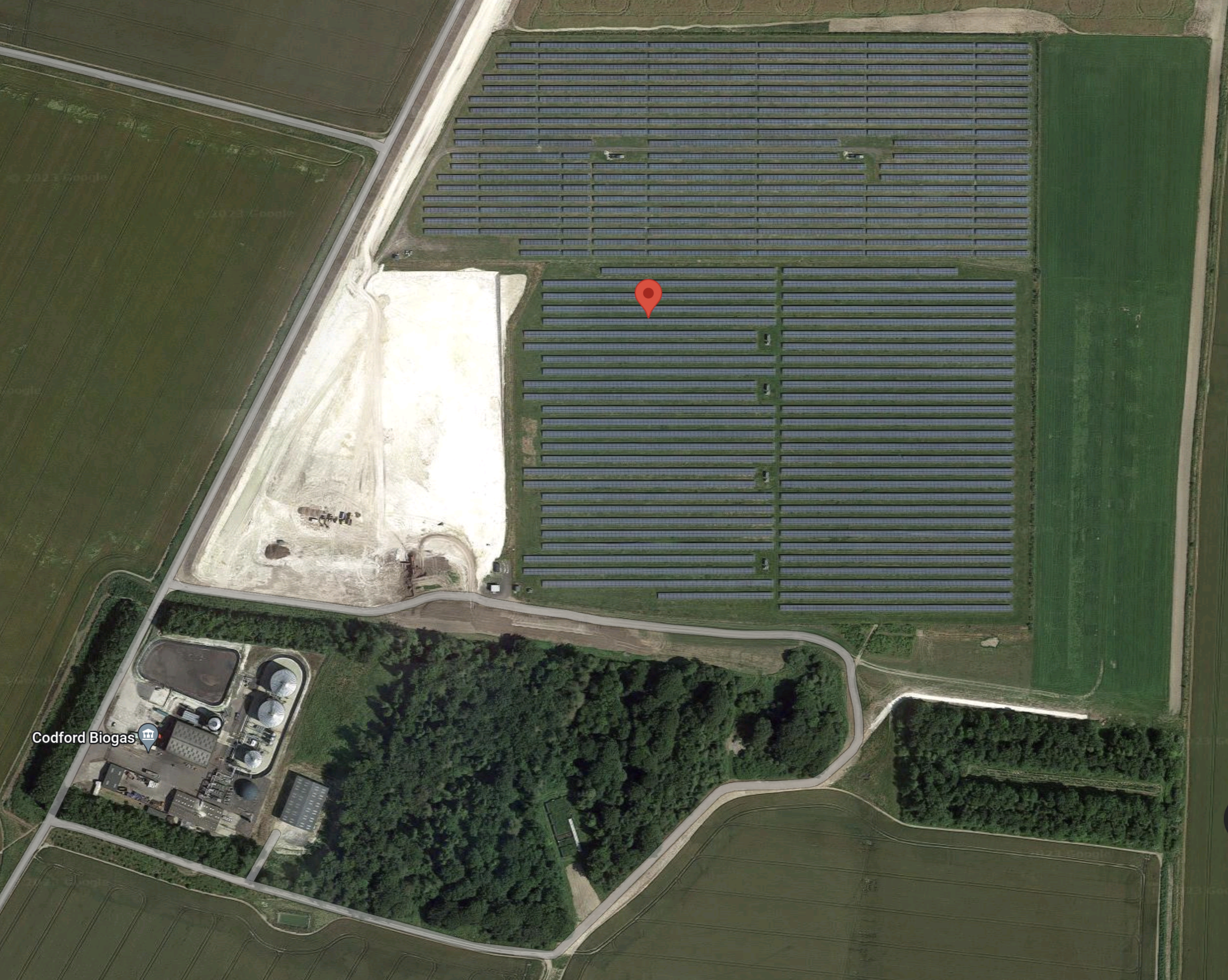
This Google Map shows the location of the Codford Solar Farm.
Note.
- The solar panels marked with the red arrow.
- Codford Biogas in the South-West corner of the map.
- The site is surrounded with the fields of a large arable farm, that grows wheat, barley and oilseed rape.
- The site is also shielded by trees.
This second Google Map shows Codford Biogas.
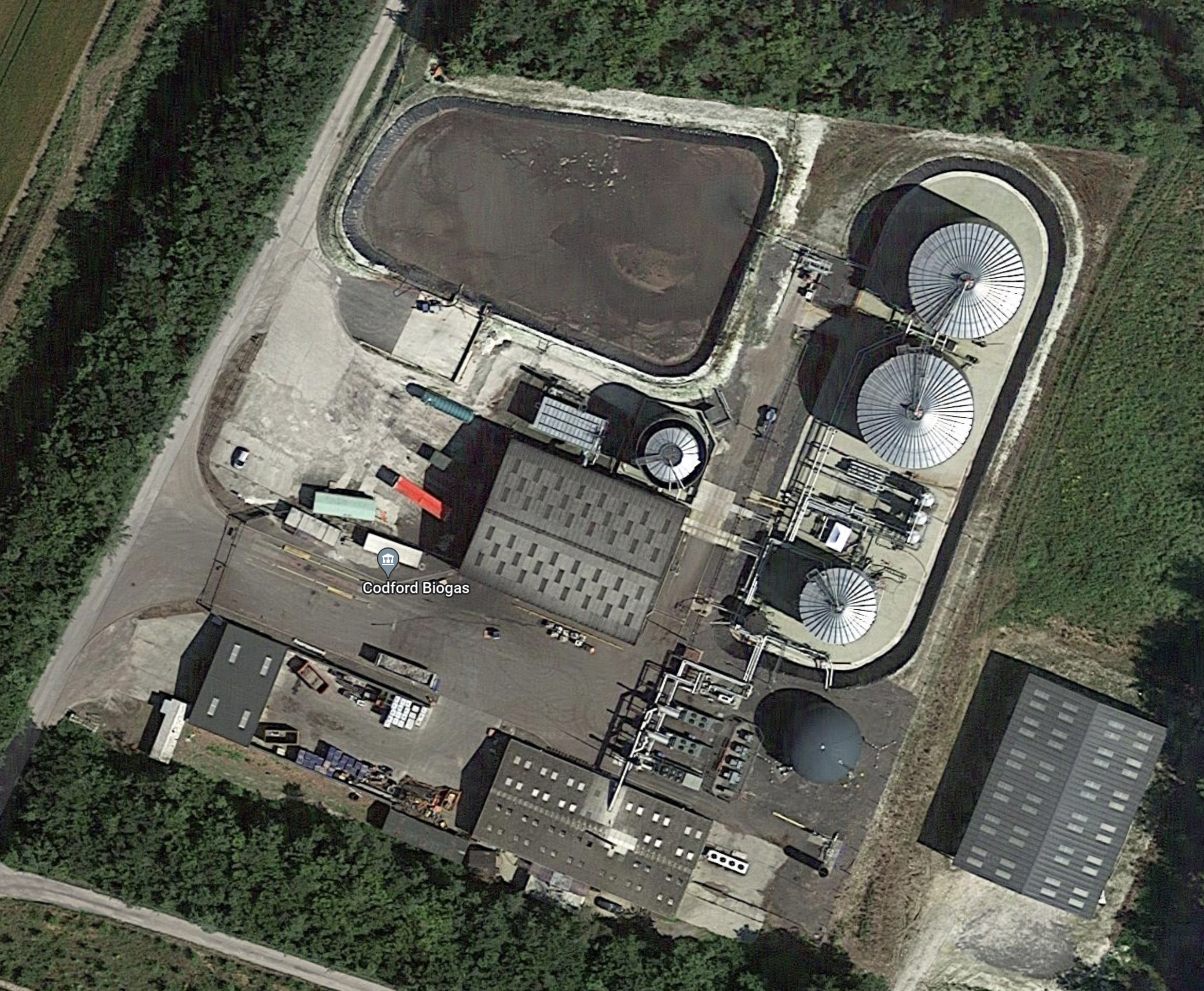
According to their web site, Codford Biogas accept the widest range of food waste in southern England.
The home page describes waste collection, secure disposal and carbon reduction.
Their method of disposal uses anaerobic digestion, which is a complex biological process involving the breakdown of organic matter in the absence of air in large, sealed and insulated vessels with controlled heating and mixing.
The Wikipedia entry for anaerobic digestion describes the process in detail.
On their web site, there is a page, which is entitled What Is AD?, which has an interactive graphic describing the process at Codford.
Main products from the site include.
- 3.6 MW of electricity, which can be fed to the grid.
- Fertiliser, which can be spread directly on the surrounding arable land.
- Waste heat, which will be developed for businesses that need it.
Obviously, the electricity export will need a grid connection, which I suspect will also be used by the new solar farm.
Conclusion
It looks like Centrica have piggy-backed their solar farm on to an existing grid connection.
But it does look like connecting your solar farm to the grid through a power station that can operate continuously, helps to give a more continuous output.
I think we’ll see more of this!
Ofgem’s New Net-Zero Mandate To Speed Up ‘Glacial Pace’ Of Realising Grid Connections
The title of this post, is the same as that of this article on offshoreWIND.biz.
This is the sub-heading.
The UK government will amend the Energy Security Bill to include a statutory net-zero duty for Ofgem, which the British energy regulator will be required to apply and document in decision-making. According to RenewableUK, this will speed up the realisation of grid connections and help unlock at least GBP 15 billion of investment in offshore wind alone by the end of the decade.
I feel, that this must be a good thing.
SSEN Transmission Signs Debut £750m Sustainability-Linked Facility
The title of this post, is the same as that of this news item from SSE.
This is the sub-heading.
SSEN Transmission has signed its first ever sustainability-linked Revolving Credit Facility (RCF), further reinforcing the company’s commitment to sustainability in line with its Sustainability Action Plan.
This is the first paragraph.
The facility has been upgraded to include four key performance indicators, which have been designed to align with SSEN Transmission’s commitment to sustainability, and each indicator will be assessed annually during the term of the loan, thus bringing greater alignment between SSEN Transmission’s sustainability and financing strategies.
It seems to be that SSEN Transmission are benefitting from some innovative financing.
As someone, who benefited from innovative financing from a bank manager in the past, I’m all for more of this, if it helps development of our renewables.
UK Launches GBP 160 Million Floating Wind Funding Round, Industry Not Satisfied With Investment
The title of this post, is the same as that of this article on offshoreWIND.biz.
This is the sub-heading.
The UK Government has announced that up to GBP 160 million in grant funding will be made available for certain investments for the floating offshore wind sector
These three paragraphs outline the scheme,
The Department of Energy Security and Net Zero (DESNZ) has established the Floating Offshore Wind Manufacturing Investment Scheme (FLOWMIS) to distribute GBP 160 million in funding to support critical port infrastructure that could enable the delivery of floating offshore wind.
Through this scheme, the government hopes to enable the delivery of the country’s 5 GW 2030 deployment ambition by securing additional suitable port capacity necessary to scale up and accelerate floating offshore wind deployment in the UK, as well as to increase capability in the UK floating wind supply chain, drive cost reduction, and the commercialisation of floating offshore wind technology.
In addition, the government hopes that this scheme will deliver industrial growth and associated regional economic and social benefits (for example, quality jobs and increased GVA).
Note.
- The scheme is called FLOWMIS.
- It seems to be geared to improve port infrastructure.
- It looks like some of these projects will be needed to support ScotWind and INTOG.
- This page on the Government web site, gives the latest state of FLOWMIS.
FLOWMIS could bring forward some interesting projects.
Wind Power For 1.2m Homes Is Wasted Because Of Lack Of Storage
The title of this post, is the same as that of this article on the Daily Telegraph.
These two paragraphs outline what happened.
Enough wind power to supply 1.2m homes a day was wasted over winter because there is no capacity to store extra energy generated on gusty days, according to new research.
National Grid’s electricity system operator asked wind turbines which were expected to generate about 1.35 terawatt-hours of electricity between October and January to switch off instead because they were not needed to meet demand at the time, according to the consultancy Stonehaven.
The problem has been flagged up by Rupert Pearce of Highview Power, who in my view could have a solution with their CRYOBatteries.
Pearce is quoted as saying this.
Renewable energy storage is essential to powering a cleaner, cheaper, always-on Britain.
By capturing and storing excess renewable energy, which is now the UK’s cheapest, most secure and most abundant form of energy, we can power Britain’s homes and businesses with renewable green energy, taking millions of tonnes of carbon out of the atmosphere and ending a culture of reliance on expensive foreign imports.
He’s too bloody right! And my experience of mathematical modelling large vessels at ICI in the 1970s, says that Highview Power have one of the sensible solutions to large scale energy storage.
Wind Generation Sets New Record In UK Surpassing 21 GW
The eye-catching title of this post, is the same as that of this article on Renewables Now.
I regard anything over 20 GW as very good, as the UK’s average daily consumption is typically around 23 GW, so surely we can find a couple of gigawatts of biomass, gas, hydro or nuclear.
The Renewables Now article says this about UK electricity generation.
According to National Grid ESO, on Monday, January 9, wind accounted for 50.2% of British electricity, nuclear for 15.9%, gas for 13.1%, imports for 10%, biomass for 4.8%, hydro for 3.8%, solar for 1.3% and coal for 1.1%. Tuesday’s wind record may undergo slight adjustments in expectation of all data for yesterday.
I shall be following these figures.
- Especially, as Wikipedia says another 3 GW will be installed this year.
But it does seem that we’re getting there with renewable electricity.
A Thought On Energy Storage
I also think that if we are generating large amounts of electricity at times, which are more than we need, then we had better crack on and build lots of energy storage.
If we don’t need the energy and Europe or Ireland doesn’t want it, then we must store it, so that if the wind isn’t blowing we can recover it for a useful purpose, even if it is only selling it to the Germans to make hydrogen, which is used to replenish their stores.
Scotland’s Renewable Energy Jackpot: Hydrogen Exports Alone Could Be worth £25 Billion A Year By 2045
The title of this post, is the same as that of this article on the Edinburgh News.
This is the sub-heading.
Scotland is a phenomenally energy rich country. For decades the largest oil-producing nation in the European Union, it is now set to trail-blaze as a leader in renewable energy.
The title and sub-heading say it all for Scotland.
But these words could equally well apply to Anglesey, Cornwall, Devon, East Anglia, Humberside, Liverpool and Morecambe Bays, the Severn Estuary and Pembrokeshire.
We also mustn’t forget the Dogger Bank!
71 Offshore Wind Applications Now Filed In Brazil, Proposals Total 176.6 GW
The title of this post, is the same as that of this article on offshoreWIND.biz.
ECML Net Zero Traction Decarbonisation
This project was one of the winners in the First Of A Kind 2022 competition run by Innovate UK.
In this document, this is said about the project.
Project No: 10036245
Project title: ECML Net Zero Traction Decarbonisation
Lead organisation: SIEMENS MOBILITY LIMITED
Project grant: £59,983
Public description: Electrification is the foundation of all modern railways and fundamental to decarbonisation. Through
delivering faster, smoother, quieter and more reliable train services, rail electrification reduces
industry fuel cost by 45%, rolling stock costs by 33%, and track maintenance costs by 10-20%
(compared to diesel operation). Electric railways are the most efficient, lowest carbon form of
transportation in the UK.
Network Rail operates the largest power distribution network in the UK, and is the largest consumer
of electricity in the UK, consuming 4TWh electricity per year. Power is provided from the electricity
supply industry, a mix of gas, nuclear, coal and renewables, emitting approximately 944,000 tonnes
of carbon dioxide annually. Connecting new renewable generation directly to the railway reinforces
the railway power supply, while reducing coal and gas use in the UK and is a longstanding Network
Rail industry challenge statement. To date, engineering incompatibilities between renewable,
electricity supply systems and the railway single-phase electrical and other railway systems have
prevented local renewable connection in rail.
In a world first, Siemens Mobility, working with British Solar Renewables, DB Cargo UK, Network
Rail, ECML operators, and the University of York, will directly connect large-scale renewable
generation to the East Coast Mainline. The demonstrator phase will deliver up to 1GWh green
electricity direct to trains each year, reducing UK gas imports by 151,000 cubic metres and carbon
emissions by 236 tonnes annually. It will gather vital data creating a new green industry, creating a
precedent and setting standards to enable larger scale roll-out across the UK.
My Thoughts And Conclusion
This page on the Network Rail web site is entitled Power Supply Upgrade.
Since 2014, Network Rail and its partners have been upgrading the overhead electrification and the associated substations and electricity supply on the East Coast Main Line (ECML).
- It is not a small project which includes fifty new substations and 1,600 km. of new cabling between London and Edinburgh.
- When complete, fleets of electric trains on the route will be receiving high-quality electric power from the upgraded overhead electrification.
However, the East Coast Main Line is unique among British electrified main lines, in that it runs more or less close to a coast, that is populated by a large number of massive wind farms.
I believe the objective of this project, is to more directly connect the massive wind farms to the East Coast Main Line.
Lessons learned could then be applied to other electrified main lines.
We may even see onshore wind farms or small modular nuclear reactors built to power the railways.
Hydrogen-Powered Turbines May Help Clean And Improve Electrical Grid Reliability
The title of this post, is the same as that of this article on Hydrogen Fuel News.
This is the first paragraph.
In less than three years, one or more hydrogen-powered turbines are expected to be up and running at or near New Jersey’s Bayonne Energy Center power plant, which feeds power to New York City.
Note.
- The Bayonne Energy Center is a peaker plant with ten gas turbines, with a total capacity of 640 MW.
- Peaker plants automatically cut in, when power demand is high, but power generation is low.
- The Bayonne Energy Centre transfers power to New York, through an underwater cable.
- The electrolyzers will be made by Ohmium International Inc and I suspect they will be powered by offshore wind.
- The hydrogen that is created will be stored. As Bayonne has a history of chemical manufacturing, there may be salt caverns that can be used or the hydrogen could be stored as a compressed gas or liquid in tanks.
I can see hydrogen being used in peaker plants elsewhere in the world, where there is lots of renewable energy and suitable hydrogen storage.
The hydrogen can also be used to decarbonise local industries and transportation.
The Potential For Wind Power In New Jersey
Wikipedia says this about the potential of wind power in the state.
New Jersey has the potential to generate 373 GWh/year from 132 MW of 80 m high wind turbines or 997 GWh/year from 349 MW of 100 m high wind turbines located onshore as well as 430,000 GWh/year from 102,000 MW of offshore wind turbines.
Note.
- New Jersey used 76,759 GWh in 2011
- It appears that most of these turbines would be located along the coast.
There is also a worry about hurricanes. But solving that is an engineering problem.
From my experience of modelling floating structures, I believe they may stand up to high winds better. But I’m not sure!
 The Anonymous Widower