Judge Rules Scottish Schools Must Provide Single-Sex Lavatories
The title of this post, is the same as that of this article on The Times.
This is the sub-heading.
Parents win legal fight after head teacher dismissed concerns over only gender-neutral facilities
This reminds me of a lecture I went to at Emmanuel College in Cambridge given by the retiring Head of Projects at Unicef. The lecture told what Unicef had done during International Women’s Year.
One story was about why girls tended to leave school at an early age in India.
Unicef didn’t know why, although they thought it could be arranged marriages. Then someone produced a peer-reviewed paper from the University of Delhi, which blamed the fact that boys and girls shared the same toilets.
Unicef set up a program with Hari Krishna to segregate the toilets and it worked.
Earba 1.8GW Pumped Storage Hydro Project Secures Approval
The title of this post, is the same as that of this article on the Solar Power Portal.
These three paragraphs introduce the article.
Gilkes Energy has been awarded planning consent for its Earba Pumped Storage Hydro (PSH) scheme.
The Earba PSH scheme is set to be the largest project of its kind in the UK, with an installed capacity of 1.8GW and a storage capacity of 40GWh, meaning that it can provide 22 hours of storage at full power. The planning application for the project was submitted to the Scottish government in early March 2024.
The project will be located at Loch Earba in the Scottish central Highlands. Gilkes Energy states that this location was chosen because the area has an ideal combination of geology and topography, which the firm states will make it one of the most economically viable PSH projects under development in the UK.
In Gilkes Reveals 900MW Scottish Pumped Storage Plan, I said that Loch Earba was a 900 MW/33 MWh PSH scheme, but now it appears a it is 1.8 GW/40 GWh scheme, which will probably put it in the largest twenty PSH schemes in the world.
It will be one of four PSH schemes under development in Scotland.
- Coire Glas – 1.3 GW/30 GWh
- Loch Earba – 1.8 GW/40 GWh
- Loch na Cathrach (formerly known as Red John) – 450 MW/2.8 GWh
- Loch Sloy – 160 MW/16 GWh
In addition.
- Cruachan is being extended to 1 GW/7 GWh.
- Highview Power are planning to build two 200 MW/2.5 GWh of their liquid air batteries in Scotland.
Everything totals up to 5.1 GW/100.8 GWh, which compares with a UK electricity production as I write this article of just under 29.5 GW.
I wouldn’t be surprised to see some high-energy industries moving to Scotland because of all this renewable and hopefully reliable power.
SSE Files Plans For 100 MW Pumped Hydro Scheme
The title of this post is the same as that of this article on reNews.biz.
This is the sub-heading.
Proposal aims to convert iconic Sloy Power Station into storage facility by end of 2030
These three paragraphs outline the proposals.
SSE has submitted plans to the Scottish Government for the 100MW Sloy pumped storage hydro scheme.
The plans would see the existing Sloy Power Station – a conventional hydro power station – on the banks of Loch Lomond converted into a pumped storage hydro scheme with a pumping capacity of up to 100MW.
If given the green light, the converted Sloy scheme would be capable of delivering up to 16GWh of long-duration electricity storage capacity.
SSE intend to make an investment decision by late 2027 and this is said about increasing capacity.
As part of the planning application, SSE Renewables is also proposing to upgrade the existing 32.5MW G4 turbine to match its sister units, which would increase the station’s generating output by 7.5MW to 160MW.
This appears to be a world-class example of canny Scottish engineering.
The project would turn the current 152.5 MW hydroelectric power station into a 160 MW/16 GWh pumped storage hydroelectric power station.
Not a bad transformation, that was opened three years after I was born.
Zenobē Lands Financing For 400MW Eccles Project
The title of this post, is the same as that of this article on Solar Power Portal.
This is the sub-heading.
Battery energy storage system (BESS) developer/operator Zenobē has announced that it has successfully financed its Eccles BESS project in Scotland, in one of the biggest finance rounds in European history.
These two paragraphs add more details.
The total debt raised for the 400MW/800MWh project was £220 million, which the company says is one of the largest finance raises for a standalone BESS project ever made in Europe. The funding was provided by a group of lenders organised by National Westminster Bank and KKR Capital Markets Partners LLP. Additionally, Zenobē has announced that construction on the Eccles BESS—the company’s largest battery project to date—has begun.
The Eccles BESS is the final part of the firm’s £750 million investment in Scotland. Zenobē’s Blackhillock BESS, a 200MW/400MWh project located near Inverness, recently began commercial operations, and is set to expand to 300MW/600MWh later this year.
Zenobe seem to be able to finance these projects, without too much difficulty.
Construction seems to have started. But then, I suspect there are wind turbines in the vScottish Borders already lined up to use the batteries.
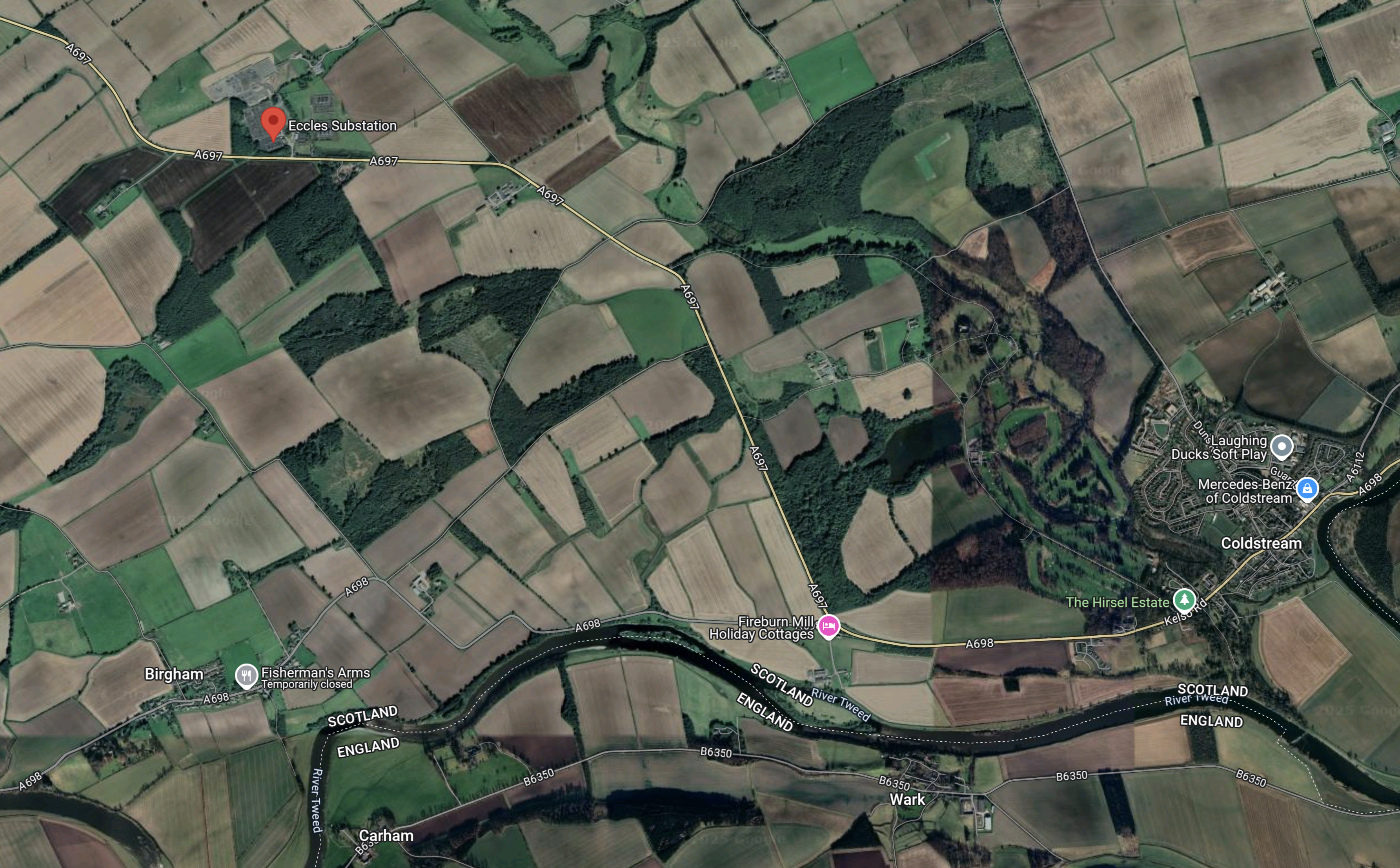
This Google Map shows an Eccles substation.
Note.
- The Eccles substation is marked by the red arrow.
- The town at the East edge of the map is Coldstream.
- The England-Scotland border is clearly marked.
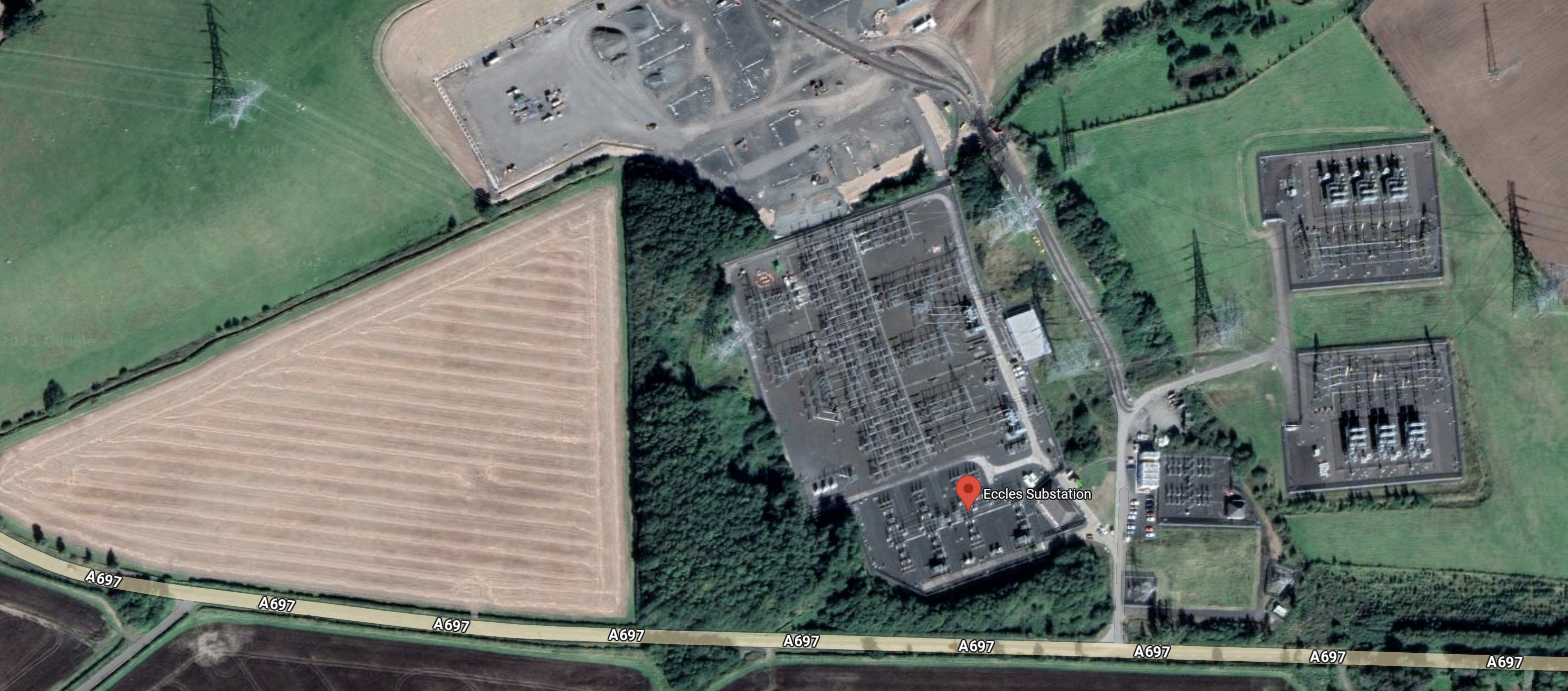
This second Google Map shows a closer view of the Eccles substation.
Note.
- t looks to be a substantial substation.
- There would appear to be plenty of space for a large battery.
- It is close to the A 597 road for the delivery of heavy equipment.
I suspect this substation could be the location of the battery.
It’s also right in the heart of Scottish onshore wind territory.
It is also according to the Solar Power Portal a £220 million project.
A project of this size will deliver substantial benefits in terms of work to the local community.
It will likely have a community benefit fund or something similar.
So you would expect the project would be welcomed into the local area.
But you would be wrong, if this article on the BBC, which is entitled Village ‘Heart Ripped Out’ By Battery Site Plans, is typical of the feeling about the batteries.
This is the sub-heading.
A rural community in the Borders is warning that Scotland’s renewable energy revolution is coming at a cost.
These three paragraphs add more detail.
Residents of Leitholm – a village between Coldstream and Greenlaw – claim the heart is being ripped out of their community with the arrival of battery storage facilities.
If all six proposed facilities are approved, more than 200 acres of farmland will be turned over to concreted compounds within a three-kilometre radius of their village.
Retired nursery owner Seonaid Blackie said: “This is not the place it used to be – people are worried sick.”
The residents view is balanced by industry expert Professor John Irvine, from St Andrew’s University, believes energy storage has a vital role to play in reaching net-zero targets.
My view is what is needed is an energy storage system, that can be built substantially underground.
If you look at large Battery Energy Storage Systems (BESS), they are best described as container parks.
We need energy storage systems, that fit in a single tennis court, rather than thirty football pitches.
Gravitricity is one possibility, who are also Scottish, who store energy using weights in disused mine shafts.
The French system; DELPHY is also a vertical system for storing hydrogen in a custom-built hole.
Practically, I believe the solution adopted will be to spread the batteries out and spend money on surrounding them with trees and other camouflage.
Europe’s Biggest Battery Storage Project Goes Live In Scotland
The title of this post, is the same, as this article in The Times.
This is the sub-heading.
Zenobe’s site at Blackhillock can store surplus generation for when the wind doesn’t blow and the sun doesn’t shine
These are the first two paragraphs.
Europe’s biggest battery storage project has entered commercial operation in Scotland, promising to soak up surplus wind power and prevent turbines being paid to switch off.
Zenobe said the first phase of its project at Blackhillock, between Inverness and Aberdeen, was now live with capacity to store enough power to supply 200 megawatts of electricity for two hours. It is due to be expanded to 300 megawatts by next year.
I believe we can do better, than install large lithium-ion batteries.
We need to get the pumped storage like Coire Glas, the liquid air like Highview Power and the gravity batteries like Gravitricity going as fast as we can.
They are more environmentally friendly than Tesla’s lithium ion tiddlers and a second generation liquid air battery appears to be 200 MW and 2.5 MWh, so they can supply 200 MW for 12.5 hours.
The Blackhillock battery can do just two hours.
Two of them working as a pair, with a 1 GW wind farm, are as big as a small modular nuclear reactor, so could do the same job, with respect to power supply, using machinery and tank designs, that have been used for decades.
I suspect, that like 1960s coal-fired power stations, they would keep running for fifty years and be simply recycled as steel, copper and other scrap.
Highview Power could make Bishops Stortford famous!
Scotch Whisky Is In A Unique Position
Scotland has so much zero-carbon energy now, let alone in a few years, that Scotch whisky would not be the most difficult of industries to make completely zero-carbon, which could marketing-wise completely trump any tariffs, that Trummkopf might impose.
- Already some small distilleries are using hydrogen to distill the whisky.
- Some glass bottles are already made using hydrogen instead of natural gas to make zero-carbon malt whiskies.
- I’m sure Cummins in Darlington, JCB in Rocester and Ricardo in Sussex will be pleased to help make farm machinery, mechanical handling and road transport zero carbon.
- Soft fruit like raspberries are already used to absorb the carbon dioxide from the distillation process in some areas of Scotland. I’m sure dealing with more quality raspberries would not be a problem.
- A large electrolyser is planned for Kintore in the North of Scotland. Think of the good publicity for say Centrica or SSE, if they built the world’s largest hydrogen plant to help make zero-carbon whisky.
These are some more thoughts.
Taste Is Everything
As only the method of providing heat and electricity will have been changed, I can’t see there will be any change to the taste.
It’s Already Happening
This page on the Annandale Distillery web site is entitled Annandale Distillery Pioneers Zero-Carbon Whisky Production with EXERGY 3 Project.
The Kintore Electrolyser
These figures summarise the Kintore Electrolyser.
- Total Electrolyser Capacity – 3 GW
- First Phase – 500 MW
- Hydrogen – 200 kTonnes per year
Explore the Kintore Hydrogen web site.
Marketing Advantage
Scotland, is probably, the only country, where the main ingredients for whisky come together in abundance ; barley, energy, tradition and water.
It also is all produced in a single country in many different brands and types, which could all be produced in a zero-carbon manner.
Conclusion
Let’s give Trump a beating and the planet a kiss.
1.1 GW Inch Cape Wind Farm Entering Offshore Construction Phase
The title of this post, is the same as that of this article on offshoreWIND.biz.
This is the sub-heading.
ESB and Red Rock Renewables have reached a financial close on the 1,080 MW Inch Cape offshore wind farm in Scotland, and the project will now progress into its offshore construction phase.
Inch Cape will be a 1.1 GW wind farm, which as this web site/data sheet shows could be capable of generating enough green energy to power more than half of Scotland’s homes.
Highlights from the data sheet include.
- Represents an around £3 billion investment in the UK’s electrical infrastructure
- Will contribute significantly to the UK Government’s target of 50 gigawatts (GW) of offshore wind installed capacity by 2030
- Constitutes 10% of the Scottish Government’s ambition of 11 GW of offshore wind installed by 2030
- As at Q1 2025, has already invested almost £300 million with 300 UK companies (more than £100 million in Scotland with 120 Scottish companies)
- Is set to spend a further (approx.) £700 million with UK supply chain (and create associated direct and indirect jobs)
- Efficient re-use of a brownfield site in East Lothian (of former coal-fired power station) including existing grid capacity and established transmission infrastructure
- The offshore substation is being built by Siemnens and Smulders at Wallsend on Tyneside.
- On track to deliver at least 50% UK content over life cycle of the project
- Will mean large investment in a new facility in the Port of Montrose and more than 50 long-term skilled local jobs
- Once operational the wind farm will reduce carbon emissions by 2.5 million tonnes per year compared to using fossil-fuels.
I like this project.
- It has a capacity of 1.1 GW.
- The turbines are 15 MW Vestas units.
- The connection to the grid is at the site of the demolished Cockenzie coal-fired power station.
- 50 % of the content of the £ 3 million project is British, spread among three hundred companies. That is certainly spreading the money around.
- I calculate that, when the turbines are fully turning, the Inch Cape wind farm will generate £ 44, 201.38 per hour or just over a million pounds per day.
I suspect we will be seeing lots more wind farms like this in the next thirty or forty years.
These are currently under construction.
- Neart Na Gaoithe – Scotland – 450 MW
- Sofia – England – 1400 MW
- Dogger Bank A – England – 1235 MW
- Dogger Bank B – England – 1235 MW
- Dogger Bank C – England – 1218 MW
- Moray West – Scotland – 882 MW
- East Anglia 3 – England – 1372 MW
- Total – 7792 MW
These are pre-construction.
- Hornsea 3 – England – 2852 vMW
- Inch Cape – Scotland – 1080 MW
- Total – 3932 MW
These are proposed wind farms – Contracts for difference Round 4
- Norfolk Boreas – Round 1 – 1380 MW
- Total – 1380 MW
These are proposed wind farms – Contracts for difference Round 6
- Hornsea 4 – England – 2400 MW
- East Anglia 2 – England – 963 MW
- Greeen Volt – Scotland – 400 MW
- Total – 3763 MW
These are proposed wind farms – Early Planning
- East Anglia 1 North – England – 800 MW
- Rampion 2 Extension – England – 1200 MW
- Norfolk Vanguard East – 1380 MW
- Norfolk Vanguard West – 1380 MW
- Dogger Bank South – England – 3000 MW
- Awel y Môr – Wales – 500 MW
- Five Estuaries – England – 353 MW
- North Falls – England – 504 MW
- Dogger Bank D – England – 1320 MW
- Berwick Bank – Scotland – 4100 MW
- Seagreen Phase 1A – Scotland – 500 MW
- Outer Dowsing – England – 1500 MW
- Morecambe – England – 480 MW
- Mona – England – 1500 MW
- Morgan – England – 1500 MW
- Morven – England – 2907 MW
- Ossian – Scotland – 3610 MW
- Bellrock – Scotland – 1200 MW
- CampionWind – Scotland – 2000 MW
- Muir Mhòr – Scotland – 798 MW
- Bowdun – Scotland – 1008 MW
- Ayre – Scotland – 1008 MW
- Broadshore – Scotland – 900 MW
- Caledonia – Scotland – 2000 MW
- Stromar – Scotland – 1000 MW
- MarramWind – Scotland – 3000 MW
- Buchan – Scotland – 960 MW
- West of Orkney – Scotland – 2000 MW
- Havbredey – Scotland – 1500 MW
- N3 Project – Scotland – 495 MW
- Spiorad na Mara – Scotland – 840 MW
- MachairWind – Scotland – 2000 MW
- Sheringham Shoal and Dudgeon Extensions – England – 719 MW
- Llŷr 1 – Wales – 100 MW
- Llŷr 2 – Wales – 100 MW
- Whitecross – England – 100 MW
- Total – 48262 MW
- Grand Total – 57337 MW
57337 MW would have enough electricity left over to replace Germany’s gas.
US President Trump Issues Executive Order Suspending Offshore Wind Leasing
The title of this post, is the same as that of this article on offshoreWIND.biz.
This is the guts of the article.
US President Donald Trump has issued an Executive Order pausing offshore wind leasing on the US Outer Continental Shelf (OCS) and mandating a review of the federal government’s leasing and permitting practices for wind projects. The Order also stops all relevant agencies from issuing approvals, either new or renewed, for both onshore and offshore wind projects until the review is completed.
The following was the response from someone with intelligence, sense and authority.
After the White House issued the Executive Order, Liz Burdock, founder and CEO of the US offshore renewable energy industry organisation, Oceantic Network, said.
Today’s executive order pausing offshore wind leasing and permitting is a blow to the American offshore wind industry and hurts the hundreds of U.S. supply chain companies and thousands of workers already building more American energy. While under a National Energy Emergency created by an unprecedented rise in energy demand, we should be working to quickly bring generation online instead of curtailing a power source capable of providing base load generation and creating new jobs across 40 states.
I wouldn’t be surprised to see some of those companies and their equipment ending up in the UK and Scotland in particular.
‘Europe’s Biggest Battery Farm’ Built On Coal Mine
The title of this post, is the same as that of this article on the BBC.
This is the sub-heading.
Work is under way to create what has been described as Europe’s largest battery storage project at Coalburn in South Lanarkshire.
These three paragraphs add a bit more detail.
Developers say the two huge neighbouring battery farms – one at the site of a former opencast coal mine – will store enough electricity to power three million homes.
Battery Energy Storage Systems (BESS) are being built across the UK to help balance the electricity grid, which is becoming increasingly powered by renewables.
Almost 90% of the electricity generated in Scotland last year was from low carbon sources like wind, solar or nuclear, according to figures from the Scottish government.
A search of the Internet found this paragraph describing the size of the battery.
The CIP BESS portfolio (Coalburn 1, Coalburn 2, and Devilla) will have total power capacity of 1.5GW and will be able to store and supply the grid with a total of 3GWh of electricity, equivalent to the electricity demand of over 4.5 million households, across a 2-hour period.
Note.
- CIP is Copenhagen Infrastructure Partners, who are a large developer of energy infrastructure.
- It appears there are three separate 500 MW/ 1 GWh batteries being developed together.
- The batteries can supply electricity for two hours.
This looks like a sensible project in an area, where there could be plenty of spare electricity.
Competition With Highview Power
Highview Power’s web site has a Projects section, where this is said.
Scotland And The North-East, UK
Highview Power’s next projects will be located in Scotland and the North East and each will be 200MW/2.5GWh capacity. These will be located on the national transmission network where the wind is being generated and therefore will enable these regions to unleash their untapped renewable energy potential and store excess wind power at scale.
I can see Highview Power’s 200MW/2.5GWh liquid air batteries and 500 MW/ 1 GWh Battery Energy Storage System (BESS) competing for the same projects.
However, it does appear at Trafford Energy Park, both types of battery appear to be being installed.
- Carlton Power Secures Planning Consent For World’s Largest Battery Energy Storage Scheme
- Centrica Invests In Renewable Energy Storage Capabilities To Boost UK’s Energy Security And Accelerate Transition To Net Zero
Perhaps the two together give the best response?
Scotland To Get New Intercity Fleet
The title of this post is the same as that of this press release from Transport Scotland.
These eight paragraphs make up the body of the press release.
The Scottish Government announced today that procurement will begin to replace the trains in its Intercity fleet.
The procurement will seek a replacement for the High Speed Train (HST) fleet of 25 trains which operates on its InterCity routes between Glasgow, Edinburgh, Aberdeen, and Inverness.
Cabinet Secretary for Transport, Fiona Hyslop said:
“Resilient, reliable ScotRail services are key to encouraging more people to choose to travel by train for work, leisure and learning.
“Over 4 million passengers travelled on InterCity trains between our key cities in the last year – we want to encourage even more people to do so. This procurement will enable us to replace the current Intercity fleet with trains which provide improved facilities and accessibility.
“Any replacement fleet is expected to be more energy efficient and therefore will significantly reduce emissions, reduce operating costs and be more in line with current passenger expectations, including for accessibility. The procurement process ensures Scottish suppliers will be able to offer to provide their services to potential bidders.
“This latest milestone in our rolling programme of decarbonisation will ensure the reliability of our Intercity routes for the long-term, making Scotland’s railway a more attractive and greener travel choice.”
Further details on this announcement will be shared when the contract is awarded in 2025. It is also expected that the refreshed Decarbonisation Action Plan will be published in Spring 2025, and this will detail updated targets for replacing ScotRail’s existing diesel fleets.
It is a press release full of good intentions, but very few facts.
Is this what Scots get from their political party?
I have a few questions.
Will The Trains Be Built In The UK?
This must surely give some advantages, but will it get the best trains at the best price?
What Will Be The Number And Capacity Of The Trains?
Transport Scotland could go for a like for like number and capacity replacement.
- But there have been capacity problems in Scotland, which have meant using diesel Class 153 trains as baggage cars.
- They might also want to add extra services.
- Will they replace the train lost at Stonehaven?
They could add a few options.
Other Companies May Need Similar Trains
Consider.
- GWR will need to replace their similar Castles.
- CrossCountry will need new trains.
- Grand Central will need new trains.
- South Western Railway may need new trains for services between Cardiff and Devon.
- Transport for Wales may need new trains.
Hull Trains and Lumo have recently ordered a selection of new Hitachi Class 802 and 803 trains, which I wrote about in Fourteen New Trains To Drive First Rail Open Access Growth.
I can see an argument for buying more Hitachi Class 80x trains, as it will surely save Great British Railways costs in the long time.
Should The New Trains Be A Forever Solution?
When British Rail electrified to Brighton, Crewe, Edinburgh, Glasgow, Leeds, Liverpool, Manchester, Newcastle, Norwich, Portsmouth, Southampton, Weymouth and many other places from London, they saw it as a mode of traction, that would be used forever.
As the trains wore out or got outdated, they would be replaced with trains, which at least could run using the same mode of traction.
Generally, on electrified routes, when British Rail’s electric trains have been replaced, they have been replaced by more modern new electric trains.
The one major exception was on the East Coast Main Line where some InterCity 225 trains were replaced with Hitachi Class 800 and Class 802 diesel bi-mode trains.
But as the Class 800 and Class 802 diesel bi-mode trains were also replacing InterCity125 trains, they were a pragmatic replacement.
The Hitachi trains can be considered a Forever Solution, as bi-mode trains will always be able to work some routes that will never get electrified.
But Hitachi are developing the successor to their diesel bi-mode train, which is the tri-mode train, capable of running on electrification, diesel or battery power.
- Diesel power-packs can be swapped for battery packs.
- The battery packs have the same weight and power as a diesel power-pack.
- Existing diesel bi-mode trains can be converted to tri-mode or battery-electric bi-mode trains.
- A range of over forty miles on a single battery pack has been demonstrated.
Could Hitachi tri-mode trains be The replacements for the Inter7City trains?
Will Some Trains Have A Battery Electric Capability?
I very much believe so, as some routes in Scotland could be decarbonised by battery-electric trains.
What Top Speed Would The Trains Have?
Most of the routes in Scotland, where new modern quality rolling stock is needed, has a top speed of less than 100 mph, but in places the top speed is 125 mph.
I suspect, if trains can run at 125 mph in the places, where it is allowed, could probably save a few minutes on journey times.
Take the Borders Railway.
- The electrification runs out at Brunstane. Batteries would be charged between Edinburgh and Brunstane using the existing electrification.
- To go from Brunstane to Tweedbank and return to Brunstane is 63 miles.
- To work the Borders Railway would need a battery range of 63 miles.
I suspect every route in Scotland could have an electrification strategy for use with battery-electric trains. Some of which would have short lengths of extra electrification.
What Lengths Would The Trains Be?
In my example I used the Borders Railway.
A typical service is run by a three-car Class 170 train or two such trains running as a pair.
Perhaps, a single four- or five-car train could work the service all day and still provide enough capacity?
Conclusion
I believe, that Scotrail services could be electrified line-by-line.
Some lines would need more or longer trains and an update to the electrification.
 The Anonymous Widower