‘Ryanair Of Rail’ Lights Up The East Coast On Fast Track To Profit
The title of this post, is the same as that of this article on The Times.
This is the first paragraph.
A cut-price rail service between London and Edinburgh, dubbed the Ryanair of rail, is on track to turn a profit after a year in service and has helped to reverse the airlines’ previous dominance of the travel market between the capitals.
Other points from the article.
- Lumo will carry its millionth passenger in November.
- The average one-way fare has been less than £40.
- Rail is now claiming 63 % of the London and Scotland travel market.
Will this success lead to more trains attracting more rail travellers between England and Scotland?
Can Lumo Carry More Passengers?
Lumo use five-car Hitachi Class 803 trains for their services.
- Their fleet consists of five cars.
- Each five-car train can carry 402 passengers.
- Lumo run five trains per day (tpd) in both directions.
There are various ways that the number of passengers could be increased.
Could Lumo Run More Services?
This may seem to be a solution, but only a fixed number of trains can be run in every hour, between England and Scotland.
- Other train operators may also want to run more services.
- It would also mean Lumo would need to buy more trains.
On the other hand it may be possible to squeeze in perhaps one extra service.
Could Lumo Run Longer Trains?
Lumo’s Class 803 trains are unusual among the Hitachi AT 300 trains, that handle long distance services all over the UK, in that they have no diesel engines and rely on battery power for emergencies.
As the trains’ computer work out which cars are present, I wouldn’t be surprised that these trains can be lengthened or even run as a pair, as GWR’s and LNER’s five-car Hitachi trains often do.
Platforms at King’s Cross, Stevenage, Newcastle, Morpeth and Edinburgh are probably already longer than is needed for a five-car train.
I could even see Lumo adding coaches as required to satisfy the need of the day. On a day like the Calcutta Cup, they might even run ten or twelve car trains, which is the longest formation possible with the Hitachi trains. But they’d have to have enough coaches!
Lumo use a very simple catering option, which I suspect can be modified to serve a longer train.
I am fairly certain, that LUMO’s fleet has been designed for gradual lengthening to expand capacity.
Would The Lumo Model Work On The West Coast Main Line?
As the Lumo model seems to work to Edinburgh, would it work to Glasgow?
I don’t see why not! And it might improve the service from Avanti West Coast?
Grand Union have lodged an application to run four tpd between London and Stirling via at Milton Keynes Central, Nuneaton, Crewe, Preston, Carlisle, Lockerbie, Motherwell, Whifflet, Greenfaulds and Larbert with InterCity 225s.
This proposal seems to be stalled at the moment, but I do feel it is a good idea.
I would certainly use it, as the air-conditioning on the Class 390 trains, used by Avanti West Coast, makes me ill!
CIP Picks Stiesdal Floater For 100MW Scottish Offshore Wind Farm
The title of this post, is the same as that of this article on Offshore Engineering.
These two paragraphs introduce the project.
Copenhagen Infrastructure Partners (CIP) has selected Stiesdal Offshore’s TetraSub floating foundation structure for the 100MW Pentland Floating Offshore Wind Farm project, to be located off the coast of Dounreay, Caithness, Scotland.
The technology has been said to offer a lightweight and cost-effective floating solution, based on factory-made modules which are then assembled domestically in port to form a complete foundation.
Note.
- The TetraSub seems to have been designed for ease of manufacture.
- One if the aims appears to be to build a strong local supply chain.
- The TetraSub was designed with the help of Edinburgh University.
- The TetraSpar Demonstrator is in operation off the coast of Norway.
- This page on Mission Innovation describes the TetraSpar in detail.
- The TetraSpar foundation, owned by Shell, TEPCO RP, RWE, and Stiesdal.
- It can be deployed in water with a depth of up to 200 metres.
- Currently, they carry a 3.6 MW turbine.
- At that size, they’d need 27 or 28 turbines to create a 100 MW wind farm.
The home page of the Pentland Offshore Wind Farm gives more details.
This article on offshoreWIND.biz is entitled CIP And Hexicon To Halve Pentland Floating Wind Project Area.
- The project area has been halved.
- The number of turbines has been reduced from ten to seven.
- Compact turbines will be used.
- The project will be built in two phases, one turbine in 2025 and six in 2026.
- Effectively, the first turbine will help to fund the second phase, which eases cash flow.
The changes show how the wind farm has changed during development due to local pressures and improved technology.
Conclusion
It does seem that the competition is growing in the field of floating wind turbines.
Given the quality of the research and backing for these floats and the fact they now have an order, I wouldn’t be surprised to see this technology be a success.
Is There A Virtuous Circle In The Installation Of Wind Farms?
Because we are developing so much offshore wind turbine capacity, this will result in two things.
- A big demand for steel for the foundations and floats for wind turbines.
- A large amount of electricity at a good price.
In my view the UK would be the ideal country to develop an integrated steel and wind turbine foundation/float capability.
There will also be a strong demand for deep water ports and sea lochs to assemble the floating turbines.
Our geography helps in this one. We also have Milford Haven, which is just around the corner from Port Talbot. Scunthorpe is on the River Trent, so could we assemble floats and foundations and take them by barge for assembly or installation.
We probably need an integrated capability in Scotland.
Conclusion
It looks to me, that there is a virtuous circle.
- The more offshore wind turbine capacity we install, the more affordable electricity we will have.
- This will in turn allow us to make more steel.
- If this steel was produced in an integrated factory producing foundations and floats for wind farms, this would complete the circle.
- It would also be inefficient to make the foundations thousands of miles away and tow them to UK waters.
Any improvements in costs and methods, would make the system more efficient and we would have more wind turbines installed.
It looks to be a good idea.
What Is INTOG?
This page on the Crown Estate Scotland web site outlines INTOG.
This is the introduction at the top of the page.
Innovation and Targeted Oil & Gas (INTOG) is a leasing round for offshore wind projects that will directly reduce emissions from oil & gas production and boost further innovation.
Developers can apply for seabed rights to build two types of offshore wind project:
IN – Small scale, innovative projects, of less than 100MW
TOG – Projects connected directly to oil and gas infrastructure, to provide electricity and reduce the carbon emissions associated with production
INTOG is designed, in response to demand from government and industry, to help achieve the targets of the North Sea Transition Sector Deal, which is a sector deal between government and the offshore oil and gas industry.
I have a few thoughts and have also found some news stories.
Isolated Communities
This document from the Department of Business, Industry and Industrial Strategy lists all the Contracts for Difference Allocation Round 4 results for the supply of zero-carbon electricity that were announced yesterday.
The document introduces the concept of Remote Island Wind, which I wrote about in The Concept Of Remote Island Wind.
I don’t know of one, but there might be isolated communities, with perhaps a dodgy power supply, who might like to improve this, by means of a small offshore wind farm, meeting perhaps these criteria.
- Less than 100 MW.
- Agreement of the locals.
- A community fund.
- An important use for the electricity.
Locations and applications could be.
- A small fishing port, where winds regularly bring the grid cable down in winter.
- A village with a rail station to perhaps charge battery-electric trains.
- A deep loch, where floating wind turbines are erected.
- To provide hydrogen for transport.
We shall see what ideas are put forward.
Floating Power Stations
Floating wind farms are generally made up of individual turbines on floats.
- Turbines can be up to the largest used onshore or on fixed foundations.
- The Kincardine floating offshore wind farm in Scotland uses 9.5 MW turbines.
- The floats are anchored to the sea bed.
- There is a power cable connecting the turbines appropriately to each other, the shore or an offshore substation.
But we are talking innovation here, so we might see some first-of-a-kind ideas.
Single Floating Turbines
A large floating wind farm, is effectively a large number of floating wind turbines anchored in the same area of sea, and connected to the same floating or fixed substation.
I can’t see any reason, why a single floating wind turbine couldn’t be anchored by itself to provide local power.
It might even be connected to an onshore or subsea energy store, so that it provided a more constant output.
Surely, a single turbine perhaps ten miles offshore wouldn’t be a very large blot on the seascape?
I grew up in Felixstowe and got used to seeing HM Fort Roughs on the horizon from the beach. That is seven miles offshore and some people, I know have windsurfed around it from the beach.
TwinHub
I talked about TwinHub in Hexicon Wins UK’s First Ever CfD Auction For Floating Offshore Wind.
TwinHub mounts two turbines on one float and this is a visualisation of a TwinHub being towed into place.
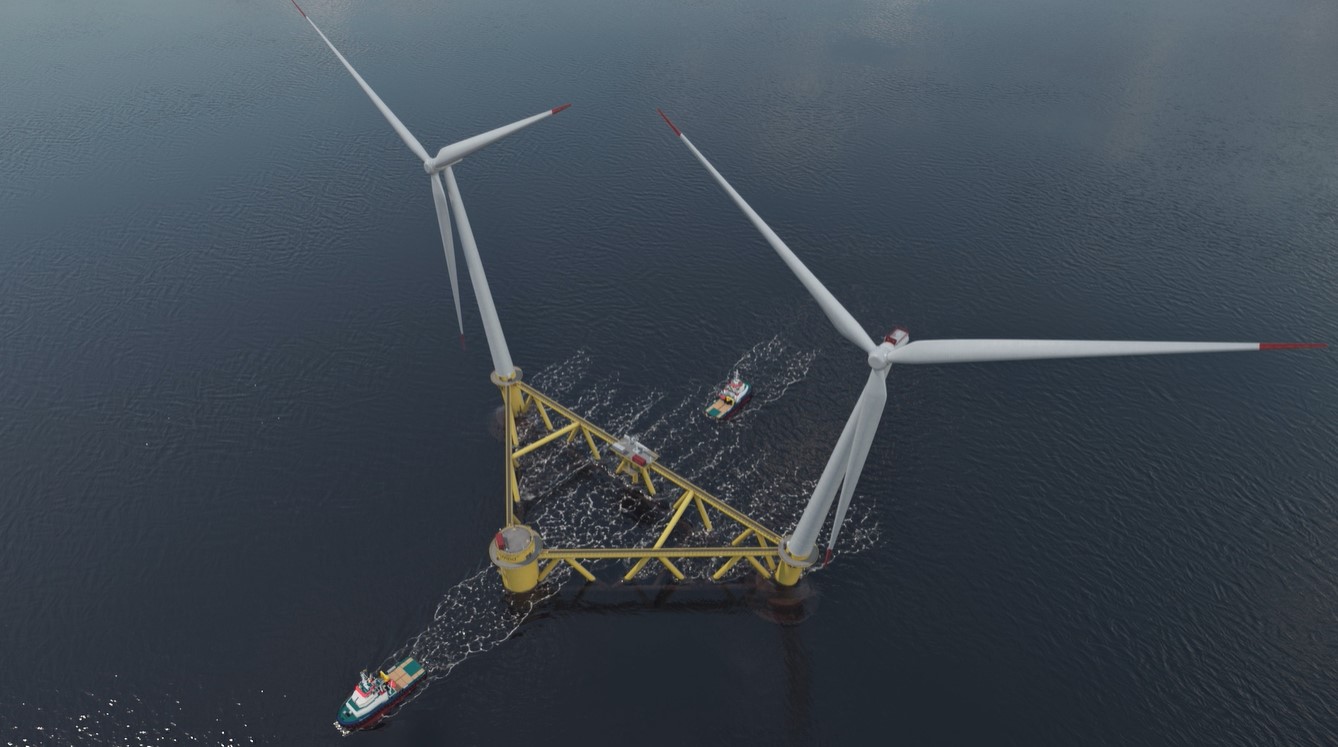
Note.
- The design turns into the wind automatically, so that the maximum amount of electricity is generated.
- A Contract for Difference for a 32 MW TwinHub has been awarded, at a strike price of £87.30/MWh, that will be installed near Hayle in Cornwall.
- With a capacity factor of 50 %, that will produce just over 140,160 MWh per year or over £12 million per year.
This article on the BBC, which is entitled Funding Secured For Floating Wind Farm Off Cornwall, gives more details of the Hayle TwinHub.
The possibility of a floating wind farm off the coast of Cornwall has moved a step closer after securing government funding, project bosses have said.
Swedish company Hexicon plans to install its TwinHub system, with the hope it could begin operating in 2025.
It would be deployed about 10 miles (16km) off Hayle.
Project supporters said it could be a boost to the local economy and help establish Cornwall in the growing renewable energy sector.
Figures have not been released, but it is understood the government funding has effectively secured a fixed price for the power TwinHub would produce for 15 years, making it economically viable.
The article says that this 32 MW system could develop enough electricity for 45,000 homes.
This could be a very suitable size for many applications.
- As at Hayle, one could be floated just off the coast to power a remote part of the country. As Cornwall has a few old mine shafts, it might even be backed up by a Gravitricity system on shore or another suitable non-lithium battery.
- Could one float alongside an oil or gas platform and be tethered to it, to provide the power?
Scotland’s hydroelectric power stations, prove that not all power stations have to be large to be successful.
Vårgrønn and Flotation Energy’s Joint Bid
This article on offshoreWIND.biz is entitled Vårgrønn And Flotation Energy To Jointly Bid in INTOG Leasing Round, gives a few details about their joint bid.
But there is nothing substantial about ideas and locations.
I can see several joint ventures with a suitable system, bidding for various projects around the Scottish coast.
Cerulean
Cerulean sounds like it could be a sea monster, but it is a shade of blue.
This article on offshoreWind.biz is entitled Cerulean Reveals 6 GW Floating Offshore Wind Bid Under INTOG Leasing Round.
These are the two introductory paragraphs.
Green energy infrastructure developer Cerulean Winds has revealed it will bid for four seabed lease sites with a combined capacity of 6 GW of floating wind to decarbonise the UK’s oil and gas sector under Crown Estate Scotland’s Innovation and Targeted Oil and Gas (INTOG) leasing round.
This scale will remove more emissions quickly, keep costs lower for platform operators and provide the anchor for large-scale North-South offshore transmission, Cerulean Winds said.
Note.
- It is privately-funded project, that needs no government subsidy and will cost £30 billion.
- It looks like each site will be a hundred turbines.
- If they’re the same, they could be 1.5 GW each.
- Each site will need £7.5 billion of investment. So it looks like Cerulean have access to a similar magic money tree as Kwasi Kwarteng.
Effectively, they’re building four 1.5 GW power stations in the seas around us to power a large proportion of the oil and gas rigs.
For more on Cerulean Winds’ massive project see Cerulean Winds Is A Different Type Of Wind Energy Company.
Will There Be An Offshore Wind Supermarket?
I can see the big turbine, float and electrical gubbins manufacturers establishing a one-stop shop for developers, who want to install small wind farms, that meet the INTOG criteria.
So suppose, the archetypal Scottish laird in his castle on his own island wanted a 6 MW turbine to go green, he would just go to the B & Q Offshore web site and order what he needed. It would then be towed into place and connected to his local grid.
I can see modular systems being developed, that fit both local infrastructure and oil and gas platforms.
Conclusion
I can see scores of projects being submitted.
I even know the son of a Scottish laird, whose father owns a castle on an island, who could be taking interest in INTOG. They might also apply under Remote Island Wind in another leasing round.
But we will have to wait until the end of March 2023, to find out who have been successful.
Ricardo Partners On Innovative Hydrogen-Electric Train Trial
The title of this post, is the same as that of this press release from Ricardo Rail.
This is the introductory paragraph.
Ricardo, in partnership with Scottish Power, Network Rail Scotland and the University of Leeds, have received next phase energy sector funding to develop their innovative Holistic Hydrogen Approach to Heavy Duty Transport (H2H) project, which aims to be a catalyst that will help the UK remove all diesel trains from the network by 2040.
Of all British companies, one of those with most to lose from world-wide decarbonisation and the phase out of petrol and diesel is Ricardo.
Ricardo plc is an unusual company, which started life as Engine Patents Ltd in 1915.
For over a hundred years, they have been the go-to company, if you have a tricky design problem, with your diesel or petrol engines or the transmission.
Wikipedia has a list of technologies that shaped the company’s first 100 years.
I used to know the grandson of the company’s founder; Sir Harry Ricardo and he told me, that virtually every modern diesel or petrol engine in the world, has been designed with help from one or more of the company’s patents.
So decarbonisation has meant that Ricardo has diversified and their innovative Holistic Hydrogen Approach to Heavy Duty Transport (H2H) project has been one of the results.
Biden-Harris Administration Announces New Actions To Expand U.S. Offshore Wind Energy
The title of this post is the same as that of this fact sheet from the White House briefing room.
This is the sub-title.
Departments of Energy, Interior, Commerce, and Transportation Launch Initiatives on Floating Offshore Wind to Deploy 15 GW, Power 5 Million Homes, and Lower Costs 70% by 2035.
Some points from the fact sheet.
- The President set a bold goal of deploying 30 gigawatts (GW) of offshore wind by 2030, enough to power 10 million homes with clean energy, support 77,000 jobs, and spur private investment up and down the supply chain.
- Conventional offshore wind turbines can be secured directly to the sea floor in shallow waters near the East Coast and the Gulf of Mexico.
- However, deep-water areas that require floating platforms are home to two-thirds of America’s offshore wind energy potential, including along the West Coast and in the Gulf of Maine.
- Globally, only 0.1 GW of floating offshore wind has been deployed to date, compared with over 50 GW of fixed-bottom offshore wind.
- The Floating Offshore Wind Shot will aim to reduce the costs of floating technologies by more than 70% by 2035, to $45 per megawatt-hour.
- The Administration will advance lease areas in deep waters in order to deploy 15 GW of floating offshore wind capacity by 2035.
This all seems to be ambitious!
But!
- In ScotWind Offshore Wind Leasing Delivers Major Boost To Scotland’s Net Zero Aspirations, I looked at Scotland’s latest round of offshore wind leases.
- If the lessors carry out their proposals Scotland will add 9.7 GW of fixed-foundation offshore wind farms and 14.6 GW of floating offshore wind farms, which I estimate will be built by 2035.
- In Three Shetland ScotWind Projects Announced, I looked at three floating wind farms to the East of Shetland, which are a secondary deal after ScotWind, which could generate 2.8 GW by 2035.
- In Is This The World’s Most Ambitious Green Energy Solution?, I describe an ambitious plan called Northern Horizons, proposed by Norwegian company; Aker to build a 10 GW floating wind farm, which will be 120 km to the North-East of the Shetlands.
It could be possible that little Scotland installs more floating wind farms before 2035, than the United States.
And what about England, Wales and Northern Ireland?
- England hasn’t announced any floating wind farm projects, but has around 17 GW of fixed-foundation offshore wind farms under development in the shallower waters along the East and South coasts.
- In Two Celtic Sea Floating Wind Projects Could Be Delivered By 2028, I looked at prospects for the Celtic Sea between Wales, Ireland and Devon/Cornwall. It is possible that a GW of floating wind could be developed by 2028, out of an ultimate potential of around 50 GW.
- Northern Ireland is a few years behind England and Scotland and might eventually make a substantial contribution.
But Biden’s aims of a strong supply chain could be helped by Scotland, as several of the floating wind farms in Scotland are proposing to use WindFloat technology from Principle Power, who are a US company. The Principle Power website has an explanatory video on the home page.
Pumped Storage Development In Scotland
The title of this post, is the same as that of this article on International Water Power & Dam Construction.
It describes and gives the current status of the two large pumped storage hydroelectric schemes under development in Scotland.
The 1.5 GW/30 GWh scheme at Coire Glass, that is promoted by SSE.
The Cruachan 2 scheme, that is promoted by Drax, that will upgrade Cruachan power station to 1.04 GW/7.2 GWh.
Note.
- Construction of both schemes could start in 2024, with completion in 2030.
- Both, SSE and Drax talk of a substantial uplift in employment during the construction.
- Both companies say that updated government legislation is needed for schemes like these.
The article is very much a must-read.
Conclusion
Welcome as these schemes are, given the dates talked about, it looks like we will need some other energy storage to bridge the gap until Coire Glas and Cruachan 2 are built.
Will Highview Power step forward with a fleet of their 2.5 GW/30 GWh CRYOBatteries, as was proposed by Rupert Pearce in Britain Will Soon Have A Glut Of Cheap Power, And World-Leading Batteries To Store It.
- The site needed for each CRYOBattery could be smaller than a football pitch.
- In Could A Highview Power CRYOBattery Use A LNG Tank For Liquid Air Storage?, I came to the conclusion that a single LNG tank could hold a lot of liquid air.
- The storing and recovery of the energy uses standard turbomachinery from MAN.
- Highview Power should unveil their first commercial system at Carrington near Manchester this year.
I am sure, that when they get their system working, they could build one in around a year.
Safety Message Clear As Leven Work Ramps Up
The title of this post, is the same as that if this press release from Network Rail.
The press release has a positive tone and indicates.
- Track is starting to be laid at the Thornton end and this track will be used to help build the Levenmouth Rail Link.
- The connection to the main line at Thornton is complete.
- Safety is emphasised.
- Planning permission for the two stations should be submitted this year.
- The programme is scheduled to complete in Spring 2024.
As it is not much larger than the Okehampton scheme, which Network Rail delivered so well, I would feel that date is feasible.
Rivalry With The Northumberland Line
The Wikipedia entry for the Northumberland Line says this about the line.
The Northumberland Line is a planned passenger rail route connecting the city of Newcastle upon Tyne with Ashington, Blyth and south-east Northumberland. The route of the line uses part of the larger Blyth and Tyne Railway, a network of lines that cover south-east Northumberland. Construction of stations is planned for the summer of 2022, with the opening of the line for passenger services planned for December 2023.
Note, that both projects are planned to be completed within a few months.
Will there be an Anglo-Scottish rivalry, perhaps with pipers on both sides?
The Plans For Giant Seaweed Farms In European Waters
The title of this post, is the same as that of this article on the BBC.
The article describes how the Dutch are developing the growing and harvesting of seaweed.
This is all fascinating stuff and reminds me of reading of a company called Alginate Industries in the Meccano Magazine in the 1950s.
I can’t find much about the company, except that they were taken over by Merck & Co in 1979.
The Wikipedia entry for alginic acid, gives this information on alginates.
Alginates are refined from brown seaweeds. Throughout the world, many of the Phaeophyceae class brown seaweeds are harvested to be processed and converted into sodium alginate. Sodium alginate is used in many industries including food, animal food, fertilisers, textile printing, and pharmaceuticals. Dental impression material uses alginate as its means of gelling. Food grade alginate is an approved ingredient in processed and manufactured foods.
I remember the Meccano Magazine saying that alginates were an important food additive and UK production came from the North of Scotland.
This page on the Secret Scotland wiki gives details of current alginate production in Scotland.
Has Wikipedia replaced the Meccano Magazine, as a source of information for scientifically-inquisitive children?
XLCC Obtains Planning Approval To Build UK’s First HVDC Cable Factory In North Ayrshire
The title of this post, is the same as that of this press release from XLCC.
These are the first three paragraphs.
On 29th June 2022, the North Ayrshire Council Planning Committee resolved to grant planning permission for XLCC’s HVDC subsea cable manufacturing operations in Hunterston, Scotland.
Breaking ground in the coming months, the brownfield site will create a new UK industry to support global decarbonisation targets. Once fully operational, the facility will support 900 jobs in the area, with thousands more in the wider supply chain.
XLCC’s first order is for four 3,800km long cables to connect solar and wind renewable power generation in the Sahara to the UK for the Xlinks Morocco-UK power project.
XLCC have also issued two other important press releases.
XLCC To Build New Cable Laying Vessel To Address Increase In Future Demand For HVDC Cable
These are the first paragraphs.
XLCC, the new HVDC, renewable energy focused business in the UK, has completed the concept design of an advanced, first-of-a-kind Cable Laying Vessel to be delivered in the first half of 2025.
As the world strives for Net Zero, the UK, EU and other world economies have set themselves ambitious targets for decarbonisation. The UK, for example, has stated that it will be powered entirely by clean energy by 2035 and that it will fully decarbonise the power system in the same time frame. This ambition is driving an exponential growth in high voltage cable demand as the increase in installation of offshore wind and interconnectors drive a forecast six times increase (2020 – 2027 over 2014 – 2020) for HVDC cable.
The planned delivery of the XLCC CLV will support the Morocco – UK Power Project, the first client project, through the delivery of four 3,800km subsea HVDC cables from a wind and solar generation site in Morocco to the UK.
This press release can be read in full here.
XLCC Signs UK Steel Charter For New Export-Led Cable Industry
These are the first paragraphs.
XLCC signed the UK Steel Charter at an event in Parliament on 19 April 2022, alongside representatives from politics, business and the trade union movement.
XLCC will create a new export-led HVDC cable manufacturing industry for the UK, nearly doubling the world’s current production. It aims to support renewable energy projects with the first factory planned for Hunterston, Scotland. XLCC will deliver its first project for the Xlinks Morocco-UK Power Project, consisting of four 3,800km long subsea cables, with the first phase between 2025-2027 connecting wind and solar power generated in Morocco exclusively to the UK in Devon.
Signing the UK Steel Charter shows a commitment to supporting existing and future jobs within the sector and the supply chain. Along with strengthening UK-based business, sourcing steel locally will cut transport emissions and seek to support decarbonisation in a sector dedicated to finding ways to minimise environmental impact of steel use.
This press release can be read in full here.
I have a few thoughts.
You Wait For A Large Interconnector Project To Come Along And Then Two Arrive Holding Hands
This paragraph introduces the Morocco-UK Power Project.
The Xlinks Morocco-UK Power Project will be a new electricity generation facility entirely powered by solar and wind energy combined with a battery storage facility. Located in Morocco’s renewable energy rich region of Guelmim Oued Noun, it will cover an approximate area of 1,500km2 and will be connected exclusively to Great Britain via 3,800km HVDC sub-sea cables.
XLCC have this mission statement on their home page.
XLCC will establish a new, export-led, green industry in the UK: world class HVDC subsea cable manufacturing.
Our mission is to provide the connectivity required for renewable power to meet future global energy needs.
Xlinks Morocco-UK Power Project and XLCC appear to be made for each other.
In some ways it takes me back to the 1970s, where large oil and gas projects in the North Sea were paired with platform building in Scottish lochs.
There Are Several Interconnector Projects Under Development
We will see a lot of undersea interconnectors in the next few years.
- Country-to-country interconnectors
- Interconnectors along the coast of the UK.
- Connections to offshore wind farms.
This capacity, with a ship to lay it, is being created at the right time.
Icelink
Icelink is a proposed interconnector between Iceland and the UK.
- It would be up to 1200 km long.
- It would have a capacity of around 1 GW
XLCC could spur the development of this project.
Floating Wind Farms Hundreds Of Miles Out To Sea
The developer of a floating wind farm, say a hundred miles out to sea, is not going to develop it, if there isn’t a secure supply of cable.
Where Will Finance Come From?
Wind farms have proven to be good investments for finance giants such as Aviva.
See World’s Largest Wind Farm Attracts Huge Backing From Insurance Giant, for Aviva’s philosophy.
As mathematical modelling for electrical systems get better, the estimates of the finance needed and the returns to be made, will indicate whether these mega-projects can be funded.
It was done with North Sea oil and gas and it can be done with offshore wind power and its interconnectors.
In The Times on the 4th of July 2022, there is this article, which is entitled Schroders Chief Buzzing To Take Finance Offshore Wind Farms.
It is a must-read!
Conclusion
XLCC and its cable factory will spur the expansion of zero-carbon electricity in the UK.
 The Anonymous Widower