ABP’s New Lowestoft Facility To Support East Anglia Two & Three O&M Ops
The title of this post, is the same as that of this article on offshoreWIND.biz.
This is the sub-heading.
UK port operator Associated British Ports (ABP) and ScottishPower Renewables have entered into a long-term agreement for supporting operations and maintenance (O&M) activities at the East Anglia Two and East Anglia Three offshore wind farms from ABP’s Lowestoft Eastern Energy Facility (LEEF).
These two initial paragraphs add a few more details.
Under the agreement, ScottishPower Renewables will utilise berths at LEEF for service operations vessels (SOVs) and crew transfer vessels (CTVs) that will serve the East Anglian offshore wind farms. The company already operates its East Anglia One O&M base in Lowestoft.
LEEF was officially opened by the UK Secretary of State for Energy Security and Net Zero in January 2025, after ABP invested GBP 35 million (almost EUR 40 million) in the port infrastructure. The facility features deep-water berths, modern utilities and future-proofed infrastructure to support shore power and alternative fuels, according to the port operator.
These are some of my thoughts
How Large Are The East Anglian Wind Farms?
There are four East Anglian Wind Farms.
- East Anglian 1 – 714 MW, which was commissioned in 2020.
- East Anglian 1 North – 800 MW, which is planned to be commissioned in 2026.
- East Anglian 2 – 963 MW, which is planned to be commission in 2029.
- East Anglian 3 -1372 MW, which is planned to be commission in 2026.
That makes a total of 3849 MW.
Where Do The Cables Come Ashore?
Google AI gives this answer to the question.
The subsea export cables for the East Anglia wind farms, including East Anglia ONE, come ashore at Bawdsey in Suffolk, where they connect to onshore cables that run underground for about 23-37 km to the Bramford converter station, near Ipswich, to join the National Grid.
I know Bawdsey well from about the late 1950s until we moved my wife and I moved our family from East Suffolk to West Suffolk in the 1990s.
These posts are two memories of Bawdsey Manor and Felixstowe Ferry on the other side of Deben, that I wrote after one of my last visits to the Deben Estuary in 2009.
It hasn’t changed much over the years.
ScottishPower Renewables Picks Port For East Anglia Two Pre-Assembly
The title of this post, is the same as that of this article on offshoreWIND.biz.
This is the sub-heading.
ScottishPower Renewables, Iberdrola’s UK arm, has selected Peel Ports Great Yarmouth as the staging ground for pre-assembly works for its 960 MW East Anglia Two offshore wind project.
This is the introductory paragraph.
The companies have signed a reservation agreement that will see the Siemens Gamesa turbine components and sections come together for assembly at the Norfolk site before installation in the southern North Sea in 2028.
Note.
- The Port of Great Yarmouth was used for this task with East Anglia One.
- The turbine blades will be manufactured at Siemens Gamesa’s offshore wind blade factory in Hull.
- The monopiles will come from Sif in Rotterdam.
This is the first sentence of the Wikipedia entry for the East5 Anglia Array.
The East Anglia Array is a proposed series of offshore wind farms located around 30 miles off the east coast of East Anglia, in the North Sea, England. It has begun with the currently operational East Anglia ONE, that has been developed in partnership by ScottishPower Renewables and Vattenfall. Up to six individual projects could be set up in the area with a maximum capacity of up to 7.2 GW.
These articles on offshoreWIND.biz indicate that ScottishPower Renewables has been busy signing contracts for East Anglia Two.
- December 4th, 2024 – Nexans Lands Export Cable Contract For East Anglia Two Offshore Wind Farm.
- November 28th, 2024 – Hitachi Energy to Integrate 960 MW East Anglia Two Wind Farm into UK Grid.
- November 12th, 2024 – Siemens Gamesa Bags GBP 1 Billion Turbine Contract For East Anglia Two.
- November 6th, 2024 – Seaway7 Wins East Anglia Two Inter-Array Cable Contract.
- October 31st, 2024 – Sif, Smulders to Deliver Monopiles and TPs For ScottishPower’s East Anglia Two Offshore Wind Farm.
They must have employed lawyers on roller skates to get five contracts signed in just over a month.
Conclusion
East Anglia Two appears to be definitely under way and the Wikipedia extract says there could be a lot more, if all the other wind farms are developed in the same way using the Port of Great Yarmouth.
A total capacity in the East Anglia Array of 7.2 GW will surely be good for both East Anglia and the UK as a whole, but will the natives be happy with all the onshore infrastructure?
I wouldn’t be surprised to see further wind farm developed to generate hydrogen offshore, which will be either brought ashore to the Bacton gas terminal, using existing or new pipelines or distributed using tanker ships to where it is needed.
ScottishPower Makes Hydrogen Aviation Pact
The title of this post, is the same as that of this article on reNEWS.biz.
These two paragraphs outline the project.
ScottishPower has partnered with ZeroAvia to explore the development of green hydrogen supply solutions for key airports, with the aim of seeing the decarbonisation of air travel take off.
The collaboration will allow the companies to explore the hydrogen infrastructure for airports to support hydrogen-electric flight and other potential uses.
There is no point of having zero-carbon hydrogen-electric aircraft without the ability to refuel them.
This picture comes from ScottishPower’s original press release.
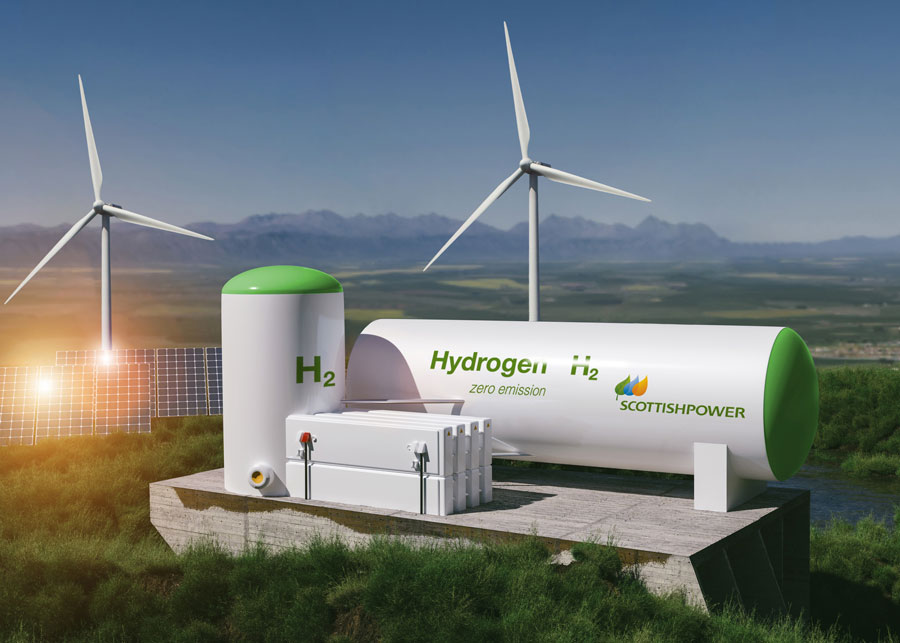
I can see a system like this having applications in industries like buses, farming, heavy transport and mining.
EDF Receives Green Light For Solar Farm At The Macallan Estate
The title of this post, is the same as that of this article on Solar Power Portal.
These three paragraphs outline the story.
Energy company EDF Renewables UK has been granted the green light to develop a 4MW solar farm to decarbonise the production of The Macallan’s single malt Scotch whisky in Craigellachie.
Located at The Macallan Estate in north-east Scotland, the distillery company alongside EDF Renewables will integrate ground-mounted solar panels to deliver up to 50% of the daytime electricity needs at peak output. In doing so, this could provide 30% of the site’s yearly electricity demand.
A key aspect of the project is biodiversity and local community engagement – aspects of solar projects which regular readers of Solar Power Portal will be aware of across a number of different schemes.
This Google Map shows the Macallan Estate about sixty miles to the North-West of Aberdeen.
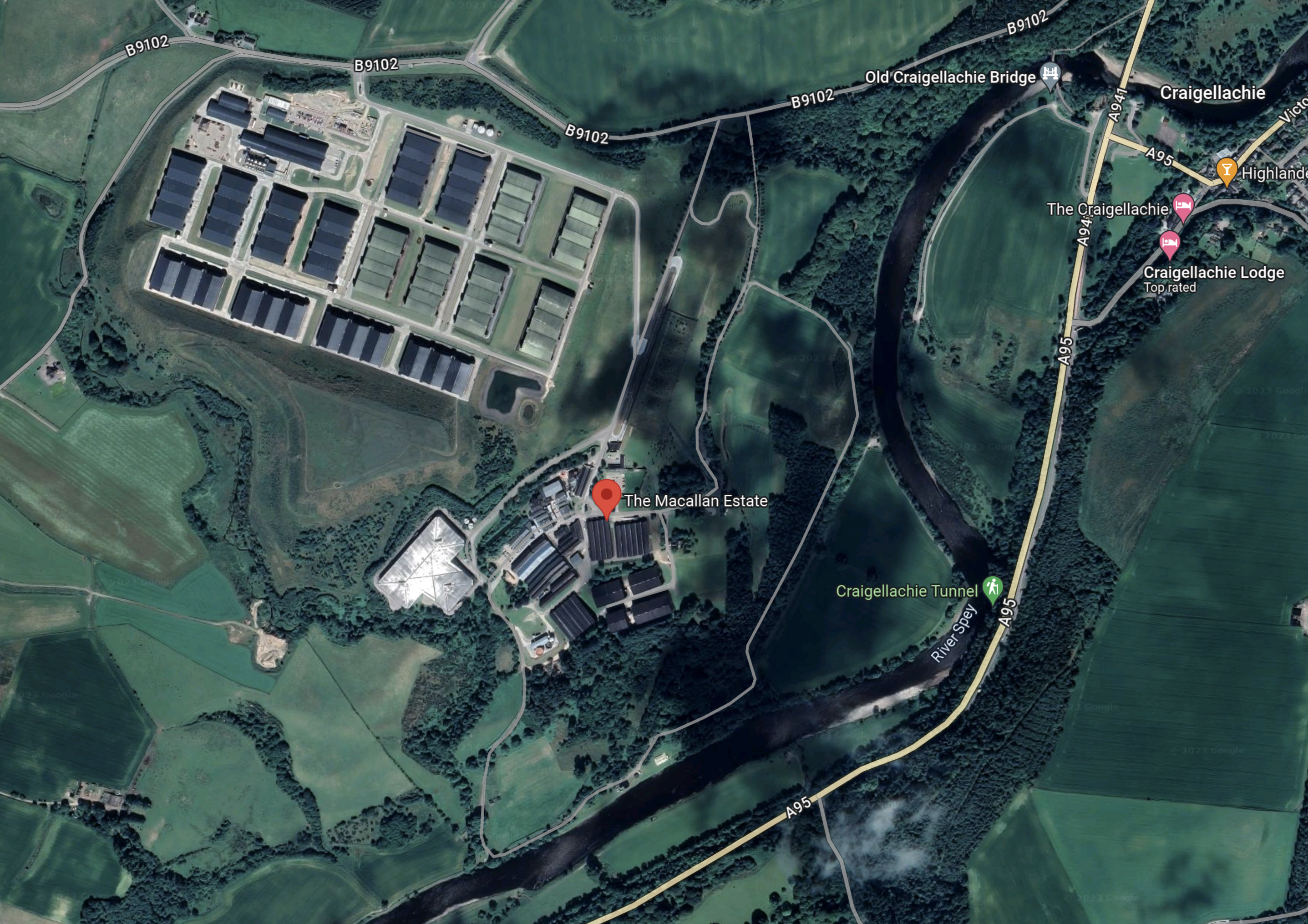
This page on the Macallan Estate web site gives details about the company, its whisky and principles.
As the estate is 485 acres, they’ve certainly got enough space for 4 MW of solar panels.
I do wonder though if low- or zero-carbon whisky and other spirits is the way the industry is going.
Searching the Internet for “Zero-Carbon Whisky” gives some worthwhile results.
- NC’NEAN is organic Scotch Whisky distilled in a net-zero distillery in the Western Highlands of Scotland.
- Cooper King is the is the very first whisky in England to be distilled using net zero energy.
- Diageo opens its first carbon neutral whiskey distillery in North America
- The Scotch Whisky Association will achieve Net Zero emissions by 2040 in our own operations.
- Scotch Whisky Heads To Zero Emissions With Wind & …
Scotland seems to be moving to make whisky at least carbon neutral.
There are also two hydrogen projects aimed at distilleries under development.
This is a paragraph from the home page of the Cromarty Hydrogen Project.
The Cromarty Hydrogen Project is the first project in the Scotland Hydrogen Programme. It originated from a collaboration between the Port of Cromarty Firth, ScottishPower, Glenmorangie, Whyte & Mackay and Diageo and the project originator, Storegga during the feasibility stage. This project is looking to develop a green hydrogen production hub in the Cromarty Firth region and revolves around the local distilleries forming the baseload demand for early phases of the project, which would enable them to decarbonise in line with their own ambitions and sector targets.
This project appears to be backed by three companies, who produce Scotch whisky.
In Major Boost For Hydrogen As UK Unlocks New Investment And Jobs, I said this.
I have just looked at the InchDairnie Distillery web site.
- It looks a high class product.
- The company is best described as Scotch Whisky Reimagined.
- The company is based in Fife near Glenrothes.
- They appear to have just launched a rye whisky, which they are aiming to export to Canada, Japan and Taiwan.
The press release says this about InchDairnie.
InchDairnie Distillery in Scotland, who plan to run a boiler on 100% hydrogen for use in their distilling process.
That would fit nicely with the image of the distillery.
I suspect the hydrogen will be brought in by truck.
Would a zero-carbon whisky be a hit at Extinction Rebellion and Just Stop Oil parties?
Diageo
This page on the Diageo web site is entitled Accelerating To A Low Carbon World.
It would probably help if more companies thought like Diageo.
Conclusion
Macallan are certainly going in the right direction.
Major Boost For Hydrogen As UK Unlocks New Investment And Jobs
The title of this post, is the same as that of this press release from the Government.
These three bullet points, act as sub-headings.
-
Eleven new production projects will invest around £400 million up front over the next 3 years, growing the UK’s green economy
-
More than 700 jobs to be created, representing the largest number of commercial scale green hydrogen production projects announced at once anywhere in Europe
-
New certainty for industry as government sets out hydrogen ambitions, including future production, transport and storage rounds
These two paragraphs outline the investment.
Over 700 jobs will be created across the UK in a world-leading hydrogen industry from the South West of England to the Highlands of Scotland, backed by £2 billion in government funding over the next 15 years.
Energy Security Secretary Claire Coutinho today (Thursday 14 December) announced backing for 11 major projects to produce green hydrogen – through a process known as electrolysis – and confirmed suppliers will receive a guaranteed price from the government for the clean energy they supply.
Note.
- This represents the largest number of commercial scale green hydrogen production projects announced at once anywhere in Europe.
- It is green hydrogen produced by electrolysis.
- The projects appear to be distributed around the UK.
- 125 MW of new hydrogen for businesses will be delivered.
I detailed the shortlist in Hydrogen Business Model / Net Zero Hydrogen Fund: Shortlisted Projects Allocation Round 2022, which used this press release from the Government as source.
Projects And Topics
This notice from the Government lists the eleven successful projects.
Projects and topics mentioned in the notice include.
Bradford Low Carbon Hydrogen
I was very impressed, when I went to see the public exhibition of this project.
- One of the reasons for building the electrolyser, is that Bradford has too many steep hills for electric buses, so will have to use more powerful hydrogen buses.
- I also got talking to a Bradford councillor, who said that they were going to use hydrogen to attract businesses to the city.
- It’s also rather large with a capacity of 24.5 MW.
The press release also gives this comment from Gareth Mills, Managing Director at N-Gen who said.
This is an important and exciting project, not just for Bradford, but also for the wider area and the community that lives here, so we are delighted to now have financial backing from government to allow us to start work on the site.
Bradford Council declared a climate emergency in 2019 and we believe this facility will play an important role in helping the area deliver on its climate change ambitions.
We know hydrogen can support decarbonising all energy types including transport, and producing green hydrogen is central to this, so we’re really excited to work with Hygen to deliver this development.
I very much feel that other large towns and cities will follow Bradford’s example.
Carlton Power
Carlton Power is a developer, who have been successful with bids for three hydrogen production projects.
- Barrow Green Hydrogen – 21 MW
- Langage Green Hydrogen – 7 MW
- Trafford Green Hydrogen – 10.5 MW
The links go to the respective web sites.
The press release also gives this comment from Eric Adams, Carlton Power’s Hydrogen Projects Director who said.
We are delighted with today’s announcement from the Department for Energy Security and Net Zero (DESNZ). Securing contracts for each project – totalling 55MW of capacity and an investment of c£100 million, and each with planning consent – is a major achievement and places Carlton Power among the leading British companies that are helping to build the hydrogen economy in the UK.
The press release also gives this comment from Keith Clarke, Founder and Chief Executive of Carlton Power who said.
We are supporting UK industry to decarbonise their operations, supporting the UK’s efforts to reach net zero and we are a catalyst for green investment and jobs into the UK regions. Working with our financial partners, Schroders Greencoat, we can now work towards Final Investment Decisions for each scheme in the early part of next year and thereafter work to have the 3 enter commercial operation within 2 years.
Carlton Power seem pleased, they got all the projects, they wanted.
Cromarty Hydrogen Project
The Cromarty Hydrogen Project has a web site, where this is said about the background of the project.
This Proposed Development would form part of the North of Scotland Hydrogen Programme recognised in the Scottish Government’s Hydrogen Action Plan1 The North of Scotland Hydrogen Programme is a strategic programme in line with the Scottish Government’s resolve to achieve Net Zero greenhouse gas (GHG) emissions by 2045 and the UK Government’s ambition by 2050. The programme is aimed at developing hydrogen production hubs across the North of Scotland to supply hydrogen, initially to meet industrial and heavy goods vehicle (HGV) transport demand in the near term and then expand to cater to additional hydrogen demands in the future.
The Cromarty Hydrogen Project is the first project in the Scotland Hydrogen Programme. It originated from a collaboration between the Port of Cromarty Firth, ScottishPower, Glenmorangie, Whyte & Mackay and Diageo and the project originator, Storegga during the feasibility stage. This project is looking to develop a green hydrogen production hub in the Cromarty Firth region and revolves around the local distilleries forming the baseload demand for early phases of the project, which would enable them to decarbonise in line with their own ambitions and sector targets.
Note.
- In Cromarty Firth And Forth To Host First Green Freeports, I talk about how Cromarty Firth is going to be a green freeport.
- The electrolyser is a medium-sized one at 10.6 MW.
- Initially HGVs will take a large part of the output.
The distillers seem to be playing a large part. I assume it it’s because distilling needs a lot of heat to boil off all the water from a spirit.
The press release also gives this comment from Sarah Potts, Storegga’s Hydrogen Managing Director, who said.
After a lot of hard work by the integrated Storegga and ScottishPower project team, particularly over the past 18 months since the UK government launch of HAR1, I’m delighted that Cromarty has been selected by the UK government Department of Energy Security and Net Zero as one of 11 projects to be awarded a funding support contract. As an SME originating from North East Scotland, I believe Storegga is able to bring a unique perspective and ambition to deliver decarbonisation solutions for Scottish industry. We look forward to now being able to take the project forward to a final investment decision in 2024, with first production in 2026 and continuing to grow our hydrogen investments in the region.
The Cromarty Hydrogen Project appears to be a local project developed to satisfy a local need, but within Government policy.
Green Hydrogen 3
I wrote about this project in Government Hydrogen Boost To Help Power Kimberly-Clark Towards 100% Green Energy Target.
It is being developed by HYRO at Northfleet for Kimberly-Clark.
The press release also gives this comment from Alex Brierley, co-head of Octopus Energy Generation’s fund management team, who said.
This is a major milestone as this funding will enable HYRO to roll out green hydrogen projects at scale in hard-to-electrify industrial processes. Our first project will be working with Kimberly-Clark to flush away fossil fuels when manufacturing Andrex and Kleenex. We’ve got a big pipeline of projects to help even more industrial businesses decarbonise – and we’re on track to invest billions in this sector.
Note.
- Will Andrex become the bog-roll of choice for the supporters of Extinction Rebellion and Just Stop Oil?
- Octopus Energy seem to be getting their fingers into lots of projects.
- I suspect that Octopus Energy will need billions.
I very much like the way that Kimberly-Clark are going and it will be interesting, if they bring out a sales philosophy based on low-carbon manufacture.
Hydrogen Blending
The press release talks of hydrogen blending.
Ministers have also announced their decision to support hydrogen blending in certain scenarios – subject to an assessment of safety evidence and final agreement.
Currently, less than 1% of the gas in distribution networks is hydrogen. Under proposals, hydrogen could be blended with other gases in the network as an offtaker of last resort, working to reduce costs in the hydrogen sector by helping producers, and to support the wider energy system.
Hydrogen blending may help achieve the UK’s net zero ambitions, but would have a limited and temporary role as the UK moves away from the use of natural gas.
When I was a wet-behind-the-ears young engineer working on ICI’s hydrogen plant at Runcorn in the 1960s, one of the topics over coffee was how can ICI find more markets for the hydrogen they produce. I suspect a lot of the excess hydrogen went to raise steam in ICI’s power station. That wasn’t very efficient or profitable.
But suppose it is deemed safe to have up to 5 % of hydrogen in the natural gas supply. Then an electrolyser operator, would know they have an offtaker of last resort, which would in effect set a minimum price for the hydrogen.
- I believe this could help their sales of hydrogen to heavy gas users, within easy reach by pipeline or truck of the electrolyser.
- It might also attract businesses with a heavy energy usage or large carbon emissions to relocate close to an electrolyser.
Allowing hydrogen blending will also mean that no expensive hydrogen is wasted.
The government’s proposal on hydrogen blending is very sensible.
Hydrogen In Home Heating
The press release says this about using hydrogen for home heating.
Ministers have decided not to proceed with a hydrogen trial in Redcar, as the main source of hydrogen will not be available. The government recognises the potential role of hydrogen in home heating and will assess evidence from the neighbourhood trial in Fife, as well as similar schemes across Europe, to decide in 2026 whether and how hydrogen could help households in the journey to net zero.
I believe the ideal way to heat homes and other buildings depends on what is available at the building’s location.
Promising ideas are coming through, but I haven’t seen one that will suit my circumstances.
But something will come through and my engineering instinct says it will be powered by natural gas and the carbon will be captured. The system would probably work on a district-wide basis.
HyMarnham
HyMarnham is probably the most unusual of the projects.
It is a collaboration between J G Pears and GeoPura.
J G Pears describe themselves like this on their web site.
JG Pears is one of the UK’s leading processors of animal by-products and food waste. Pioneering environmentally-aware practices since we started out in 1972, we play a vital role in the agricultural and food industries.
GeoPura has this mission statement on their web site.
GeoPura has a totally zero-emissions answer to how we’re going to generate, store and distribute the vast amount of energy required to decarbonise our global economies. Clean fuels. Green fuels. We believe that renewable energy is the future.
It appears that a 9.3 MW electrolyser will be built on the site of the demolished High Marnham coal-fired power station, which is shown on this Google Map.
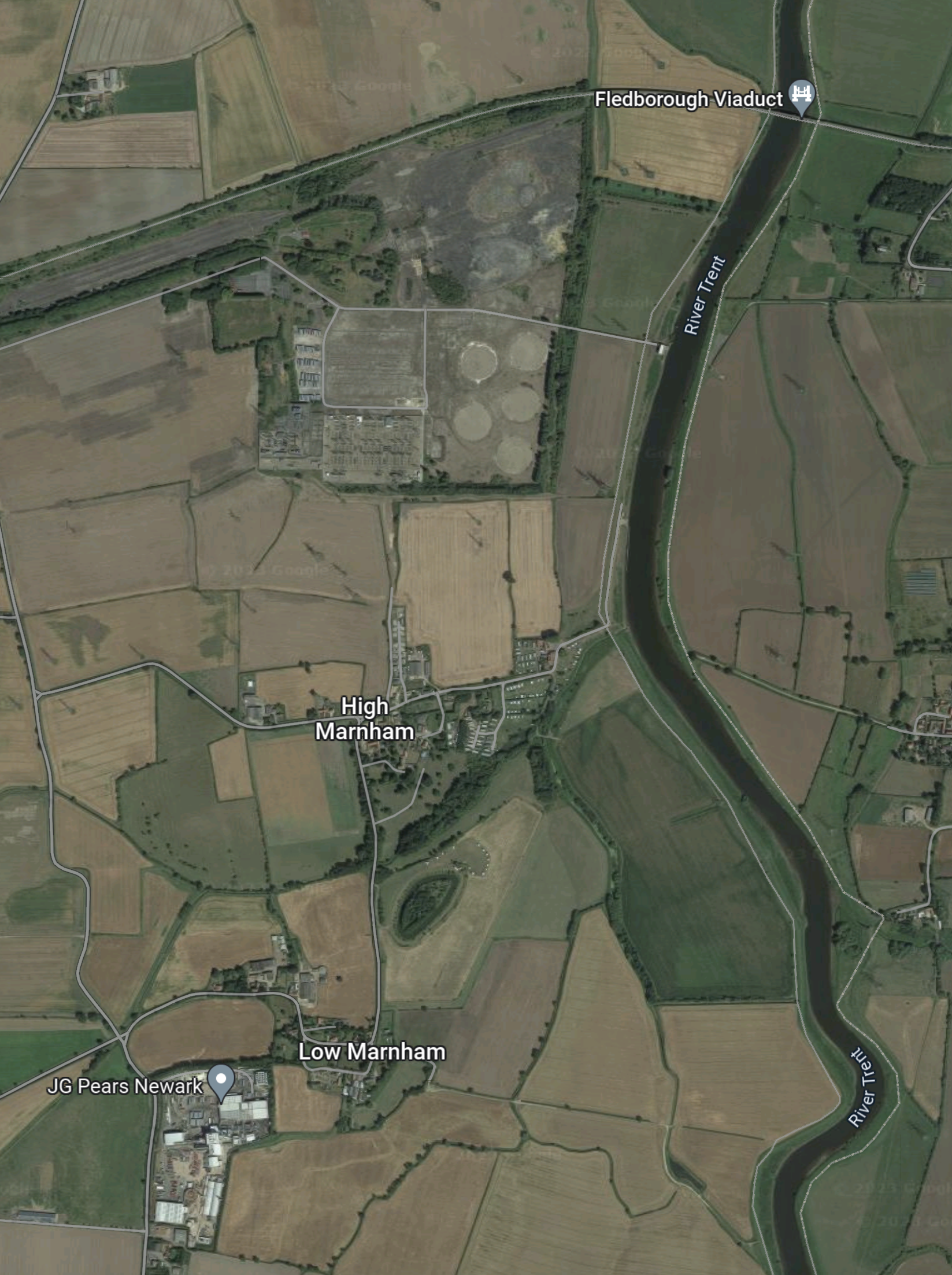
Note.
- The River Trent runs North-South across the map.
- There are two villages of High and Low Marnham in the middle of the map.
- The circles at the top of the map indicate the cooling towers of the demolished High Marnham power station.
- The High Marnham power station site is now owned by J G Pears.
- J G Pears Newark site is to the West of Low Marnham village.
- In the North-East corner of the map is the Fledborough viaduct, which crosses the River Trent.
- Network Rail’s High Marnham Test Track runs East-West across the map and uses the Fledborough viaduct to cross the Trent.
This second Google Map shows a close up of the former power station site.
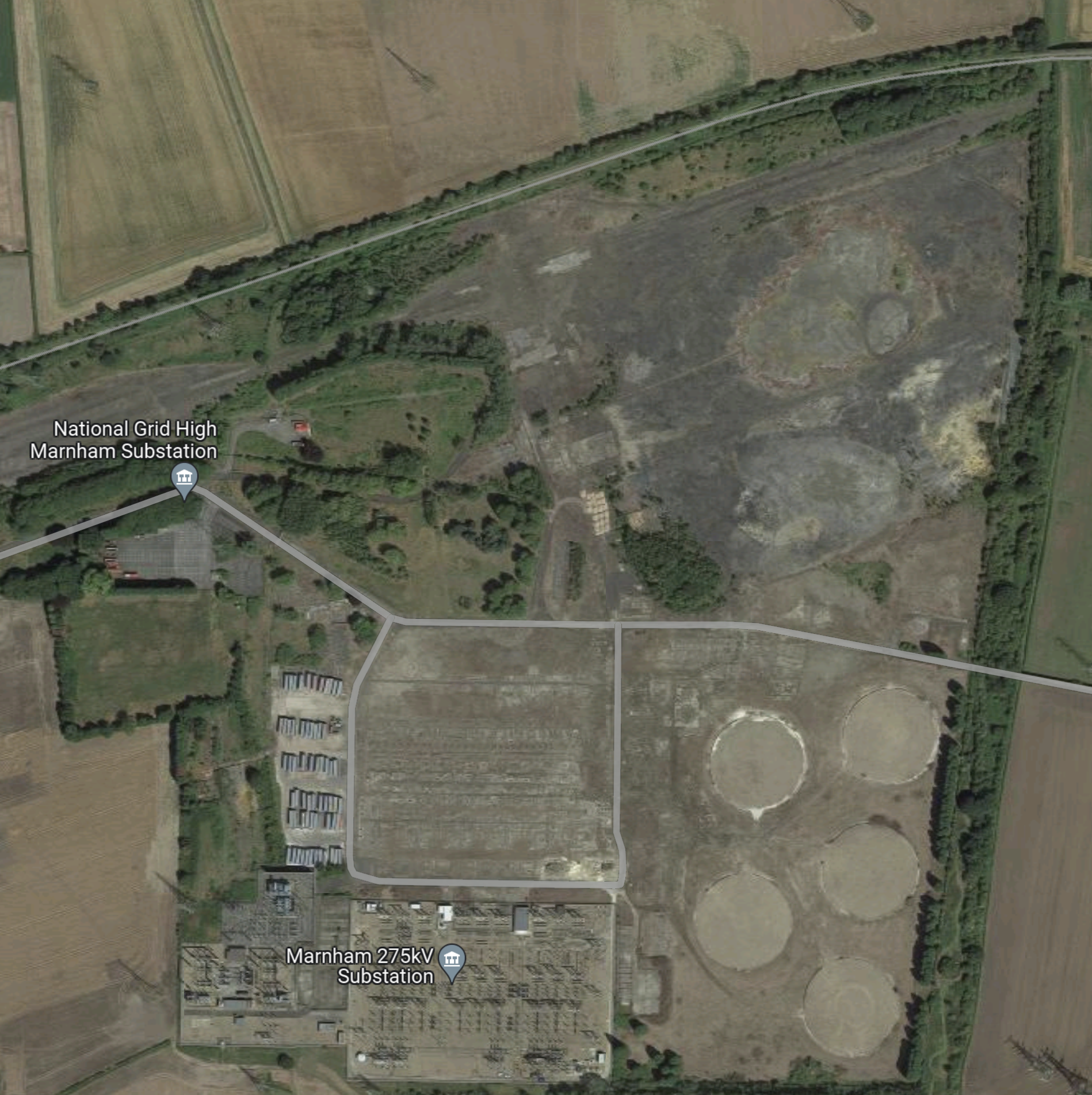
Note.
- Network Rail’s High Marnham Test Track runs East-West across the map at the top.
- The remains of High Marnham power station can be clearly seen.
- The sub-stations that connected the power station to the grid are still in place.
This article on Energy-Pedia is entitled UK: HyMarnham Power’s Green Hydrogen Project Shortlisted for UK’s Net Zero Hydrogen Fund and contains this paragraph.
Harnessing the expertise of GeoPura and JG Pears, the site will be powered by 43 MW of new solar energy and utilises 8MW of electrolysers; establishing a long-term supply of low carbon hydrogen in the region.
Note that the electrolysers are now sized at 9.3 MW.
It looks to me like one or both companies wanted an electrolyser and J G Pears had the site, so engineers and executives of the two companies got together in a decent real ale pub, started thinking and the result is HyMarnham.
- Electricity can come from the solar panels or the National Grid.
- Excess solar electricity can be exported through the National Grid.
- There is plenty of space on the site for a hydrogen filling station for vehicles.
- There could even be a filling point for refueling hydrogen-powered trains on the High Marnham Test Track.
The Energy-Pedia article indicates that GeoPura and JG Pears would like to get started this year.
Could the partners install a small electrolyser linked to the National Grid, initially, so that Network Rail has the ability to test hydrogen trains?
InchDairnie Distillery In Scotland
I have just looked at the InchDairnie Distillery web site.
- It looks a high class product.
- The company is best described as Scotch Whisky Reimagined.
- The company is based in Fife near Glenrothes.
- They appear to have just launched a rye whisky, which they are aiming to export to Canada, Japan and Taiwan.
The press release says this about InchDairnie.
InchDairnie Distillery in Scotland, who plan to run a boiler on 100% hydrogen for use in their distilling process.
That would fit nicely with the image of the distillery.
I suspect the hydrogen will be brought in by truck.
But would a zero-carbon whisky be a hit at Extinction Rebellion and Just Stop Oil parties?
PD Ports In Teesside
The press release says this about PD Ports.
PD Ports in Teesside, who will use hydrogen to replace diesel in their vehicle fleet, decarbonising port operations from 2026
I’ve felt for some time, that ports and freight interchanges, where you have lots of cranes, trucks and other diesel-powered equipment running hither and thither, is a good application for hydrogen, as not only does it cut carbon-emissions, but it also provides cleaner air for the workforce.
PD Ports have a Wikipedia entry, where this is said about their operations.
As of 2013 PD Ports owns and operates the Ports of Tees and Hartlepool under the name Teesport. The company also operates the Hull Container Terminal at the Port of Hull, and provides stevedoring and warehousing services at the Port of Immingham; logistics and warehousing at the Port of Felixstowe, Scunthorpe, and Billingham; and operates a wharf on the Isle of Wight. The company also owns the short sea ports in Scunthorpe (Groveport), Howden (Howdendyke, River Ouse, Yorkshire), and Keadby (River Trent).
The company appears to be bigger, than just Teesport and this project could grow.
The hydrogen for this project in Teesport appears to come from Tees Green Hydrogen, which will be a 5.2 MW facility developed by EDF Renewables Hydrogen.
The press release also gives this comment from Sopna Sury, Chief Operating Officer Hydrogen RWE Generation, who said.
Today’s announcements on the first 2 hydrogen allocation rounds mark a significant milestone in the development of the UK hydrogen economy. They represent a shift from policy development to project delivery, giving industry more clarity on the route to final investment decisions. Alongside the wider policy publications, this demonstrates that the UK wants to be a leader in delivering the clean energy transition.
These early projects are vital not only in driving the production of electrolytic hydrogen but also in signalling the need to build-out the T&S infrastructure for its wider distribution.
As a company with ambitions to develop approximately 2 gigawatts of green hydrogen projects across all our markets, and to invest around 8 billion euros net in green technologies in the UK between 2024-2030, RWE looks forward to being part of building a thriving hydrogen ecosystem in the UK.
These are positive words from the German energy company; RWE.
Sofidel In South Wales
The press release says this about Sofidel.
Sofidel in South Wales, who will replace 50% of their current gas boiler consumption with hydrogen at their Port Talbot paper mill.
The Wikipedia entry for the Sofidel Group has this first paragraph.
Sofidel is an Italian multinational producer of tissue paper for sanitary and domestic use. The Sofidel Group was founded in 1966. It is one of the world leaders in the tissue paper market and the second largest producer in Europe behind Essity. The privately held company is owned by the Stefani and Lazzareschi families, has subsidiaries in 13 countries and more than 6,600 employees.
Note.
- From the Wikipedia entry, it looks like the company has a good record on sustainability and has set itself good objectives.
- Sofidel are nor far from Tata Steel, who could be another large hydrogen user.
- Port Talbot will be a support port for the wind farms in the Celtic Sea.
- This is a typical hydrogen application, which reduces emission of carbon dioxide.
- But like me, have the Italian owners of the company been impressed with some of the Italian food, I’ve eaten in South Wales?
- Are British sweeteners better than Italian ones?
- The hydrogen for this project appears to come from HyBont Bridgend, which will be a 5.2 MW facility developed by Marubeni Europower.
The press release also gives this comment from Mr Tomoki Nishino, President and CEO of Marubeni Europower Ltd, who said.
Marubeni team is very honoured to be selected as a recipient of Hydrogen Allocation Round 1. Recently in October 2023, Marubeni signed an MoU with the UK government whereby we have shown our plan to invest £10 billion (along with our partners) into UK green business. We truly hope that a combination of HAR1 funding and Marubeni’s investment help decarbonize UK through HyBont, especially in the South Wales region.
It all seems to be happening in Port Talbot.
Tees Green Hydrogen
Tees Green Hydrogen is a 5.2 MW project being developed by EDF Renewables on Teesside.
The project has a web site, which has this project description on the home page.
Tees Green Hydrogen, will be a pioneering project, using the green electricity from nearby Teesside Offshore Wind Farm along with a new solar farm, which EDF Renewables UK intends to construct near Redcar, to power its hydrogen electrolyser.
The press release also gives this comment from Tristan Zipfel, Director of Strategy and Analysis at EDF Renewables UK, who said.
Today’s announcement is a huge leap forward for green hydrogen innovation which has the capacity to guarantee the long-term sustainability of industry in the North East. We are delighted that the government has given this vote of confidence in both EDF Renewables UK, Hynamics and the capacity of the region to be a world-leader in green technology and innovation.
The press release also gives this comment from Pierre de Raphelis-Soissan, CEO at Hynamics UK, who said.
This is a very important step towards realising the potential of Tees Green Hydrogen and making a ground breaking contribution to decarbonisation in the Tees Valley. The project is uniquely placed to be scalable in order that future demand can be met as hydrogen-based technology becomes the industrial norm.
Note.
- The project will be powered by both wind and solar.
- Hynamics is a subsidiary of EDF.
- I suspect that this project will supply PD Ports with hydrogen.
This project looks like it could be just a starter for 5.2 MW.
West Wales Hydrogen
West Wales Hydrogen is a 14.2 MW project being developed by H2 Energy and Trafigura in West Wales.
The best source of information is this must-watch Youtube video.
- The company appears to be able to lease you a hydrogen truck on a pay per mile basis, at the same price as a diesel truck.
- Get the finance right for your customers and yourself and everybody will be happy.
I know it will work, as I used to own half a company that leased a lot of trucks in Ipswich.
- My experience, also says the model would work with taxis, Transit-sized vans, company cars and vehicles like Defenders.
- It would also work very well around Ipswich, like my company did.
The press release also gives this comment from Julien Rolland, CEO of H2 Energy Europe, who said.
We are very grateful for the support that the UK government has announced for our 20MW electrolytic hydrogen production facility, marking a significant milestone in our journey to develop South Wales’s first large-scale green hydrogen production plant. The facility will enable industry in South Wales to transition to using green hydrogen produced from renewable energy sources.
The green hydrogen produced at Milford Haven will be used to displace natural gas and other fossil fuels in industrial and chemical processes and contribute to the decarbonisation of the local industry. The interest that we’ve already received from local industry means we are already reviewing the opportunity to scale up the facility.
I can see this model being applied all over the UK.
Whitelee Green Hydrogen
Whitelee Green Hydrogen is a 7.1 MW project being developed by Scottish Power close to the Whitelee Wind Farm.
The Whitelee Wind Farm has a comprehensive Wikipedia entry, where this is said about the future of the wind farm.
In May 2009, the Scottish Government granted permission for an extension to the wind farm to produce up to a further 130 megawatts of power, which would increase the total generating capacity of Whitelee to 452 MW.
In 2010 a 75 turbine extension commenced, adding an additional 217 MW of capacity, enough to power the equivalent of over 124,000 homes. This brought the total generating capacity of the wind farm up to 539 MW. Additionally, the extension added a further 44 km of trails to the site. John Sisk and Son Limited and Roadbridge were jointly appointed as Principal Contractors for the site during construction with Alstom Limited erecting and commissioning the wind turbines.
In August 2012 Scottish Power announced that it was applying for a further small extension of five turbines on the west of the existing site, adding 12 MW of capacity. This was refused by the DPEA on 19 Oct 2016.
A £21 million (US$29.35 million) 50MW/50MWh grid battery is being added to improve resource utilization, with plans for a 40 MW solar farm and a 20 MW hydrogen electrolyzer.
The press release also gives this comment from Peter Jones, Director of ScottishPower Green Hydrogen Business, who said.
The first wave of production facilities like Whitelee and Cromarty will demonstrate that zero-emission hydrogen can be delivered at commercial scale and drive the development of a viable market for the green fuel.
It will also create highly skilled green jobs across the UK and quickly support a world leading supply chain.
It’s early days for this burgeoning market and government support is to be welcomed to help deliver a future green hydrogen economy.
With 539 MW of wind, 40 MW of solar and a 50MW/50MWh grid battery to drive a 7.1 MW electrolyser, this should prove to be a reliable source of green hydrogen.
My Thoughts
I have a few extra thoughts.
Coverage Is Rather Patchy
Some areas of the UK don’t seem to be well-served with green hydrogen from this funding.
- East Suffolk with all those trucks going to and from the Port of Felixstowe. There’s certainly no lack of renewable energy.
- Humberside with all its energy-hungry industries. There’s certainly no lack of renewable energy.
- Hampshire with all those trucks going to and from the ports of Portsmouth and Southampton. But there is a lack of renewable energy.
- Lincolnshire with all those trucks going to and from Immingham. There’s certainly no lack of renewable energy.
- London with all those local trucks delivering building materials to sites all over the capital. But then the current Mayor doesn’t have a hydrogen policy.
I would assume, that some of these areas will be funded for hydrogen in the second round.
Ricardo Partners On Innovative Hydrogen-Electric Train Trial
The title of this post, is the same as that of this press release from Ricardo Rail.
This is the introductory paragraph.
Ricardo, in partnership with Scottish Power, Network Rail Scotland and the University of Leeds, have received next phase energy sector funding to develop their innovative Holistic Hydrogen Approach to Heavy Duty Transport (H2H) project, which aims to be a catalyst that will help the UK remove all diesel trains from the network by 2040.
Of all British companies, one of those with most to lose from world-wide decarbonisation and the phase out of petrol and diesel is Ricardo.
Ricardo plc is an unusual company, which started life as Engine Patents Ltd in 1915.
For over a hundred years, they have been the go-to company, if you have a tricky design problem, with your diesel or petrol engines or the transmission.
Wikipedia has a list of technologies that shaped the company’s first 100 years.
I used to know the grandson of the company’s founder; Sir Harry Ricardo and he told me, that virtually every modern diesel or petrol engine in the world, has been designed with help from one or more of the company’s patents.
So decarbonisation has meant that Ricardo has diversified and their innovative Holistic Hydrogen Approach to Heavy Duty Transport (H2H) project has been one of the results.
Sizewell C Nuclear Plant Campaigners Challenge Approval
The title of this post, is the same as that of this article on the BBC.
These three paragraphs introduce the article.
Campaigners against the Sizewell C nuclear power station have written to Business Secretary Kwasi Kwarteng to legally challenge his decision to give the scheme the go-ahead.
The £20bn project for the Suffolk coast was given government approval in July.
However, the decision was against the advice of the Planning Inspectorate and those against the scheme said the consent was therefore “unlawful”.
I summed up my attitude to nuclear power in Sizewell C: Nuclear Power Station Plans For Suffolk Submitted, where I said this.
As a well-read and experienced engineer, I am not against the technologies of nuclear power.
But I do think, by the time it is completed , other technologies like wind and energy storage will be much better value. They will also be more flexible and easier to expand, should we get our energy forecasts wrong.
I wrote that in May 2020, which was before Vlad the Mad started his war in Ukraine. So our energy forecasts are totally wrong! Thanks for nothing, Vlad!
In Plan To Build £150m Green Hydrogen Plant At Felixstowe Port, I talked about ScottishPower’s plan to build a large electrolyser at Felixstowe.
The Port of Felixstowe has in the past talked of using electricity from Sizewell C to create hydrogen.
So is the port backing another horse or just playing safe?
Plan To Build £150m Green Hydrogen Plant At Felixstowe Port
The title of this post, is the same as that of this article in The Times.
These two paragraphs introduce the project.
A £150 million green hydrogen plant is to be built at the UK’s busiest container port according to proposals by ScottishPower, it emerged yesterday.
The energy company has devised plans for a 100MW plant at the Port of Felixstowe which will provide fuel to power trains, trucks and ships.
There’s a lot more to this project than it would appear at first.
Where Will The Electrolyser Be Sited?
The Times article says this.
The site will be around the size of a football pitch, on brownfield land within the port.
I have flown my virtual helicopter over the port and there could be a couple of suitable football pitch-sized plots.
Where Will The Electricity Come From?
The East Anglia Array is a proposed massive series of offshore wind farms, which will be about thirty miles off the Suffolk coast.
Wikipedia says this about the size.
Up to six individual projects could be set up in the area with a maximum capacity of up to 7.2 GW.
But the main thing about the East Anglian Array is that it is being developed by a partnership of ScottishPower and Vattenfall.
Negotiations shouldn’t be difficult.
This Google Map shows the town of Felixstowe.
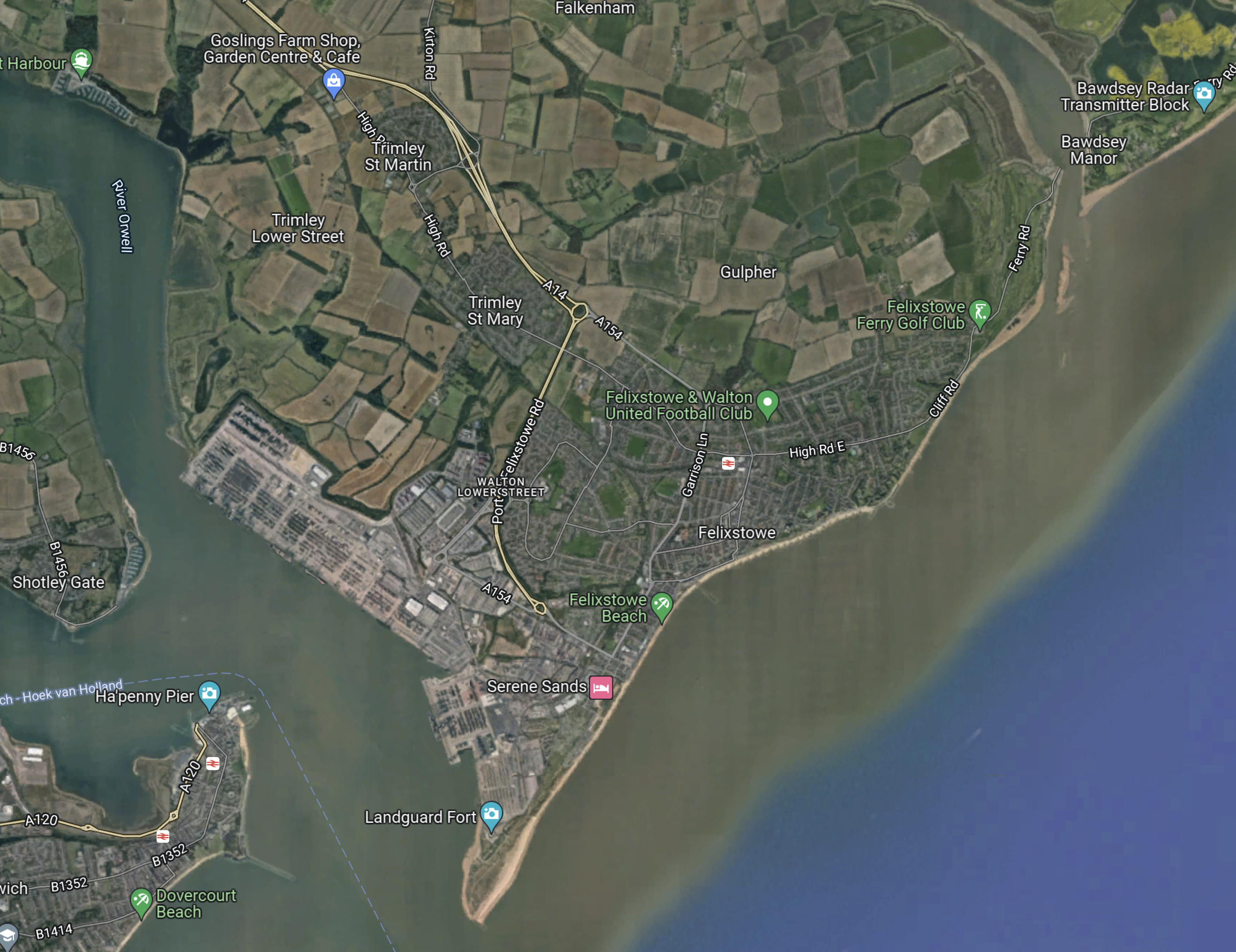
Note.
- The Ports of Felixstowe and Harwich are opposite each other on the two banks of the River Orwell.
- The power cable to the East Anglia Array comes ashore at Bawdsey in the North-East corner of the map.
- The Port of Felixstowe has two rail links, which are not electrified.
I suspect that the electric power to the electrolyser might well be routed underwater to the Port of Felixstowe either from Bawdsey or possibly direct from the wind farm.
A Meeting With A Crane Driver
I used to regularly go to Ipswich Town away matches and at one match, I met a senior crane operator from the Port of Felixstowe. We got talking about electrifying the rail link to the port and decarbonisation of the port in general.
He was adamant that electrification of the rail lines in the port, wouldn’t be a good idea as containers occasionally get dropped or crane drivers aren’t as accurate as they should be.
Hydrogen-Powered Freight Locomotives
When, I told him about the possibilities of hydrogen rail locomotives, he felt this was the way to go, as no rail electrification would be needed in the port.
Hydrogen-electric hybrid locomotives would also be able to take containers cross-country to the main electrified routes to the North and West, where they would raise their pantographs and use electric power.
How many trucks would be removed from the A14, A1 and M6?
Will Greater Anglia Convert Their Class 755 Trains to Hydrogen?
Class 755 trains have a short PowerPack in the middle and are designed for conversion to hydrogen-electric operation.

Note the PowerPack has four slots for diesel engines, batteries or hydrogen fuel-cells.
A Better Working Environment
But my fellow supporter felt the biggest gain in the port, would come with replacement or updating of all the vehicles and handling equipment, as if all these machines were hydrogen-powered, this would greatly improve the working conditions for the dock workers.
ScottishPower’s Vision
This press release on ScottishPower’s web site is entitled ScottishPower Vision For Green Hydrogen Fuels Hub At Port Of Felixstowe.
Conclusion
The Port of Felixstowe is doing the planning for this in the right way, as ensuring the hydrogen supply in the port first, is the logical way to transition to hydrogen power.
But then, I’ve watched the Port of Felixstowe grow since the 1960s and they usually get their decisions right.
The press release starts with these bullet points.
- ScottishPower explores green hydrogen at Port of Felixstowe to help decarbonise the UK’s busiest port.
- The project could help kick-start the low carbon transformation of the UK’s heavy transport sector.
- 100MW facility could deliver up to 40 tonnes of green hydrogen per day – enough to power 1300 hydrogen trucks.
- International export also being explored.
And these two paragraphs.
ScottishPower, with Hutchison Ports, is exploring the opportunity to develop, build and operate a multi-hundred MW green hydrogen production facility at the Port of Felixstowe – with the potential to decarbonise industry and transportation in the region.
Both companies have set out their vision to help create a greener port, which could provide clean fuel for customers at Britain’s busiest container port.Plans are being developed to use green hydrogen for onshore purposes, such as road, rail and industrial use, with the potential to create liquid forms, such as green ammonia or e-methanol. This could, in turn, provide clean fuels for shipping and aviation, and create opportunities for cost-effective export to international markets. The project aims to continue engineering and site development works to align with customer demand from 2025 onwards.
It is certainly a very extremely ambitious vision!
But then the county of my conception, has a tremendous determination to succeed. And often against all conventional logic!
ScotWind Offshore Wind Leasing Delivers Major Boost To Scotland’s Net Zero Aspirations
The title of this post, is the same as that of this press release on the Crown Estate Scotland web site.
This is the first two paragraphs.
Crown Estate Scotland has today announced the outcome of its application process for ScotWind Leasing, the first Scottish offshore wind leasing round in over a decade and the first ever since the management of offshore wind rights were devolved to Scotland.
The results coming just months after Glasgow hosted the global COP26 climate conference show the huge opportunity that Scotland has to transform its energy market and move towards a net zero economy.
Some highlights are then listed.
- 17 projects have been selected out of a total of 74 applications.
- A total of just under £700m will be paid by the successful applicants in option fees and passed to the Scottish Government for public spending.
- The area of seabed covered by the 17 projects is just over 7,000km2.
- Initial indications suggest a multi-billion pound supply chain investment in Scotland
- The potential power generated will move Scotland towards net-zero.
This map shows the position of each wind farm.

Note, that the numbers are Scotwind’s lease number in their documents.
Fixed Foundation Wind Farms
These are the six fixed foundation wind farms.
- 1 – BP Alternative Energy Investments – 859 km² – 2.9 GW
- 6 – DEME – 187 km² – 1.0 GW
- 9 – Ocean Winds – 429 km² – 1.0 GW
- 13 – Offshore Wind Power – 657 km² – 2.0 GW
- 16 – Northland Power – 161 km² – 0.8 GW
- 17 – Scottish Power Renewables – 754 km² – 2.0 GW
Adding up these fixed foundation wind farms gives a capacity of 9.7 GW in 3042 km² or about 3.2 MW per km².
Floating Wind Farms
These are the ten floating wind farms.
- 2- SSE Renewables – 859 km² – 2.6 GW
- 3 – Falck Renewables Wind – 280 km² – 1.2 GW
- 4 – Shell – 860 km² – 2.0 GW
- 5 – Vattenfall – 200 km² – 0.8 GW
- 7 – DEME Concessions Wind – 200 km² – 1.0 GW
- 8 – Falck Renewables Wind – 256 km² – 1.0 GW
- 10 – Falck Renewables Wind – 134 km² – 0.5 GW
- 11 – Scottish Power Renewables – 684 km² – 3.0 GW
- 12 – BayWa r.e. UK – 330 km² – 1.0 GW
- 14 – Northland Power – 390 km² – 1.5 GW
Adding up the floating wind farms gives a capacity of 14.6 GW in 4193 km² or about 3.5 MW per km².
Mixed Wind Farms
This is the single wind farm, that has mixed foundations.
15 – Magnora – 103 km² – 0.5 GW
This wind farm appears to be using floating wind turbines.
I have a few general thoughts.
Are Floating Wind Farms Further Out?
There does appear to be a pattern, where the wind farms that are further from the land tend to be floating wind farms and those closer to the land appear to be fixed.
Consider.
- As the water gets deeper, fixed wind turbines will surely get more expensive.
- Floating wind turbines are the newer and more unproven technology, so only those bidders, who have done their research and are happy with it, will have bid.
Falck Renewables Wind Seem To Be Working With BlueFloat Energy
In the three Falck Renewables successes with leases 3, 8 and 10, BlueFloat Energy is a partner in the lease.
According to their web site, BlueFloat Energy were very much involved in WindFloat Atlantic, where this is said.
Top members of our team were key contributors to the development and construction of the WindFloat Atlantic project from concept to Final Investment Decision to commissioning. This 25 megawatt (MW) floating offshore wind project in Portugal marked a turning point in the offshore wind industry as it was the first floating offshore wind project to secure bank financing. With 3 x MVOW’s 8.4 MW turbines, the WindFloat Atlantic project was the world’s first semi-submersible floating wind project and continental Europe’s first floating wind project.
So do Falck Renewables intend to use WindFloat technology in their areas, which are to produce a total of 2.7 GW?
Perhaps a fleet of two hundred floating wind turbines based on WindFloat technology each with a capacity of 14 MW would be ideal.
- Wind turbines would be interchangeable between all three farms.
- There could be a few standby turbines to allow for maintenance.
- It would be possible to borrow a turbine to explore a new site.
All it would need is technology to be able to position and connect a turbine into the wind farm and disconnect and remove a turbine from the wind farm, with simple procedures.
Did BP Avoid the Floating Wind Farms?
BP, who are relatively new to offshore wind, only had one success, for a large fixed wind farm. So did they avoid the floating wind farms?
Do Shell and Scottish Power Have A Bigger Plan?
Shell and Scottish Power were successful with leases 4 and 11, which are reasonably close together.
They also won lease 17, which I wrote about in MacHairWind Wind Farm, where I concluded this.
The MacHairWind wind farm seems a well-positioned wind farm.
- It is close to Glasgow.
- It can be used in tandem with the Cruachan pumped hydro power station.
- It will have access to the Western HVDC Link to send power to the North-West of England.
Is Scotland replacing the 1.2 GW Hunterston B nuclear power station with a 2 GW wind farm, with help from Cruachan and other proposed pumped storage hydro schemes to the North of Glasgow?
So did Shell and Scottish Power get the pick of the bunch and will build two large floating wind farms close together?
Shell and Scottish Power seem to be using French company; Eolfi’s floating wind technology.
Why Do Floating Wind Farms Have A Higher Density?
The floating wind farms have an average energy density of 3.5 MW per sq. km, whereas the fixed wind farms only manage 3.2 MW per sq. km.
It may be only ten percent, but does that help the economics? It certainly, wouldn’t make them worse.
I do wonder though, if the reason for the higher density is simply that a floating turbine can be bigger, than a corresponding fixed turbine.
I also have a few more specific thoughts about individual farms.
Lease 15 – The Odd Bid Out
In any design competition, there is usually at least one design, that is not look like any of the others.
In the successful bids for the ScotWind leases, the bid from Magnora ASA stands out.
- The company has an unusual home page on its offshore wind web site.
- This page on their web site outlines their project.
- It will be technology agnostic, with 15MW turbines and a total capacity of 500MW
- It will use floating offshore wind with a concrete floater
- It is estimated, that it will have a capacity factor of 56 %.
- The water depth will be an astonishing 106-125m
- The construction and operation will use local facilities at Stornoway and Kishorn Ports.
- The floater will have local and Scottish content.
- The project will use UK operated vessels.
- Hydrogen is mentioned.
- Consent is planned for 2026, with construction starting in 2028 and completion in 2030.
This project could serve as a model for wind farms all round the world with a 500 MW power station, hydrogen production and local involvement and construction.
I discuss this project in more detail in ScotWind N3 Offshore Wind Farm.
A Conclusion About Floating Wind
The various successful bids in this round of Scottish wind farm leases can be split by capacity into two groups.
- Floating + Mixed – 15.1 GW – 61 %
- Fixed – 9.7 GW – 39 %
Note that I have included Magnora’s successful mixed bid with the successful floating bids, as it uses floating wind turbines to generate electricity.
The over 60 % of successful bids involving floating wind farms, indicates to me, that the day of floating wind farms has arrived.
Shell And ScottishPower Win Bids To Develop 5 GW Of Floating Wind Power In The UK
The title of this post, is the same as that of this press release from Shell.
This is three paragraphs from the press release.
Shell and ScottishPower have secured joint offers for seabed rights to develop large-scale floating wind farms as part of Crown Estate Scotland’s ScotWind leasing. The partners have won two sites representing a total of 5 gigawatts (GW) off the east and north-east coast of Scotland.
The new wind farms will be delivered through two joint ventures called MarramWind and CampionWind. They bring together ScottishPower’s and Shell’s decades of experience working offshore and significant presence in Scotland, as well as their strong innovation capabilities for delivering world-class offshore energy projects.
The development, construction and operation of ScotWind projects is set to bring new skilled jobs and manufacturing opportunities and boost local supply chains.
ScottishPower are actually involved in three large ScotWind projects; one by themselves and two in partnership with Shell.
MacHairWind
MachairWind is a project that Scottish Power is developing alone.
- It has its own page on the ScottishPower Renewables web site.
- It will be a 2 GW wind farm to the North-West of Islay.
- The turbines will be on fixed foundations.
I wrote about this project in MacHairWind Wind Farm.
MarramWind And CampionWind
These two wind farms are being developed in partnership with Shell.
They both have their own web sites.
MarramWind’s web site has this introduction.
ScottishPower and Shell have joined forces to develop the MarramWind offshore windfarm following success in the recent ScotWind auction process by Crown Estate Scotland.
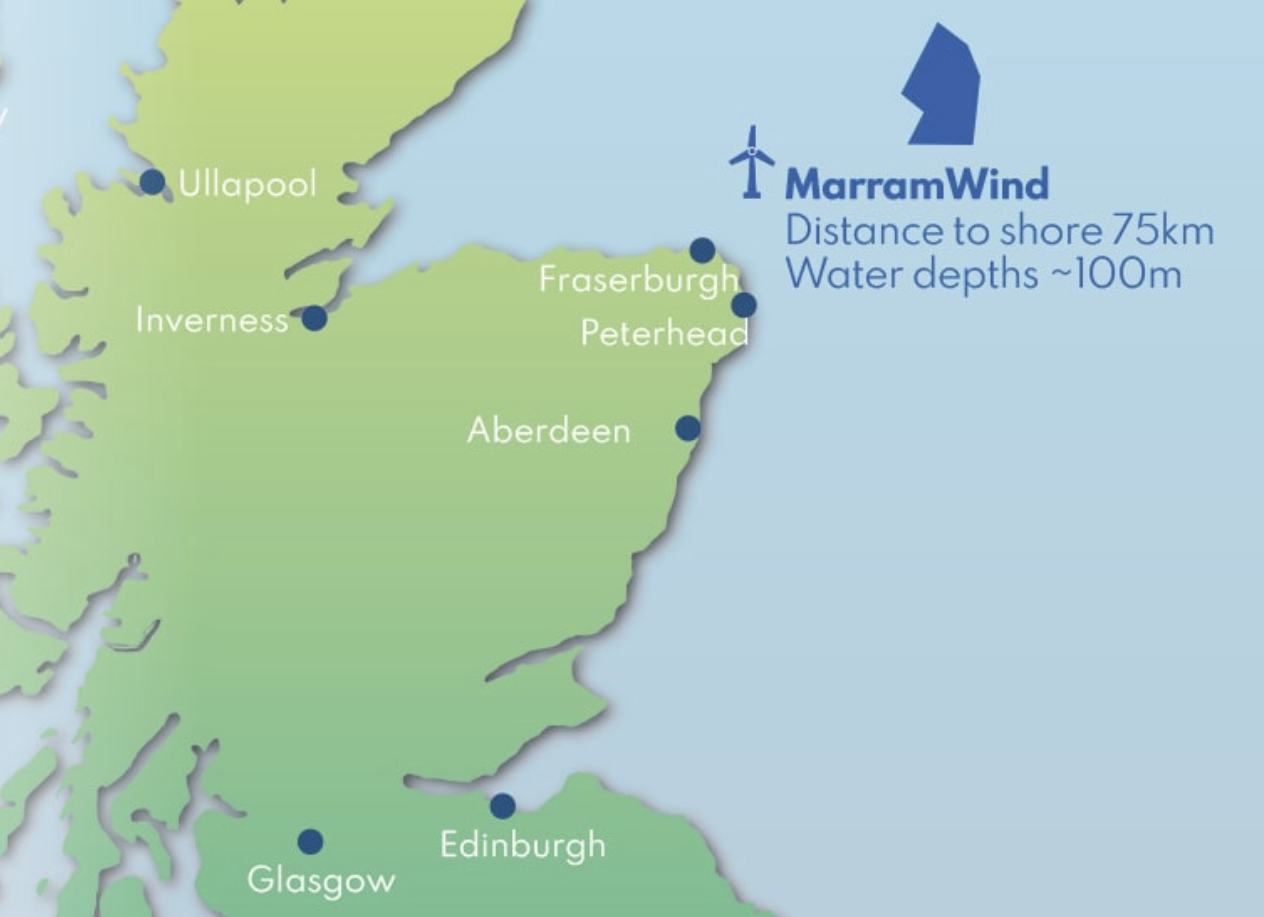
Located 75 kilometres off the North East coast of Scotland in water depths averaging 100 metres, the proposed MarramWind floating offshore windfarm could deliver up to 3 gigawatts (GW) of cleaner renewable energy.
This map clipped from the MarramWind web site, shows the location of the wind farm.
CampionWind’s web site has this introduction.
ScottishPower and Shell have joined forces to develop the CampionWind offshore windfarm following success in the recent ScotWind auction process by Crown Estate Scotland.
Located 100 kilometres from the east coast of Scotland, in water depths averaging 77 metres, the proposed CampionWind floating offshore windfarm could deliver up to 2 gigawatts (GW) of cleaner renewable energy.
This map clipped from the CampionWind web site, shows the location of the wind farm.
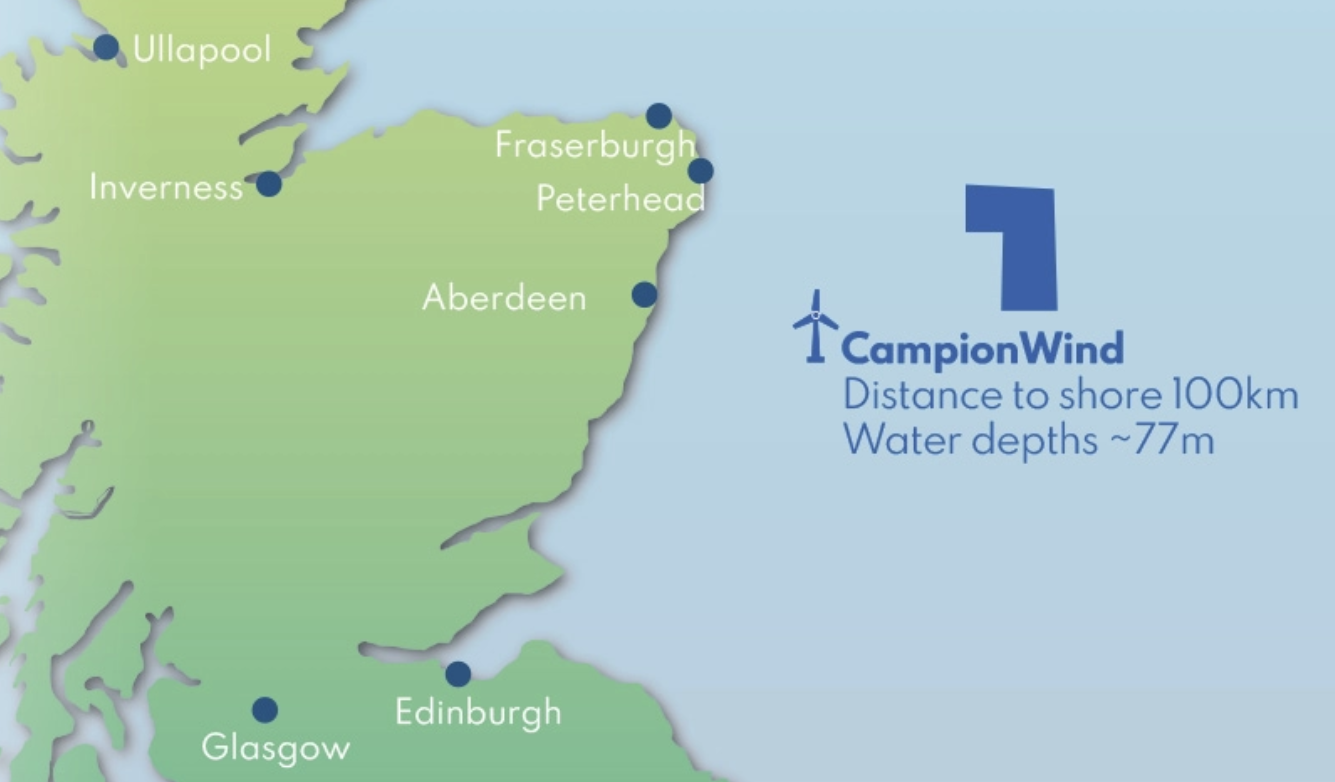
Note.
- The two wind farms will be within a few miles of each other.
- Both wind farms will use floating wind turbines.
- The water is a bit deeper at MarramWind, but this surely doesn’t bother a floating turbine.
- MarramWind and CampionWind will have a total capacity of 5 GW.
- Hywind Scotland is the world’s first commercial wind farm using floating wind turbines, situated 29 kilometres off Peterhead. This wind farm is only 30 MW, but in its first years of operation has achieved a capacity factor of over 50 %.
- The proposed turbines at Northern Horizons‘ 10 GW wind farm, which is 130 kilometres to the North-East of Shetland will be 20 MW giants and nearly as tall as The Shard in London.
So will Scottish Power and Shell design and build a combined field, similar in concept to Northern Horizons’ wind farm, using an armada of 250 floating wind turbines?
- The wind turbines might be moored around a fixed or floating mother platform or structure, that will collect the electricity and deliver it to the shore.
- Turbines could be serviced in situ or moved into port, as needed.
- Extending the wind farm could just be a matter of mooring the extra turbines in position and then connecting them to the mother platform.
- Is there a convenient disused oil or gas platform, that could be repurposed as the mother platform?
It certainly would appear to be a way of building large offshore fields in deep waters.
Where Would The Combined MarramWind And CampionWind Rank In Terms of UK Wind Farms?
Consider.
- MarramWind and CampionWind will have a total capacity of 5 GW.
- Phase one of the Hornsea Wind Farm is the largest offshore wind farm in the world, with a capacity of just over 1.2 GW and when complete it will have a capacity of 6 GW.
- Northern Horizons is planned to be 10 GW.
- The East Anglian Array could be as large as 7.2 GW.
- The Dogger Bank Wind Farm is planned to be as large as 4.8 MW.
- Norfolk Vanguard and Norfolk Boreas are a pair of 1.8 GW wind farms.
- MacHairWind will be a 2 GW wind farm.
Note.
- This is not a complete list of large wind farms in the development pipeline.
- BP have obtained leases, but have not published their plans.
- Most farms under development are at least one GW.
- These farms are a total of 38.6 GW.
The Combined MarramWind and CampionWind would be one of several large wind farms around 5 GW.
There Is A Desperate Need For Energy Storage
If we are generating upwards of 40 GW of wind and solar energy in the UK, there will be a desperate need for energy storage to cover for the times, when the wind doesn’t blow and the sun doesn’t shine.
Scotland should be OK, as there are various energy storage projects in development.
- The 1.5 GW/ 30 GWh Coire Glas project is according to SSE shovel-ready and has planning permission.
- The 450 MW/2.8 GWh Red John project is being constructed.
- Drax, ILI Group and SSE have several other projects under development.
So what would happen in the South?
The government appears to be on the case as I wrote in Ministerial Roundtable Seeks To Unlock Investment In UK Energy Storage.
But there is also the possibility of using hydrogen.
- Hydrogen could be created by a series of giant electrolysers.
- It could be blended with natural gas to eke out our natural gas and save carbon. According to HyDeploy, it appears that up to 20 % can be added, without needing to change boilers and appliances.
- It can be stored in depleted offshore gas fields.
- It can be used to power heavy transport like buses, trucks, trains and ships.
- It can be burned in gas-fired power stations to generate electricity.
Hydrogen can also be used as a feedstock or green energy source for the making of chemicals, concrete and steel.
Conclusion
We are approaching the end of the first phase of the development of renewable energy in the UK.
Massive floating wind farms using armadas of floating wind farms, a large expansion of pumped storage hydro and a huge expansion of the use of hydrogen will see us through to a carbon-free future.
 The Anonymous Widower