Shell Pulls Plug On Rotterdam Biofuels Plant
The title of this post, is the same as that of this article on The Times.
This is the sub-heading.
Retreat from green energy continues as facility that was earmarked to produce sustainable aviation fuel and renewable diesel will not now be built
These first three paragraphs add some details.
Shell has scrapped construction of one of Europe’s biggest biofuels plants as it continues its retreat from green energy
The move by the FTSE 100 oil and gas group represents a further setback for efforts to cut aviation emissions.
Shell said it would not restart construction of the biofuels facility at its Rotterdam energy and chemicals plant, which was due to produce sustainable aviation fuel (SAF) and renewable diesel.
When I wrote Centrica Secures Investment Stake In Gasrec Helping Boost UK Bio-LNG Ambitions, I took a look at the use of liquified natural gas (LNG) in transport.
This paragraph from the Centrica press release about the stake, gives the thoughts of Chris O’Shea, who is Group Chief Executive, Centrica.
Chris O’Shea, Group Chief Executive, Centrica plc, said: “Demand for bio-LNG for transport is growing fast as more HGV operators make the switch – drawn by a clean, ready-to-use fuel which slashes CO2 emissions by up to 85 per cent in comparison to diesel*. This investment in Gasrec enhances our collaboration with the leading company in the sector, and puts us in a strong position to energise a vital sector of the industry on its journey to net zero.”
Chris O’Shea of Centrica appears to feel that bio-LNG is a good alternative to diesel, so have Shell come to a similar decision, about satisfying the demand for diesel?
I asked Google AI if LNG has advantages over diesel as a truck fuel and received this answer.
Yes, LNG offers advantages over diesel, including significantly lower emissions of nitrogen oxides (NOx), sulfur oxides (SOx), and particulate matter (PM), which improves local air quality. It can also be more economically efficient, with fuel costs potentially lower than diesel depending on market conditions. However, the overall greenhouse gas (GHG) benefits are mixed; while LNG has a lower carbon content, it can result in higher lifecycle GHG emissions due to energy losses in its production and transport, as well as methane slip.
Note.
- If it drops emissions by up to 85 percent for bio-LNG, surely, it would do the same for LNG.
- I also think with tight regulations, the use of LNG could improve air quality in cities like London.
- LNG would probably be a more affordable fuel than hydrogen.
It should also be noted, that several major diesel engine makers, now make families of engines, which can handle, diesel, hydrogen and natural gas.
LNG would also be a convenient stepping stone between current fuels and hydrogen, that might give a few extra years for the transition.
Could LNG Be Used In Aircraft?
Consider.
- LNG would certainly give some reduction in carbon emissions.
- Handling LNG in aircraft could have similar problems to hydrogen, so companies like Airbus might have already solved them.
- In addition, LNG doesn’t have the fearsome reputation, that hydrogen seems to have gained because of the Hindenburg.
- It would be easier to provide LNG fuel at airports all round the world.
- Airbus have said availability of hydrogen at airports, could be a problem.
Out of curiosity, I asked Google AI if LNG could be used to power an airliner and received this answer.
Yes, liquefied natural gas (LNG) can theoretically be used to power airliners, offering a potential reduction in CO2 emissions compared to conventional jet fuel, but significant challenges exist. These challenges include the need for entirely new, larger, and heavier cryogenic fuel tanks, modifications to aircraft engines and fuel systems, and the development of a new global infrastructure for LNG supply. While experimental tests have been conducted, such as on the Soviet Union’s Tupolev Tu-155 in 1989, LNG is not currently in normal service due to these practical and infrastructural hurdles.
I would prefer it was a purpose-designed Airbus, than a Soviet-era Tupolev.
TetraSpar Demonstrator Floating Wind Turbine Hits 63 Pct Capacity Factor In Norway
The title of this post, is the same as that of this article on offshoreWIND.biz.
This is the sub-heading.
Stiesdal has revealed that its TetraSpar Demonstrator, located in Norway, has reached a capacity factor of 63 per cent.
These three paragraphs give a few more details.
Since its commissioning in late 2021, the TetraSpar Demonstrator has been operational at METCentre in Norway, delivering green energy, gathering data, validating numerical models, supporting research and development projects, and serving as a living laboratory for the development of floating wind technology, said Stiesdal in a recent social media post.
To date, the demonstrator has generated more than 37 GWh of renewable energy, according to the company. The 3.6 MW Siemens Gamesa direct-drive wind turbine and very high wind speeds at the METCentre site combined to yield a capacity factor of 54 per cent, said Stiesdal.
In the first two years of operation, the availability was recorded at 97 per cent and 98.3 per cent, respectively. For 2024, the availability has increased to 99.5 per cent with a capacity factor of almost 63 per cent, according to the company.
I have some further thoughts.
Tetra Offshore Foundations For Any Water Depth
The title of this section, is the same as that of this page on the Siesdal web site.
The page gives a lot of information and says that the TetraSpar can handle water depth of over a thousand metres.
Wind Farm Capacity Factor
The Wikipedia entry for capacity factor says this about the range of wind farm capacity factors.
Wind farms are variable, due to the natural variability of the wind. For a wind farm, the capacity factor is determined by the availability of wind, the swept area of the turbine and the size of the generator. Transmission line capacity and electricity demand also affect the capacity factor. Typical capacity factors of current wind farms are between 25 and 45%. In the United Kingdom during the five year period from 2011 to 2019 the annual capacity factor for wind was over 30%.
From that paragraph, 63 % seems to be extraordinarily good.
Conclusion
The TetraSpar appears to be a powerful concept.
Ecojet: Dale Vince Launches An Aviation Revolution
The title of this post is the same as that as this news story from Ecotricity.
This is the sub-heading.
The world’s first electric airline powered by renewable energy
These three paragraphs outline the project.
Ecotricity founder, Dale Vince, has announced the launch of Ecojet, the world’s first Electric Airline, powered by renewable energy. The move marks the beginning of an aviation revolution by making net-zero, emission-free air travel possible for the first time.
Ecojet’s fleet will comprise conventional planes retrofitted with hydrogen-electric powertrains. Once converted, the aircraft will operate with the same power output as before, but with a one-hundred percent reduction in CO2 emissions.
The decision to repurpose old planes rather than build new models from scratch will save 90,000 tonnes of carbon per year. The only byproduct will be water, which can be captured and released into the lower atmosphere to avoid the harmful effects of contrails.
These ae my thoughts.
The Aircraft
The news story contains pictures of two aircraft; a de Havilland Canada Twin Otter and a 737 or A320 variant.
- It also says that hydrogen-electric powertrains will be used.
- ZeroAvia in partnership with Cranfield Aerospace are developing such a powertrain and I suspect they could have one certified by 2025.
This would be used in the Twin Otter.
But what about 737 or A320 variant?
Airbus are already proposing the ZEROe Turbofan, which appears to be based on an improved A320 neo.
But the image on the news story looks more like a Boeing 737 from the wing-tips.
This article on the IET web site, which is entitled Airbus And Boeing To Embrace Hydrogen From Mid-2030s, indicates that it will be the mid-2030s before hydrogen twinjets of this size are in service.
This paragraph from the news story indicates his philosophy about the aircraft.
Short-term, to secure routes and a license from the Civil Aviation Authority, Ecojet will initially launch using conventionally fuelled planes. Ecojet will launch with two different sizes of turboprop aircraft (a 19-seat aircraft and a 70-seat aircraft). These aircraft will be retrofitted with the hydrogen-electric powertrains as they become approved for service by the CAA – the first retrofits will take place in 2025, one year after the commencement of flights.
Note.
- The news story clearly states that two types of aircraft will be used; a 19-seat turboprop and 70-seat turboprop.
- So the second picture of a Boeing 737 had nothing to do with the news story.
- They will be retrofitted with hydrogen-electric powertrains, when they have been certified.
- Flights are planned to start next year.
It looks a very canny philosophy, as Ecojet will be able to prove the route with aircraft running on traditional fuels or sustainable aviation fuel (SAF) and only switch to hydrogen, when the hydrogen-electric powertrains are proven, certified and installed, and the hydrogen infrastructure is in place.
The Smaller Aircraft
The first picture in the news story is of a de Havilland Canada Twin Otter.
- This aircraft accommodates 19-20 passengers.
- It has two turboprop engines.
- Production started in 1966 and it is still ongoing.
- Nearly a thousand have been built, so plenty of nearly-new examples will be available for refurbishment and conversion.
- Loganair operate three aircraft in Scotland.
It looks fairly certain, that Ecojet’s 19-seat aircraft will be a Twin Otter.
The Larger Aircraft
Possibilities would include these aircraft.
- ATR-72 – 72 seats
- de Havilland Canada Dash 8 – > 50 seats
Note.
- Both aircraft are still in production.
- In ZeroAvia To Bring Zero-Emissions Flight To Sweden, I talk about how ZeroAvia have sold their hydrogen-electric powertrains to Swedish ATR-72 operator; Braathens and are targeting Dash 8 operators.
- In Universal Hydrogen Successfully Completes First Flight Of Hydrogen Regional Airliner, I talk about Universal Hydrogen’s successful progress in selling hydrogen-electric powertrains for ATR-72s and Dash 8s. The first flight of their system was in an ATR-72.
It looks to me, that Dale Vince has a choice of two 70-seat aircraft and hydrogen-electric powertrains from two manufacturers; ZeroAvia and Universal Hydrogen.
In Monte To Purchase 100 FC Aircraft Drives From ZeroAvia, I talk about how Monte Aircraft Leasing have done a deal with ZeroAvia to lease ZeroAvia’s hydrogen-electric powertrains to regional airlines.
Has Dale Vince done a deal with Monte Aircraft Leasing for his aircraft?
- Monte Aircraft Leasing and ZeroAvia would get an eco-celebrity customer, who could even be the launch customer.
- Ecojet’s aircraft would all have similar ZeroAvia hydrogen-electric powertrains, although the size might be different.
- Dale Vince would only be sharing the risk, if the technology was a dog.
- De Havilland Canada and/or ATR will see how the passengers like zero-carbon flight.
There is also, one of aviation’s most powerful companies close to the deal, as Airbus own half of ATR.
Airbus are developing the hydrogen-powered ZEROe Turboprop, which is shown in this Airbus image.
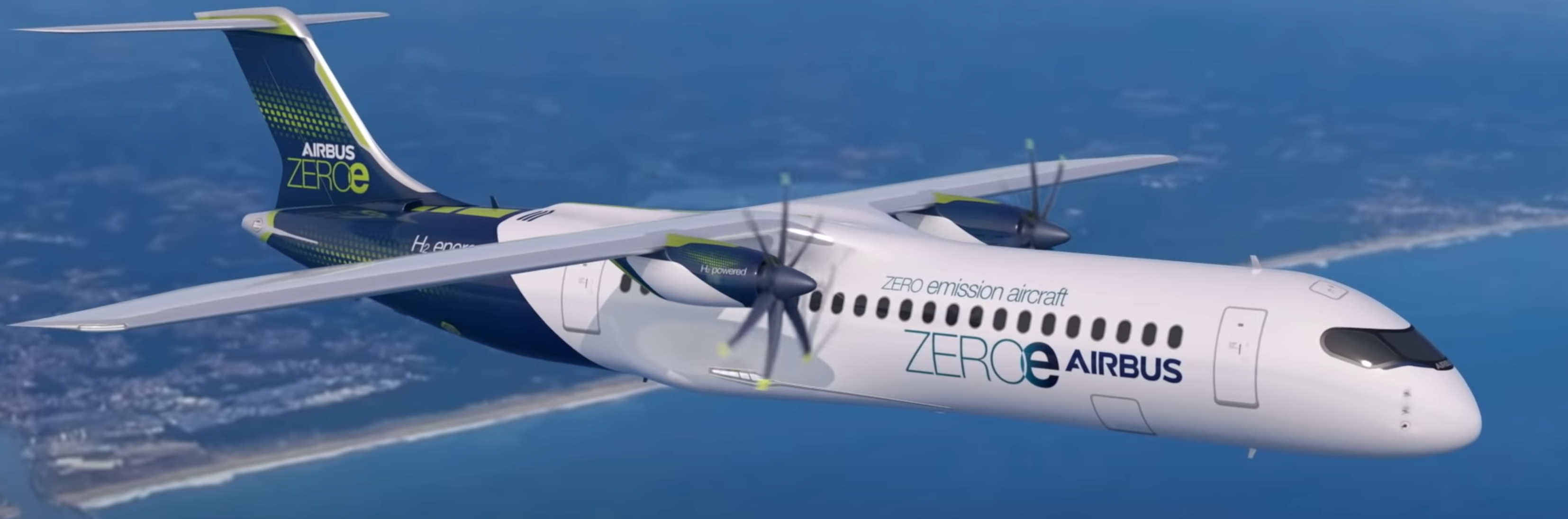
Note.
- It looks very much like an improved ATR-72.
- It has more extreme propellers and probably better aerodynamics.
- Airbus might like to persuade Ecojet to use ATR-72s as their 70-seat airliner.
- Information from an operator of hydrogen-powered airliners would be very valuable to Airbus.
I wouldn’t be surprised to see Ecojet lease some nearly new ATR-72s.
Would Airbus Fit ZeroAvia Hydrogen-Electric Powertrains In The ZEROe Turboprop?
This page on the Airbus website is entitled ZEROe.
In a section, which is entitled Hydrogen Propulsion To Power Future Aircraft, this is said.
All three ZEROe concepts are hybrid-hydrogen aircraft. They are powered by hydrogen combustion through modified gas turbine engines. Liquid hydrogen is used as fuel for combustion with oxygen.
In addition, hydrogen fuel cells create electrical power that complements the gas turbine, resulting in a highly efficient hybrid-electric propulsion system. All of these technologies are complementary, and the benefits are additive.
In 2022, we launched our ZEROe demonstrator with the aim to test hydrogen combustion technology on an A380 multimodal platform. Through future ground and flight testing, we expect to achieve a mature technology readiness level for a hydrogen-combustion propulsion system by 2025.
Note.
- Airbus state they are using modified gas turbine engines.
- Airbus also talk about using fuel cells to create electrical power that complements the gas turbines.
- Could the hydrogen fuel cells be used to power the aircraft’s systems, like avionics, control systems, air-conditioning and the hydrogen system for the main engine?
- This concept of effectively a hydrogen auxiliary power unit, might be a more efficient way of using the hydrogen, which either gives longer range or a smaller fuel tank.
- In The ZEROe Demonstrator Has Arrived, I talk about the ZEROe Demonstrator, which is a modified Airbus A 380.
Did the adding of hydrogen fuel cells to the ZEROe aircraft, lead to the concept of a hydrogen-powered auxiliary power unit, that I talked about in Airbus To Trial In-flight Auxiliary Power Entirely Generated By Hydrogen?
It looks to me, that Airbus have developed their own simple concept of powering the aircraft.
I doubt they will need ZeroAvia’s technology.
But.
- Aircraft manufacturers like Airbus generally fit the best and most suited engines they can find in their aircraft.
- The Wikipedia entry for ZeroAvia says that the prototype hydrogen-electric powertrain is in the cabin, consisting of two fuel cells and a lithium-ion battery for peak power.
- ZeroAvia have powerful shareholders like Amazon, Bill Gates and Royal Dutch Shell.
- ZeroAvia have also received grants from the UK Government.
I wouldn’t be surprised to learn, that Airbus have taken a long hard look at ZeroAvia’s technology.
After all, ZeroAvia could probably build a hydrogen fuel cell power pack, that would meet Airbus’s needs for a hydrogen-powered auxiliary power unit.
Remember too, that many fleets of aircraft have been updated with new engines for decades and I don’t think Airbus would mind ZeroAvia giving a new zero-carbon lease of life to the hundreds of ATR-72s in service around the world.
Surely, a successful hydrogen-powered ATR-72 is only going to create more interest in airlines buying ZEROe Turboprops.
All the converted aircraft will still need support from ATR.
Both the converted and new aircraft will need hydrogen refuelling services, so could the two aircraft use a common standard.
Airbus and ZeroAvia would appear to have several common interests.
Ecojet’s Core Route
This is a paragraph from the news story on the Ecotricity web site.
Dale has partnered with experienced pilot Brent Smith and a team of aviation specialists to set up Ecojet. Flights across the UK will commence in early 2024, starting with the Edinburgh to Southampton route, and expanding to mainland Europe shortly after, with long-haul flights planned for the future.
Note.
- The ATR-72 has a range of 949 miles, which is more than adequate for Southampton and Edinburgh, which is just over 350 miles.
- Diagonal journeys in the UK are often the most passenger-unfriendly by rail and tend to use diesel trains.
- Southampton Airport has good road and rail connections, with the terminal less than a minute from the station.
- Edinburgh Airport has good road and tram connections, with rail connections needing a short journey on the tram.
- Southampton Airport has flights to the Channel Islands, Ireland and Schiphol.
- Edinburgh Airport has a comprehensive service from major airlines and low-cost carriers, and several flights to destinations in the North of Scotland and on the Islands.
I think that it is a well-chosen core route for their 70-seat aircraft.
Which Routes Will Ecojet Fly With The Twin Otters?
Consider.
- My Scottish friends tell me that flying to the Scottish Islands, like the Hebrides, Orkney and Shetland is expensive.
- The growth of the Scottish wind power industry will mean, that more capacity is needed to serve the North of Scotland and the Islands.
- Tourism to the North of Scotland and the Islands is on the up.
- There will not be a shortage of green electricity to produce green hydrogen.
- The North of Scotland isn’t short of airports.
- The Twin Otter has a surprisingly long range on aviation fuel and I suspect, that a hydrogen version would be designed to have a similar range.
- The longest flight needed would probably be Edinburgh and Sumburgh, which is about 280 miles, which should be well within the range of a Twin Otter.
- I suspect that hydrogen refuelling could be easily provided at enough airports, to support hydrogen-powered airliners.
- I am sure, that the Twin Otters could be used on a network of zero-carbon flights from Edinburgh to the North of Scotland and the Islands.
- A zero-carbon airline would help Scotland’s net-zero ambitions.
There is certainly a need for another airline to connect Edinburgh to the North of Scotland and the Islands and the infrastructure could be upgraded to support a hydrogen-based zero-carbon airline.
Could Ecojet build a similar network at Southampton, that served the Channel Islands, Southern Ireland and Northern France?
Conclusion
There’s a lot more to this venture, than there appears at first sight.
O wish Vince and his partners well, but as a coeliac, I’ll skip the food.
Shell And Eneco Joint Venture Looks To Build Greener Offshore Wind Farm
The title of this post, is the same as that of this article on offshoreWIND.biz.
This is the sub-heading.
Ecowende, the joint venture (JV) of Shell and Eneco, has unveiled plans for building an offshore wind farm that will be in harmony with nature, with minimal impact on birds, bats, and marine mammals.
This is the first paragraph.
Ecowende, which presented its holistic approach at WindDay 2023, said it is going to implement various innovations, large-scale mitigating and stimulating ecological measures, and an extensive above and under-water monitoring and research programme.
This is all good stuff.
These two paragraphs outline some ideas that will be tried.
Specific measures include increasing the height of the lowest tip of the rotor blades, creating a corridor to Natura 2000 area by placing the turbines extra far apart, and an option to bring the turbines to a standstill that adapts to the flight movements of birds in the wind farm.
This way, Ecowende expects to minimise the number of bird and bat collisions.
The Natura 2000 areas are described in this web site.
Other innovative ideas are described in these two paragraphs.
Biodegradable reef structures are being constructed using fruit trees sourced from Dutch fruit farms. These tree reefs offer a place for fish to shelter and reproduce, according to the press release.
Ecowende said it will also install various forms of eco-friendly erosion protection and the oyster larvae network will be expanded to spread the native flat oyster population.
It certainly looks like Ecowende are making sure, that Just Stop Oil’s offshoot; Just Stop Wind doesn’t take root!
Shell Joins VindØ Energy Island Consortium
The title of this post, is the same as that of this article on offshoreWIND.biz.
This is the sub-heading.
Global energy major Shell is joining the VindØ consortium which is aiming to take a leading role in developing and building Denmark’s first energy island.
This paragraph outlines the project.
The island will be able to connect 10 GW of offshore wind to Denmark and other neighboring countries, plus host an innovation zone with potential for large-scale Power-to-X production and energy storage. It would include accommodation and operation and maintenance services from onsite harbour facilities.
It looks spectacular in the visualisation.
Oceans of Energy To Build Offshore Solar Array At Hollandse Kust Noord Offshore Wind Park
The title of this post, is the same as that of this article on offshoreWIND.biz.
This is the sub-heading.
Oceans of Energy has been awarded the contract for installing and operating offshore solar farm inside the Hollandse Kust Noord offshore wind park being developed by CrossWind, a joint venture between Shell and Eneco.
This is the first paragraph.
This is set to be the first offshore solar farm in the world to be connected, installed, and operated within a wind farm in high wave conditions. The offshore solar farm will be realized in 2025, while the wind park will be operational by the end of 2023, according to Oceans of Energy.
These are some other points from the article.
- It looks like the solar will be floating.
- The wind/solar farm will have offshore battery storage.
- Green hydrogen will be generated offshore.
This wind/solar farm will be all things to all men and women.
Ramboll To Develop Offshore Wind-To-Hydrogen Concept
The title of this post, is the same as that of this article on offshoreWIND.biz.
This is the sub-heading.
Ramboll has been selected to investigate the feasibility of producing hydrogen offshore at a multi-gigawatt scale with NortH2 in the Dutch part of the North Sea.
Note.
- NortH2 has a web site.
- There is a very rich About NortH2 page.
- NortH2 is a consortium made up of Equinor, Eneco, Gasunie, Groningen Seaports, RWE and Shell Netherlands.
- The consortium aims to use 4 GW to produce hydrogen by 2030 and 10 GW by 2040.
The world needs more ambitious projects like this.
New South Wales Plans Three Batteries
This article on Energy Storage News is entitled Shell Battery Project In New South Wales Would Add 1GWh Energy Storage To Growing Market.
The three batteries are.
- Shell – 500MW/1,000MWh BESS project in Wellington, in Central West NSW.
- Waratah Super Battery 700MW/1,400MWh transmission system “shock absorber”
- A proposed 500MW/2,000 MWh BESS from energy generator-retailer EnergyAustralia.
Note.
- All batteries appear to be lithium ion.
- This gives a total output of 1.7 GW and a total storage capacity of 4.4 GWh.
- The NSW government is targeting 12GW of renewable energy capacity by 2030.
- 3 GW of utility-scale wind and solar in development, construction, or already in operation, in the state.
The state seems to be making a good start.
CIP Picks Stiesdal Floater For 100MW Scottish Offshore Wind Farm
The title of this post, is the same as that of this article on Offshore Engineering.
These two paragraphs introduce the project.
Copenhagen Infrastructure Partners (CIP) has selected Stiesdal Offshore’s TetraSub floating foundation structure for the 100MW Pentland Floating Offshore Wind Farm project, to be located off the coast of Dounreay, Caithness, Scotland.
The technology has been said to offer a lightweight and cost-effective floating solution, based on factory-made modules which are then assembled domestically in port to form a complete foundation.
Note.
- The TetraSub seems to have been designed for ease of manufacture.
- One if the aims appears to be to build a strong local supply chain.
- The TetraSub was designed with the help of Edinburgh University.
- The TetraSpar Demonstrator is in operation off the coast of Norway.
- This page on Mission Innovation describes the TetraSpar in detail.
- The TetraSpar foundation, owned by Shell, TEPCO RP, RWE, and Stiesdal.
- It can be deployed in water with a depth of up to 200 metres.
- Currently, they carry a 3.6 MW turbine.
- At that size, they’d need 27 or 28 turbines to create a 100 MW wind farm.
The home page of the Pentland Offshore Wind Farm gives more details.
This article on offshoreWIND.biz is entitled CIP And Hexicon To Halve Pentland Floating Wind Project Area.
- The project area has been halved.
- The number of turbines has been reduced from ten to seven.
- Compact turbines will be used.
- The project will be built in two phases, one turbine in 2025 and six in 2026.
- Effectively, the first turbine will help to fund the second phase, which eases cash flow.
The changes show how the wind farm has changed during development due to local pressures and improved technology.
Conclusion
It does seem that the competition is growing in the field of floating wind turbines.
Given the quality of the research and backing for these floats and the fact they now have an order, I wouldn’t be surprised to see this technology be a success.
Will Our Gas Supplies Hold Up This Winter?
I am prompted to ask this question because of this article in The Times, which is entitled ‘Really High Gas Prices’ Loom For UK As Europe Faces Winter Rationing.
These are a few thoughts.
UK Gas-Fired Power Station Capacity
This entry in Wikipedia is entitled List Of Natural Gas Power Stations In The United Kingdom.
This statement summarises the capacity.
There are currently 32 active gas fired combined cycle power plants operating in the United Kingdom, which have a total generating capacity of 28.0 GW.
This section is entitled Decline Of Gas For Power In The United Kingdom, where this is said.
In 2016 gas fired power stations generated a total of 127 TWh of electricity. Generation has dropped to 119 TWh in 2017, 115 TWh in 2018, 114 TWh in 2019 and 95 TWh in 2020. The decline is largely due to the increase in renewable sources outweighing the decline of coal, and an overall reduction in demand.
Putting these pictures as a table and applying a simple numerical analysis technique gives the following.
- 2016 – 127 TWh
- 2017 – 119 TWh – Drop of 8TWh
- 2018 – 115 TWh – Drop of 4 TWh
- 2019 – 114 TWh – Drop of 1 TWh
- 2020 – 95 TWh – Drop of 19 TWh
In four years the amount of electricity generated each year by gas-fired power stations has dropped by an amazing 8 TWh on average per year.
Factors like the increase in renewables and an overall reduction in demand will still apply.
I wouldn’t be surprised to see a continuous reduction of electricity generated by gas of 8 TWh per year.
Figures like these could be possible.
- 2021 – 87 TWh
- 2022 – 79 TWh
- 2023 – 71 TWh
- 2024 – 63 TWh
- 2025 – 55 TWh
- 2026 – 47 TWh
- 2027 – 39 TWh
I have stopped these figures at 2027, as one major event should happen in that year, as Hinckley Point C is planned to switch on in June 2027, which will contribute 3.26 GW. or 28.5 TWh per year.
In Will We Run Out Of Power This Winter?, I also summarised the energy that will be produced by the various projects, that were signed off recently in the Contracts for Difference Allocation Round 4′, where I said this.
Summarising the figures for new capacity gives.
- 2022 – 3200 MW
- 2023 – 1500 MW
- 3024 – 2400 MW
- 2025 – 6576 MW
- 2026 – 1705 MW
- 2027 – 7061 GW
This totals to 22442 MW.
Note that a 1 GW power source would generate 8.76 TWh of electricity per year.
One problem we may have is too much electricity and as we are not blessed with much storage in the UK, where will be able to put it?
In a strange way, Vlad the Mad may solve the problem, by cutting off Europe’s gas.
Jackdaw Gas Field
This document on the Shell web site is the standard information sheet for the Jackdaw field development.
This is the short description of the development.
The Jackdaw field is an uHPHT reservoir that will be developed with a not permanently
attended WHP. Four wells will be drilled at the Jackdaw WHP. Produced fluids will be
exported via a subsea pipeline to the Shearwater platform where these will be processed
before onward export via the Fulmar Gas Line and the Forties Pipeline System.
The proposed development may be summarised as follows:
- Installation of a new WHP
- Drilling of four production wells
- Installation of a new approximately 31 km pipeline from the Jackdaw WHP to the Shearwater platform
- Processing and export of the Jackdaw hydrocarbons via the Shearwater host platform
First production expected between Q3 – Q4 2025.
Note.
- Production could start in just over three years.
- This gas will come ashore at the Bacton gas terminal in Norfolk.
- Bacton has two gas interconnectors to Europe; one to Belgium and one to The Netherlands, so is ideally connected to export gas to Europe.
Given the high gas prices, I am sure any company would pull out all the stops to shorten the project development time.
HyDeploy
I described HyDeploy, which is a project to blend up to 20 % of hydrogen into the distributed natural gas in HyDeploy.
In The Mathematics Of Blending Twenty Percent Of Hydrogen Into The UK Gas Grid, I worked how much electricity would be needed for HyDeploy’s target blending of hydrogen.
It was 8.2 GW, but!
- It would save a lot of carbon emissions.
- Boilers and other appliances wouldn’t have to be changed, although they would probably need a service.
- It would significantly cut the amount of natural gas we need.
- It might even be a product to export in its own right.
I certainly feel that HyDeploy is a significant project.
Gas Imports And Existing Fields
This entry in Wikipedia is entitled Energy in the United Kingdom.
In this section, which is entitled Natural Gas, this is said.
United Kingdom produced 60% of its consumed natural gas in 2010. In five years the United Kingdom moved from almost gas self-sufficient (see North Sea gas) to 40% gas import in 2010. Gas was almost 40% of total primary energy supply (TPES) and electricity more than 45% in 2010. Underground storage was about 5% of annual demand and more than 10% of net imports.
Gasfields include Amethyst gasfield, Armada gasfield, Easington Catchment Area, East Knapton, Everest gasfield and Rhum gasfield.
Consider.
- We know that the amount of gas used for generating electricity is reducing , due to the increase in renewables and an overall reduction in demand.
- The cost of both gas imports and exports are rising.
- In two years time the Jackdaw gas field should be producing gas.
Would it be sensible to squeeze as much gas out of the existing fields, as by the time they run out, renewables, an overall reduction in demand, the Jackdaw gasfield and other factors will mean that we will have enough gas and electricity for our needs.
 The Anonymous Widower