UK’s Largest Solar Park Cleve Hill Granted Development Consent
The title of this post, is the same as that of this article on Solar Power Portal.
These are the two introductory paragraphs.
Cleve Hill Solar Park, set to be the largest in the UK, has been granted development consent by the energy secretary.
The colossal 350MW project will include 880,000 panels along with battery storage, and sit just one mile northeast of Faversham, in Kent, situated close to the village of Graveney.
Other points from the article.
- Cleeve Hill Solar Park is a £450million project.
- It is the first solar project to be considered a Nationally Significant Infrastructure Project.
- It is being developed as a joint venture between Hive Energy and Wirsol.
- It is due to be operational by 2022.
- To complete the project 700 MWh of energy storage will be added later.
The article also contains this quote from Solar Trade Associations chief executive Chris Hewett.
Solar has a significant role to play in boosting the economy in the wake of the coronavirus crisis. With the right policies we can expect to see an 8GW pipeline of solar projects unlocked and rapidly deployed, swiftly creating a wealth of skilled jobs and setting us on the path towards a green recovery.
8 GW of intermittent energy will need a lot of storage.
As Cleeve Hill’s developers are planning to provide 700 MWh of storage for 700 MW of solar panels, it would appear that 8 GW of solar panels could need up to 16 GWh of energy storage.
As our largest energy storage system is the pumped storage Electric Mountain in Snowdonia with a capacity of 9.1 GWh and most of the large solar developments are towards the South of England, the UK needs to develop a lot more energy storage, where the solar is generated and much of the energy is used.
I can see the following environmentally-friendly developments prospering.
- Highview Power‘s CRYOBattery, which uses liquid air to store energy. Systems have a small footprint and up to a GWh could be possible.
- Electrothermal energy storage like this system from Siemens.
- Using electrolysers from companies like ITM Power to convert excess energy into hydrogen for transport, steelmaking and injecting into the gas main.
- Zinc8‘s zinc-air battery could be the outsider, that comes from nowhere.
Developers could opt for conservative decision of lithium-ion batteries, but I don’t like the environmental profile and these batteries should be reserved for portable and mobile applications.
Floatovoltaics
One concept, I came across whilst writing was floatovoltaics.
The best article about the subject was this one on Renewable Energy World, which is entitled Running Out of Precious Land? Floating Solar PV Systems May Be a Solution.
A French company call Ciel et Terre International seem to be leading the development.
Their web site has this video.
Perhaps, some floatovoltaics, should be installed on the large reservoirs in the South of England.
- The Renewable Energy World article says that panels over water can be more efficient due to the cooling effect of the water.
- Would they cut evaporative losses by acting as sunshades?
- As the French are great pecheurs, I suspect that they have the answers if anglers should object.
This Google Map shows the reservoirs to the West of Heathrow.
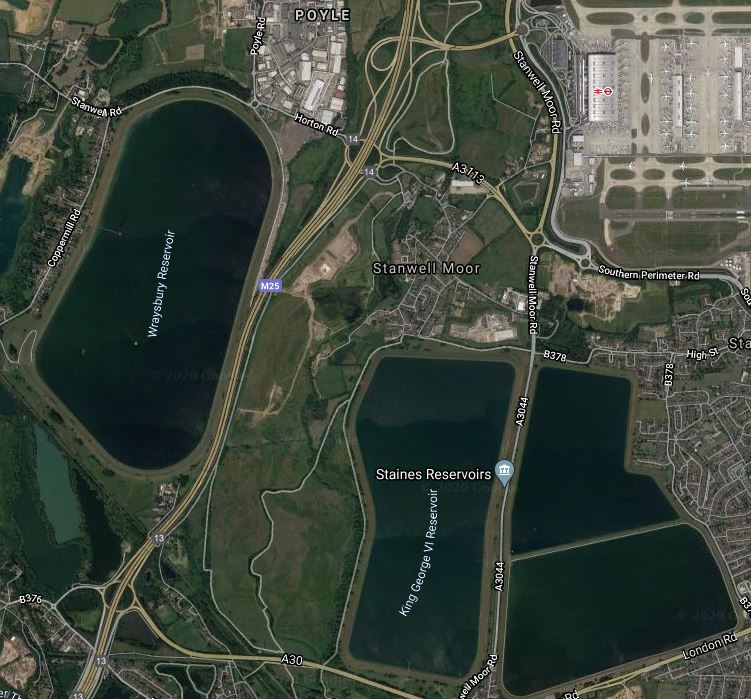
Note.
- Wraysbury Reservoir has an area of two square kilometres.
- King George VI Reservoir has an area of one-and-a-half square kilometres.
- Using the size and capacity of Owl’s Hatch Solar Farm, it appears that around 65 MW of solar panels can be assembled in a square kilometre.
- All these reservoirs are Sites of Special Scientific Interest because of all the bird life.
- Heathrow is not an airport, that is immune to bird-strikes.
Could floatovoltaics be used to guide birds away from the flightpaths?
Incidentally, I remember a report from Tomorrow’s World, probably from the 1960s, about a porous concrete that had been invented.
- One of the uses would have been to fill reservoirs.
- The capacity of the reservoir would only have been marginally reduced, as the water would be in the voids in the concrete like water in a sponge.
- Soil would be placed at the surface and the land used for growing crops.
I wonder what happened to that idea from fifty years ago!
Hydrogen Power Plant Bid In Herne Bay Set For Green Light From Canterbury City Council
The title of this post, is the same as that of this article on Kent Online.
These are the introductory paragraphs.
Controversial plans to build a hydrogen fuel plant on a rundown plot of land look set to be given the green light – despite more than 160 objections from concerned residents.
Canterbury City Council was inundated with letters from locals – with one even worried about a Fukushima-style disaster – after a bid to construct the plant in Westbrook Lane, Herne Bay, was revealed in January.
The article said, that the project would create twenty jobs.
This Google Map shows the proposed site for the electrolyser.

Note.
- The Railway running East-West at the top of the map.
- The A2990 Thanet Way running East-West at the bottom of the map.
From a visualisation on the Kent Online article, it appears that the electrolyser will be built to the West of the Recycling Centre.
I suspect that given the closeness of the railway, it might even be possible to despatch hydrogen to users by specially-designed trains.
The electrolyser will need large quantities of electricity and I can’t see any wires around the site.
This Google Map shows the wider area around the site.

Note.
- The Recycling Centre indicated my a blue arrow, just to the right of top-centre of the map.
- The A2990 running East-West across the top of the map.
- The 18 MW Molehill Solar Farm between the old and new Thanet Ways, in the middle of the map.
- The 51.9 MW Owls Hatch Solar Farm, in the South East corner of the map.
- For full production, the electrolyser needs 23 MW!
These two solar farms, mean, that there must be a high-quality electricity connection in the area.
With all the offshore wind in Kent and these solar farms on the doorstep, the Herne Bay electrolyser, will not have much difficulty obtaining genuine renewable electricity.
Conclusion
As someone, who once worked, in a hydrogen factory, I would be happy to live near to the site.
Are Ryze Hydrogen planning to put a filling station for hydrogen vehicles on the A2990?
Hawaii’s Renewable Tender To Deliver Major Solar And Storage Push
The title of this post, is the same as that of this article on PVTech.
This is the introductory paragraph.
The largest renewable tender in Hawaii’s history has chosen its winners, contracting a solar and storage pipeline that exceeds anything the US state has ever seen.
The article gives a lot of information about the order and Hawaii’s energy.
- A fleet of 400 MW of solar panels and 3 GWh of energy storage will be installed, with some running in 2022.
- Another fleet of 260 MW of solar panels and 1 GWh of energy storage is in the pipeline, for delivery in 2021.
- The strike price appears to be 9.38 US dollar cents per KWh or $93.80 per MWh. We’re paying £92.50 per MWh for electricity at Hinckley Point C nuclear power station.
- Hawaii aims to be full-powered by renewable energy by 2045.
- Two fossil-fuel plants will shut by 2024.
From this document on the Hawaii State Energy Office, I have found that in 2018, these renewable energy sources contributed to the state’s electricity.
- Geothermal sources – 2.9%
- Wind – 4.9%
- Hydro – 0.9%
- Biomass – 2.8%
- Small-scale solar – 9.3%
- Utility-scale solar – 3.9%
These add up to 24.7%.
I’ll be interested to see, what the percentage will be in 2024!
Israel Should Be Funding Alternative Energy, Not Another Gas Pipeline
The title of the post, is the same as that of this article from The Jerusalem Post.
This is the introductory sub-title.
A pipeline only serves interests of the gas tycoons and not the taxpayers or the environmentally minded residents of the region.
The pipeline is proposed to run to Eilat in the South of Israel, which is an area, that gets enough sun for most of its electricity needs.
Some points from the article.
- Jordan will be 100 % daytime solar by 2030.
- Israel could be 100 % daytime solar by 2030.
- The Arava region of Israil will achieve this aim, by the end of this year.
The article gives an interesting insight into how you get electricity, when you have plenty of sun.
Highview Power And Railway Electrification
In Encore Joins Highview To Co-Develop Liquid Air Energy Storage System In Vermont, I gave brief notes about a proposed Highview Power CRYOBattery in Vermont.
- The system will supply 50 MW for eight hours.
- The total capacity will be 400 MWh.
Other articles have suggested, that the system could be built on the site of a demolished coal-fired power station, which still has a good connection to the electricity grid.
In other words, I believe that a CRYOBattery can be considered to be a small 50 MW power station.
- It could be charged by local excess renewable energy during the day.
- It could be charged by excess renewal energy from the electricity grid during the night, when there can be large amounts of wind energy, that needs a home.
- Intelligent control systems, would balance the output of the CRYOBattery to the needs of the electricity grid.
It would be used in very much the same way as gas-turbine power-stations are used in electricity grids all over the world.
The Braybrooke Feeder Station
The National Grid is providing a feeder station at Braybrooke to support the Midland Main Line electrification.
This page on the Harbough Rail Users site is entitled Electrification Substation Plan for Braybrooke.
It gives this description of the sub-station.
Electrification of part of the Midland Main Line has moved a tentative step closer with the plans being prepared by National Grid for a feeder substation at Braybrooke, just outside Market Harborough. The location is where a high-voltage National Grid power-line crosses over the railway and the plan is for a substation and associated equipment plus an access road from the A6. The substation is due to be completed by October 2020 and is intended to feed the power supply for the Corby line pending electrification of the main line through Market Harborough.
This Google Map shows the rough area, where it will be located.
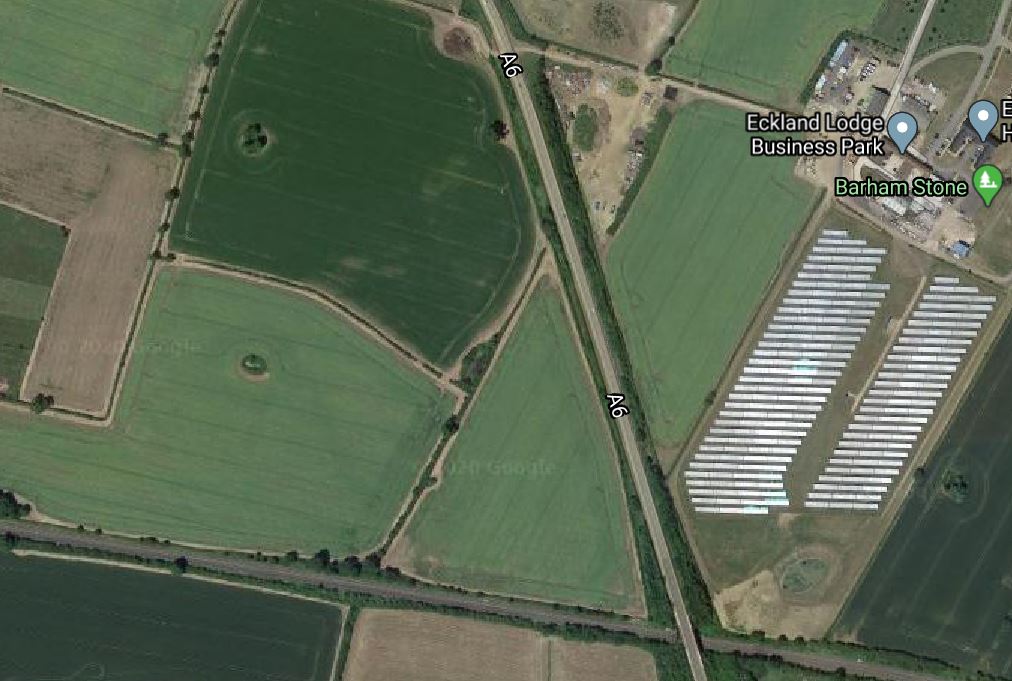
Note.
- The A6 crossing the Midland Main Line.
- The solar farm in the South-facing field, which has a 3MW capacity, according to the Eckland Lodge Business Park web site.
- Various planning documents say the transformers on the substation will be 400/25 kV units.
- This means that the power-line in the area must be a 400 kV.
Unfortunately, I can’t pick out the line of 400 kV pylons marching across the countryside. But they are rather large.
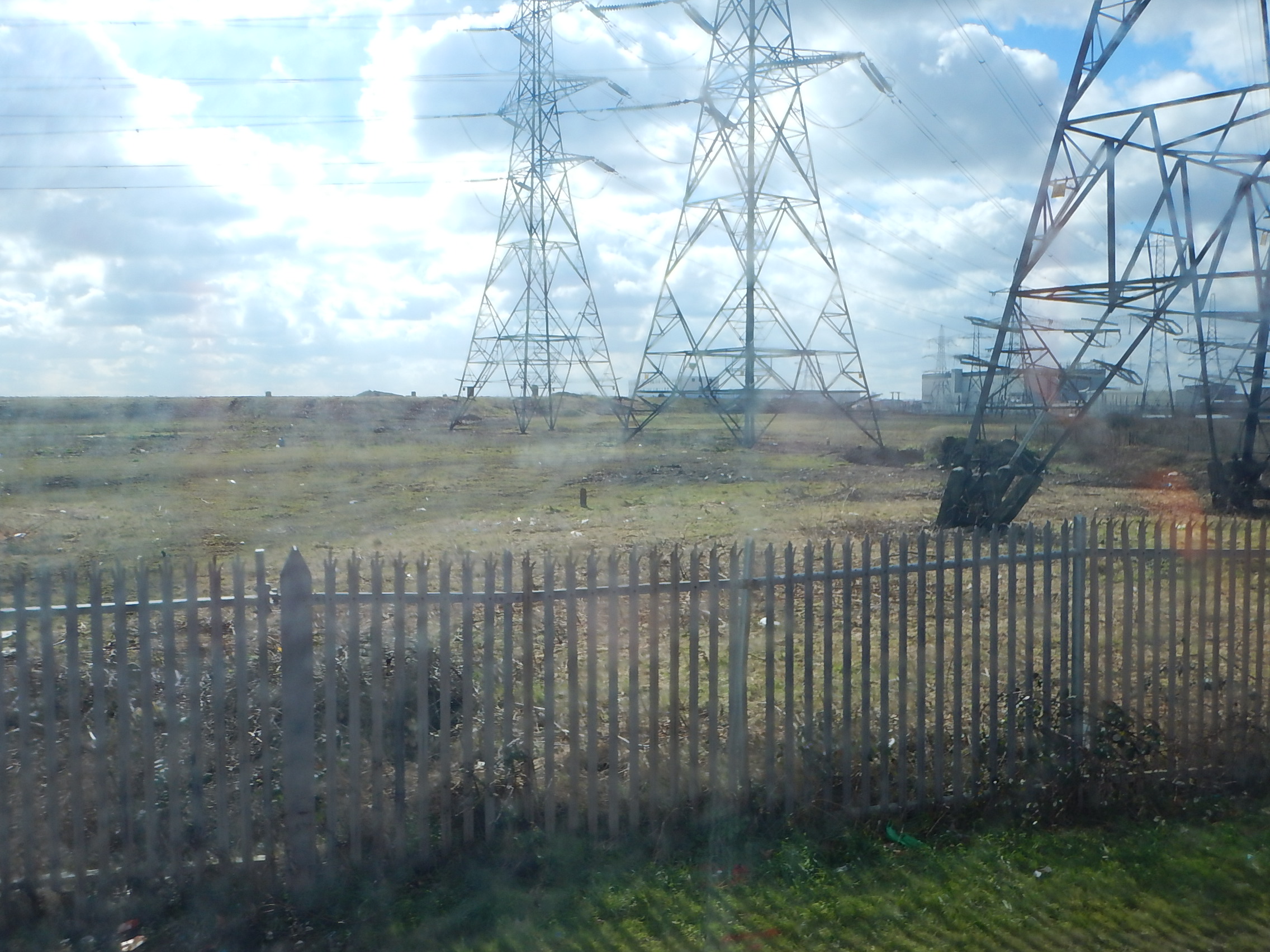
The pictures show a group of 400 kV pylons near Barking.
- The Midland Main Line at Braybrooke certainly seems to be getting a solid supply of electricity.
- It was originally planned, that the electrification would go all the way, but it was cut back to Kettering and Corby a couple of years ago.
- But to power, the electrification to Corby, it is being extended all the way to Braybrooke, so that the electrification can act as a giant extension lead for the Corby Branch Line.
The page on the Harborough Rail Users Site says this.
The Braybrooke substation is still planned, however, and the DfT has advised that the bi-mode trains will be able to switch power mode at speed. They would therefore be able to continue running electrically north from Kettering as far as Braybrooke before ‘pan down’
It would appear, that the end of the electrification will be at Braybrooke, but the sub-station seems to have enough power to extend the electrification further North if that is ever planned.
I also think, that is rather an efficient and affordable solution, with very little modification required to the existing electricity network.
But not all electricity feeds to railway electrification have a convenient 400 kV line at a handy site for installing all the needed transformers and other electrical gubbins.
How Much Power Will Needed To Be Supplied At Braybrooke?
This can probably be dismissed as the roughest or rough calculations, but the answer shows the order of magnitude of the power involved.
Consider.
- Braybrooke must be sized for full electrification of the Midland Main Line.
- Braybrooke will have to power trains North of Bedford.
- If there is full electrification of the Midland Main Line, it will probably have to power trains as far North as East Midlands Parkway station, where there is a massive power station.
- Trains between Bedford and Market Harborough take thirty minutes.
- Trains between Bedford and Corby take around thirty minutes.
- Four trains per hour (tph) run between Bedford and Market Harborough in both directions.
- The system must be sized to handle two tph between Bedford and Corby in both directions.
- The power output of each Class 360 train, that will be used on the Corby route is 1,550 kW, so a twelve-car set will need 4.65 MW.
- I can’t find the power output of a Class 810 train, but an InterCity 125 with similar performance has 3.4 MW.
- A Class 88 bi-mode locomotive has a power output of 4 MW when using the electrification.
I estimate that Braybrooke could have to support at least a dozen trains at busy times, each of which could need 4 MW.
Until someone gives me the correct figure, I reckon that Braybrooke has a capacity to supply 50 MW for trains on the Midland Main Line.
A Highview Power system as proposed for Vermont, would have enough power, but would need a lot more storage or perhaps local wind or solar farms, to give it a regular charging.
Riding Sunbeams
Riding Sunbeams are a company, who use solar power to provide the electricity for railway electrification.
I’ll let their video explain what they do.
It’s a company with an idea, that ticks a lot of boxes, but would it be able to provide enough power for a busy electrified main line? And what happens on a series of rainy or just plain dull days?
Highview Power
Could a Highview Power energy storage system be used?
- To store electricity from local or grid electrical sources.
- To power the local electrification.
If required, it could be topped up by affordable overnight electricity, that is generated by wind power.
The Highview Power system could also be sized to support the local electricity grid and local solar and wind farms.
Conclusion
I think that Riding Sunbeams and Highview Power should be talking to each other.
Hydrogen Islands
I found this concept on the ITM Power web site.
This was the sub-title.
Islands tend to have abundant renewable resources yet they rely heavily upon importing fossil fuels, often at relatively high cost.
And this was the body of the page.
The integration of renewables into an island’s power grid soon creates substantial balancing and curtailment problems. These can be overcome by deploying controllable rapid response electrolysers to produce green hydrogen for the island’s transport, heat and power sectors. Projects such as BigHit are demonstrating how this may be achieved.
It would create a zero-carbon island for an Internet tycoon or a Bond villain.
I’m certain that the concept would work for somewhere like a farm or even a small village, which is effectively a landlocked island, with perhaps wind turbines or solar panels.
Australia’s New Community Solar, Solar-Storage, ‘Solar Hydro’ And Solar Hydrogen Projects
The title of this post is the same as that of this article on Energy Storage News.
This is the introductory paragraph.
In the past couple of weeks, national and state government organisations in Australia have announced various stages of consideration for solar projects with a range of advanced and innovative storage solutions attached.
The article then goes on to describe some projects.
RayGen’s PV Ultra System
This paragraph describes the PV Ultra system.
The fully dispatchable power plant would use RayGen’s own technology PV Ultra, which is a combination of photovoltaic (PV) solar generation with the more expensive and engineering-intensive concentrated solar technology using angled mirror towers (heliostats). The PV Ultra system would generate both electricity and heat.
It’s obviously using what Australia has a lot of; sun to advantage.
RayGen’s Innovative Thermal Storage
This paragraph outlines the principle of RayGen’s thermal method of storage.
This generation technology would in turn be co-located and connected to a ‘Thermal Hydro’ energy storage facility, with 17 hours of storage, which again is based on a technology RayGen is developing. Unlike pumped hydro energy storage which uses two reservoirs at different heights, relying on gravity to drive turbines, the Thermal Hydro plant would use a hot reservoir and a cold reservoir, linked together.
The principle of operation is described in this second paragraph.
The PV Ultra solution will therefore cool one reservoir using photovoltaic power and grid power when needed, while also heating the other reservoir using the heliostats. The difference in temperature would then generate electricity, via an Organic Rankine Cycle engine, a device which uses thermodynamic cycles to convert steam into mechanical energy and is widely used for biomass, waste incinerators and other existing generation types.
The article states that an Organic Rankine cycle engine has an efficiency of about seventy percent. I have linked to Wikipedia, which gives a good explanation of the Organic Rankine cycle, which is typically used in waste heat recovery and biomass power plants.
RayGen’s Flagship Project
RayGen’s flagship project will be rated at 4 MW, with a storage capacity of 50 MWh. It will be used to provide power in the West Murray region.
New South Wales Community Projects
The article then describes a group of community projects that are being set up in New South Wales.
This is the introductory paragraph
Elsewhere in Australia, the government of New South Wales approved grants earlier this month to assist the development of seven solar projects, all but one of which will include energy storage. Notably, five out of the seven will also be community distributed energy projects, including one standalone shared battery energy storage site.
Some points from the article include.
- The total solar power is rated at 17.2 MW.
- The energy storage is rated at 39.2 MWh
- One site is co-located with hydrogen electrolysis and storage,
New South Wales has certainly launched an ambitious plan.
Conclusion
I like RayGen’s system and the New South Wales initiative.
I also think, that both projects could find applications in some of the hotter places in the world.
Could solar power systems like these solve power supply problems in Africa, India and other sun-rich places>
Novel Long-Duration Energy Storage System Installed At World’s Largest CSP Plant
The title of this post is the same as that of this article on Recharge.
This is the sub-title.
Technology that stores power in molten aluminium inaugurated at 580MW Noor Ouarzazate solar complex in Morocco.
Other points from the original article.
- The idea is from Swedish start-up; Azelio.
- The the Noor Ouarzazate solar complex is rated at 580MW
- Noor is Arabic for light.
- Energy is stored as heat in molten recycled aluminium at 600 °C.
- When energy is needed, a Stirling engine is used to generate energy.
- Waste heat can also be captured and used to heat buildings.
- The system has a 90 % round-trip efficiency.
I feel this could be a winner in the long term.
The Power Of Battery Storage
This article on Fastmarkets is entitled Neoen To Expand Li-ion Battery Capacity at Hornsdale Plant.
This is the introductory paragraph.
Australia’s Hornsdale Power Reserve, the world’s biggest lithium-ion battery plant, is set to expand capacity by 50% to 150 megawatts, according to Neoen SA, the French power producer that owns and operates the site.
If you read the article and the Wikipedia entry for Hornsdale Power Reserve (HPR), you’ll see why it is being expanded.
This paragraph is from Wikipedia.
After six months of operation, the Hornsdale Power Reserve was responsible for 55% of frequency control and ancillary services in South Australia.[11] By the end of 2018, it was estimated that the Power Reserved had saved A$40 million in costs, most in eliminating the need for a 35 MW Frequency Control Ancillary Service.
Somewhat surprisingly, the power is mainly generated by the associated Hornsdale Wind Farm.
These are some statistics and facts of the installation at Hornsale.
- There are 99 wind turbines with a total generation capacity of 315 megawatts.
- HPR is promoted as the largest lithium-ion battery in the world.
- HPR can store 129 MWh of electricity.
- HPR can discharge 100 MW into the grid.
- The main use of HPR is to provide stability to the grid.
HPR also has a nice little earner, in storing energy, when the spot price is low and selling it when it is higher.
It certainly explains why investors are putting their money in energy storage.
Wikipedia lists four energy storage projects using batteries in the UK, mainly of an experimental nature in Lilroot, Kirkwall, Leighton Buzzard and six related sites in Northern |England. One site of the six has a capacity of 5 MWh, making it one of the largest in Europe.
But then we have the massive Dinorwig power station or Electric Mountain, which can supply ,1,728-MW and has a total storage capacity of 9.1 GWh
Consider.
- Electric Mountain has seventy times the capacity of Hornsdale Power Reserve.
- Electric Mountain cost £425 million in 1984, which would be a cost of £13.5 billion today.
- Another Electric Mountain would cost about £1.6 billion per GWh of energy storage.
- Hornsdale Power Reserve cost $ 50 million or about £26 million.
- Hornsdale Power Reserve would cost about £0.2 billion per GWh of energy storage.
So it would appear that large batteries are better value for money than large pumped storage systems like Electric Mountain.
But it’s not as simple as that!
- There aren’t many places, as suitable as North Wales for large pumped storage systems.
- Omce built, it appears pumped storage system can have a long life. Electric Mountain is thirty-five years old and with updating, I wouldsn’t be surprised to see Electric Mountain in operation at the end of this century.
- Battery sites can be relatively small, so can be placed perhaps in corners of industrial premises or housing developments.
- Battery sites can be built close to where power is needed, but pumped storage can only be built where geography allows.
- Pumped strage systems can need long and expensive connections to the grid.
- I think that the UK will not build another Electric Mountain, but will build several gigawatt-sized energy storage facilities.
- Is there enough lithium and other elements for all these batteries?
- Electric Mountain is well-placed in Snowdonia for some wind farms, but many are in the North Sea on the other side of the country.
In my view what is needed is a series of half-gigawatt storage facilities, spread all over the country.
Highview Power looks to be promising and I wrote about it in British Start-Up Beats World To Holy Grail Of Cheap Energy Storage For Wind And Solar.
But there will be lots of other good ideas!
Renewable Energy Outperforms Fossil Fuels For A Whole Quarter
The title of this post is the same as that of an article in today’s copy of The Times.
This is the introductory paragraph.
Wind and solar farms and other sources of renewable power have produced more electricity than fossil fuels for the first time in a three-month period.
This is a good figure, but how do we compare with the rest of the world.
This Wikipedia entry is entitled List Of Countries By Electricity Production Prom Renewable Sources.
These are some example percentages of renewable energy production.
- Albania – 100 %
- Australia – 14.5 %
- Belgium – 16.6 %
- Brazil – 80.4 %
- Canada 65.0 %
- China – 24.5 %
- Denmark – 60.5 %
- Egypt – 8.2 %
- Ethiopia 93.6 %
- France – 17.5 %
- Germany – 29 %
- Hungary – 10.1 %
- Iceland – 100.0 %
- India – 16.88 %
- Indonesia – 15.9 %
- Iran – 5.8 %
- Iraq – 6.4 %
- Ireland – 24.7 %
- Israel – 2.5 %
- Italy – 37.3 %
- Japan – 15.0 %
- Kuwait – 0.1 %
- Libya – 0.0 %
- Malaysia – 13.7 %
- Netherlands – 12.1 %
- New Zealand – 83.9 %
- Norway – 97.2 %
- Poland – 13.7 %
- Qatar – 0.3 %
- Pakistan – 32.7 %
- Russia – 16.9 %
- Saudi Arabia – 0.0 %
- South Africa – 3.2 %
- South Korea – 2.8 %
- Spain – 38.1 %
- \sweden – 57.1 %
- Switzerland – 59.8 %
- Taiwan – 4.2 %
- Turkey – 32.9 %
- UAE – 0.3 %
- United Kingdom – 27.9 %
- United States – 14.7 %
Figures are for 2016
 The Anonymous Widower