9.58 GW of Renewable Energy Contracts Signed In UK’s Latest CfD Auction
The title of this post, is the same as that of this article on offshoreWIND.biz.
This is the sub-heading.
The Low Carbon Contracts Company (LCCC), a UK government-owned company, has signed 130 contracts for a total of 9.58 GW of renewable energy generation, covering the projects that were successful in the country’s latest Contracts for Difference (CfD) allocation round 6 (AR6).
These three paragraphs give more detail.
AR6 secured a broad range of technologies from wind and solar to emerging, innovative projects like tidal and floating offshore wind.
Offshore wind developers were awarded contracts for approximately 5.3 GW of capacity.
In the Round 6 auction, nine contracts for fixed-bottom projects were awarded, totalling 4.9 GW, while a single contract was granted for a floating wind project to Green Volt Offshore Windfarm, a consortium of Flotation Energy and Vårgrønn.
Once operational, AR6 projects will see 9.58 GW of renewable generation coming online, bringing the total CfD capacity to 34.74 GW. According to LCCC, this is the highest number of contracts ever signed in a single round.
Note that this will add nearly a third to the UK’s current renewable capacity.
DCO Decision On 480MW West Burton Solar NSIP Delayed Until 2025
The title of this post, is the same as that of this article on Solar Power Portal.
The article talks about Island Green Power and their plans to develop three large solar farms in Eastern England.
They appear to be a UK-registered company with international connections.
These are the three projects.
The West Burton Project
This is the introductory paragraph for the West Burton Project.
Solar PV developer Island Green Power has seen a development consent order (DCO) decision delayed by the UK government for its 480MW West Burton project located across Lincolnshire and Nottinghamshire.
Note.
- The West Burton Project has a web site.
- It will have a capacity of 480 MW.
- The solar farm will use the grid connection of the former coal-powered West Burton power station.
- The project will cover 788 hectares.
The site is a few miles South-West of Gainsborough in Lincolnshire.
The East Pye Solar Project
These are the two introductory paragraphs for the East Pye Solar Project.
This setback comes days after Island Green Power opened a public consultation on early-stage plans for a 500MW solar PV power plant co-located with a battery energy storage system (BESS) that could have up to 500MW output.
The East Pye Solar project will be situated on 1,100 hectares of land south of Norwich and north of Harleston. Solar PV modules would be installed at two points within this area, approximately 6.5km apart.
Note.
- The East Pye Solar Project has a web site.
- It will have a capacity of 500 MW, with a battery with a 500 MW output. The battery capacity is not stated.
- The project will cover 1100 hectares.
- This article on the BBC is entitled New Proposed Solar Farm Could Power 115,000 Homes, gives more details.
- It appears that the solar farm will have a new grid connection to the grid connection between Norwich and Bramford to the West of Ipswich.
- There is also a web site, which is entitled Block The Development of East Pye Solar Farm.
The site is a few miles East of Long Stratton in South Norfolk.
The Cottam Solar Project
These are the two introductory paragraphs for the Cottam Solar Project.
The non-statutory consultation comes after Island Green revealed plans for the development early in September, just one week after energy secretary Ed Miliband granted the developer a DCO for the 600MW Cottam Solar Project.
The 600MW development will comprise four ground-mounted solar PV generating stations in West Lindsay, Lincolnshire, four on-site substations and a BESS across four separate sites, totalling an area of 1,270 hectares.
Note.
- The Cottam Solar Project has a web site.
- It will have a capacity of 600 MW, with a battery, with a battery with a 600 MW output and a 600 MWh capacity.
- The solar farm will use the grid connection of the former coal-powered Cottam power station.
- The project will cover 1270 hectares.
The site is a few miles East of Retford in Lincolnshire.
Island Green
It does appear that Island Green like large solar farms.
- West Burton – 480 MW – 788 hectares
- East Pye – 500 MW, – 500 MW battery- 1100 hectares
- Cottam – 600 MW, 600 MW/600 MWh battery – 1270 hectares
Whether some of their neighbours will is another matter.
But at least two of them have batteries.
What we will be forced to accept from this unscientifically-green Government, I dread to think.
Solar Farms Could Partly Power London Underground
The title of this post, is the same as that of this article on the BBC.
This is the sub-heading.
Transport for London (TfL) is planning to set up solar farms to help power its Underground network.
These three introductory paragraphs give more details.
The transport body has asked for potential “delivery partners” to apply to provide up to 64 megawatts of zero-carbon electricity from purpose-built solar farms.
This would be about 5% of the power needed to run the Tube and would bypass the National Grid, according to TfL.
It says it is the largest single electricity consumer in London – at a level equivalent to that consumed by about 420,000 homes – and the project would reduce pressure on the central grids.
These are my thoughts.
Solar Panels At Cockfosters
This Google Map shows Cockfosters Depot and the surrounding land.
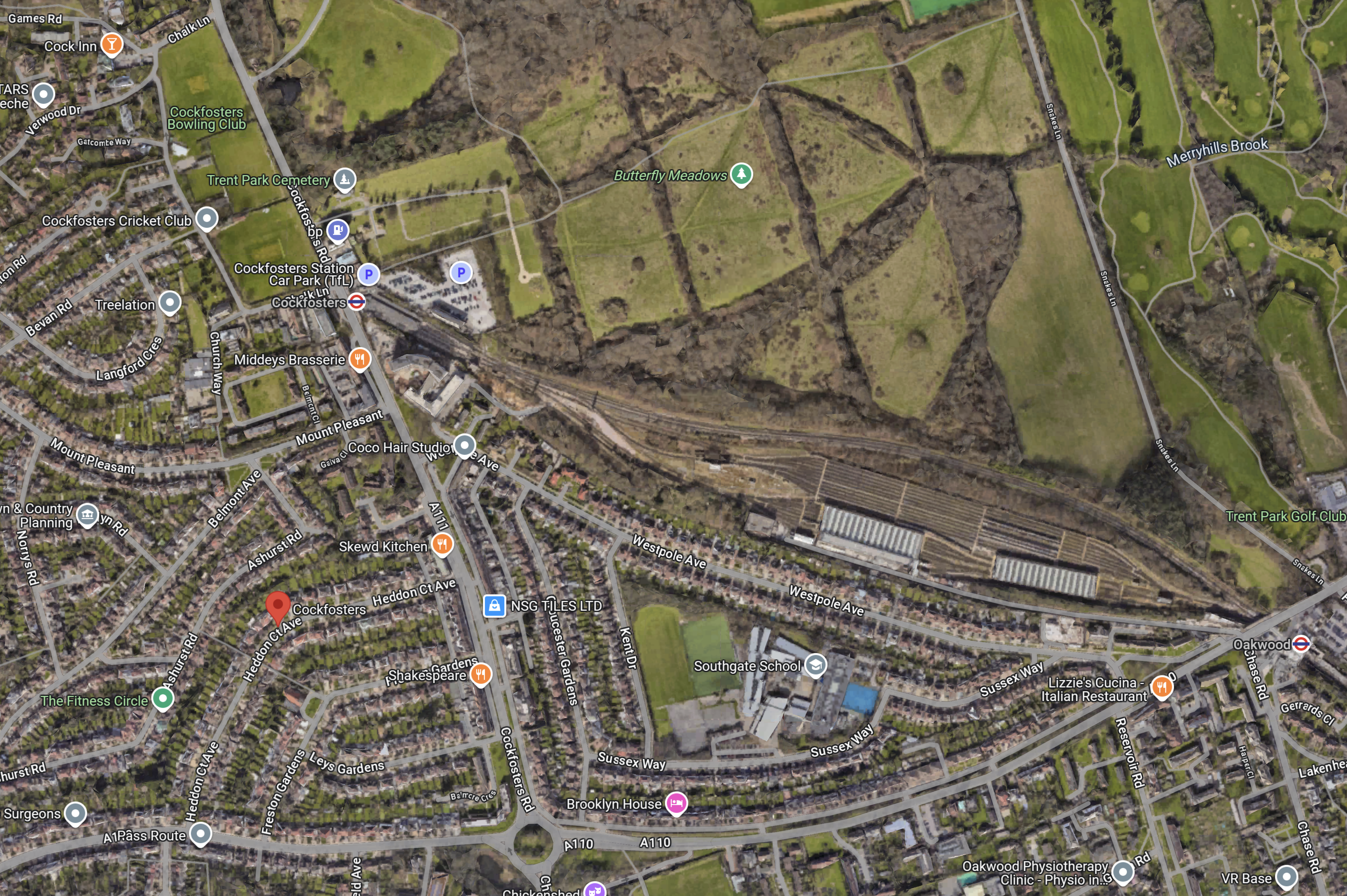
Note.
- The London Underground roundel in the North-West corner of the map indicates Cockfosters station.
- The London Underground roundel in the South-East corner of the map indicates Oakwood station.
- Between the two stations lies the large Cockfosters Train Depot, which is one of the major depots for the Piccadilly Line.
- To the North of the railway is Trent Park, which in its Wikipedia entry is described as a country house in North London.
I know the area well, as I used to live opposite Southgate School, which is towards the bottom of the map, until I was sixteen.
I believe that solar panels could be installed in three places.
- As a solar roof over a rebuilt depot.
- As a solar farm on some of the Trent Park land.
- In Would A Solar Roof With Added Vertical Turbines Work?, I suggested a hybrid installation on top of Oakwood station.
As it is a very windy hill-top, I would look into the possibility of perhaps four large wind turbines between the tracks of the depot.
It is definitely an area, where there are possibilities for renewable power.
But given that the Nimbies are objecting to the building of housing on the car-parks at Cockfosters and Oakwood stations, I suspect they will object.
Solar Roofs Above Depots And Sidings
In the previous sub-section, I suggested what was possible at Cockfosters, by installing a solar roof above Cockfosters Train Depot
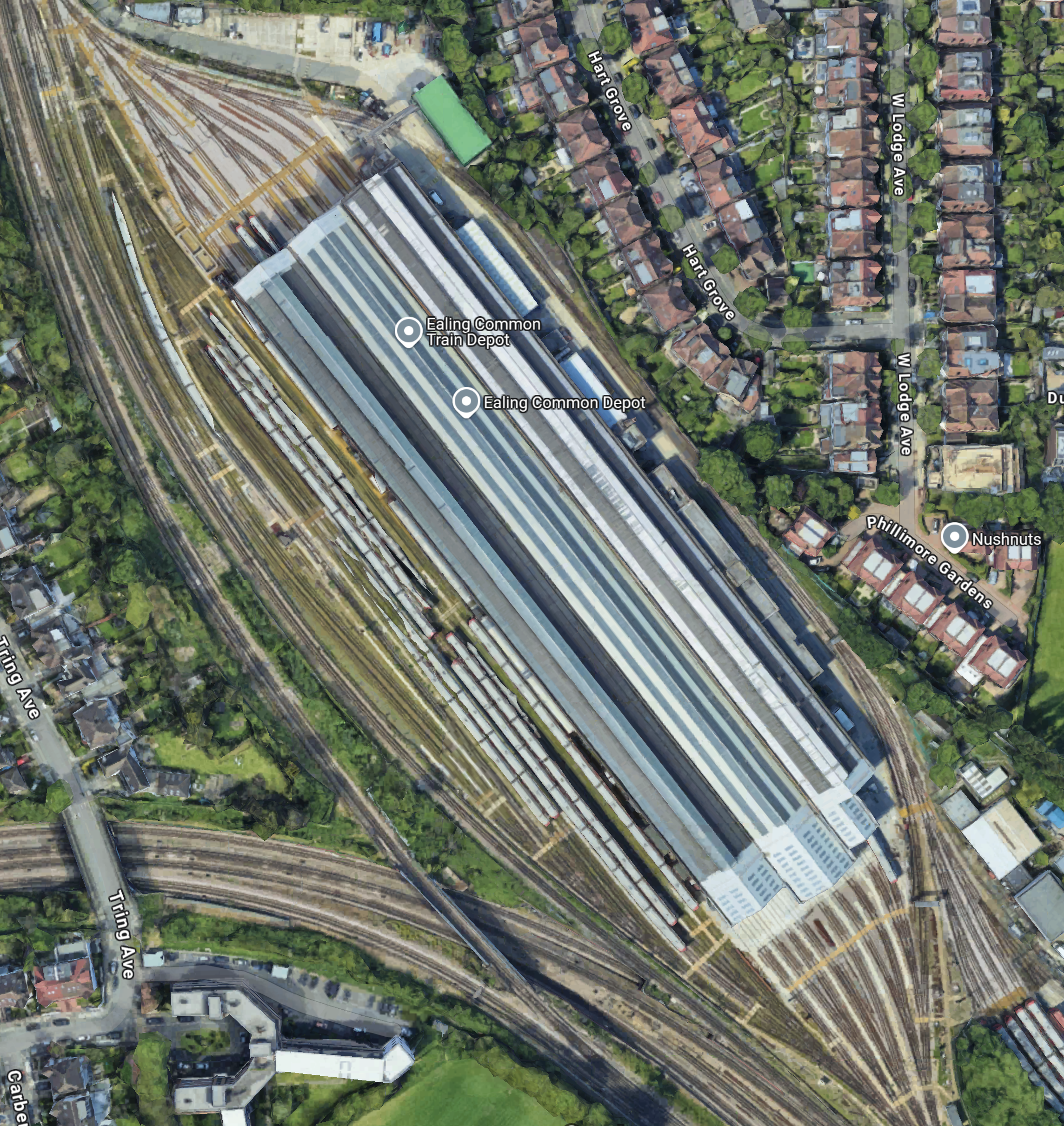
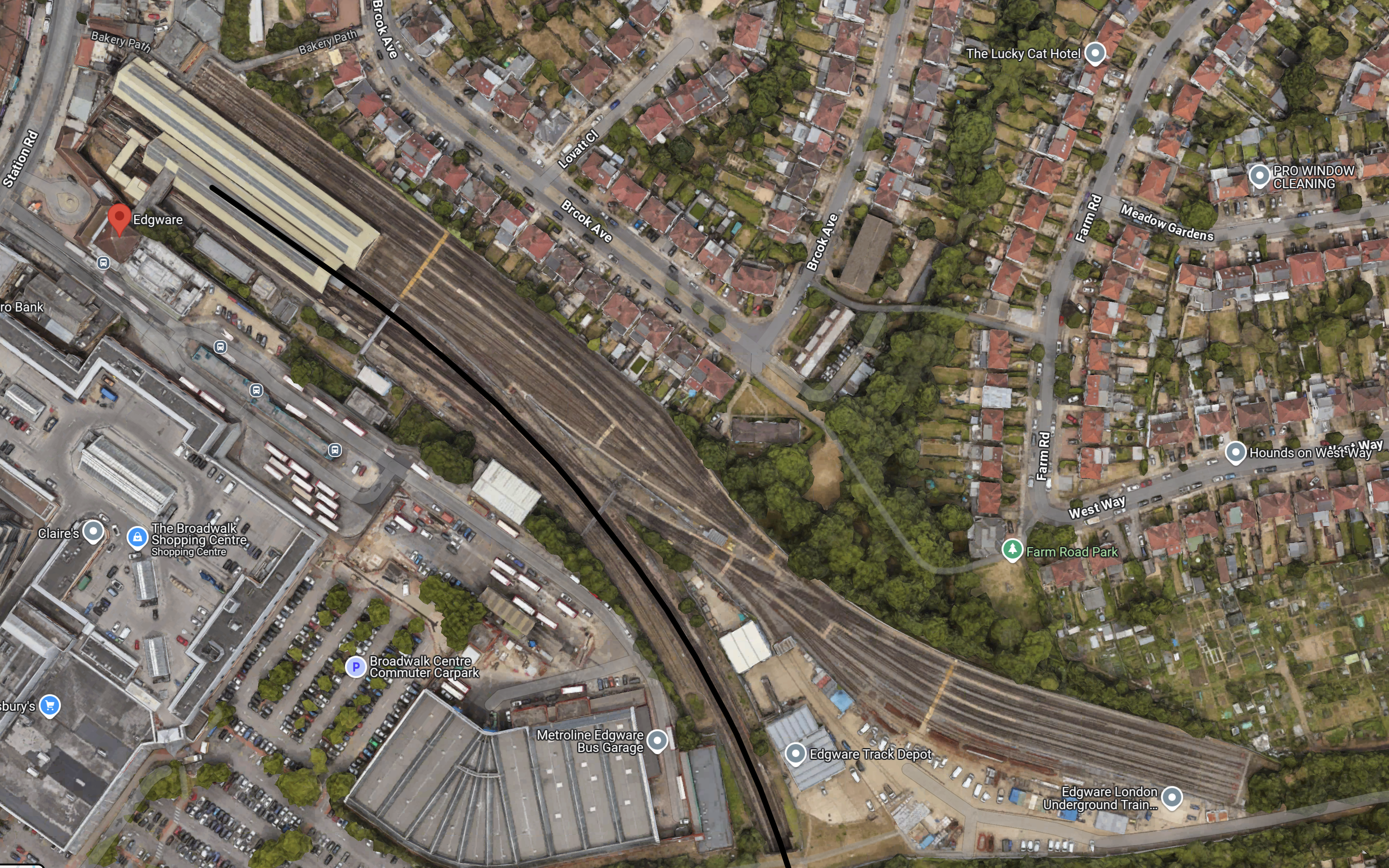
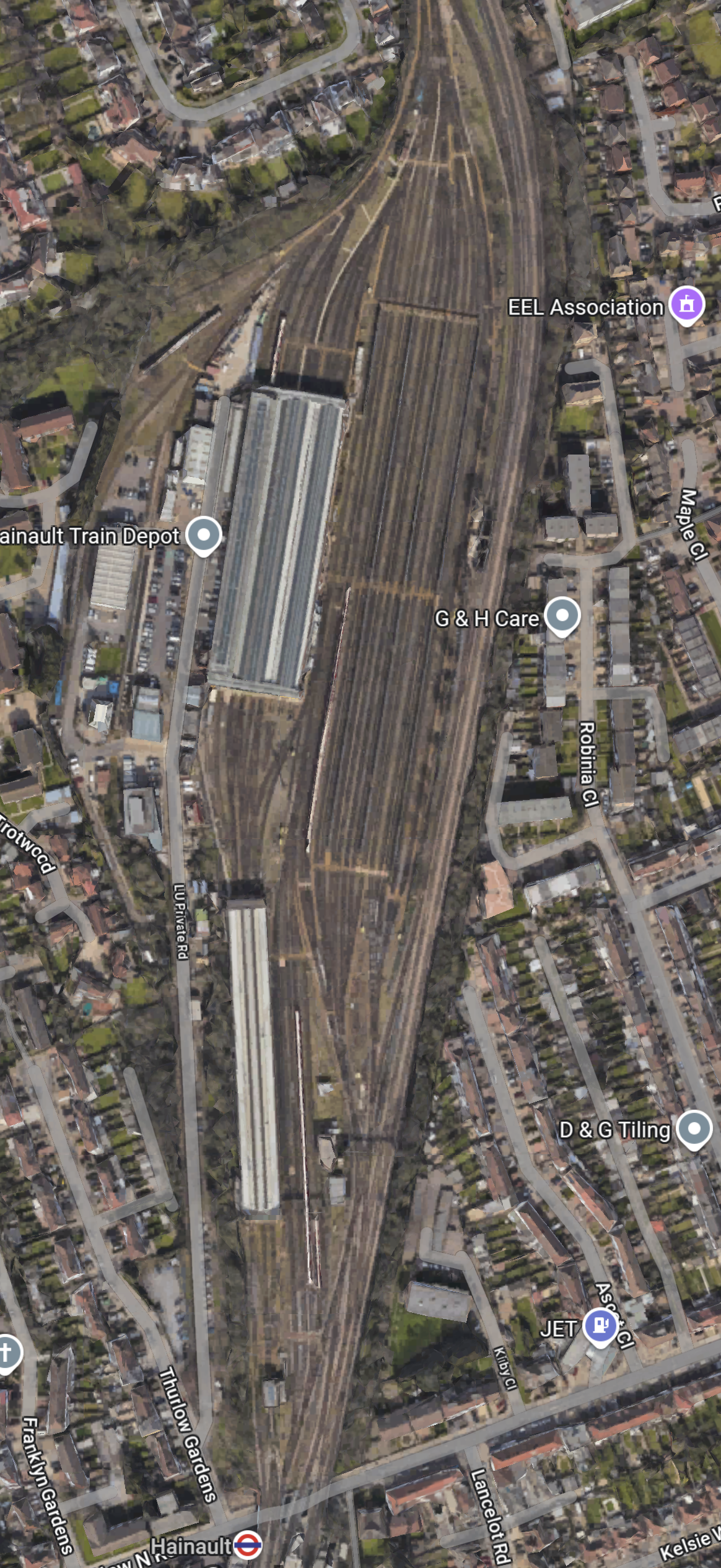
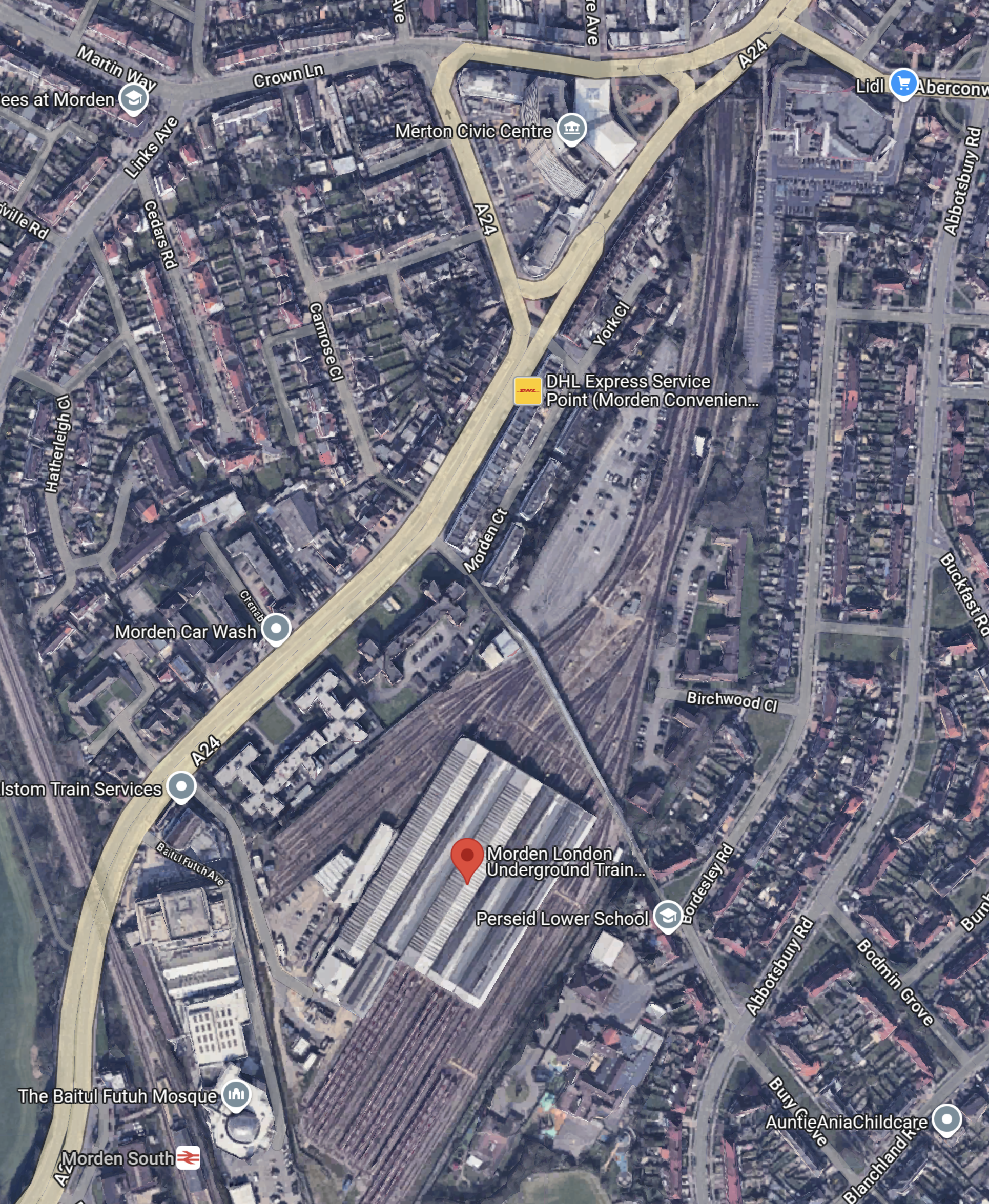
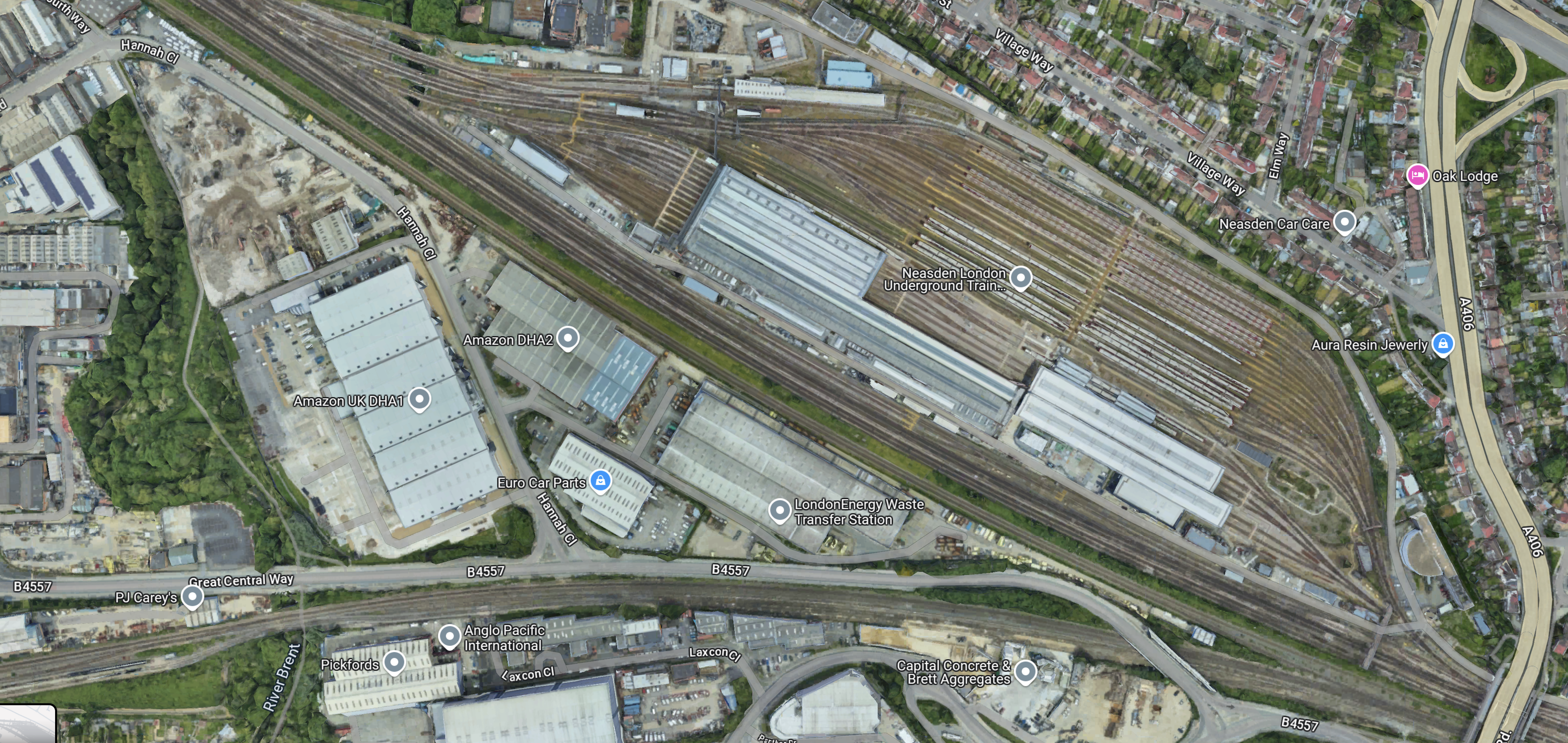
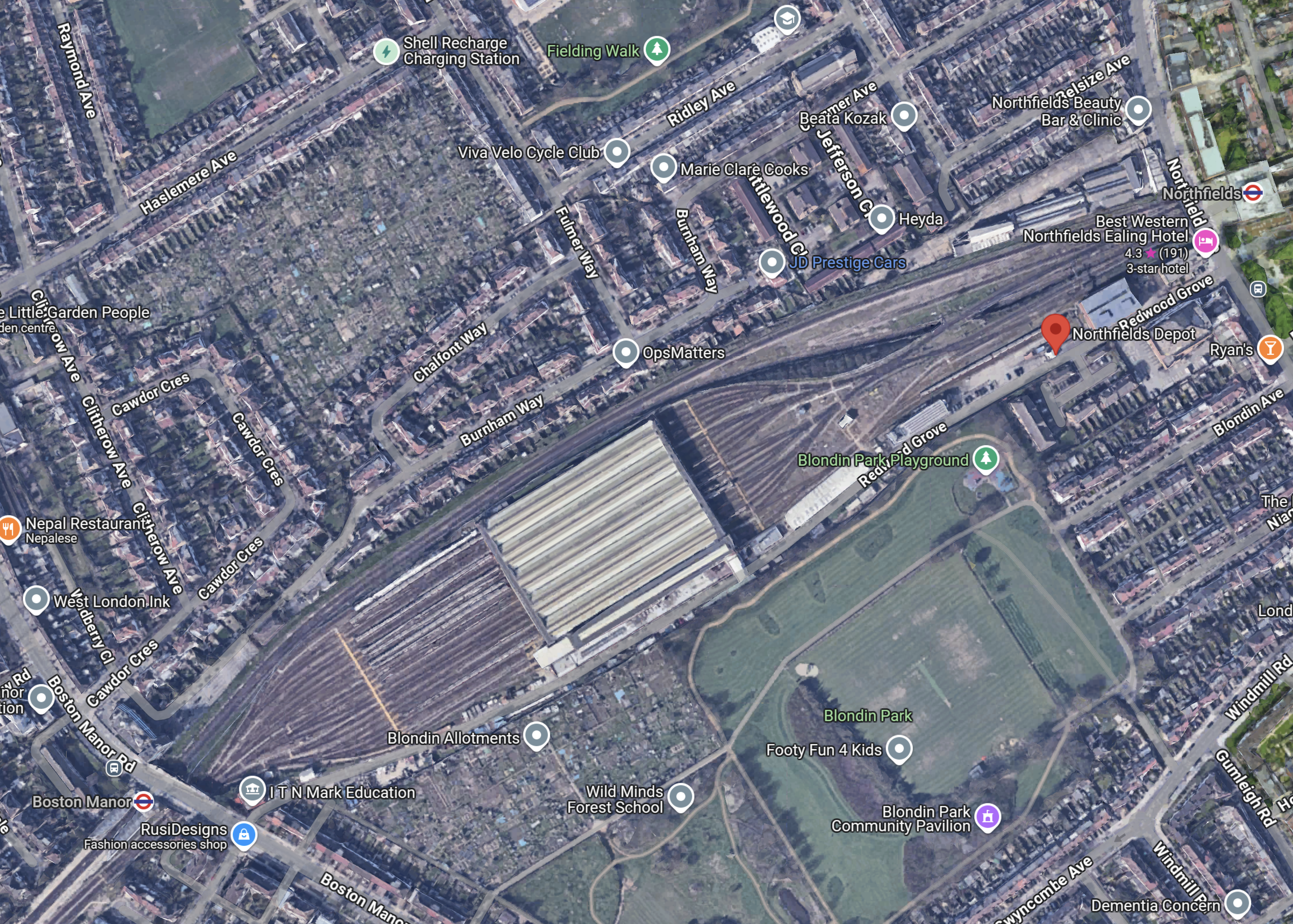
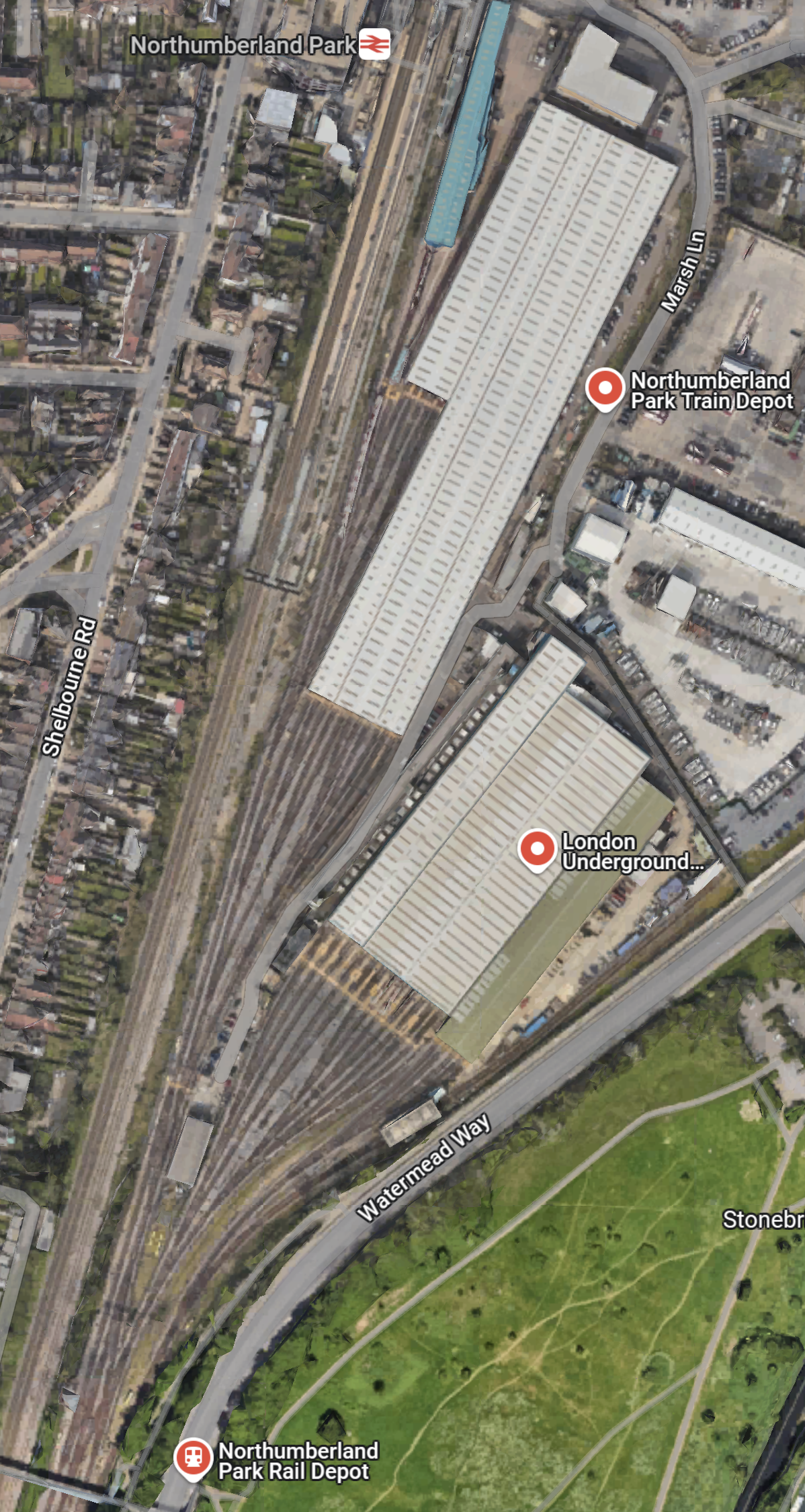
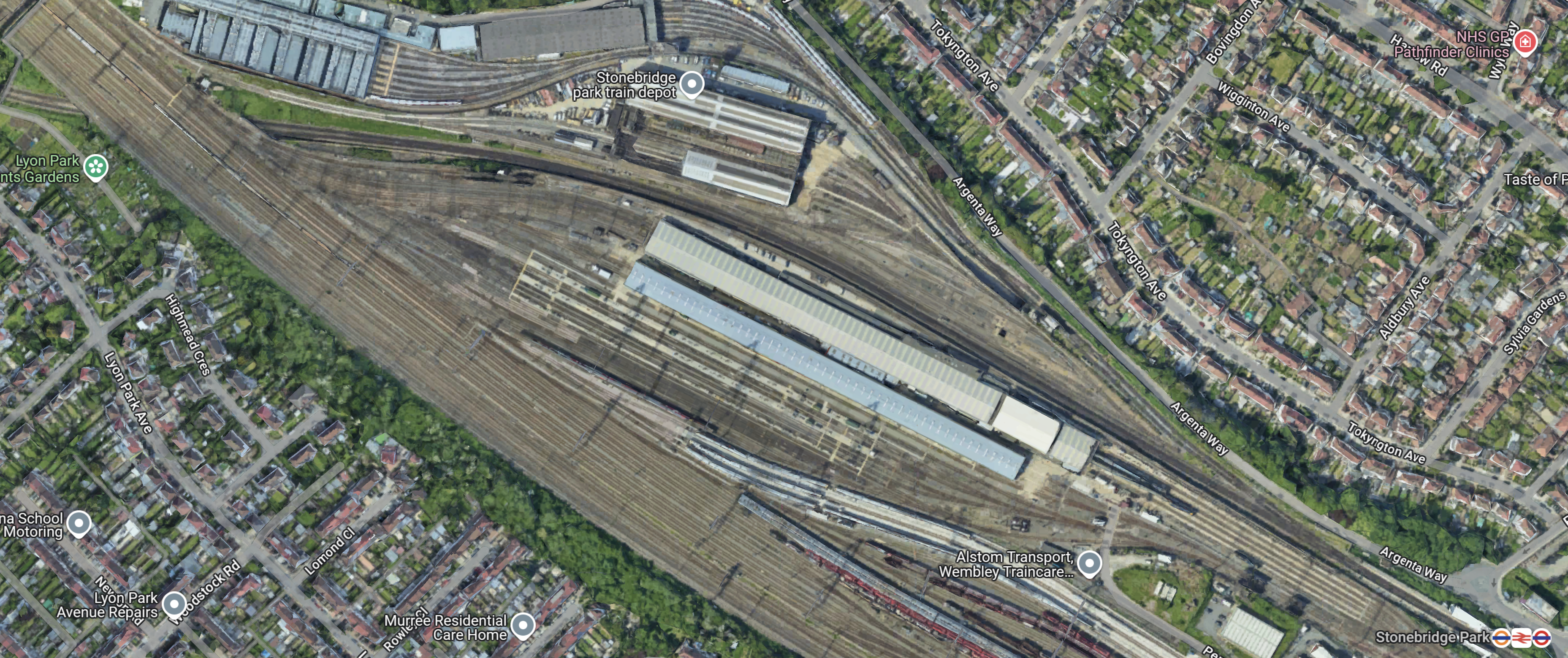
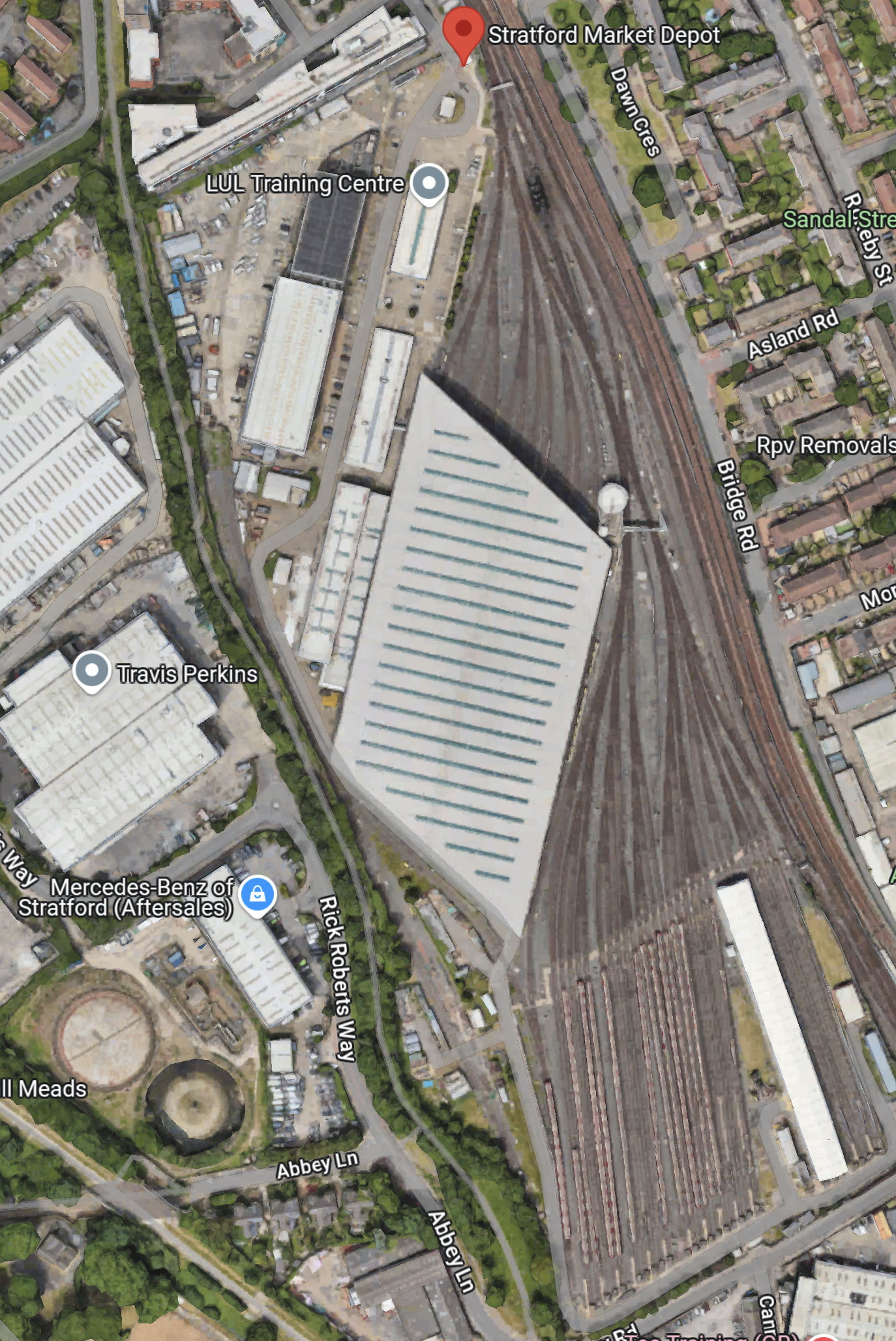
These Google Maps show a number of other depots, that have possibilities for solar roofs.
Ealing Common
Edgware
Golders Green

Hainault
Hammersmith

Morden
Neasden
Northfields
Northumberland Park
Old Oak Common

Ruislip

Stonebridge Park
Stratford Market
Upminster
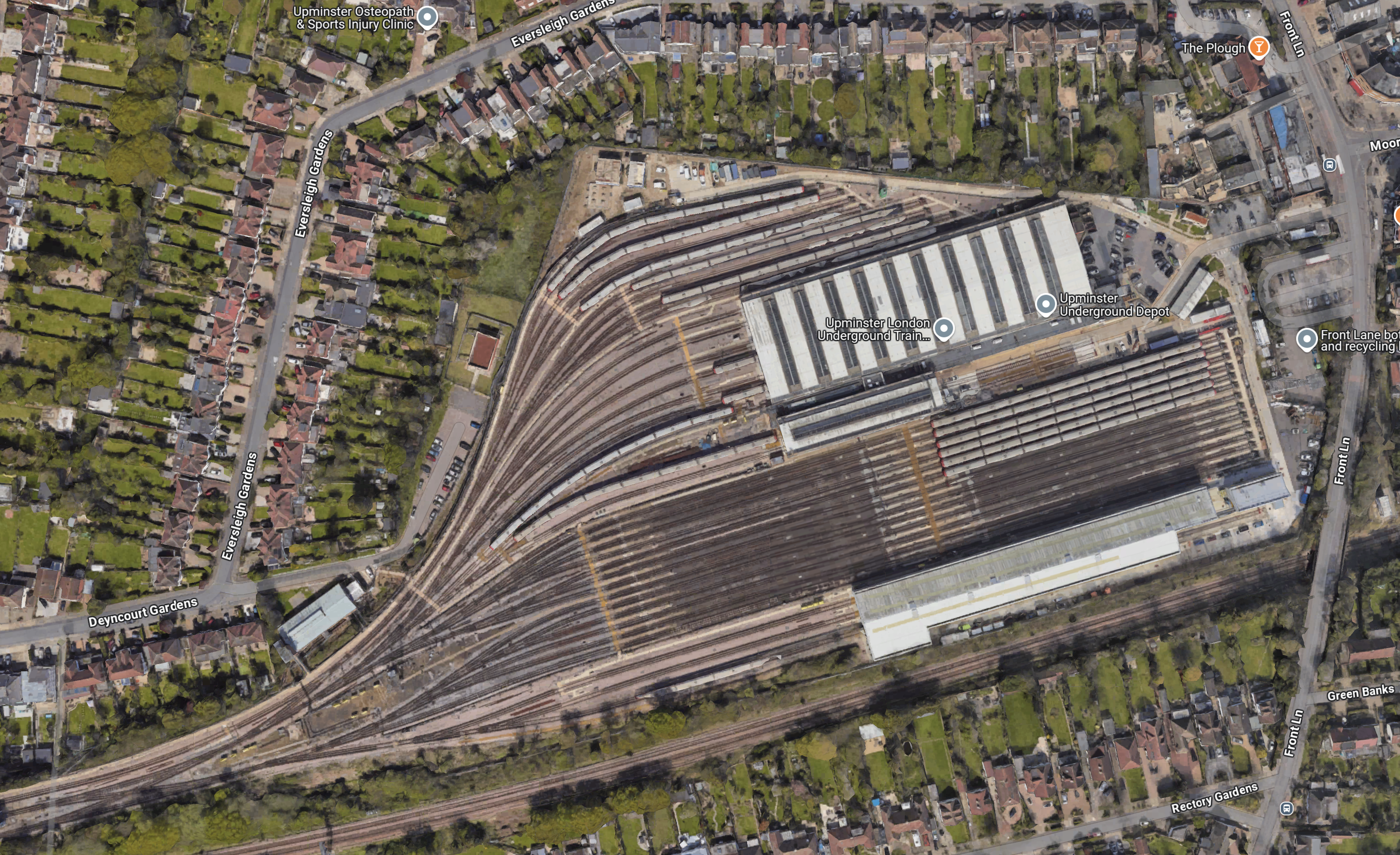
All these depots are different, but I do feel there is scope for solar roofs and panels above the sidings.
Other developments like housing may also be possible over some of the depots.
Hawthorn Pit Solar Farm
This document from the Department of Business, Industry and Industrial Strategy lists all the Contracts for Difference Allocation Round 6 results for the supply of zero-carbon electricity.
Hawthorn Pit solar farm was given a Contract for Difference.
The solar farm has a web page on the Aura Power web site, where this paragraph describes the solar farm.
Aura Power is working on a solar farm proposal between Murton and South Hetton, with a capacity of up to 49.9MW (Megawatts). The solar farm will be built without subsidy and would generate enough clean electricity to power the equivalent of over 17,000 homes, saving around 15,203 tonnes of CO2 from entering the atmosphere each year.
This Google Map shows the location of Hawthorn Pit.
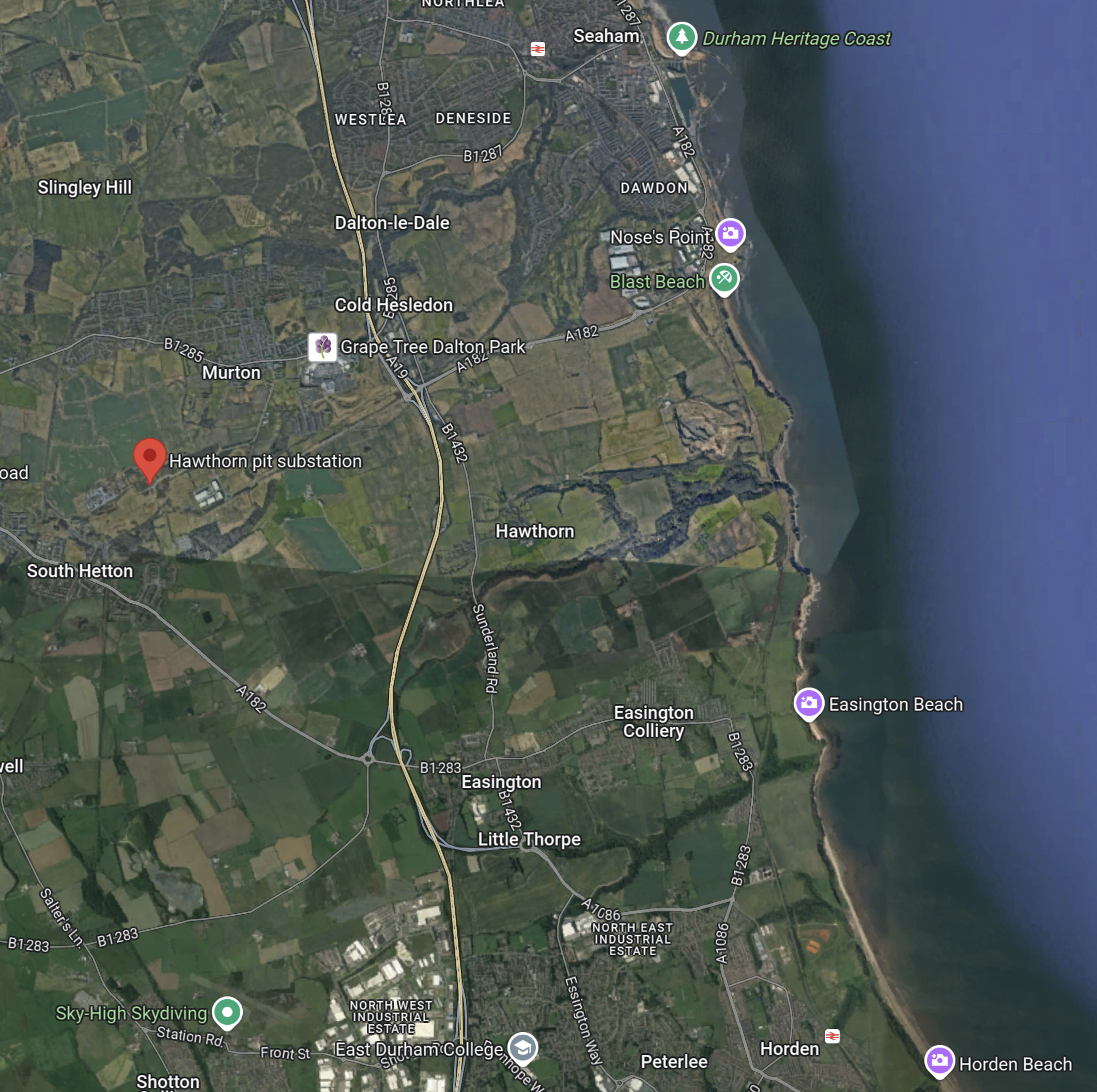
Note.
- The Durham coast is at the East with Seaham at the North and Horden at the South.
- The A 19 runs North-South in the middle of the map.
- Hawthorn Pit substation is marked by the red arrow.
This second Google Map shows the substation in more detail.
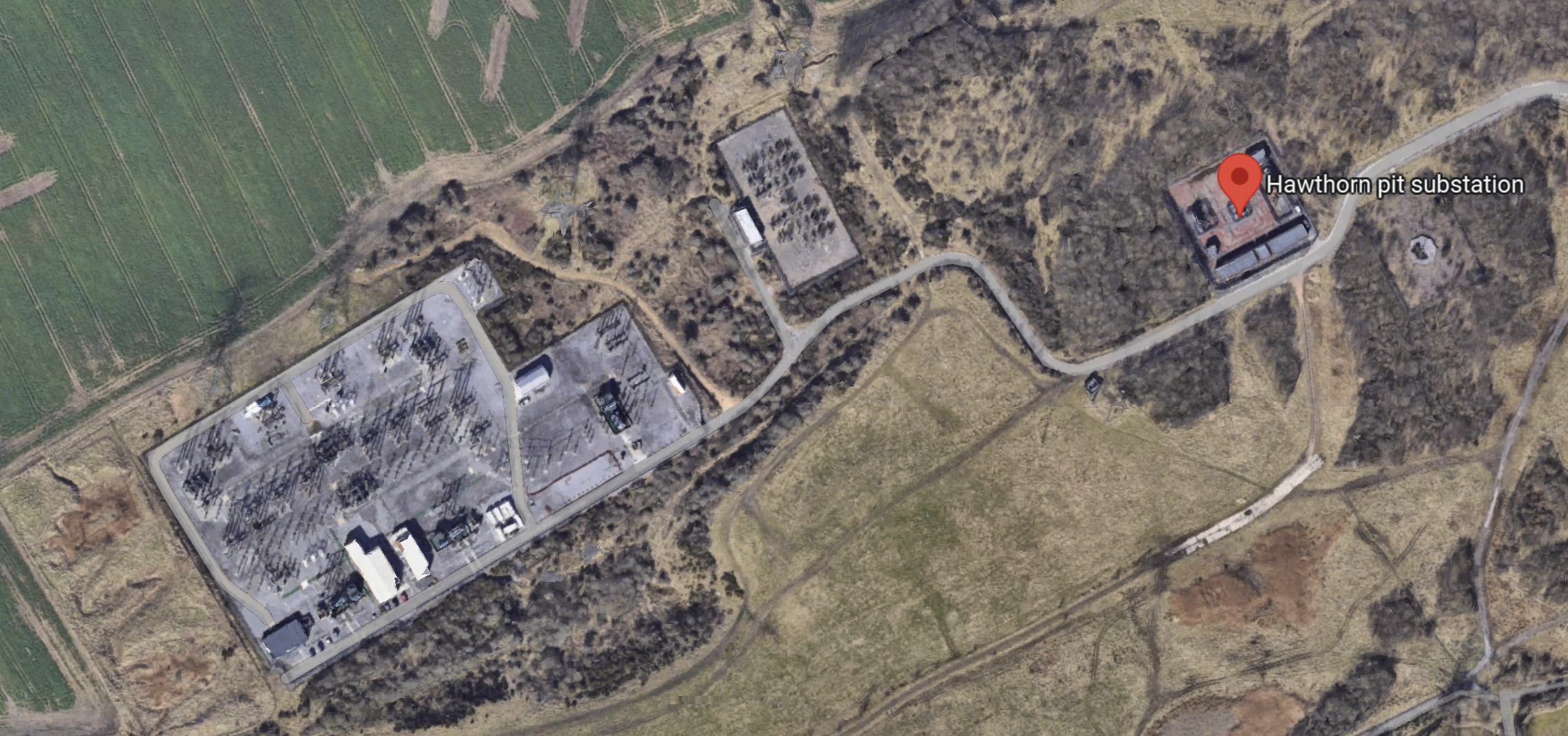
There are a lot of switches and wires.
From the map on the Aura Power web site, it appears that the solar farm is to to the North side of the substation.
Eastern Green Link One
In the future Hawthorn Pit substation will also host the Southern end of Eastern Green Link One, which will be a a 2 GW high voltage direct current (HVDC) electrical superhighway to be built between the Torness area in East Lothian, Scotland and Hawthorn Pit in County Durham, England.
This is number one of four such 2 GW undersea connections that will distribute energy between England and Scotland.
Conclusion
Hawthorn Pit substation could growto an important interchange in the grid.
England’s First Onshore Wind Farm Of A New Generation
This document from the Department of Business, Industry and Industrial Strategy lists all the Contracts for Difference Allocation Round 6 results for the supply of zero-carbon electricity.
There is only one English onshore wind farm listed in the document and it is the 8 MW Alaska Wind Farm in Dorset.
It has its own web site and this is the sub heading.
Alaska is a wind energy project comprising 4 wind turbines that are currently under construction at Masters Quarry in East Stoke, near Wareham, Purbeck. This website aims to update you on progress and provide ways to get in touch with the project team.
This is the introductory paragraph.
Alaska Wind Farm is the first of its kind in the county. Dorset has a limited potential for large-scale onshore wind development due to a variety of environmental and technical constraints, such as landscape designations and grid connection opportunities. Extensive technical assessments undertaken during the planning process have demonstrated that the quarry off Puddletown Road makes an excellent site for a wind farm. At present, all four wind turbines have been installed and the team is working on connecting them to the local electricity network. Grid connection is taking longer than anticipated, but the project team are working with the Distribution Network Operator, SSE Networks, to get the wind farm connected over the summer. Once operational, the amount of green electricity generated is expected to meet the annual demand of up to 5,200 average UK households every year*.
This Google Map shows the site on Puddletown Road.
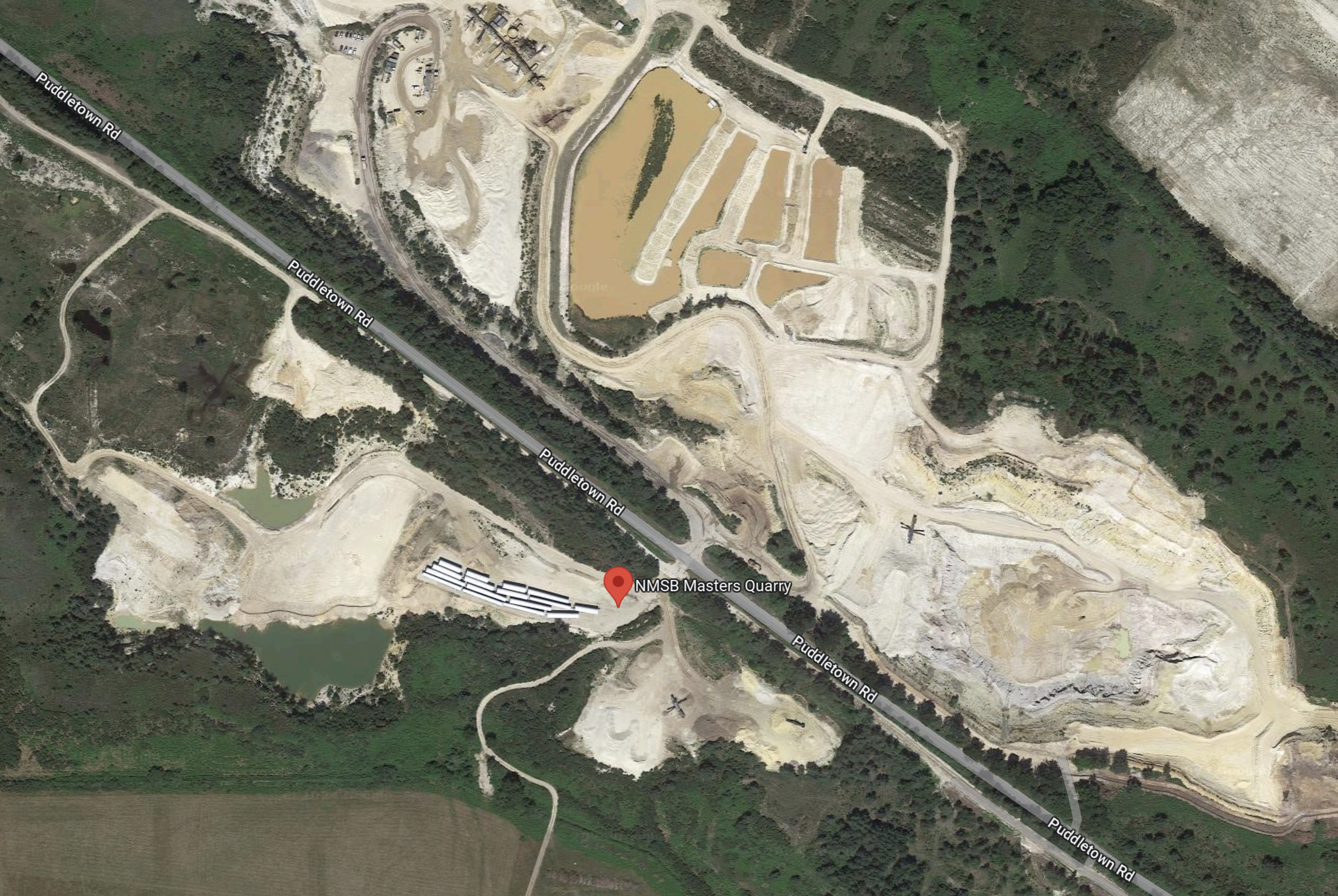
This second Google Map shows an enlargement of part of the site.
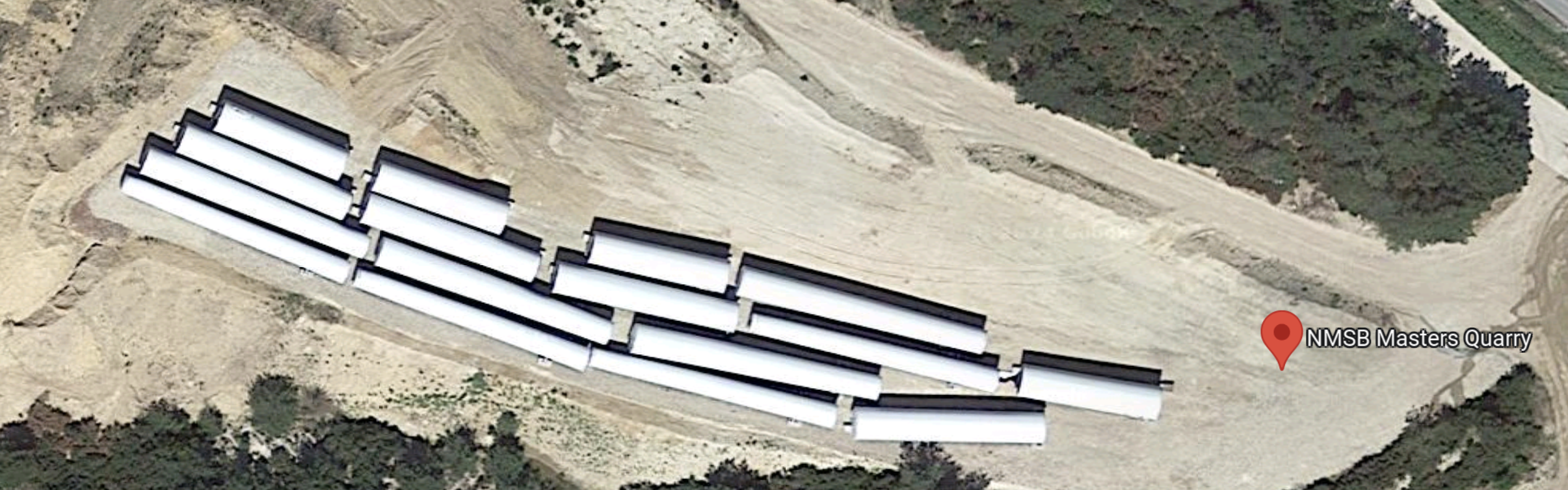
Note that are sixteen segments of wind turbine towers.
This article on the Swanage News is entitled Twenty Year Battle To Build Purbeck Wind Farm Is Finally Over.
It gives full details of the history of the wind farm.
The wind farm and a solar farm, will be surrounded by a new heath.
I particularly like this paragraph.
The new heath is expected to be home to all of Britain’s reptiles, including rare smooth snakes and sand lizards among other animals, as well as threatened butterflies, birds, bats and plants.
Renewable energy doesn’t have to wreck the countryside.I shall be watching how this project develops.
Solar With Battery In Germany Now Cheaper Than Conventional Power
The title of this post, is the same as that of this article on Renewables Now.
These two paragraphs outline the article.
Ground-mounted solar PV and onshore wind energy are the most cost-effective technologies among all types of new power plants in Germany, with levelised cost of electricity (LCOE) ranging from EUR 41 (USD 44.75) to EUR 92 per MWh, according to a study by research institute Fraunhofer ISE.
The LCOE for new solar installations in combination with battery systems vary between EUR 60 and EUR 225 per MWh reflecting the high cost differences for battery and solar systems along with the different levels of solar radiation.
Note.
- The article states that these figures are lower than newly-built coal and gas-fired power plants.
- The Fraunhofer Institute for Solar Energy Systems ISE in Freiburg, Germany is the largest solar research institute in Europe.
The original Renewables Now article is well worth reading in full.
Conclusion
This paragraph concludes the Renewables Now article.
These calculations show that the large-scale projects currently underway in Germany, which combine ground-mounted PV systems, wind farms and stationary battery storage systems, are good investments,” says Christoph Kost, head of the Energy System Analysis Department at Fraunhofer ISE and lead author of the study.
As the climate for much of Northern Europe is not that different to Germany, I suspect we’ll be seeing large numbers of hybrid wind/solar/battery power plants created in the next few years.
Centrica Business Solutions And Highview Power
Centrica Business Solutions is one of Centrica’s business units.
It has its own web page, with this sub heading.
Helping Organisations Balance Planet And Profit
This is followed by this mission statement.
Centrica Business Solutions helps organisations to balance the demands of planet and profit, by delivering integrated energy solutions that help you save money and become a sustainable business.
Several pictures show some of the solutions, that Centrica Business Solutions can provide.
Centrica Business Solutions In Numbers
These numbers are given about the customers of Centrica Business Solutions.
- Customer Sites Globally – 7000
- Solar PV Installations Delivered Worldwide – 16,380+
- Solar PV Installations Delivered Power – 240 MW
- CHP Units Operated And Maintained Globally – 700 MW+
- Energy Data Points Collected Each Month Globally – 29 billion
Theses are large numbers.
How Would Centrica Business Solutions Use Highview Power’s Batteries?
The obvious use of Highview Power’s batteries is to connect them between a solar or wind farm and the grid, for when the sun isn’t shining or when the wind isn’t blowing.
Currently, there are three sizes of Highview Power batteries, either working on under development.
5MW/15 MWh
This is the demonstration system, which is described on this page of the Highview web site.
Surely, if a system of this size is very useful for Viridor, there may be other applications and customers out there.
This system will provide 5 MW for three hours.
50MW/300MWh
This is the Carrington system, which is described on this page of the Highview web site.
The Highview web site says this about output potential and connectivity.
The facility will store enough clean, renewable energy to serve the needs of 480,000 homes, as well as providing essential grid stabilisation services. The site will use existing substation and transmission infrastructure.
This system will provide 50 MW for six hours.
200MW/2.5GWh
This is the larger system for Scotland and the North East, which is under development and described on this page of the Highview web site.
The Highview web site says this about output their use.
These will be located on the national transmission network where the wind is being generated and therefore will enable these regions to unleash their untapped renewable energy potential and store excess wind power at scale.
This system will provide 200 MW for 12.5 hours.
In Rio Tinto Punts On British Start-Up To Plug Renewables Gap, I said this.
In Britain, Highview hopes to be putting four 2.5-gigawatt assets into planning this year – one in Scotland, three with Orsted in England.
This sentence was originally published in this article on the Australian Financial Review.
I believe that Centrica could find applications for all three sizes of Highview’s batteries.
Suppose, though Centrica find that an application needs say a 100 MW/1 GWh battery.
From the mathematics, I did at ICI in the 1970s, when looking at the scaling of chemical plants, I believe that Highview’s battery design could be scalable, by just using appropriately-sized turbomachinery, matched to the right number of tanks.
So the customer would get the battery size they needed!
How Much Electricity Could One Of Highview’s Batteries Store?
This image shows large LNG tanks at Milford Haven.
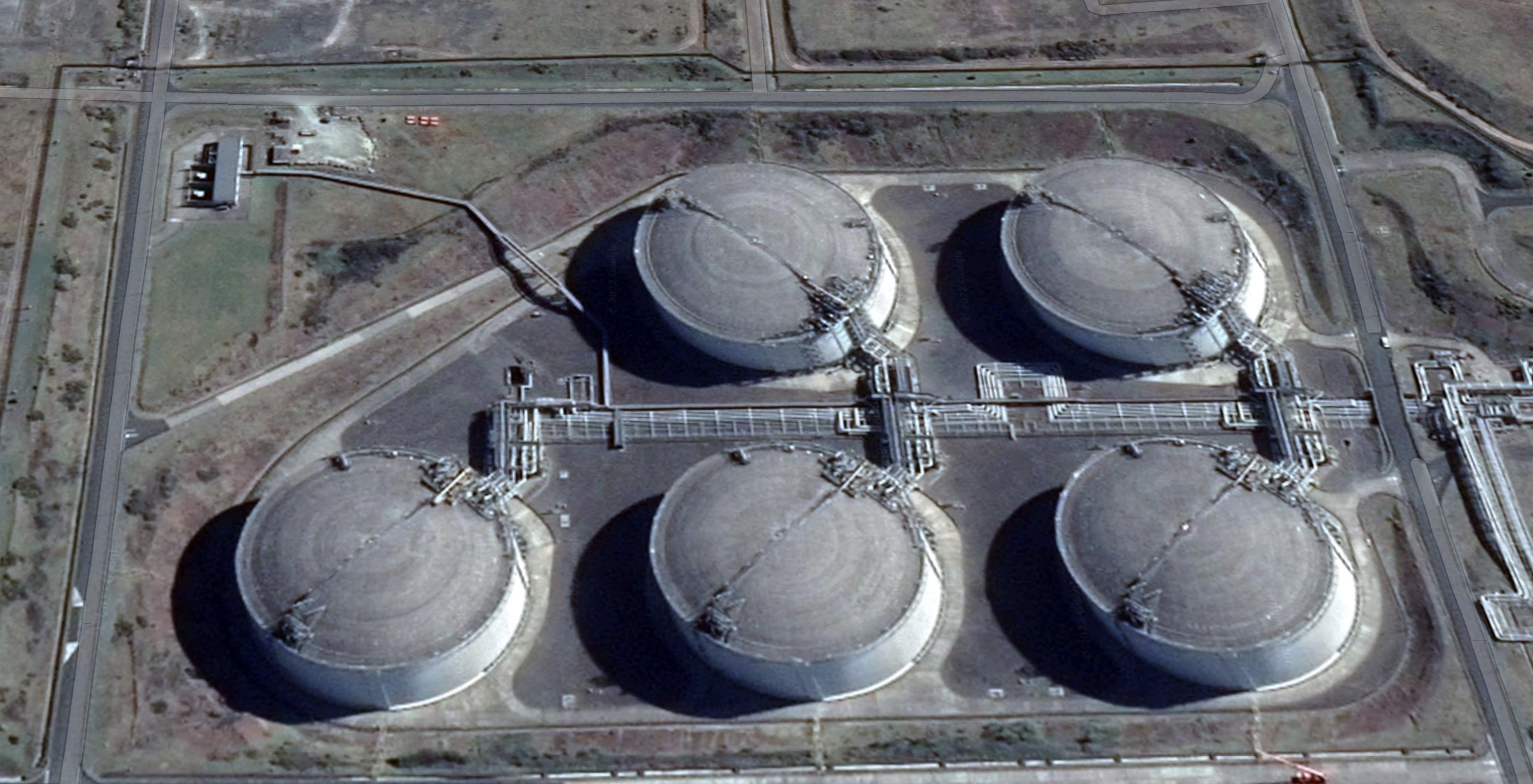
In Could A Highview Power CRYOBattery Use A LNG Tank For Liquid Air Storage?, I did a rough calculation and found that the largest LNG tanks could hold enough liquid air, that would be the equivalent of around one GWh.
So the image above could be a 5 GWh battery.
This image clipped from Highview’s web site, shows large tanks for liquified gas storage.
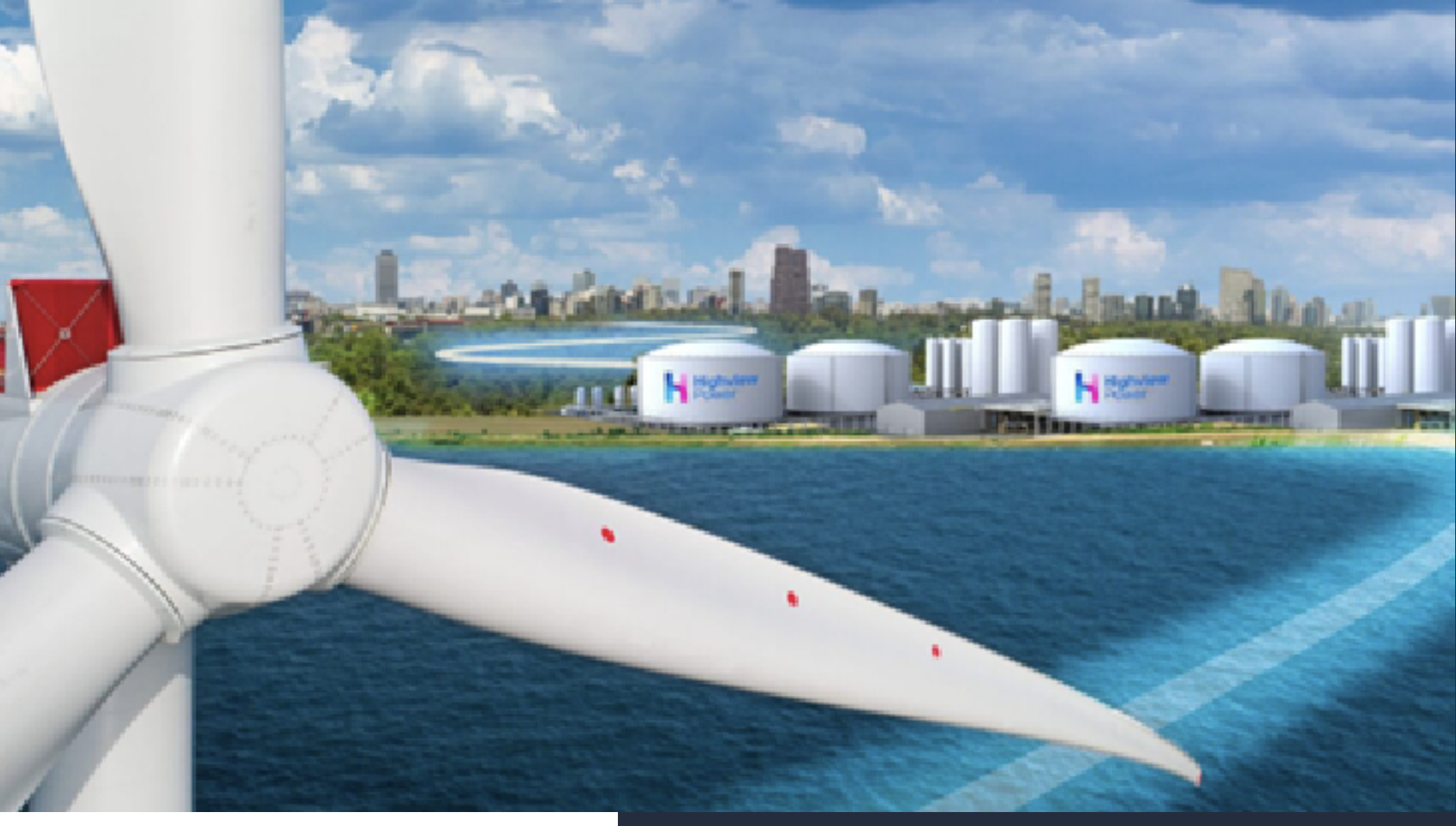
With tanks like these, Highview could be building batteries with storage to rival the smaller pumped storage hydroelectric power stations.
In Grid Powers Up With One Of Europe’s Biggest Battery Storage Sites, I talked about how Ørsted were planning the Swardeston BESS, where the 2852 MW Hornsea Three wind farm connects to the grid.
The chosen battery will be from Tessla with an output of 300 MW and a capacity of 600 MWh.
I suspect Ørsted couldn’t wait for Highview, but circumstances might have changed now, with the financing deal for the Carrington battery!
Are Combined Heat And Power Units And Highview’s Batteries Interchangeable And Complementary Technologies?
According to the Centrica Business Systems web site, they have deployed over 700 MW of CHP systems globally.
I wonder how many of these systems could have used a standard Highview battery?
Perhaps, Centrica Business Systems have done a survey and found that it could be quite a few.
So, perhaps if Centrica Business Systems had access to Highview’s technology, it would increase their sales.
In addition how many of Centrica Business Systems existing CHP systems, would be improved with the addition of a Highview battery?
It appears to me, that if Centrica Business Systems were to develop a series of standard solutions based on Highview’s technology, they could substantially increase their sales.
What Could Centrica Business Systems Do For Highview Power?
Centrica Business Systems could probably develop several standard applications with Hoghview’s technology, which would be to the benefit of both companies.
But, I believe that as Centrica Business Systems are supporting large number of systems globally, that they are in a good place to help develop and possibly run Highview Power’s support network.
Conclusion
I can see Centrica Business Systems and Highview Power having a long and profitable relationship.
Recurrent Energy’s Middle Road Project Sold To Centrica
The title of this post, is the same as that pf this article on Solar Power Portal.
These are the first two paragraphs.
Recurrent Energy, a global solar and energy storage developer and a subsidiary of Canadian Solar, announced the sale of its 49.9 MWp Middle Road solar project in Harbury, Warwickshire, to Centrica Business Solutions. The subsidy-free project, slated for construction this summer, will commence operations in 2025.
The Middle Road project is just one piece of Recurrent Energy’s expanding UK pipeline, which boasts over 2.6 GWp of solar PV and 6.7 GWh of battery storage projects. This mirrors the broader trend of increased investment in UK solar. Indeed, Recurrent announced €1.3 billion of financing for EU and UK solar projects earlier this week.
This 49.9 MW solar project shows three ways to make money from a solar project.
The Developer
Recurrent Energy would appear to have developed the expertise to put together these solar farms and do all the legals and administration to connect them to the National Grid.
They obviously can show their financial backers, the cash flow, that the farms generates.
So if you’re good at building solar farms, I suspect you can develop a substantial pipeline of projects, each with their own case flow.
The Operator
Initially in the early days, Recurrent Energy will probably be the operator, so they can sort out any teething problems and build the financial profile of the site.
The Owner
But as at Middle Road, they may decide to cash in their investment.
Centrica have now taken over the ownership and they can operate the farm themselves or pay, Recurrent Energy a fee.
Note.
- Developer, operator and owner all have ways of making money from this solar farm.
- Developer and owner can use the solar farm, as an asset on which to raise money.
- Similar cash flows and inside probably apply to batteries and wind farms.
By buying, selling and updating the various assets, a financial operator, can use their assets to make money.
As Centrica are also an electricity supplier, they can probably suggest to developers, where a solar farm or battery-electric storage system is needed.
Are Centrica Developing A Pipeline Of Projects?
In Centrica Set For Solar Boost With Acquisition Of Two Projects In South-West England, I talked about how Centrica had acquired two projects in South-West England.
The Middle Road project is the third project that Centrica has purchased this year.
As a Control and Electrical Engineer, I know, that by careful management of the assets, Centrica can achieve the following.
- Delivery of electricity to their customers at a competitive price.
- If a battery is included in the local grid, higher supply reliability can be achieved.
- Batteries also allow the local network to carry out other tasks, like frequency stabilisation.
The flexibility of the local network should allow other assets to be added.
Electricity Networks Accelerate Potential Connection Dates Of Over 200 Clean Energy Projects
The title of this post, is the same as that of this press release from National Grid.
This is the sub-heading.
7.8GW of clean energy projects, more than double the output of Hinkley Point C nuclear power station, have had their connection offer dates brought forward by up to 10 years through the Technical Limits programme, which is allowing projects to connect to lower voltage distribution networks prior to reinforcement of the high voltage transmission network.
These are the first two paragraphs.
Networks have so far sent offers to 203 projects totalling 7.8GW with an average connection acceleration of 6.5 years. In total 393 projects are eligible for the programme with the further 190 projects able to receive accelerated offers once they have progressed through the connection offer process. Last month a solar farm near Bridgwater in Somerset became the first project to be energised under this scheme. Horsey Levels solar farm, which will provide clean energy for 10,000 homes annually, connected to National Grid’s electricity distribution network significantly ahead of its original planned connection date. This initial acceleration has been delivered in the first phase of the Technical Limits programme, with further phases and analysis planned.
Technical Limits, a collaborative project from National Grid Electricity Transmission, Energy Networks Association, the Electricity System Operator and the Distribution Network Operators (DNOs) forms part of the ongoing collaborative industry efforts, together with Ofgem and government, to speed up and reform connections to the grid. Scottish Transmission and Distribution network owners have been involved in developing the Technical Limits programme and are in the process of rolling out the programme in their license areas also.
Note.
- National Grid seem to measure large amounts of power, with respect to Hinkley Point C nuclear power station, which will have an output of 3.26 GW.
- The Technical Limits programme seems to be a sensible idea.
- Was the idea thought up by National Grid or is it an idea borrowed from another country?
- If it allows another 7.8 GW of clean electricity projects to be connected an average of 6.5 years earlier, then there can’t be much wrong with the idea.
- Horsey Levels solar farm is to the East of the M5, just to the North of Bridgwater.
I shall be following the roll-out of National Grid’s Technical Limits programme, as more clean power projects are connected to the grid.
National Grid And Innovation
This is another post about innovation at National Grid.
Others include.
- £9.2m Electricity Research Project To Save 39,000 Tonnes Of C02 Gets Go-Ahead, which talks about modifying transmission lines to carry more electricity. This means, that theoretically, we’ll need less and smaller transmission lines.
- £400k For National Grid Innovation Projects As Part Of Ofgem Fund To Help Shape Britain’s Net Zero Transition, which talks about Ofgem grants to fund innovation.
- National Grid Fast-Tracks Overhead Line Upgrade Project To Help Accelerate Connection Dates Of 175 Clean Energy Projects, which describes acceleration of projects.
- National Grid To Accelerate Up To 20GW Of Grid Connections Across Its Transmission And Distribution Networks, which also describes acceleration of projects.
- National Grid Goes Carbon-Free With Hydrogen-Powered Substation Trial, which describes work to use hydrogen as back-up power for substations.
- University Of Manchester And National Grid Team Up To Develop SF6-Free Retrofill Solution For Electricity Network, which describes a project to remove SF6 from the grid. SF6 is a greenhouse gas.
- National Grid Installs LineVision Sensors To Expand The Capacity Of Existing Power Lines, which describes an interesting idea from the United States.
- National Grid ESO And Reactive Technologies Launch Flagship Inertia System To Measure Grid Stability, which describes an innovative Spanish way to measure grid stability.
Note.
- I have included projects, that accelerate connection of new projects to the grid.
- Does National Grid benefit from operating grids in the UK and US, as it gets offered the best technology from both sides of the Pond?
National Grid seem to be big innovators.
Mercia Power Response & RheEnergise Working Together To Build Long Duration Energy Storage Projects In The UK
The title of this post, is the same as that as this news item from Mercia PR.
As it is from the 16th of August last year, I wonder why my Google Alert didn’t pick it up.
This is the sub-heading.
Mercia Power Response, a key provider of flexible power response services to the UK grid, has signed an agreement with RheEnergise to explore the potential deployment of RheEnergise’s new and innovative form of long-duration hydro-energy storage, known as High-Density Hydro® (HD Hydro).
These are the first three paragraphs.
Mercia Power Response, a key provider of flexible power response services to the UK grid, has signed an agreement with RheEnergise to explore the potential deployment of RheEnergise’s new and innovative form of long-duration hydro-energy storage, known as High-Density Hydro® (HD Hydro). Mercia Power Response (“Mercia PR”) and RheEnergise will work together to identify suitable sites for additional HD Hydro storage projects. The two companies’ initial focus will be the feasibility of getting 100MW of HD Hydro in commercial operation by 2030 by utilising Mercia PR’s existing grid connections.
With 40 sites having a combined capacity of 263MW and a number of sites under development and construction over the next 5-10 years, Mercia PR believes that RheEnergise’s HD Hydro storage technology would be a complementary, low carbon solution to its operating portfolio.
Additionally, Mercia PR’s industry partners bring market expertise in energy trading and forecasting, helping RheEnergise to optimise grid-connected energy storage projects.
Note.
- The average size of Mercia PR’s batteries would appear to be 6.5 MW.
- Working on the often-used two-hour duration, that would be a storage capacity of 13 MWh.
- I suspect some of Mercia PR’s sites will be more suitable for lithium-ion batteries and some will be more suitable for RheEnergise’s HD Hydro systems.
- I have witnessed local Nimbys objecting to lithium-ion systems on grounds of the fire risk.
- I am fairly sure, that the National Grid will be able to cope with both lithium-ion batteries and RheEnergise’s HD Hydro systems.
- I suspect Mercia PR’s industry partners, with their market expertise in energy trading and forecasting, could turn a small wind or solar farm into a nice little earner.
This looks to be a good fit between two innovative companies.

