Fresh Air Fuels Global
Because of its history, South Africa has developed technology to create biofuels, as alternatives to diesel.
If you read the Wikipedia entry for South African chemical company; SASOL, you’ll see the things that South African chemists did, to get round the sanctions imposed because of apartheid.
SASOL has advanced the Fischer–Tropsch process and uses it to produce diesel and other fossil fuels.
Note that Velocys have also developed this process to make sustainable aviation fuel in the UK.
Fresh Air Fuels Global have a page on the G-volution web site.
The page is dominated by an infographic, which shows organic waste (animals and plants) going into an anaerobic digester, which produces.
- Biogas, which is used to create heat, electricity, CO2, biomethane, fuel and gas for the grid.
- Digestate, which is used for fertiliser and livestock bedding.
It almost sounds too good to be true.
This is the mission statement below the graphic.
Our mission: To be the most reliable producer of energy secure low carbon fuels.
There is then these paragraphs, which explain the relationship between G-volution and Fresh Air Fuels Global.
Global energy security concerns and climate targets necessitate countries and businesses to transition away from high-cost fossil fuels towards low-carbon alternatives.
Over more than a decade, Cape Advance Engineering South Africa (CAE) have been developing an incredibly cost-effective Anaerobic Digestion (AD) technology, which has proven to generate renewable energy from organic waste in the form of gas, heat and electricity that is cost competitive with fossil fuels.
G-Volution has partnered with CAE to form Fresh Air Fuels Global (FAFG), with aim of introducing the CAE technology to international markets that the G-Volution already have a foothold, constructing AD plants and creating carbon neutral biofuel from waste that can be used in dual fuel engines.
In Grand Central DMU To Be Used For Dual-Fuel Trial, I describe how G-volution’s dual fuel technology has been applied to one of Grand Central’s Class 180 train.
This picture I took after travelling in a Grand Central Class 180 train, shows that G-volution don’t hide their light under a bushel.
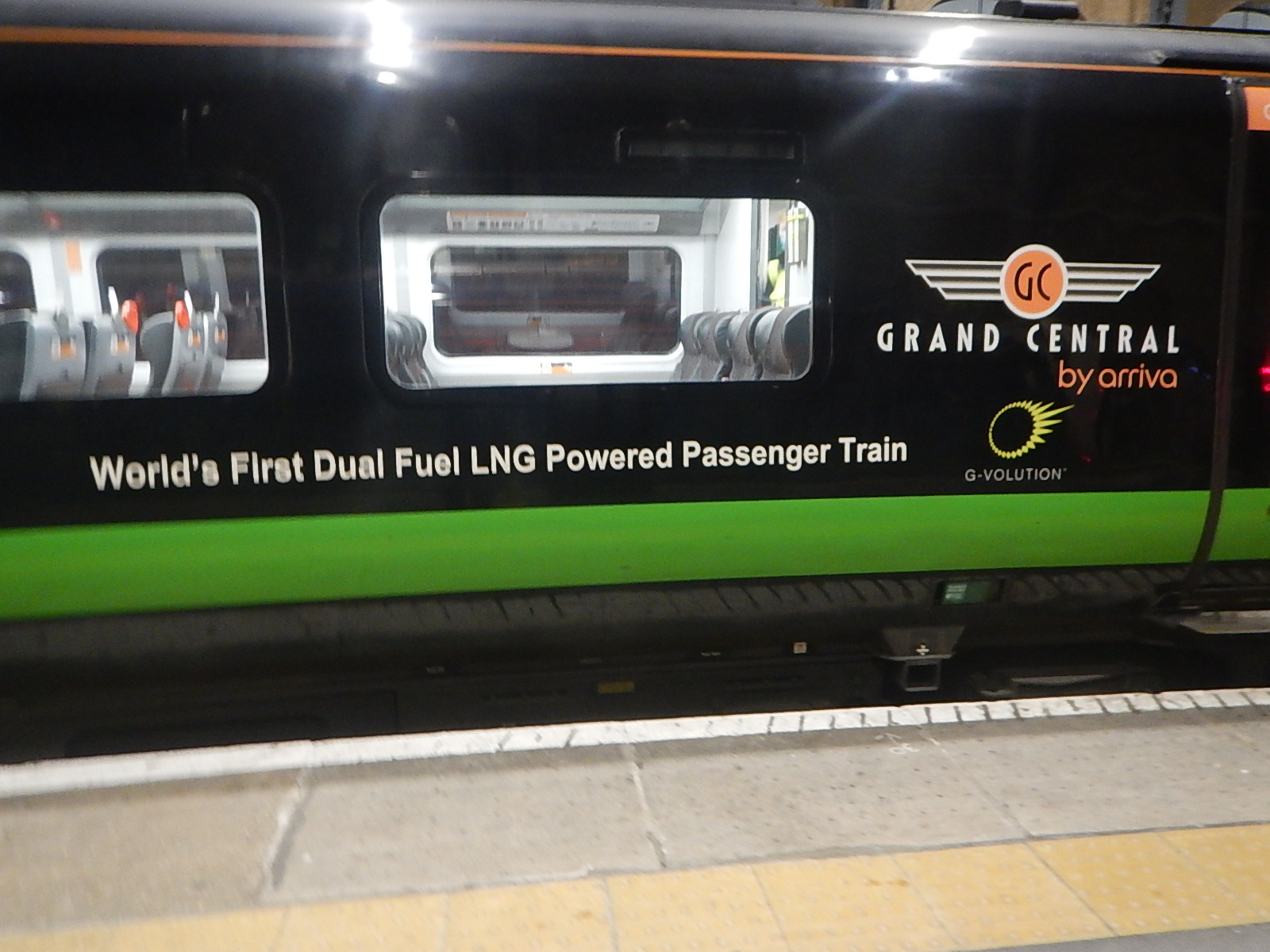
Note.
- This train appears to run on diesel and liquified natural gas.
- This G-volution video gives more details.
This clip from the video, shows the possible fuels.
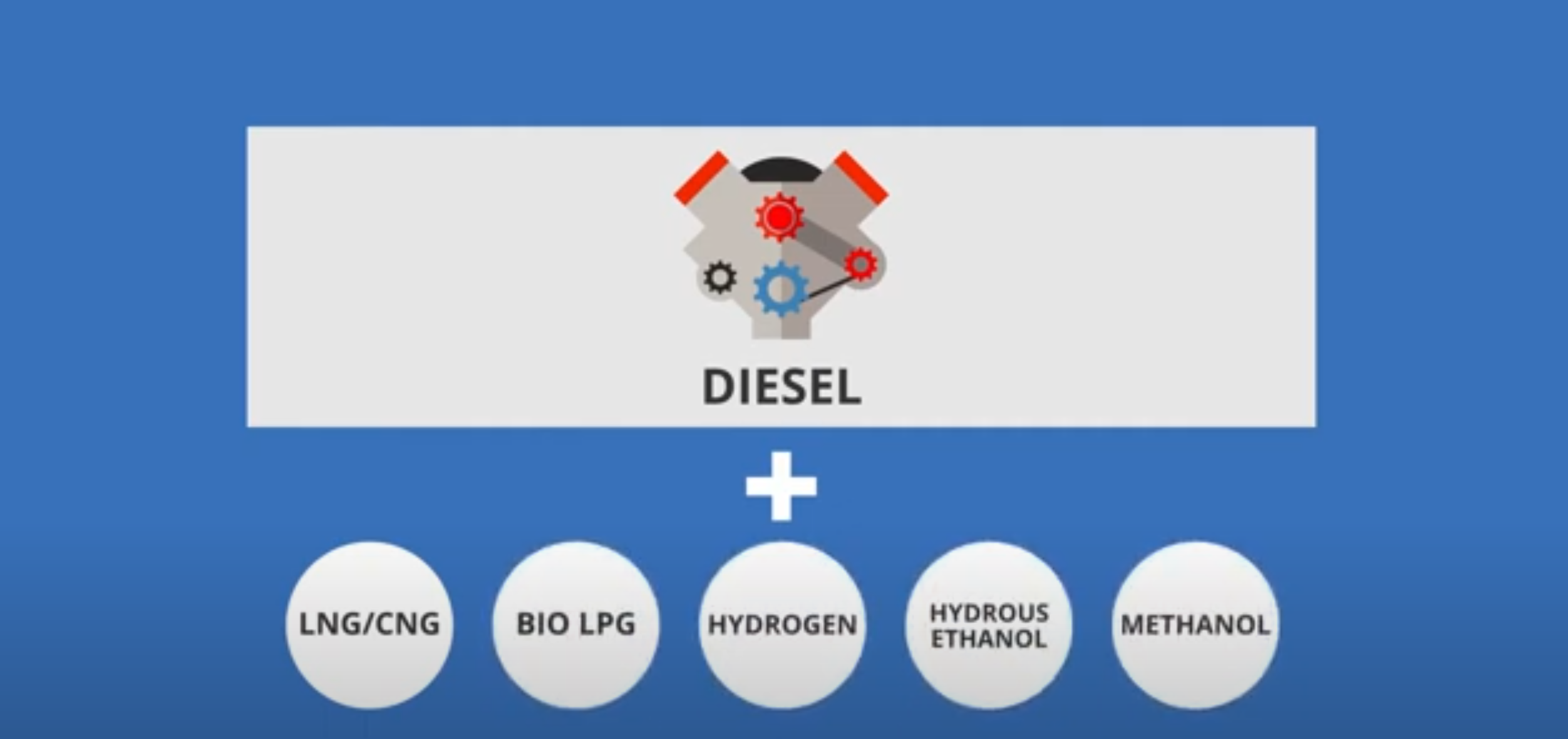
Note.
- Can the dual fuel engine use biodiesel or HVO instead of diesel?
- It looks like the Fresh Air Fuels Global process can produce biomethane, which could be liquified as LNG.
- Hydrogen is the only true zero-carbon secondary fuel.
- There is a Wikipedia entry for ethanol fuel.
- Hydrous ethanol is about 95% ethanol and 5% water and is used as a fuel in Brazil in petrol cars.
- There is a Wikipedia entry for the use of methanol as fuel.
Have G-volution got access to the technology to both reduce the fuel consumption of diesel engines and run them on zero-carbon fuel?
UK Trains That Have Cummins QSK-19 R Diesel Engines
Grand Central’s Class 180 trains have a Cummins QSK-19 R diesel engine.
All these trains have the same engine.
- 14 – Class 180 trains
- 51 – Class 185 trains
- 34 – Class 220 trains
- 44 – Class 221 trains
- 27 – Class 222 trains
In addition, Class 175 trains have a different engine made by Cummins.
Conclusion
If G-volution’s technology can be made to work successfully, it could play a large part in the decarbonisation of UK passenger trains.
Germany ‘A Laughing Stock’ After Minister’s Plane Grounded
The title of this post, is the same as that of this article in The Times.
This is the first paragraph.
Faulty wing flaps on an ageing Airbus have left officials red-faced after Germany’s foreign minister was forced to abandon the plane en route to Australasia.
Germany’s foreign minister is Annalena Baerbock, who is a Green Party politician.
A lot of the comments are asking, what was a Green Party politician doing flying all the way to Australia in a fuel-hungry four-engine Airbus A 340.
The article got me thinking.
Consider.
- Government ministers, diplomats and some business people, will always need to fly around the world for some important face-to-face meetings.
- Perhaps, this won’t happen as much as it did in the past with the development of better communications technology, but there will always be a need in some cases.
- There are over 20,000 business jets in service.
- Most business jets could be run on sustainable aviation fuel.
- Some business jets have a very long-rage.
I can see one of the manufacturers developing sustainable business aircraft to fit various segments.
Lightweight Zero-Carbon Business Aircraft
Aircraft like the Eviation Alice will dominate this field.
- The aircraft is battery-powered.
- It can carry nine passengers.
- It has a range of 440 nautical miles.
- It can operate as either a feeder airliner, business aircraft or small parcel carrier.
- It is planned to be in service in 2027.
The Alice already has a substantial order book.
There are several other aircraft in this segment under development.
Lightweight Hybrid-Electric Business Aircraft
Aircraft like the Faradair BEHA are under development.
- The aircraft is powered by a Honeywell turbo generator running on sustainable aviation fuel.
- It can carry eighteen passengers.
- It has a range of around a thousand miles.
- It is being developed at Duxford Airfield.
- The aircraft has a radical quick-change interior.
- Operational trials are planned to start in 2026.
Like the Alice the Faradair BEHA is different.
Lightweight Business Aircraft Running On Sustainable Aviation Fuel
I can see several of the smaller business aircraft being certified for sustainable aviation fuel.
Cessna sold 8,000 of their Citation jets in 2022 and have delivered around 7,500 according to Wikipedia.
Cessna won’t be giving up that market without a fight.
Certifying the aircraft to run on sustainable aviation fuel would be the interim solution until a hydrogen-powered business aircraft becomes available as it surely will.
The biggest problem will be to make enough sustainable aviation fuel.
Long-Range Business Aircraft Running On Sustainable Aviation Fuel
Long-range business jets like the Gulfstream G800 are true intercontinental transport.
- They can carry nineteen passengers and sleep ten.
- Range is 8,000 nautical miles.
- The jets are powered by Rolls-Royce Pearl 700 engines.
- This press release from Rolls-Royce is entitled Rolls-Royce Conducts First Tests Of 100% Sustainable Aviation Fuel For Use In Business Jets.
I think it is right to assume that long-range business jets like the Gulfstream G800 will be able to fly intercontinental routes on a net-zero basis.
An Airbus A321 XLR Running On Sustainable Aviation Fuel
Airbus and to a certain extent Boeing are the elephants in the room.
Airbus have launched an A321 XLR for long routes.
- The aircraft can carry over 200 passengers.
- It can fly up to 5,400 miles.
- It is selling well.
- Air Canada are thinking of using the plane on transatlantic routes.
The engines are from either CFM or Pratt & Whitney and I would be very surprised if the aircraft couldn’t run on sustainable aviation fuel.
Conclusion
I can see a new pattern of flying developing.
To return to the case of Germany’s foreign minister, I could see her going to Australia in a long-range business jet like the Gulfstream G800 running on sustainable aviation fuel.
- She might take a flight from Berlin or perhaps a more convenient airport with a rail connection.
- The plane would refuel in the Middle East and possibly Singapore.
It would be interesting to see how her green supporters reacted.
I can also see Airbus A321 XLRs running on sustainable aviation fuel across the Atlantic, being marketed as the net-zero way to the USA.
After all, Lumo market themselves as the net-zero way to Scotland against the airlines.
Ecojet: Dale Vince Launches An Aviation Revolution
The title of this post is the same as that as this news story from Ecotricity.
This is the sub-heading.
The world’s first electric airline powered by renewable energy
These three paragraphs outline the project.
Ecotricity founder, Dale Vince, has announced the launch of Ecojet, the world’s first Electric Airline, powered by renewable energy. The move marks the beginning of an aviation revolution by making net-zero, emission-free air travel possible for the first time.
Ecojet’s fleet will comprise conventional planes retrofitted with hydrogen-electric powertrains. Once converted, the aircraft will operate with the same power output as before, but with a one-hundred percent reduction in CO2 emissions.
The decision to repurpose old planes rather than build new models from scratch will save 90,000 tonnes of carbon per year. The only byproduct will be water, which can be captured and released into the lower atmosphere to avoid the harmful effects of contrails.
These ae my thoughts.
The Aircraft
The news story contains pictures of two aircraft; a de Havilland Canada Twin Otter and a 737 or A320 variant.
- It also says that hydrogen-electric powertrains will be used.
- ZeroAvia in partnership with Cranfield Aerospace are developing such a powertrain and I suspect they could have one certified by 2025.
This would be used in the Twin Otter.
But what about 737 or A320 variant?
Airbus are already proposing the ZEROe Turbofan, which appears to be based on an improved A320 neo.
But the image on the news story looks more like a Boeing 737 from the wing-tips.
This article on the IET web site, which is entitled Airbus And Boeing To Embrace Hydrogen From Mid-2030s, indicates that it will be the mid-2030s before hydrogen twinjets of this size are in service.
This paragraph from the news story indicates his philosophy about the aircraft.
Short-term, to secure routes and a license from the Civil Aviation Authority, Ecojet will initially launch using conventionally fuelled planes. Ecojet will launch with two different sizes of turboprop aircraft (a 19-seat aircraft and a 70-seat aircraft). These aircraft will be retrofitted with the hydrogen-electric powertrains as they become approved for service by the CAA – the first retrofits will take place in 2025, one year after the commencement of flights.
Note.
- The news story clearly states that two types of aircraft will be used; a 19-seat turboprop and 70-seat turboprop.
- So the second picture of a Boeing 737 had nothing to do with the news story.
- They will be retrofitted with hydrogen-electric powertrains, when they have been certified.
- Flights are planned to start next year.
It looks a very canny philosophy, as Ecojet will be able to prove the route with aircraft running on traditional fuels or sustainable aviation fuel (SAF) and only switch to hydrogen, when the hydrogen-electric powertrains are proven, certified and installed, and the hydrogen infrastructure is in place.
The Smaller Aircraft
The first picture in the news story is of a de Havilland Canada Twin Otter.
- This aircraft accommodates 19-20 passengers.
- It has two turboprop engines.
- Production started in 1966 and it is still ongoing.
- Nearly a thousand have been built, so plenty of nearly-new examples will be available for refurbishment and conversion.
- Loganair operate three aircraft in Scotland.
It looks fairly certain, that Ecojet’s 19-seat aircraft will be a Twin Otter.
The Larger Aircraft
Possibilities would include these aircraft.
- ATR-72 – 72 seats
- de Havilland Canada Dash 8 – > 50 seats
Note.
- Both aircraft are still in production.
- In ZeroAvia To Bring Zero-Emissions Flight To Sweden, I talk about how ZeroAvia have sold their hydrogen-electric powertrains to Swedish ATR-72 operator; Braathens and are targeting Dash 8 operators.
- In Universal Hydrogen Successfully Completes First Flight Of Hydrogen Regional Airliner, I talk about Universal Hydrogen’s successful progress in selling hydrogen-electric powertrains for ATR-72s and Dash 8s. The first flight of their system was in an ATR-72.
It looks to me, that Dale Vince has a choice of two 70-seat aircraft and hydrogen-electric powertrains from two manufacturers; ZeroAvia and Universal Hydrogen.
In Monte To Purchase 100 FC Aircraft Drives From ZeroAvia, I talk about how Monte Aircraft Leasing have done a deal with ZeroAvia to lease ZeroAvia’s hydrogen-electric powertrains to regional airlines.
Has Dale Vince done a deal with Monte Aircraft Leasing for his aircraft?
- Monte Aircraft Leasing and ZeroAvia would get an eco-celebrity customer, who could even be the launch customer.
- Ecojet’s aircraft would all have similar ZeroAvia hydrogen-electric powertrains, although the size might be different.
- Dale Vince would only be sharing the risk, if the technology was a dog.
- De Havilland Canada and/or ATR will see how the passengers like zero-carbon flight.
There is also, one of aviation’s most powerful companies close to the deal, as Airbus own half of ATR.
Airbus are developing the hydrogen-powered ZEROe Turboprop, which is shown in this Airbus image.
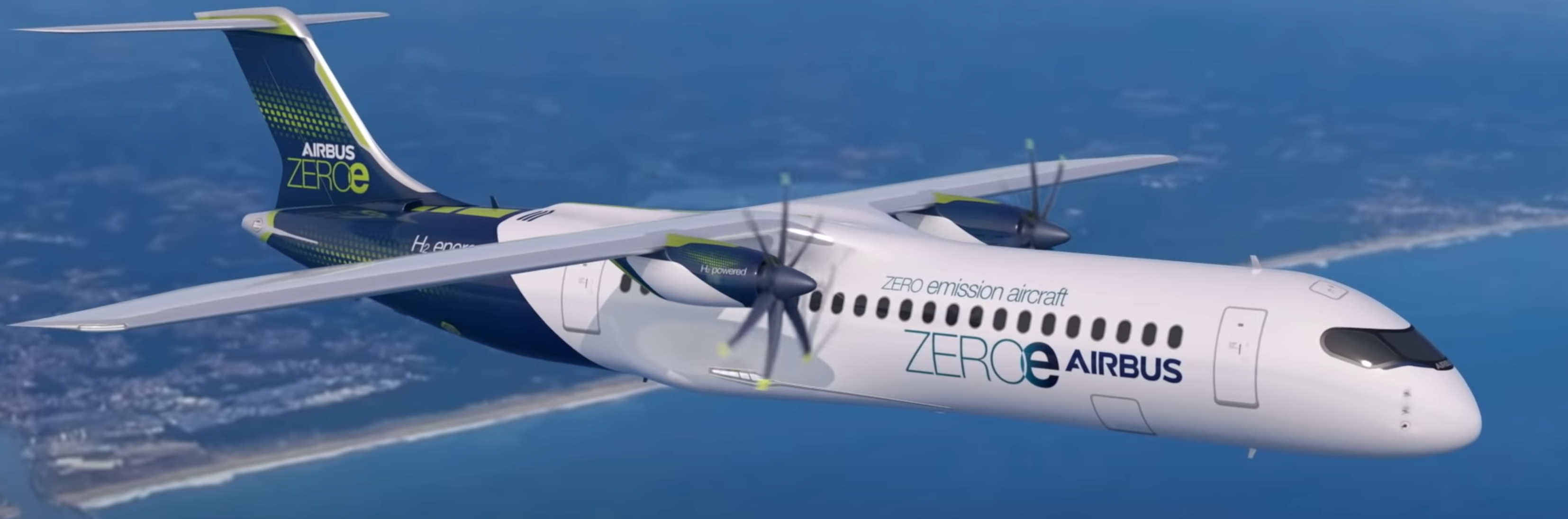
Note.
- It looks very much like an improved ATR-72.
- It has more extreme propellers and probably better aerodynamics.
- Airbus might like to persuade Ecojet to use ATR-72s as their 70-seat airliner.
- Information from an operator of hydrogen-powered airliners would be very valuable to Airbus.
I wouldn’t be surprised to see Ecojet lease some nearly new ATR-72s.
Would Airbus Fit ZeroAvia Hydrogen-Electric Powertrains In The ZEROe Turboprop?
This page on the Airbus website is entitled ZEROe.
In a section, which is entitled Hydrogen Propulsion To Power Future Aircraft, this is said.
All three ZEROe concepts are hybrid-hydrogen aircraft. They are powered by hydrogen combustion through modified gas turbine engines. Liquid hydrogen is used as fuel for combustion with oxygen.
In addition, hydrogen fuel cells create electrical power that complements the gas turbine, resulting in a highly efficient hybrid-electric propulsion system. All of these technologies are complementary, and the benefits are additive.
In 2022, we launched our ZEROe demonstrator with the aim to test hydrogen combustion technology on an A380 multimodal platform. Through future ground and flight testing, we expect to achieve a mature technology readiness level for a hydrogen-combustion propulsion system by 2025.
Note.
- Airbus state they are using modified gas turbine engines.
- Airbus also talk about using fuel cells to create electrical power that complements the gas turbines.
- Could the hydrogen fuel cells be used to power the aircraft’s systems, like avionics, control systems, air-conditioning and the hydrogen system for the main engine?
- This concept of effectively a hydrogen auxiliary power unit, might be a more efficient way of using the hydrogen, which either gives longer range or a smaller fuel tank.
- In The ZEROe Demonstrator Has Arrived, I talk about the ZEROe Demonstrator, which is a modified Airbus A 380.
Did the adding of hydrogen fuel cells to the ZEROe aircraft, lead to the concept of a hydrogen-powered auxiliary power unit, that I talked about in Airbus To Trial In-flight Auxiliary Power Entirely Generated By Hydrogen?
It looks to me, that Airbus have developed their own simple concept of powering the aircraft.
I doubt they will need ZeroAvia’s technology.
But.
- Aircraft manufacturers like Airbus generally fit the best and most suited engines they can find in their aircraft.
- The Wikipedia entry for ZeroAvia says that the prototype hydrogen-electric powertrain is in the cabin, consisting of two fuel cells and a lithium-ion battery for peak power.
- ZeroAvia have powerful shareholders like Amazon, Bill Gates and Royal Dutch Shell.
- ZeroAvia have also received grants from the UK Government.
I wouldn’t be surprised to learn, that Airbus have taken a long hard look at ZeroAvia’s technology.
After all, ZeroAvia could probably build a hydrogen fuel cell power pack, that would meet Airbus’s needs for a hydrogen-powered auxiliary power unit.
Remember too, that many fleets of aircraft have been updated with new engines for decades and I don’t think Airbus would mind ZeroAvia giving a new zero-carbon lease of life to the hundreds of ATR-72s in service around the world.
Surely, a successful hydrogen-powered ATR-72 is only going to create more interest in airlines buying ZEROe Turboprops.
All the converted aircraft will still need support from ATR.
Both the converted and new aircraft will need hydrogen refuelling services, so could the two aircraft use a common standard.
Airbus and ZeroAvia would appear to have several common interests.
Ecojet’s Core Route
This is a paragraph from the news story on the Ecotricity web site.
Dale has partnered with experienced pilot Brent Smith and a team of aviation specialists to set up Ecojet. Flights across the UK will commence in early 2024, starting with the Edinburgh to Southampton route, and expanding to mainland Europe shortly after, with long-haul flights planned for the future.
Note.
- The ATR-72 has a range of 949 miles, which is more than adequate for Southampton and Edinburgh, which is just over 350 miles.
- Diagonal journeys in the UK are often the most passenger-unfriendly by rail and tend to use diesel trains.
- Southampton Airport has good road and rail connections, with the terminal less than a minute from the station.
- Edinburgh Airport has good road and tram connections, with rail connections needing a short journey on the tram.
- Southampton Airport has flights to the Channel Islands, Ireland and Schiphol.
- Edinburgh Airport has a comprehensive service from major airlines and low-cost carriers, and several flights to destinations in the North of Scotland and on the Islands.
I think that it is a well-chosen core route for their 70-seat aircraft.
Which Routes Will Ecojet Fly With The Twin Otters?
Consider.
- My Scottish friends tell me that flying to the Scottish Islands, like the Hebrides, Orkney and Shetland is expensive.
- The growth of the Scottish wind power industry will mean, that more capacity is needed to serve the North of Scotland and the Islands.
- Tourism to the North of Scotland and the Islands is on the up.
- There will not be a shortage of green electricity to produce green hydrogen.
- The North of Scotland isn’t short of airports.
- The Twin Otter has a surprisingly long range on aviation fuel and I suspect, that a hydrogen version would be designed to have a similar range.
- The longest flight needed would probably be Edinburgh and Sumburgh, which is about 280 miles, which should be well within the range of a Twin Otter.
- I suspect that hydrogen refuelling could be easily provided at enough airports, to support hydrogen-powered airliners.
- I am sure, that the Twin Otters could be used on a network of zero-carbon flights from Edinburgh to the North of Scotland and the Islands.
- A zero-carbon airline would help Scotland’s net-zero ambitions.
There is certainly a need for another airline to connect Edinburgh to the North of Scotland and the Islands and the infrastructure could be upgraded to support a hydrogen-based zero-carbon airline.
Could Ecojet build a similar network at Southampton, that served the Channel Islands, Southern Ireland and Northern France?
Conclusion
There’s a lot more to this venture, than there appears at first sight.
O wish Vince and his partners well, but as a coeliac, I’ll skip the food.
Would A Dual-Fuel Boeing 747 Or Airbus A380 Save Carbon?
This press release from Airbus is entitled The ZEROe Demonstrator Has Arrived.
This is the introductory paragraph.
2022 marks a new and exciting phase for ZEROe – Airbus’ ambition to develop the world’s first zero-emission commercial aircraft by 2035. The multi-year demonstrator programme has officially been launched with the objective to test a variety of hydrogen technologies both on the ground and in the air.
The ZEROe demonstrator will be the first Airbus A 380 aircraft and it is shown in this Airbus visualisation.
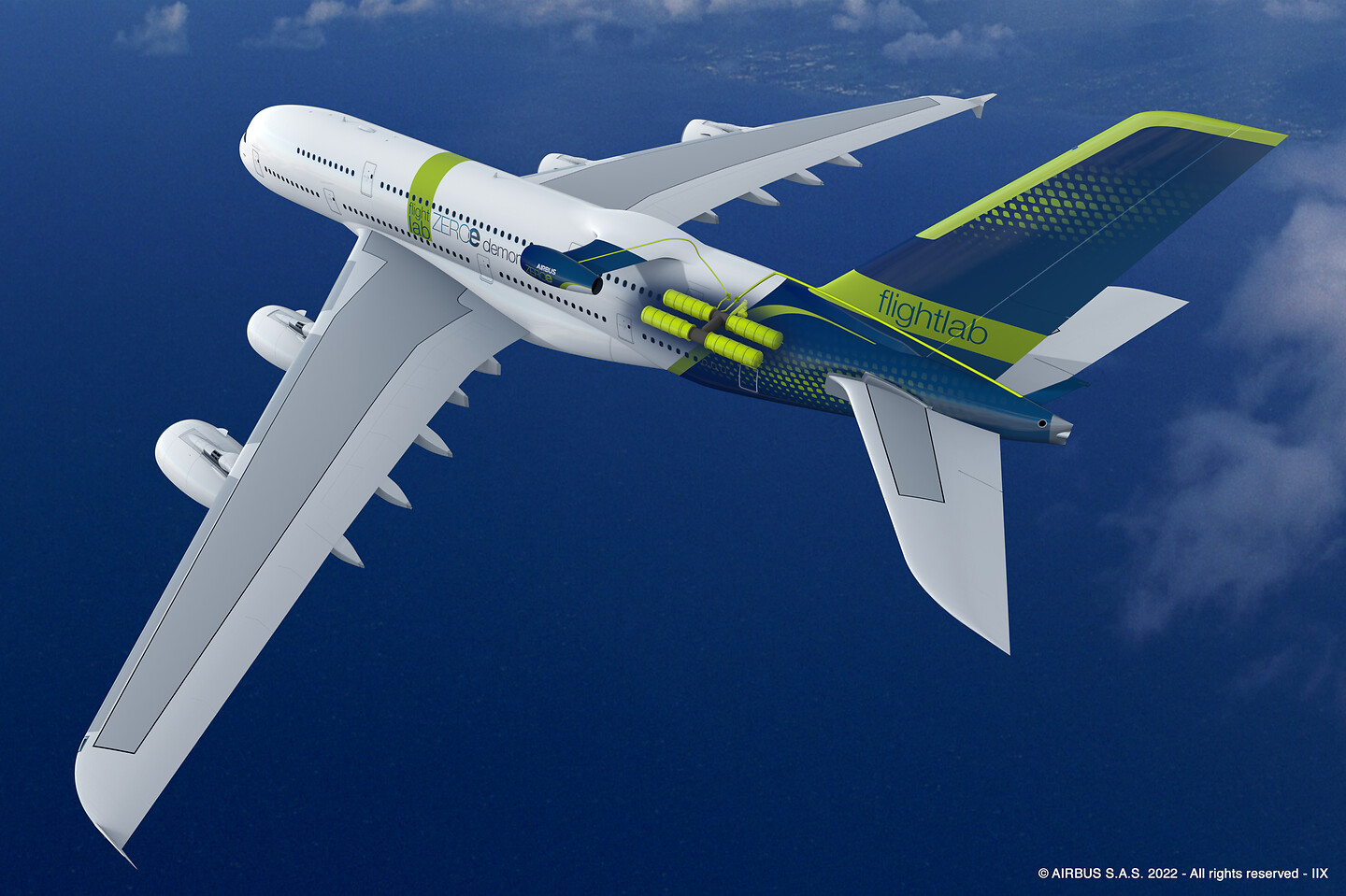
Note.
- The four hydrogen tanks in the fuselage.
- The fifth engine mounted in a pod on the fuselage.
- There’s certainly lots of space inside the fuselage for more hydrogen tanks and test and monitoring equipment.
Take away the fifth engine and the test equipment and this aircraft becomes an A380 with two fuel systems; hydrogen and aviation fuel.
Consider.
- Suppose two engines were hydrogen-capable and two were normal engines running on aviation fuel or Sustainable Aviation Fuel (SAF).
- I don’t think it is impossible to build engines that could run on both hydrogen and Sustainable Aviation Fuel.
- All aircraft use fuel at a higher rate, during take-off and climbing.
- Do long non-stop flights use less fuel, than ones with stops?
- As altitude increases, air resistance decreases.
- Aircraft could fly slower to reduce the fuel needed, as they did in the oil crises in the last century.
- Generally, the most economical way to fly a route, is to climb to maximum altitude, fly level until descending into the destination.
- The aircraft would not carry cargo in the belly-hold.
- There could be a hydrogen-powered APU, as I wrote about in Airbus To Trial In-flight Auxiliary Power Entirely Generated By Hydrogen.
- This document from IATA says that in its liquid form, contains about 2.5 times more energy per kilogram than kerosene.
- The Boeing 747 first flew in 1969 and the Airbus A 380 in 2005, so these aircraft are well known.
I just wonder, if it is possible to work out a flight profile, that would enable these aircraft to fly very long non-stop routes?
- All four engines would be used for take-off.
- An appropriate power setting would be used for the cruise and the descent.
- There would be large numbers of 747s and A 380s in good condition to convert.
- The plane would land with little or no hydrogen left.
The hydrogen used would cut the carbon footprint of the flight.
New Rolls-Royce Small Engine Set To Begin Tests To Advance Hybrid-Electric Flight
The title of this post, is the same as that of this press release from Rolls-Royce.
These are the first two paragraphs.
Rolls-Royce today announces its new small gas turbine that has been specifically developed to power hybrid-electric flight is set to begin testing. The engine is part of a turbogenerator system that is being developed for the Advanced Air Mobility market. This includes electrical vertical take-off and landing (eVTOL) Aircraft for Urban Air Mobility and Commuter Aircraft applications up to 19 seats.
The turbogenerator system will complement the Rolls-Royce Electrical propulsion portfolio by delivering an on-board power source with scalable power offerings between 500kW and 1200kW enabling extended range on sustainable aviation fuels (SAF) and later, as it becomes available, through hydrogen combustion. This will open up new, longer routes than electric battery powered aircraft can support as of today.
The press release also lays out these design targets.
- Power – 600-1200 kW
- Voltage – 850 Volts
- Power to Weight Ratio – 4 kW/Kg
- Noise – 62 dbA
- Specific Fuel Consumption v in-service products – 15% better
- MTBO – 10,000 cycles
- Length – 1,500 mm.
- Diameter – < 500 mm.
Note.
- At first look, it appears to be small and powerful.
- If they can meet the Power to Weight Ratio of 4 kW/Kg, this would mean that a 1200 kW engine will weigh just 300 Kg.
- The engine has been designed to run on sustainable aviation fuel and hydrogen.
I wouldn’t be surprised to see this engine used in non-aviation applications.
EU Co-Legislators Agree On SAF Blend Targets For Aviation
The title of this post, is the same as that of this article on Renewables Now.
These are the first two paragraphs.
The European Council and the Parliament on Tuesday reached a provisional political agreement on the ReFuelEU Aviation proposal, which will set new rules requiring fuel suppliers to blend sustainable aviation fuels (SAF) with kerosene in increasing amounts from 2025.
The European Commission, which made the proposal, welcomed this outcome on Wednesday and noted that the measure is expected to reduce aircraft carbon dioxide (CO2) emissions by about two-thirds by 2050 versus a “no action” scenario. The ReFuelEU Aviation initiative is part of the “Fit for 55” package.
Measures include.
- Aviation fuel companies to make sure that at least 2% of the fuel they supply at EU airports in 2025 is SAF.
- This share is supposed to gradually increase and reach 70% in 2050.
- A minimum share of synthetic fuels will be required from 2030.
- Aircraft operators departing from EU airports will be required to carry only the volume of fuel they need for a particular flight in order to avoid further emissions associated with extra weight or carbon leakage caused by tankering practices.
- Airports to ensure that their fuelling infrastructure is fit for SAF distribution.
Note.
- I can see some airlines complaining about some of these measures.
- I can also see the fourth measure about tankering having negative effects on airline costs and ticket prices.
Michael O’Leary’s comments will be interesting.
BP Launches Plans For Low-Carbon Green Hydrogen Cluster In Spain’s Valencia Region
The title of this post is the same as that of this press release from BP.
These are the four bullet points.
- Aims to make Valencia region a leader in green hydrogen production
- Cluster to include world-scale green hydrogen production at bp’s Castellón refinery of up to 2GW of electrolysis capacity by 2030
- Supports transformation and decarbonization of the refinery, together with tripling biofuel production
- Transformation of Castellón could see bp invest up to €2 billion
This is the first paragraph.
bp today launched the green hydrogen cluster of the Valencia region (HyVal) at its Castellón refinery. Led by bp, this public-private collaborative initiative is intended to be based around the phased development of up to 2GW of electrolysis capacity by 2030 for producing green hydrogen at bp’s refinery.
It certainly is a big hydrogen-friendly project and is a roadmap of how to decarbonise an oil refinery.
This massive commitment to hydrogen makes me more certain, that bp’s offshore 50 MW wind farm twenty miles from Aberdeen, is designed to produce hydrogen for the granite city.
Are bp putting together a strategy to bring hydrogen to the world?
After all hydrogen is the only zero-carbon fuel, that can directly replace fuels like natural gas, diesel and many hydrocarbon fuels in a large number of applications.
BAE To Produce Batteries For Electric Passenger Plane
The title of this post, is the same as that of this article on The Times.
This is the first paragraph.
BAE Systems is stepping back into the world of passenger aircraft manufacturing by partnering with a Swedish electric planemaker.
I must admit, that I’m not surprised about BAE Systems’s decision.
Aviation needs batteries for many purposes including drones, starting aircraft and auxiliary power sources, so I wouldn’t be surprised that BAE Systems know their batteries.
In The Big Beast In Your Electric Bus, I described the company’s involvement in providing batteries for electric buses in the United States.
As a former private pilot, I’m watching electric aviation with interest.
I am also an applied mathematician and control engineer and feel that electric aviation will always be playing catch up against planes powered by hydrogen and sustainable aviation fuel.
Look at some of Airbus’s ZeroE designs, which use hydrogen fuel.
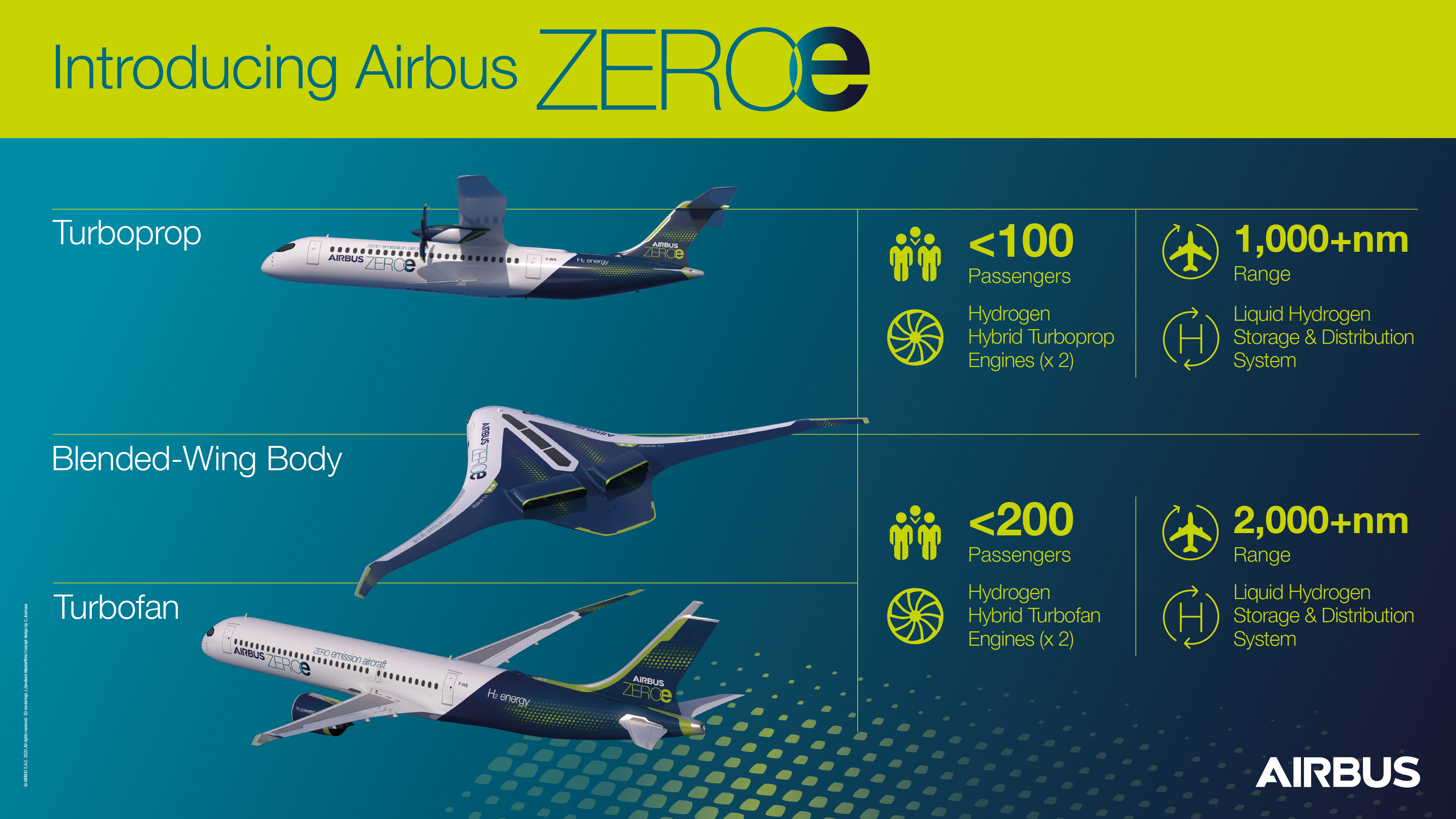
Discover the three zero-emission concept aircraft known as ZEROe in this infographic. These turbofan, turboprop, and blended-wing-body configurations are all hydrogen hybrid aircraft.
Although saying that there are large numbers of orders for electric airliners like this Swedish design and the Eviation Alice.
DHL Express Determinedly On Course To Achieve Net-Zero Emissions
The title if this post is the same as that of this article on The Lodestar.
This was the introductory paragraph.
DHL Express chief executive John Pearson came out with all guns firing when detailing the firm’s efforts to hit net-zero by 2050, during a press junket this week.
The rest of the article is basically in three sections.
The Use Of Sustainable Aviation Fuel (SAF)
Summed up by three sentences.
“When it comes to sustainable aviation fuel (SAF), we know this is expensive, but we have also put a big chunk of change into this,” he said.
By the end of the year, we want 2% of flights fuelled by SAF.
DHL has bought 15% of all globally available SAF
DHL seem to have a comprehensive policy on the use of SAF.
This reinforces my view that SAF will be important.
Alternative Approaches
This paragraph sums up some of the more alternative approaches DHL are looking at.
SAF use forms only one part of the migration to net-zero: fleet renewal; decarbonising ground handling; a fuel optimisation programme; and the use of electric aircraft, following the successful September trial over Seattle of the Alice e-cargo plane, are all critical.
I suspect there are other alternative approaches.
Fleet Renewal
The last two paragraphs talk about fleet renewal.
Fleet renewal comes after a particularly pronounced moment of growth for the company: it added 10 widebody and 70 small- and medium-body planes during the pandemic.
Described by Boeing as one of the most “fuel-efficient” aircraft on the market, thanks to its twin-engine design, the 777 freighter forms a central part of DHL Express’ renewal plans, said Mr Pearson, adding that 28 were on order.
With 28 777 freighters on order, DHL will need a lot of SAF.
A Last Thought
Given the size of DHL’s fleet, which in their Wikipedia entry is given as 197, seventy-three of which are narrow bodies, I am surprised that no dedicated zero-carbon small or medium-sized cargo aircraft, except for the Alice is under development.
Perhaps, in areas like Europe, this niche is being taken by rail or perhaps by Airbus’s proposed hydrogen-powered ZEROe Turbofan.
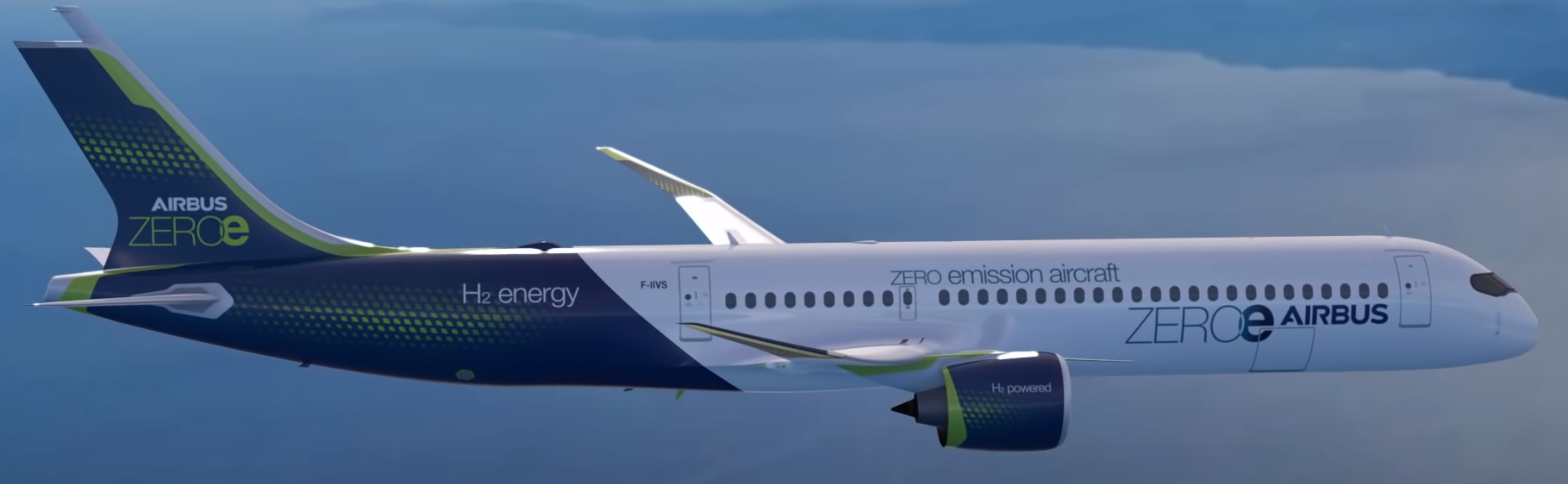
I wrote in detail about this hydrogen-powered aircraft in Could An A320 neo Be Rebuilt As A ZEROe Turbofan?.
Airbus say that the passenger version of the ZEROe Turbofan could handle up to 200 passengers, despite having a large hydrogen tank in the rear fuselage.
The cargo capacity of a ZEROe Turbofan would probably be a bit smaller than say the latest Airbus A321 or Boeing 737, but if the hydrogen-powered aircraft was built to accept a stretch, I wouldn’t be surprised to find it was a viable aircraft for DHL, with a fuselage stretch!
It would surely help passengers of future hydrogen-powered aircraft, overcome their fear of an aircraft fueled by hydrogen.
The ZEROe Turbofan is quoted as having a range in excess of two thousand nautical miles, so it would have Europe and North America fairly well covered.
I also wouldn’t rule out use of Airbus’s proposed hydrogen-powered ZEROe Turboprop for flying cargo.
It would have a smaller capacity than the ZEROe Turbofan.
- It would have a useful range of over a thousand nautical miles.
- I feel that both ZEROe aircraft have the same fuselage cross-section, which could ease cargo handling, by using the same equipment for both aircraft.
- I also feel that both ZEROe aircraft will have the same cockpit, which should reduce crew costs.
I feel that smaller cargo aircraft will play a large part in the development of hydrogen-powered aircraft.
If the plans of some companies and individuals work out, hydrogen might be a better alternative financially to SAF.
Swedish Battery-Electric Aircraft Selected By A Major Airline
The title of this post, is the same as that of this article on autoevolution.
This is the sub-heading.
You know that saying, “New year, new me”? In the case of this major airline, it’s more like “New decade, new me.” Air New Zealand wants to flaunt a brand-new regional fleet starting 2030. And it looks like that will include an all-electric model developed by the Sweden-based Heart Aerospace.
The article then gives a description of their plan called Mission Next Gen Aircraft to go zero-carbon on their short haul routes.
This paragraph describes the aircraft that will be used.
ATR will bring its upgraded aircraft concept, called the ATR EVO, designed to be 100% compatible with SAF (sustainable aviation fuel). Embraer will showcase the innovations of an entire new family of aircraft named Energia, based on various types of clean propulsion. Universal Hydrogen will retrofit the existing regional airliners with its efficient hydrogen solution. Last but not least, Heart Aerospace will focus on the niche segment of battery-electric aircraft.
It will be fascinating to see how all this works out.
We’re still waiting in the UK for an airline to announce the purchase of a zero-carbon aircraft.
Especially, as we have some routes, like those around Scottish islands, where there are many short routes, that have less than a dozen passengers on a flight.
 The Anonymous Widower