Sweden’s Grand Plan To Make Zero-Carbon Steel
The title of this post is the same as that of this article on theTelegraph.
It adds a lot of colour and background to Sweden’s plan to make zero-carbon stell using a process called HYBRIT, that I wrote about in Funding Award to Supply An 8MW Electrolyser and is illustrated in this infographic.
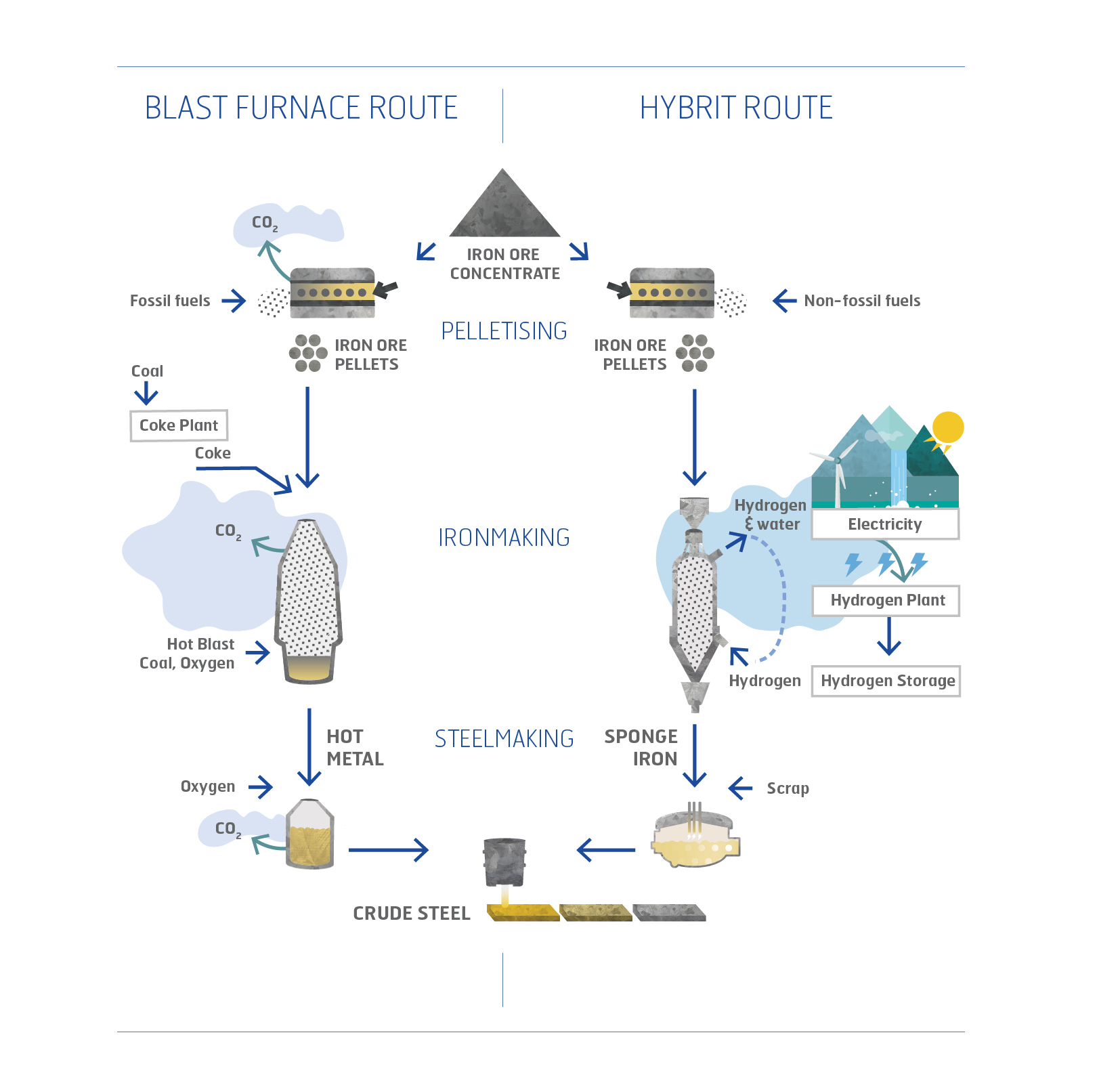
The amount of hydrogen needed is large as this paragraph from the Telegraph article says.
HYBRIT’s demonstration plant, for which an investment decision is due in 2022, will require 400MW of power just for the electrolysers to make the hydrogen. Sweden’s largest existing wind farm, Björkhöjden, produces just 288MW. Then to store the hydrogen, Vattenfall plans to build 120,000 m3 of lined underground storage, enough to store 100GWh worth of the gas.
Will they procure the electrolysers from the UK’s experts in the field; iTM Power? This innovative company is building the world’s largest electrolyser factory in Rotherham, which will be able to produce a GW of electrolysers in a year.
Conclusion
This well-written article in the Telegraph explains a lot about steel produced using hydrogen instead of coal.
Sweden has a lot of advantages at Lulea to create steel.
- The iron ore is mined locally.
- Sweden has ninety percent of Europe’s iron ore.
- Ships can sail to Lulea, which is at the top of the Baltic.
- There is gigawatts of zero-carbon electricity from the River Lule.
- They can build wind farms in the area, which has a low population.
It does look that they might export the iron ore as sponge iron, which can then be processed directly into steel products using electric arc furnaces.
Green Light For Fossil-Free Steel In Oxelösund
The title of this post, is the same as that of this article on Market Screener.
These are the first two paragraphs.
Green light for fossil-free steel in Oxelösund The Land and Environment Court has decided to grant SSAB Oxelösund an environmental permit to convert its steelmaking operations and reduce carbon dioxide activities by 2025. This also means that we will take a step nearer towards fossil-free steel production across SSAB in 2045.
This is an historic decision in many ways. It is the first time that Oxelösund has applied for changes in production to reduce carbon dioxide emissions. Use of sponge iron made through HYBRIT technology, together with scrap iron as feedstock instead of iron ore and coal, will enable SSAB to reduce emissions in Oxelösund by around 80%.
Hydrogen steelmaking processes are surely the future of steelmaking, as they can be made zero-carbon.
It will need a lot of hydrogen and I can see processes like Shell’s Blue Hydrogen Process being ideal to produce the hydrogen.
But will China and the other countries that produce cheap steel, turn to hydrogen steel-making?
Nickel Metal Hydride Battery Storage Company Receives €47m Investment From European Investment Bank
The title of this post, is the same as that of this article on Energy Storage News.
This is the introductory paragraph.
Nilar, a Sweden-headquartered producer of nickel metal hydride chemistry batteries aimed to compete with lithium-ion and lead acid, will receive €47 million (US$55.45 million) in funding from the European Investment Bank (EIB).
There certainly seem to be several promising new technologies being developed for energy storage.
Vivarail Targets Overseas Markets
The title of this post, is the same as that of this article on Rail Magazine.
This is an extract from the article.
Shooter told RAIL: “We are at the moment putting together a bid for an operator – not in this country – where the routes would be up to 500 miles long, to be provided totally with battery trains using this device.
“This bid we are putting together contemplates trains that are running for several hours – 60 to 70 miles between charging stations, but possibly going twice that far in emergency if the charging station should go down.”
By this device I suspect they mean their Fast Charge device, which is described in this press release from Vivarail.
This extract describes how it works.
The concept is simple – at the terminus 4 short sections of 3rd and 4th rail are installed and connected to the electronic control unit and the battery bank. Whilst the train is in service the battery bank trickle charges itself from the national grid – the benefit of this is that there is a continuous low-level draw such as an EMU would use rather than a one-off huge demand for power.
The train pulls into the station as normal and the shoegear connects with the sections of charging rail. The driver need do nothing other than stop in the correct place as per normal and the rail is not live until the train is in place.
That’s it!
That sounds simple to me.
Where Would This Possible Order Be From?
I have ridden in a Vivarail battery train, as I wrote in Battery Class 230 Train Demonstration At Bo’ness And Kinneil Railway.
I have also ridden the diesel variant, as I wrote in A First Ride In A Revenue-Earning Class 230 Train.
I very much feel, I can list a few of the good qualities of the trains.
Big Windows
The big windows give a good view, so I wonder if the trains would work well on a railway noted for its scenery.
Quietness
I have ridden in two battery trains.
The other was Bombardier’s Class 379 BEMU, that I wrote about in Is The Battery Electric Multiple Unit (BEMU) A Big Innovation In Train Design?.
Both were extremely quiet.
No Infrastructure Required
Except for the charging stations, no infrastructure is required.
Sturdy Engineering
Although the trains were only originally built for the London Underground, they are sturdily-built trains, as they used to share tracks with full-size trains.
I suspect, they are certified to share tracks with freight trains, as they do on the Marston Vale Line.
A Range Of Interiors And Customer Facilities
Although the trains tend to use the old London Underground seat frames, they have a range of interiors, which seem to be well-designed and comfortable.
I have been on Class 230 trains, with tables, a single toilet, onboard Wi-Fi, and electrical charging points.
Zero-Carbon
The trains are probably as near to zero-carbon, as any! Especially, if all the Fast Charge stations are powered by renewable electricity.
Remote Servicing
The trains have been designed for remote servicing.
Conclusion
All of these qualities lead me to think, that an ideal line in the UK could be the Far North Line, between Inverness and Wick and Thurso.
Although the train ticks a lot of boxes, it could well be too slow, It is also only a 160 mile route and not five-hundred
But there must be quite a few long, scenic lines in countries, where a passenger service needs to be added to a freight line, that perhaps serves a remote mining town.
Sweden and Norway are surely possibilities, but Finland is ruled out because it is Russian gauge.
Could the trains end up in parts of Africa, Canada and the United States?
Who knows?
Financing Secured To ‘Enable Rapid Development’ Of Norway’s First Lithium Battery Cell Gigafactory
The title of this post, is the same as that of this article on Energy Storage News.
The article says that the gigafactory’s biggest competitor will be in Sweden.
With companies in the UK, like Hyperdrive Innovation, Gore Street Energy Fund and others developing massive demand for batteries, perhaps we should build our own gigafactory?
This article on Energy Storage News is entitled More Money For Lithium Exploration In Cornwall.
This is the introductory paragraph.
Cornish Lithium has successfully raised over £826,000 from shareholders to continue exploration for lithium in Cornwall, in both geothermal waters and in hard rock, and will build on the successful drilling programmes that concluded earlier this year.
I wrote about Cornish Lithium in How To Go Mining In A Museum.
Could an unusual tale becoming to a successful conclusion?
Conclusion
I think we can trust the Cornish, Norwegians and Swedes to ensure, we have enough lithium-ion batteries.
Success For Ovako In Green Steel Hydrogen Trial
The title of this post, is the same as that of this article in The Engineer.
Steel usually has to be heated to a high temperature before it can be rolled.
Normally, LPG is used, but Swedish steel company; Ovako, have conducted a full-scale trial using hydrogen, which seems to have proved it doesn’t result in lower quality.
Will COVID-19 Create A Boom In Sleeper Train Services?
I have regularly used the Caledonian Sleeper to go to Scotland, as it gets you there at an early hour in the morning and if you book the train, at the right time, the cost of a single First Class cabin can be about the same cost as a day First Class ticket and a night in a Premier Inn.
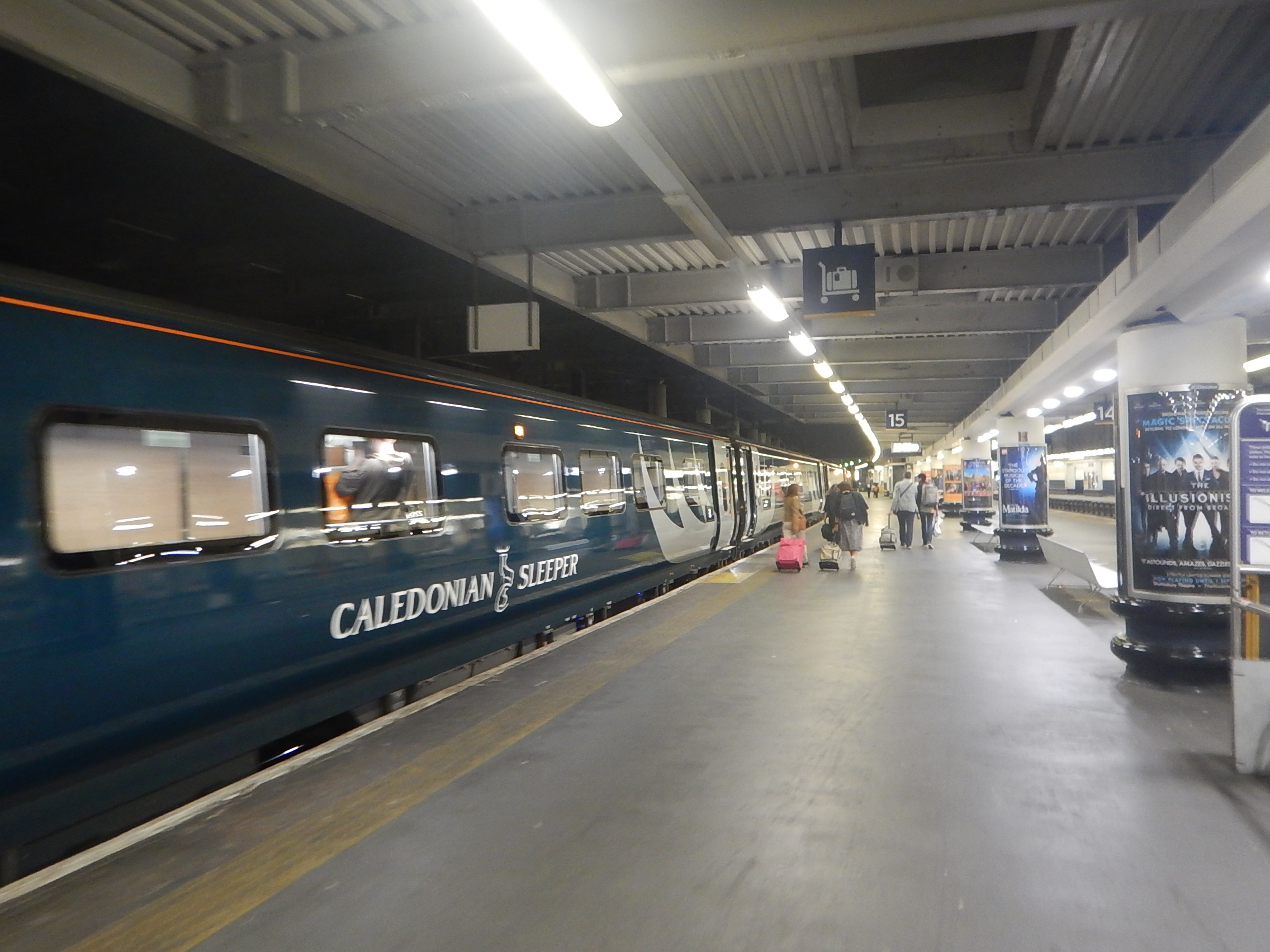
Look at this picture, that taken a few months ago, as I was leaving Euston on a Caledonian Sleeper to Edinburgh. It would be very easy to board the train without breaking the two-metre rule.
I believe sleeper trains will see an increase in passengers.
We may also see in increase in services. These posts detail various planned or possible services.
- Caledonian Sleeper Considers Seven-Day Running
- Rail Sleeper Plan Between Caithness And Edinburgh
- Lying Not Flying, As Nightjet Sleeper Train Reaches Brussels
- SJ Invests In Thriving Sleeper Trains
- Austrian Railways To Run More Sleeper Trains
Note that the Caledonian Sleeper, the Swedes and the Austrians are investing in new rolling stock, so that won’t be a problem.
But perhaps the most interesting story, is described in Nightjet Plans Mini-Capsules For Private Travellers.
I can see a series of sleeper trains criss-crossing Europe, where everybody has their own mini-capsule. Perhaps, it will be called Ryantrain or easyTrain.
Coronavirus Lockdown In Sweden: a New Take On Safe Shopping — No Assistants
The title of this post is the same as that of this article on The Sunday Times.
It could be the way, that convenience stores will be going! Even my local Marks and Spencer in Dalston, allows you to scan using an app, put the goods in your bag and just walk out!
I must try it, as it would mean that I would have to touch less equipment and won’t have to stand there like a wally, whilst the assistant verifies my age, after I have purchased low alcohol beer.
There could also be little robots like Daleks or R2-D2 wandering around, who you could ask questions, like “Where is the Adnams 0.5% low-alcohol beer?”. They would reply “Follow me!” and lead you to your next purchase.
SJ Invests In Thriving Sleeper Trains
The title of this post is the same as that on this article on Global Rail News.
This is said.
Over the last five years, passenger numbers on its Malmö to Stockholm services have increased by 100 per cent.
There has also been growth on the Gothenburg-Stockholm-Umeå-Luleå-Kiruna-Narvi route, where passenger numbers have risen by 25 per cent.
That sounds like thriving to me!
So why is it that sleeper trains are thriving in the UK and Sweden, but countries like Germany have given up?
Malmö to Stockholm
These factors probably help this service
- Malmö is Sweden’s third-largest city.
- The frequent trains between Malmö and Stockholm take four and a half hours.
- Stockholm and Malmö are a very similar distance apart as London and Glasgow or Edinburgh.
- Malmö is only thirty-five minutes from Copenhagen by train.
As the Caledonian Sleeper works between London and Edinburgh/Glasgow, why shouldn’t a quality service work on a similar distance in Sweden?
Gothenburg-Stockholm-Umeå-Luleå-Kiruna-Narvi
These factors probably help this service
- The service effectively goes from the South-West of Sweden right up to the North.
- The distance as 1,600 kilometres
- I have been recommended to take this train to go to see the Northern Lights. So perhaps, it is useful for tourists.
- The service probably appeals to train enthusiasts.
- It is probably a reasonably civilised way to go to the North of Sweden.
I would certainly use it in winter to get to see the Northern Lights at Abrisko.
Stadler To Build Another Special
Stadlet seem to be getting a reputation for building trains for niche markets.
This article on Global Rail News is entitled Stadler to build narrow-gauge EMUs for Stockholm’s Roslagsbanan.
Wikipedia has an entry for the Roslagsbanan.
After trains for the Glasgow Subway and Merseyrail, the Class 88 locomotives and Class 399 tram-trains, they must be one of the companies in prime position for the new Docklands Light Railway trains.

