Transport Enterprise Leasing To Integrate Cummins X15H Hydrogen Engine Into Heavy Duty Trucks
The title of this post, is the same as that of this article on Fleet Equipment.
This is the first paragraph.
Transport Enterprise Leasing and Cummins Inc. announced recently that TEL has signed a letter of intent planning to purchase Cummins’ 15-liter hydrogen internal combustion engines when available. TEL will integrate the Cummins’ X15H hydrogen engines into their fleet of heavy-duty trucks.
This second paragraph is very significant.
Hydrogen engines can use zero-carbon green hydrogen fuel, produced by Cummins-manufactured electrolyzers. The projected investment in renewable hydrogen production globally will provide a growing opportunity for the deployment of hydrogen-powered fleets utilizing either Cummins fuel cell or engine power.
Cummins would appear to be aiming to be a one-stop shop to decarbonise your fleet of heavy trucks or anything that is powered by a Cummins diesel engine.
I did a small amount of work for Cummins about twenty years ago and one of the companies objectives was to be able to provide a diesel engine to fit anybody’s application.
So if someone wanted a diesel engine with a particular power, that fitted in an unusually-shaped or confined space, they would rearrange the layout of the engine to make it fit.
I suspect that London’s New Routemaster buses have a special version of Cummins B Series engine, designed for its unusual location halfway up the back stairs.
Will Cummins produce a hydrogen internal combustion engine for the New Routemaster?
- The buses could become zero-carbon, at less cost than new buses.
- Passengers would notice no difference in ride comfort and experience.
- Drivers would just need to use the hydrogen systems.
- Maintenance staff would only need to be trained n handling the hydrogen system, as much of the buses would be unchanged.
- Cummins could sell an electrolyser to each garage.
- London would get some good publicity for tourism.
London’s iconic bus would look the same.
Hydrogen Tourist Transport Network Trialled In The Peak District
The title of this post, is the same as that of this article on Fleet News.
This paragraph outlines the trial.
A trial is taking place in the Peak District National Park where hydrogen fuel cell electric vehicles (FCEVs) and electric vehicles (EVs) will run together between multiple destinations and attractions.
Note.
- Toyota will provide the buses.
- Air Products is providing hydrogen.
- The services appear to be centred on Chesterfield station.
It looks like one of the objectives is to test the two types of buses against the terrain.
I can see hydrogen-powered buses being used extensively in tourist areas all over the world.
It’s A Tough Job, But Someone’s Got To Do It!
For a couple of stops today, on the Elizabeth Line, I shared my section of the carriage, with a party of four Japanese tourists, who I took to be mother, father and son, with an older man, who was probably one of the boy’s grandfathers. The father had his camera out and was photographing his family and the train. As I passed him to leave the train, he said “Good train!” He also pointed to himself and said. “Japanese railway engineer!”
I wonder how many other professional railway engineers will visit London and run their eyes over the Elizabeth Line?
Is The Okehampton Effect Starting?
This article on the Tavistock Times Gazette is entitled Hop Aboard The 118 For Town And Village Connection To Rail.
These are the first three paragraphs.
County council chiefs have confirmed they have launched a new bus service to link residents in Tavistock to Okehampton’s restored railway line.
From Saturday, Service 118 will link Tavistock to Okehampton, via Mary Tavy and Lydford, to provide an integrated connection to the rail services between Okehampton and Exeter during the day. The service is part of a bigger project to improve public transport in Devon.
The move comes as Devon County Council pushes ahead with plans to get trains rolling again in Tavistock — but in the opposite direction.
Note.
- Tavistock has almost twice the population of Okehampton.
- Okehampton and Tavistock are about sixteen miles apart.
- Buses will take about forty minutes.
- The railway from Tavistock could eventually go to Plymouth via the existing Bere Alston station and the Tamar Valley Line.
This bus route will complete a circular route between Exeter and Plymouth around Dartmoor.
Devon does seem to be getting itself ready for the next phase of rail development in the county.
But does Devon as the birthplace of those great mariners, Chichester, Drake, Gilbert, Grenville and Raleigh, follow in their footsteps and plan things well and get it done?
My maternal grandmother was born in Dalston of two Devonian parents.
Just before the Second World War my mother asked her if she was prepared for the inevitable war.
My grandmother’s reply was as follows.
I got caught out in the First War, so I’ve got a hundredweight of sugar and a hundredweight of jam in the cellar.
Was that her Devonian genes shining through?
Devon is certainly planning for the future at Okehampton.
- There are plans for an Okehampton Parkway station, where the railway crosses the A30, which I wrote about in Work Begins On Okehampton Parkway Station.
- There is this new bus route.
- Will there be more housing in Okehampton?
- There will be developments linked to tourism.
I believe the Okehampton Effect is starting.
Lumo – A View From Across The Pond
I have just read this guide to Lumo on a United States web site called NewsNation USA, which is entitled Lumo Trains: Cheaper London To Edinburgh Fares – What You Need To Know. The article is positive about the new train service.
It only misses out one important detail. Lumo have said, they will have a long booking window, which will surely appeal to travellers on the route from overseas, who are coming to the UK for a holiday and want to visit both cities.
Battery Trains Ordered For Hermann-Hesse-Bahn
The title of this post, is the same as that, of this article on Railway Gazette.
This article is yet another endorsement of battery-electric trains.
There is more about the history of the Hermann-Hesse-Bahn in Wikipedia entry for the Black Forest Railway.
Could the Germans be using a battery-electric railway to bring in the tourists?
Hydrogen Trains Planned For Apennine Route
The title of this post, is the same as that of this article on Railway Gazette.
The trains appear to be part of a project to bring a sustainable economic recovery to an area that has been affected by three earthquakes in recent years and suffered badly from depopulation.
There would appear to be four projects.
Refurbishment Of The Sansepolcro And Sulmona Railway
This 300 km railway will also switch from diesel to hydrogen trains.
- Sansepolcros is a town in the Eastern part of Tuscany, to the South-East of Florence.
- Sulmona is a city that is roughly East of Rome.
- The Northern section of the route is covered in Wikipedia by the entry for the Terni – Perugia – Sansepolcro Railway.
- The Southern section of the route is covered in Wikipedia by the entry for the Terni and Sulmona Ralway.
- There are connections to Rome at Terni and Sulmona.
This railway looks like it could be an interesting route for a railway tourist. In my past experience, Todi and Perugia were certainly worth a visit.
Two Seas Railway
The Railway Gazette article says this about the Two Seas Railway.
This would cross Italy from west to east, connecting Roma’s Fiumicino airport with San Benedetto del Tronto via Rieti, Amatrice and Ascoli Picen.
It has been proposed for a long time and could use hydrogen traction.
Building Back Sustainably
The Railway Gazette article says this about the third and fourth projects.
A third project will assess the potential for diffused green hydrogen manufacturing activity in the region, and a fourth will look at ways to apply new energy and environmental technologies in post-earthquake reconstruction.
It looks to me, that hydrogen will play a large part in restoring this region of Italy.
Conclusion
It sounds a bit like, the Italians are rebuilding their railways like the UK and several other countries are doing.
Northern line Extension’s Opening Date Announced
The title of this post, is the same as that of this article on Ian Visits.
Services will start on Monday, September 20th.
This sentence from Ian describes the service levels.
There will be an initial peak time service of six trains per hour on the extension, increasing to 12 trains per hour by mid-2022. There will be five trains per hour during off-peak times, doubling to 10 trains per hour next year.
I shall certainly try it when it opens, but I doubt I’ll be a regular user, as the Charing Cross Branch of the Northern Line can be difficult to access from Dalston. My best way is probably to use a 73 bus to Goodge Street station.
How Do I Use The Northern Line to Go Between The new Battersea Power Station Station and Bank or Moorgate Stations?
This map from cartometro.com shows, the track layout of the extension.
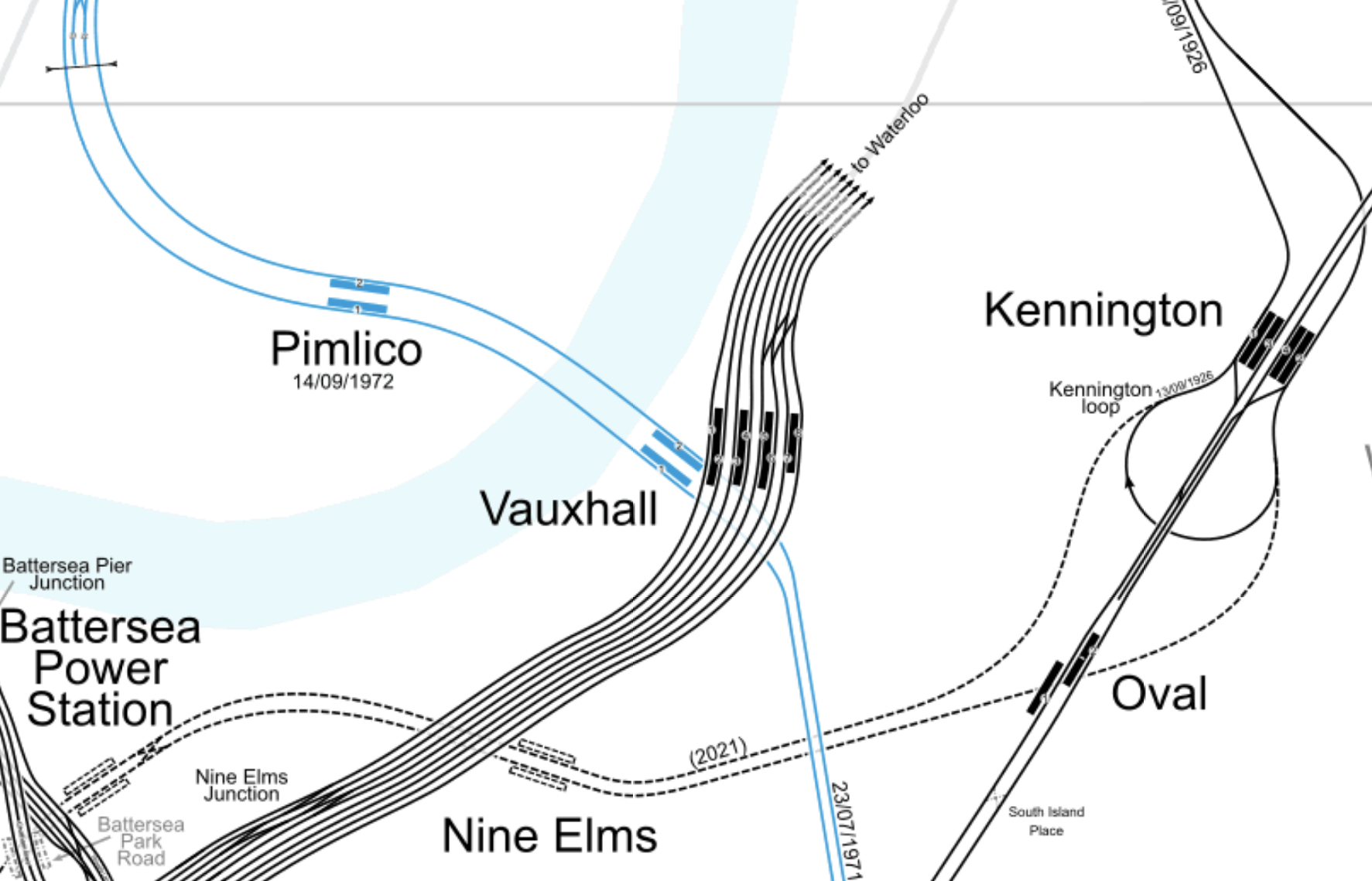
Note.
- The extension to Battersea links to the loop that turns trains that have come South through London on the Charing Cross Branch of the Northern Line, which runs North-Westerly from Kennington station.
- The Bank Branch of the Northern Line is the pair of tracks that runs North-Easterly from Kennington station.
- The Victorian builders of the Northern Line didn’t dig the tunnels and add the track, so that the loop could turn trains coming South through London on the Bank Branch of the Northern Line.
So passengers will have to change, with these possible routes.
- For London Bridge, Bank, Moorgate and Old Street change at Kennington for the Bank Branch of the Northern Line.
- For Piccadilly Circus, Oxford Circus and Paddington change at Waterloo for the Bakerloo Line.
- For Canary Wharf, London Bridge, Westminster, Green Park, Bond Street, Baker Street and Paddington change at Waterloo for the Jubilee Line.
- For Tower Hill, Monument, Westminster, Victoria and South Kensington change at Embankment for the Circle or District Lines.
- For Holborn and Kings Cross St. Pancras and Harrods change at Leicester Square for the Piccadilly Line.
- For Liverpool Street, Bank, St. Paul’s, Holborn, Bond Street and Marble Arch change at Tottenham Court Road for the Central Line.
- For Canary Wharf, Liverpool Street, Moorgate, , Bond Street, Paddington and Heathrow change at Tottenham Court Road for Crossrail.
Note.
- These are a selection of the possible routes available.
- I have included some of the possible routes to London’s important transport, tourism and business hubs.
- I suspect many will change at Tottenham Court Road station for the City, as the station has been completely rebuilt for Crossrail with full step-free access.
Residents and visitors to the large amounts of new residential properties around Battersea Power Station and Nine Elms stations, will probably find their best routes fairly quickly, but there are a large number of routes to try to most important hubs.
Will Battersea Become An Area, Where Visitors To London Stay?
Consider.
- The Northern Line Extension has connections to to Central London’s important transport, tourism and business hubs.
- The Thames Clippers give access to the Thames.
- There appears to be several good hotels open in the area.
- For Gatwick Airport, it’s Gatwick Express and a taxi from Victoria station, at around a tenner.
- For Heathrow Airport, it’s an easy journey from Heathrow on Crossrail with a change at Tottenham Court Road.
- For City Airport, it’s a direct journey on a Thames Clipper from Royal Wharf to Battersea Power Station pier.
- For Eurostar, it’s probably a £25 taxi from St. Pancras, but if you know the Underground there are several one-change routes via Euston, Kennington, Leicester Square and Warren Street.
I feel that if they get the hotels and the hospitality right, that the area could become an important one for visitors to London.
Heading North For Summer: Report Reveals £21bn Annual Visitor Spend Across The Region
The title of this post, is the same as that of this article on Transport for the North.
This is the opening paragraph.
Pan-regional figures reveal the full importance of the North of England visitor economy for the first time, with 25% of all England’s tourism spend taking place in the region.
The figures quoted are much larger than I would have expected.
Epping Station – 30th August 2021
In Essex Councillors Call For Underground Link, I discussed the pros and cons of extending the Central Line from Epping station to Harlow.
As I didn’t have any pictures of Epping station. I went to the station and took these.






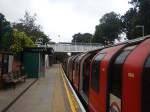
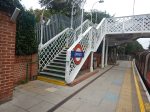

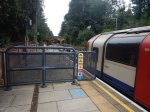


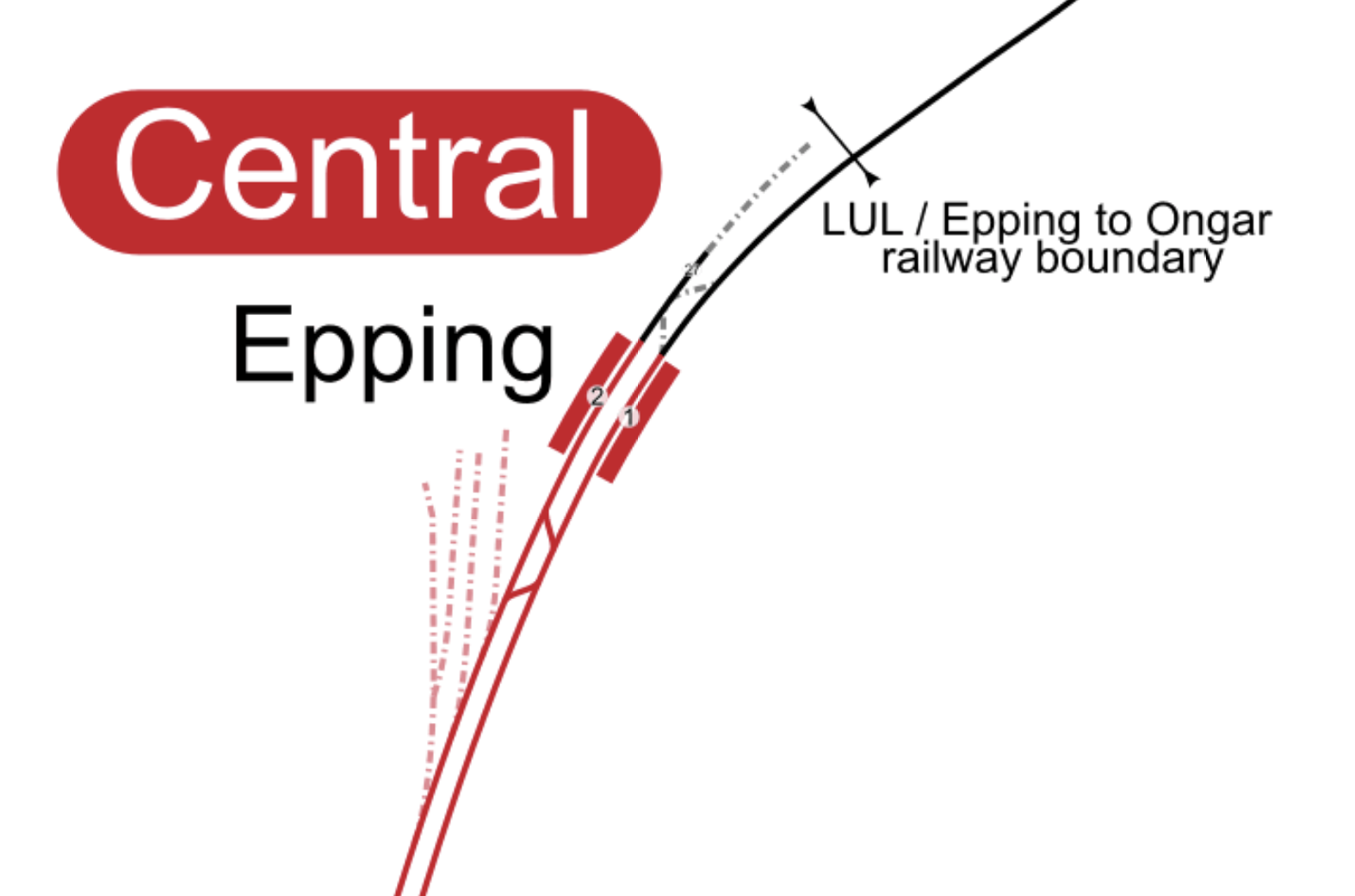
This map from cartometro.com shows the track layout at Epping station.
Note.
- There are two platforms both of which are used to terminate trains.
- Platform 2 is step-free, but Platform 1 is only step-free for exit only.
- There is a large car park with 541 spaces including twelve for disabled drivers.
I suspect this means, that someone who has difficulty with the bridge and has parked their car in the car park has a problem.
To my mind there are two obvious solutions.
- Put in a second step-free bridge at the station.
- If no trains go past the ends of the platform, it might be possible to build a level walkway across the two tracks.
It would all depend on the budget and any plans to extend the Central Line to Harlow or on to the tracks of the Epping Ongar Railway.
It would certainly be possible to extend Platform 1 to serve as a platform for the Epping Ongar Railway and have a walkway across the tracks to give step-free access between all three platforms.
- It would make the heritage Epping Ongar Railway into a unique London tourist attraction with direct access from the Underground.
- It might even be possible for the heritage railway to run connection services between Epping and Ongar at times, when they would be financially worthwhile and operationally possible.
There are certainly possibilities.
 The Anonymous Widower