Freightliner Partners With Zero To Decarbonise Critical Transport Operations
The title of this post, is the same as that of this news item from Freightliner.
This is the sub-heading.
Today, Freightliner and Zero, a breakthrough energy company that develops and manufactures whole-blend synthetic, non-biological fuels, announced a partnership to achieve a fossil-free locomotive operation by 2040 and overall Net Zero by 2050, representing a major evolution for one of the world’s oldest, safest and most reliable forms of freight transport. To successfully meet these ambitious emissions targets, Freightliner is exploring alternatives to diesel, such as Zero’s carbon-neutral synthetic diesel, which will eliminate fossil-carbon emissions and improve air quality and environmental wellbeing.
These are my thoughts.
Freightliner
Freightliner is a rail-freight company, that you see regularly hauling freight trains all over the UK.

The picture shows two of their Class 90 electric locomotives in their latest livery.
These posts talk about the company and lower or zero carbon operation.
- Clean Air Power Adds Hydrogen To Class 66 Fuel Mix
- Freightliner Continue Trials On New Low Carbon Fuel
- Freightliner Secures Government Funding For Dual-Fuel Project
- The Ultimate Bi-Mode
The current post fits that pattern.
Zero Petroleum
Zero Petroleum is one of those companies that gives Elon Musk nightmares.
But when you have backers like Babcock, Boeing, Intertek, Rolls-Royce and the Royal Air Force, you must be doing something right.
The Wikipedia entry for the company has this first paragraph.
Zero is a manufacturer of non-biological carbon-neutral synthetic fuel (also known as e-fuel) co-founded by former Formula One engineer Paddy Lowe. Its product has been developed as an alternative to fossil-based fuels and a more scalable sustainable alternative to waste and bio-fuels. The Royal Air Force used its fuel in November 2021 to achieve a World Record first flight powered by synthetic fuel. In July 2022, Zero entered a new partnership with the Royal Air Force to move towards mass production of sustainable aviation fuel.
The company is often known as just Zero.
These two and a half paragraphs from the Wikipedia entry describe the technology.
Zero uses Direct FT (a proprietary and specialised version of Fischer-Tropsch) to directly manufacture target fuels (gasoline, kerosene and diesel) at high yield and with no need for refinery upgrading.
When manufactured using renewable energy, synthetic fuel can be used as a carbon neutral or carbon negative direct drop-in replacement for fossil fuels, particularly for operations that require high energy densities – such as air travel, shipping and farming – and to ensure the continued use of legacy vehicles. It can also be used as a raw material to produce various forms of plastic.
It is manufactured using a process known as petrosynthesis, in which carbon dioxide and hydrogen are combined to create hydrocarbons. The process involves direct air capture of carbon dioxide from the atmosphere and the electrolysis of water to obtain hydrogen.
The Fischer-Tropsch process, despite its association in the past with dodgy regimes, seems to be at the heart of things, as it is with Velocys.
I describe the Velocys process and its link to Fischer-Tropsch in Grant Shapps Announcement On Friday.
Surely, the carbon-neutral fuel produced by Zero, are the ideal stop-gap fuel until true full zero-carbon fuels are available.
But Zero’s fuels will always be available for heritage and legacy trains, planes and automobiles and for applications, where older technology must be used.
As an example of older technology still being used on UK’s railways, Network Rail operate, the New Measurement Train to check all tracks in Great Britain.

The train may have been manufactured in the 1970s, but it has modern engines and is the ideal train to carry the wide variety of sophisticated equipment to ensure the safety of Britain’s railways.
Synthetic diesel like that produced by Zero could keep the New Measurement Train running for some years yet.
Freightliner Have Made A Pragmatic Decision
I believe that Freightliner have made a pragmatic decision, that allows them to go carbon neutral without without taking risks or spending millions on new equipment, that is not fully-developed.
As new zero-carbon technology is developed, like say hydrogen-electric hybrid locomotives, these may take over certain tasks, which will reduce some of the need for synthetic diesel.
But synthetic diesel from Zero will always be there as a fuel of last resort.
Fresh Air Fuels Global
Because of its history, South Africa has developed technology to create biofuels, as alternatives to diesel.
If you read the Wikipedia entry for South African chemical company; SASOL, you’ll see the things that South African chemists did, to get round the sanctions imposed because of apartheid.
SASOL has advanced the Fischer–Tropsch process and uses it to produce diesel and other fossil fuels.
Note that Velocys have also developed this process to make sustainable aviation fuel in the UK.
Fresh Air Fuels Global have a page on the G-volution web site.
The page is dominated by an infographic, which shows organic waste (animals and plants) going into an anaerobic digester, which produces.
- Biogas, which is used to create heat, electricity, CO2, biomethane, fuel and gas for the grid.
- Digestate, which is used for fertiliser and livestock bedding.
It almost sounds too good to be true.
This is the mission statement below the graphic.
Our mission: To be the most reliable producer of energy secure low carbon fuels.
There is then these paragraphs, which explain the relationship between G-volution and Fresh Air Fuels Global.
Global energy security concerns and climate targets necessitate countries and businesses to transition away from high-cost fossil fuels towards low-carbon alternatives.
Over more than a decade, Cape Advance Engineering South Africa (CAE) have been developing an incredibly cost-effective Anaerobic Digestion (AD) technology, which has proven to generate renewable energy from organic waste in the form of gas, heat and electricity that is cost competitive with fossil fuels.
G-Volution has partnered with CAE to form Fresh Air Fuels Global (FAFG), with aim of introducing the CAE technology to international markets that the G-Volution already have a foothold, constructing AD plants and creating carbon neutral biofuel from waste that can be used in dual fuel engines.
In Grand Central DMU To Be Used For Dual-Fuel Trial, I describe how G-volution’s dual fuel technology has been applied to one of Grand Central’s Class 180 train.
This picture I took after travelling in a Grand Central Class 180 train, shows that G-volution don’t hide their light under a bushel.

Note.
- This train appears to run on diesel and liquified natural gas.
- This G-volution video gives more details.
This clip from the video, shows the possible fuels.
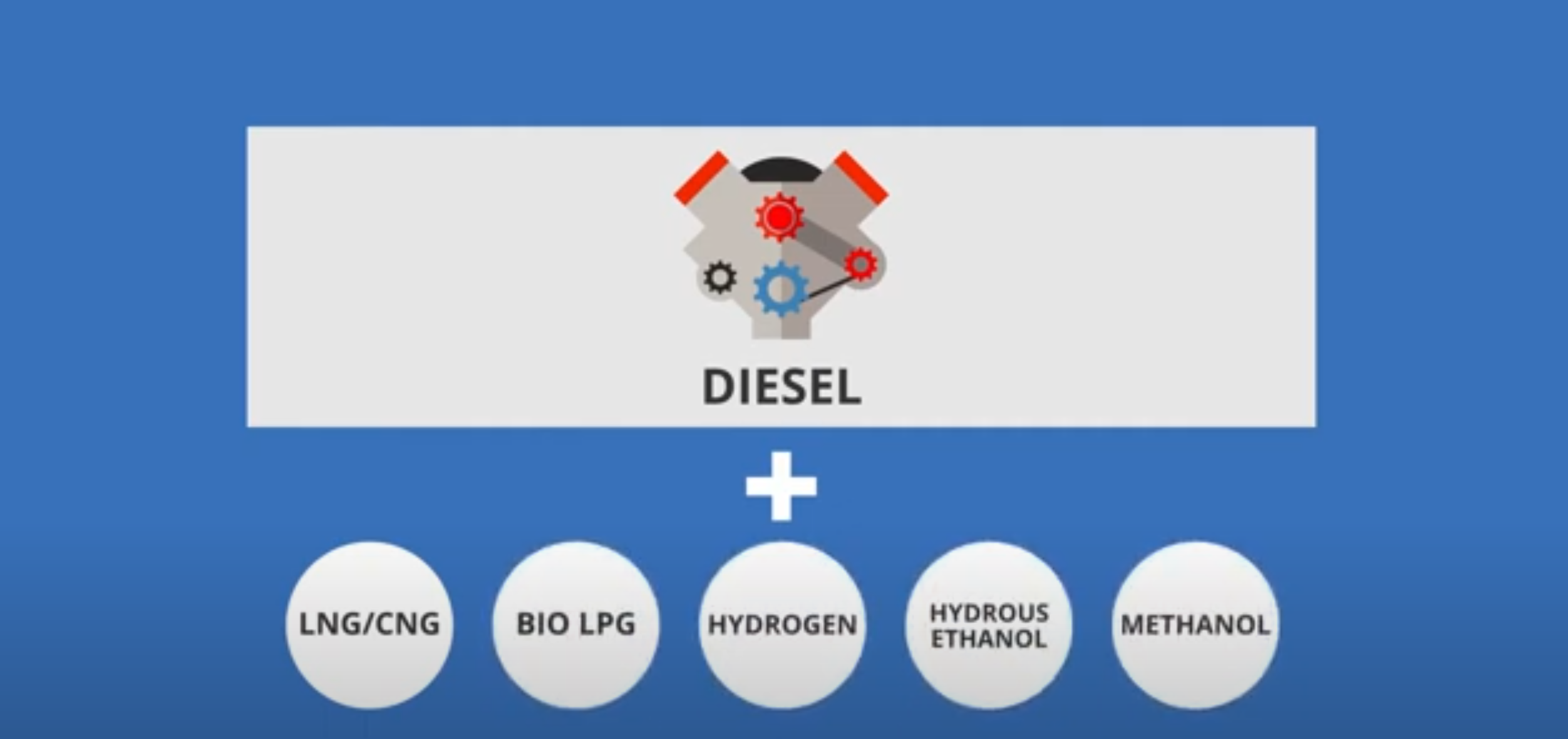
Note.
- Can the dual fuel engine use biodiesel or HVO instead of diesel?
- It looks like the Fresh Air Fuels Global process can produce biomethane, which could be liquified as LNG.
- Hydrogen is the only true zero-carbon secondary fuel.
- There is a Wikipedia entry for ethanol fuel.
- Hydrous ethanol is about 95% ethanol and 5% water and is used as a fuel in Brazil in petrol cars.
- There is a Wikipedia entry for the use of methanol as fuel.
Have G-volution got access to the technology to both reduce the fuel consumption of diesel engines and run them on zero-carbon fuel?
UK Trains That Have Cummins QSK-19 R Diesel Engines
Grand Central’s Class 180 trains have a Cummins QSK-19 R diesel engine.
All these trains have the same engine.
- 14 – Class 180 trains
- 51 – Class 185 trains
- 34 – Class 220 trains
- 44 – Class 221 trains
- 27 – Class 222 trains
In addition, Class 175 trains have a different engine made by Cummins.
Conclusion
If G-volution’s technology can be made to work successfully, it could play a large part in the decarbonisation of UK passenger trains.
Welsh Firm Wins £300K BEIS Grant To Advance Hydrogen Fuel Tech
The title of this post, is the same as that of this article on Wales247.
This is the first two paragraphs.
A gasification pioneer aims to seal the UK’s low-carbon future after winning a Government grant worth nearly £300,000 to develop waste-to-hydrogen production technology, innovation funding specialist Catax can reveal.
Compact Syngas Solutions (CSS), based in Deeside, Wales, has secured £299,886 from the Department for Business, Energy and Industrial Strategy (BEIS) with the help of Catax. The funding comes from the Low Carbon Hydrogen Supply 2 Programme, which is part of the Net Zero Innovation Portfolio.
Note.
- The objective is produce syngas or green hydrogen from waste that would normally be sent to landfill.
- Syngas, or synthesis gas, is a fuel gas mixture consisting primarily of hydrogen, carbon monoxide, and very often some carbon dioxide.
- Syngas can be used as a fuel in internal combustion engines.
The name of the company; Compact Syngas Solutions could indicate that the company aim to have a compact system to produce syngas or green hydrogen.
I have come across other companies looking at waste diverted from landfill to create aviation fuel, diesel or hydrogen.
I have invested in one; Velocys, through the Stock Market, as I feel this area of technology will be big in the future.
Compact Syngas Solutions seem to have a different take. However like many other, I suspect catalysts are involved.
Conclusion
I think, this will be a company to watch.
Affordable Blue Hydrogen Production
The title of this post, is the same as that of this page on the Shell Catalysts & Technologies web site.
This is said at the top of the page.
Natural gas producers are at a crossroads. They face a shifting regulatory landscape emphasising emissions reduction and an economic environment where cash preservation is critical. Shell Catalysts & Technologies offers resource holders a phased approach to diversifying their portfolios towards clean hydrogen fuels by leveraging proven and affordable capture technologies and catalysts.
My knowledge of advanced chemical catalysts is small, but I did work in the early 1970s on a project with one of ICI’s experts in the field and he told me some basics and how he believed that in the future some new catalysts would revolutionise chemical process engineering.
Wikipedia’s definition of catalysis, or the action of catalysts is as follows.
Catalysis is the process of increasing the rate of a chemical reaction by adding a substance known as a catalyst.
When I heard that Velocys were going to develop a catalyst-based system to turn household waste into sustainable aviation fuel, I did make a small investment in the company, as I thought the project could have legs.
Shell’s process takes natural gas and converts one molecule of methane (CH4) into two molecules of hydrogen (H2) and one of carbon dioxide (CO2) using one molecule of oxygen (O2) from the air.
In the Shell Blue Hydrogen Process, does a clever catalyst extract the carbon atom from the methane and combine it with two oxygen atoms to create a molecule of carbon dioxide? If it does, then this would leave the four atoms of hydrogen to form two molecules of H2 and the catalyst to go and repeat its magic on another methane molecule.
The video on the Shell site claims to do the conversion 10-25 % cheaper than current carbon intensive methods like steam reforming.
For every two molecules of hydrogen produced, both the Shell Blue Hydrogen Process and steam reforming will produce one molecule of carbon dioxide.
If you look at steam reforming it is an endothermic process, which means heat has to be added. The classic endothermic process is dissolving ice cubes in a glass of water.
Shell don’t say, but does their process need less energy to be added, because their clever catalyst does a lot of the work?
I wouldn’t be surprised if the reaction takes place in a liquid, with hydrogen and carbon dioxide bubbling out.
- The two gases would be separated by using their different physical properties.
- Carbon dioxide is heavier for a start.
Whatever Shell have done, it is probably pretty impressive and has probably taken many years to develop.
If as I suspect, it produces pure carbon dioxide, that would be an added bonus, as some uses of carbon dioxide wouldn’t want impurities.
Uses of pure carbon dioxide include.
- Feeding it to soft fruits, flowers, salad vegetables and tomatoes growing in large greenhouses.
- Dry ice.
- Mineral Carbonation International can use carbon dioxide to make building products like blocks or plasterboard.
- It can be added to concrete.
The more of the carbon dioxide that can be used rather than stored the better.
Velocys’s Waste-To-Fuel Project Moves Forward
The title of this post, is the same as that of this article on Let’s Recycle.
This is the first paragraph.
Velocys says it has completed works at its Altalto plant in Immingham, North East Lincolnshire, in preparation for a future connection to the East Coast Carbon Capture and Storage (CCS) cluster.
In partnership with British Airways, Velocys is developing a facility that could convert up to 500,000 tonnes of municipal solid waste into fuel for planes and cars each year.
At last, this very interesting and important project is underway.
I believe that plants like this could be the way we keep flying until hydrogen-powered planes are developed.
Nuggets From The Union Connectivity Review
The Union Connectivity Review has now been published and it can be read online.
This paragraph outlines the objective of the Review.
The UK Government asked Sir Peter Hendy CBE to undertake a detailed review into how transport connectivity across the UK can support economic growth and quality of life in England, Scotland, Wales and Northern Ireland.
Sir Peter was also asked to make recommendations as to whether and how best to improve transport connectivity between the nations of the UK.
Sir Peter Hendy is the Chairman of Network Rail.
In no particular order, these are some nuggets from the review.
The Case For UKNET – A Strategic Transport Network For The Whole United Kingdom
This paragraph introduces the case for UKNET.
Having identified the importance of good connections across internal borders and the challenges that currently prevent a pan-UK strategic vision or investment strategy, the Review recommends that the UK Government develop UKNET – a strategic transport network for the whole United Kingdom which would connect all the nations of the
UK, with appropriate funding and coordination with the devolved administrations to deliver it.
The creation only follows best practice from the European Union and large countries like the United States.
These three paragraphs sum up how UKNET would work and how it would bring benefits to the whole of the UK.
UKNET would provide a network into which transport investment would be made on a pan-UK basis to support economic growth, jobs, housing and social cohesion, across the nations of the UK, for the benefit of the whole country.
It would allow transport appraisals for schemes on the network to be undertaken on a UK-wide basis with all costs and benefits being fully accounted for. This would limit the risk of cross-border schemes being deprioritised.
The development of such a network would provide additional certainty for businesses and the private sector, allowing them to plan complementary investments in specific regions and to invest in the supply chain across the country.
I think overall that UKNET is sound thinking, but my only feeling is that it should also look at transport links to and from the whole island of Ireland.
The Case for Faster Rail Journey Times Between England And Scotland
These three paragraphs probably apply to most rail journeys in the world, that compete against air and road travel.
Both the UK and Scottish Governments have previously agreed to develop options which could support a rail journey time between London and Scotland of three hours. A journey time improvement of this size, even when compared to expected journey times once HS2 opens, would dramatically increase the number of people travelling by rail.
There is a correlation between journey times and how many people choose to travel by rail over air. If it takes the same amount of time to travel by rail or by air, the evidence shows that people choose to travel by rail. Rail is typically favoured when the journey time is around three hours between city centres.
Work undertaken by Network Rail and HS2 Ltd on behalf of the Review has demonstrated the potential for increased trips by rail if journey times are reduced. For assurance purposes, two forecasting models were used to assess savings of 20, 35 and 50 mins on the journey times forecast for HS2 Phase 2b. The outcomes for both models were broadly similar and the approach built upon the changes in mode share observed between rail and aviation following previous UK and European rail investments.
Three hours between London and Scotland could be a tough ask.
Note these points about the East Coast Main Line.
- An InterCity 225 ran between London and Edinburgh on the 26th September 1191 in three hours and 29 minutes.
- Full digital in-cab signalling will allow running at 140 mph.
- There are improvements to come on the East Coast Main Line.
- As now, the review says two tph will run between London and Edinburgh.
- London Kings Cross and Edinburgh is 393 miles
- On the East Coast Main Line a non-stop train between would need to average 131 mph.
Three hours is tough but not impossible.
And these points about the West Coast Main Line.
- Trains will run on High Speed Two between London Euston and Crewe.
- High Speed Two are claiming fifty-six minutes between London Euston and Crewe.
- Full digital in-cab signalling will allow running at 140 mph.
- Crewe and Glasgow Central is 243.4 miles.
- Current fastest time between Crewe and Glasgow Central is three hours and five minutes.
- Between Crewe and Glasgow Central, a non-stop train would need to average 118 mph.
A well-driven InterCity 125, with a clear track, could average that speed between Crewe and Glasgow Central.
Three hours is tough but very possible.
This paragraph sums up the mode shift expected between air and road to rail.
These initial estimates indicated that a three-hour journey time was forecast to increase the number of passengers by around four million a year and increase rail mode share from the 2019 level of 29% to around 75%. It was also forecasted that journey times in the region of three hours would generate considerable transport user benefits and revenues over the lifetime of the scheme.
People travelling from the Midlands and North West England to and from Scotland would also get substantial reductions in journey times.
Linking High Speed Two With The WCML
The review says this about linking High Speed Two with the West Coast Main Line.
The UK Government has already acknowledged some of the issues identified by the Review. The ‘Golborne Link’—the current proposed connection between HS2 and the WCML—is expected to deliver quicker journey times and more capacity between England and Scotland and resolve some of the constraints between Crewe and Preston.
However, the ‘Golborne Link’ does not resolve all of the identified issues. The suitability of alternative connections between HS2 and the WCML have been considered by the Review. The emerging evidence suggests that an alternative connection to the WCML, for example at some point south of Preston, could offer more benefits and an opportunity to reduce journey times by two to three minutes more than the ‘Golborne Link’. However, more work is required to better understand the case for and against such options.
These benefits could also include additional operational flexibility when timing freight services and less disruption to the WCML than major upgrades as most construction could take place away from the railway.
An infrastructure philosophy is also detailed.
- Replacing and enhancing track, signalling and power supply.
- Possible new sections of line north of Preston.
- Maximising of line speed.
My feeling is that for good project management reasons and to give faster journey times with the existing trains, that a lot of these improvements should be started as soon as possible.
Borders Railway
The Review says this about the Borders Railway.
Communities in the Scottish Borders region are enthusiastic about the economic and social benefits they see resulting from an extension of the Borders Railway south, across the border, to Carlisle.
The Review also welcomes the £5 million in funding that the UK Government has made available for the development of a possible extension to the Borders Railway which would support improved connections to and from Scotland and with the WCML at Carlisle.
I would build this early, as when the West Coast Main Line is being upgraded between Carlisle and Glasgow, this would be available as a diversion route.
Perhaps too, the Glasgow South Western Line should be improved and electrified as well.
Air Passenger Duty
The Review has a sizeable session on Air Passenger Duty, where it concentrates on the problems of its application to domestic flights.
The Review makes this recommendation.
Where journeys are too long to be reasonably taken by road or rail, the UK Government should reduce the rate of domestic aviation tax.
I believe that before the end of this decade, there will be smaller zero-carbon airliners, that will be ideal for domestic routes, which could totally change the regime of domestic Air Passenger Duty.
Decarbonisation And The Future Of Flight
This is a section in the Review, where this is the first paragraph.
In July 2021, the Department for Transport published the Jet Zero Consultation: a consultation on our strategy for net zero aviation127, alongside the Transport Decarbonisation Plan. This includes the ambition to have zero-emission routes connecting different parts of the UK by 2030 and a commitment to assess the feasibility of serving PSO routes with low carbon aviation. The Review welcomes the commitments made in both publications to accelerate the uptake of sustainable aviation fuels (SAFs) and develop low and zero-emission aircraft.
The Review goes on to make two recommendations.
- Drive the uptake of sustainable fuels and zero emission technologies on domestic aviation through a combination of incentives, tax benefits and subsidies to make the UK a world leader in developing these fuels and technologies.
- Support the development of sustainable aviation fuel plants in parts of the United Kingdom that are particularly reliant on aviation for domestic connectivity.
Note.
- PSO means Public Service Obligation.
- One of the world leaders in the field of sustainable aviation fuels is Velocys, which is a spin out from Oxford University.
- The Review also suggests building a sustainable aviation fuel plant in Northern Ireland.
The Review gives the impression it is keen on the use of sustainable aviation fuel
Conclusion
There are some good nuggets in the sections I have read in detail.
This post is not finished and there will be additions to the list.
With Southwest Airlines Deal, Velocys Presells 100% Of The Output From Its US Biobased Jet Fuel Project
The title of this post, is the same as that of this article on the American Chemical Society.
This is the first paragraph.
The biofuel maker Velocys has signed jet fuel purchase agreements with Southwest Airlines and International Airlines Group. Velocys says it now has agreements for the entire output of the facility it plans to open in Mississippi in 2026. The plant, known as Bayou Fuels, will use gasification and Fischer-Tropsch chemistry to make the fuel from wood waste. It will be fitted with carbon-capture equipment from Oxy Low Carbon Ventures, making its fuel net-negative in CO2 emissions. The two airlines have also agreed to buy the resulting greenhouse gas.
Note that the technology is net-negative in carbon dioxide emissions.
This must be a short-term route to decarbonise existing aviation.
Freightliner Continue Trials On New Low Carbon Fuel
The title of this post, is the same as that of this article on Rail Technology Magazine.
This is the first paragraph.
As part of their commitment to carbon reduction Freightliner will conduct operational trials of a new low carbon fuel supplied by Green Biofuels Ltd (GBF).
And this paragraph described the fuel.
GBF are the UK’s leading provider of Hydrogenated Vegetable Oil (HVO) and the new fuel consists of 55% Shell GTL (gas to liquids) Fuel and 45% Gd+ HVO.
It does appear that hydrotreated vegetable oil or HVO, could be becoming an intermediate step on the route to decarbonisation, as I’ve posted about the fuel before in Powered By HVO.
The other promising route to decarbonisation must surely be that of producing fuel from waste, as pioneered by Velocys and others.
But they are only intermediate steps before hydrogen becomes the preferred zero-carbon fuel for rail freight services.
Velocys Announces Long-Term Clean Avgas Deals With Airline Behemoths
The title of this post, is the same as that of this article on the Energyst.
This is the first paragraph.
Fuel-from-waste pioneer Velocys has made the world’s biggest sustainable aviation fuel (SAF) plant more investible, as it detailed massive likely long-term supply deals to two big airline groups.
The share price seemed to benefit from the announcement.
I’m not bothered, as I have a small investment.
Velocys Welcomes US Government SAF Policy Support
The title of this post, is the same as that of this article on London South East.
This is the first paragraph.
Velocys plc – Oxford, England-based fuels technology company – Welcomes US government announcement last week of a set of comprehensive new policy actions in support for Sustainable Aviation Fuel production in the US. Notes Velocys is cited in a White House briefing paper setting out the Biden administration’s plans to incentivise commercial scale supply of SAF in the US to meet decarbonisation objectives while stimulating economic growth.
I hope that being cited by the White House is a good thing.
I do think though, that Velocys have the technology, that could help us to keep flying until hydrogen-powered aircraft are developed.
 The Anonymous Widower