Hydrogen And Electric Propulsion Compared
Stadler have given us an interesting way of comparing the range and other properties of hydrogen-powered and battery-electric trains, as their Flirt H2 and Akku trains have both set Guinness World Records for distance travelled.
The Hydrogen-Powered Flirt-H2
In Stadler’s FLIRT H2 Sets World Record For Hydrogen Powered Train, I write about how a Stadler Flirt-H2 had set a record of 2803 kilometres, without refilling.
This page on the Stadler web site gives details of the Flirt-H2.
- Hydrogen Range – 460 km.
- Operating Speed – 127 kph
- Refuelling Time – < 30 minutes
- Seats – 116
This graphic clipped from the Stadler web site shows the Flirt-H2.

Like Greater Anglia’s Class 755 train, it has a PowerPack in the middle, which contains a fuel cell and the hydrogen tank, instead of the Class 755 train’s diesel engines.
The Battery-Electric Akku
In Flirt Akku And Class 755 Train Compared, I compare a Flirt Akku and Greater Anglia’s Class 755 train, after the battery-electric Akku had set a record of 224 kilometres, with recharging.
This page on the Stadler web site gives details of the Flirt Akku.
- Battery Range – 150 km
- Operating Speed – 160 kph
- Chrging Time – 15 minutes
- Seats – 120-180
This graphic clipped from the Stadler web site shows the Flirt Akku.
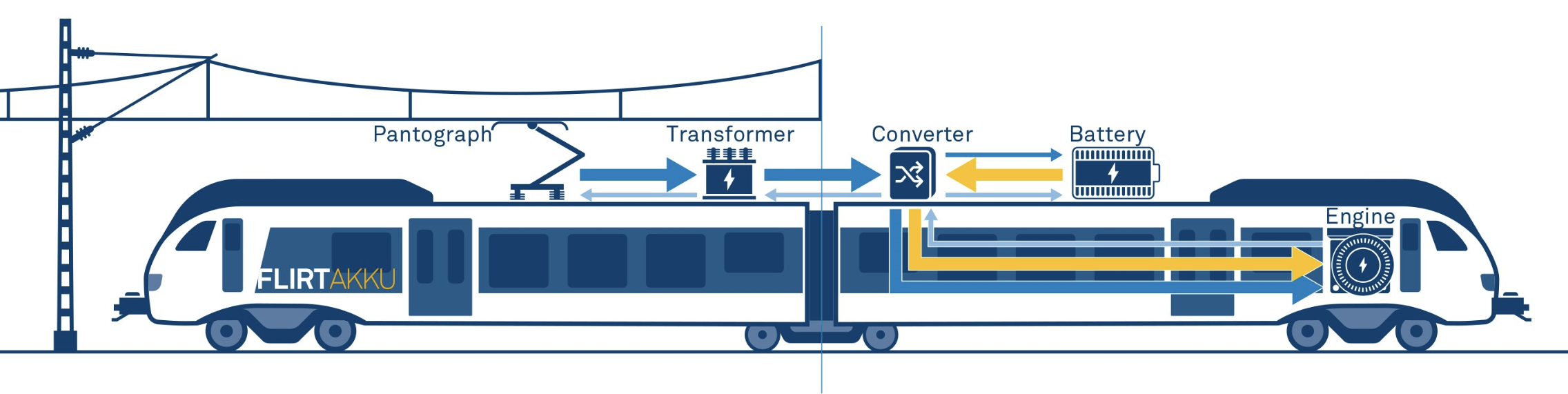
At a quick glance, the trains seem to be fairly similar, with the exception of the PowerPack.
- Both have regenerative braking.
- Both have the battery and the power converter on the roof.
- I would expect that the Flirt-H2 could be fitted with a pantograph and a transformer.
- Both trains have two passenger carriages.
I also suspect, both trains can be lengthened by adding extra coaches.
These are my thoughts.
Thoughts On The PowerPack In A Flirt-H2
This picture shows the PowerPark car of a Class 755 train.

Note.
- These PowerPacks have slots for up to four 480 Kw diesel engines.
- PowerPacks on a Class 788/4 train with four diesel engines weighs 27.9 tonnes.
- PowerPacks on a Class 788/3 train has two diesel engines.
- In the UK, trains with PowerPacks have up to four passenger cars.
- The PowerPack has a walkway from one end of the car to the other.
As customers, might like to replace their diesel PowerPacks, with something that was zero-carbon, I would expect, that the hydrogen PowerPack would have the following properties.
- Hydrogen and diesel PowerPacks would be interchangeable.
- The hydrogen PowerPack would come in two handy sizes of hydrogen fuel cell; 0ne and two MW.
- The weight of both hydrogen and diesel PowerPacks would be similar, as if power and weight were similar, then this could help certification.
- The Flirt-H2 for California, which would only have two passenger cars, would have the smaller hydrogen fuel cell.
I would expect that a conservative designer would use any spare space for hydrogen storage.
- Perhaps, there would be one tank either side of the walkway.
- The quoted range of 450 kilometres for the Flirt-H2 is just under 300 miles, so it would probably cover most regional round trips in Europe without refuelling.
- On many routes refuelling would only need to be done once-per-day.
- Refuelling can be some distance from operation.
- Large tanks would explain the thirty minutes refuelling time.
Obviously, large tanks have the collateral benefit of setting distance records.
The Kinetic Energy Of A Flirt-H2 Train
In My First Rides In A Class 755 Train, I calculated the kinetic energy of a Class 755/4 train.
I said this.
I will use my standard calculation.
The basic train weight is 114.3 tonnes.
If each of the 229 passengers weighs 90 kg with Baggage, bikes and buggies, this gives a passenger weight of 20.34 tonnes.
This gives a total weight of 134.64 tonnes.
Using Omni’s Kinetic Energy Calculator gives these figures for the Kinetic energy.
- 60 mph – 13.5 kWh
- 100 mph – 37.4 kWh
- 125 mph – 58.4 kWh
If we are talking about the Greater Anglia Class 755 train, which will be limited to 100 mph, this leads me to believe, that by replacing one diesel engine with a plug compatible battery of sufficient size, the following is possible.
- On all routes, regenerative braking will be available under both diesel and electric power.
- Some shorter routes could be run on battery power, with charging using existing electrification.
- Depot and other short movements could be performed under battery power.
The South Wales Metro has already ordered tri-mode Flirts, that look like Class 755 trains.
The calculation for a Flirt-H2 train is as follows.
Train Weight – 82.3 tonnes
Passenger Weight – 10.4 tonnes
Total Weight – 92.7 tonnes
This gives these kinetic energies
- 60 mph – 9.3 kWh
- 79 mph – 16.0 kWh
- 100 mph – 25.7 kWh
It looks like the 79 mph; Flirt-H2 would only need a 16 KWh battery.
It seems when a battery is not for traction and only handles the regenerative braking, it can be surprisingly small.
Mathematical Advantages Of Hydrogen
I do wonder that on balance, there may be mathematical advantages to hydrogen; long range, less frequent refuelling and small batteries.
But as I indicated in Zillertalbahn Hydrogen Plan Dropped In Favour Of Battery Traction, the decision doesn’t always go hydrogen’s way!
Conclusion
I feel Stadler have the right approach of a modular concept that incorporates both hydrogen-powered and battery-electric trains.
I also think, if you have a route, you want to decarbonise, Stadler have the train for you.
Zillertalbahn Hydrogen Plan Dropped In Favour Of Battery Traction
The title of this post, is the same as that of this article on Railway Gazette.
I wrote about this order in Zillertalbahn Orders Stadler Hydrogen-Powered Trains.
I didn’t blog about it but I remembered an article a few years ago about Stadler getting an order from the Zillertalbahn.
It appears the change is down to improvements in battery technology.
Narrow-gauge battery-electric multiple units must be right up Stadler’s street, as they built the new trains for the narrow gauge Glasgow Subway.
No News On Hydrogen Trains For The Midland Main Line
In April 2019, I wrote Hydrogen Trains To Be Trialled On The Midland Main Line, which was based on an article on Railway Gazette that is entitled Bimode And Hydrogen Trains As Abellio Wins Next East Midlands Franchise.
I said this in my post.
Abellio will be taking over the franchise in August this year and although bi-mode trains were certain to be introduced in a couple of years, the trialling of hydrogen-powered trains is a surprise to me and possibly others.
This is all that is said in the article.
Abellio will also trial hydrogen fuel cell trains on the Midland Main Line.
It also says, that the new fleet will not be announced until the orders are finalised.
Nothing has been heard since about the hydrogen train trial for the Midland Main Line.
But there have been several related developments, that might have implications for the trial.
East Midlands Railway Has Ordered Hitachi Class 810 Trains For EMR InterCity Services
Class 810 trains are Hitachi’s latest offering, that are tailored for the Midland Main Line.
The trains will have a few differences to the current Class 800,/801/802 trains.
But will they be suitable for conversion to hydrogen power?
Consider.
- The Hitachi trains have a comprehensivecomputer system, that looks at the train and sees what power sources are available and controls the train accordingly.
- Trains have already been ordered in five, seven and nine-car lengths. I have read up to twelve-car trains are possible in normal operation. See Do Class 800/801/802 Trains Use Batteries For Regenerative Braking?
- Hydrogen train designs, with a useful range of several hundred miles between refuelling, seem to need a hydrogen tank, that takes up at least half of a twenty metre long carriage.
- The Hitachi train design has pantographs on the driver cars and can support diesel generator units in the intermediate cars, as it does in current trains.
- The Japanese are researching hydrogen trains.
- The five-car Class 802 trains have 2,100 kW of installed generator power.
I think that Hitachi’s engineers can build another carriage, with the following characteristics.
- It could be based on a Motor Standard car.
- The passenger seats and interior would be removed or redesigned in a shorter space.
- Powered bogies would be as required.
- It would contain a hydrogen tank to give sufficient range.
- Appropriately-sized batteries and fuel-cells would be inside or under the vehicle.
- Regenerative braking would help to recharge the batteries.
- There would probably be no diesel generator unit.
There would need to be a walkway through the car. Stadler have shown this works in the Class 755 train.
A Hydrogen Power car like this would convert a five-car bi-mode diesel-electric train into a six-car hydrogen-electric hybrid train. Or they might just replace one Motor Standard car with the Hydrogen Power Car to create a five-car hydrogen-electric hybrid train, if the longer train would cause problems in the short platforms at St. Pancras.
- The computer system would need to recognise the Hydrogen Power Car and control it accordingly. It would probably be very Plug-and-Play.
- The weight of the train could probably be reduced by removing all diesel generator units.
- The passenger experience would be better without diesel power.
- The range away from the wires would probably be several hundred miles.
The drivers and other staff would probably not need massive retraining.
What Do I Mean By Appropriately-Sized Batteries And Fuel Cells?
I can’t be sure,, but I suspect the following rules and estimates hold.
- The batteries must be large enough to more than hold the kinetic energy of a full five-car train, running at the full speed of 140 mph.
- I estimate that the kinetic energy of the train,will be around 200 kWh, so with a contingency, perhaps battery capacity of between 400-500 kWh would be needed.
- Currently, a 500 kWh battery would weigh five tonnes, which is of a similar weight to one of the diesel generator units, that are no longer needed.
- In How Much Power Is Needed To Run A Train At 125 mph?, I estimated that the all-electric Class 801 train, needs 3.42 kWh per vehicle mile to maintain 125 mph. This means that travelling at 125 mph for an hour would consume around 2,000 kWh or an output of 2,000 kW from the fuel cell for the hour.
- Note that 1 kg of hydrogen contains 33.33 kWh of usable energy, so the hydrogen to power the train for an hour at 125 mph, will weigh around sixty kilograms.
From my past experience in doing chemical reaction calculations in pressure vessels, I think it makes the concept feasible. After all, it’s not that different to Alstom’s Breeze.
I would assume, that the train manufacturers can do a full calculation, to a much more accurate level.
Applying The Concept To Other Hitachi Trains
Once proven, the concept could be applied to a large number of Hitachi bi-mode trains. I suspect too, that it could be applied to all other Hitachi A-train designs, that are in service or on order, all over the world.
In the UK, this includes Class 385, Class 395 and Class 80x trains.
Bombardier Have Said That They’re Not Interested In Hydrogen Power
But Electrostars and Aventras have the same Plug-and-Play characteristic as the Hitachi train.
I wouldn’t be surprised to find that Bombardier have a Hydrogen Power Car design for an Aventra. All that it needs is an order.
They could also probably convert a five-car Class 377 train to effectively a four-car train, with a Hydrogen Power Car in the middle. This would be ideal for the Uckfield Branch and the Marshlink Lines. I suspect it could be done to meet the timescale imposed by the transfer of the Class 171 trains to East Midlands Railway.
There must be an optimal point, where converting an electric multiple unit, is more affordable to convert to hydrogen, than to add just batteries.
But then everybody has been dithering about the Uckfield and Marshlink trains, since I started this blog!
Stadler Have Shown That a Gangway Through A Power Car Is Acceptable To Passengers In The UK
Stadler’s Class 755 trains seem to be operating without any complaints about the gangway between the two halves of the train.
Stadler Have Two Orders For Hydrogen-Powered Trains
These posts describe them.
- Zillertalbahn Orders Stadler Hydrogen-Powered Trains
- MSU Research Leads To North America’s First Commercial Hydrogen-Powered Train
Stadler also have a substantial order for a fleet of battery Flirt Akku in Schleswig Holstein and they are heavily involved in providing the rolling stock for Merseyrail and the South Wales Metro, where battery-powered trains are part of the solution.
It looks to me, that Stadler have got the technology to satisfy the battery and hydrogen train market.
The Driver’s View Of Stadler
It’s happened to me twice now; in the Netherlands and in the UK.
- Both drivers have talked about hydrogen and Stadler’s trains with the engine in the middle.
- They like the concept of the engine.
- The English driver couldn’t wait to get his hands on the train, when he finished his conversion.
- Both brought up the subject of hydrogen first, which made me think, that Stadler are telling drivers about it.
Or does driving a hydrogen-powered vehicle as your day job, score Greta points in the pub or club after work?
Could The Hydrogen Train On The Midland Main Line Be A Stadler?
Greater Anglia and East Midlands Railway are both controlled by Abellio or Dutch Railways.
In The Dutch Plan For Hydrogen, I laid out what the Dutch are doing to create a hydrogen-based economy in the North of the country.
Stadler are going to provide hydrogen-powered for the plan.
In addition.
- Greater Anglia have bought a lot of Class 755 trains.
- A lot of Lincolnshire and Norfolk is similar to the North of the Netherlands; flat and windy.
- One of these trains with a hydrogen PowerPack, could be an ideal train for demonstrating hydrogen on rural routes like Peterborough and Doncaster via Lincoln.
But the promise was on the Midland Main Line?
Conclusion
Hydrogen trains seem to be taking off!
Even if there’s been no news about the trial on the Midland Main Line.
Hydrogen Trains To Be Trialled On The Midland Main Line
This article on Railway Gazette is entitled Bimode And Hydrogen Trains As Abellio Wins Next East Midlands Franchise.
Abellio will be taking over the franchise in August this year and although bi-mode trains were certain to be introduced in a couple of years, the trialling of hydrogen-powered trains is a surprise to me and possibly others.
This is all that is said in the article.
Abellio will also trial hydrogen fuel cell trains on the Midland Main Line.
It also says, that the new fleet will not be announced until the orders are finalised.
In this post, I’m assuming that the hydrogen trial will be performed using the main line trains.
Trains for the Midland Main Line will need to have the following properties
- 125 mph on electric power
- 125 mph on diesel power
- Ability to go at up to 140 mph, when idigital n-cab signalling is installed and the track is improved.
- UK gauge
- Ability to run on hydrogen at a future date.
I think there could be three types of train.
- A traditional bi-mode multiple unit, with underfloor engines like the Hitachi Class 800 series, is obviously a possibility.
- An electrical multiple unit, where one driving car is replaced by a bi-mode locomotive with appropriate power.
- Stadler or another manufacturer might opt for a train with a power pack in the middle.
The second option would effectively be a modern InterCity 225.
- South of Kettering, electricity would be used.
- North of Kettering, diesel would be used
- Hydrogen power could replace diesel power at some future date.
- Design could probably make the two cabs and their driving desks identical.
- The locomotive would be interchangeable with a driver car.
Bi-modes would work most services, with electric versions working to Corby at 125 mph.
Which manufacturer has a design for a 125 mph, hydrogen-powered train?
Alstom
Alstom have no 125 mph UK multiple unit and their Class 321 Hydogen train, is certainly not a 125 mph train and probably will still be under development.
Bombardier
In Mathematics Of A Bi-Mode Aventra With Batteries, I compared diesel and hydrogen-power on bi-mode Aventras and felt that hydrogen could be feasible.
In that post, I wrote a section called Diesel Or Hydrogen Power?, where I said this.
Could the better ambience be, because the train doesn’t use noisy and polluting diesel power, but clean hydrogen?
It’s a possibility, especially as Bombardier are Canadian, as are Ballard, who produce hydrogen fuel-cells with output between 100-200 kW.
Ballard’s fuel cells power some of London’s hydrogen buses.
The New Routemaster hybrid bus is powered by a 138 kW Cummins ISBe diesel engine and uses a 75 kWh lithium-ion battery, with the bus being driven by an electric motor.
If you sit in the back of one of these buses, you can sometimes hear the engine stop and start.
In the following calculations, I’m going to assume that the bi-mode |Aventra with batteries has a power source, that can provide up to 200 kW, in a fully-controlled manner
Ballard can do this power output with hydrogen and I’m sure that to do it with a diesel engine and alternator is not the most difficult problem in the world.
So are Bombardier designing the Bi-Mode Aventra With Batteries, so that at a later date it can be changed from diesel to hydrogen power?
All an Aventra needs to run is electricity and the train, the onboard staff and passengers don’t care whether it comes from overhead wires, third-rail, batteries, diesel or hydrogen.
Bombardier also have the technology for my proposed locomotive-based solution, where one driver-car of an Aventra is replaced by what is effectively a locomotive.
If Bombardier have a problem, it is that they have no small diesel train to replace Abellio’s small diesel trains. Could the longer services use the bi-mode Aventras and the shorter ones Aventras with battery power?
CAF
CAF probably have the technology, but there would be a lot of development work to do.
Hitachi
Hitachi have the bi-mode trains in the Class 802 trains, but haven’t as yet disclosed a hydrogen train.
Siemens
They’ve made a few noises, but I can’t see them producing a bi-mode train for 2022.
Stadler
In a few weeks time, I will be having a ride in a Stadler-built Class 755 train, run by Abellio Greater Anglia.
The Class 755 train is a bi-mode 100 mph train, from Stadler’s Flirt family.
Could it be stretched to a 125 mph train?
- Stadler have built 125 mph electric Flirts.
- It is my view, that Stadler have the knowledge to make 125 mph trains work.
- Flirts are available in any reasonable length.
- I’ve read that bi-mode and electric Flirts are very similar for drivers and operators.
These could work the Midland Main Line.
If the mainline version is possible, then Abellio could replace all their smaller diesel trains with appropriate Class 755 trains, just as they will be doing in East Anglia.
Stadler with the launch of the Class 93 locomotive, certainly have the technology for a locomotive-based solution.
East Midlands Railway would be an all-Stadler Flirt fleet.
As to hydrogen, Stadler are supplying hydrogen-powered trains for the Zillertalbahn, as I wrote in Zillertalbahn Orders Stadler Hydrogen-Powered Trains.
Talgo
Talgo could be the joker in the pack. They have the technology to build 125 mph bi-mode trains and are building a factory in Scotland.
My Selection
I think it comes down to a straight choice between Bombardier and Stadler.
It should also be noted, that Abellio has bought large fleets from both manufacturers for their franchises in the UK.
Zero-Carbon Pilots At Six Stations
This promise is stated in the franchise.
Once the electrification reaches Market Harborough in a couple of years, with new bi-mode trains, running on electricity, the following stations will not see any passenger trains, running their diesel engines.
- St. Pancras
- Luton Airport Parkway
- Luton
- Bedford
- Wellingborough
- Kettering
- Corby
- Market Harborough
These are not pilots, as they have been planned to happen, since the go-ahead for the wires to Market Harborough.
Other main line stations include.
- Beeston
- Chesterfield
- Derby
- East Midlands Parkway
- Leicester
- Long Eaaton
- Loughborough
- Nottingham
- Sheffield
Could these stations be ones, where East Midlands Railway will not be emitting any CO2?
For a bi-mode train to be compliant, it must be able to pass through the station using battery power alone.
- As the train decelerates, it charges the onboard batteries, using regernerative braking.
- Battery power is used whilst the train is in the station.
- Battery power is used to take the train out of the station.
Diesel power would only be used well outside of stations.
How would the trains for the secondary routes be emission-friendly?
- For the long Norwich to Derby and Nottingham to Liverpool routes, these would surely be run by shorter versions of the main line trains.
- For Stadler, if secondary routes were to be run using Class 755 trains, the battery option would be added, so that there was no need to run the diesel engines in stations.
- For Bombardier, they may offer battery Aventras or shortened bi-modes for the secondary routes, which could also be emission-free in stations.
- There is also the joker of Porterbrook’s battery-enhaced Class 350 train or BatteryFLEX.
I think that with the right rolling-stock, East Midlands Railway, could be able to avoid running diesel engines in all the stations, where they call.
Why Are Abellio Running A Hydrogen Trial?
This is a question that some might will ask, so I’m adding a few reasons.
A Train Manufacturer Wants To Test A Planned Hydrogen Train
I think that it could be likely, that a train manufacturer wants to trial a hydrogen-powered variant of a high-speed train.
Consider.
- The Midland Main Line is about 160 miles long.
- A lot of the route is quadruple-track.
- It is a 125 mph railway for a proportion of the route.
- It has only a few stops.
- It is reasonably straight with gentle curves.
- Part of the route is electrified.
- It is connected to London at one end.
In my view the Midland Main Line is an ideal test track for bi-mode high speed trains.
A Train Manufacturer Wants To Sell A Fleet Of High Speed Trains
If a train manufacturer said to Abellio, that the fleet of diesel bi-mode trains they are buying could be updated to zero-carbon hydrogen bi-modes in a few years, this could clinch the sale.
Helping with a trial, as Abellio did at Manningtree with Bombardier’s battery Class 379 train in 2015, is probably mutually-beneficial.
The Midland Main Line Will Never Be Fully Electrified
I believe that the Midland Main Line will never be fully-electrified.
- The line North of Derby runs through the Derwent Valley Mills World Heritage Site. Would UNESCO allow electrification?
- I have been told by drivers, that immediately South of Leicester station, there is a section, that would be very difficult to electrify.
- Some secondary routes like Corby to Leicester via Oakham might be left without electrification.
But on the other hand some sections will almost certainly be electrified.
- Around Toton, where High Speed Two crosses the Midland Main Line and the two routes will share East Midlands Hub station.
- Between Clay Cross North Junction and Sheffield, where the route will be shared with the Sheffield Spur of High Speed Two.
- The Erewash Valley Line, if High Speed Two trains use that route to Sheffield.
The Midland Main Line will continue to need bi-mode trains and in 2040, when the Government has said, that diesel will not be used on UK railways,
It is my view, that to run after 2040, there are only two current methods of zero-carbon propulsion; on the sections without overhead electrification battery or hydrogen power.
So we should run trials for both!
Abellio Know About Hydrogen
Abellio is Dutch and after my trip to the Netherlands last week, I wrote The Dutch Plan For Hydrogen, which describes how the Dutch are developing a green hydrogen economy, where the hydrogen is produced by electricity generated from wind power.
So by helping with the trial of hydrogen bi-mode trains on the Midland Main Line, are Abellio increasing their knowledge of the strengths and weaknesses of hydrogen-powered trains.
In Thoughts On Eurostar To North Netherlands And North West Germany, I proposed running bi-mode trains on the partially-electrified route between Amsterdam and Hamburg via Groningen and Bremen, which would be timed to connect to Eurostar’s services between London and Amsterdam. These could use diesel, hydrogen or battery power on the sections without electrification.
If hydrogen or battery power were to be used on the European bi-mode train, It would be possible to go between Sheffield and Hamburg on a zero-carbon basis, if all electric power to the route were to be provided from renewable sources.
Abellio Sees The PR Value In Running Zero-Carbon Trains
In My First Ride In An Alstom Coradia iLint, I talked about running hydrogen-powered trains on a hundred mile lines at 60 mph over the flat German countrside
The Midland Main Line is a real high speed railway, where trains go at up to 125 mph between two major cities, that are one-hundred-and-sixty miles apart.
Powered by hydrogen, this could be one of the world’s great railway journeys.
If hydrogen-power is successful, Abellio’s bottom line would benefit.
Conclusion
This franchise will be a big improvement in terms of carbon emissions.
As I said the choice of trains probably lies between Bombardier and Stadler.
But be prepared for a surprise.
Zillertalbahn Orders Stadler Hydrogen-Powered Trains
The title of this post is the same as that of this article on the International Railway Journal.
This is the first paragraph.
Austria’s narrow-gauge Zillertalbahn announced on May 15 that Stadler is the successful bidder for a €80m contract to supply five hydrogen fuel cell multiple-units.
The Zillertal Railway is in the Tyrol district of Austria and has a gauge of 760 mm.
It looks like Stadler are supplying another market, that is rather special.
 The Anonymous Widower