Reform UK leader Richard Tice To Stand In Boston And Skegness
The title of this post, is the same as that of this article on the BBC,
This is the sub-heading.
The leader of Reform UK has announced he is to stand as a candidate in Boston and Skegness at the general election.
Anr this is the first paragraph.
Richard Tice announced his intention to stand in the Lincolnshire constituency on social media on Thursday morning.
This article on The Times is entitled What are Reform UK’s Policies — And How Is The Party Polling?
The article has these two paragraphs on energy, decarbonisation and net-zero.
Energy and net zero is another major area of focus. Tice has referred to net zero as “net stupid” and wants to accelerate the granting of oil and gas licences in the North Sea.
Reform has said all existing carbon emissions targets should be abandoned, due to what it says is an unfair burden being placed on taxpayers and consumers.
I shall do some arithmetic to give a few pointers to the constituency he hopes to win.
The Boston and Skegness constituency is a large green energy hub, where in a few years electricity from various source will be collected for distribution to East Anglia and the South of England.
Currently, in operation, under construction or in planning, are the following sources of green electricity.
- Viking Link is a 1.4 GW interconnector between Bicker Fen in Lincolnshire and Denmark.
- EGL3 is a 2 GW interconnector between Lincolnshire and Peterhead in Scotland.
- EGL4 is a 2 GW interconnector between Lincolnshire and Westfield in Scotland.
- Lincs is a 270 MW wind farm.
- Lynn and Inner Dowsing is a 194 MW wind farm.
- Outer Dowsing is a 1500 MW wind farm.
- Triton Knoll is a 857 MW wind farm.
- Race Bank is a 573 MW wind farm.
Note.
- The three interconnectors can send electricity in both directions.
- The wind farms are in North-South order.
- There would appear to be space in the sea for more wind farms.
- The 950 MW Spalding gas-fired power station is available locally, when the wind is on strike.
- The owners of Spalding power station are rumoured to be putting a large battery alongside the power station.
The totals are as follows.
- 1.4 GW – Interconnector to Denmark
- 4 GW – Interconnector to Scotland
- 3.4 GW – Wind farms
- 1 GW – Gas-fired power station.
These total up to 9.8 GW of power.
Conclusion
Consider.
- It would appear that Richard Tice of Reform UK, has decided to stand in a constancy with one of the highest levels of green energy and energy security in the UK.
- It is also likely to be a constituency, which in the future will benefit from investment and employment, as more wind farms are developed in the North Sea.
It looks to me, that he’s a politician with very little mathematical ability.
Should All Hospital In-Patients Be Tested For Coeliac Disease?
I went to a medical lecture tonight and I came home on the tube with a cardiologist. As we chatted, the title of this post occurred to me.
Consider.
- A diagnosed coeliac on a gluten-free diet tends to have a stronger immune system.
- I am a diagnosed coeliac on a gluten-free diet.
- An undiagnosed coeliac tends to have a poor immune system.
- It would certainly mean, you got the right diet in hospital.
I also have some further more detailed thoughts.
My Son, George
NHS advice on those, who need to be tested for coeliac disease includes this sentence.
Testing is also recommended if you have a first-degree relative (parent, sibling or child) with coeliac disease.
When I was diagnosed as a coeliac in 1997, I told my three sons to get tested. None did!
A month or so before he did, George ended up in Trafford Park Hospital.
If they had tested him, would they have picked up his pancreatic cancer earlier?
Probably not, but it’s a question that must be asked.
Research From The University Of Padua
This paper on the US National Library of Medicine, which is from the University of Padua in Italy.
The University followed a group of 138 patients with coeliac disease, who had been on a gluten-free diet for at least six years, through the first wave of the Covid-19 pandemic in Padua.
This sentence, sums up the study.
In this analysis we report a real life “snapshot” of a cohort of CeD patients during the SARS-CoV-2 outbreak in Italy, all followed in one tertiary centre in a red area of Northern Italy. Our data show, in accordance with Emmi et al., the absolute absence of COVID-19 diagnosis in our population, although 18 subjects experienced flu-like symptoms with only one having undergone naso-pharyngeal swab.
It says that no test subject caught Covid-19, in an admittedly smallish number of patients.ost
But it reinforces my call for more research into whether if you are a diagnosed coeliac on a long-term gluten-free diet, you have an immune system, that gives you a degree of protection from the Covids.
Conditions Linked To Coeliac Disease
This page on the Coeliac UK web site is entitled Conditions Linked To Coeliac Disease, has the following subsections.
- Autoimmune Disease
- Type 1 Diabetes
- Autoimmune Thyroid Disease
- Down’s and Turner Syndrome
- Osteoporosis
- Lactose Intolerance
- Lymphoma And Small Bowel Cancer
- Autism
- Fertility
Some of the keywords are linked to other pages on the Coeliac UK web site.
Testing For Coeliac Disease
Testing for coeliac disease is not an expensive process and just involves a simple blood test, where the blood goes to the lab.
My now-retired GP reckoned in nearly all cases, the test is decisive.
UK Breakthrough Could Slash Emissions From Cement
The title of this post. is the same as that of this article on the BBC.
This is the sub-heading.
Scientists say they’ve found a way to recycle cement from demolished concrete buildings.
These five paragraphs outline, why cement is such an environmental problem.
Cement is the modern world’s most common construction material, but it is also a huge source of planet-warming gas emissions.
That is because of the chemical reactions when you heat limestone to high temperatures by burning fossil fuels.
Recycling cement would massively reduce its carbon footprint. Researchers say that if they switched to electric-powered furnaces, and used renewable energy like wind and solar rather than fossil fuels, that could mean no greenhouse gases would be released at all.
And that would be a big deal. Cement forms the foundation of the modern economy, both literally and metaphorically.
It is what binds the sand and aggregate in concrete together, and concrete is the most widely used material on the planet after water.
If cement was a country, it would be the third biggest source of emissions after China and the US, responsible for 7.5% of human-made CO2.
This article shows how by applying chemical magic to two effectively unrelated processes; the recycling of steel and the recycling of concrete to make new cement, very high rewards are possible.
Cambridge University are calling their new product electric cement.
As large amounts of electricity are used in an arc furnace, to produce the two products
These paragraphs outline the innovative Cambridge process.
Cement is made by heating limestone to up 1600 Celsius in giant kilns powered by fossil fuels.
Those emissions are just the start. The heat is used to drive carbon dioxide from the limestone, leaving a residue of cement.
Add both these sources of pollution together and it is estimated that about a tonne of carbon dioxide is produced for every tonne of cement.
The team of scientists,, has found a neat way to sidestep those emissions.
It exploits the fact that you can reactivate used cement by exposing it to high temperatures again.
The chemistry is well-established, and it has been done at scale in cement kilns.
The breakthrough is to prove it can be done by piggybacking on the heat generated by another heavy industry – steel recycling.
When you recycle steel, you add chemicals that float on the surface of the molten metal to prevent it reacting with the air and creating impurities. This is known as slag.
The Cambridge team spotted the composition of used cement is almost exactly the same as the slag used in electric arc furnaces.
They have been trialling the process at a small-scale electric arc furnace at the Materials Processing Institute in Middlesbrough.
These are my thoughts.
The Only Inputs Are Steel Scrap, Green Electricity And Used Cement
Consider.
- We probably need to increase the percentage of steel scrap we collect.
- Gigawatts of green electricity in a few years, will be available in those places like Port of Ardersier, Port Talbot, Scunthorpe and Teesside, where large amounts of steel will be needed.
- I can envisage large steel users having their own hybrid electric cement/electric arc furnace plants.
- Used cement would be collected and brought to the plants.
- Years ago, I used to live next door to an old World War II airfield. The farmer who owned the airfield, told me, that the concrete was his pension, as when he needed money, he called a company, who crushed it up for aggregate.
I can see a whole new integrated industry being created.
Conclusion
This could be one of the best inventions since sliced bread.
An Early General Election
One thing that worries me about an early election, is it gives Putin less time to plan and execute his dirty work.
So he might do something a lot more extreme!
So make sure your cybersecurity is up to date!
First US Hydrogen-Fueled Ferry Okayed For Commercial Operation
The title of this post, is the same as this of this article on OffshoreEnergy.biz.
This is the sub-heading.
US-based shipping company SWITCH Maritime has received approval from the U.S. Coast Guard for its hydrogen-powered ferry Sea Change to enter commercial operations.
This is the first paragraph.
As informed, the company was presented with the signed Certificate of Inspection (COI) by Captain Taylor Q. Lam, the U.S. Coast Guard Sector San Francisco commander and Captain of the Port, for its flagship hydrogen ferry.
This paragraph gives more details of the ferry.
Built and launched at All American Marine shipyard in Bellingham, Washington, Sea Change is a 75-passenger catamaran ferry featuring an integrated hydrogen power system from Zero Emission Industries (ZEI), with 360kW of fuel cells from Cummins and 600kW of electric motor propulsion from BAE Systems.
As the electric motor propulsion is 600 kW and there are only 360 kW of hydrogen fuel cells, I suspect there is a battery in there somewhere.
The Orkney Islands have their own hydrogen ferry project called HySeasIII.
The Orkney ferry uses 600 kW of Ballard fuel cells.
There is no news this year about what is happening to the Orkney project.
Redevelopment Of Scottish Port Begins As Owner Secures GBP 400 Million For Offshore Wind Upgrade
The title of this post, is the same as that of this article on offshoreWIND.biz.
This is the sub-heading.
Haventus, the owner of the Ardersier Port in the Moray Firth, Scotland, has taken a final investment decision and kicked off construction work on redeveloping the port to serve both fixed-bottom and floating offshore wind projects. The revamped port is expected to open in the second half of 2025.
These are the first two paragraphs.
This month, Haventus was granted a GBP 100 million (approximately 117 million) joint credit facility from the Scottish National Investment Bank and UK Infrastructure Bank with GBP 50 million (approx. EUR 58.5 million) investment from each.
This follows a GBP 300 million (approx. 351 million) investment commitment by the energy investment firm Quantum Capital Group in 2023 when Haventus began the redevelopment of Ardersier Port.
This page on the Haventus web site, gives more details of the Port of Ardersier.
Included are.
- Access channel width – 160 m.
- Access channel depth – 12.4 m.
- Landside area – 350 acres.
- 420m main quay.
- 80 m Ro/Ro capable berth.
- People-friendly midges
- Green Freeport tax site designation
- More space is available if required.
There is also an informative video.
Haventus say they are delivering a world-leading energy transition facility. I can go along with that!
These are my thoughts.
The Location Of The Port of Ardersier
This Google Map shows the location of the Port of Ardersier.
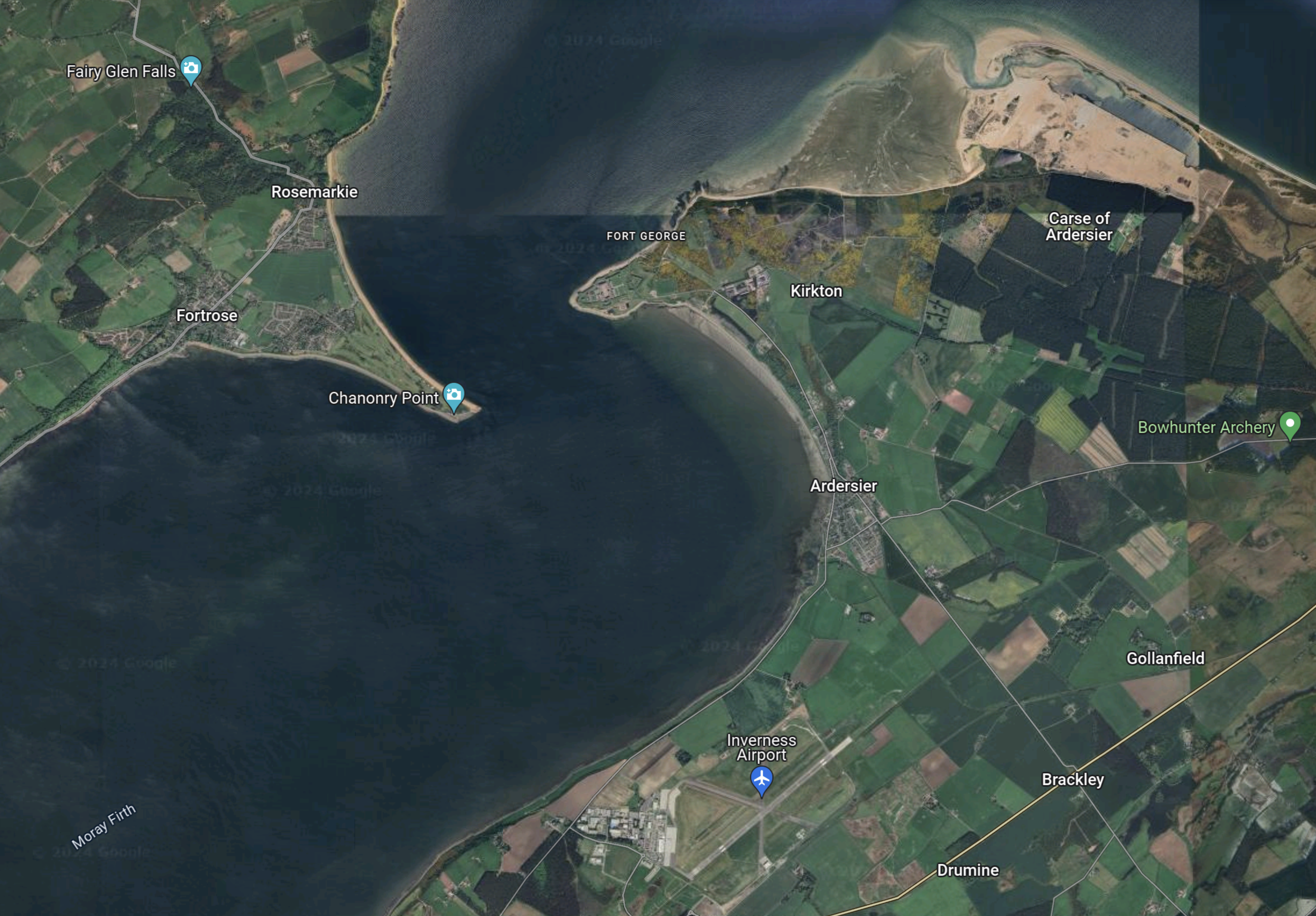
Note.
- The large expanse of water in the middle of the map is Moray Firth.
- The blue arrow at the bottom of the map indicates Inverness Airport.
- Inverness Airport, has a railway station on the Aberdeen and Inverness Line.
- The village of Ardersier is on the the Eastern bank of the Moray Firth
- The Port of Ardersier is in the North-East corner of the map.
The city of Inverness, with a population of around 48,000, is a few miles South-West of the South-West corner of the map.
Which Windfarms Will Be Built And Serviced From The Port Of Ardersier?
This map shows the various ScotWind leases, around the North of Scotland.

The numbers are Scotwind’s lease number in their documents.
These are the Scotwind wind farms to the North-East of Scotland, that could reasonably be assumed to be built and served from the Port of Ardersier.
- 7 – DEME Concessions Wind – 200 km² – 1.0 GW – Floating
- 8 – Falck Renewables Wind – 256 km² – 1.0 GW – Floating
- 9 – Ocean Winds – 429 km² – 1.0 GW – Fixed
- 10 – Falck Renewables Wind – 134 km² – 0.5 GW – Floating
- 11 – Scottish Power Renewables – 684 km² – 3.0 GW – Floating
- 12 – BayWa r.e. UK – 330 km² – 1.0 GW – Floating
These are the Scotwind wind farms to the North-West of Scotland, that could reasonably be assumed to be built and served from the Port of Ardersier.
- 13 – Offshore Wind Power – 657 km² – 2.0 GW – Fixed or Floating
- 14 – Northland Power – 390 km² – 1.5 GW – Floating
- 15 – Magnora – 103 km² – 0.5 GW – Floating
- 16 – Northland Power – 161 km² – 0.8 GW – Floating
These ten wind farms add up to 12.3 GW.
Transport
Consider.
- Obviously, heavy components will be brought in by sea, using the Ro/Ro capable berth or using a crane to unload a barge.
- Personnel will be able to fly in for the day.
- Will some visitors rom London use the Caledonian Sleeper to and from Inverness station to get a full day on site and a good night’s sleep, whilst travelling.
But I do see a problem with local traffic to and from the site.
Hydrogen Buses
This page on the Sizewell C web site, discusses how they will use hydrogen buses.
I could see the Port of Ardersier taking a leaf out of Sizewell C’s book and run hydrogen buses to Inverness, Inverness Airport and other nearby towns.
The North of Scotland certainly won’t be short of green hydrogen to power the buses.
Hydrogen
Conclusion
If you thought that the only useful wind-driven thing to come out of Scotland was bagpipes, you had better think again.
The Port of Ardersier will be the factory and operation and maintenance port for one of the largest offshore wind industries in the world.
Dr. David Owen And The NHS Infected Blood Scandal
I am writing this post, mainly using Dr. David Owen’s Wikipedia entry.
This paragraph describes Dr. Owen’s early days as a minister in Harold Wilson’s first government and the early days of Harold Wilson’s second government
From 1968 to 1970, Owen served as Parliamentary Under Secretary of State for the Navy in Harold Wilson’s first government. After Labour’s defeat in the 1970 general election, he became the party’s Junior Defence Spokesman until 1972 when he resigned with Roy Jenkins over Labour’s opposition to the European Community. On Labour’s return to government in March 1974, he became Parliamentary Under-Secretary for Health before being promoted to Minister of State for Health in July 1974.
There is also this paragraph describing his involvement as Minister of State for Health in the NHS Infected Blood Scandal.
As Minister of State for Health he encouraged Britain to become “self-sufficient” in blood products such as Factor VIII, a recommendation also promoted by the World Health Organisation. This was principally due to the risk of Hepatitis infection from high-risk blood donors overseas who were often paid and from “skid-row” locations. David Owen has been outspoken that his policy of “Self-Sufficiency” was not put into place (although he was, himself, Minister of Health) and gave rise to the Tainted Blood Scandal which saw 5,000 British Haemophiliacs infected with Hepatitis C, 1,200 of those were also infected with HIV. It was later described in the House of Lords as “the worst treatment disaster in the history of the National Health Service”.
So why did Dr. Owen’s and the World Health Organisation’s view of making the UK “self-sufficient” in blood products such as Factor VIII not prevail?
Did Sir Brian Langstaff and his team go through minutes of cabinet meetings, when Dr. David Owen was Minister of State for Health?
Did Harold Wilson or the Chancellor; Denis Healey overrule David Owen’s view, as they needed what little money we had for other purposes?
I must admit, that if I had been in Dr. Owen’s position in 1974 and the Government were proposing to something against, my engineering experience, I would have resigned. Note that Dr. Owen did resign in 1972, over Labour’s opposition to the European Community.
If any doctors are reading this, who were qualified at the time, I’d like to hear their views.
Conclusion
One way to ascertain the truth, would be to charge Dr. Owen with something serious and led the Law decide.
Thoughts On The NHS Infected Blood Scandal
In the early 1970s, I was working with the Chief Management Accountant of a retail bank, writing a computer system to analyse and compare the performance and costs of all their branches.
We used scatter diagrams and other graphical techniques to show all the branches on single sheets produced by line printers on a powerful time-shared computer. It would be so much easier today.
Any branch not following the rules was often found sitting alone away from the mass of branches on the graphs.
I remember one branch had costs, that were much higher than expected. It turned out it was the Stevenage Branch, where the premises were rented rather than owned freehold.
Expanding The System To Other Industries
The Accountant, who had also been Chief Accountant of a FTSE 500 company, felt that the techniques we had developed had other applications in the management and auditing of large companies and organisations.
Sadly my partner in crime, died of cancer and I went on to other things.
From my own generally good family experiences of the NHS, I feel that this sort of analysis used rigorously could give early warning of some of the scandals we’ve seen in the NHS.
Around the turn of the century, I used similar techniques to improve the manufacturing quality in a diesel engine factory.
Conclusion
Perhaps we need an independent Office of NHS Responsibility?
Fifth Hydro Project Proposed At Loch Ness
The title of this post. is the same as that of this article on the BBC.
This is the sub-heading.
The local community is to be asked for its views next week on plans for a new hydro-electric scheme at Loch Ness.
These three paragraphs introduce the new scheme.
Glen Earrach Energy’s, external (GEE) pumped storage hydro project is the fifth hydro scheme proposed for the Loch Ness area.
The company said its project on Balmacaan Estate would create clean energy while protecting the environment, and create 600 on-site jobs.
But concerns have been raised about the number of planned schemes, with Ness District Salmon Fishery Board worried about the effect on wild fish.
The project has a web site, which has a section entitled About The Project, where this is said.
Glen Earrach Energy, which means “Valley of Spring” in Gaelic, stands at the forefront of energy innovation. The Pumped Storage Hydro (PSH) project, located at Balmacaan Estate, Scotland, is a critical component for achieving a net-zero grid by 2030.
The project prioritises environmental preservation and biodiversity enhancement while achieving outstanding efficiency in energy storage and generation.
This ensures a healthier and more sustainable balance between harnessing natural energy resources and the maintenance and reinforcement of the surrounding ecosystem.
Note.
- It doesn’t say, but it looks like Glen Earrach Energy aim to complete the project by 2030.
- Glen Earrach Energy also seem to be playing a strong environmental card.
But nothing is said about the size of the project.
This article on Business Insider, which is entitled £3 billion Loch Ness Hydro Project Plans Unveiled, does give some details.
- Potential Investment – More than £2 billion
- Output – 2 GW
- Storage Capacity – 30 GWh
- The project could create at least 600 on-site construction jobs in Scotland over a six-year period, plus many thousands more locally in the supply chain.
It is larger, than SSE’s flagship Coire Glas pumped storage hydroelectric power station, which is planned to be a 1.5 GW/30 GWh station, at the other end of the Great Glen.
I have some thoughts.
The Existing Hydro Schemes On Loch Ness
According to the BBC article, there are two existing hydro schemes on Loch Ness.
- Foyers is described on this web site and is a reasonably modern 305 MW/6.3 GWh pumped storage hydroelectric power station, that was built by SSE Renewables in the last fifty years.
- Glendoe is described on this web site and is a modern 106.5 MW conventional hydroelectric power station, that was built by SSE Renewables in the last twenty years.
Foyers and Glendoe may not be the biggest hydroelectric power stations, but they’re up there in size with most solar and onshore wind farms. Perhaps we should look for sites to develop 100 MW hydroelectric power stations?
The Proposed Hydro Schemes On Loch Ness
According to the BBC article, there are four proposed hydro schemes on Loch Ness.
- Coire Glas is described on this web site and will be a 1.5GW/30 GWh pumped storage hydroelectric power station, that is being developed by SSE Renewables.
- Fearna is described on this web site and will be a 1.8GW/37 GWh pumped storage hydroelectric power station, that is being developed by Gilkes Energy.
- Loch Kemp is described on this web site and will be a 600MW/9 GWh pumped storage hydroelectric power station, that is being developed by Statera.
- Loch Na Cathrach is described on this web site and will be a 450MW/2.8 GWh pumped storage hydroelectric power station, that is being developed by Statktaft.
In addition there is, there is the recently announced Glen Earrach.
- Glen Earrach is described on this web site and will be a 2GW/30 GWh pumped storage hydroelectric power station, that is being developed by Glen Earrach Energy.
Note.
- The total power of the seven pumped storage hydroelectric power stations is 4.76 GW.
- The total storage capacity is 85.1 GWh.
The storage capacity is enough to run all turbines flat out for nearly five hours.
Could Glendoe Be Updated To Pumped Storage?
The Wikipedia entry for the Glendoe Hydro Scheme mentions pumped storage several times.
In Glendoe Hydro Power Station, I estimate that a Glendoe pumped storage scheme could be perhaps 50 % bigger than the system at Foyers.
I feel that if more storage capacity is needed in the Highlands, then Glendoe could be converted to pumped storage.
 The Anonymous Widower