London’s Other New Underground Line
In the middle of next month, Phase One of London’s other new Underground line will open.
The Bank station upgrade may only be a short section of new Southbound tunnel and track for the Northern Line and a much expanded station, but it promises to do proportionally for the City of London, what Crossrail will do for the whole of London.
The lucky Ian of IanVisits has been allowed to descend into the depths of the new section of the station with his camera and has posted this report on his web site, which is entitled Behind The Scenes At Bank Tube Station’s Huge Upgrade Project. The report contains twenty-four revealing photographs.
If ever there was a must-read, then Ian’s article must be it.
Blue Gem Wind
Principle Power are the designers of the WindFloat.
The Projects page of the Principle Power web site led me to a project called Erebus. This is Principle Power’s description of the project.
The Celtic Sea, located between the United Kingdom and Ireland, holds an estimated 50 GW of offshore wind resource. The 96 MW Erebus project, located offshore Pembrokeshire, Wales, is a flagship project planned by Blue Gem Wind, a joint venture between Total and Simply Blue Energy, to unlock the potential of this region.
The project will feature between 7 and 10 turbines on WindFloat® floating platforms located approximately 44 km southwest of the Pembrokeshire coastline.
The Erebus project will see the deployment of a fully industrialized WindFloat® and represents a stepping stone that will allow the local supply chain to build capabilities for the delivery of larger projects under development in the Celtic sea region.
Note.
- Developing 50 GW of offshore wind in the Celtic Sea is not a small amount of wind power.
- The 96 MW Erebus project would appear to be the first project in the Celtic Sea.
- The turbines would be between 9.5 and 14 MW.
- The Principle Power website states that the water depth of the Erebus wind farm is seventy metres.
- The deployment of a fully industrialized WindFloat.
- The Erebus wind farm is being developed by Blue Gem Wind.
It would be larger than the current world’s largest floating wind farm, which is the Kincardine Wind Farm.
Who Are Blue Gem Wind?
Blue Gem Wind have a web site, with a picture of three turbines riding on WindFloats and a couple of support boats and this mission statement.
Floating Offshore Wind
A new generation of energy in the Celtic Sea
The Our Projects page shows a good picture and says this.
Floating wind is set to become a key technology in the fight against climate change with over 80% of the worlds wind resource in water deeper than 60 metres. Independent studies have suggested there could be as much as 50GW of electricity capacity available in the Celtic Sea waters of the UK and Ireland. This renewable energy resource could play a key role in the UK meeting the 2050 Net-Zero target required to mitigate climate change. Floating wind will provide new low carbon supply chain opportunities, support coastal communities and create long-term benefits for the region.
A header indicates a stepping-stones approach to assist the local supply chain and says this.
We believe that a stepping stone approach to the development of floating wind in the Celtic Sea brings a number of benefits. Starting with smaller demonstration and early-commercial projects, increasing in size, will help to capture the highest local supply chain content. It will also maximise knowledge transfer and facilitate a sustainable transfer to a low carbon economy.
Because of this focus on stepping stone projects we have proposed Erebus, a 96MW test and demonstration project followed by Valorous, a 300MW early-commercial project.
These links give more details of the two projects.
- Erebus – 100MW Test & Demonstration project in the Celtic Sea
- Valorous – A 300MW Early Commercial project in the Celtic Sea
It appears that the company is taking a sensible approach.
- They are starting small and building up deployment.
- They are using proven WindFloat technology.
- They are developing a local supply chain.
This Google Map shows the area of the two wind farms.
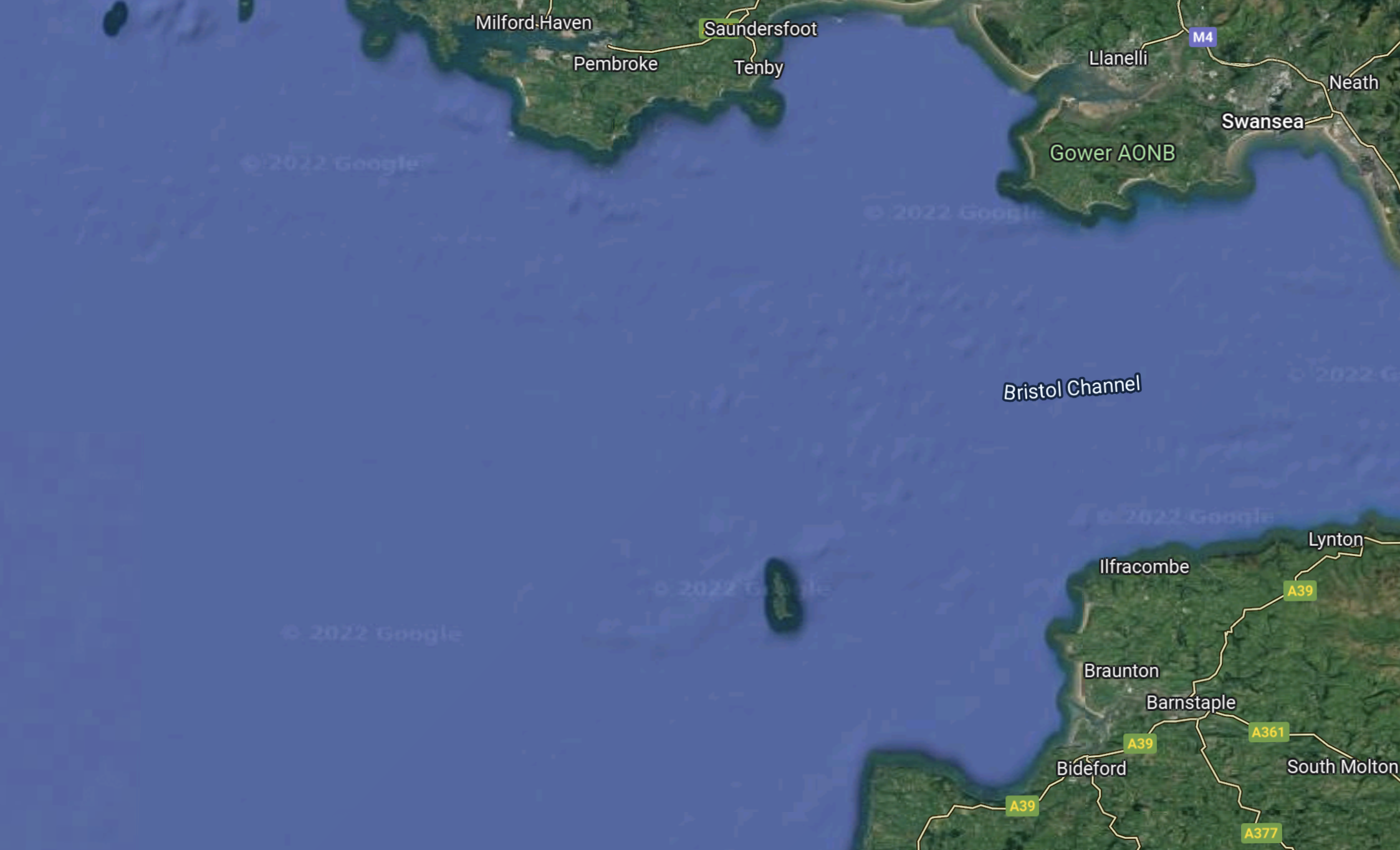
Note.
- Pembroke in the middle at the top of the map.
- Barnstaple and Bideford in Devon in the South-East corner of the map.
- Lundy Island off the Devon coast.
I estimate that the two wind farms will be about the Western edge of this map, with Erebus to the North of Valorous. They wouldn’t want to be too far to the West, as that would put them in the shipping lanes between Ireland and France.
Will The Turbines Be Assembled In The Milford Haven Waterway?
This Google Map shows the Milford Haven Waterway.
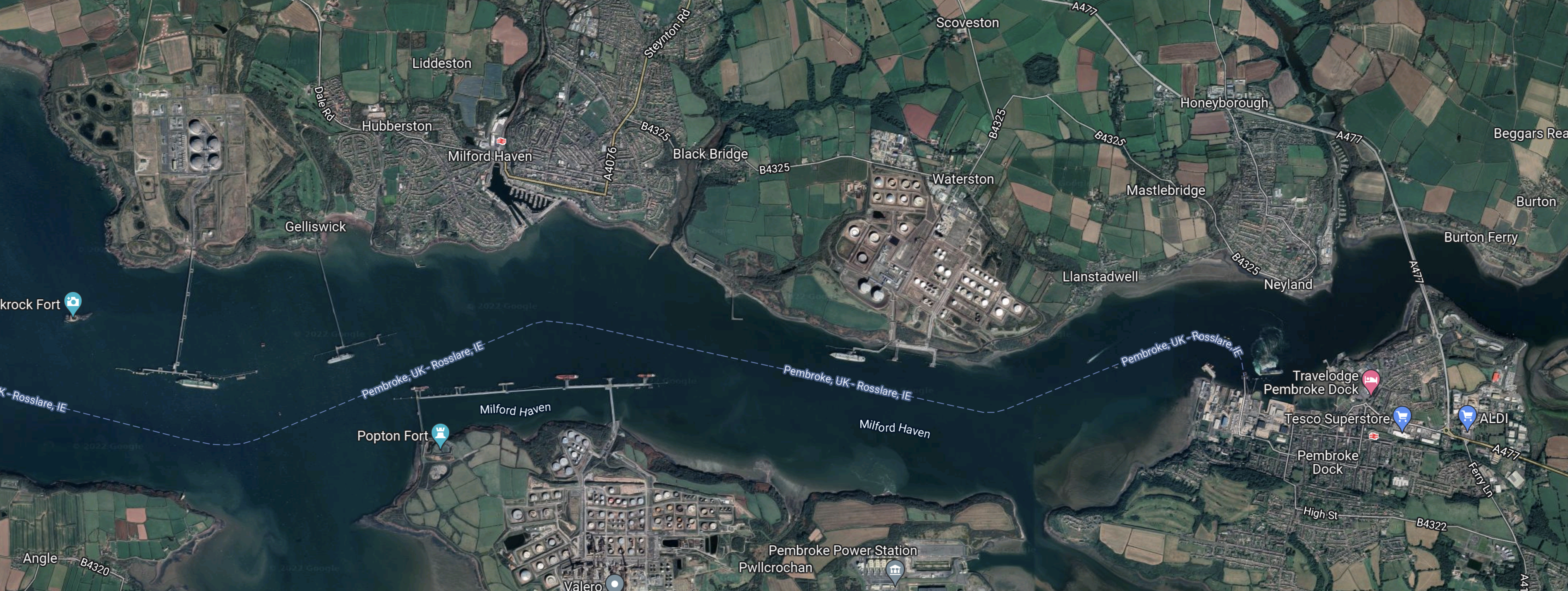
Note.
- Pembroke Dock, where Blue Gem Wind has its offices, is at the Eastern end of the map.
- The oil refineries and LNG terminals.
- Milford Haven on the North side of the waterway.
- The 2.2 GW gas-fired Pembroke power station on the South side of the waterway.
- The ferry route between Rosslare and Pembroke Dock.
But as the waterway is one of the deepest natural harbours in the world, I wouldn’t be surprised to find, that the turbines will be lifted on to the WindFloats in this waterway.
The turbines would be brought in by sea and the WindFloats would be towed in from their manufacturing site.
Where Will The WindFloats And Turbines Be Built?
There could be enough space to build the WindFloats in the Milford Haven Waterway, but I suspect they will be built in a shipyard, which is close to a supply of steel. South Wales is an obvious possibility.
I estimate that for the two wind farms between twenty-eight and forty turbines would be needed and these would probably be brought in by sea and then lifted onto the WindFloats somewhere in the Milford Haven Waterway.
It could be a very efficient process.
Will Pembroke Power Station Have A Future Role?
Consider.
- Pembroke power station is the largest gas-fired power station in Europe.
- It has a capacity of 2.2 GW.
- It was only completed in 2012, so it has many years of life yet!
- It is also probably young enough, to be able to be converted to run on hydrogen.
- It obviously will have a very good connection to the National Grid.
I would suspect that initially, the power cable from Erebus and Valorous, would use the same grid connection as the power station.
But in the future there must be some interesting ways that the wind farms and the power station can work together.
- A large electrolyser could be built to create hydrogen for heavy transport and industrial uses, from excess electricity.
- Could the oxygen from the electrolyser be used for steelmaking in South Wales?
- As natural gas is phased out the power station could be converted to hydrogen power.
- In times of low wind, the power station could make up the shortfall.
- The wind farms could be used as the primary electricity source, with the power station adding the extra power needed to meet demand.
There are certainly ways, the wind farms and the power station can work together.
Conclusion
These two related wind farms seems a good way to start wind developments between the UK and the island of Ireland.
Old Street Station – 28th March 2022
More beams have gone up at Old Street station in the last ten days.





Several beams have now been erected.
West Midlands To Run ‘Largest Hydrogen Bus Fleet’ Due To New Funding
The title of this post, is the same as that of this article on the BBC.
These are a few points from the article.
- The region is set to get 124 new hydrogen vehicles.
- The West Midlands is set to run the UK’s largest hydrogen bus fleet after securing new funding.
- The region will get 124 new buses after it won £30m from the Department for Transport to fund a switchover.
- Twenty four of the new vehicles will be articulated tram-style buses set to run on a new bus priority route between Walsall, Birmingham and Solihull.
Does the last statement mean, that they will buying a hundred double-decker hydrogen buses?
A few thoughts.
Riding Birmingham’s New Hydrogen-Powered Buses
These are a few pictures from Riding Birmingham’s New Hydrogen-Powered Buses.





They were excellent buses from Wrightbus.
The Tram Style Buses
The Belgian firm; Van Hool have a product called Exquicity. This video shows them working in Pau in France.
These tram buses run on rubber types and are powered by hydrogen.
Similar buses running in Belfast are diesel-electric.
Could these be what the article refers to as tram-style buses?
It should be noted, that the West Midlands and Pau have bought their hydrogen filling stations from ITM Power in Sheffield.
So has there has been a spot of the Entente Cordiale between Pau and the West Midlands?
Will The West Midlands Buy The Other Hundred Buses From Wrightbus?
There doesn’t seem to be any problems on the web about the initial fleet, so I suspect they will.
It should also be noted that Wrightbus make the following types of zero-emission buses.
- StreetDeck – Hydroliner FCEV – Double-deck hydrogen bus
- StreetDeck – Electroliner BEV – Double-deck battery bus
- GB Kite – Hydroliner FCEV – Single-deck hydrogen bus
- GB Kite – Electroliner BEV – Single-deck battery bus
These would surely enable the West Midlands to mic-and-match according to their needs.
Imagine Peace
This poster has appeared opposite Dalston Junction station.





If you can’t read the two small words underneath, it just says “love, yoko 2022”
Australian Start-Up Eyes Disused Mine Shafts For Giga-Scale Gravity Energy Storage
Thye title of this post, is the same as that of this article on Renew Economy.
This is the first paragraph.
A newly launched Australian start-up has unveiled its own take on gravitational energy storage technology that will use super-heavy weights in legacy mine shafts to capture and release energy, with around 3GWh of potential storage capacity already identified for development.
Note.
- The company is called Green Gravity.
- I can’t find a web site.
The idea seems very much like Gravitricity.
- The energy stored seems about the same order of magnitude.
- In Disused Coal Mine Could Host Gravity Energy Storage Project, I describe how Gravitricity will be using coal mines to store energy.
Gravitricity’s ideas may be patented.
Hysata – Electrolyser Breaks Efficiency Records, Enabling World-Beating Green Hydrogen Cost
The title of this post, is the same as that of this article on Hydrogen Central.
These three paragraphs explain what Hysata have achieved.
Hysata – electrolyser breaks efficiency records, enabling world-beating green hydrogen cost.
Hysata’s world-leading hydrogen electrolyser technology has been recognised on the global stage with ground-breaking research published in top tier peer-reviewed scientific journal Nature Communications.
The research confirms Hysata’s ‘capillary-fed electrolysis cell’ can produce green hydrogen from water at 98% cell energy efficiency, well above International Renewable Energy Agency’s (IRENA) 2050 target and significantly better than existing electrolyser technologies, enabling a hydrogen production cost well below A$2/kg (US$1.50/kg).
Note.
- Hysata are an Australian company.
- The research and its results have have met the gold standard of pier review in a respected journal.
Their efficiency levels would appear to be breathtaking.
I have some more information and a couple of thoughts.
The Technology
This article on New Atlas is entitled Record-Breaking Hydrogen Electrolyzer Claims 95% Efficiency, gives a full overview of the technology.
It does appear that Hysata have shown tremendous attention to detail to raise the efficiency.
The Efficiency
In Can The UK Have A Capacity To Create Five GW Of Green Hydrogen?, I said the following.
Ryze Hydrogen are building the Herne Bay electrolyser.
- It will consume 23 MW of solar and wind power.
- It will produce ten tonnes of hydrogen per day.
The electrolyser will consume 552 MWh to produce ten tonnes of hydrogen, so creating one tonne of hydrogen needs 55.2 MWh of electricity.
55.2 MWh/tonne is 55.2 kWh/kg.
Hysata are claiming on their web site, that their electrolysers have 95% efficiency, which is 41.5 kWh/kg.
- A megawatt of electricity at Herne Bay will produce 18.1 Kg of hydrogen.
- A megawatt of electricity in a Hysata electrolyser will produce 24.1 Kg of hydrogen.
That is 33 % more.
Conference Calls For More Freight Routes To And From Spain
The title of this post, is the same as that of this article on Railway Gazette.
This is the first paragraph.
Salvador Galve, Chairman of the Railway Commission of the General Council of Industrial Engineers, presented the European Alliance for the Development of Railway Corridors in the Iberian Peninsula initiative at a conference held in Madrid on March 9.
These are some points from the article.
- Less than 4% of freight is currently transported by rail in Spain, compared with an average of 18% across the EU.
- The Spanish government wants to raise this to 20%.
- Incidentally, in the UK, rail freight is at a level of 5 %.
- Italy has seven main lines connecting it to its neighbours, Spain has only two!
- Spain also has a break of gauge, whereas the UK and Italy do not!
- Plans exist for more freight corridors in Spain, and linking these to ports in North Africa and logistics hubs in the rest of Europe.
- Zaragoza, could be turned into a key southern European logistics hub, linked by tunnels to the main line between Toulouse and Bordeaux.
But to me the most interesting plan is set out in this paragraph.
On March 1 the Infrastructure Ministry gave its provisional approval for study into the feasibility of converting the single track, non-electrified line from Huesca to Canfranc from 1 668 mm gauge to 1 435 mm gauge, ahead of any possible reconstruction of the through route to Pau in France in the longer term.
It has always been on my bucket list to visit the magnificent Canfranc station.
UK On Track To Reach 4,000 Zero Emission Bus Pledge With £200 Million Boost
The title of this post, is the same as that of this press release from the Government.
These are the main points of the press release.
- Nearly 1,000 more zero-emission buses to be funded in towns and cities across the country, bringing the total funded in England to 2000 so far under this government.
- A further 600 zero-emission buses have been funded in Scotland, Wales and Northern Ireland.
- Comes as consultation launched on ending sale of all new non-zero emission buses from 2025 to 2032.
- Government continues taking unprecedented action to hit net zero and level up transport across the country.
Areas to get the new buses include.
- Blackpool
- Greater Manchester
- Hertfordshire
- Norfolk
- North Yorkshire
- Nottingham
- Oxfordshire
- Portsmouth
- South Yorkshire
- West Midlands
- West Yorkshire
- York
I would also like to see the government fund trials for the conversion of suitable buses to zero carbon. I certainly believe that London’s New Routemaster buses could be converted to hydrogen.
Sizewell C Nuclear Power Station: Government To Take 20% Stake
The title of this post, is the same as that of this article on the BBC.
This is the first three paragraphs.
The government plans to take a 20% stake in a £20bn large-scale nuclear plant at Sizewell, the BBC has learned.
French developer EDF will also take a 20% stake in the Suffolk power station.
Ministers hope the confirmation of two cornerstone investors will encourage infrastructure investors and pension funds to take up the remaining 60%.
I used to live near Sixewell and the general feeling of local Suffolk people is not particularly against having nuclear power stations in their back yards.
There are several small points in favour of Sizewell C.
- Sizewell has been operating nuclear power plants safely since the 1960s.
- Leiston, which is the nearest town, has a very strong engineering tradition.
- Leiston also improved by several notches during the building of Sizewell B.
- The site is accessible by rail and possibly sea with the right ship.
- Nuclear fuel can be brought in and out by train.
- If they spent a small amount on the train service to Saxmundham, construction workers could come in by train.
- Sizewell C has been proposed to be used to generate hydrogen for Freeport East at the Ports of Harwich an Felixstowe.
- The power cable to take electricity from Sizewell C towards London is already built.
- Sizewell is much more convenient to get to from London, than other possible nuclear sites.
Overall, I feel that Sizewell is a good place for nuclear power station.
On the other hand, there are these points against the station.
- There will be at least 6.7 GW of wind farms built off the East Anglian coast before Sizewell C is completed.
- There may be substantial objection to the new power station.
- Large nuclear power stations are rarely built to time and on budget.
- I feel that if we go the nuclear route, that small modular nuclear reactors may be better.
I can understand why Governments like Sizewell as a nuclear power station site.
 The Anonymous Widower