My Unusual Feet
My feet are often a red colour, as is shown in these pictures.




Note.
- It’s always the left that’s the reddest.
- They often itch, which I usually can cure with lots of Body Shop Hemp Foot Cream.
- I have no hard skin on my feet.
- I used to suffer badly from plantar fasciitis, but the foot cream seems to have stopped it.
Yesterday, I went to Liverpool on the train.
No problems, but this morning when I got out of bed and pulled my right calf muscle. Not badly as I was able to cure it with a bit of light massage and a hot bath.
I also found that in twenty-four hours, I’d lost nearly a kilo and my left foot was very red.
This is not the first time, I’ve had troubles after travelling on Class 390 trains. In another incident my left hand stopped working. That ended up with an overnight stay in hospital.
I’m no medic, but I do wonder, if I have a very leaky skin. I’ve mused on this before in My Unusual Body.
But does it let water molecules through, but the larger red corpuscles in my blood can’t get out, so my skin looks red?
Could it also explain, why I never need a plaster for an injection or when a blood sample is taken? Perhaps, the skin just parts for the needle and then closes after it’s taken out, so that the blood doesn’t leak.
To return to the Class 390 trains, I just wonder if their air-conditioning is set, so that the temperature and humidity is just right to suck the water out of my body. I certainly don’t get any problems on InterCity 225s, Hitachi AT-300 trains or Stadler Class 745 trains.
Norfolk Vanguard Offshore Wind Farm Re-approved By Government
The title of this post, is the same as that of this article on the BBC.
These are the two introductory paragraphs.
An offshore wind farm capable of generating electricity for nearly two million homes has been re-approved by government after consent was previously overturned by a High Court judge.
Vattenfall’s 1.8-gigawatt Norfolk Vanguard project had been granted consent by the Department for Business, Energy and Industrial Strategy (BEIS).
Note.
- Norfolk Boreas and Norfolk Vanguard are a pair of 1.8 GW offshore wind farms to be developed 72 and 47 kilometres off the Norfolk coast by Swedish company; Vattenfall.
- Hinckley Point C will have a capacity of 3.25 GW.
This map shows the two fields in relation to the coast.
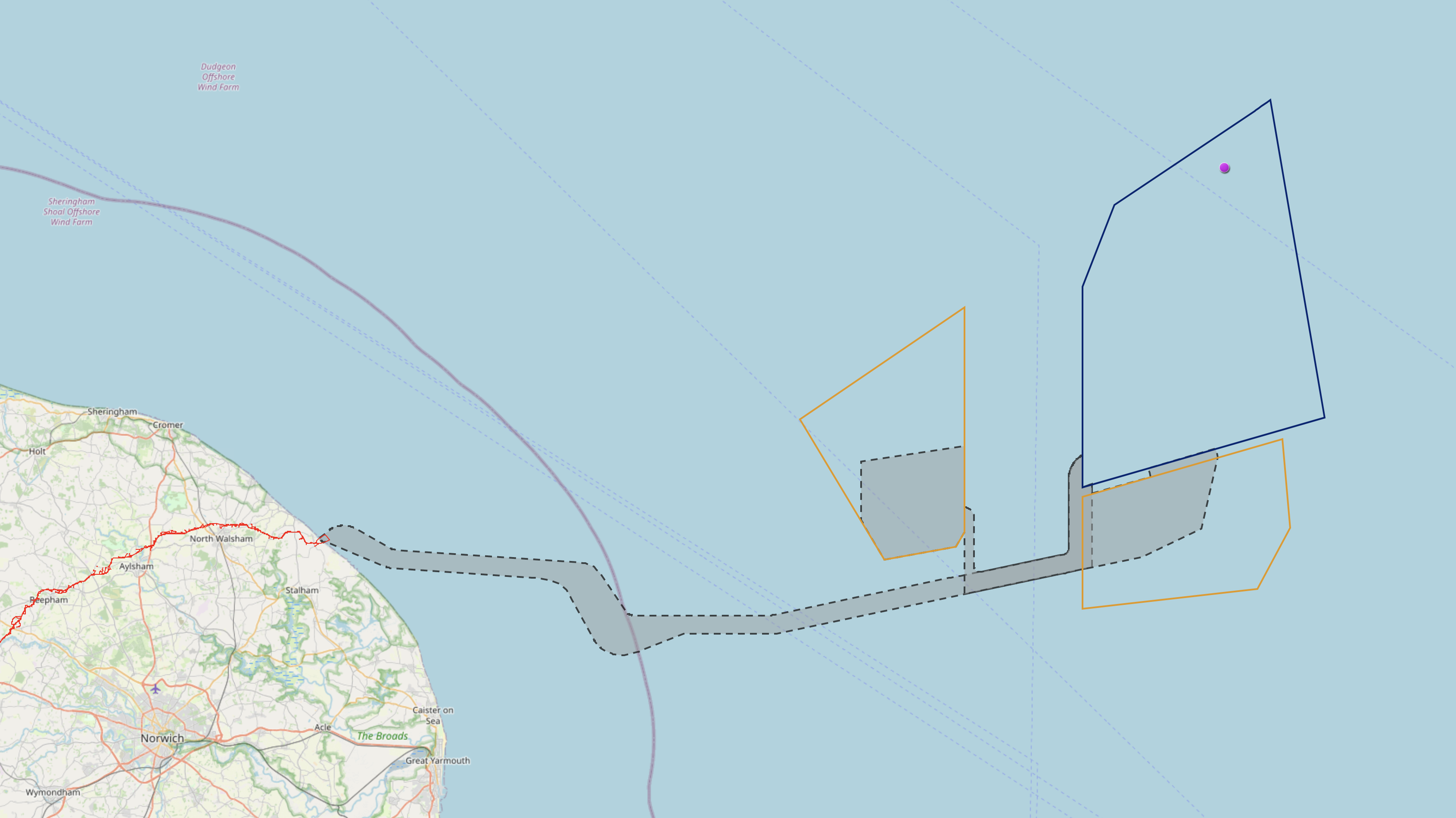
Note.
- The purple line appears to be the UK’s ten mile limit.
- Norfolk Boreas is outlined in blue.
- Norfolk Vsnguard is outlined in orange.
- Cables will be run in the grey areas.
This second map shows the onshore cable.
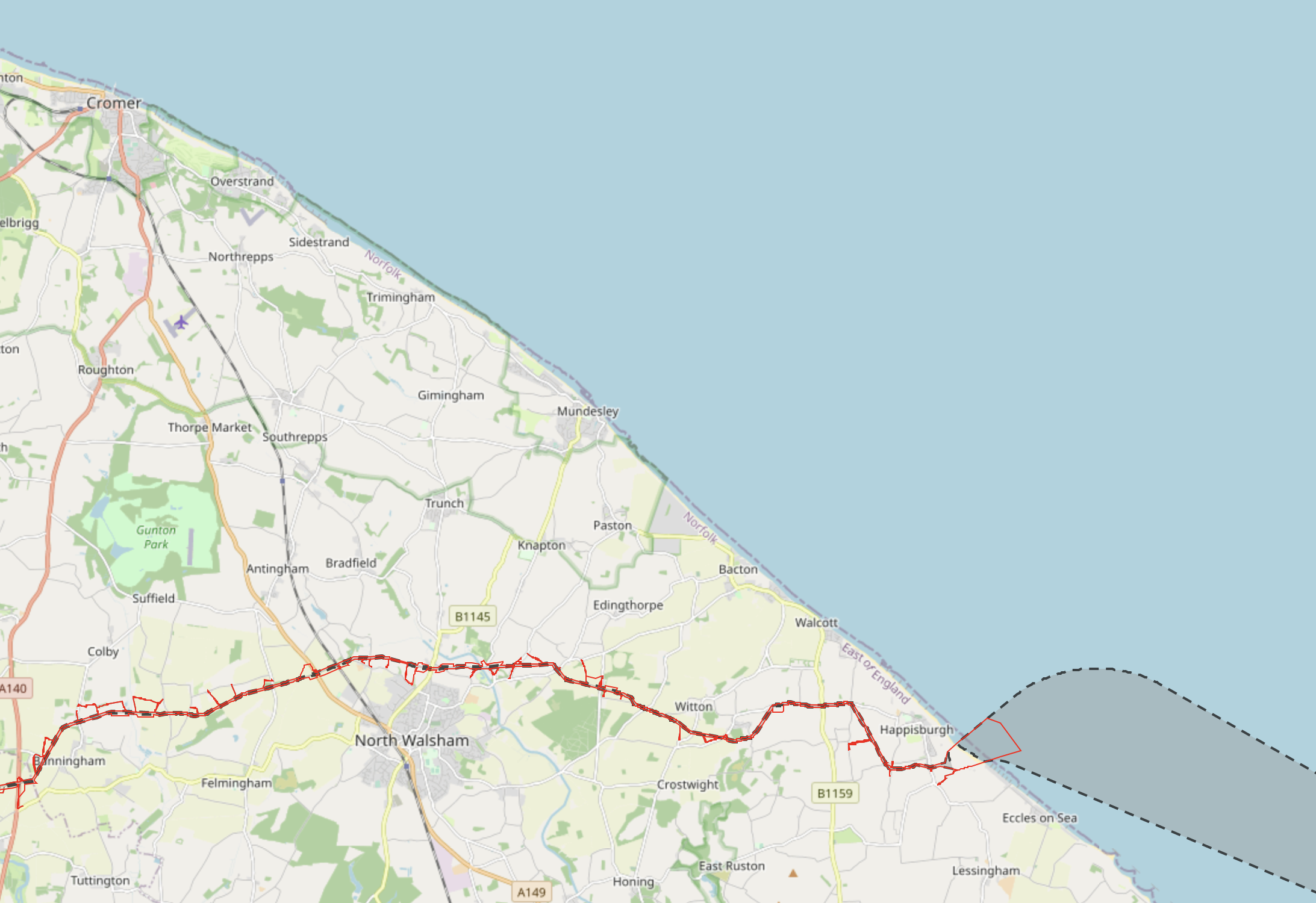
Note.
- The cables are planned to come ashore between Happisburgh and Eccles-on-Sea.
- Bacton is only a short distance up the coast.
- The onshore cable is planned to go from here across Norfolk to the Necton substation.
But the planning permission was overturned by a legal ruling.
This article on the BBC is entitled Norfolk Vanguard: Ministers Wrong Over Wind Farm Go-Ahead, Says Judge.
These are the first four paragraphs.
A High Court judge has quashed permission for one of the world’s largest offshore wind farms to be built off the east coast of England.
The Norfolk Vanguard Offshore Wind Farm was granted development consent in July by the Secretary of State for Business, Energy and Industrial Strategy (BEIS).
But Mr Justice Holgate overturned the decision following legal action from a man living near a planned cable route.
A Department for BEIS spokeswoman said it was “disappointed by the outcome”.
This is a paragraph in today’s BBC article.
Kwasi Kwarteng, Secretary of State at the Department of Business, Energy and Industrial Strategy, granted development consent for the wind farm, having re-determined the application.
So will we be back to the Law Courts?
In Is There A Need For A Norfolk-Suffolk Interconnector?, I said this.
But seriously, is it a good idea to dig an underground cable all the way across Norfolk or in these times build a massive overhead cable either?
Perhaps the solution is to connect the Norfolk Boreas And Norfolk Vanguard wind farms to a giant electrolyser at Bacton, which creates hydrogen.
- The underground electricity cable across Norfolk would not be needed.
- Bacton gas terminal is only a few miles up the coast from the cable’s landfall.
- The UK gets another supply of gas.
- The hydrogen is blended with natural gas for consumption in the UK or Europe.
- A pure hydrogen feed can be used to supply hydrogen buses, trucks and other vehicles, either by tanker or pipeline.
- Excess hydrogen could be stored in depleted gas fields.
Thye main benefit though, would be that it would transform Bacton gas terminal from a declining asset into Norfolk’s Hydrogen Powerhouse.
For more information on blending hydrogen into our natural gas supply see HyDeploy.
Glendoe Hydro Power Station
When I think of hydro-electric power stations in the UK, I generally, think that most of the hydro-electric power stations were built years ago by organisations like the North of Scotland Hydroelectric Board. These power stations were one of the staples of the Meccano Magazine, of which I was a long-term subscriber in the 1950s.
But Glendoe hydro-electric power station is relatively new having been opened in 2009. At only 100 MW, the power-station may not be large in comparison to others around the world, but it does show what can be built in the Highlands of Scotland.
This Google Map shows the layout of the power station.
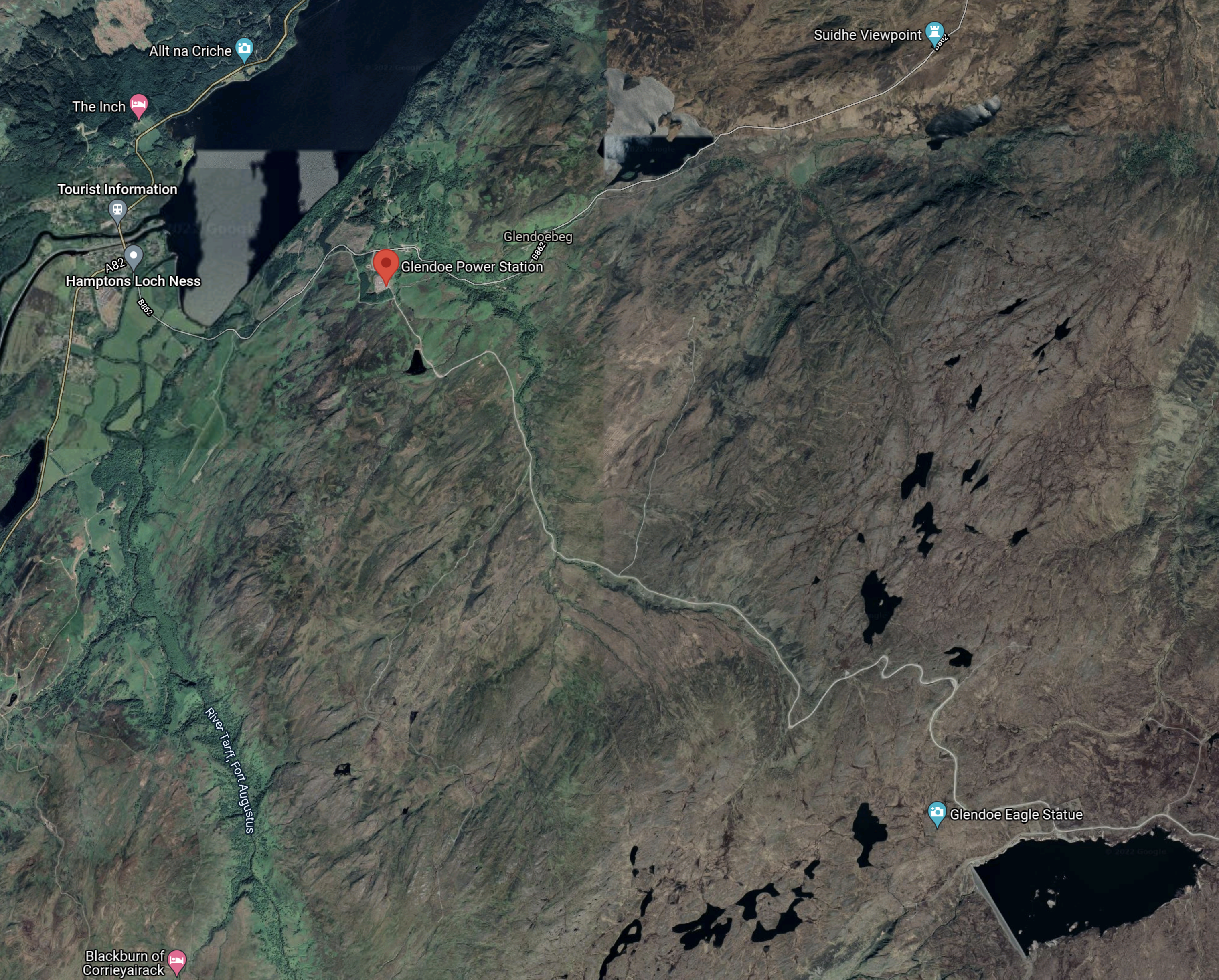
Note.
- The red arrow indicates the location of Glencoe power station, which is underground.
- To the North of the power station, is the Southern end of Loch Ness.
- In the South-Eastern corner of the map there is the lake from which the power station draws its water.
- The dam is at the Western end of the lake.
According to this article on Power Technology, the project cost £160 million.
This extract from a page on the SSE Renewables web site, describes the layout of the tunnels and the operation of the power station.
Engineers began planning the Glendoe project as far back as October 2001. Formal construction work at the site started over four years later, in January 2006. It involved constructing a 960 metre-wide dam on the River Tarff to create a new reservoir some 600 metres above the power station, giving it the greatest head of any hydro electric power station in the UK.
An 8.6 kilometre tunnel connects the reservoir to the power station that is built 250 metres below ground level, about two kilometres from the banks of Loch Ness. Although some of the tunnel was created using traditional drill and blast techniques that would have been familiar to the Tunnel Tigers of the last century, much of its length was bored out using a massive tunnelling machine named Eliza Jane by local schoolchildren.
The SSE page also describes the working and living conditions of those who built the scheme.
Most lived in specially constructed camps high in the hills above Loch Ness, braving brutal weather conditions in winter, and the fearsome Scottish midges in the summer.
The SSE page also gives the main use of the power station.
Today, the main operating feature of Glendoe is its ability to react quickly to changing demand for electricity, being able to reach full output in just 90 seconds.
So when there is an important football or rugby match on the television, it is ideal to supply the surge of electricity, when everybody puts on the kettle at half time.
Could This Power Station Have A Pumped Storage System Added?
Consider.
- There is a large lake six hundred metres above the power station.
- Loch Ness is a large source of water at the bottom of the mountain.
- Every tonne or cubic metre of water pumped into the upper lake would store 1.63 kWh of electricity.
- The world’s and the UK’s tunneling engineers are getting better and more ambitious.
- When this power station was built in the early years of this century, there wasn’t the large amount of wind turbines in Scotland, that there are now.
I suspect, it’s an idea that’s been looked at, but the costs or the distance to pump the water might kill it.
If a second project was the same size as the first, it would cost £210 million based on inflation.
But.
- It wouldn’t need another dam or a substation to connect to the National Grid.
- There would probably be a need for extra excavation at the power station to put in the pumps.
- I suspect it would need an extra tunnel to get the water uphill.
- One tunneling engineer told me, as with sex, digging a second tunnel is easier.
The main benefit, would be that it would be hidden infrastructure.
As to the energy storage capacity, I estimate from maps that the top reservoir at Glendoe is about half the size of Loch Mohr at Foyers power station, but the head is 600 metres as against 197 metres. As Foyers can store 10 GWh, it looks to me, that Glendoe could store around 15 GWh.
Also, as Glendoe power station was designed and built after the successful conversion of Foyers to a pumped storage station, I wouldn’t be surprised to find that Glendoe was designed, so that the station could be converted to pumped storage at a later date.
Conclusion
This scheme will be seriously looked at for extension with a pumped storage facility.
National Grid Bets On Surge Pricing And Electric Cars To Avoid Another Energy Crisis
The title of this post is the same as that of this article on the Telegraph.
These are the first few paragraphs.
With wind supplies forecast to be low and other energy sources offline, a power crunch was looming by teatime the next day.
A call for help went out on a Tuesday afternoon and at 4.30pm on the Wednesday, electric car drivers plugged in special chargers to export power from their car batteries back to the grid, as part of a trial run by Ovo Energy.
Their efforts in November 2020 may have amounted to only a tiny portion of the power needed on that day, but it was a taste of things to come.
Cars and other devices will be both a source of electricity demand and a helpful tool to keep the lights on as the UK tries to build a much greener energy system at the least expense.
It is as the article says the shape of things to come.
I also believe that long-term car parking at places like airports will become storage batteries in the future. You will tell your car, when you will be returning and it will be fully charged to drive home, when you arrive. If you are running late, you would probably use an app to tell your car the new arrival time.
These developments will all be part of the Internet of Power.
The Future Of The Class 387 And Class 379 Trains
This post is to try to get some logic into everybody’s comments on UK’s First 100mph Battery-Diesel Hybrid Train Enters Passenger Service, which are about the Class 379 trains.
Here are my thoughts about the current situation.
Class 379 Trains
I regularly use Hackney Downs and Liverpool Street stations.
A few months ago, you would see Class 379 trains on services to Cambridge and Hertford North.
At the present time, you rarely see them, as these services now seem to be run by new Class 720 trains, with the Stansted services being run by Class 745 trains.
There are also articles like this one on Rail Technology Magazine, which is entitled Greater Anglia’s New Rolling Stock Helps To Drive Record Autumn Results.
These are the first three paragraphs.
Greater Anglia’s new rolling stock has helped drive the operators record-beating autumn performance results over the challenging autumn months.
During autumn 2021 Greater Anglia recorded an overall punctuality score of 94.48% from 19th September 2021 – 8th January 2022.
This was the best autumn performance ever recorded by the train company.
It would appear that Greater Anglia are pleased with their new stock, which surely means that the thirty Class 379 trains can be moved on, stored or converted to battery-electric operation.
c2c’s Class 387 Trains
c2c has six Class 387 trains, which are similar to the Class 379 trains.
Currently, because of cracks in Class 800 trains, three of them are on loan to GWR.
But in the next year or so, these six trains will be moved on or stored as c2c have ordered twelve Class 720 trains to replace the Class 387 trains.
Southern’s Class 387 Trains
Southern has twenty-seven Class 387 trains for the Gatwick Express, of which three are used by Great Northern, who are a sister company of Southern, and six are on loan to GWR
Great Northern’s Class 387 Trains
Great Northern has twenty-nine Class 387 trains of its own and three on loan from Southern.
These trains are used mainly on Cambridge, Ely and Kings Lynn services out of King’s Cross.
Great Western Railway (GWR)’s Class 387 Trains
Great Western Railway has forty-five Class 387 trains of its own, three on loan from c2c and six on loan from Southern.
The Battery-Electric Class 379 Train
I rode this prototype train in 2015.

An Outwardly Normal Class 379 Train
I think it is reasonable to assume, that as battery technology has improved in the seven years since I rode this train, that converting Class 379 trains to battery-electric operation would not be a challenging project.
Creating A Battery-Electric Class 387 Train
If the Class 387 train is as internally similar to the Class 379 train as it outwardly looks, I couldn’t believe that converting them to battery-electric operation would be that difficult.
Conclusion
I feel the way to proceed is to create a small fleet of both battery-electric Class 379 and Class 387 trains and assess their performance, reliability and customer acceptance.
Macron Refused To Take Russian Covid Test
The title of this post is the same as that of this article on the BBC.
These are the first four paragraphs.
French President Emmanuel Macron refused a Russian Covid test ahead of his meeting with Russia’s Vladimir Putin, the Kremlin has confirmed.
The test required a health protocol that was unacceptable and did not fit with the French leader’s schedule, a French source told the BBC.
It follows reports that Mr Macron refused the PCR test over fears the Russians would get hold of his DNA.
The leaders subsequently held a socially-distanced meeting on Monday.
The article is accompanied by an hilarious picture of the two leaders at each end of a long marble table, which is crying out for a caption like Who Isn’t Using Lifebuoy?
Seriously though, if the Russians wanted Macron’s DNA, there are ways.
- Send his water glass or coffee cup to a lab.
- Make sure Macron uses a special toilet that collects his pee, poo and toilet paper.
- It might even be possible to collect it off the marble table.
I suspect that the Russians have collected Macron’s fingerprints from the table for some nefarious purposes.
UK’s First 100mph Battery-Diesel Hybrid Train Enters Passenger Service
The title of this post, is the same as that of this article on ITV.
These are the first three paragraphs.
The UK’s first 100mph battery-diesel hybrid train is entering passenger service to cut carbon emissions and boost air quality.
It was developed by adding a powerful battery to a 20-year-old diesel train to reduce fuel consumption and CO2 emissions by 25%, according to owner Porterbrook.
The firm added that the two-carriage train, named HybridFLEX, also provides a 75% decrease in noise and a 70% decrease in nitrogen oxide.
The battery-diesel hybrid transmission is from MTU, who are a Rolls-Royce company and they go further with this press release which is entitled World Premiere: MTU Hybrid PowerPack From Rolls-Royce Enters Passenger Service.
This is the first paragraph.
Rolls-Royce, Porterbrook and Chiltern Railways are making rail history together with a climate-friendly world premiere: A hybrid diesel-battery-electric train that reduces CO2 emissions by up to 25% entered passenger service in the UK today for the first time. The so-called HybridFLEX train is powered by two mtu Hybrid PowerPacks and is operated by Chiltern Railways on the route between London Marylebone and Aylesbury. Together with the leasing company Porterbrook and Chiltern Railways, Rolls-Royce has converted a Class 168 DMU into the HybridFLEX train. The partners are proving that existing rail vehicles can be used in a climate-friendly way without the need to install complex and expensive new infrastructure. It is the world’s first regular passenger operation with mtu Hybrid PowerPacks, of which 13 have already been ordered.
This is significant for the railways of the UK.
The train that has been converted is a Class 168 train, which itself had been converted from a Class 170 train, when it transferred to Chiltern Railways in 2016.
I think this means that all Bombardier Turbostars in Classes 168, 170, 171 and 172 can probably be fitted with MTU Hybrid PowerPacks.
That is the following numbers of trains and cars.
- Class 168 – 28 trains – 86 cars
- Class 170 – 139 trains – 372 cars
- Class 171 – 20 trains – 56 cars
- Class 172 – 39 trains – 93 cars
Note.
- This totals to 226 trains and 607 cars.
- As each car has an engine, this will be an order of 607 PowerPacks, if all trains were to be converted.
This could certainly help to meet the Government’s aim of getting rid of all diesel only trains by 2040.
Can The CAF Civities Be Converted?
There are three Classes of CAF Civity diesel multiple units; 195, 196 and 197, all of which have Rolls-Royce MTU engines.
Could these be converted to hybrid operation by the swapping of the current diesel engines for MTU Hybrid PowerPacks?
I would suspect they could, as the CAF Civity trains might have been designed after MTU disclosed plans of the MTU Hybrid PowerPack to train builders prior to its announcement in September 2018.
Conclusion
MTU Hybrid PowerPacks could go a long way to eliminating diesel-only trains on UK railways. They could even run the diesels on Hydrotreated Vegetable Oil (HVO) to lower their carbon-footprint further.
Corrievarkie Pumped Storage Hydro Project
When I wrote ILI Group To Develop 1.5GW Pumped Storage Hydro Project, I noticed that they were also developing a scheme called Corrievarkie at Loch Ericht.
This document on the Highland Council web site gives details of the planning application.
This is said.
Corrievarkie Pumped Storage Hydro Scheme – Construction and Operation of a Pumped Storage Hydro Scheme with generation capacity of approximately 600MW and storage capacity of 14.5 GWh comprising headpond reservoir, surge shaft, tailpond, headrace, tailrace, power cavern, temporary access tracks for construction, permanent access tracks, 12 construction compounds, temporary worked accommodation, switching station, loch based structures and ancillary infrastructure.
Note.
- With storage of 14.5 GWh, it is bigger than Electric Mountain, which has only 9.1 GWh of storage.
- But with a generation capacity of 600 MW, this is only a third of that of Electric Mountain.
This Google Map shows the area, where the scheme will be realised.
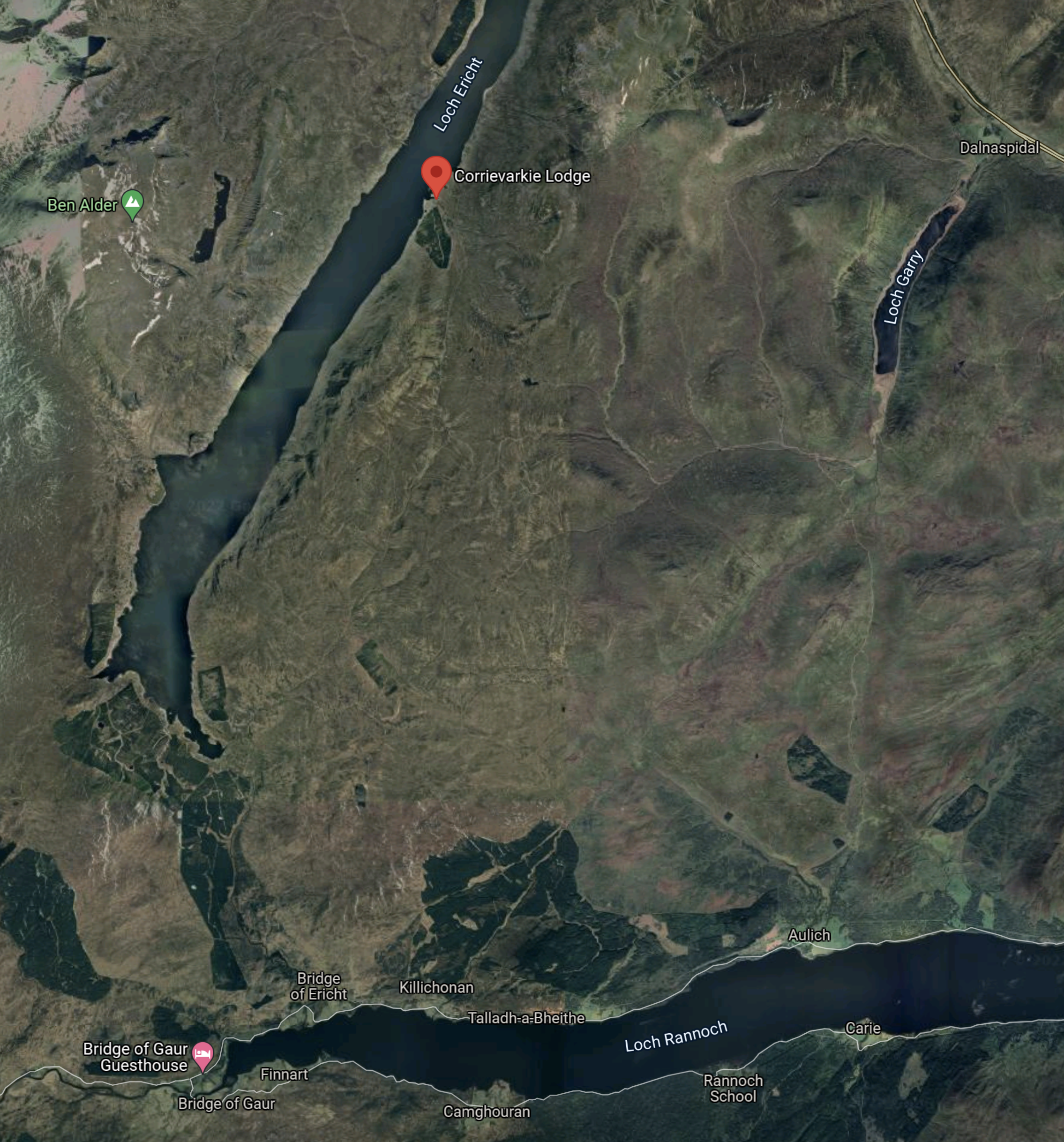
The red arrow indicates Corrievarkie Lodge.
I shall be interested to see the full details of this scheme.
Red John Pumped Storage Hydro Project
When I wrote ILI Group To Develop 1.5GW Pumped Storage Hydro Project, I noticed that they were also developing a scheme called Red John near Inverness.
The title of this post is the same as that of this article on Power Technology.
I have also found a web site for the project, which is part of the ILI Group web site.
- The scheme has an output of 450 MW.
- The storage capacity is 2,800 MWh or 2.8 GWh.
- The scheme has planning consent.
- The project is budgeted to cost £550 million.
- The construction program indicates that the scheme will be completed by the end of 2025.
This paragraph from this article on Water Power and Dam Construction, describes the head and tail ponds.
The Red John project will be located on the eastern shore of the north end of Loch Ness in the Highlands of Scotland. Loch Ness is to be the tail pond for the project, with the head pond to be newly constructed. It will use the natural topography between Loch Duntelchaig, Loch Ashie and Loch na Curra and Lochan an Eoin Ruadha, from where the development gets its Red John name.
This Google Map shows the area.
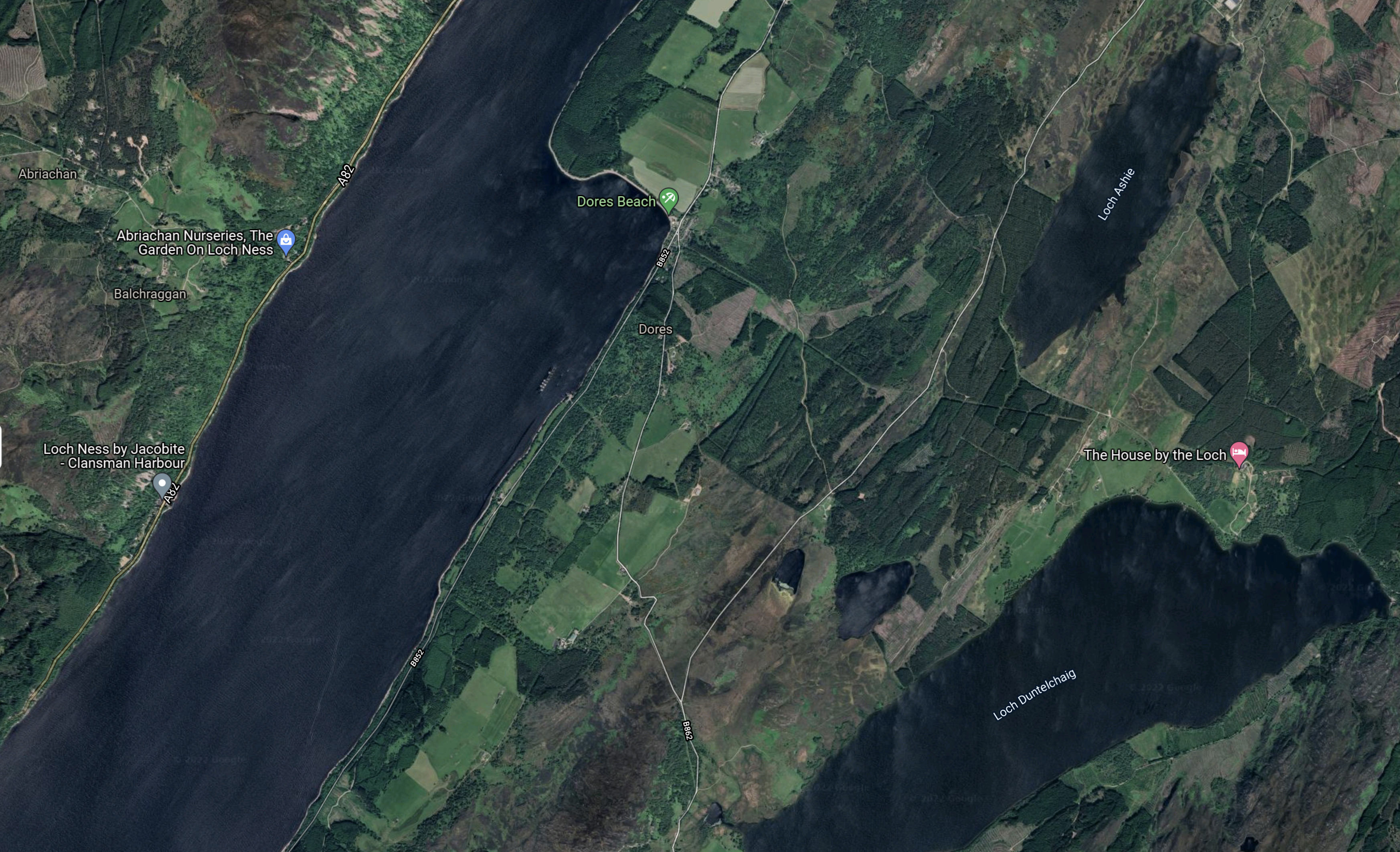
Note.
- Loch Ness is in the West.
- Loch Ashie is in the North.
- Loch Duntelchaig is in the East.
This second Google Map shows the area between Lochs Ness, Duntelchaig and Ashie in more detail.
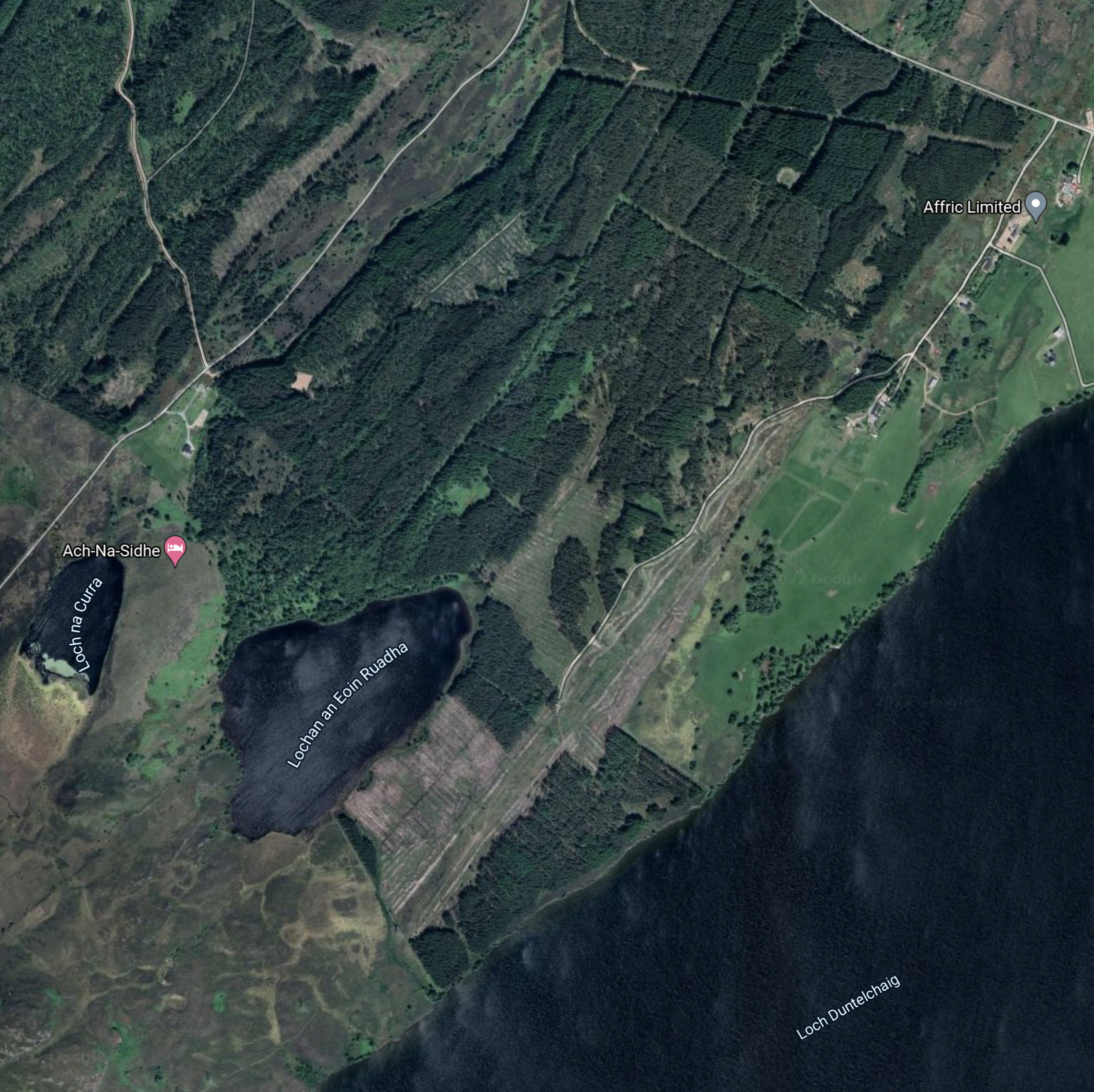
Loch na Curra and Lochan an Eoin Ruadha are now named and can be picked out in the previous map.
It looks like there will be a lot of heavy construction works to create the head pond.
Conclusion
This scheme has the output of a large gas-fired power station for just over six hours.
The finances must add up, as no-one would back a scheme like this if they didn’t get an adequate return on their money.
 The Anonymous Widower