Universities Study Options For Battery Traction To Replace Diesel
The title of this post, is the same as that as this article on Railway Gazette.
This is the introductory paragraph.
A three-month study of the extent to which battery-powered trains could replace diesel traction in Germany is being undertaken through a collaboration between rolling stock financing company Rock Rail, Technische Universität Dresden and the UK’s University of Birmingham.
In some ways, two Universities and one rolling stock leasing company are strange bedfellows for a study of trains in Germany.
But then Rock Rail are a very successful and surprisingly innovative company, who appear to know their trains. This sentence, is taken from the home page of their web site.
Rock Rail works closely with the franchise train operators and manufacturers to ensure a collaborative approach to design, manufacture and acceptance of the new state of the art trains on time and to budget.
They have certainly been involved in several large fleet orders in the last few years.
I have a feeling that this study will lead to sensible and workable conclusions, that may well have lessons for the UK.
Understanding Floatovoltaics
Floatovoltaics is mounting panels on floats, on an appropriate stretch of water.
This video, which I think from some of the words in the commentary, is shown to visitors who visit the floating solar farm at Yamakura Dam.
It describes all the advantages of floating solar and shows how this 13.7 MW solar farm was constructed.
We’ve even got a couple of these floating solar farms in the UK.
This Google Map shows the farm in the Queen Elizabeth II Reservoir, near Walton-on-Thames.
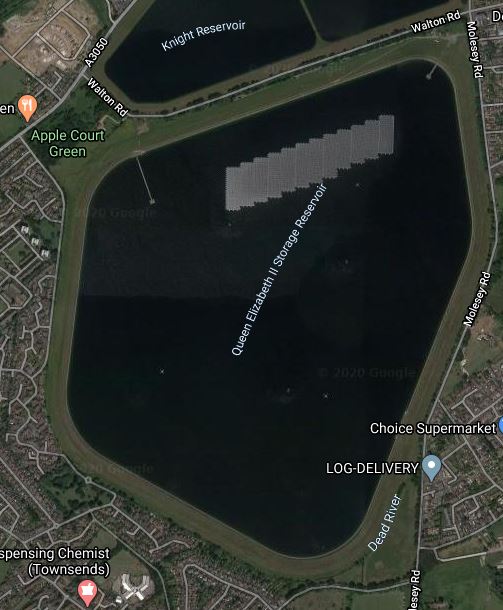
There is also this article in the Guardian, which is entitled World’s Biggest Floating Solar Farm Powers Up Outside London. It gives a good description of the project.
The article also states that unlike large solar arrays on land, no planning permission is required.
United Utilities have also installed a system at Godley Reservoir in Hyde, near Manchester, as this Google Map shows.
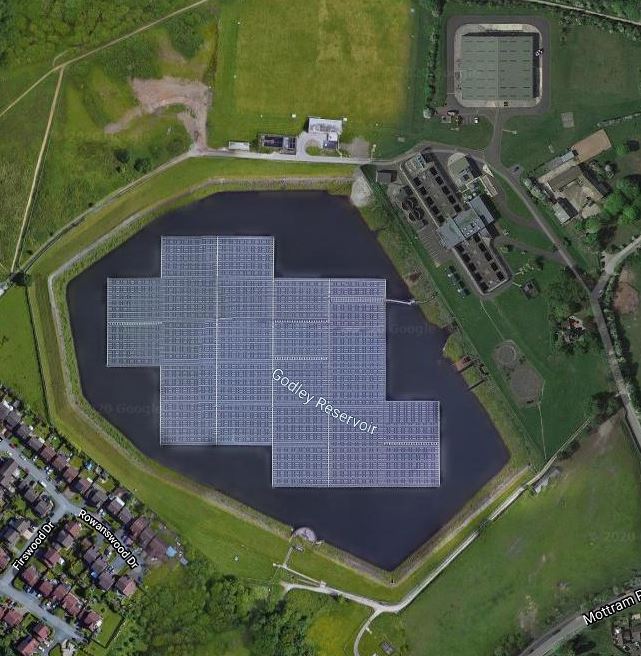
They must like the first installation, as this Press Release from United Utilities indicates that they are now building a second floating solar farm at Langthwaite Reservoir near Lancaster.
Some points from the Press Release.
- The floats are made locally.
- Godley is three times the size of Langthwaite.
- Godley can generate up to 3 GWh per year.
- It is thought that the panels help to stop the growth of algae in the water.
- United Utilities already has 45 MW of installed solar and intends to add 22 more sites in the next two years.
In some ways, this embracing of solar is a bit surprising, as the North West, is England’s wettest region.
Conclusion
If my excellent physics teacher in the 1960s had said that it will be commonplace by 2020 to generate electricity using solar panels floating on water, I would not have believed him!
UK’s Largest Solar Park Cleve Hill Granted Development Consent
The title of this post, is the same as that of this article on Solar Power Portal.
These are the two introductory paragraphs.
Cleve Hill Solar Park, set to be the largest in the UK, has been granted development consent by the energy secretary.
The colossal 350MW project will include 880,000 panels along with battery storage, and sit just one mile northeast of Faversham, in Kent, situated close to the village of Graveney.
Other points from the article.
- Cleeve Hill Solar Park is a £450million project.
- It is the first solar project to be considered a Nationally Significant Infrastructure Project.
- It is being developed as a joint venture between Hive Energy and Wirsol.
- It is due to be operational by 2022.
- To complete the project 700 MWh of energy storage will be added later.
The article also contains this quote from Solar Trade Associations chief executive Chris Hewett.
Solar has a significant role to play in boosting the economy in the wake of the coronavirus crisis. With the right policies we can expect to see an 8GW pipeline of solar projects unlocked and rapidly deployed, swiftly creating a wealth of skilled jobs and setting us on the path towards a green recovery.
8 GW of intermittent energy will need a lot of storage.
As Cleeve Hill’s developers are planning to provide 700 MWh of storage for 700 MW of solar panels, it would appear that 8 GW of solar panels could need up to 16 GWh of energy storage.
As our largest energy storage system is the pumped storage Electric Mountain in Snowdonia with a capacity of 9.1 GWh and most of the large solar developments are towards the South of England, the UK needs to develop a lot more energy storage, where the solar is generated and much of the energy is used.
I can see the following environmentally-friendly developments prospering.
- Highview Power‘s CRYOBattery, which uses liquid air to store energy. Systems have a small footprint and up to a GWh could be possible.
- Electrothermal energy storage like this system from Siemens.
- Using electrolysers from companies like ITM Power to convert excess energy into hydrogen for transport, steelmaking and injecting into the gas main.
- Zinc8‘s zinc-air battery could be the outsider, that comes from nowhere.
Developers could opt for conservative decision of lithium-ion batteries, but I don’t like the environmental profile and these batteries should be reserved for portable and mobile applications.
Floatovoltaics
One concept, I came across whilst writing was floatovoltaics.
The best article about the subject was this one on Renewable Energy World, which is entitled Running Out of Precious Land? Floating Solar PV Systems May Be a Solution.
A French company call Ciel et Terre International seem to be leading the development.
Their web site has this video.
Perhaps, some floatovoltaics, should be installed on the large reservoirs in the South of England.
- The Renewable Energy World article says that panels over water can be more efficient due to the cooling effect of the water.
- Would they cut evaporative losses by acting as sunshades?
- As the French are great pecheurs, I suspect that they have the answers if anglers should object.
This Google Map shows the reservoirs to the West of Heathrow.
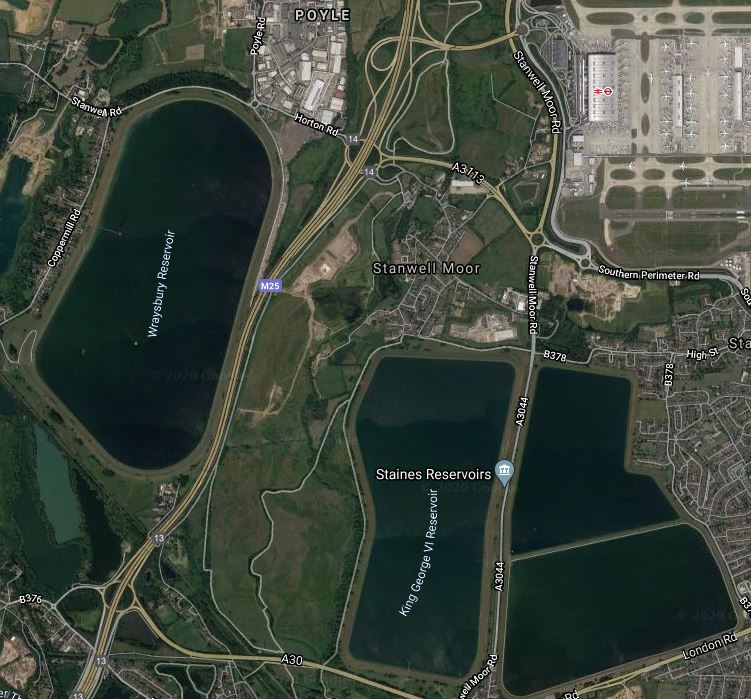
Note.
- Wraysbury Reservoir has an area of two square kilometres.
- King George VI Reservoir has an area of one-and-a-half square kilometres.
- Using the size and capacity of Owl’s Hatch Solar Farm, it appears that around 65 MW of solar panels can be assembled in a square kilometre.
- All these reservoirs are Sites of Special Scientific Interest because of all the bird life.
- Heathrow is not an airport, that is immune to bird-strikes.
Could floatovoltaics be used to guide birds away from the flightpaths?
Incidentally, I remember a report from Tomorrow’s World, probably from the 1960s, about a porous concrete that had been invented.
- One of the uses would have been to fill reservoirs.
- The capacity of the reservoir would only have been marginally reduced, as the water would be in the voids in the concrete like water in a sponge.
- Soil would be placed at the surface and the land used for growing crops.
I wonder what happened to that idea from fifty years ago!
Alstom And Snam To Develop Hydrogen Trains In Italy
The title of this post, is the same as that of this article on H2 View.
This paragraph sums up the agreement.
As part of the agreement, Alstom will manufacture and maintain newly built or converted hydrogen trains, while Snam will develop the infrastructures for production, transport and refuelling.
It does appear that Alstom is setting up similar deals across Europe, with now Germany, the Netherlands, the UK and Austria being prepared for hydrogen trains, manufactured or converted by Alstom.
The only recent reference, that I can find to the Alstom Breeze for the UK, is this article in Electric And Hybrid Vehicle Technology International, which is entitled Is Post-Covid The Perfect Time To Start A Hydrogen Transportation Revolution?
There is just a new visualisation pf the train to illustrate an article.
A Timeline Of Hitachi’s Statements And News About Battery Trains
These are posts on this blog, that reference articles about Hitachi and battery trains.
21st November 2018 – Hitachi’s Thoughts On Battery Trains – Modern Railways Modern Railways January 2018 – Candid interview with Nick Hughes of Hitachi.
21st March 2019 – Trains Ordered For 2021 Launch Of ‘High-Quality, Low Fare’ London – Edinburgh Service – Railway Gazette – Announcement of service, but no mention of batteries, diesel or bi-mode.
26th March 2019 – Hitachi Plans To Run ScotRail Class 385 EMUs Beyond The Wires – Rail Engineer – Batteries for Class 385 trains.
1st January 2020 – Hitachi Trains For Avanti – Modern Railway January 2020 – The Hitachi trains for Avanti West Coast can be fitted with batteries, if required.
16th February 2020 – Sparking A Revolution – Rail Magazine Issue 898 – Informative interview with Andrew Barr of Hitachi.
16th April 2020 – First of Five FirstGroup Class 803s Arrives In UK – Rail Magazine Issue 903 – Disclosure that the Class 803 trains will use a battery instead of diesel power for on-board services, but not traction power.
Hitachi seem to have opened up gradually with more information.
‘Chernobyl’ Fears Dismissed As Herne Bay Hydrogen Plant Bid Approved
The title of this post, is the same as that of this article on Kent Online.
it would appear that Kent Online got their prediction right. that I wrote about in Hydrogen Power Plant Bid In Herne Bay Set For Green Light From Canterbury City Council.
UK Energy Storage ‘Nears 4GW’
The title of this post, is the same as that of this article on ReNews.biz.
This is the introductory paragraph.
Almost 4GW of energy storage capacity is now connected to the UK network with a further 9GW in the planning process, according to a new report released today by the Electricity Storage Network (ESN).
It is a small article, where GW is mentioned nine times.
Thoughts On East Coast Trains
According to an article and a picture, the second new Class 803 train for Open Access Operator; East Coast Trains, has arrived in the UK to be fitted out at Newton Aycliffe.
These are my thoughts on the service.
The Trains
The Class 803 trains are similar to the other Hitachi A-trains running in the UK, but with two big differences.
- They will have a one class interior and they will be fitted with a battery, instead of a diesel engine.
- The battery is not for traction and is to provide hotel power in stations and in the event of a dewiring. The latter has been surprisingly common on the East Coast Main Line in recent years.
Normally, these five-car trains are fitted with a single MTU 12V 1600 R80L diesel engine, which is described in this datasheet on the MTU web site.
The mass of the engine is given as 6750 Kg, when it is ready to run.
It would seem logical to replace the diesel engine with a battery of the same weight. I’ll use seven tonnes, as the fuel tank won’t be needed either.
This page on the Clean Energy institute at the University of Washington is entitled Lithium-Ion Battery.
This is a sentence from the page.
Compared to the other high-quality rechargeable battery technologies (nickel-cadmium or nickel-metal-hydride), Li-ion batteries have a number of advantages. They have one of the highest energy densities of any battery technology today (100-265 Wh/kg or 250-670 Wh/L).
Using these figures, a seven-tonne battery would be between 700 and 1855 kWh in capacity.
Incidentally, the power output of an MTU 12V 1600 R80L is 700 kW.
In Sparking A Revolution I gave Hitachi’s possible specification of a battery-electric train.
- Range – 55-65 miles
- Performance – 90-100 mph
- Recharge – 10 minutes when static
- Routes – Suburban near electrified lines
- Battery Life – 8-10 years
These figures are credited to Hitachi.
Doing a quick calculation, it would appear that.
- A 700 kWh battery could supply the same power as the diesel engine for an hour.
- A 1855 kWh battery could supply the same power as the diesel engine for two hours and thirty-nine minutes.
I am drawn to the conclusion, that although Hitachi say the battery is not for traction purposes in a Class 803 train, that a battery the same weight as the current diesel engine, would be a very adequate replacement.
If say, you put a 300-500 kWh battery in a Class 803 train, it would probable give enough hotel power until the train was able to move again. but it would also reduce the weight of the train and thus improve the acceleration in normal running.
A Battery Module
I wouldn’t be surprised if Hitachi are developing a battery module, that can replace the MTU 12V 1600 R80L diesel engine.
- The module would be used for both traction and hotel services on the train.
- It would be charged from the electrification or by regenerative braking.
- It would act as emergency power.
- To the driver and the train’s computer, it would have similar performance to the diesel engine.
The diesel engine and the battery module would be plug-compatible and could be exchanged as required.
I can do a quick calculation for a 1000 kWh battery, which would weigh under four tonnes.
- A 1000 kWh battery would provide 700 kW for 86 minutes.
- At 90 mph, the train would travel for 129 miles.
- At 100 mph, the train would travel for 143 miles.
That would be a very handy extended range.
As East Coast Trains will only run on a fully-electrified route, they have no need for the traction capability.
- But it would fit well with the routes of Avanti West Coast, East Midlands Railway, Great Western Railway, Hull Trains, LNER and TransPennine Express.
- All except East Midlands Railway and LNER, share part or full ownership with East Coast Trains.
It does look to me, that Hitachi is using East Coast Trains and their fully electrified route to give the battery module for the trains, a thorough work-out, on a route, where it will not normally be needed.
The Proposed Service
From various sources we know the following.
- There will be five trains per day in both directions between London Kings Cross and Edinburgh. – See Wikipedia
- East Coast Trains have ordered five trains. – See Wikipedia.
- There will be stops at Stevenage, Durham, Newcastle and Morpeth. – See Wikipedia
- The first Northbound service will arrive in Edinburgh before 10:00. – See Rail Advent.
- Fares will be low-cost at around £25 – See Wikipedia.
It is also likely that East Coast Trains will want a journey time of under four hours, which is being planned for the route anyway under the L2E4 project.
As the record time between London and Edinburgh was set in 1991 by an InterCity 225 train at a minute under three-and-a-half hours, could a time of around three hours and forty-five minutes be possible, including the turnaround of the train?
10:00 Arrival In Edinburgh
This is obviously a good idea, but with a four hour journey time, it would mean leaving London before six.
- Perhaps to make the most of clear tracks in the morning the train would leave early.
- Currently, the first two trains from Kings Cross are the 06:15 to Edinburgh, which arrives at 11:08 and the 06:33 to Leeds.
- How early could the train leave?
I suspect that the first train to Edinburgh would leave Kings Cross around 05:30 and arrive in Edinburgh and be ready to return before 10:00.
10:00 Arrival In London
If arriving in Edinburgh before ten is a good idea, then surely arriving in London by the same time is worthwhile.
- Currently, the first train from Edinburgh to London is the 05:48, which arrives at 10:40.
As with the Northbound service, I suspect the first train to Kings Cross would leave Edinburgh around 05:30 and arrive in Kings Cross and be ready to return before 10:00.
Five Services Per Day
If the first Edinburgh and Kings Cross services left at 05:30 and after unloading and loading, were ready to return before 10:00, that would be the first service.
The simplest way to handle the rest of the day would be to split the time into four and run the trains continuously.
Suppose, the last train got to its destination at one in the morning, that would mean that fifteen hours were available for four trains or three hours and forty-five minutes for each trip between London and Edinburgh and the turnaround.
The train starting from Kings Cross would run the following services.
- Kings Cross to Edinburgh – Leaves 05:30 – Arrives before 10:00
- Edinburgh to Kings Cross – Leaves 10:00
- Kings Cross to Edinburgh – Leaves 13:45
- Edinburgh to Kings Cross- Leaves 17:30
- Kings Cross to Edinburgh – Leaves 21:15 – Arrives 01:00 on the next day.
The train starting from Edinburgh would run the following services.
- Edinburgh to Kings Cross – Leaves 05:30 – Arrives before 10:00
- Kings Cross to Edinburgh – Leaves 10:00
- Edinburgh to Kings Cross – Leaves 13:45
- Kings Cross to Edinburgh – Leaves 17:30
- Edinburgh to Kings Cross – Leaves 21:15 – Arrives 01:00 on the next day.
There would be two very tired trains at the end of every day, that would be looking forward to some well-deserved tender loving care.
This has been my best guess at what the timetable will be! But!
- Travellers can catch an early train, do a full days work in the other capital and return at the end of the day.
- There are three services during the day; one each in the morning, the afternoon and the early evening, for those who want affordable, slightly less frenetic travelling.
- I suspect the intermediate stops have been chosen with care.
- Improvements at Stevenage station could make the station, the preferred interchange for many between East Coast, LNER and local services for Cambridgeshire, Hertfordshire and North London. Car parking is probably easier than Kings Cross!
- Is Durham station an alternative station on the other side of the Tyne from Newcastle, with better parking?
- Could Durham City Centre be the terminal of a Leamside Line extension of the Tyne and Wear Metro?
- Newcastle station is very well-connected to all over the North East.
- Morpeth station could attract a large number of travellers from over the Border. It also looks to have space to expand the parking!
It looks a well-designed route and timetable.
How Many Trains Would Be Needed?
Consider.
- Each train could be two five-car trains working together as a ten-car train.
- This would maximise the use of paths on the East Coast Main Line.
- Four trains would be needed for the full five trains per day ten-car service.
As there is going to be a fleet of five trains, the fifth train would either be in maintenance or waiting to enter the action as a substitute.
Improving Efficiency
It looks to me, that the efficiency of this service could be improved by good old-fashioned time and motion study.
- Will drivers use stepping-up to speed the reverse of trains?
- Would cleaning teams board at Morpeth and Stevenage stations and clean the train on the last leg?
- Will the buffet be designed for fast replenishment?
- Will drivers be given all possible aids to go faster?
Every little will help!
Conclusion
I like this system and the competition will keep LNER on its toes!
Would a similar system work on the West Coast Main Line?
- Grand Union have proposed a service between Euston and Stirling stations.
- There will be stops at Milton Keynes Central, Nuneaton, Crewe, Preston, Carlisle, Lockerbie, Motherwell, Whifflet, Greenfaulds and Larbert.
- Trains will be InterCity 225s.
The service could start in 2021.
After Coronavirus, What’s Next? China: More Coal, US: More Oil, EU: More Renewables
The title of this post, is the same as that of this article on CleanTechnica.
The title says it all, but read the article to get the detail.
Wabtec Launches BlueFilter Air Filters For Trains
The title of this post, is the same as that of this article on Railway Gazette.
This is the introductory paragraphs.
Wabtec Corp has launched BlueFilter, a filter designed to be retrofitted to current passenger train HVAC systems to ensure the provision of clean air on board.
The company says it can remove contaminants that are .01 to 1 000 μm size, smaller than current standard filters and including bacteria, dust and viruses.
Does viruses include COVID-19?
This Press Release on Wabtec’s web site gives more details.
BlueFilter’s design removes contaminants that are .01 to 1,000 micrometers in size. That includes allergens, bacteria, various dusts and viruses. By comparison, today’s standard filters typically only remove particles that are between 10 to 1,000 micrometers in size, which only includes contaminants such as pollen, most dusts and some bacteria.
It certainly gets down to the nitty-gritty.
 The Anonymous Widower