Ambitious £10bn Plans For Gatwick Heathrow HS4Air Rail Service Rejected
The title of this post is the same as that of this article on Rail Technology Magazine.
This paragraph outlines the reasons for rejection of HS4Air.
But the DfT has reportedly turned down the proposal, primarily over concerns about the affordability and that it would likely face issues because the proposed route will run across greenbelt land.
It would appear from the report, that the promoters of the project; Expedition Engineering, are not happy.
This is the last three paragraphs of the article
Lenczner said that most of the rail line was going to be in tunnels, ensuring the impact to open green areas was limited and less than the Lower Thames Crossing.
He said: “We’re trying to encourage people to get out of cars and use more sustainable modes of transport and the HS4Air would have contributed to that.
“We have had lots of messages of support who are also utterly gobsmacked that it has been rejected at this stage.
He added that “we don’t intend to back down,” and said the engineering company plans to challenge the DfT’s decision.
Alistair Lenczner is a director of Expedition Engineering.
I think that HS4Air proposal is the sort of bold infrastructure project, that we will increasingly need in a post-Brexit world.
There were four major proposals to create better rail access to Heathrow up before the Department of Transport.
In Could Rail Access To Heathrow Be Formed Of The Best Bits Of Various Schemes?, I summed them all up.
Heathrow Southern Railway
I summed up the Heathrow Southern Railway like this.
- Connectivity to Waterloo, Clapham Junction, South and South West London
- Extends Heathrow Express to Woking and Basingstoke
- Adds a new route for commuters into Paddington.
- Extends Crossrail from Heathrow to Staines.
- It will be built alongside the M25 with a tunnel to Terminal Five.
- All terminals served
- Provides a freight route into the airport from the South West.
- Privately funded.
HS4Air
I summed up HS4Air like this.
- Connectivity to High Speed 2, the Midlands, North and West of England and WalesHigh Speed
- Possible connection to Gatwick and Ashford for the Continent.
- North-South station in a tunnel deep under Heathrow.
- The Heathrow station will be able to handle full-length high speed trains from Birmingham, Cardiff and Manchester.
- Heathrow could become a High Speed Rail hub serving Greater Western London.
- Sneaks along the M25.
- All terminals could probably be served, by escalators and lifts from the deep station.
- Provides a freight route into the airport from the North and West.
- Privately funded
I’m keener on the section North of Heathrow, than that to the South.
Western Rail Approach To Heathrow
I summed up the Western Rail Approach To Heathrow like this.
- Connectivity to Slough and Reading and further West with a change.
- All terminals served.
- Provides a freight route into the airport from the West.
- Network Rail’s proposed scheme.
- Government funded (?)
Windsor Link Railway
I summed up the Windsor Link Railway like this.
- Connectivity to Slough and Reading and further West with a change.
- All terminals served.
- Provides a freight route into the airport from the West.
- Privately funded
This scheme also unlocks development of upmarket housing in Windsor.
Why Does Heathrow Need Better Rail Access?
Heathrow Airport is continuously expanding and needs better transport access.
To the man or woman in the Woking 4×4, the baggage handler in his clapped diesel Toyota and the myriad numbers of Air Cargo operators with their polluting trucks, that means better and cheaper parking and more comprehensive road networks at the Airport.
We are not talking about an American Airport with masses of space, but an airport with limited land surrounded by housing, office and commercial development.
It also has a massive non-aviation pollution footprint, caused by all the diesel vehicles serving the airport.
Surely, more and better electric trains and road vehicles into Heathrow should be part of the solution. Most politicians, trade union officials, businessmen and travellers, probably feel so.
The Airport Of The Future
In the modern world, an ideal airport should be designed so that.
- All air-side vehicles serving the planes, runways and airport buildings, should be battery-powered or zero carbon.
- All passengers and airport workers must arrive or leave the airport, by means of electric train, bus, tram or taxi.
- All supplies and air cargo must arrive and leave the airport by means of electric train or truck.
Heathrow will have a large fight to get the Planning Permission for their new runway and expansion plans. But declaring the Airport to be electric vehicle only on the ground, could be a bold move, that could turn the minds of opposing residents, politicians and Local Authorities.
Electric Air-Side Vehicles
This is starting to happen, with even giant electric aircraft tugs for A380s now available.
Moving People To And From The Airport
Add up all the numbers of passengers and workers and there isn’t enough capacity at the preset time.
There needs to be the following.
- More frequent and longer trains.
- More platforms
- Access to the West
- Access to High Speed Two
HS4Air offered a different approach of a North-South railway through the Airport, which could be built without disturbing the existing rail network at Heathrow.
But it has been rejected.
HS4Air would also have allowed important local networks to be built onto Crossrail.
- Extending Crossrail to Staines.
- Adding the West London Orbital Railway to Old Oak Common.
I feel that combining the best bits of HS4Air, Heathrow Southern Railway and the West London Orbital Railway could be a good idea, to bring all those important workers to the Airport.
Moving Air Cargo And Supplies To And From The Airport
Some of the automated-logistics networks used by the likes of Amazon are incredibly impressive.
Could a massive logistics hub be built in the centre of the Airport?
- Electric trains would arrive with pre-loaded containers of air cargo and supplies.
- The containers would be automatically directed to the appropriate place on a network of tracks deep under the airport.
- Containers would also travel in the reverse direction with inbound air cargo, returned empties and rubbish.
I’m sure something like this will happen and underneath the third runway is surely the place to build such a logistics hub.
My Views On Each Proposal
These are my views on each proposal are as follows.
Heathrow Southern Railway
This is probably the second largest and boldest of the four schemes.
It has the following advantages.
- It gives good connections to large areas of South and South West London.
- It connects to the two big rail hubs of Waterloo and Charing Cross.
- It extends Heathrow Express from a short express airport service into a much-needed new commuter route between Surrey and Hampshire and London.
- It extends Crossrail to Staines to create an important local link into the Airport for the workforce.
- It could connect to a freight logistics hub under the new third runway.
- It could be built without affecting existing services.
- It will probably be a privately-funded scheme.
But there is a big disadvantage; there is no connection to Reading, Slough and the West.
HS4Air
This is probably the largest and boldest of the four schemes.
It has the following advantages.
- It connects to High Speed 2 and the Great West Main Line.
- It could be connected to Gatwick and High Speed One in the future.
- It would be built mainly in tunnel under Heathrow Airport.
- It proposes a North South station under Heathrow Airport, below existing rail links.
- It would be able to handle full-size high speed trains.
- It could connect to a freight logistics hub under the new third runway.
- It would fit in well with the development of a third runway and new terminals, as it will be well below in tunnel.
- It could be built without affecting existing services.
But there are disadvantages
- It will probably be a very expensive privately-funded scheme.
- It does provide good connectivity to Slough, but doesn’t improve the connectivity to other areas, where workers at the Airport will live.
I think if this scheme is built, then the following two smaller schemes should be built as well.
- West London Orbital Railway.
- Crossrail extension to Staines.
These schemes would bring in Heathrow’s much-needed workers.
I don’t think we’ve heard the last of this scheme.
Western Rail Approach To Heathrow
It has the following advantages.
- It should provide good connectivity to Reading, Slough and further West.
- It wouldn’t be difficult to build.
- It could connect to a freight logistics hub under the new third runway.
But there are disadvantages.
- Except for Slough, it doesn’t connect to much affordable housing, where Heathrow’s massive workforce live.
- It is Network Rail’s pet scheme.
- Would it need to be government-funded?
As with HS4Air, I think if this scheme is built, then the following two smaller schemes should be built as well.
- West London Orbital Railway.
- Crossrail extension to Staines.
These schemes would bring in Heathrow’s much-needed workers.
Windsor Link Railway
This is very much a local scheme and doesn’t give enough capacity increase for the Airport.
But I don’t rule out in the future, a tunnel under Windsor connecting Slough and Staines to aid the development of the important town.
A Pragmatic Approach
Could a pragmatic approach be taken to give Heathrow, the world-class rail access it needs?
What About The Workers?
This may seem a strange place to start, but I believe that if Heathrow expands, the following will be true.
- The airport will need large numbers of workers.
- Not all jobs will be high salaries, so good access to areas of low-cost housing from the airport on a 24/7 basis will be needed.
- If you work at the airport, then it’ll be the first place from where you want to fly on holiday.
- Heathrow will not want workers to add to the Airport’s chronic, local pollution footprint.
Prime areas for the recruitment of airport workers will be Basingstoke, Bracknell, Reading, Slough, Staines and North West and South London.
All currently have bad rail connections to Heathrow.
To ease these journeys, the following local connections must be built.
Crossrail Extension from Heathrow Terminal 5 To Staines
In Heathrow Southern Railway’s Plans For Staines, I looked at this extension in detail and came to the conclusion that four trains per hour (tph) could run to and from Staines for Crossrail.
Although this extension came about because of the Heathrow Southern Railway proposal, I feel that it should be built whatever scheme is chosen.
- It will add a capacity of up to 6,000 passengers per hour, between Staines and Heathrow, in both directions.
- It will increase the capacity of Heathrow Terminal 5 station.
- It will enable extra Crossrail services between Central London and Heathrow Terminal 5.
But the main reason is that it will create a new route between Staines and Abbey Wood via Old Oak Common (for High Speed Two) the West End, Farringdon ( for Thameslink), the City and Canary Wharf.
West London Orbital Railway
The West London Orbital Railway is planned to run in a circular manner around North West London.
I wrote about it in detail in New Railway Line For West London Proposed.
Two routes are proposed.
- Brentford to West Hampstead Thameslink via Old Oak Common.
- Kew Bridge to Brent Cross via Old Oak Common.
The routes would use the freight-only Dudding Hill Line.
Major costs would be.
- Resignalling the route.
- Up to half-a-dozen new or upgraded stations.
- A small number of battery-electric Class 710 (?) trains.
Crossrail or High Speed Two it is not!
The railway will bring large numbers of travellers to Old Oak Common station, where Crossrail will take them to the Airport or Central London.
Windsor Link Railway
I said I was taking a pragmatic approach to rail access to Heathrow and the Windsor Link Railway build in conjunction with extending Crossrail to Staines could have several advantages.
- Remove a lot of road traffic from the Centre of Windsor.
- Create a rail service between Reading and Heathrow via Windsor and Slough.
- A Park-and-Ride could be built South of Slough by the M4.
- Unlock land for development in Windsor.
- One tunnelling project could be used to access Heathrow Terminal 5 station.
The route could be run with a frequency of four tph, using Crossrail trains.
Perhaps it should even be part of Crossrail?
What About The Air Cargo And Supplies?
The Combined Car Park And Storage Battery
I don’t drive these days, but I did for well over forty years.
If I was still driving now and still lived in Suffolk, I’d be looking seriously at an electric car as an everyday runabout, as rarely in the last twenty years, have I had the need to do a long journey, that I couldn’t do by train.
So my electric car would probably sit in a car park space at Cambridge North station, attached to a charger, a lot of the time. But with better batteries and vehicle-to-grid systems, there will come a time, when you will park your battery vehicle and tell it you’ll be returning in a few hours or days and you’ll need say four hours of charge on return. Obviously, if your circumstances change, you will have an app on your phone to make adjustments.
Suppose your average car had a 30 kWh battery, this would mean that the 450 space car park at Cambridge North station, if say 300 spaces were for electric cars would have a electricity storage capacity of around 0.9MWh.
So if the wind wasn’t blowing or the sun wasn’t shining, then there’s probably about half a MWh of electricity that can be borrowed and still allow drivers to get home.
It may all sound terribly complicated, but electricity put into batteries at night or other quiet times, gets used when it’s needed.
Batteries and other forms of energy storage will be everywhere; in houses, offices, public buildings, wind and solar farms, and in every electric vehicle.
There are 31.,6million cars alone in the UK and how many are quietly sitting in car parks and garages or at the side of the street, for most of the day.
The Car Park As A Power Station
There will be multi-story car-parks reserved for electric cars.
- Each parking space will have a charging point.
- The roof will of course have solar panels.
- I would expect that in a few years time the connection between car and charger will be automatic.
- The parking charge would be based on a mixture of time parked and energy passed to or from the battery.
- Car parks would probably also be paid by National Grid dependent on how much energy they can make available automatically.
The control system for all this lot, would do my head in! But it would mean that all generated energy was either used or stored!
In some ways a car pack for electric cars would become a small power station.
Examples Of Car Parks
These car-parks would have some interesting applications.
Airports
Airports like Heathrow have a pollution problem and it’s not just the planes, but masses of diesel and petrol vehicles.
- To encourage more passengers to drive electric vehicles to an airport, why not make the closest car parks electric car only?
- Long-term car parks for electric vehicles could be a massive storage battery, which would be used to help power the airport.
- Car parks for electric cars would be less polluted.
- Car parks for electric cars could be under the ground with runways and taxiways on top.
Everyone would be a winner.
- Passengers’ electric cars would be earning an energy storage charge from the National Grid.
- The Airport would have a reliable back-up power source.
- There would be much less pollution at the Airport.
- National Grid would gain additional much-needed energy storage.
There will be a lot of thought going in to making airport parking more efficient and affordable for electric cars.
Business Parks And Offices
Much of the logic for airports would apply.
But I do feel, that companies with medium and large-sized fleets of vehicles will go electric, as they can then integrate energy management across their premises and fleet.
Town And City Centres
Towns and cities with a pollution problem like London, will surely use the best car parks as bribes to get more electric vehicles into the centre.
Residential Developments
The mind boggles at what could be done in residential developments.
- Cars could go to and from parking automatically.
- Every house would come with energy storage plus that in the car.
- The development would appear car-free.
- Cars could be in shared ownership with the development.
- There could be automatic trolleys running through the development delivering parcels.
The market will determine what is needed.
Conclusion
Creating car parks solely for electric cars will create energy storage units at points of employment, living, shopping and transport.
Rail Operations Seeks New Sites To Extend Storage Space
The title of this post, as the same as that of this article in Issue 869 of Rail Magazine.
This is the first two paragraphs.
Rail operations (UK) Limited is looking to lease more sites for storing off-lease trains.
Via ita Traxion business, the company has already leased Crewe South Yard and the Marks & Sencer Logistics site at Castle Donington.
Much of the rest of the article is an interview with Karl Watts, who is Chief Executive of Rail Operations (UK) Limited, where he outlines the train storage market. He appears to be a man, who builds a strategy around facts and then pounces.
To do this he would need to have.
- Good advisers, with excellent knowledge of and contacts in the UK Rail and European rail industry.
- Reliable financial backing.
- The ability to give a good story to the media.
It appears, Karl could have used similar tactics, when he commissioned ten Class 93 locomotives from Stadler, that I wrote about in Stadler’s New Tri-Mode Class 93 Locomotive.
He puts forward some firm views and facts.
- 4,000 vehicles are coming off-lease.
- 46-47 miles of track will be needed.
- 313s, 314s and 315s will be scrapped.
- 317s, 319s, 321s and 442s will be re-engineered.
The customer gets what they want with appropriate servicing and maintenance.
Have I Regressed To My Childhood?
Growing up in the early 1950s in London, I wasn’t the healthiest of children.
- At some time most winters, I would have several weeks off school with a severe cold with extras.
- I can remember my mother cutting up old sheets for hankerchiefs.
- These would be boiled after use in a large saucepan on the gas cooker.
- I would cough all night and a good part of the day.
- I would inhale steam from a large jug of hot water and Friar’s Balsam.
Dr. Egerton White was always round our house.
Things improved towards the end of the 1950s.
- The passing of the Clean Air Act in 1956.
- I would be given penicillin which seemed to help. Naughty! Naughty!
- At weekends we’d go to Felixstowe.
What finally improved my health was going to Liverpool University.
Now over fifty years later, I’ve got a cold like I had in the 1950s.
- I can’t stop coughing for more than ten or twenty minutes.
- Nothing seems to work to stop the cough!
- It’s gone on for eight days now!
- I’m not getting much sleep.
Could the pollution from all the diesel vehicles be the key?
The Original Walk-Through Train In The UK
It’s not often, you are more or less alone in one of London Underground’s S8 Stock trains, that is stationary.
But this train was stuck as a red signal outside Farringtdon station on a quiet day over the Christmas period, so I took advantage.
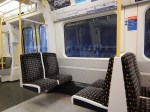

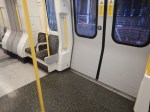
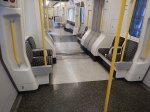
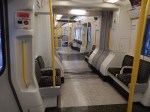
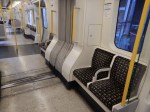
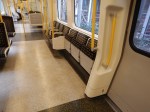
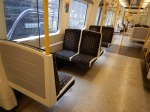
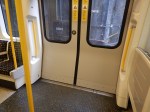
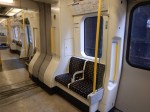
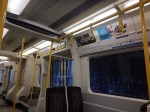
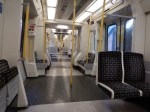
You can understand, why these eight car and 134 metre long trains can handle a couple over a thousand passengers for big matches at Wembley and also make journeys acceptable for long-distance commuters from Amersham, Chesham, Uxbridge and Watford.
Note the following features.
- Walk-through design.
- Better seats than Thameslink’s Call 700 trains.
- Wide all-double doors and lobbies.
- Wheelchair spaces with tip-up seats.
- Big, wide windows.
- Space under the seats.
Air-conditioning, step free access to platform and selective door opening are not shown.
The trains started to enter service in 2010 and they will probably have an interior refresh in around five years time, with the probably addition of wi-fi and USB power sockets.
Transport for London have used similar designs for three trains since.
- The Overground’s Class 378 trains
- Crossrail’s Class 345 trains
- The Overground’s Class 710 trains
The refurbishment of Docklands Light Railway trains has also been following similar principles.
Tottenham Hale Station – 2nd January 2019
I took these pictures yesterday pf the rebuilding of Tottenham Hale station.
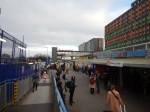

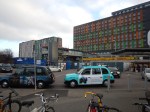

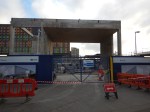



Note.
- The basic concrete structure of the station box appears complete.
- The footbridge is coming on.
- The lift tower on the Stansted-bound platform appears far back on the platform.
- Network Rail seem to be seriously pruning trees.
- The third track isn’t complete yet.
There must be a chance that the station will open as planned in May 2019.
Poetic Return For The Night Train In The Era Of ECommerce
The title of this post is the same as that of a half-page article on Page 34 of the Business Section of today’s copy pf The Times.

As you can see The Times gave it the full treatment with stills from the classic documentary film; The Night Mail, which has a verse commentary written by W. H. Auden.
It’s an idea from the seemingly irrepressible Karl Watts, who is Chief Executive of Rail Operations (UK) Limited.
He plans to start test operations with two Class 769 trains leased from Porterbrook.
I wrote about this concept two years ago, in The Go-Anywhere Express Parcel And Pallet Carrier (HSPT).
Climate Change: The Massive CO2 Emitter You May Not Know About
The title of this post is the same as that of this article on the BBC.
This is the first three paragraphs..
Concrete is the most widely used man-made material in existence. It is second only to water as the most-consumed resource on the planet.
But, while cement – the key ingredient in concrete – has shaped much of our built environment, it also has a massive carbon footprint.
Cement is the source of about 8% of the world’s carbon dioxide (CO2) emissions, according to think tank Chatham House.
Read the whole article.
Huge Increase In Capacity On GWR As Final Class 800 Enters Traffic
The title of this post is the same as that of this article on Rail Madazine.
This is the first two paragraphs.
More than 10,000 extra seats will be available to Great Western Railway passengers on January 2, compared with the same number last year.
This follows the delivery of the final Class 800 Intercity Express Train.
This means that Great Western Railway (GWR) ‘s fleet is now
- 21 x nine-car Class 800 trains
- 36 x five-car Class 800 trains.
- 21 x Class 802 trains
With still another 15 Class 802 trains to come of the 32 x five-car and 14 x nine-car order.
They are certainly ready to increase services in 2019.
Introduction Of New Trains To East Anglia Will Be Like Moving ‘From Mid-Table To Champions League’ Says Greater Anglia Boss
The title of this post is the same as that of this article on the East Anglian Daily Times.
It is a rare detailed article on how new trains are introduced to a network.
This is a quote from Jamie Burles of Greater Anglia in the article.
On some lines there will be a huge quality uplift – going from a 40-year old single carriage diesel train to a minimum three-carriage state-of-the-art bi-mode train with air conditioning, plug sockets and broadband wi-fi.
East Anglia is being subjected to one of most radical rail upgrades in the history of railways in the UK.
 The Anonymous Widower