New Proton Ceramic Reactor Stack For Highly Efficient Hydrogen Production And Carbon Capture In A Single Step
The title of this post, is the same as that of this article on Green Car Congress.
This is the opening paragraph.
A team of researchers from CoorsTek Membrane Sciences and SINTEF in Norway, and Universitat Politècnica de València in Spain, has demonstrated a 36-cell well-balanced proton ceramic reactor stack enabled by a new interconnect that achieves complete conversion of methane with more than 99% recovery to pressurized hydrogen, leaving a concentrated stream of carbon dioxide. The team has also demonstrated that the process can be scaled up for commercial application.
A paper has been published in the journal; Science.
I find this concept interesting for a number of reasons.
- I’ve believed for some time, that applications, that need a good supply of pure carbon dioxide will be developed. One obvious use is feeding it to plants in large greenhouses, so we can have our CO2 and eat it!
- 99 % is a very high efficiency.
- Ammonia, natural gas or biogas can be used as a feedstock.
Coors were an Artemis user for project management and I had an enjoyable few days Golden, Colorado and at the Coors brewery, sometime in the 1980s.
- It was then that I first heard of CoorsTek, who used to make ceramics for the US defence industry.
- In those days, the beer was made to German brewing rules and was unpasteurised.
- The beer had to be delivered to customers within a certain time, so long distance deliveries used trains.
- Coors Brewing Company has since merged with Molson, but CoorsTek appears to be still owned by the Coors family.
- I had taken a few small bottles of Adnams Broadside with me and one of their managers analysed one before drinking the rest of the bottle. He informed me that it was a felony to be in possession of such a strong beer in Colorado.
Coors were and probably still are in some ways not your average brewing company.
Coors News Item On Proton Ceramic Membranes For Hydrogen Production
This page on the CoorsTek web site, which is entitled Proton Ceramic Membranes For Hydrogen Production Published In ‘Science’, gives more details.
Conclusion
This technology could be massive.
Does Anybody Have Good Contacts At Network Rail?
In the 1980s, I did some business with British Rail, as it then was.
I provided my Daisy software and they used it to analyse signal failures.
It led to a guy called J S Firth, writing a paper called Failure Recording And Analysis On British Rail.
He had the courtesy to send me a copy of the paper, which mentions SigTech, which appears to have been a business unit of the British Railways Board.
All my dealings with Firth and his colleagues were in person at an office block in front of Marylebone station, which is now a posh hotel.
And then, a few months ago, someone contacted me from Network Rail.
Apparently, his father had worked on the signal failure project with me and he was now working in Milton Keynes for Network Rail on a similar project.
He asked if I had a copy of the paper.
At the time, I didn’t, but today I had a small sort out and found a copy.
Unfortunately, I have now lost the piece of paper on which I wrote the guy’s details.
Does anybody have any ideas, how I can find the guy, who contacted me?
Difficulty Looking At Pictures On The Blog
One reader of this blog, has informed me, that he’s started having difficulty looking at the pictures.
I haven’t changed anything in the production of this blog, but I do feel WordPress have done a recent upgrade.
If anybody has any problems, please tell me.
It’s Time We Used Cyber Dark Arts To Foil Putin
The title of this post, is the same as that of this article on The Times, which was written by Edward Lucas.
This is the first paragraph.
Breaking the Kremlin’s grip on the Russian people is the greatest national security priority of our lives. We cannot (or rather, will not) fight the Russian invaders in Ukraine. But we can fight inside Russia, using disruption and subversion to disable the war machine, ideally to the point that the country becomes ungovernable.
He suggests the following.
- Russian speakers could sow doubt about the regime’s lies and brutalities.
- Use the Russian diaspora to contact friends and relatives back home.
- Build and unleash a psychological warfare arsenal against Putin’s cocktail of crimes, lies and secrecy.
- Send condolences to family members for their losses in the war.
- Prepare Nuremberg for war crimes trials.
- Highlight the friendly treatment that Ukrainians give Russian deserters.
- Use wit as a weapon.
Edward Lucas then talks about the antics of Sefton Delmer in World War II. Wikipeda says this about him.
During the war, he led a black propaganda campaign against Hitler by radio from England. It was so successful that Delmer was named in the Nazis’ Black Book for immediate arrest after their planned invasion of Britain.
I suspect he was very good at his job. Two of his weapons were.
Aspidistra, which was a 500 kW radio station.
A daily “grey” German-language newspaper titled Nachrichten für die Truppe (“News for the Troops”). These leaflets were delivered by the USAF.
Edward Lucas says that we should all read Delmer’s autobiography, which is called Black Boomerang, which is now out of print and difficult to find.
Wikipedia gives this explanation of Black Boomerang.
When fighting entered Germany itself, black propaganda was used to create an impression of an anti-Nazi resistance movement.
At the end of the war in Europe, Delmer advised his colleagues not to publicise the work they had been involved in, lest unrepentant Nazis claim (as had been the case after the First World War), that they had been defeated by unconscionable methods, rather than on the battlefield. Consequently, former Nazis were able to claim, without contradiction, that they had assisted the fictitious resistance movement; Delmer described this unintended consequence as a “black boomerang”
Edward Lucas suggests reprinting Black Boomerang.
If someone has a good clear copy, I could possibly arrange it.
Demoralising The Russians
Edward Lucas believes, we can use similar techniques to Delmer to attack the Russians.
But instead of using a massive radio, he proposes using the Internet and its various messaging apps.
I suspect with a bit of arm-twisting Facebook, Twitter, Google, Microsoft et al, could produce a very good list of Russian Internet users.
It might be against the law, but who cares? It’s a war out there, we’re not using the information to physically hurt anybody or steal anything of value.
News For The Troops
I believe we can go one better than Sefton Delmer.
We are dealing with Russians invading and occupying Ukrainian territory, where many of the inhabitants can certainly read Russian.
So could we develop a truthful leaflet, that is delivered across Ukraine to both Russian Troops and the Ukrainian population?
Delivery would be primarily by the Internet, but why not deliver it by drone?
Delivery from say 5000 feet would distribute the leaflets over a wide area.
Could We Go Candy Bombing?
Gail Halvorsen, who died recently was known as the Candy Bomber.
This is the introduction to his Wikipedia entry.
Gail Seymour Halvorsen (October 10, 1920 – February 16, 2022) was a senior officer and command pilot in the United States Air Force. He is best known as the “Berlin Candy Bomber” or “Uncle Wiggly Wings” and gained fame for dropping candy to German children during the Berlin Airlift from 1948 to 1949.
I think, his actions could be copied in Ukraine.
Consider.
- The Ukrainian people are starving in the occupied territories.
- The Russian soldiers aren’t doing much better.
- These days, we can supply nutrition bars instead of sweets.
- Automated drones could deliver them safely from 5000 feet.
- They could be flown on behalf of the Red Cross from over the border in Hungary, Moldova, Poland and Slovakia.
Organised properly, the Russians would have a problem.
- If they let the drones through, the siege will be broken in a small way.
- If they shoot them down, their soldiers won’t get the smallest snack and the Russians will be attacking the Red Cross.
We might lose a lot of drones, but eventually we’ll get the nutrition through, each wrapped in a large dollop of propaganda.
Could Norfolk And Suffolk Be Powered By Offshore Wind?
This week this article on the BBC was published, which had a title of Government Pledges £100m For Sizewell Nuclear Site.
These are the first three paragraphs.
The government is putting up £100m to support the planned Sizewell C nuclear plant in Suffolk, Business and Energy Secretary Kwasi Kwarteng has announced.
The investment marks the latest stage in efforts to build the £20bn reactor on the east coast of England.
However, it does not commit the government to approving the project, which is still subject to negotiations.
My view of the proposed Sizewell C nuclear plant is that of an engineer, who used to live within thirty minutes of the Sizewell site.
- Hinckley Point C power station, which is currently being constructed, will have a nameplate capacity of 3.26 GW.
- Sizewell C would probably be to a similar design and capacity to Hinckley Point C.
- Sizewell C would likely be completed between 2033-2036.
- Sizewell B is a 1250 MW station, which has a current closing date of 2035, that could be extended to 2055.
- East Anglia and particularly the mega Freeport East, that will develop to the South at the Ports of Felixstowe and Harwich will need more electricity.
- One of the needs of Freeport East will be a large supply of electricity to create hydrogen for the trains, trucks, ships and cargo handling equipment.
- Sizewell is a large site, with an excellent connection to the National Grid, that marches as a giant pair of overhead cables across the Suffolk countryside to Ipswich.
But.
- We still haven’t developed a comprehensive strategy for the management of nuclear waste in the UK. Like paying for the care of the elderly and road pricing, it is one of those problems, that successive governments have kept kicking down the road, as it is a big vote loser.
- I was involved writing project management software for forty years and the building of large nuclear power plants is littered with time and cost overruns.
- There wasn’t a labour problem with the building of Sizewell B, as engineers and workers were readily available. But with the development of Freeport East, I would be very surprised if Suffolk could provide enough labour for two mega-projects after Brexit.
- Nuclear power plants use a lot of steel and concrete. The production of these currently create a lot of carbon dioxide.
- There is also a large number of those objecting to the building of Sizewell C. It saddened me twenty-five years ago, that most of the most strident objectors, that I met, were second home owners, with no other connection to Suffolk.
The older I get, the more my experience says, that large nuclear power plants aren’t always a good idea.
Small Modular Nuclear Reactors
In Is Sizewell The Ideal Site For A Fleet Of Small Modular Nuclear Reactors?, I looked at building a fleet of small modular nuclear reactors at Sizewell, instead of Sizewell C.
I believe eight units would be needed in the fleet to produce the proposed 3.26 GW and advantages would include.
- Less land use.
- Less cost.
- Less need for scarce labour.
- Easier to finance.
- Manufacturing modules in a factory should improve quality.
- Electricity from the time of completion of unit 1.
But it would still be nuclear.
Wind In The Pipeline
Currently, these offshore wind farms around the East Anglian Coast are under construction, proposed or are in an exploratory phase.
- East Anglia One – 714 MW – 2021 – Finishing Construction
- East Anglia One North 800 MW – 2026 – Exploratory
- East Anglia Two – 900 MW – 2026 – Exploratory
- East Anglia Three – 1400 MW – 2026 – Exploratory
- Norfolk Vanguard – 1800 MW – Exploratory
- Norfolk Boreas – 1800 MW – Exploratory
- Sheringham Shoal/Dudgeon Extension – 719 MW – Exploratory
Note.
- The date is the possible final commissioning date.
- I have no commissioning dates for the last three wind farms.
- The East Anglia wind farms are all part of the East Anglia Array.
These total up to 8.13 GW, which is in excess of the combined capacity of Sizewell B and the proposed Sizewell C, which is only 4.51 GW.
As it is likely, that by 2033, which is the earliest date, that Sizewell C will be completed, that the East Anglia Array will be substantially completed, I suspect that East Anglia will not run out of electricity.
But I do feel that to be sure, EdF should try hard to get the twenty year extension to Sizewell B.
The East Anglia Hub
ScottishPower Renewables are developing the East Anglia Array and this page on their web site, describes the East Anglia Hub.
This is the opening paragraph.
ScottishPower Renewables is proposing to construct its future offshore windfarms, East Anglia THREE, East Anglia TWO and East Anglia ONE North, as a new ‘East Anglia Hub’.
Note.
- These three wind farms will have a total capacity of 3.1 GW.
- East Anglia ONE is already in operation.
- Power is brought ashore at Bawdsey between Felixstowe and Sizewell.
I would assume that East Anglia Hub and East Anglia ONE will use the same connection.
Norfolk Boreas and Norfolk Vanguard
These two wind farms will be to the East of Great Yarmouth.
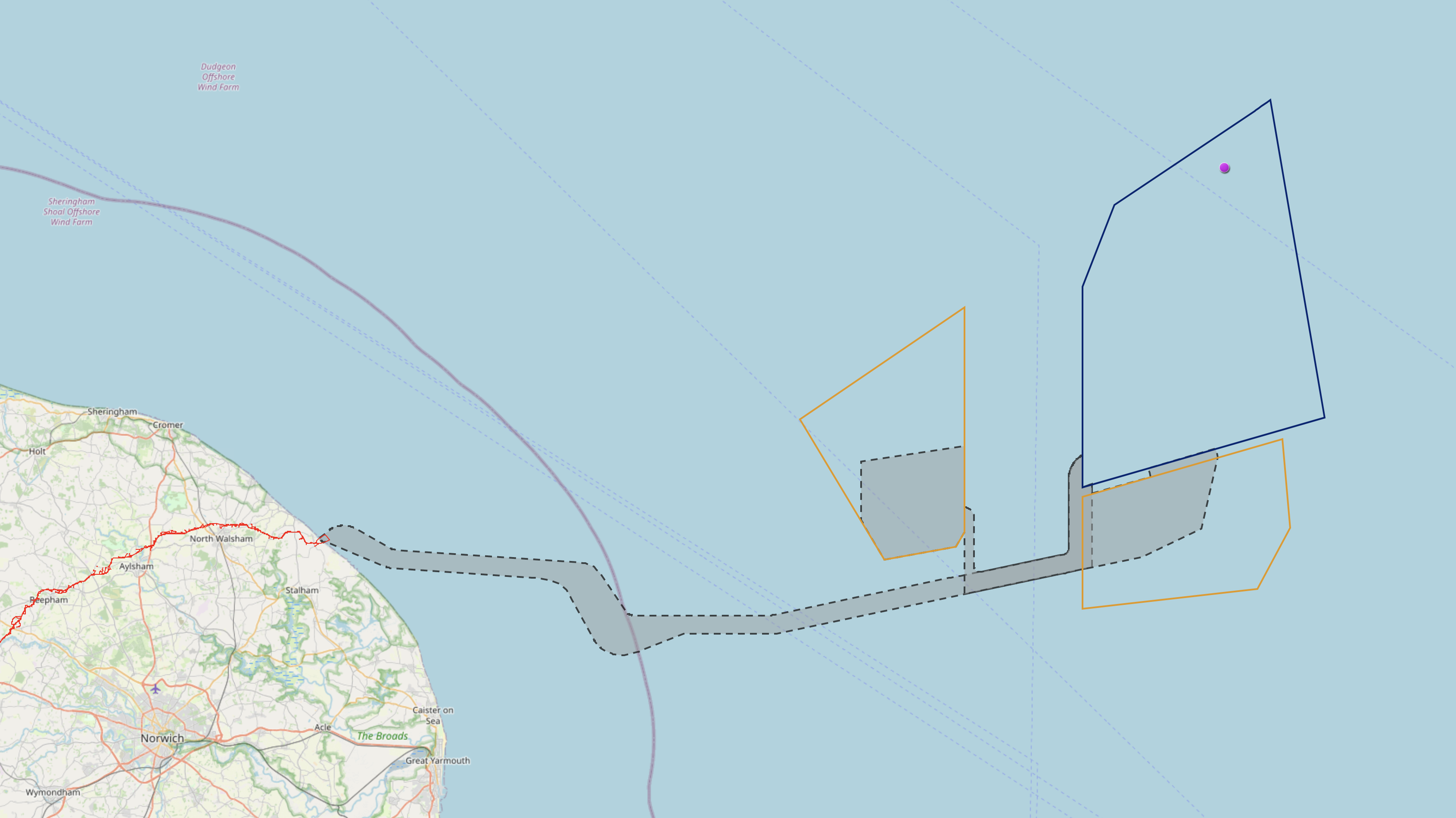
This map from Vattenfall web site, shows the position of the two wind farms.
Note.
- Norfolk Boreas is outlined in blue.
- Norfolk Vanguard is outlined in orange.
- I assume the grey areas are where the cables will be laid.
- I estimate that the two farms are about fifty miles offshore.
This second map shows the landfall between Eccles-on-Sea and Happisburgh.
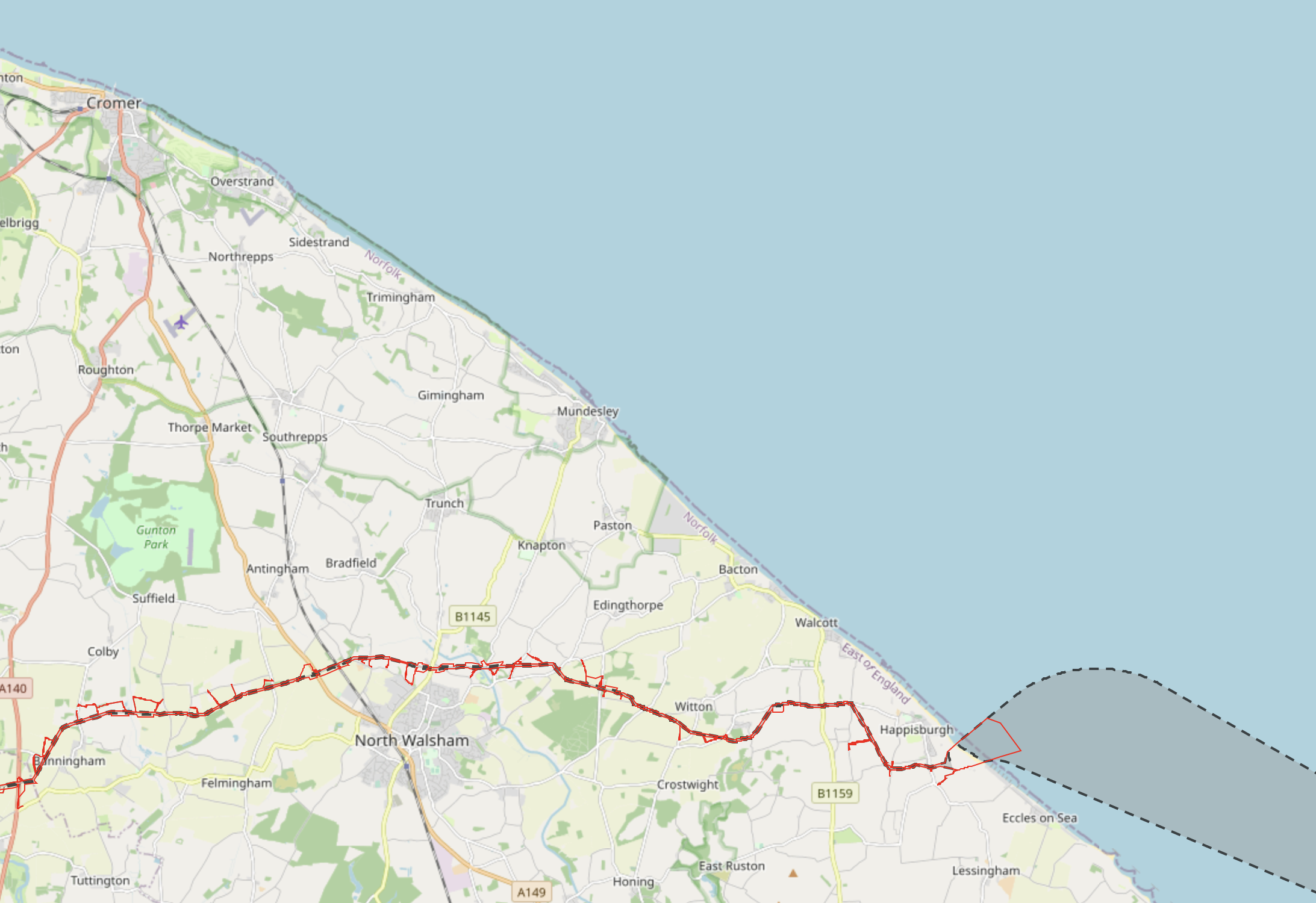
Note the underground cable goes half-way across Norfolk to Necton.
Electricity And Norfolk And Suffolk
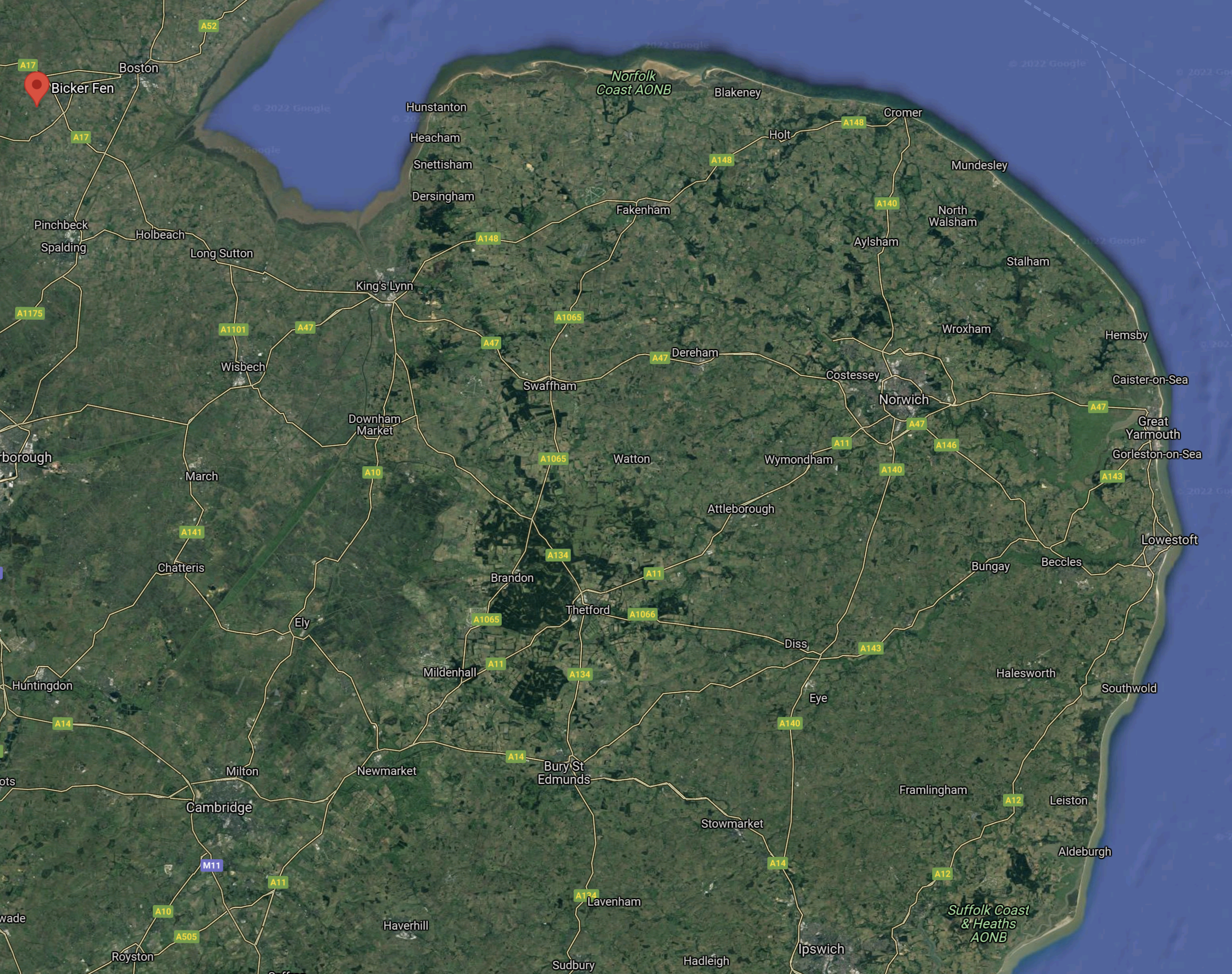
This Google Map shows Norfolk and Suffolk.
Note.
- The red arrow in the North-West corner marks the Bicker Fen substation that connects to the Viking Link to Denmark.
- The East Anglia Array connects to the grid at Bawdsey in the South-East corner of the map.
- Sizewell is South of Aldeburgh in the South-East corner of the map.
- The only ports are Lowestoft and Yarmouth in the East and Kings Lynn in the North-West.
There are few large towns or cities and little heavy industry.
- Electricity usage could be lower than the UK average.
- There are three small onshore wind farms in Norfolk and none in Suffolk.
- There is virtually no high ground suitable for pumped storage.
- There are lots of areas, where there are very few buildings to the square mile.
As I write this at around midday on a Saturday at the end of January, 49 % of electricity in Eastern England comes from wind, 20 % from nuclear and 8 % from solar. That last figure surprised me.
I believe that the wind developments I listed earlier could provide Norfolk and Suffolk with all the electricity they need.
The Use Of Batteries
Earlier, I talked of a maximum of over 7 GW of offshore wind around the cost of Norfolk and Suffolk, but there is still clear water in the sea to be filled between the existing and planned wind farms.
Batteries will become inevitable to smooth the gaps between the electricity produced and the electricity used.
Here are a few numbers.
- East Anglian Offshore Wind Capacity – 8 GW
- Off-Peak Hours – Midnight to 0700.
- Typical Capacity Factor Of A Windfarm – 20 % but improving.
- Overnight Electricity Produced at 20 % Capacity Factor – 11.2 GWh
- Sizewell B Output – 1.25 GW
- Proposed Sizewell C Output – 3.26 GW
- Largest Electrolyser – 24 MW
- World’s Largest Lithium-Ion Battery at Moss Landing – 3 GWh
- Storage at Electric Mountain – 9.1 GWh
- Storage at Cruachan Power Station – 7.1 GWh
Just putting these large numbers in a table tells me that some serious mathematical modelling will need to be performed to size the batteries that will probably be needed in East Anglia.
In the 1970s, I was involved in three calculations of a similar nature.
- In one, I sized the vessels for a proposed polypropylene plant for ICI.
- In another for ICI, I sized an effluent treatment system for a chemical plant, using an analogue computer.
- I also helped program an analysis of water resources in the South of England. So if you have a water shortage in your area caused by a wrong-sized reservoir, it could be my fault.
My rough estimate is that the East Anglian battery would need to be at least a few GWh and capable of supplying up to the output of Sizewell B.
It also doesn’t have to be a single battery. One solution would probably be to calculate what size battery is needed in the various towns and cities of East Anglia, to give everyone a stable and reliable power supply.
I could see a large battery built at Sizewell and smaller batteries all over Norfolk and Suffolk.
But why stop there? We probably need appropriately-sized batteries all over the UK, with very sophisticated control systems using artificial intelligent working out, where the electricity is best stored.
Note that in this post, by batteries, I’m using that in the loosest possible way. So the smaller ones could be lithium-ion and largest ones could be based on some of the more promising technologies that are under development.
- Highview Power have an order for a 50 MW/500 MWh battery for Chile, that I wrote about in The Power Of Solar With A Large Battery.
- East Anglia is an area, where digging deep holes is easy and some of Gravitricity’s ideas might suit.
- I also think that eventually someone will come up with a method of storing energy using sea cliffs.
All these developments don’t require large amounts of land.
East Anglia Needs More Heavy Consumers Of Electricity
I am certainly coming to this conclusion.
Probably, the biggest use of electricity in East Anglia is the Port of Felixstowe, which will be expanding as it becomes Freeport East in partnership with the Port of Harwich.
One other obvious use could be in large data centres.
But East Anglia has never been known for industries that use a lot of electricity, like aluminium smelting.
Conversion To Hydrogen
Although the largest current electrolyser is only 24 MW, the UK’s major electrolyser builder; ITM Power, is talking of a manufacturing capacity of 5 GW per year, so don’t rule out conversion of excess electricity into hydrogen.
Conclusion
Who needs Sizewell C?
Perhaps as a replacement for Sizewell B, but it would appear there is no pressing urgency.
Novac Djokovic Is Screwed, Glued And Tattooed By The BBC
This article on the BBC is entitled Novak Djokovic: Doubts Over Timing Of Covid Test.
This is the introductory paragraph.
BBC research has cast doubt on the timing of the positive Covid test Novak Djokovic used to enter Australia to try to compete in the Australian Open.
The BBC have done some impeccable research on the tests and their dates.
Read it, as nothing they did was difficult, once they had details of all the tests.
As my old company accountant would say.
Novac Djokovic Is Screwed, Glued And Tattooed.
But then the accountant had ways of making money and numbers talk and perform!
In my life, I’ve had three accountants as friends and all have shown me simple ways to detect fraud.
One even showed me how to dress up a spreadsheet, so that a banker would believe it. As he had been Chief Accountant of one the most famous names in British industry, I always wrote my software to his rules.
Rolls-Royce Provide mtu Trigeneration Plant For Largest Data Centre In Romania
The title of this post, is the same as that of this press release on the Rolls Royce web site.
- mtu Series 4000 gas generator sets to provide electricity, heat and cooling for ClusterPower’s Technology Campus in Craiova
The completed campus will feature five data centers and provide a significant boost to the region’s global IT infrastructure competitiveness - Rolls-Royce, along with its distributor partner Knopf & Wallisch (K&W), has supplied three mtu customized and containerized combined cooling, heat and power plant (CCHP) trigeneration units to Romanian cloud service provider ClusterPower. They will be used for the efficient and sustainable energy supply at its new technology campus near the southern Romanian city of Craiova, where the IT company will open the largest data center in Romania.
The press release also says that trigeneration plants are hydrogen-ready.
The engines are gas engines, that can be converted to running on a mix of 25 % hydrogen and natural gas or eventually to pure hydrogen.
Conclusion
This would appear to be a neat way to sell the end customer an engine that can handle natural gas now and convert it over time to hydrogen.
Platform Construction Underway At Winslow On New East West Railway
The title of this post, is the same as that as this article on Rail Advent.
This picture from Network Rail shows the Winslow station construction site.

This paragraph from the Rail Advent article describes the operation.
A 250 tonne crawler crane is being used to lift over 500 pre-cast concrete platform units into position within new railway cutting. As there is limited space available on site, a smartphone app has been developed to allow the platform units to be called for delivery in the exact construction sequence. The crane’ ‘lattice boom’ is 62-metres long , which is taller than Nelson’s Column.
That all sounds like good project management to me.
Caterpillar To Launch Demonstration Project Using Hydrogen Fuel Cell Technology For Backup Power At Microsoft Data Center
The title of this post, is the same as that of this press release on the Caterpillar web site.
This is the first two paragraphs.
Caterpillar Inc. today announced a three-year project through a collaboration with Microsoft and Ballard Power Systems to demonstrate a power system incorporating large-format hydrogen fuel cells to produce reliable and sustainable backup power for Microsoft data centers. The project is supported and partially funded by the U.S. Department of Energy (DOE) under the H2@Scale initiative and backed by the National Renewable Energy Lab (NREL).
“At Caterpillar, we focus on supporting our customers with reliable, resilient and economical power solutions while achieving their climate-related goals,” said Jason Kaiser, vice president for Caterpillar’s Electric Power Division. “This hydrogen fuel cell demonstration project enables us to collaborate with industry leaders to take a large step toward commercially viable power solutions that also support our customers in making their operations more sustainable.”
It certainly looks like Caterpillar are turning to the use of hydrogen to keep their existing markets.
This press release explains the cooperation in a paragraph.
Caterpillar experts in advanced power technologies, controls and system integration are working alongside Microsoft experts in data center design and Ballard experts in fuel cell design to demonstrate a 1.5 MW backup power delivery and control system that would meet or exceed the expectations set by current diesel engine systems.
Elsewhere the press release says that Caterpillar aims to be carbon negative by 2030.
Conclusion
We will see lots of systems like this providing reliable and sustainable power systems for entities like airports, city centres, data centres, hospitals, ports, shopping malls and other large users of electricity.
Is Thermify The Ultimate Zero-Carbon Boiler?
In The Sunday Times today, there is an article, which is entitled Tech Is Putting Net Zero Within Reach, which lists several ideas to help us achieve net zero.
The first is the best idea, that I’ve seen this year.
When you talk using a phone, tablet or computer to your family, preferred social network, bank or company, you are probably talking to or through a server somewhere on the Internet.
These servers are often a bank of computers and they use a lot of electricity and give out a lot of heat. So they are often located in unusual places like Iceland. Someone has even suggested putting them deep under the sea.
Under a section entitled Computer Power, the article in The Times introduces Thermify.
The Welsh company has combined a computer server with a heat exchanger to replace your gas-fired boiler.
I suspect all of these servers fit together just like data centres do all over the world.
It would be ideal for my house, as I only use gas for heating and hot water and I have solar panels on the roof and under-floor heating using hot water.
I shall be contacting the company next week.

