The Anonymous Widower

Marsh Barton Station – A Ride-To-Work Station

According to this article on pbctoday, work has started at the new Marsh Barton station in Exeter.

This first paragraph from the article makes it clear.

Graham has commenced works on the construction of the new £16m Marsh Barton railway station in Exeter.

This Google Map shows the location.

Note.

  1. The Riviera Line between Paignton and Exeter towards the Western side of the map.
  2. Clapperbrook Lane running to the South-West corner of the map over the railway.
  3. The large blue-clad building with the chimney, is the Viridor energy-from-waste plant.
  4. Marsh Barton itself is a large trading estate to the North-East of the railway.

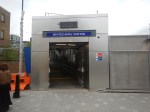
The station will be built where Clapperbrook Lane crosses the railway,

This document of the Devon County Council (DCC) web site gives more details about the station.

This image from the DCC document shows how the completed station will look.
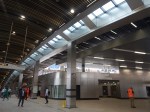
These are my thoughts.

Crossing The Tracks

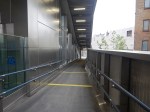
A cycle and foot bridge will be built parallel to the current Clapperbrook Lane East Bridge over the railway.

The DCC document says this about the bridge.

The key changes from the previous proposal relates to the ramps and access
between the two platforms. The previous design included ramps running parallel to
the railway, with long ramps and imposing structures due to Network Rail
requirements for their asset. The redesign now includes the ramps and a new bridge
constructed parallel to Clapperbrook Lane. This will instead be a Devon County
Council-owned asset and allows Devon County Council standards to be applied for
their pedestrian bridges. This is more in line with preferences expressed by disability
groups who supported shorter length but slightly steeper gradient with resting
platforms.

It looks to me that the final design will be much more aesthetically-pleasing than some of the structure Network Rail have erected lately.

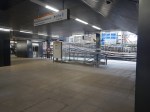
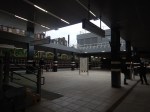
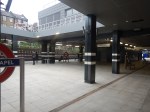
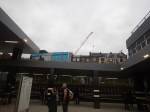
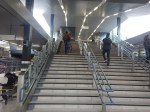
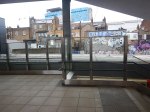
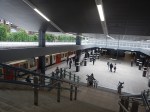
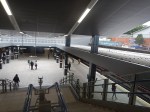
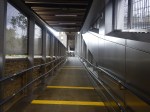
These pictures show Network Rail’s traditional approach at Horden station.

I feel the Devonian approach could be better, when I see it.

From the Google Map 3D image of the station, it looks like the bridge could be already under construction, so I don’t think, I’ll have long to wait.

The Platforms

The DCC document says that there will be two 124 metre long platforms, which will take six-car local trains.

It strikes me that although 124 metres can accommodate a formation of three Class 150 trains, it might be  too short in the future.

Especially, as trains likely to be available in battery-electric versions, which will surely be used to decarbonise the Riviera Line in the future, all have cars of 23 metres or longer.

Both platforms appear to have just a single waiting shelter.

Cycle Parking

There are twenty parking spaces for cycles on each side of the line.

The DCC document says this about local housing and cycling.

The station will be within reasonable cycling distance of the 2,500 dwelling South
West Exeter strategic allocation and Alphington village and so forms an important
part of mitigating traffic impacts on routes on the western side of the city.

Is there enough provision for the secure storage of cycles?

Disabled Parking

There are just three parking spaces for disabled passengers.

Car Parking

There are no generally-available car parking spaces.

The DCC document says this about car parking.

The scheme will also support aims for low-car development aspirations as part of the
emerging Liveable Exeter housing plans, which includes proposals for strategic
levels of housing in the Marsh Barton area, all within easy walking distance of the
station.

But will the station persuade local residents to forgo driving into Exeter and use the train?

Who Will Use The Station?

The DCC document talks of Marsh Barton station being a destination station for those who work in the area.

It also says this about leisure use.

In addition, the existing Clapperbrook Lane adjacent to the station provides an important link into the Riverside Valley multi-use trail network for leisure trips as well as commuter journeys to RD&E and County Hall, within a short walk/cycle distance of the station. Being located adjacent to a high quality, attractive cycle network offers huge potential to improve integration between rail and cycling.

Currently the lane is very popular with over 400 cyclists per day recorded crossing the rail bridge; however, it is narrow with poor visibility and although lightly trafficked is not suitable for all young families, people with disabilities or people less confident on bicycles.

I have a feeling that the station will need some extra facilities to attract more passengers. Ideas like a drop-off and pick-up facility, a warm place to wait and perhaps a local shuttle bus come to mind.

But as I said in the title it is very much a Ride-To-Work station.

Conclusion

The station has an interesting feature in the bridge over the railway, which gives full step-free access.

But I do feel that some of the details of the station will need some extra thought.

From other pages on the web, it appears the station is being constructed under a Design and Build contract with experienced station builder; Graham Construction. So hopefully, the details will be properly sorted.

The proof of the quality of the design will be in the usage figures.

May 26, 2021 Posted by | Design, Transport/Travel | , , , , | 3 Comments

Headbolt Lane Station Fly-Through

I had to show this Merseytravel YouTube video, as I feel the new Headbolt Lane station uses some interesting ideas.

This Google Map shows Headbolt Lane and the railway.

Note.

  1. The footbridge over the railway. I took the pictures from and around this bridge in Merseyrail To Skelmersdale – Headbolt Lane Station.
  2. The footbridge can’t be seen in the YouTube video.

Liverpool is to the West and Wigan is to the East.

These are my thoughts.

Is The Station North Or South Of The Railway?

As it is called Headbolt Lane, the station must have good access from that road, otherwise travellers will get rather confused.

So until proven otherwise, I will assume that the station must be to the North of the railway.

Which Way Is Liverpool In the Video?

If the station is North of the railway, then in the first part of the video, the visualisation approaches the station from the North and Liverpool is to the right and Wigan is to the left.

If that is right, then the yellow bus always points towards Liverpool.

How Many Platforms?

Wikipedia says that Headbolt Lane station will have three platforms.

From the video there will be two platforms for trains to and from Liverpool, although the current layout at Kirkby station makes do with just one platform.

There would also appear to be a single platform for trains to and from Wigan, Bolton and Manchester.

But there is a second Eastern track shown in the video, which possibly indicates provision has been made for a second platform for services in that direction.

Wot No Bridge?

It would appear that there is no bridge over or subway under the railway.

But it does appear that the platform layout shown allows passengers to walk between the ends of the tracks on the level to the platform or platforms on the side of the station away from the station building.

Will There Be A Second Entrance To The Station On The Other Side Of The Tracks?

The layout would allow this and it could be useful for those passengers living or working on that side of the railway.

Is The Platform Layout Unique?

I have travelled widely looked at railway stations all over the world.

But I can’t remember seeing a layout like this.

The layout does have advantages.

  • An expensive bridge with lifts will not be needed.
  • There is nothing mechanical or electrical to go wrong.
  • Extra platforms can be added if required.
  • It can also be used as a simple step-free way to cross the railway.

I suspect that the layout could be used in other places.

Train Frequencies To Liverpool

The current service between Kirkby station and Liverpool is four trains per hour (tph), which is handled on a single platform.

One platform at Headbolt Lane would surely be sufficient, but a second platform must surely allow extra services and provide more resilience in case of train failure.

Train Frequencies To Wigan, Bolton And Manchester

The current service between Kirkby station and Manchester is one tph, which is handled on a single platform.

One platform at Headbolt Lane would surely be sufficient and could easily handle two tph.

Are two platforms provided for Liverpool services, so that extra services could be run in the Peak or to provide more resilience, should a train fail in the station.

A Service To Skelmersdale

Consider.

  • Skelmersdale is about five miles North of the line between Headbolt Lane and Wigan.
  • One of Merseyrail’s current Class 507 trains covers the 5.5 miles between Kirkby and Sandhills station in twelve minutes.
  • The proposed layout of Headbolt Lane station does not allow direct services between Liverpool and Skelmersdale.

These distances and timing would mean the following.

  • A single shuttle train between Headbolt Lane and Skelmersdale could run a two tph service.
  • A pair of shuttle trains between Headbolt Lane and Skelmersdale could run a four tph service.

Passengers would need to change trains at Headbolt Lane station.

This may seem less passenger-friendly than a direct service, but it could be the most affordable option.

And it could always be improved with modifications at Headbolt Lane station.

Is There A Role For Battery-Electric Trains?

Consider.

  • For Health and Safety reasons, it is very unlikely that any new third-rail track will be laid in the UK.
  • The distance between the current Kirkby station and the new Headbolt Lane station is about 1.5 miles.
  • The distance between Headbolt Lane and Skelmersdale stations is less than eight miles.
  • I suspect Headbolt Lane and Skelmersdale stations would both have good power supplies.
  • Merseyrail’s new Class 777 trains have a battery capability.

Would this allow the following?

  • Liverpool and Headbolt Lane services to use battery power between Kirkby and Headbolt Lane station. All charging would be done between Liverpool and Kirkby.
  • The shuttle train between Headbolt Lane and Skelmersdale would work on battery power, with batteries charged at both ends of the route.

There is also the possibility, that the Headbolt Lane and Manchester Victoria service could be run using battery-electric Class 331 trains.

  • Headbolt Lane and Manchester Victoria will be a 28.5 mile service with a couple of miles of electrification at the Manchester end.
  • I estimate that the battery-electric Class 331 trains will have sufficient range to handle this route with charging at Headbolt Lane station.
  • Currently, trains from Manchester Victoria take over ten minutes to turnround at Kirkby station.
  • Provision for a charger could be built into Headbolt Lane station.

It would be a simple way to electrify the Kirkby and Manchester Victoria service.

In addition, battery-electric Class 331 trains are likely to have longer battery range than the Class 777 trains.

So might it be better if the Headbolt Lane and Skelmersdale shuttle was worked by battery-electric Class 331 trains.

If the two East-facing platforms at Headbolt Lane station were to be fitted with charging facilities, this would give an increased level of reliability.

Could Northern’s Manchester Victoria Service Terminate At Skelmersdale?

If both services were to be run by Northern’s battery-electric Class 331 trains, this could be a possibility.

  • A reverse would be needed at Headbolt Lane station.
  • I estimate that 2tph on the route would fit together well.
  • Trains would be charged at Skelmersdale station.
  • Chargers might not be needed at Headbolt Lane station.

In addition, a two tph service would fit in well with four or six tph to Liverpool.

Conclusion

It’s almost as if Headbolt Lane station could consist of three elements.

  • The station facilities, bus interchange and car parking.
  • A two-platform station for Merseyrail services to Liverpool
  • A two-platform station with charging facilities for Northern services to Blackburn, Bolton, Manchester Victoria, Skelmersdale and Wigan.

All services from Headbolt Lane station will be run by battery-electric reains.

Costs have been saved by the following.

  • Not having a bridge over the tracks.
  • Maintaining the separation between Northern and Merseyrail services.
  • Not electrifying between Kirkby and Headbolt Lane stations.
  • Not electrifying the Skelmersdale Branch.

The whole station appears to have been designed on a single level.


May 24, 2021 Posted by | Design, Transport/Travel | , , , , , , , , , , | 7 Comments

A Fair Recovery For Hackney Central

This image from Hackney Council shows a visualisation of the new entrance to Hackney Central station, that will be created on Graham Road.

I took these pictures of the site in October 2019.

I wrote about the new entrance in Will Hackney Central Station Get A Second Entrance?.

It’s certainly a site in need of improvement.

Here’s a few more of Hackney’s images from this page on Hackney Council’s web site.

If they build it like the visualisations, it could be something special.

May 24, 2021 Posted by | Design, Transport/Travel | , , , | Leave a comment

An Elegant Way To Cope With Roof Leaks

I took these pictures at St. Pancras station.

Note.

  1. The full wording is “I catch rain, not rubbish”
  2. The green grass is something like Astroturf.
  3. There were three of them!
  4. They appear to be fitted with castors.

I’m surprised, I’ve not seen this idea used before.

May 19, 2021 Posted by | Design, Transport/Travel, World | , , | Leave a comment

Massless Energy Storage: The Next Step In Battery Technology

The title of this post, is the same as that of this article on AZOCleanTech.

This is the introductory paragraph.

In this environmentally conscious world, fossil fuels are being shunned in favor of renewables for electricity generation and transportation. Due to their periodic nature, excess energy generated by renewables is frequently stored in batteries. However, these often add extra weight to the cars and consumer electronics they power.

To solve the problem, researchers in Sweden have developed a structural battery.

Sounds like a good idea to me!

April 9, 2021 Posted by | Design, Energy, Energy Storage | , | Leave a comment

Piney Point: Emergency Crews Try To Plug Florida Toxic Wastewater Leak

The title of this post, is the same as that of this article on the BBC.

This is the introductory paragraph.

Emergency crews in Florida have been working to prevent a “catastrophic” flood after a leak was found in a large reservoir of toxic wastewater.

This Google Map shows the location.

Note.

  1. At the top of the map is an area called Tampa Bay Estuarine Ecosystem Rock Ponds.
  2. The reservoir appears to be in the South East corner of the map.
  3. There appear to be several chemical works to the West of the highway.

This second Google Map shows the reservoir at a larger scale.

Note.

  1. The picture in the BBC article was taken from the North West.
  2. The problem reservoir is right and above of centre.
  3. To its right is Lake Price, which appears to be the sort of lake to sail a boat and perhaps do a bit of fishing and swimming.
  4. Moore Lake to the South appears similar to Lake Price.

It looks to me that it is not the place to have an environmental incident.

This article in The Times says this.

Engineers are furiously pumping the phosphate-rich water into the sea to avoid an uncontrolled spill at Piney Point, whose failure could unleash a 20ft-high wall of toxic effluent.

Pumping it into the sea? Surely not?

I suspect there could have been a mixture of sloppy management and loose regulation, with minimal enforcement and I’ll be interested to see what recommendations are put forward by the inevitable investigation.

In my varied past, I was once indirectly involved, in the toxic waste that comes out of chemical plants. At the time, I was working for ICI in Runcorn and my main job was building designing and building instruments for the various chemical plants in and around Runcorn.

As they had hired me because of my programming skills, they asked me if I could do a few small jobs on their Ferranti Argus 500, which could be plugged in to both their Varian NMR machine and their AEI mass spectrometer.

With the former, to get better accuracy in analysis of chemicals, I would take successive scans of a sample and aggregate them together. The accuracy of the results would be proportion to the square root of the number of scans.

The second to my mind was more difficult and much more interesting.

This explanation of mass spectroscopy is from Wikipedia.

Mass spectrometry (MS) is an analytical technique that is used to measure the mass-to-charge ratio of ions. The results are typically presented as a mass spectrum, a plot of intensity as a function of the mass-to-charge ratio. Mass spectrometry is used in many different fields and is applied to pure samples as well as complex mixtures.

ICI at Runcorn had a lot of complex mixtures and the aim of my project, was to take a mass spectrum and automatically decide what chemicals were present in the mixture.

The mass spectra were presented as a long graph on a roll of thermal paper. I noticed that operators would pick out distinctive patterns on the graph, which they told me were distinctive patterns of chlorine ions.

Chlorine has an unusual atomic weight of 35.5 because it is a mixture of two stable isotypes Chlorine-35 and Chlorine-37, which produced these distinctive patterns on the spectra.

I was able to identify these patterns to determine the number of chlorine atoms in a compound. By giving the algorithm a clue in stating how many carbon, oxygen and hydrogen atoms could be involved, it was able to successfully identify what was in a complex mixture.

All this was programmed on computer with just 64K words of memory and a half-megabyte hard disc.

ICI must have been pleased, as I got a bonus.

One of the jobs the software was used for was to identify what chemicals were present in the lagoons alongside the River Weaver, which are shown today in this Google Map.

Note.

  1. The chemical works, which were part of ICI in the 1960s, to the North of the Weaver Navigation Canal.
  2. The two former lagoons between the canal and the River Weaver, which seem to have been cleaned out and partially restored.
  3. Was that a third large lagoon to the South of the River Weaver?
  4. There also appears to be a fourth smaller triangular lagoon between the canal and the river.

There certainly seems to have been a better clear-up in Runcorn, than in Florida.

I moved on from Runcorn soon after, I’d finished that software and have no idea how or if it developed and was used.

But the techniques I used stayed in my brain and were used at least four times in the future.

  • In the design of a Space Allocation Program for ICI Plastics Division.
  • In the design of two Project Management systems for Time Sharing Ltd.

And of course, they were also used in designing the scheduler in Artemis for Metier.

I


April 5, 2021 Posted by | Computing, Design, World | , , , , , , , , , | Leave a comment

Design For Bank Tube Station Entrance For Approval

The title of this post, is the same as that of this article on Ian Visits.

This is the introductory paragraph.

Design details for Bank tube station’s new Cannon Street entrance have been submitted to the City of London for planning approval.

Note.

  1. It certainly looks to be an entrance with a very high capacity.
  2. It looks like there will be a fully-accessible toilet inside the barriers, which many will welcome.

I would hope that approval will be quickly nodded through!

March 2, 2021 Posted by | Design, Transport/Travel | , , | 1 Comment

Inappropriate Language

My bank sends a six character code of three letters and three numbers to my phone, so that I can login.

Today, the three letters were KKK.

How inappropriate is that?

I have complained!

February 5, 2021 Posted by | Computing, Design, Finance & Investment | , | 3 Comments

Students Design ‘Mitt’ Prosthetic Limb For Children

The title of this post, is the same as this article on the BBC.

This was the good news story of the day, which started with these two paragraphs.

Even the most up-to-date prosthetic limbs can often be too heavy, or hard for young children to use with ease.

But now, a group of Imperial College engineering students has created a new, lighter one.

There is a video in the BBC article, which shows how it works.

  • It looks like it doesn’t have any power, so there are no heavy batteries.
  • Tools are attached by a powerful magnet.
  • As the name suggests, it is worn like a glove.
  • Judging by the look on the little girl’s face, as she used it to do simple tasks, it has found a satisfied customer!

What puzzles me, is that it is such a simple idea, that it hasn’t been thought off before.

Could The Mitt Have Other Applications?

I have a feeling it could.

I recently cut the back of my hand badly.

The picture shows it soon afterwards.

I don’t work or do many dirty tasks around the house, but could the students use their design principles for someone, who has perhaps damaged their hand and needs some protection.

This second picture shows how well it healed in the end.

I think the principle behind the Mitt has legs.

December 29, 2020 Posted by | Design, Health | , , | 1 Comment

Beeching Reversal – Ferryhill Station Reopening

This is one of the Beeching Reversal projects that the Government and Network Rail are proposing to reverse some of the Beeching cuts. There used to be a Ferryhill station on the East Coast Main Line. It closed in 1967 and burnt down in 1969, before being demolished.

I first noted the station in Boris Johnson Backs Station Opening Which Could See Metro Link To County Durham, after Boris promised it would be built in PMQs.

I then mentioned the station in Northern Powerhouse Rail – Significant Upgrades Of The East Coast Main Line From Leeds To Newcastle (Via York And Darlington) And Restoration Of The Leamside Line.

Last night, I read this document from Railfuture, which talks about rail improvements in the North East and on the East Coast Main Line.

In the document, Ferryhill station is mentioned eighteen times.

Reopening Ferryhill station would appear to have support at all levels.

The Location Of Ferryhill Station

This Google Map shows the general area of the proposed Ferryhill station.


Note.

  1. Ferryhill is the village in the North-West corner of the map.
  2. The lion-shaped quarry in the North-East is destined to become a landfill site.
  3. Below this is Thrislington Plantation, which is a National Nature Reserve.
  4. The East Coast Main Line runs North-South between the village and the quarry.

South of the village the line splits, as is shown in detail in this second Google Map.

Note.

  • Ferryhill South junction by Denhamfields Garage, with the nearby Ferryhill Station Primary School
  • The line going South-East is the Stillington freight line to Teesside.
  • The other line going in a more Southerly direction is the electrified East Coast Main Line to Darlington and the South.
  • Between Ferryhill South junction and Tursdale Junction with the Leamside Line is a 2.5 mile four-track electrified railway.

I suspect the station could be any convenient location, to the North of the junction.

Railfuture have strong opinions on the station and feel it should be a Park-and-Ride station for the settlements in the former North Durham coalfield, with frequent services to Newcastle.

Current Passenger Train Services Through Ferryhill

These services currently pass the location of the proposed Ferryhill station.

  • LNER – London Kings Cross and Edinburgh via York, Darlington. Newcastle and Berwick-upon-Tweed
  • LNER – London Kings Cross and Edinburgh via Peterborough, Newark North Gate, Doncaster, York, Darlington, Durham and Newcastle
  • CrossCountry – Plymouth and Edinburgh via Totnes, Newton Abbot, Exeter St Davids, Tiverton Parkway, Taunton, Bristol Temple Meads, Bristol Parkway, Cheltenham Spa, Birmingham New Street, Derby, Chesterfield, Sheffield, Wakefield Westgate, Leeds, York, Darlington, Durham and Newcastle
  • CrossCountry – Southampton and Newcastle via Birmingham New Street, Derby, Sheffield, Doncaster, York, Darlington and Durham
  • TransPennine Express – Liverpool Lime Street and Edinburgh via Newton-le-Willows, Manchester Victoria, Huddersfield, Leeds, York, Darlington, Durham, Newcastle and Morpeth
  • TransPennine Express – Manchester Airport and Newcastle via Manchester Piccadilly, Manchester Oxford Road, Manchester Victoria, Huddersfield, Dewsbury, Leeds, York, Northallerton, Darlington and Durham

Note.

  1. All trains have a frequency of one train per hour (tph)
  2. All trains call at York, Darlington and Newcastle.
  3. I have missed out some of the intermediate stations, where trains don’t call at least hourly.
  4. I have missed out stations South of Birmingham New Street.
  5. A few Northern Trains services pass through at Peak times or to go to and from depots.

I suspect some of these services could stop and to encourage commuters to Newcastle, Durham and Darlington to swap from car to train,

I also suspect that Ferryhill station needs a frequency of at least two tph and if possible four! Four tph would give a Turn-up-and-Go service to Darlington, Newcastle and York.
Planned And Possible Future Passenger Train Services Through Ferryhill

From various sources, these services are either planned or possible.
High Speed Two

High Speed Two are planning the following services, that will pass through.

  • Birmingham Curzon Street and Newcastle via East Midlands Hub, York, Darlington and Durham.
  • London Euston and Newcastle via Old Oak Common, East Midlands Hub and York.
  • London Euston and Newcastle via Old Oak Common, East Midlands Hub, York and Darlington.

Note.

  1. All trains have a frequency of one tph.
  2. All trains call at York, East Midlands Hub, York and Newcastle.
  3. All trains will be 200 metres long.

I feel that Ferryhill station should have platforms long enough to accommodate these trains and other long trains, to future-proof the design and to cater for possible emergencies.

The longest trains on the route would probably be one of the following.

  • A pair of five-car Class 800 trains or similar, which would be 260 metres long.
  • A High Speed Two Classic-Compatible train, which would be 200 metres long.

Unless provision needed to be made for pairs of High Speed Two Classic-Compatible trains.

East Coast Trains

From next year, East Coast Trains, intend to run a five trains per day (tpd) service between London and Edinburgh via Stevenage, Newcastle and Morpeth.

Note that in Thoughts On East Coast Trains, I said this service would stop at Durham, as that was said in Wikipedia at the time.

Northern Powerhouse Rail

Northern Powerhouse Rail has an objective to to run four tph between Leeds and Newcastle in 58 minutes.

At present there are only three tph on this route, two tph from TransPennine Express and one tph from CrossCountry. All three services stop at Leeds, York, Darlington, Durham and Newcastle.

I believe that the best way to provide the fourth service between Leeds and Newcastle would be to run a third LNER service between London Kings Cross and Edinburgh, when upgrades to the East Coast Main Line give the train operating company another path.

  • The service would only stop en route at Leeds and Newcastle.
  • It would increase the frequency between London Kings Cross and Leeds to three tph
  • It would increase the frequency between London Kings Cross and Newcastle to three tph
  • It would increase the frequency between London Kings Cross and Edinburgh to three tph
  • It would increase the frequency between London Leeds and Newcastle to four tph
  • It would run non-stop between London Kings Cross and Leeds, in under two hours.

I believe that, when all the upgrades to the East Coast Main Line are complete, that such a service could match or even better High Speed Two’s time of three hours and forty-eight minutes between London and Edinburgh.

Ferryhill And Teesside Via The Stillington Freight Line

The Clarence Railway is described in this paragraph in its Wikipedia entry.

The Clarence Railway was an early railway company that operated in north-east England between 1833 and 1853. The railway was built to take coal from mines in County Durham to ports on the River Tees and was a competitor to the Stockton and Darlington Railway (S&DR). It suffered financial difficulty soon after it opened because traffic was low and the S&DR charged a high rate for transporting coal to the Clarence, and the company was managed by the Exchequer Loan Commissioners after July 1834.

But it has left behind a legacy of useful rail lines, that connect important factories, ports, towns, works on other railways on Teesside.

This Google Map shows the triangle between Eaglescliffe, Stockton-on-Tees and Thornaby stations.

Note.

  1. Eaglescliffe station is in the South-West corner of the map and lines from the station lead to Darlington and Northallerton stations.
  2. Thornaby station is in the North-East corner of the map and connects to Middlesbrough station.
  3. Stockton station is at the North of the map.

Tracks connect the three stations.

This Google Map shows the connection between Thornaby and Stockton stations.

Note.

  1. Stockton station is at the North of the map.
  2. Thornaby station is at the East of the map.
  3. In the South-Western corner of the map is a triangular junction, that links Eaglescliffe, Stockton-on-Tees and Thornaby stations.

Currently, this triangular junction, allows trains to go between.

  • Middlesbrough and Newcastle via Thornaby, Stockton, Hartlepool and Sunderland.
  • Middlesbrough and Darlington via Thornaby and Eaglescliffe.
  • Middlesbrough and Northallerton via Thornaby and Eaglescliffe.

But it could be even better.

This Google Map shows another triangular junction to the North of Stockton station.

Note.

  1. The Southern junction of the triangle leads to Stockton station and ultimately to Darlington, Eaglescliffe, Middlesbrough, Northallerton and Thornaby.
  2. The Eastern junction leads to Hartlepool, Sunderland and Newcastle.

So where does the Western Junction lead to?

The railway is the Stillington Branch Line.

  • It leads to Ferryhill.
  • It is about ten miles long.
  • It is double-track.
  • There used to be intermediate stations at Radmarshall, Stillington and Sedgefield.

Looking at timings for trains on the various sections of the route gives.

  • Middlesbrough and Stockton – 11 minutes
  • Stockton and Ferryhill South Junction – 23 minutes
  • Ferryhill South Junction and Newcastle – 20 minutes

This gives a timing of 54 minutes compared with up to 78 minutes for the current service on the Durham Coast Line.

In their document, Railfuture gives this as one of their campaigns.

Providing Faster Journeys Teesside to Tyneside by running passenger services from
Middlesbrough, Thornaby and Stockton via the 10 mile Stillington freight only line and then via the
East Coast Main Line to Newcastle. Our aim is to reduce overall journey time on direct train
between Middlesbrough to Newcastle from 1 hour 15 minutes to 55 minutes and so open up many
additional job opportunities to the residents of both areas.

My calculations say that it should be possible, to run a useful service between Middlesbrough and Newcastle, via the Stillington freight line.

  • The route is used regularly for freight trains and by LNER for what look to be testing or empty stock movements.
  • Will any station be built at Radmarshall, Stillington or Sedgefield?
  • I estimate that between Ferryhill South Junction and Middlesbrough, is about fifteen miles, so it might be possible to run a Middlesbrough and Newcastle service using battery electric trains, like Hitachi’s Regional Battery Trains, which would be charged on the East Coast Main Line.

Activating the route, doesn’t look to be the most expensive passenger reopening on the cards.

I suspect though, that if passenger services were to be run on the Stillington Line, that Ferryhill station, will need platforms on both the East Coast Main Line and the Stillington Line.

Services could include.

  • Newcastle and Middlesbrough via Ferryhill
  • Newcastle and Hartlepool via Ferryhill
  • Newcastle and York via Eaglescliffe and Ferryhill, with a reverse at Middlesbrough.


Note.

  1. The Northern terminus could be Ferryhill for some trains.
  2. Two tph between Stockton and Ferryhill would be a useful service.
  3. Would a Newcastle and Middlesbrough service call at the poorly-served Chester-le-Street station to improve services?

I also feel that as some of these services will be running on the East Coast Main Line between Ferryhill and Newcastle, it probably would be desirable for these services to be run by Hitachi’s Regional Battery Trains, which would be capable of maintaining the maximum speed for the route, as all the other passenger services can at present!

Ferryhill And Tyneside Via The Leamside Line

The reopening of the Leamside Line is a high priority of Northern Powerhouse Rail, which I wrote about in Northern Powerhouse Rail – Significant Upgrades Of The East Coast Main Line From Leeds To Newcastle (Via York And Darlington) And Restoration Of The Leamside Line.

In their document, Railfuture gives this as one of their campaigns.

Reopening the rail line from Ferryhill to Pelaw (the Leamside Line) with the aim of providing
services that will improve local connections and open new opportunities to people living in this part
of County Durham, as well as providing relief for congestion on the existing line through Durham.

This reopening has been talked about for years, so I suspect that Network Rail know the problems and at least have a rough estimate for what needs to be done and how much it will cost.

The Wikipedia entry for the Leamside Line has a section, which is entitled Proposed Re-Opening, Upgrade and Development, where this is the first paragraph.

Since the line’s closure in the early 1990s, a number of proposals to re-open the Leamside Line were put forward, including plans by AECOM, ATOC, Durham County Council, Railtrack and Tyne and Wear PTE. The line has been considered for a number of potential uses, including a regional suburban rail service linking Tyneside and Teesside, a diversionary freight route for the East Coast Main Line, and an extension to the Tyne and Wear Metro network.

Wikipedia also states that an application to the Restoring Your Railway Fund for money for a feasibility study was unsuccessful.

All that could change with the developments needed between Leeds and Newcastle for High Speed Two and Northern Powerhouse Rail.

  • High Speed Two are planning to run at least three tph to and from Newcastle.
  • Northern Powerhouse Rail are planning to run an extra service between Leeds and Newcastle.
  • LNER will have an extra path on the East Coast Main Line, that could be used through the area.

Using the Leamside Line as a diversion for freight and slower passenger trains would appear to be a possibility.

It could also be combined with the Stillington Line and Northallerton and Stockton to create a double-track diversion, alongside the double-track section of the East Coast Main Line between Northallerton and Newcastle.

Extending The Tyne And Wear Metro Along The Leamside Line

This has been talked about for some time.

In the Wikipedia entry for the Tyne and Wear Metro. there is a section, which is entitled Extension To Washington IAMP, where this is said.

There have been a number of proposals looking in to the possibility of re-opening the former Leamside Line to Washington, including a 2009 report from the Association of Train Operating Companies (ATOC), and a 2016 proposal from the North East Combined Authority (NECA), as well as the abandoned Project Orpheus programme, from the early 2000s. Most recently, proposals are being put forward to link the current network at Pelaw and South Hylton, with the International Advanced Manufacturing Park in Washington, using part of the alignment of the former Leamside Line.

If the Tyne and Wear Metro were to be extended to the Southern end of the Leamside Line, Ferryhill station could be a Southern terminal.

  • There is space to create a line alongside the East Coast Main Line between Tursdale Junction, where it connects with the Leamside Line and Ferryhill station.
  • The new Tyne and Wear trains have been designed to share tracks with other trains on Network Rail tracks.
  • This would enable interchange between East Coast Main Line, Stillington Line and Metro services, without going North to Newcastle.

At the present time, all that would be needed would be for the Metro connection to be safeguarded.

Railfuture’s Campaigns In The North East

This is a tidying up of several improvements, which are campaigns of Railfuture, that are outlined in this document.

They will be covered in separate posts.

Conclusions

I can separate conclusions into sections.

The Design Of Ferryhill Station

These are my conclusions about the design of Ferryhill station.

  • It should be built as a Park-and-Ride station.
  • It should have platforms long enough for any train that might stop at the station. I suspect this would be a pair of Class 800 trains, which would be 260 metres long.
  • Platforms should be on both the East Coast Main Line and the Stillington Line.
  • There should be safeguarding of a route, so that Metro trains could access the station from the Leamside Line.

As the station could be a Park-and-Ride station, I will assume the station will need good road access.

Train Services At Ferryhill Station

These are my conclusions about the services calling at Ferryhill station.

There should be four tph between Leeds and Newcastle, all of which would stop at York, Darlington, Ferryhill and Durham, with some services calling at Northallerton and Chester-le-Street.

There should also be less frequent services at Ferryhill to Scotland and London. Perhaps a frequency of around six tpd would be sufficient, as changes could be made at Leeds, Newcastle of York.

Two tph would probably be ideal for services on the Stillington Line to Hartlepool, Middlesbrough and Redcar.

It would certainly be a busy and well-connected station.


December 13, 2020 Posted by | Design, Transport/Travel | , , , , , , , , , , , , , , , , , , | 5 Comments