The Anonymous Widower

Watford Junction Station’s Barrier Seats

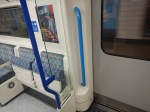
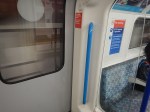
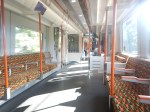
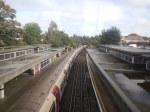
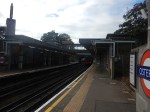
I quite like these seats at Watford Junction station.

They would appear to give a nice perch to sit, whilst waiting for the train and also act as a crush barrier for the glass shelter behind.

They also give me something to hold, when a train goes through.

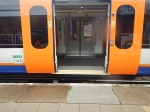
The train shown in the picture was a Tesco train between Tilbury and Daventry.

It went through the station at probably over 60 mph.

It had the usual smelly and polluting Class 66 on the front.

It took four hours 45 minutes for the journey, which included the Gospel Oak and Barking Line through London.

I did note earlier that the train seemed to be using modern wagons.

Are these wagons faster than those you generally see on UK railways?

Surely too, this is the type of train, that could be hauled by an electric locomotive with a Last-Mile capability, like a Class 88 Locomotive.

I would have thought, that Tesco could benefit, by using electric haulage, especially if the locomotive was appropriately liveried.


July 6, 2021 Posted by | Design, Transport/Travel | , , , | 2 Comments

Is This The Shape Of Freight To Come?

This article on Rail Advent is entitled Eversholt Rail Unveils First Swift Express Freight Train In Doncaster.

It is a full report on the first of a new breed of freight trains based on redundant 100 mph electric multiple units.

Three Rail Problems

The rail industry, its financiers and customers have a lot of problems, they’d like to solve, but these three seem to be coming together to create a whole new industry.

Rolling Stock Leasing Companies Have A Surplus Of Redundant Rolling Stock


Most of the released rolling stock has been made redundant because of the arrival of new trains.

What will be left will be a an assortment, which will contain a lot of trains with these characteristics.

  • Four cars
  • Can run in formations of 4, 8 and 12 cars
  • Electrically-powered.
  • Some trains are even dual voltage.
  • 100 mph operating speed.
  • Good reliability.
  • Easy maintenance and modification if needed.

Many were even built over thirty years ago by British Rail Engineering Ltd.

As someone, who used to part-own a company that leased trucks to operators, I know that to maximise cash-flow and ultimately profits, you don’t want them sitting in a yard or a siding.

Conversion to zero carbon is one option.

  • Porterbrook have said they will convert the Class 350 trains, that they own to battery-electric operation.
  • Porterbrook have also converted some Class 319 trains to electro-diesel Class 769 trains.
  • Porterbrook have also converted a Class 319 train to hydrogen operation.
  • Eversholt Rail Group and Alstom are converting Class 321 trains to hydrogen operation.

I also believe that the redundant Class 379 trains will also be converted to battery-electric operation.

But there will still be a substantial number of quality trains, that need a second life.

The Growth Of Parcel Freight

Parcel freight traffic driven by on-line shopping, has boomed in the pandemic.

This type of traffic often originates from outside of the UK and enters the country at places like London Gateway or East Midlands Airport.

Much of it is currently distributed to large cities by truck, which in this day and age is not a green option, or even an option at all.

Rail Operations Group have leased ten Class 769 trains and 9 Class 319 trains with the intention of running parcel services under the Orion brand. I wrote about this proposal in A Freight Shuttle For Liverpool Street Station Planned.

Road Congestion

Road congestion is getting worse and there is bir much point in having product stuck on the motorway, when it can be running along at a 100 mph on an electrified rail line.

The Need For Just-In-Time Deliveries

Many factories these days work on the Just-In-Time principle, with product delivered just as its needed.

As an example Toyota build their cars at Burnaston near Derby, but the engines are built in North Wales. I suspect that they go across the country by truck.

Looking at maps, the engine plant could be rail connected and I feel one could be arranged at Burnaston.

Do they keep a good stock of engines at Burnaston?

I can see several situations like this needing a regular company train.

Fast Food

Because of Brexit we will need to be growing more of our own food.

Traditionally, the Class 43 power cars of InterCity 125 trains carried flowers and fish up from Cornwall.

So will we see rail provide an alternative.

Conclusion

Put these problems together and you can see a fair number of four-car electric multiple units being converted to short 100 mph electric freight trains.

Eversholt Rail Group‘s Swift Express Freight Train is very much a demonstrator for their ideas and it has some expected and unexpected features.

Based On A Class 321 train

The train is based on a four-car Class 321 train.

I rode one recently and I timed it at over 90 mph on the way to Southend.

Trolley Cages

Pictures in the Rail Advent article show a stripped-bare interior with a steel floor, with another picture showing three supermarket trolley cages arranged across the train.

One estimate in the article says that each coach can handle over fifty of these cages and up to nine-and-a-half tonnes of cargo.

Four Seats And A Toilet

Eversholt feel that some of the trains could be used in a Travelling Post Office mode and there may be a need for sorting en route, so two first-class seats, two second-class seats and a toilet are provided.

This train would enable an Anglo-Scottish parcel service.

  • It might stop several times en route.
  • At each stop parcels would be rolled out and in, perhaps with the help of a Harrington Hump.
  • The on-train staff would sort the incoming parcels and put them in the required trolley for offloading.

I don’t think though, they’ll be delivering postal orders.

A Last Mile Capability

The article also disclosed that Eversholt were thinking of fitting a Last-Mile capability to the Swift Express Freight Train.

Batteries were mentioned and they would obviously work.

But one development recently is Porterbrook’s HydroFlex train, which has converted a Class 319 train to hydrogen power.

  • The conversion was done by Birmingham University.
  • It appears that all the hydrogen gubbins is underneath the floor, so cargo capacity would not be reduced.

I suspect underfloor hydrogen power could be very viable in an express freight train.

Fleet Size

The article talks of a fleet size of twenty and also says that the first train has been leased to an unnamed parcel distributor in the UK.

July 3, 2021 Posted by | Design, Finance & Investment, Transport/Travel | , , , , , , , , , , , , , | 7 Comments

Wrightbus Presents Their First Battery-Electric Bus

The title of this post, is the same as that of this article on Electrive.

This is the first paragraph.

The Northern Irish bus manufacturer Wrightbus presents its first battery-electric vehicle in its portfolio: a double-decker bus called StreetDeck Electroliner. Until now, the Northern Irish manufacturer has been known primarily for its hydrogen-powered buses.

In My First Ride In A Hydrogen-Powered Double-Deck Bus, I rode in a Wrightbus StreetDeck Hydroliner FCEV, so these pictures of that bus, will at least show the external style of the StreetDeck Electroliner BEV.

These two links show the web page for each product on the Wrightbus web site.

Electric – Wrightbus StreetDeck Electroliner BEV

Hydrogen – Wrightbus StreetDeck Hydroliner FCEV

Wrightbus on their web page announce the Electroliner with a headline of The Electric Bus Perfected.

This is the first paragraph of the web page.

Meet the electric bus from the future of environmentally friendly transport. Our StreetDeck Electroliner is built with features to inspire the next wave of electric transport including best in class range to cover most duty cycles, modern passenger-focused amenities, best in class charge time, and many more. Making every kilometer a new sustainability milestone.

These are some features of the bus, gleaned from Wrightbus web page and the electrive article.

Battery Power

The Wrightbus web page says this about the batteries.

StreetDeck Electroliner’s maximum power from a 454kW zero-emission battery electric powertrain is the highest battery capacity for a UK Double Deck bus. It powers it to a leading range of up to 200 miles and a fast charge time of just 2.5 hours ensures longer journeys with fewer refueling breaks. Our commitment to greener transport is also strengthened with an optional 8-year battery warranty.

Note.

  1. On the Wrightbus web page, a cutaway drawing appears to show batteries everywhere.
  2. Reading the Wrightbus web page, the specification says that there are two battery sizes available; 340 kWh and 454 kWh.

They certainly seem to have all angles covered with batteries.

According to the electrive article, the StreetDeck Electroliner uses slim batteries from French company; Forsee Power.

On their web site, there is a paragraph, which is entitled Wrightbus Will Integrate ZEN SLIM Batteries, where this is said.

As part of its exclusive supplier partnership with Wrightbus, Forsee Power will supply Wrightbus with the new ZEN SLIM batteries, whose extra flat format allows easy integration into the chassis of vehicles (standard or double-decker buses).

Each bus will be equipped with three battery systems up to 340 kWh and an extension including a fourth system will also be possible, providing exceptional capacity of 432 kWh and a battery range of more than 350 kilometers.

The figure of 432 kWh does not fit with the Wrightbus specification and is not 340*4/3, so I suspect the Forsee web site is a couple of figures out of date.

The Forsee brochure for the ZEN SLIM batteries gives an energy density of 166 Wh per Kg. This means that the weight of the 454 kWh battery is around 3.7 tonnes.

I do like the modularity of the batteries, as it means must mean greater flexibility for bus operators, especially in a large city, where there is a varied mix of routes.

Intriguingly the batteries appear to be water cooled. Is the heat generated by the batteries, used to warm the bus in winter? Now that would be kool!

Battery Charging

In the specification on the Wrightbus web site, under a heading of EV Charging, this is said.

CCS2.0 Compliant Combo2 Socket
150kW or 300kW fast charge

And under a heading of EV Charge Time, this is said.

340kWh – 2 ½ hours @ 150kW
454kWh – 3 hours @ 150Kw
Up to 420kW Opportunity Charging / Pantograph Charging

I find the pantograph charging interesting.

I have been following a battery train charging device called a Railbaar since 2016, when I wrote How To Charge A Battery Train.

The device is now available for buses as a Busbaar and this page on the opbrid web site talks about opportunity charging for buses.

Opportunity Charging would entail charging the buses at suitable points along the route, using an overhead charging point and a speciality designed pantograph on the roof of the bus.

Wrightbus claims a charging rate of 420 kW for their system. With a claimed range of 200 miles, these buses should be able to handle at least 90 % of the bus routes in the UK.

Note that Opbrid are part of Furrer + Frey, the Swiss supplier of railway overhead electrification, who have a quality pedigree and are Network Rail’s supplier of choice for overhead electrification.

Co-location Of Bus And Railway Stations

Bus stations with charging for battery buses and electrified railway lines will both need a high grade connection to the electricity grid.

As an Electrical Engineer, I think it would be prudent to co-locate bus and railway stations so that all heavy users and the parked electric vehicles nearby could share the grid connection.

Both The Hydroliner And The Electroliner Appear To Share A Chassis

Looking at the cutaways on the two web pages for the buses, the chassis of both buses appear to be very similar.

The cutaway for the Electroliner shows some of the batteries low down between the wheels with more stacked up at the back of bus.

On the Hydroliner much of the equipment seems to be stacked up at the back of the bus.

The similar chassis and body designs must surely help production and allow a lot of components to be shared between the two buses.

Drive System

This article on electrive is entitled Voith To Deliver Electric Drives For Wrightbus and this is the first paragraph.

Northern Irish bus manufacturer Wrightbus has selected Voith as its exclusive partner to supply the electric drive system for the second generation of its battery-electric and fuel cell buses for Europe.

The second paragraph, says that Wrightbus has an order for eighty Electroliners for Translink in Northern Ireland to be delivered after August 2021.

This electrive article also described Voith’s electric drive system (VEDS).

The German supplier says it has developed the VDES specifically for the requirements of public transport. The 340 kW electric motor is said to be able to drive even double-decker buses, heavy articulated buses and trucks over long distances. The system also includes a water-cooled converter system, a drive management unit (called DMU), further converters for auxiliary units and the on-board charging management system including the cabling. Voith expects this to result in the highest possible efficiency, as all components are coordinated with each other.

Note the water-cooled converter system.

Running Gear

No vehicle is complete without a good set of wheels and suspension. The first electrive article says this.

Other features of the StreetDeck Electroliner, Wrightbus says, include a ZF rear axle system (AV133) and an independent front suspension system (RL 82 EC), also from ZF.

Few would question the choice of ZF as a supplier.

Conclusion

It looks to me, that Wrightbus have designed two buses, from the best components they can find and fitted them into their own purpose-built chassis and bodywork.

It’s almost as how the great Colin Chapman of Lotus fame would have designed a bus.


I

July 3, 2021 Posted by | Design, Transport/Travel | , , , , , , , , | 5 Comments

Decarbonisation Of London’s Freight Routes

London has a rail capacity problem, for both freight and passenger trains.

This report from Network Rail is entitled The London Rail Freight Strategy (LRFS).

Surprisingly, the report only mentions decarbonisation once and that is when it is talking about moving the AC/DC switchover point on the West London Line to Kensington Olympia station.

This section from the report describes how dual-voltage electrically-hauled freight trains would handle the electrification on the West London Line.

Although moving the changeover to Shepherd’s Bush would eliminate the need for passenger trains to slow down or stop at North Pole Junction, electrically hauled freight trains will still need to switch power supply modes whilst moving, wherever the AC/DC interface is located.

Due to the substantial incline facing trains running northward on the WLL, which increases in severity towards the Willesden end of the route, it would be preferable for the changeover to be made as far south as possible. This would enable freight trains to slow down to switch traction before reaching the worst of the gradient, giving them a much better chance of regaining line speed once drawing power from the OLE.

Although Kensington Olympia is less than a mile to the south of Shepherd’s Bush, the intervening route section is almost entirely level, with the incline commencing just before Shepherd’s Bush station and continuing to rise sharply along the rest of the WLL. The capacity and performance benefits of relocating the changeover are therefore likely to be greater if the overhead wires are extended to Kensington Olympia, removing the risk to traffic flow that would remain if freight trains were forced to switch whilst running uphill.

This would prepare the West London Line for the transition to electric freight that will be necessary as part of the decarbonisation of the railway over the next thirty years.

Resolving the current traction changeover issues for freight as well as passenger trains would support this transition by encouraging freight operators to invest in electric locomotives to run on the orbital routes, in the confidence that this constraint has been addressed.

Where is Network Rail’s guidance?

These are a few thoughts.

How Many Of The Freight Trains Through London Could Be Electrically-Hauled?

Most freight trains are hauled by diesel Class 66 locomotives.

But that doesn’t mean that these freight trains between say Ipswich and Cardiff are electrically-hauled on what is a fully-electrified route.

There are various reasons, why they aren’t.

  • There are large fleets of cheap, nasty and polluting Class 66 locomotives.
  • There isn’t many suitable electric locomotives.
  • The routes to major ports like Felixstowe, Immingham, London Gateway and Southampton are not electrified.
  • Many busy cross-country freight routes like Ipswich and Peterborough are not fully-electrified.

But powerful bi-mode electric-locomotives, like the Class 88 locomotives, that can do many tricky trips in the UK are available. Although there are only ten of them.

I have done a quick analysis and found the following.

  • There are a good proportion of lighter weight freight trains, that are not long and heavy.
  • There are a good proportion of freight trains running over routes that are electrified with 750 VDC third-rail equipment.
  • There are also some freight services, where a dual-voltage locomotive would be needed.
  • If a locomotive had a Last-Mile capability of perhaps forty miles, a lot of services could be electric-hauled.

Network Rail should do an analysis of all freight working in the various regions of the UK, to find out what are the needs of the electrically-hauled market in the various regions of the UK.

Could There Be A London Locomotive?

I wouldn’t want to get too regional, but looking at the figures, I think the following locomotive could be developed to handle freight trains in and through London.

I’m very much of the opinion, that the UK needs a battery-electric locomotive with the following capabilities.

  • The physical size and axle loading of a Class 68 or 88 locomotive.
  • Up to 4 MW when running on 25 KVAC overhead electrification.
  • Up to 2.5 MW when running on 750 VDC third-rail electrification.
  • Up to 2 MW for 30 minutes when running on battery power.
  • Regenerative braking to batteries.

Note.

  1. The axle load of a Co-Co Class 66 locomotive is 21.6 tonnes.
  2. The axle load of a Bo-Bo Class 88 locomotive is 21.5 tonnes.

But the overall weight of the Class 66 locomotive is fifty percent higher.

I believe, that a locomotive with this specification could replace the ubiquitous, cheap, smelly, polluting and carbon-emitting Class 66 locomotive on a lot of duties. Especially, in London and the South East, where there is a lot of running on tracks with 750 VDC third-rail electrification.

I believe that this locomotive would be able to haul some of the heaviest trains on these routes.

  • Ipswich and the Port of Liverpool via London.
  • Ipswich and Wentloog (Cardiff) via London.
  • Ipswich and Coatbridge via London.
  • Ipswich and Birmingham via London.
  • Ipswich and Crewe via London.

These routes cry out for the ability to be able to do the last miles into Felixstowe.

Ipswich And Felixstowe On Battery Power

If the diesel engine and all the associated gubbins are removed from a Class 88 locomotive, a battery with the same weight could be fitted into the locomotive, without unduly affecting handling or axle load.

Doing rough calculations, this battery would have a capacity of at least 1 MWh.

  • This battery would be able to supply 2.5 MW for twenty-four minutes, which would be a very valuable Last-Mile capability.
  • The battery would also enable regenerative braking to the battery, which would increase the energy efficiency of the locomotive.

These capabilities may open up the possibility of battery-electric haulage of some trains into and out of the Port of Felixstowe.

  • Freight trains take around 32 minutes to travel from the Great Eastern Main Line to the port.
  • Freight trains take around 36 minutes to travel from the port to the Great Eastern Main Line.
  • The route is fairly level although there is the climb over Spring Road viaduct.

If necessary, the route could be electrified, between the Great Eastern Main Line and Derby Road station.

  • The climb over the viaduct would be electrified.
  • Only 21 minutes of the route would not be electrified.

I believe that, it would be possible for Stadler to design a dual-mode battery-electric locomotive that could haul most of the heaviest trains into and out of the Port of Felixstowe.

This would effectively decarbonise a large proportion of freight traffic on the North London and Gospel Oak to Barking Lines.

Third-Rail Freight

In addition, a locomotive of this class, with a third-rail capability would be able to handle the numerous freight trains on the third-rail network.

With third-rail electrification, there are always worries that it can supply enough power.

  • A Class 66 locomotive has a diesel engine generating 2.5 MW.
  • An eight-car Class 700 train is rated at 3.3 MW. These trains are seen all over South London.
  • A Class 377 train is rated between 0.8 and 1.2 MW. Pairs of these trains are seen all over South London.

It would appear that an electric Class 66-sized locomotive would only draw the same power as typical trains on the third-rail network.

So perhaps a dual-voltage electric locomotive suitable for freight through much of South London, wouldn’t leave all of South London in the dark?

Junctions Which Need Upgrading

The London Rail Freight Strategy, identifies these junctions as needing an upgrade.

Would these junctions be easier to upgrade, if the designers of the junctions, knew that many more trains using the junction were to be hauled by powerful and spritely electric-haulage?

West London Line Issues

Two of the posts covering the London Rail Freight Strategy concern the AC/DC  switchover on the West London Line.

The proposed locomotive wouldn’t care where the switchover happened, as it would use batteries to achieve a smooth switchover.

Conclusion

The UK rail network needs a go-anywhere battery-electric locomotive.

Related Posts

These are related posts about the London Rail Freight Strategy (LRFS).

Doubling Harlesden Junction

East Coast Main Line South Bi-Directional Capability

Gauge Improvements Across London

Gospel Oak Speed Increases

Headway Reductions On The Gospel Oak To Barking, North London and West London Lines

Heavy Axle Weight Restrictions

Kensal Green Junction Improvement

Longhedge Junction Speed Increases

Moving The West London Line AC/DC Switchover To Kensington Olympia

Moving The West London Line AC/DC Switchover To Shepherd’s Bush

Nunhead Junction Improvement

Stratford Regulating Point Extension

Will Camden Road Station Get A Third Platform?

Will Clapham Junction Station Get A Platform 0?

June 28, 2021 Posted by | Design, Transport/Travel | , , , , , , | 15 Comments

Is Caledonian Road And Barnsbury An Ideal Four-Track Station?

This Google Map shows Caledonian Road And Barnsbury station.

Note the island platform, with two tracks on either side.

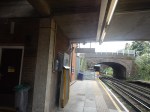
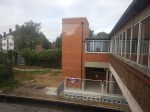
These four pictures show each pair of tracks in both directions.

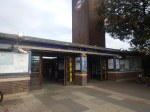
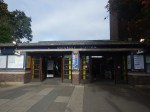
And these pictures show general views of the station.

I don’t know the layout of every station, but Caledonian Road And Barnsbury seems to be unusual.

  • There is a spacious island platform in the middle of the four tracks.
  • On either side of the island platform, there are the two lines for local passenger trains.
  • Outside of the two local passenger lines, there are two lines for freight trains.
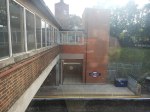
  • Access to the island platform is via a simple half-bridge with only two lifts.
  • Everybody enters the station from one side.

Does this layout have advantages?

Ease Of Construction

I think that this station was designed, so that it was quick and easy to build.

Once the tracks are aligned correctly, it shouldn’t be too complicated to build.

The bridge only has to span two tracks, so that must be half the work of crossing four tracks.

Passenger Safety

I have used real time trains to check the platform of freight trains passing through Caledonian Road And Barnsbury station.

It seems that only rarely do trains use the tracks in the two platforms.

This must surely be safer, when compared with the standard arrangement.

These pictures were taken at Highbury & Islington station.

The wide platform, also allows passengers to keep well out of the way of any trains that do pass through.

Would The Layout Work With High Speed Trains?

I don’t see why not!

The space between the outside lines and the platform, almost acts like a moat in a zoo, that keeps visitors away from dangerous animals.

Costs

It was probably not an expensive station to build.

Conclusion

Why are other four-track stations not built like this?

The main reason is probably, that most four-track main lines were laid out decades or even centuries ago and their builders used their own layouts.

June 19, 2021 Posted by | Design, Transport/Travel | , , , , , , | 7 Comments

Thoughts On Step-Free Access At Manor House Station

I use Manor House station regularly, as I have a bus-stop by my house, that is perhaps fifty metres from my front door, that connects to the station.

  • There is also a zebra crossing to get to the other side of the road.
  • The 141 bus actually connects me to Manor House, Turnpike Lane and Wood Green stations on the Piccadilly Line.
  • This is because it was a replacement for the 641 trolley-bus route that used to run between Winchmore Hill and Moorgate via. Milmay Park.
  • I also use the station as a convenient station to go West on the Piccadilly Line.
  • As it connects step-free at Finsbury Park station to the Victoria Line, it certainly has its uses.

Click this link to see an excellent photo of a 641 trolley-bus at Manor House station.

The pub in the photo was the Manor House, where I saw such performers as John Mayall and Eric Clapton amongst others.

I took these pictures today

The station has an unusual layout.

      • Two major roads; the Seven Sisters Road (A503) and Green Lanes (A 105) cross at the station.
      • The four major roads are all controlled by traffic lights, which also allow pedestrians to cross the major roads safely on the surface.
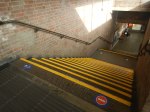
      • There are a couple of staircases at each corner of the junction and these lead down to a maze of passages that connect these entrances to the escalators that lead up and down to the platforms.
      • The former Manor House pub and a new Travel Lodge sit opposite each other on the junction.
      • The Travel Lodge sits on the South-West corner.
      • The North-West corner leads directly into Finsbury Park., which is not a bad place to go for a walk or a jog.

The below ground subways in the station are all level.

The staircases between subway and street level are very reminiscent of those at Piccadilly Circus or Leicester Square stations.

The staircases also have some excellent period details.

But then they tend to do things as they should in my part of North London.

This picture was taken after a World Cup Third!

What will happen, if England win the Euros?

Manor House station’s design can best be summed up as two level areas connected by a series of staircases.

  • Central London stations with this layout include Bank, Cockfosters, Kings Cross St. Pancras,Leicester Square, Manor House, Piccadilly Circus. Tottenham Court Road and Victoria.
  • At least Cockfosters, Kings Cross St. Pancras, Tottenham Court Road and Victoria have lifts between the two levels.
  • Bank station will have more lifts than Oti Mabusi in a dance routine, after the rebuild.
  • Old Street was similar, but Transport for London (TfL) are rebuilding the station.

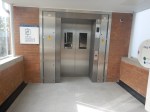
Cockfosters has level access at both the surface and the platform level and they have sneaked in a lift in a corner of the station.

Grandparents in a wheel-chair or Louis or Lilibet in a pushchair can easily be taken easily between train and the car-park.I am certain, that if there are a number of lifts at the four corners of the road junction at Manor House, then access both to the station and across the junction will be substantially eased.

That just leaves us with the problem of getting between subway and platform levels.

This map from cartometro.com shows the platform layout.

Note that as at Turnpike Lane station in this platform layout, there is also a generous space between the platforms.

The two escalators and a set of stairs face North.

Wood Green station is a bit different, as it has a turnback siding

The two escalators and a set of stairs also face South.

When I used to use the Piccadilly Line in the 1960s, it tended to be pain, if a Wood Green train turned up, when you wanted  to go to Oakwood or Cockfosters.

Bounds Green station is shown in this map.

Again the tracks appear to have been curved to allow generous space.

The two escalators and a set of stairs face North.

Arnos Grove station is a station with sidings and four platforms on the surface.

The car parks are likely to be developed for housing, so there will be major changes at the station.

Southgate station is the last station, that doesn’t have step-free access.

But again there is some space between the tracks.

The two escalators and a set of stairs face North.

So did the designers of the Northern Extension of the Piccadilly Line leave space to put in more equipment or even lifts?

After all they didn’t stint themselves on the design of the stations.

Designing Step-Free Access

This is not easy and various considerations must be taken into account.

Revenue Protection

At Cockfosters station, the new lift goes between two areas that are outside the ticket barriers.

If as I have proposed at Manor House station, where there would be lifts between the surface and the subway level, both areas are outside the ticket barriers.

At Tottenham Hale station, there several lifts all of which are inside the ticket barrier.

Staff At The Barrier

Nearly all ticket barriers in London are watched by staff to sort out problems like passengers, who don’t know how to use the system.

Costs

It is unlikely, that large sums of money will be available to add step-free access to all stations on the Underground.

I also think, that step-free access at stations will be funded by developments close to stations.

A London-Wide Solution

It is for these and other reasons, that I think London needs to look in detail at all stations and see if a series of solutions can be developed for all stations.

In this section of the Piccadilly Line, there are five stations with three escalators or two escalators and a staircase.

But there are others on the other deep tube lines.

So should a standard solution be developed for all stations like this? And for all groups of similar stations.

Could An Inclined Lift Be Used At This Group Of Stations?

This picture shows the first inclined lift, I ever saw, which was on the Stockholm Metro.

Looking at the picture shows it was installed on a very long set of escalators.

At present, there is only one inclined lift on the London Underground and that one is at Greenford station.

It is a very neat and compact installation, that incorporates a double-staircase, an up escalator and an inclined lift in a confined space.

I think we’ll see similar solutions to Greenford employed in some stations on the Underground. In Is This A Simple And Affordable Solution To Providing Step-Free Access At Essex Road Station?, I outline how an inclined lift could be used at Essex Road station.

These pictures show the three escalators at Manor House station.

Note.

  1. The middle escalator was switched off.
  2. There is a spacious lobby at the bottom of the escalators.

The other four below-ground stations North of Finsbury Park; Turnpike Lane, Wood Green, Bounds Green and Southgate all have two escalators and a central staircase

These pictures show Bounds Green station.

Note that the stairs are in the middle.

It looks to me, that all five escalator systems to the North of Finsbury Park are more or less identical.

  • Only Manor House has a third escalator.
  • There is a large lobby at the bottom.
  • All stairs are in the middle escalator slot.
  • Are the stairs designed to be replaced with a third escalator?

So would it be possible to design an inclined escalator solution for all stations, that fitted all of the stations?

I think it might be very much a possibility.

  • The central staircase would be replaced by a third escalator.
  • One of the outside escalators would be replaced with an inclined lift.

Note

  1. Many of these escalators were probably  installed in the early 1990s, a few years after the Kings Cross Fire.
  2. Escalators are replaced regularly every ten or twenty years.

So could the installation of the inclined lifts, be worked into the schedule of escalator maintenance and replacement?

I believe with good project management it could be arranged.

  • At no time during the works would any station have less than two escalators.
  • If there were to be an escalator failure, all of the stations are connected by frequent buses and some are even within walking distance.

The works could also be arranged to fit in with available cash-flow.

I believe that eventually all these stations will need to be provided with full step-free access.

Conclusion

I believe that a sensible program of works can be developed to make all deep-level stations North of Finsbury Park step-free on the Piccadilly Line.

  • The deep-level platforms would be served by two escalators and an inclined lift.
  • The works would be performed alongside the regular maintenance and replacement of the current escalators.
  • There would be no substantial tunneling.
  • The works could also be arranged to fit in with available cash-flow.

The technique would be applicable to other stations on the Underground network.

Turnpike Lane Station

In Is Turnpike Lane Tube Station Going Step-Free?, I tried to explain the puzzling works going on at Turnpike Lane station.

Could those works be digging a lift-shaft or something in a more engineering line, like installing more ventilation or new power cables?

There’s certainly no clues on the Internet.

This table shows step-free status and 2019 passenger numbers at the Piccadilly Line stations to the North of Kings Cross St. Pancras station.

  • Cockfosters – Step-Free – 1.86 million
  • Oakwood – Step-free – 2.78 million
  • Southgate – 5.43 million
  • Arnos Grove – 4.44 million
  • Bounds Green – 5.99 million
  • Wood Green – 12.13 million
  • Turnpike Lane – 10.6 million
  • Manor House – 8.55 million
  • Finsbury Park – Step-free – 33.40 million
  • Arsenal – 2.77 million
  • Holloway Road – 6.69 million
  • Caledonian Road – Step-free – 5.60 million
  • Kings Cross St. Pancras – Step-free – 88.27 million

Note.

  1. The high passenger numbers at Finsbury Park and Kings Cross St. Pancras, where there is interchange with lots of other services.
  2. The long gap of step-free access between Oakwood and Finsbury Park.
  3. Arnos Grove could be an easier station to make step-free.

I just wonder, if a lift at Turnpike Lane station could be the interim solution, until inclined lifts are installed in the distant future.


June 16, 2021 Posted by | Design, Sport, Transport/Travel | , , , , , , , , , , , , | 5 Comments

Cargo Sous Terrain

This is a Swiss idea to move small parcels around the country.

This is the project’s web site.

There will be a network of tunnels under Switzerland serving all the major centres.

This article on LeNews is entitled Switzerland’s Underground Tunnel Project Gets Green Light From Upper House, describes the project.

This is the first paragraph.

On 1 June 2021, a project to build an underground freight tunnel network stretching from Geneva to St Gallen, gained almost unanimous support in the Council of States, Switzerland upper house.

These are a few points from the article.

  • It appears to be privately funded.
  • There will be a three-lane tunnel network across the country.
  • It will use driverless electric vehicles.
  • Speed will be 30 kph.
  • It will run twenty-four hours per day.
  • There will be a track in the roof of the tunnel for smaller parcels.
  • There will be a total of 500 km of tunnels.
  • Completion date is set for 2045.
  • It will cost around £24 billion.

It’s as though all of Switzerland were to be turned into a giant Amazon or Ocado warehouse.

Will It Work?

I don’t see why not, although it would be an immense project!

This paragraph indicates they will start small.

The first 70 km section of the tunnel network, which will connect a hub in Härkingen-Niederbipp with Zurich, is scheduled for completion in 2031.

But even that will cost around £2.5 billion!

It certainly, is a bold idea, that has possibilities.

June 15, 2021 Posted by | Design, Transport/Travel | , , , , | Leave a comment

UK Air Taxi Start-Up Finds Early Buyers For 1,000 Vehicles

The title of this post, is the same as that of this article on the Financial Times.

The article is well worth a read and describes the progress of Vertical Aerospace, which was started by Ovo Energy founder; Stephen Fitzpatrick.

The Vertical Aerospace web site is worth a visit.

Details given of their VA-X4 plane include.

  • Range – 100+ miles
  • Speed – 202 miles
  • Capacity – 5
  • Carbon Emissions – Zero
  • Certification – EASA/CAA
  • Noise – 100 times quieter than a helicopter.

There is a lot to like!

What is certain in my mind, is that there is a market for a short range zero-carbon aircraft of some sort.

Judging by the number of aircraft being proposed for this market, I come to two conclusions.

  • The market isn’t mythical.
  • Someone will make a success of it.

I also wouldn’t be surprised, if the most successful design has rather a weird look about it.

But despite saying that, two of the frontrunners; the Cessna Electric Caravan and the electric version of the Britten-Norman Islander are both conversions of existing successful aircraft.

I believe, that I’m young enough to fly in an electric aircraft.

June 11, 2021 Posted by | Design, Transport/Travel | , , , , | Leave a comment

United Airlines Eyes A Supersonic Future With Deal To Buy Boom’s Overture Jets

The title of this post, is the same as that of this article on The Times.

Some may feel that the future of supersonic aviation is about as rosy, as an empty glass of tap water.

But!

  • A flight across the Atlantic in three-and-a-half hours, as is promised by the Boom Overture, is below the four-hour travel limit, where average people start to get anxious about being banged up!
  • Not for nothing do UK train companies want to get London and Edinburgh services below, the magic four-hour time.
  • Technology will get better to reduce the noise and carbon emissions of all aircraft and not just supersonic ones!

I don’t put it outside the genius of engineers to by 2050, be able to create a supersonic, almost noise-free aircraft.

I do have a few thoughts about the Boom Overture.

A Comparison With Concorde

These are comparisons of the Boom Overture to Concorde.

  • Engines – Three as opposed to four.
  • Length – Similar
  • Wingspan – 71 % of Concorde
  • Passengers – 75 % of Concorde

It’s almost as if the Boom Overture is a three-quarter scale model of Concorde.

The Wing/Airframe

When I left Liverpool University in 1968, I wasn’t totally sure, what I wanted to do. So I visited a lot of engineering and aerospace companies including both BAC and Hawker Siddeley. Including my own University, I must have visited about four or five large wind tunnels in that period and every one had a Concorde-like model for the wind tunnel.

Every company had their own ideas on what a supersonic wing, should look like.

And surprise-surprise they were all very similar!

Take the advertising off Formula One cars and paint them all silver and very few could tell them apart.

Aerodynamics defines the shape so strongly, they all look the same.

It’s the same with supersonic aircraft and I’m not surprised that wing planform of the Boom Overture appears to be similar to Concorde, but narrower.

Perhaps the more dart-like shape significantly reduces the drag? It should be noted that drag is proportional to cross-sectional area.

In Concorde’s Wikipedia entry there is a section called Development, which explains how the Royal Aircraft Establishment developed the slender delta wing planform, used by Concorde and now likely to be used by Boom.

Although, it would be different inside the wing, as Concorde was mainly made from metal and the Overture is a composite aircraft.

Perhaps composite construction helps with creating the perfect aerodynamic shape. I don’t have any experience of composites, but they surely mean more aerodynamic shapes and they are regularly used for airframes.

This page on the Heritage Concorde web site gives details of the airframe production materials.

I suspect that Concorde was a nightmare to build, but that the challenge helped develop a large number of machining and fabrication techniques.

The Fuselage

As I said earlier, the length of the plane is similar to Concorde, but the wingspan is 29 % smaller and the number of passengers is around 25 % less.

But if you look at the picture of the aircraft in the Times article, where it is emerging from the hangar, it’s almost as if the fuselage has a square cross section than Concorde.

I wonder about this square cross section. I remember an interview on the radio with Barnes Wallis, where he talked about his latest idea for a fast supersonic aircraft capable of flying between the UK and Australia.

This paragraph is from Barnes Wallis’s Wikipedia entry.

In the late 1950s, Wallis gave a lecture entitled “The strength of England” at Eton College, and continued to deliver versions of the talk into the early 1970s, presenting technology and automation as a way to restore Britain’s dominance. He advocated nuclear-powered cargo submarines as a means of making Britain immune to future embargoes, and to make it a global trading power. He complained of the loss of aircraft design to the US, and suggested that Britain could dominate air travel by developing a small supersonic airliner capable of short take-off and landing.

It sounds to me that he would have been a Brexiteer.

Could this supersonic airliner, be what I heard him talking about?

I distinctly remember that he was advocating a fuselage with a square cross section for supersonic flight.

  • It would have given more space inside for passengers.
  • Concorde was a bit pokey with small windows!
  • The picture in The Times of the interior of the Boom Overture is certainly spacious.

Have Boom, been looking through Barnes Wallis’s ideas?

One quote I heard Barnes Wallis say, in an interview with Chris Brasher was this.

There is no greater thrill in life, than proving something is impossible and then showing how it can be done.

Boom may not have been able to develop a small supersonic airliner capable of short take-off and landing, but it does sound, they’ve developed a smaller supersonic airliner capable of shorter take-off and landing.

The Engines

In the Boom Overture’s Wikipedia entry there is a section called Engines, where this is the last sentence.

In July 2020, the company announced that it had entered into an agreement with Rolls-Royce to collaborate on engine development.

As Rolls-Royce built the engines for Concorde, they probably have some experience locked away.

The design of the Olympus 593 engines for Concorde wasn’t simple.

  • The engines were based on an Olympus engine used in aircraft like the Avro Vulcan and the TSR-2.
  • The engines were fitted with afterburners, as the extra thrust was needed for take-off.
  • According to Wikipedia the engines had a high thermal efficiency in supersonic cruise.
  • According to Wikipedia, there was an engine without afterburning for a longer range Concorde under development.

Over the years, there have been various proposals for supersonic aircraft, in military, commercial and business fields, so I suspect Rolls-Royce have done significant work in powering supersonic flight.

But then other engine companies would have gone down similar routes!

Rolls-Royce though probably have all the data on the engine ideas for Concorde that failed.

I wouldn’t be surprised, if one of the major aero-engine companies has a solution to the powerplant for the Boom Overture, based on the chase for supersonic speeds forty and fifty years ago.

But Rolls-Royce because of the Concorde experience could be closer to a successful development.

So I think signing with Rolls-Royce could be a very sensible move.

The Afterburners

The Wikipedia entry for the Boom Overture says this about afterburners.

Boom wants to use moderate bypass turbofans without afterburners, unlike Concorde’s Rolls-Royce/Snecma Olympus.

Could that be one piece of complication, that improvements in technology has eliminated?

The Engine Intakes

The Wikipedia entry for the Olympus 593 engines has a section called Intakes.

They were thought to be clever in the 1960s, but they just look complicated to me, with all my extra experience.

The intakes seem to have used very comprehensive digital control systems, but these days controls like these will be even more comprehensive and a lot more sophisticated, as computing has moved on.

I very much feel that if the Boom Overture needed sophisticated variable-geometry engine intakes like Concorde, we have the knowledge to create them and the computer expertise to make them act as needed.

The Exhaust Nozzle

The Wikipedia entry for the Olympus 593 engines has a section called Exhaust Nozzle.

These too are complicated and a lot of what I said for the intakes, would apply to the nozzles.

The Fuel

The Wikipedia entry for the Boom Overture says

The aircraft is intended to run on Sustainable Aviation Fuel.

It is likely, that Sustainable Aviation Fuel will be used for commercial aviation until there is a significant move to hydrogen.

  • In the UK, a company called Altalto is building a large plant to make the fuel at Immingham from household and industrial waste.
  • One idea being pursued by some companies is to create the fuel from used disposable nappies.
  • Wikipedia indicates that the fuel could cut CO2 emissions by between 20-98%.
  • Altalto is backed by British Airways and Velocys, who are a spin-out from Oxford University.

There is certainly a lot of money and technology being thrown behind Sustainable Aviation Fuel to make it a net-zero alternative for the powering of aircraft.

The Noise

This Youtube video shows Concorde’s last take-off from New York.

It was certainly a noisy aircraft.

  • Concorde’s engines had afterburners.
  • It also needed a long take-off run, so it made more noise on the ground.
  • It used to take off with a high angle of attack with the nose high.

All of these factors would have increased real and perceived noise levels.

I feel that if the Boom Overture is going to have significantly lower noise levels than Concorde, then its design will need to be radically different.

The lack of afterburners will make some difference.

It carries only about 75 % of the passengers of Concorde.

It is roughly, the same length as Concorde, but the wingspan is nearly thirty percent smaller.

To be continued…


June 6, 2021 Posted by | Design, Hydrogen, Transport/Travel | , , , , , , , , , | 1 Comment

Thoughts On Seating In East Coast Trains’ New Class 803 trains

This page on RailAdvent contains this YouTube video of one of East Coast Trains’ New Class 803 trains under test.


On this page on the First Group web site, they give some details of the service.

  • Five trains per day, seven days per week in both directions.
  • One class of travel
  • Offer tickets at an average price of less than £25.
  • At seat catering on every train.
  • Introduce an additional 1.5 million seats on the route every year.

They also expect 80 % of passengers to be new to rail.

The internet doesn’t give the number of seats on the train, so I will estimate a number.

The number of trains per year will be at least 365 * 2  * 5, which is an easy 3650 trains.

Dividing this into 1.5 million gives 410.9 seats per train. I’ll call that 411.

After I made that estimate, I found this page on the Beacon Rail Leasing web site.

It gives this information.

  • Power – 4.5 MW
  • Speed – 125 mph
  • Passenger Capacity – 400
  • Weight – 228.5 tonnes

Using the figure of 400 passengers and 3650 trains per year, that gives a total number of 1,460,000 passengers per year, which is probably within the margin of error for the arithmetic of marketing experts.

If you watch the video, the following can be ascertained.

  • The two driver cars have six large windows each.
  • The three centre cars have nine large windows each.
  • It looks like the seating in the train is three on one side and two on the other.

This picture shows the Standard Class seating bay layout on a Great Western Railway Class 802 train.


Note.

  1. The seats are arranged either side of the window.
  2. There are lots of tables.
  3. If the blind was up, passengers will get a good view.

If as I surmised from the video, seating is two+three and there are 39 bays, that means that the train has a base seating capacity of 390 seats.

That leaves ten seats to find places for, or just two per car.

With two+two seating, there would be 312 seats in the bays under windows, so there would be a need to fit in another 86 seats.

It appears to me that to meet their objective of 1.5 million additional seats that a two+three layout is needed.

But it could be that most passengers will get a proper table and possibly reasonable leg room. Try getting that on a budget airline!

A Few Questions

These are a few questions.

When Will The Service Start?

Your guess is as good as mine, but First Group are saying Autumn 2021.

Is The Service Geared For Group Or Family Travel?

Each train has thirty-nine groups of six seats and the same number of groups of four seats.

If say it was granny’s birthday in Edinburgh or a group of six friends were going to Scotland-England at Murrayfield, the layout would accommodate groups and families well.

They certainly need a good seat allocation algorithm.

Will I Be Able To Use My Railcard?

I would suspect not!

But then it would only save £8.33!

What About Delay Repay?

This will be automatic! I can’t ever be bothered to claim otherwise!

Will There Be Disabled Toilets?

It’s the law! But I have seen some much smaller ones that are well-designed and meet all aspects of the law in some new trains, so I would expect to find innovative designs.

Will There Be Single Seats?

I can sleep anywhere and regularly find myself returning to London curled in the corner of my seat fast asleep.

A single seat in the corner of the carriage might be ideal for some passengers.

Will Everybody Get A Table?

If I’m right about each seating bay having a table, then it would look like around ninety-seven percent of passengers would get a proper table. Not big enough for a copy of the Daily Telegraph, but they should have enough space for a laptop and/or a few beers.

What Food And Drink Will Be Offered?

I suspect, it will mainly be drinks and snacks like crisps or nutrition bars, which can be easily served from a trolley.

It should be noted that the three major stations on the route King’s Cross, Newcastle and Edinburgh all have a good selection of places to buy a carry-on!

But unlike at an airport, I suspect passengers won’t turn up two or three hours before departure, so will be unlikely to eat before departure.

I do think, that we could see improvements in the food offerings for taking on the train at Stevenage and Morpeth.

East Coast Trains may also contribute to the development of carry-on shops at some stations.

Will The Trains Accept Bicycles?

This is a tricky one and personally I feel that offering a decent bike hire service could be better value all round.

Using The Fleet Of Five Trains

Wikipedia and other sources indicate that the fleet is just five trains.

We know these facts or proposals.

  • King’s Cross and Edinburgh are 393.15 miles apart.
  • LNER run trains between King’s Cross and Edinburgh in four hours and twenty minutes (4 stops) and four hours and forty minutes (9 stops)
  • The record time between King’s Cross and Edinburgh was set in 1991 by a shortened all-electric InterCity 225 train at three hours twenty-nine minutes  and thirty seconds, which represented an average speed of 112.5 mph.
  • Trains start leaving King’s Cross and Edinburgh about 05:45.
  • The Werrington Dive-Under will, be completed in 2021.
  • The King’s Cross Remodelling should be completed this year.
  • Full digital in-cab signalling is being installed between King’s Cross and Doncaster. This will allow 140 mph running and as a Control Engineer, I believe it could ease the bottlenecks at Newark and over the Digswell Viaduct.
  • East Coast Trains’ Class 803 trains appear to have been designed for sparkling acceleration.
  • East Coast Trains will only make three stops.
  • East Coast Trains intend to compete with the budget airlines.
  • East Coast Trains intend their first train to arrive in London by 10:00. Does that mean Edinburgh as well?

I have just checked on Real Time Trains and this East Coast Trains timetable can be found.

King’s Cross and Edinburgh

  • 05:45 – Arrives 10:10 – 4 hours 25 minutes – Stops at Stevenage
  • 10:45 – Arrives 15:17 – 4 hours 32 minutes
  • 12:18 – Arrives 16:41 – 4 hours 23 minutes – Stops at Stevenage
  • 14:36 – Arrives 19:15 – 4 hours 39 minutes
  • 20:18 – Arrives 00:46 – 4 hours 28 minutes

Edinburgh and King’s Cross

  • 06:14 – Arrives 10:51 – 4 hours 37 minutes
  • 09:11 – Arrives 13:48 – 4 hours 37 minutes
  • 11:14 – Arrives 15:46 – 4 hours 32 minutes
  • 16:12 – Arrives 20:47 – 4 hours 35 minutes – Stops at Stevenage
  • 19:58 – Arrives 01:05 – 5 hours 7 minutes – Stops at Stevenage

Note.

  1. Times appear to be in-line with those of LNER.
  2. East Coast Trains’ objective of arriving by 10:00 is not met.
  3. Paths exist for East Coast Trains from the 7th June.

I believe this timetable is based on what is possible today without the improvements at King’s Cross and Werrington, and the digital signalling.

What Could Be Possible?

Consider.

  • The improvements that are underway will help to reduce journey times.
  • I also believe that by being clever, East Coast Trains could reduce turn-round times at King’s Cross and Edinburgh.

I think it is likely, that East Coast Trains could probably run between King’s Cross and Edinburgh in a time of around four hours.

I can also see a turn-round time of five minutes, if East Coast Trains use all their First Group experience.

Could this mean, a train starting from King’s Cross doing the following trips in a day?

  • 05:50 – King’s Cross to Edinburgh – Arrives 09:50
  • 09:55 – Edinburgh to King’s Cross – Arrives 13:55
  • 14:00 – King’s Cross to Edinburgh – Arrives 18:00
  • 18:05 – Edinburgh to King’s Cross – Arrives 22:05
  • 22:10 – King’s Cross to Edinburgh – Arrives 02:10

Note.

  1. A second train would mirror this time-table starting in Edinburgh.
  2. Every minute saved on each journey between King’s Cross and Edinburgh will bring the final arrival forward.
  3. There is tremendous potential to speed up services.

This time-table would be straight out of Michael O’Leary’s notebook about making assets sweat.

Conclusion

I think that East Coast Trains have done a Ryanair and designed the train to accommodate the maximum number of passengers. But the quoted £25 fare does appear to be good value.

I am certain that two+three seating will be used.

May 28, 2021 Posted by | Design, Transport/Travel | , , , , , , | 10 Comments