Intriguing “Frozen Air” Energy Storage In Vermont Gets Canned
The title of this post, is the same as that of this article on the Concord Monitor.
This is the first paragraph.
Alas, the company Highview Power has given up on a plan I wrote about in 2019 to develop a long-term energy storage project in northern Vermont that freezes and unfreezes air.
The author had asked Highview Power for an update and received this statement.
As a UK-based company our primary focus right now is on our Carrington project in the North of England. This will be our first commercial plant in the wider development of a 45GWh, £10 billion programme in the UK. While the Vermont project no longer remains in our current plans, we are developing a longer-term portfolio of projects in Spain, Australia, and the U.S and we look forward to pushing forward with these after we achieve our primary UK projects.
It sounds to me that the new CEO; Rupert Pearce, is simplifying the company’s operations and aiming to get the important Carrington plant working as a priority.
Energy Dome Launches World’s First CO2 Battery Long-Duration Energy Storage Plant
The title of this post, is the same as that of this article on Renewable Energy Magazine.
This is the first paragraph.
Energy Dome, a provider of utility-scale long-duration energy storage, has successfully launched its first CO2 Battery facility in Sardinia, Italy. This milestone marks the final de-risking of the CO2 Battery technology as Energy Dome enters the commercial scaling phase, becoming the first commercial long-duration energy storage technology on the market offering a reliable alternative to fossil fuels for dispatchable baseload power globally.
I like their technology and you can find more about it on their web site.
They say this about how they use the unique properties of carbon dioxide.
CO2 is the perfect fluid to store energy cost effectively in a closed thermodynamic process as it is one of the few gases that can be condensed and stored as a liquid under pressure at ambient temperature. This allows for high density energy storage without the need to go at extreme cryogenic temperatures.
And it’s not that carbon dioxide is a rare and expensive gas.
This is certainly technology to watch.
Will Coire Glas Start A Pumped Storage Boom In Scotland?
This article on Renewables Now is entitled SSE Gets Tenders For Construction Of 1.5-GW Pumped Hydro Scheme.
This is the first paragraph.
SSE Renewables said on Wednesday it has received tenders for the main construction works for the Coire Glas hydro pumped storage project with a capacity of up to 1.5 GW in the Scottish Highlands.
It then lists, the companies who have tendered for the project.
SE Renewables said the ITT has drawn global interest. The tenderers shortlisted for mechanical and electrical plant scope are a partnership between ANDRITZ HYDRO GmbH and Voith Hydro GmbH & Co KG, and GE Hydro France. The parties shortlisted for the civil engineering scope include three consortia and STRABAG UK Ltd. The consortia are made up of Bechtel Ltd, Acciona Construccion SA and Webuild SpA; BAM Nuttall Ltd, Eiffage Genie Civil SA and Marti Tunnel AG; and Dragados SA and BeMo Tunnelling UK Ltd.
It is an impressive list.
The article says that construction is to start in 2024. Other sources say the pumped storage project will have a storage capacity of 30 GWh, which will make it the largest pumped storage plant in the UK.
This press release from SSE Renewables is entitled Tenders Submitted For The Coire Glas Pumped Storage Scheme.
The press release contains this quote from the Project Director for Coire Glas; Ian Innes.
Receiving the tenders on schedule from the six short-listed tenderers is another significant milestone for the Coire Glas project and we are grateful for their continued interest in the project.
We are encouraged by the content of the tenders which now provides the Coire Glas project team with several options on how construction of the project could be undertaken. It is going to take some time to carefully consider and scrutinise the tenders thoroughly and we look forward to working with the tenderers as we endeavour to make our selection decision.
It appears that not only were the tenders received from quality companies, but that they contained options and ideas that could improve the project.
Coire Glas would appear to me to be a project, that is attracting the best companies and they could be putting their best workers on the project.
These are my thoughts.
The Potential For Pumped Storage Schemes In Scotland
There are at least six schemes under development or proposed in Scotland.
- Balliemeanoch – 45 GWh
- Coire Glas – 30 GWh
- Corrievarkie – 14.5 GWh
- Loch Earba – 33 GWh
- Loch Sloy – 14 GWh
- Red John – 2.8 GWh
This page on the Strathclyde University web site, gives these figures for the possible amounts of pumped-storage that can be added to existing hydro schemes.
- Errochty – 16
- Glasgarnock – 23
- Luichart – 38
- Clunie – 40
- Fannich – 70
- Rannoch – 41
- Fasnakyle – 78
- Tummel – 38
- Ben Lawers – 12
- Nant – 48
- Invermoriston – 22
- Invergarry – 41
- Quoich – 27
- Sloy – 20
That is a total of 547 GWh or 653.3 GWh if you include the new storage, I listed above.
Scotland would appear to be land overflowing with large pumped storage possibilities and could provide the modern equivalent of milk and honey.
The Potential For Offshore Wind Power Schemes In Scotland
This is the first two paragraphs of this press release on the Crown Estate Scotland web site.
Crown Estate Scotland has today announced the outcome of its application process for ScotWind Leasing, the first Scottish offshore wind leasing round in over a decade and the first ever since the management of offshore wind rights were devolved to Scotland.
The results coming just months after Glasgow hosted the global COP26 climate conference show the huge opportunity that Scotland has to transform its energy market and move towards a net zero economy.
Some highlights are then listed.
- 17 projects have been selected out of a total of 74 applications.
- A total of just under £700m will be paid by the successful applicants in option fees and passed to the Scottish Government for public spending.
- The area of seabed covered by the 17 projects is just over 7,000km2.
- Initial indications suggest a multi-billion pound supply chain investment in Scotland
- The potential power generated will move Scotland towards net-zero.
This map shows the location of each wind farm.

Note, that the numbers are Scotwind’s lease number in their documents.
Fixed Foundation Wind Farms
These are the six fixed foundation wind farms.
- 1 – BP Alternative Energy Investments – 859 km² – 2.9 GW
- 6 – DEME – 187 km² – 1.0 GW
- 9 – Ocean Winds – 429 km² – 1.0 GW
- 13 – Offshore Wind Power – 657 km² – 2.0 GW
- 16 – Northland Power – 161 km² – 0.8 GW
- 17 – Scottish Power Renewables – 754 km² – 2.0 GW
Adding up these fixed foundation wind farms gives a capacity of 9.7 GW in 3042 km² or about 3.2 MW per km².
Floating Wind Farms
These are the ten floating wind farms.
- 2- SSE Renewables – 859 km² – 2.6 GW
- 3 – Falck Renewables Wind – 280 km² – 1.2 GW
- 4 – Shell – 860 km² – 2.0 GW
- 5 – Vattenfall – 200 km² – 0.8 GW
- 7 – DEME Concessions Wind – 200 km² – 1.0 GW
- 8 – Falck Renewables Wind – 256 km² – 1.0 GW
- 10 – Falck Renewables Wind – 134 km² – 0.5 GW
- 11 – Scottish Power Renewables – 684 km² – 3.0 GW
- 12 – BayWa r.e. UK – 330 km² – 1.0 GW
- 14 – Northland Power – 390 km² – 1.5 GW
Adding up the floating wind farms gives a capacity of 14.6 GW in 4193 km² or about 3.5 MW per km².
Mixed Wind Farms
This is the single wind farm, that has mixed foundations.
15 – Magnora – 103 km² – 0.5 GW
This wind farm appears to be using floating wind turbines.
These wind farms total up to 24.8 GW
I would expect that this is only a phase in the development of Scottish wind power, which will grow substantially over the next decade.
As I write this the UK is generating a total of 26.2 GW of electricity.
Backing Up The Wind Power
This wind power, which could grow up to well over 50 GW in Scotland alone.
But what do you do, when there is no wind?
Energy will need to come from batteries, which in Scotland’s case could be over 500 GWh of pumped storage.
Europe’s Powerhouse
It is not an unreasonable prediction, that we will continue to expand our wind farms to supply Europe with thousands of GWh of electricity and/or millions of tonnes of green hydrogen.
Conclusion
It is likely that we’ll see an upward increase of wind power in Scotland closely matched by a similar increase in pumped storage.
It is no wonder that the world’s largest and most experienced contractors were so keen to get the first big contract in Scotland’s new pumped storage boom.
They know a good thing, when they see it and after their experience with the Scotland’s oil boom in the last century, I doubt they are delaying their return.
The Massive Hydrogen Project, That Appears To Be Under The Radar
This page on the SSE Thermal web site, is entitled Aldbrough Gas Storage.
This is the introductory paragraph.
The Aldbrough Gas Storage facility, in East Yorkshire, officially opened in June 2011. The last of the nine caverns entered commercial operation in November 2012.
This page on Hydrocarbons Technology is entitled Aldbrough Underground Gas Storage Facility, Yorkshire.
It gives these details of how Aldbrough Gas Storage was constructed.
The facility was originally planned to be developed by British Gas and Intergen in 1997. British Gas planned to develop Aldbrough North as a gas storage facility while Intergen planned to develop Aldbrough South.
SSE and Statoil became owners of the two projects in 2002 and 2003. The two companies combined the projects in late 2003. Site work commenced in March 2004 and leaching of the first cavern started in March 2005.
The storage caverns were created by using directional drilling. From a central area of the site, boreholes were drilled down to the salt strata located 2km underground.
After completion of drilling, leaching was carried out by pumping seawater into the boreholes to dissolve salt and create a cavern. Natural gas was then pumped into the caverns and stored under high pressure.
Six of the nine caverns are already storing gas. As of February 2012, dewatering and preparation of the remaining three caverns is complete. Testing has been completed at two of these caverns.
The facility is operated remotely from SSE’s Hornsea storage facility. It includes an above ground gas processing plant equipped with three 20MW compressors. The gas caverns of the facility are connected to the UK’s gas transmission network through an 8km pipeline.
Note.
- The caverns are created in a bed of salt about two kilometres down.
- It consists of nine caverns with the capacity to store around 370 million cubic metres (mcm) of gas.
- Salt caverns are very strong and dry, and are ideal for storing natural gas. The technique is discussed in this section in Wikipedia.
As I worked for ICI at Runcorn in the late 1960s, I’m very familiar with the technique, as the company extracted large amounts of salt from the massive reserves below the Cheshire countryside.
This Google Map shows the location of the Aldbrough Gas Storage to the North-East of Hull.
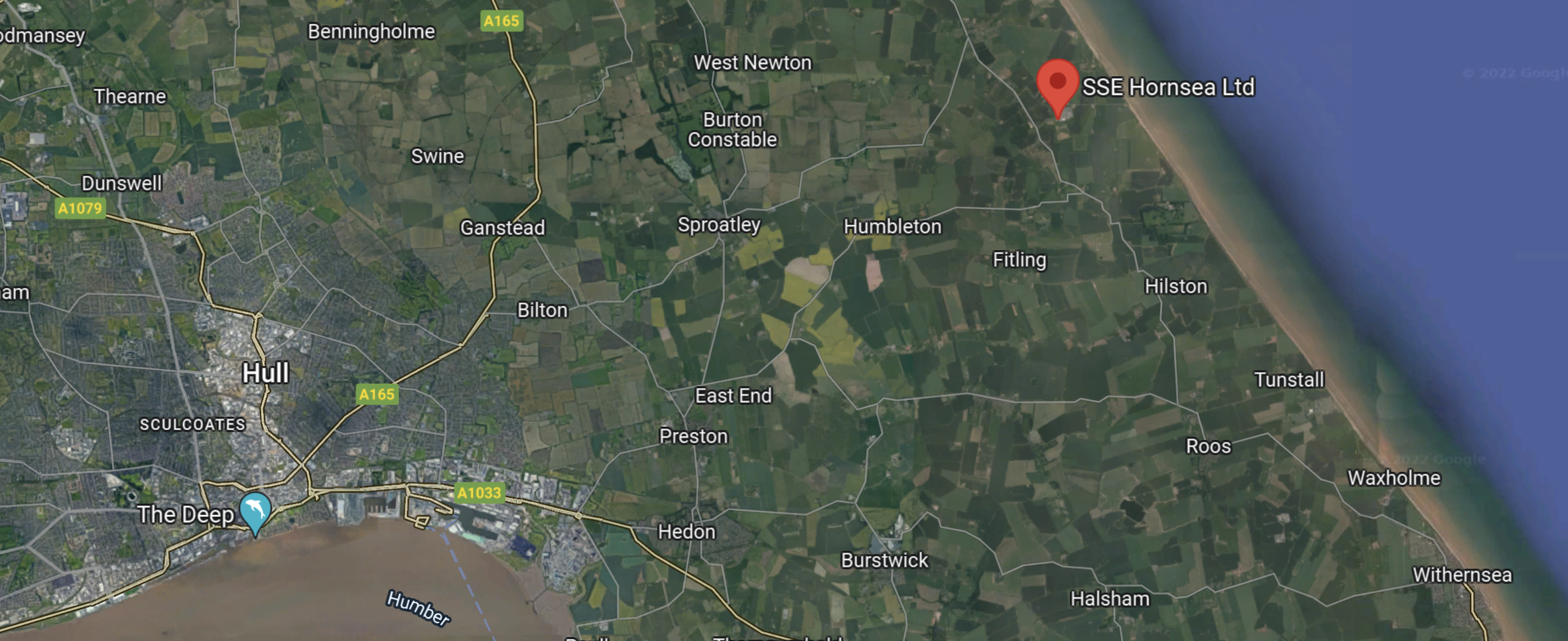
Note.
- The red-arrow marks the site of the Aldbrough Gas Storage.
- It is marked on the map as SSE Hornsea Ltd.
- Hull is in the South-West corner of the map.
This Google Map shows the site in more detail.
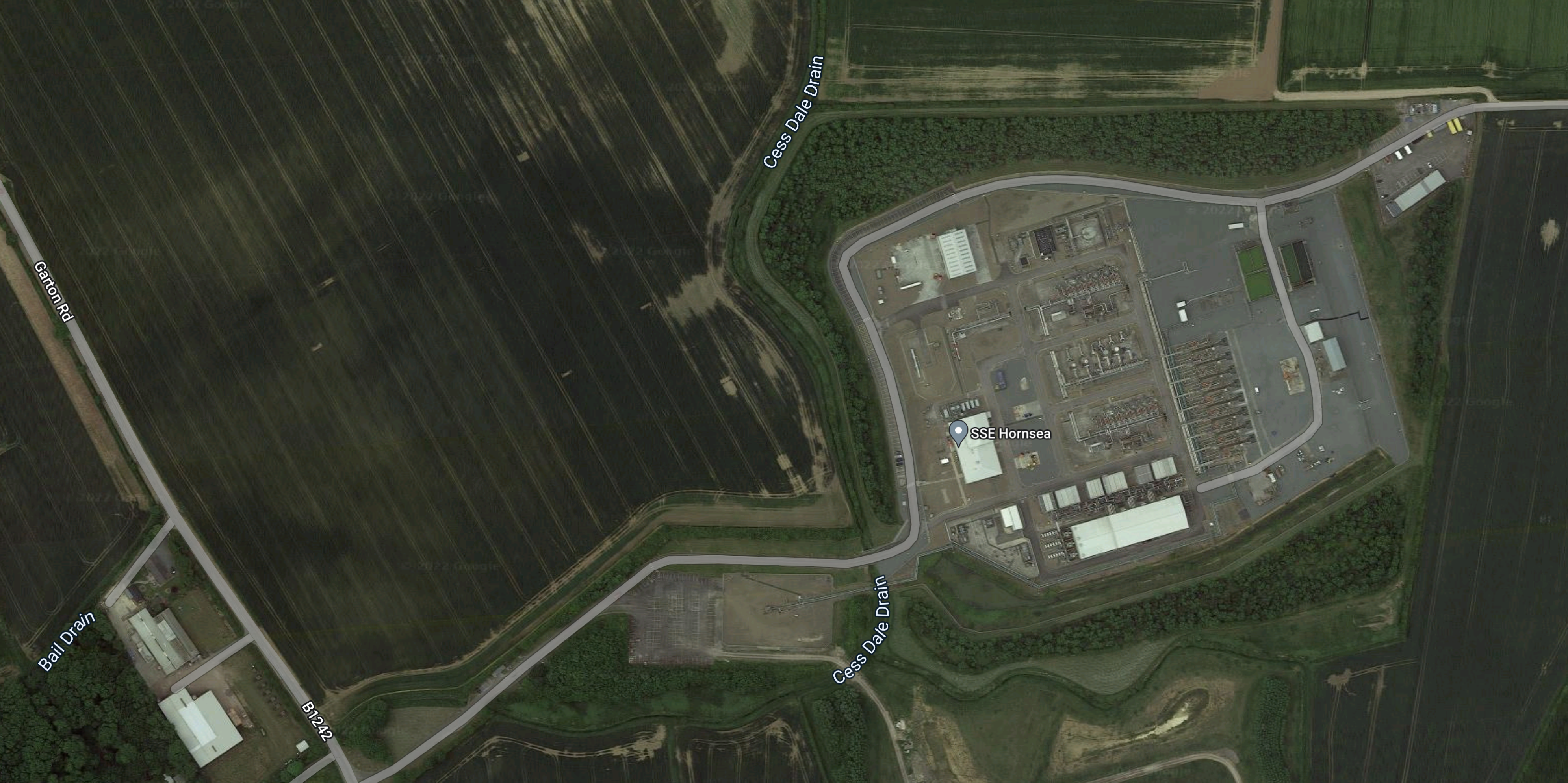
It appears to be a compact site.
Atwick Gas Storage
This page on the SSE Thermal web site, is entitled Atwick Gas Storage.
This is said on the web site.
Our Atwick Gas Storage facility is located near Hornsea on the East Yorkshire coast.
It consists of nine caverns with the capacity to store around 325 million cubic metres (mcm) of gas.
The facility first entered commercial operation in 1979. It was purchased by SSE in September 2002.
This Google Map shows the location of the Atwick Gas Storage to the North-East of Beverley.
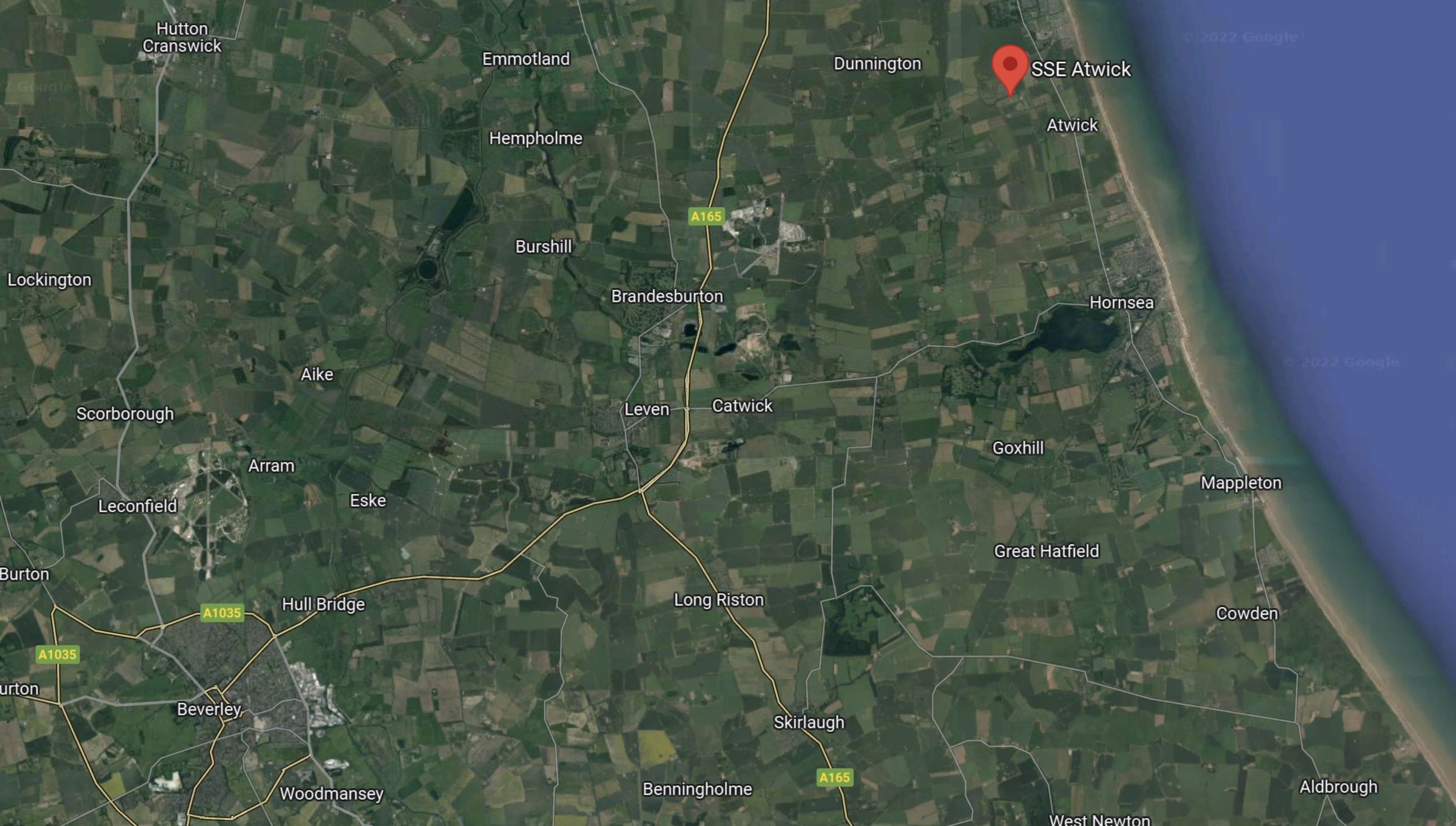
Note.
- The red-arrow marks the site of the Atwick Gas Storage.
- It is marked on the map as SSE Atwick.
- Beverley is in the South-West corner of the map.
This Google Map shows the site in more detail.
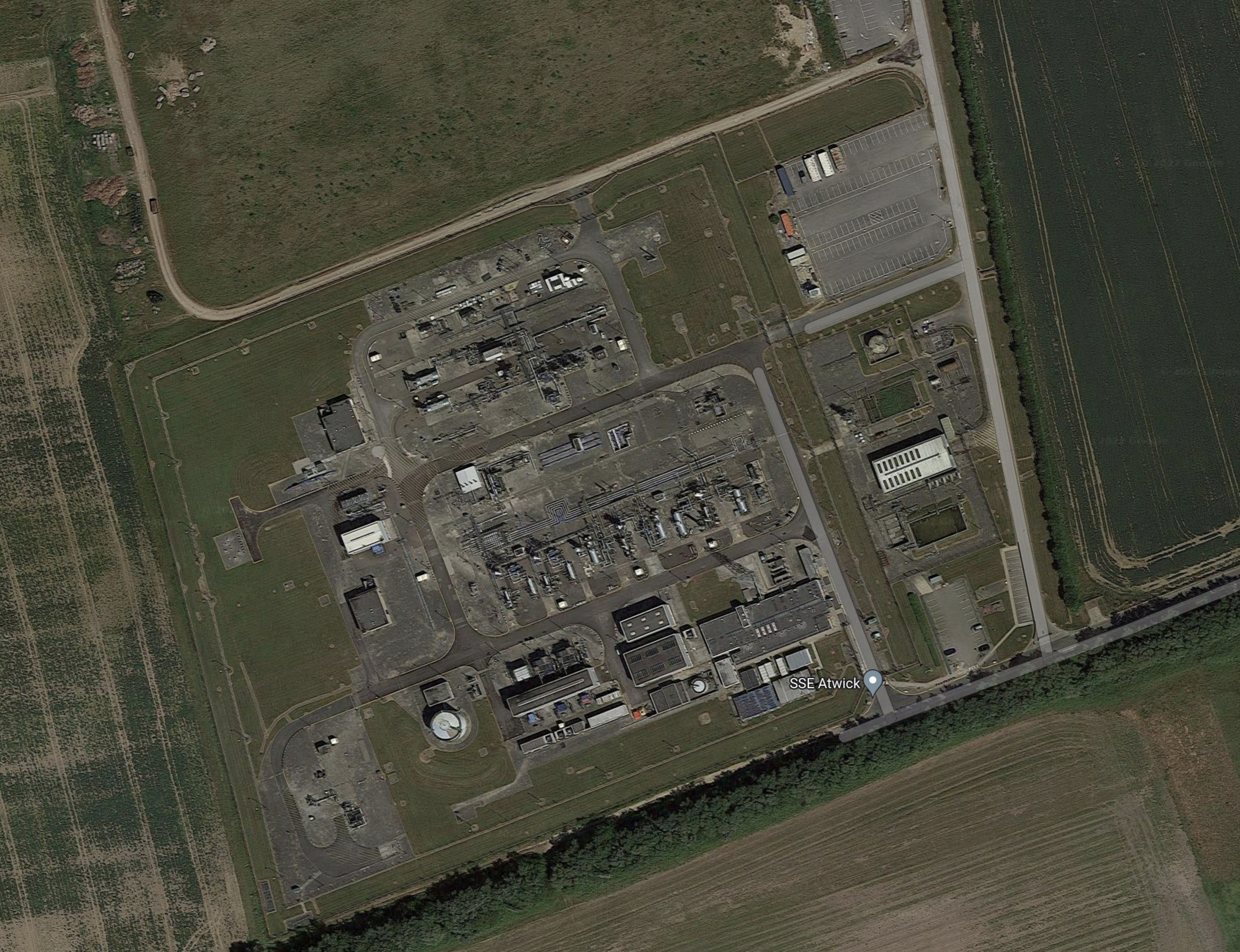
As with the slightly larger Aldbrough Gas Storage site, it appears to be compact.
Conversion To Hydrogen Storage
It appears that SSE and Equinor have big plans for the Aldbrough Gas Storage facility.
This page on the SSE Thermal web site is entitled Plans For World-Leading Hydrogen Storage Facility At Aldbrough.
These paragraphs introduce the plans.
SSE Thermal and Equinor are developing plans for one of the world’s largest hydrogen storage facilities at their existing Aldbrough site on the East Yorkshire coast. The facility could be storing low-carbon hydrogen as early as 2028.
The existing Aldbrough Gas Storage facility, which was commissioned in 2011, is co-owned by SSE Thermal and Equinor, and consists of nine underground salt caverns, each roughly the size of St. Paul’s Cathedral. Upgrading the site to store hydrogen would involve converting the existing caverns or creating new purpose-built caverns to store the low-carbon fuel.
With an initial expected capacity of at least 320GWh, Aldbrough Hydrogen Storage would be significantly larger than any hydrogen storage facility in operation in the world today. The Aldbrough site is ideally located to store the low-carbon hydrogen set to be produced and used in the Humber region.
Hydrogen storage will be vital in creating a large-scale hydrogen economy in the UK and balancing the overall energy system by providing back up where large proportions of energy are produced from renewable power. As increasing amounts of hydrogen are produced both from offshore wind power, known as ‘green hydrogen’, and from natural gas with carbon capture and storage, known as ‘blue hydrogen’, facilities such as Aldbrough will provide storage for low-carbon energy.
I have a few thoughts.
Will Both Aldbrough and Atwick Gas Storage Facilities Be Used?
As the page only talks of nine caverns and both Aldbrough and Atwick facilities each have nine caverns, I suspect that at least initially only Aldbrough will be used.
But in the future, demand for the facility could mean all caverns were used and new ones might even be created.
Where Will The Hydrogen Come From?
These paragraphs from the SSE Thermal web page give an outline.
Equinor has announced its intention to develop 1.8GW of ‘blue hydrogen’ production in the region starting with its 0.6GW H2H Saltend project which will supply low-carbon hydrogen to local industry and power from the mid-2020s. This will be followed by a 1.2GW production facility to supply the Keadby Hydrogen Power Station, proposed by SSE Thermal and Equinor as the world’s first 100% hydrogen-fired power station, before the end of the decade.
SSE Thermal and Equinor’s partnership in the Humber marks the UK’s first end-to-end hydrogen proposal, connecting production, storage and demand projects in the region. While the Aldbrough facility would initially store the hydrogen produced for the Keadby Hydrogen Power Station, the benefit of this large-scale hydrogen storage extends well beyond power generation. The facility would enable growing hydrogen ambitions across the region, unlocking the potential for green hydrogen, and supplying an expanding offtaker market including heat, industry and transport from the late 2020s onwards.
Aldbrough Hydrogen Storage, and the partners’ other hydrogen projects in the region, are in the development stage and final investment decisions will depend on the progress of the necessary business models and associated infrastructure.
The Aldbrough Hydrogen Storage project is the latest being developed in a long-standing partnership between SSE Thermal and Equinor in the UK, which includes the joint venture to build the Dogger Bank Offshore Wind Farm, the largest offshore wind farm in the world.
It does seem to be, a bit of an inefficient route to create blue hydrogen, which will require carbon dioxide to be captured and stored or used.
Various scenarios suggest themselves.
- The East Riding of Yorkshire and Lincolnshire are agricultural counties, so could some carbon dioxide be going to help greenhouse plants and crops, grow big and strong.
- Carbon dioxide is used as a major ingredient of meat substitutes like Quorn.
- Companies like Mineral Carbonation International are using carbon dioxide to make building products like blocks and plasterboard.
I do suspect that there are teams of scientists in the civilised world researching wacky ideas for the use of carbon dioxide.
Where Does The Dogger Bank Wind Farm Fit?
The Dogger Bank wind farm will be the largest offshore wind farm in the world.
- It will consist of at least three phases; A, B and C, each of which will be 1.2 GW.
- Phase A and B will have a cable to Creyke Beck substation in Yorkshire.
- Phase C will have a cable to Teesside.
Creyke Beck is almost within walking distance of SSE Hornsea.
Could a large electrolyser be placed in the area, to store wind-power from Dogger Bank A/B as hydrogen in the Hydrogen Storage Facility At Aldbrough?
Conclusion
SSE and Equinor may have a very cunning plan and we will know more in the next few years.
Salt Deposits And Gas Cavern Storage In The UK
This post is mainly to point to this useful document on the government web site, that is entitled Salt Deposits And Gas Cavern Storage In The UK With A Case Study Of Salt Exploration From Cheshire.
UK Energy Exports To Europe At Record High
The title of this post, is the same as that of this article on The Times.
This is the first two paragraphs.
Britain has exported record amounts of gas to Europe so far this year as its liquefied natural gas terminals receive shipments destined for the Continent.
Electricity exports also have surged to unprecedented highs in recent weeks after an unexpected glut of gas pushed down short-term gas prices and resulted in gas-fired power plants generating more for export.
Who’d have thought it, that all those gas pipelines and electricity interconnectors between the UK and the Continent of Europe would be part of the replacementliqui for Russian gas.
According to Wikipedia, we have three liquified natural gas terminals; two at Milford Haven; South Hook and Dragon, and Grain on the Isle of Grain.
Note.
- South Hook is Europe’s largest liquified natural gas terminal and is owned by a partnership of the Qataris, ExxonMobil and Elf.
- South Hook and Dragon together can provide 25 % of the UK’s natural gas needs.
- Grain is owned by National Grid and according to Wikipedia, is in terms of storage capacity it is the largest LNG facility in Europe and the eighth largest in the world.
- Grain can supply 20 % of the UK’s natural gas needs.
- Grain has a reloading facility, so that gas can be exported.
- Grain seems to be continually expanding.
- Both Milford Haven and the Isle of Grain have large gas-fired power-stations.
Politicians say we don’t have enough gas storage, but we do seem to have world-class LNG terminals.
I have a couple of extra thoughts.
Blending Natural Gas With Hydrogen
HyDeploy is a project investigated blending hydrogen natural gas to cut carbon emissions. The project is described in this post called HyDeploy.
Surely, these terminals could be places, where hydrogen is blended with our natural gas supply.
- The terminals are connected to the UK gas network.
- Both Milford Haven and the Isle of Grain should have access to large amounts of offshore wind energy in the next few years, which could be used to generate green hydrogen.
- The terminals would need electrolysers to generate the hydrogen.
The Isle of Grain already has a blending capability.
NeuConnect
NeuConnect is an under-development interconnector between the Isle of Grain in Kent and Wilhelmshaven in Germany.
- It will have a capacity 1.4 GW.
- All the planning permissions seem to be in place.
- Prysmian have won a € 1.2 million contract to deliver the interconnector.
- Arup and German engineering firm Fichtner have formed a joint venture to provide project services for the interconnector.
- Construction could start this year.
It looks like the Germans will be replacing some of Putin’s bloodstained gas with clean zero-carbon energy from the UK.
Should We Develop More Gas Fields?
There are some gas fields in the seas around the UK, like Jackdaw, that could be developed.
Suppose, we extracted the gas and sent it to the reloading terminal on the Isle of Grain through the gas transmission network, where it could be exported by ship, to the Continent.
The UK would not be increasing its carbon emissions, as that would surely be the responsibility of the end-user.
Should We Develop More Gas Fired Power-Stations?
I believe it is possible to develop carbon-capture technology for gas-fired power stations.
The carbon dioxide would be either used in a beneficial way or stored in perhaps a worked-out gas field under the North Sea.
So long as no carbon dioxide is released into the atmosphere, I don’t see why more gas-fired power stations shouldn’t be developed.
What is happening at Keadby near Scunthorpe would appear to be one model for zero-carbon power generation.
Keadby Power Station
This is an existing
Conclusion
We will be exporting more energy to the Continent.
Gravitricity And Arup Secure Funding To Develop Below Ground Hydrogen Storage
The title of this post, is the same as that of this article on Offshore Energy.
This is the first paragraph.
Edinburgh-based storage tech firm Gravitricity and British environment consultancy Arup have secured $372,073 (£300,000) from the UK government to study the feasibility of storing hydrogen in purpose-built underground shafts.
The biggest thing about this grant is that it has gone to Scottish start-up; Gravitricity and one of the UK’s most respected engineering consultancy companies; Arup, who have over 16,000 staff in their world-wide operation.
For Gravitricity, it is the sort of deal, that could make this small company.
It follows their link up with world-class Dutch winch specialist Huisman, who provide the winches they need.
If you judge a company, by their friends, Gravitricity now have two of the biggest and best.
This paragraph described the objectives of the study.
The parties will collaborate to deliver a complete system design and commercial feasibility report for the new idea, as well as identify a potential site for their underground hydrogen store. The design will also include integration with gravity energy storage and inter-seasonal heat.
This could turn out to be one of the most significant energy storage announcements of 2022.
Conclusion
I am not disappointed that I invested a small sum in Gravitricity through a crowd funding.
Drax Submits Application To Expand Iconic ‘Hollow Mountain’ Power Station
The title of this post, is the same as that of this press release from Drax.
The project is called Cruachan 2 and is described on this web site.
This is the introduction to the project.
We have kickstarted the planning process to build a new underground pumped hydro storage power station – more than doubling the electricity generating capacity at Cruachan.
The 600 megawatt (MW) power station will be located inside Ben Cruachan – Argyll’s highest mountain – and increase the site’s total capacity to 1 gigawatt (GW).
The new power station would be built within a new, hollowed-out cavern which would be large enough to fit Big Ben on its side, to the east of Drax’s existing 440MW pumped storage hydro station. More than a million tonnes of rock would be excavated to create the cavern and other parts of the power station. The existing upper reservoir, which can hold 2.4 billion gallons of water, has the capacity to serve both power stations.
Note.
- The generation capacity will be increased from 440 MW to 1040 MW, which is an increase of 36 %.
- Cruachan has a storage capacity of 7.1 GWh, which will not be increased.
- Cruachan opened in October 1965, so the generating equipment is nearly sixty years old.
I will assume that Drax and its various previous owners have kept the turbines, generators, dam and associated pipework in good condition, but as an Electrical Engineer, I do believe that the modern equipment, that will be used in Cruachan 2 will offer advantages.
- One of these advantages could be the ability to ramp up power faster, than the original equipment.
- I also suspect, it will have a sophisticated computer control system, that will allow the output of the power station to be precisely controlled.
These two features should mean that when a spike in power demand happens, that the combined Cruachan will step up to the plate.
So all those watching the Celtic and Rangers match on television, will still get their half-time cuppa.
I suspect that the combined Cruachan will be a power regulator of the highest quality.
Will The Storage Capacity Of Drax Be Increased?
Drax don’t appear to have any plans for increasing the size of the upper reservoir and I suspect that geography can’t deliver an affordable solution.
But.
- Loch Awe is an excellent lower reservoir for a pumped storage system.
- The building of Cruachan 2 may create substantial employment and economic benefits in the area.
- Cruachan 2 is not the only pumped storage scheme under development in the area.
- The UK needs as much pumped energy storage as can be created.
I wouldn’t be surprised to see, further development of Cruachan, if Cruachan 2 is an overwhelming success.
It’ll all be down to the geography and the economics.
Ofgem Enables National Grid To Make Early Payment Of Interconnector Revenues, Helping To Reduce Household Bills
The title of this post, is the same as that of this press release from National Grid.
These are the first three paragraphs.
National Grid has offered to pay £200m of interconnector revenues ahead of schedule rather than at the end of the standard five-year review period to play its part in reducing household energy bills.
Interconnectors, which are subsea electricity cables connecting the UK and Europe, enable the import of cheaper, cleaner energy from European neighbours, supporting security of supply and reducing carbon emissions.
It’s estimated that National Grid’s interconnector portfolio will help the UK avoid around 100 million tonnes of carbon emissions by 2030.
Ofgem has approved National Grid’s request to make early payments.
These are my thoughts.
What’s In It For Consumers?
National Grid is making a payment early, so they are not getting anything, they won’t eventually get.
But they are getting it early!
What’s In It For National Grid?
As National Grid is making a payment early, they are forgoing interest on the £200 million.
In New Electricity ‘Superhighways’ Needed To Cope With Surge In Wind Power, I talked about National Grid’s plan to build new North-South interconnectors, that would handle all the extra wind-power.
National Grid currently owns all or part of these operating or planned interconnectors.
- BritNed
- HVDC Cross-Channel
- IceLink
- IFA-2
- Isle of Man to England Interconnector
- NemoLink
- North Sea Link
- Viking Link
- Western HVDC Link
National Grid would appear to have a substantial interest in the UK’s interconnectors and is the £200 million payment to ensure they get the contract to build and operate any new UK interconnectors? I’m not saying it’s a bribe, but it’s just operating the interconnectors in a manner that is an advantage to the UK and its electricity customers.
Surely, if the ultimate customers are happy, there will be less calls for the break-up of National Grid.
What Is A Cap And Floor Regime?
The press release explains a cap and floor regime like this.
Ofgem’s cap and floor regime sets a yearly maximum (cap) and minimum (floor) level for the revenues that the interconnector licensees can earn over a 25-year period. Usually, revenues generated by the interconnector are compared against the cap and floor levels over five-year periods. Top-up payments are made to the interconnector licensee if revenues are lower than the floor; and similarly, the licensee pays revenues in excess of the cap to consumers.
Ofgem’s approval enables National Grid to make payments of above cap revenues significantly earlier than originally planned, which will contribute to reducing consumer energy costs over the next two years. National Grid is now working with Ofgem to explore how to ensure the early payments can have the most impact for consumers.
I wonder if Ofgem and National Grid feel that a cap and floor regime is not only good for them, but for electricity consumers as well.
Cap And Floor Regimes And Energy Storage
There has been talk that cap and floor regimes should be used for energy storage.
This article on Current News is entitled Cap And Floor Mechanism The ‘Standout Solution’ For Long Duration Storage, KPMG Finds.
These are the first two paragraphs.
A cap and floor regime would be the most beneficial solution for supporting long duration energy storage, a KPMG report has found.
Commissioned by Drax, the report detailed how there is currently no appropriate investment mechanism for long duration storage. Examining four investment mechanisms – the Contracts for Difference (CfD) scheme, Regulated Asset Value (RAV) model, cap and floor regime and a reformed Capacity Market – it identified cap and floor as the best solution.
I also suspect that if the operator does a National Grid with the revenues, a cap and floor regime, must be even better.
I would not be surprised to see schemes like Coire Glas pumped hydro operating under a cap and floor regime.
Effect On Other Energy Companies
Wind farms seem to be operated under the Contracts for Difference scheme in many cases, but will we see cap and floor regimes being used in this market?
I can certainly see a new regime emerging, that is better for investors, wind farm builders, consumers and the Treasury.
In some ways keeping a happy relationship between the investors, Government and consumers is most important. So as National Grid, the Government and consumers don’t seem to be jumping up and down about their cap-and-floor regime, it must be working reasonably well!
Conclusion
Get the right regime and quality investors could be flocking to the UK’s energy generation and supply industry.
National Grid by their actions in paying up early, have thoroughly endorsed the system.
Wind And Solar Boom Will Bring Energy Surplus
The title of this post, is the same as that of this article on The Times.
Under the picture, is this sub-title.
The government has set a target of 50 gigawatts of offshore wind farms by 2030, up from about 10 gigawatts at present.
According to this Wikipedia list of offshore wind farms, the UK currently has 2180 offshore turbines with a capacity of 8113 MW.
These wind farms appear to be planned.
Hornsea
The Hornsea wind farm is currently supplying 1.2 GW to the grid, but it is planned to be expanded to 6 GW, which is another 4.8 GW.
East Anglia Array
The East Anglia Array is currently supplying 0.7 GW to the grid, but it is planned to be expanded to 7.2 GW, which is another 6.5 GW.
Sofia
The Sofia wind farm will supply 1.4 GW from 2026.
Moray East
The Moray East wind farm will supply 0.95 GW from 2022.
Neart Na Gaoithe
The Neart Na Gaoithe wind farm will supply 0.45 GW from 2023.
Triton Knoll
The Triton Knoll wind farm will supply 0.86 GW from 2022.
Seagreen
The Seagreen wind farm will supply 1.1 GW from 2023.
Dogger Bank
The Dogger Bank wind farm will supply 3.6 GW from 2025.
Moray West
The Moray West wind farm will supply 1.2 GW from 2025.
Rampion 2
The Rampion 2 wind farm will supply 1.2 GW before 2030.
Norfolk Boreas
The Norfolk Boreas wind farm will supply 1.8 GW before 2030
Norfolk Vanguard
The Norfolk Vanguard wind farm will supply 1.8 GW before 2030
These wind farms total up to 31.1 GW
Morgan And Mona
The Morgan and Mona wind farms will supply 3 GW from 2028.
ScotWind
This map shows the wind farms in the latest round of leasing in Scotland.
These wind farms should be providing 24.8 GW by 2030.
Celtic Sea
In Two More Floating Wind Projects In The Celtic Sea, I give details of six wind farms to be developed in the Celtic Sea, that will produce a total of 1.2 GW.
All should be delivered by 2030.
Northern Horizons
In Is This The World’s Most Ambitious Green Energy Solution?, I talk about Northern Horizons, which will produce 10 GW of wind energy from 2030.
An Armada Of Wind Farms
As many of these wind farms will be floating and wind-powered, the collective noun must surely be an armada.
These are some figures.
- The size is certainly spectacular at 70.1 GW.
- As the UK electricity consumption in 2020-2021 was 265.4 TWh, the average hourly production throughout the year is 30.3 GW.
- As I write this post, the UK is generating 30.1 GW.
As the best offshore wind farms have a capacity factor of around fifty percent, we should be able to power the UK with wind power alone.
So when The Times says this in the first two paragraphs of the article.
Britain will have excess electricity supplies for more than half of the year by 2030 as a huge expansion of wind and solar power transforms the energy system, a new analysis suggests.
Energy storage technologies, including batteries and electrolysers to make hydrogen, will need to be deployed at massive scale to prevent this surplus electricity going to waste, according to LCP, a consultancy.
The article would appear to correct.
The Need For Energy Storage
If we look at energy production at the current time, energy production is as follows.
- Biomass – 0.5 GW
- Gas – 17 GW
- Nuclear – 5 GW
- Onshore Wind – 12 GW with 20 % capacity factor – 2.4 GW
- Offshore Wind – 8.1 GW with 30 % capacity factor – 2.4 GW
- Interconnects – 0.4 GW
- Others – 0.5 GW
This totals up to 28.2 GW.
In 2030, energy production could be as follows.
- Biomass – 0.5 GW
- Nuclear – 5 GW
- Onshore Wind – 12 GW with 20 % capacity factor – 2.4 GW
- Offshore Wind – 30 GW with 30 % capacity factor – 9 GW
- Floating Offshore Wind – 40 GW with 50 % capacity factor – 20 GW
- Others – 0.5 GW
This totals up to 37.4 GW.
So if you take a typical day, where on average throughout the day we are producing around 7 GW more of electricity than we need, we will actually produce around 7 * 24 GWh = 168 GWh of excess electricity
Whichever was you look at it, we have got to do something concrete with a large amount of electricity.
- Store it in batteries of various types from lithium ion, through new types of batteries like those being developed by Highview Power and Gravitricity to pumped hydro storage.
- Store the energy in the batteries of electric cars, vans, buses, trucks, trains and ships.
- Store the energy in Norwegian pumped hydro storage.
- Convert it to hydrogen using an electrolyser and blend the hydrogen with the natural gas supply.
- Convert it to hydrogen using an electrolyser and use the hydrogen to make zero-carbon steel, concrete and chemicals.
- Convert it to hydrogen using an electrolyser and develop new zero-carbon industries.
- Convert it to hydrogen using an electrolyser and store the hydrogen in a depleted gas field.
- Sell it to Europe, either as electricity or hydrogen.
Note.
- We are going to have to build a lot of batteries and I suspect they will be distributed all round the country.
- We are going to have to build a lot of hydrogen electrolysers.
- We have world class battery and electrolyser companies.
We should also fund the following.
- Developments of technology, that makes better batteries, electrolysers, boilers and heat pumps.
- I would also do a lot of work to increase the capacity factor of wind farms.
I also believe that if we have masses of electricity and hydrogen, we might find as a country, it’s very beneficial in terms of jobs, exports and a healthier economy to invest in certain industries.
Conclusion
The future is rosy.

