Will We Run Out Of Power This Winter?
Someone asked me if we will run out of power, if Vlad the Mad cuts all the gas to Western Europe.
This was my reply.
It appears that this year, 3.2 GW of new offshore wind farms could start producing electricity, followed by similar amounts in both 2023 and 2024.
One of those to come on stream about now is the 1.4 GW Hornsea 2 wind farm!
The follow-up 2.9 GW Hornsea 3, signed a contract last week for delivery in 2026/27.
Moray East in Scotland and Triton Knoll off Lincolnshire, are also scheduled to come on stream this year and they’re around 900 MW each.
As someone, who used to write project management software, I hope the companies building these fields have enough resources, in terms of people, boats, cranes and money. But as the companies are all the Shells of the wind industry, I would hope they have got their sums right.
What About The Contracts for Difference Awarded In Allocation Round 4?
We are currently fighting two wars at the moment.
- The main war in Ukraine, where we are giving that unfortunate country all the help we can.
- The secondary war in the UK against energy prices.
Would it help our cause in both wars, if we produced more energy?
- More renewable energy would reduce our dependence on imported gas.
- The gas saved could go to Europe.
- Europe would not be buying Vlad the Mad’s bloodstained gas.
- Replacing gas with solar and wind power might reduce energy prices.
If I put myself in the position of a struggling farmer with a contract for difference to build a solar farm on a poor field, I would want that farm to be earning money as soon as possible.
- Now that I have the contract can I start assembling that solar farm?
- Similar arguments can probably be used for onshore wind, which must be easier to assemble, than offshore wind.
- I don’t think that the hard-pressed energy suppliers would bother, if they received some quality cheap electricity earlier than they expected.
- Obviously, all the cables and the substations would need to be in place.
So I think that it is reasonable to assume, that energy might ramp up quicker than expected.
It could even be more front-loaded, if all the installers got a shift on.
Every little helps!
New Renewable Energy In 2023?
These wind farms are scheduled for commissioning in 2023.
- Neart Na Gaoithe – 450 MW
- Sofia Offshore Wind Farm – 1400 MW
- Seagreen Phase 1 – 1075 MW
We could see 2925 MW of offshore wind power commissioned in 2023.
New Renewable Energy In 2024?
These renewable energy sources are scheduled for commissioning in 2024.
- Dogger Bank A – 1200 MW
- Round 4 Solar – 125.7 MW
- Dogger Bank B – 1200 MW
- Dogger Bank C – 1200 MW
Note, where a windfarm is given a commissioning date of 2023/24 in Wikipedia , I will put it in 2024.
We could see 3726 MW of renewable energy commissioned in 2024.
New Renewable Energy In 2025?
These renewable energy sources are scheduled for commissioning in 2025.
- Moray West – 1200 MW
- Round 4 Solar – 1958 MW
- Round 4 Onshore Wind – 888 MW
- Round 4 Energy from Waste – 30 MW
- Vanguard Boreas Phase 1 – 1400 GW
We could see 6476 MW of renewable energy commissioned in 2025.
New Renewable Energy In 2026?
These renewable energy sources are scheduled for commissioning in 2026.
- East Anglia 1 North – 800 MW
- East Anglia 2 – 900 MW
- Round 4 Tidal Stream – 5.62 MW
We could see 1705 MW of renewable energy commissioned in 2026.
New Renewable Energy In 2027?
These renewable energy sources are scheduled for commissioning in 2027.
- Round 4 Tidal Stream – 35.2 MW
- Round 4 Floating Offshore Wind – 32 MW
- Round 4 Offshore Wind – 5594 MW
- Hornsea 3 Offshore Wind – 2852 MW
- Hinckley Point C Nuclear – 3,260 MW
We could see 13173 MW of renewable energy commissioned in 2027.
Too Much Electricity!
Summarising the figures for new capacity gives.
- 2022 – 3200 MW
- 2023 – 2925 MW
- 3024 – 3726 MW
- 2025 – 6476 MW
- 2026 – 1705 MW
- 2027 – 11773 MW
This totals to 28554 MW.
One problem we may have is too much electricity and as we are not blessed with much storage in the UK, where will be able to put it?
In a strange way, Vlad the Mad may solve the problem, by cutting off Europe’s gas.
We have a few interconnectors, where we can export the electricity to allow the Belgians, Dutch, French and the Germans to have a shower.
- BritNed – 1 GW – Isle of Grain and Rotterdam
- ElecLink – 1 GW – England and France through the Channel Tunnel.
- HVDC Cross-Channel – 2 GW – England and France
- IFA-2 – 1 GW – England and France
- Nemo Link – 1 GW – Richborough and Zeebrugge
- North Sea Link – 1.4 GW – Blyth and Norway
- Viking Link – 1.4 GW – Lincolnshire and Denmark
It looks like construction may be starting soon for another interconnector. NeuConnect will have a capacity of 1.4 GW between the Isle of Grain and Wilhelmshaven.
Conclusion
If I was the German Chancellor, I’d do everything in my power to accelerate the construction of NeuConnect!
2.2 GW Of Solar Farms To Be Installed In The UK
This document from the Department of Business, Industry and Industrial Strategy lists all the Contracts for Difference Allocation Round 4 results for the supply of zero-carbon electricity that were announced yesterday.
There were sixty-six solar power projects, that totalled up to 2.2 GW, which gives an average size of 33.3 MW.
- Many complain that we don’t have enough sun in this country, so surely solar farms totalling up to 2.2 GW is an astonishing figure.
- For a comparison, Hinckley Point C will supply 3.26 GW.
- In Cleve Hill Solar Park, I wrote about the largest, which will be a 350 MW solar farm with a 700 MWh battery.
- Sixty-one are in England, two are in Wales and surprisingly three are in Scotland, So being that far North isn’t as bad for solar power, as you might think.
- It looks like 251.38 MW are proposed to be installed in 2023/24 and 1958.03 MW in 2024/25.
The Wikipedia entry for Solar Power In The United Kingdom, gives these numbers.
UK solar PV installed capacity at the end of 2017 was 12.8 GW, representing a 3.4% share of total electricity generation. Provisionally, as of the end of January 2019 there was 13,123 MW installed UK solar capacity across 979,983 installations. This is an increase of 323 MW in slightly more than a year. A new record peak generation from photovoltaics was set at 9.68 GW on 20 April 2020.
How many people correctly predicted that the UK would be be generating so much energy from the sun?
How Many Of These Solar Farms Will Be Co-located With Batteries Or Wind Farms?
Consider.
- Cleve Hill Solar Park will be a 350 MW solar farm, that is co-located with a 700 MWh battery.
- Is it significant that the battery could supply 350 MW for two hours?
- It also connects to the grid at the same substation, that connect the London Array offshore wind farm.
- As substations are complicated and probably expensive bits of electrical gubbins, sharing a substation is probably a good idea to save costs.
I hope that companies like wind and solar farm developers, the National Grid and Network Rail talk a lot to each other, so that efficient infrastructure is developed.
Conclusion
Over the years 2023 to 2025, we should develop these solar farms at a rate of around 0.7 GW per year.
Can we sustain that rate in the future or will we run out of land?
Birth Of A Station
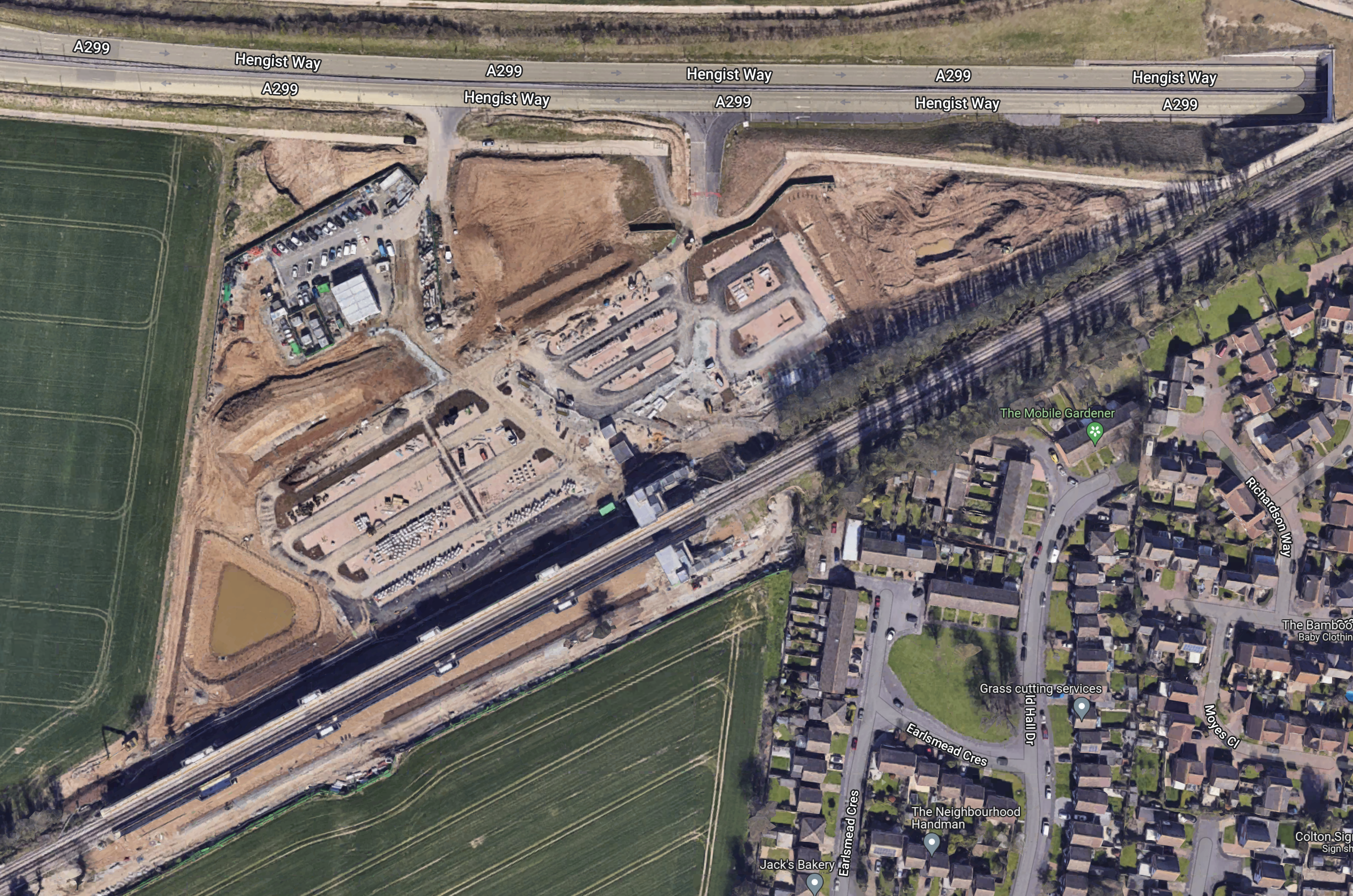
Thanet Parkway station is under construction and should be opened in May next year.
Work is progressing as this Google Map shows.
Note.
- The A299 goes across the top of the map.
- The Ashford – Canterbury – Ramsgate Line runs diagonally from South-West to North-East across the map.
- Ashford and Canterbury are to the South-West.
- Ramsgate is to the North-East.
The new Thanet Parkway station appears to be being built on the triangular site between the A299 and the railway.
- There appear to be two entrances/exits to the station from the A299.
- The pedestrian bridge over the railway is under construction.
- The roads and walkways around the station are being laid.
This video gives more details of the station.
Parking At Thanet Parkway
According to the video, there are nearly three hundred parking spaces, with a number of disabled spaces and spaces with charging for electric cars.
Is that going to be enough spaces?
But at least, there may be fields around the station, that could be used to provide additional parking.
Richborough Energy Park
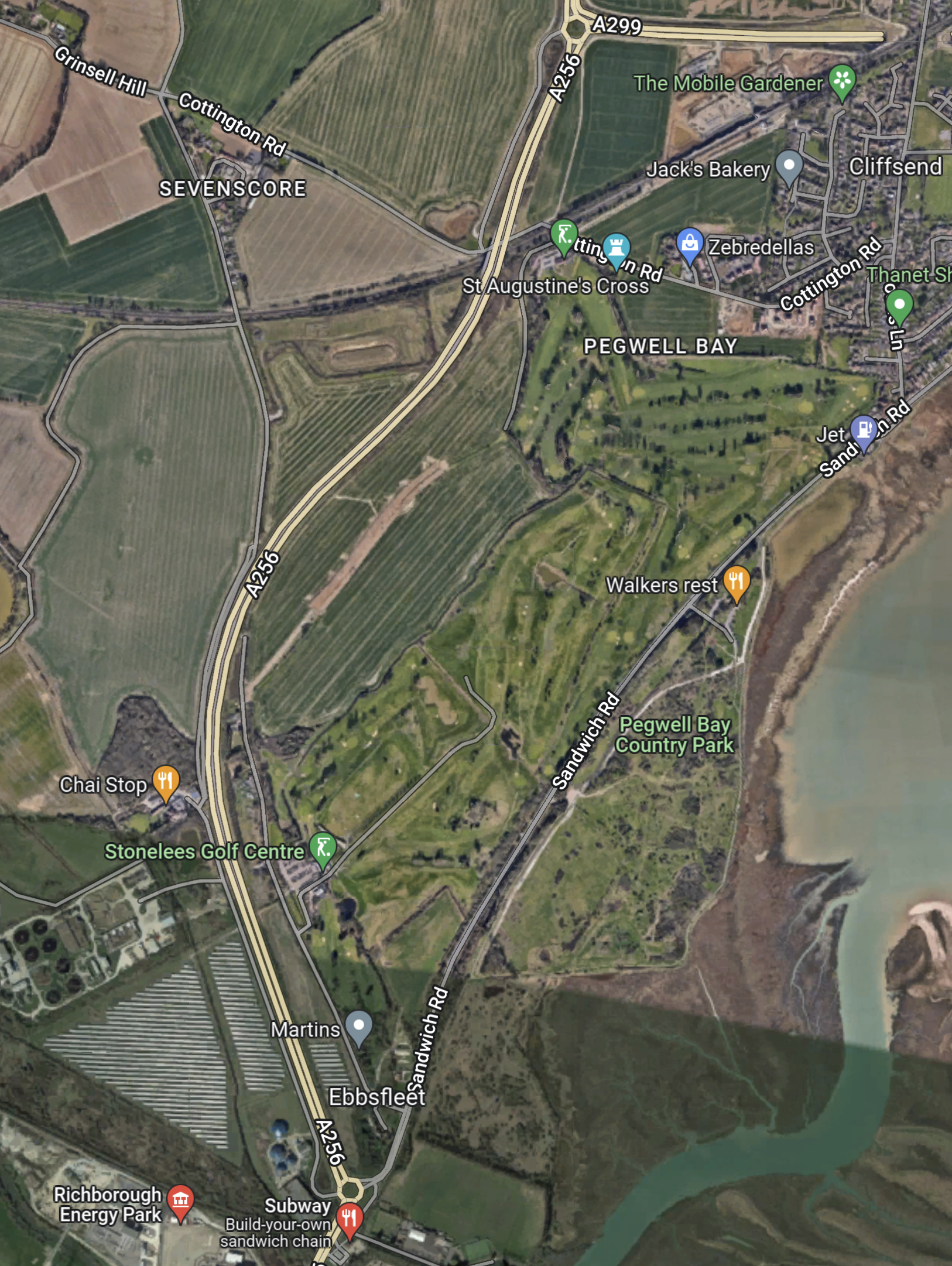
This Google Map shows the area around the station and to the South towards Richborough.
Note.
- The under-construction Thanet Parkway station is in the North-East corner of this map to the West of the village of Cliffsend.
- The dual-carriageway of the A256 runs North-South down the map to a roundabout.
- To the West of the roundabout is Richborough Energy Park.
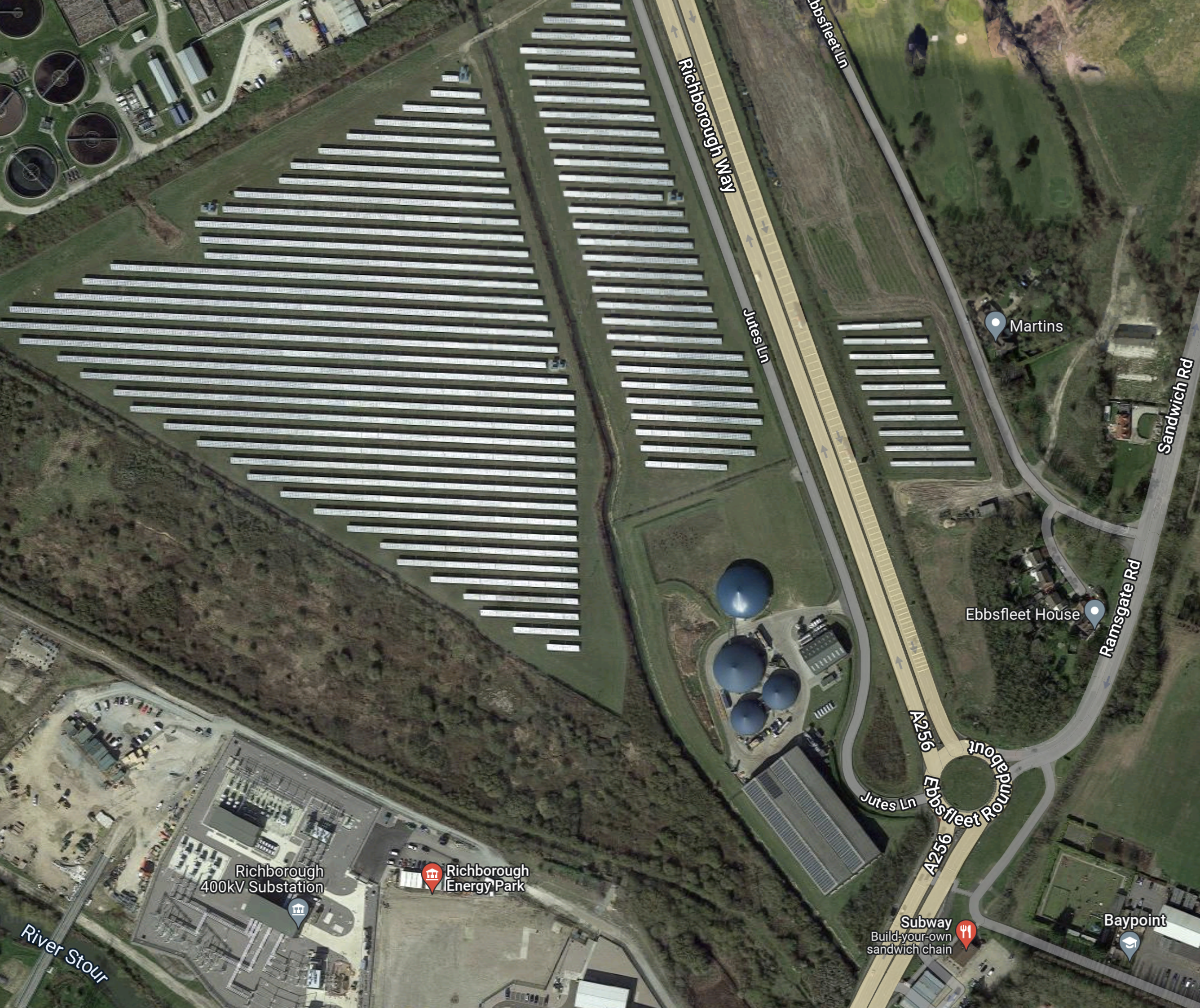
This Google Map shows the are round the energy park and the roundabout in more detail.
Note.
- The Richborough substation in the South-West corner of the map.
- The Richborough Energy Park sits to the East of the substation.
- The solar panels to the North of the roundabout are the 4.9 MW Ebbsfleet Solar Farm, which is part of Richborough Energy Park.
Richborough Energy Park is an ongoing project.
The national grid interconnector from the original power station is still in place, and is now the grid link for the 300 MW offshore Thanet Wind Farm.
It is the terminal for the NemoLink interconnector to Belgium.
Wikipedia says this about future plans.
The current owner of the site, BFL Management Ltd, plan to bring the site back into use as a £750 million green energy park. There are additional plans to create additional recycling and green energy facilities on site, including an anaerobic digester, a waste processing plant, a biomass combined heat and power generator, a pyrolysis plant and a peak demand 30MW diesel generator. When fully operational, the park could provide up to 1,400MW of power, employing 100 full-time equivalent, with up to 500 jobs in the construction phase.
I am surprised, that there is no mention of batteries or energy storage.
This press release from Network Rail is entitled Charge While You Travel With New Electric Vehicle Charging Points At Network Rail Stations.
This the body of the press release
Rail passengers with electric vehicles will be able to charge while they travel thanks to the introduction of 450 new electric vehicle charging points at Network Rail-managed car parks at railway stations.
The charging points, powered by guaranteed renewable energy, provide enough power to fully charge a vehicle in as little as 3-4 hours.
In this phase, Network Rail has powered: 160 charging points in Reading, 111 in Manchester, 84 in Edinburgh, 56 at Leeds and 41 in Welwyn Garden City.
Electric vehicle charging points will be installed across 10% of car parking spaces (approximately 779 spaces) at car parks managed by Network Rail by March 2024.
Rail is already the leading form of green public transport and this marks another milestone in Network Rail’s commitment to a low-emission railway – making sure rail is environmentally-friendly, resilient to climate change and able to provide an excellent service for years to come.
The new Compleo charging points are marked with green parking bays and passengers can pay for what they need quickly and easily via the APCOA Connect app.
Note, that there is no mention, if these are vehicle-to grid (V2G) chargers.
In Airport Plans World’s Biggest Car Parks For 50,000 Cars, I stated my belief that car parks, with hundreds or even thousands of vehicles could be turned into giant grid batteries.
- All electric vehicles, when they are parked would be plugged in to V2G chargers.
- The vehicle and the grid, would know your expected return time and how much power you would need. Probably from a parking app, assisted by AI!
- If the grid borrowed your electricity, whilst you were away, you wouldn’t know, until you received the payment for the loan.
- If your car runs on hydrogen, the parking could also handle the battery, that all hydrogen-powered vehicles have.
Thanet Parkway station would be an ideal station for such a parking system for electric vehicles.
Cleve Hill Solar Park
This document from the Department of Business, Industry and Industrial Strategy lists all the Contracts for Difference Allocation Round 4 results for the supply of zero-carbon electricity that were announced yesterday.
There were sixty-six solar power projects, that totalled up to 2.2 GW, which gives an average size of 33.3 MW.
I looked at the list and found the following.
- All contracts had the same strike price of £45.99 per MWh.
The largest solar farm with a contract is Cleve Hill Solar Park.
- ,Cleve Hill Solar Park received a contract for 112 MW.
- According to Wikipedia, the solar park will have a battery of 700 MWh.
- Will the battery enable the solar park to supply 112 MW on a twenty-four seven basis?
- According to Wikipedia, solar farms have a capacity factor of about 10 % in the UK.
- The Cleve Hill Solar Park will have a capacity of 350 MW.
- On a typical day, it will generate 350 * 24 *0.1 = 840 MWh
- The Contract for Difference mechanism means they get the strike price for each MWh of electricity up to the level in the contract, which is 112 MW.
- I suspect that for several months of the year, the solar park will be able to supply 112 MW to the grid.
- I do feel that overnight and on sunless winter days, the system will provide a lot less electricity.
- This page on the EMR web site explains Contract for Difference mechanism.
This extract from Wikipedia, describes, the solar park’s connection to the National Grid.
Across the marsh run the 400kV powerlines of the national grid. They are supported by eight 40m pylons. There is a large 150/400kV electricity substation at Cleve Hill, serving the London Array offshore wind farm that lies to the north beyond the mouth of the Thames Estuary. The output from the Solar Farm will use this substation to connect to the grid. Here, a battery array will placed, that will charge from the sunlight during the day and release the energy at night when it is needed.
I can build a table showing the earnings on a per day and per year basis, against average output.
- 20 MW – £22,076.20 per day – £8,057,448 per year
- 50 MW – £55,188 per day – £20,143,620 per year
- 70 MW – £77,263.20 per day – £28,201,068 per year
- 100 MW – £110,376 per day – £40,287,240 per year
- 112 MW – £123,621.12 per day – £45,121,708.80 per year
Note.
- I have assumed the year is 365 days.
- As a time-expired Control Engineer, I know that the battery can be optimised to supply the electricity, when it is needed and the price is highest.
- I wouldn’t be surprised to see co-operation between the London Array and Cleve Hill Solar Farm, as on a sunless but windy day, there may be scope to store excess wind energy in the battery for later release.
On this brief look, it appears that owning a solar farm, can be a nice little-earner.
Thoughts On The Battery
Consider.
- According to Wikipedia, the solar park will have a battery of 700 MWh.
- One of the largest lithium batteries in the UK is the one at Clay Tye in Essex, which is just under 200 MWh.
I suspect that lithium ion batteries will not be used.
Highview Power are building a 250 MWh battery in Manchester.
- This battery will be able to supply 50 MW.
- The batteries use liquid air as an energy storage medium.
- The company says the design can be extended up to a GWh by adding more tanks for the liquid air.
- The only fossil fuels used in Highview’s batteries is probably some lubricating oil.
I feel that a Highview battery or something similar would be an ideal solution at Cleve Hill Solar Farm.
I should be noted that the London Array is a 630 MW wind farm, so the London Array and Cleve Hill Solar Farm have a combined nameplate capacity of 980 MW.
I feel there is a case for a larger battery at the substation, to give the grid an almost-guaranteed GW all day.
It would be large than most if not all gas-fired power stations.
It could be used to balance the grid.
The controlling software would optimise the finances by buying and selling electricity at the right time.
Climate Change: ‘Sand Battery’ Could Solve Green Energy’s Big Problem
The title of this post, is the same as that of this article on the BBC.
This is the introductory paragraph.
Finnish researchers have installed the world’s first fully working “sand battery” which can store green power for months at a time.
The article then gives a detailed explanation about how the battery works.
Note.
- The article does not give any details on battery capacity.
- The heat stored in the battery is extracted as hot water.
- The Finnish company is called Polar Night Energy.
In Bang Goes My Holiday!, I described the Siemens Gamesa ETES, which appears to work on similar principles, to the Finnish battery.
This document on the Siemens Gamesa web site describes that installation.
- The nominal power is 30 MW.
- The storage capacity is 130 MWh.
- Siemens use volcanic rock as the storage medium.
- 80 % of the technology is off the shelf.
The picture on the front says “Welcome To The New Stone Age”.
The BBC have published a video of the Polar Night Energy Battery.
Enery Dome Closes $11M Convertible Round To Accelerate Commercial Deployment Of CO2 Battery
The title of this post, is the same as that of this press release from Energy Dome.
When I first saw Energy Dome on the Internet, I thought they had something.
Energy Dome Secures Funding, Partner For New CO2 Energy Storage Projects was my first post about the company and this is an extract, from that post.
Note.
- It appears that Energy Dome has weaponised carbon dioxide against climate change.
- Providing 2.5 MW for over an hour and a half is an impressive performance.
- I think this project has the style we associate with Italy and Italians.
I have found their website at energydome.com and behind their energy storage system is unusual technology.
Their web site says this about their choice of storage medium.
CO2 is the perfect fluid to store energy cost effectively in a closed thermodynamic process as it is one of the few gases that can be condensed and stored as a liquid under pressure at ambient temperature. This allows for high density energy storage without the need to go at extreme cryogenic temperatures.
That is breathtakingly simple!
The main tank for the gaseous carbon dioxide is an inflatable dome and the liquid carbon dioxide is stored in steel tanks.
A turbine -compressor moves the carbon dioxide between gaseous and liquid states storing it appropriately.
It is very impressive! And I suspect extremely affordable!
This was the sub-heading of Tuesday’s press release.
Provider of long-duration energy storage completes convertible funding round co-led by CDP Venture Capital Sgr and Barclays and joined by Novum Capital Partners, ahead of planned Series B round.
This is the second time they have raised eleven million dollars to fund a project.
This paragraph from the press release outlines how the money will be used.
Energy Dome’s rapid technological development motivates the speed and frequency of the funding rounds. The Series A enabled the company to complete its 2.5MW / 4MWh commercial demonstration plant in Sardinia, Italy, the final step of technology de-risking. Energy Dome has begun the commercialization of the CO2 Battery. This latest bridge funding will allow the company to accelerate its development in advance of the Series B round by placing purchase orders for the long lead time turbomachinery equipment associated with its First of a Kind utility scale (20MW, 200MWh, 10-hour duration) energy storage projects. A Memorandum of Understanding for this first utility scale project has been signed with A2A, a major European utility, and the company is making strong progress on its commercial pipeline.
This is a company to watch.
SSE Thermal And Equinor To Acquire Triton Power In Acceleration Of Low-Carbon Ambitions
The title of this post, is the same as that as this press release from SSE.
These are the first three paragraphs.
SSE Thermal and Equinor have entered into an agreement to acquire Triton Power Holdings Ltd from Energy Capital Partners for a total consideration of £341m shared equally between the partners.
The transaction represents another step forward for the two companies’ existing collaboration, supporting the long-term decarbonisation of the UK’s power system whilst contributing to security of supply and grid stability through flexible power generation in the shorter term.
Triton Power operates Saltend Power Station which is 1.2GW CCGT (Combined Cycle Gas Turbine) and CHP (Combined Heat & Power) power station located on the north of the Humber Estuary in East Yorkshire.
This deal is more complicated than it looks and these are my thoughts.
What About The Triton Power Workers?
The press release says this.
The 82 existing employees will continue to be employed by Triton Power. In line with just transition principles, the joint venture is committed to transitioning the assets for the net zero world through responsible ownership and operation, and in consultation with the local workforce and representatives.
It does sound that they are following the right principles.
Saltend Power Station
Saltend power station is no tired ancient asset and is described like this in Wikipedia.
The station is run on gas using single shaft 3 × Mitsubishi 701F gas Turbines machines with Alstom 400 MWe generators. The station has a total output of 1,200 MW; of that 100 MW is allocated to supply BP Chemicals. Each gas turbine has a Babcock Borsig Power (BBP) heat recovery steam generator, which all lead to one steam turbine per unit (single shaft machine means Gas turbine and Steam Turbine are on the same shaft). The waste product of electricity generation is steam at the rate of about 120 tonnes/h which is sold to BP Chemicals to use in their process. This makes Salt End one of the most efficient[clarification needed] power stations in the UK. The plant is scheduled to use hydrogen from steam reformed natural gas for 30% of its power.
Note.
- It was commissioned in 2000.
- It appears there are seven CCGT power stations in England that are larger than Saltend.
- The power station seems to have had at least four owners.
The press release says this about SSE and Equinor’s plans for Saltend power station.
The transaction underscores SSE Thermal and Equinor’s shared ambition to decarbonise the Humber, which is the UK’s most carbon-intensive industrial region, as well as the UK more widely. Initial steps to decarbonise Saltend Power Station are already underway, targeting partial abatement by 2027 through blending up to 30% of low-carbon hydrogen. In addition, carbon capture provides an additional valuable option for the site. SSE Thermal and Equinor will continue to work towards 100% abatement.
Note.
- It appears that initially, Saltend power station will move to running on a mixture of 30 % hydrogen and 70 % natural gas.
- Carbon capture will also be applied.
- It looks like that in the future all carbon-dioxide emitted by the power station will be captured and either stored or used.
The press release says this about the source of the hydrogen.
Saltend Power Station is a potential primary offtaker to Equinor’s H2H Saltend hydrogen production project. H2H Saltend is expected to kick-start the wider decarbonisation of the Humber region as part of the East Coast Cluster, one of the UK’s first carbon capture, usage and storage clusters.
H2H Saltend is described in this page on the Equinor web site, which has a title of The First Step To A Zero Carbon Humber, where this is said.
This project represents a bold but practical first step towards delivering the world’s first net zero industrial cluster by 2040. This unparalleled project can play a leading role in the UK’s journey to net zero by 2050, renew the UK’s largest industrial cluster, and unlock technology that will put the UK at the forefront of a global hydrogen economy.
There is also a video.
SSE Thermal And Equinor Low-Carbon Thermal Partnership
This is a section in the press release, where after giving their policy about the workers, it says this about the acquisition of Triton Power.
This acquisition strengthens SSE Thermal and Equinor’s portfolio of joint projects, which bring together expertise in power, natural gas, hydrogen and carbon capture and storage. This portfolio includes three development projects within the Humber region:
- Keadby 3 Carbon Capture Power Station, which could be the UK’s first flexible power station equipped with carbon capture.
- Keadby Hydrogen Power Station, which could be one of the world’s first 100% hydrogen-fuelled power stations.
- Aldbrough Hydrogen Storage, located in East Yorkshire, which could be one of the world’s largest hydrogen storage facilities.
The two companies are also developing Peterhead Carbon Capture Power Station, situated on the Aberdeenshire coast in Scotland and there are further opportunities for hydrogen blending across SSE’s generation portfolio, including at Keadby 2.
Note.
- There is no mention of the three Dogger Bank Wind Farms, each of which will be 1200 MW, that are owned by SSE Renewables and Equinor.
- I wrote about Aldbrough Gas Storage in The Massive Hydrogen Project, That Appears To Be Under The Radar.
- According to this press release from Equinor, which is entitled SSE Thermal And Equinor Join Forces On Plans For First-Of-A-Kind Hydrogen And Carbon Capture Projects In The Humber, Keadby Hydrogen power station will have a capacity of 1800 MW.
The Complete System
The system has the following power sources.
- Dogger Bank A – 1200 MW – Expected commissioning in 2023/24
- Dogger Bank B – 1200 MW – Expected commissioning in 2024/25
- Dogger Bank C – 1200 MW – Expected commissioning in 2024/25
- Keadby power station – 735 MW
- Keadby 2 power station – 893 MW – Could be Part-Hydrogen
- Keadby 3 power station – 910 MW – Carbon Capture
- Keadby Hydrogen power station – 1800 MW – Hydrogen
- Saltend power station – 1200 MW – Part-Hydrogen
That totals up to 9138 MW.
Fuel will come from three sources.
- The God of the winds.
- Natural gas
- Hydrogen
Hydrogen will be sourced from.
- Blue hydrogen from H2H Saltend
- Green Hydrogen could come from electrolysers driven by wind power.
Hydrogen would be stored in Aldbrough Gas Storage.
I am by training a Control Engineer and controlling these power sources is either a wonderful dream or your most entwined and complicated nightmare.
Conclusion
I suspect on an average day, this cluster of power stations and sources could reliably supply as much zero-carbon power as two large nuclear stations.
Octopus Energy On Xlinks
Today, Octopus Energy published a web page, which is entitled Backing Cheaper, Greener Energy Globally, giving more details of the Xlinks project.
I first wrote about the tie-up between Octopus Energy and Xlinks in Xlinks Welcomes New Investor Octopus Energy In Providing Cheap Green Power To Over 7 Million Homes.
Points made in the page on the Octopus web page include.
- The project will cover over 570 square miles in Morocco with 7GW of solar and 3.5GW of wind generation alongside a 20GWh battery storage facility.
- This green energy powerhouse will be connected to the UK via 2,361 miles of HVDC subsea cables.
- The cables will be built with British steel in a new factory in Hunterton, Scotland.
- It also appears that the site of the project has been chosen to optimise energy collection.
This project appears to be excellently-thought out to bring large benefits to all stakeholders.
Gravity—Yes, Gravity—Is the Next Frontier for Batteries
The title of this post, is the same as that of this article on Popular Mechanics.
This is the first paragraph.
When the sun isn’t shining and the wind isn’t howling, suspended weights can step in to generate power.
The article goes on to explain Energy Vault and Gravitricity.
It is certainly an endorsement of the technique from one of America’s popular magazines.
Cost Of Turning Off UK Wind Farms Reached Record High In 2021
The title of this post, is the same as that of this press release from Drax.
This is the first paragraph.
The cost of turning off wind farms in the UK has reached record levels, according to a new report.
The press release makes these points.
- Investing in more long duration electricity storage, such as expanding Drax’s Cruachan pumped storage hydro plant in Scotland, would mean more excess renewable power could be stored and made available when required, cutting costs and carbon emissions.
- The cost of turning off UK wind farms to manage the electricity system rose from almost £300m during 2020 to over £500m in 2021, contributing to higher energy bills and carbon emissions, according to a new report.
- Costs increased substantially because the system relied on expensive gas power to manage periods when wind power was curtailed, as not enough electricity storage was available to prevent the excess renewable power from wind farms going to waste.
Drax give these reasons for the problems.
This happened as a result of constraints in the transmission system and a lack of long-duration storage capacity, which is needed to manage periods when renewable power generation outstrips demand.
The problem is going to get worse as we increase the amount of wind power in the UK.
Penny Small, Drax’s Group Generation Director sums everything up.
This report underlines the need for a new regulatory framework to encourage private investment in long-duration storage technologies.
The UK is a world-leader in offshore wind, but for the country’s green energy ambitions to be realised we need the right energy storage infrastructure to support this vital technology, make the system secure and reduce costs.
Drax’s plan to expand Cruachan will strengthen UK energy security, by enabling more homegrown renewable electricity to power British homes and businesses, reducing system costs and cutting carbon emissions.
A good framework has been created for wind farms and many more are being proposed and developed.
Frameworks are needed for both transmission systems and long-duration energy storage capacity.

