Merseyrail’s Battery Intentions
In New Merseyrail Fleet A Platform For Future Innovations, I quoted from this article on the Rail Technology Magazine web site.
The article mainly is an interview with David Powell, who is programme director of rolling stock at Merseytravel.
This is a direct quote from the article.
We will be exploring, with Stadler, what the options are for having the trains becoming self-powered. This isn’t the bi-modes that lots of other people are talking about in the industry; this is on-board electrical storage.
The Wikipedia entry for Merseyrail links to this document, which puts a lot more flesh on Merseyrail’s intentions for battery trains.
It outlines strategies for the following routes.
Ellesmere Port And Helsby
The document says this.
There is a reasonable business case for extending the Merseyrail service through to Helsby.
However this is likely to be best served by the use of Merseyrail battery powered enabled
services. This will be tested on the new units in 2020.
According to Wikipedia, the sixth Class 777 train to be delivered will be fitted with batteries.
Currently, the service between Liverpool Central and Ellesmere Port stations is as follows.
- A train every thirty minutes.
- Trains take eighty-five minutes to do the round trip from Ellesmere Port round the Wirral Loop under Liverpool and back to Ellesmere Port.
- There are thirty-one stops on the route.
- There is a five minute turnround at Ellesmere Port station.
Two trains are needed to run the service.
The Current Class 507/508 trains and the future Class 777 trains both have the same operating speed, but there are performance differences.
The British Rail trains have 656 kW of power per train, whereas every new Stadler train will have 2,100 kW. The speed may be the same, but the acceleration will be much greater if needed and and the regenerative braking should be powerful and smoothly controlled.
- Figures for the Class 313 train, which is similar to the Class 507/508 trains show a top speed of 75 mph and an acceleration of 0.67 m/s².
- Figures for the Class 777 train show a top speed of 75 mph and an acceleration of 1.1 m/s².
These figures mean that a Class 507 train will get to 75 mph in 125 seconds, whereas the new Stadler trains will take just 76 seconds.
In addition, loading and unloading of passengers with their increasing levels of extras will be much faster due to the hollistic design of the trains and the platforms on the new Stadler trains.
It would not be unrealistic to see around a minute saved at every stop.
I think this level of improvement could be expected, with all the modern trains in the UK.
The extended service between Ellesmere Port and Helsby stations is not much extra distance and time.
- Just over five miles each way.
- About thirteen minutes each way , based on existing services on the route.
So if the terminus were to be moved to Helsby, when the new trains are in service, the time savings between Ellesmere Port and Liverpool should cover the extra distance.
It should also be noted about Helsby station.
- It has four platforms and could probably handle four trains per hour (tph).
- A platform with a charging station could be created.
- It has a wide selection of services including Chester, Llandudno, Manchester and Warrington.
To my mind, Liverpool to Helsby would be an ideal route for a battery electric train.
Ormskirk-Preston Enhancements
The document says this.
This incorporates both electrification from Ormskirk through to Preston and the potential
reintroduction one or both of the Burscough Curves. In view of the deferral of electrification
proposals, and the relative low ranking of the electrification proposal in the Northern Sparks
report, it is unlikely that the electrification proposal is expected to be taken forward in the
near future. In addition to this, the business case for extending electrification to Burscough,
and the introduction of the southern Burscough Curve, is poor. The potential use of battery
powered Merseyrail units may improve the business case for both proposals. This will be
reviewed after the Merseyrail units have been tested for battery operation in 2020.
Currently, the service between Ormskirk and Preston stations is as follows.
- A train every hour.
- Trains take around thirty minutes to go between the two terminal stations.
- The route is fifteen and a half miles long.
- There are three stops on the route.
- There is a long turnround in a bay platform at Preston station.
At the present time, the service seems rather erratic, with some services replaced by buses and long connection times at Ormskirk.
The service between Liverpool Central and Ormskirk stations takes thirty-five minutes with eleven stops and is generally every fifteen minutes, with a half-hourly service in the evening and at weekends.
If a Class 777 train could use battery power, I estimate it could run between Liverpool Central and Preston stations within an hour.
This would surely open up the possibility of a new service between Liverpool and Preston.
- It would take only a few minutes longer than the fifty-one minutes of a direct train between Liverpool Lime Street and Preston stations.
- It would connect a lot of stations to the West Coast Main Line at Preston.
- It would link the major sporting venues of Aintree, Anfield and Goodison or Everton’s new ground to the North.
- At the Southern end, it could connect to Liverpool Airport.
The Class 777 trains would need to be able to do about thirty miles on battery power and if required, the technology exists to either top up the batteries at Preston or use a pantograph to access the overhead wires of the West Coast Main Line.
At the present time, the Ormskirk Branch Line between Ormskirk and Preston stations is only single track and probably needs resignalling, but I suspect that a four tph service could be run between Liverpool and Ormskirk, with two tph extended to Preston.
Extra track work, North of Ormskirk and the reinstatement of the Burscough curves would allow.
- Four tph between Liverpool and Preston via Ormskirk.
- A service between Liverpool and Southport via Ormskirk.
- A service between Preston and Southport.
There is even the possibility of extending Liverpool and Preston services to Blackpool South station, if they used the overhead electrification through Preston to charge the batteries.
Borderlands Development
The document says this.
While the aspiration is to fully electrify the line, and incorporate it into the Merseyrail
network, this is very much a long term aspiration. In the interim period the aim is to develop
the line through the introduction of an improved diesel service. Merseytravel will work
closely with relevant cross-border organisations such as Growth Track 360 to bring this
about. There are a number of new station proposals for the line, the principal being a new
station close to the Deeside Industrial Park, which would improve the ability of the
workforce to access the site via public transport.
The Borderlands Line provides a service between Liverpool and Wrexham Central station with a change at Bidston station.
- The twenty-seven miles between Wrexham Central and Bidston are not electrified.
- The line is double-track throughout.
- There are twelve stations on the line.
- The service is hourly, but probably needs to be at least half-hourly.
- The service takes about an hour between Wrexham and Bidston stations.
Using Class 777 trains on the route, using battery power between Bidston and Wrexham Central stations would enable.
- A direct service, that terminated in the Wirral Loop under Liverpool.
- An increased capacity at Bidston station.
- A faster service.
I estimate that a time of perhaps seventy to eighty minutes between Liverpool Central and Wrexham Central stations will be possible.
There would be very little infrastructure work, except for new stations and the possible ability to top up batteries at Wrexham Central.
I suspect that political problems, rather than any railway ones will be larger.
Bootle Branch Electrification
The document says this.
A long term proposal which will need to be considered alongside the developing freight
strategy for the region and the expansion of the Port of Liverpool. The proposal envisages
the introduction of passenger services which will operate from the Bootle Branch into Lime
Street. An initial study is required to understand fully the freight requirements for the line
and what the realistic potential for operating passenger services over the line is.
The Bootle Branch is known as the Canada Dock Branch in Wikipedia.
Class 777 trains with a battery capability and the ability to use the overhead electrification into Liverpool Lime Street would be able to serve this route, without the need for electrification.
Obviously, if for freight efficiency, the route was electrified, the trains could use it as needed.
North Mersey Branch
The document says this.
A long term proposal; this envisages a new service operating from Ormskirk via Bootle into
Liverpool. It was reviewed as part of the Merseyrail Route Utilisation Strategy in 2009 which
identified a poor business case.
I can’t identify the actual route, but there are various rail alignments into and through the Docks.
Skelmersdale
The document says this.
Merseytravel is currently working with Lancashire County Council and Network Rail to
develop the Merseyrail network from Kirkby through to Skelmersdale. This work is expected
to be completed in 2019. Further development work will be required before this project is
implemented. While 3rd rail electrification is being considered currently, alternatives will be
considered later in the development process. A new station at Headbolt Lane to serve the
Northwood area of Kirkby is an integral part of this proposal. The potential to extend the
network further through to Wigan will need to be developed separately.
I wrote about this plan in Merseyrail To Skelmersdale – How To Plan A New Rail-Link.
Thoughts On Battery Size And Range
Thjis article on Railway Gazette is entitled Battery Trial Planned For New EMU Fleet.
This is the first paragraph.
The sixth of the 52 four-car 750 V DC third rail electric multiple-units which Stadler is to supply for Merseyrail services around Liverpool is to be fitted with a 5 tonne battery to test the business case for energy storage. While all the EMUs will be equipped for regenerative braking, this is not seen as optimal on the Merseyrail network.
I find the last part of this paragraph difficult.
Does it mean the trains can use regenerative braking, but that it is not worth using?
This media release on the Stadler web site is entitled Stadler Signs Contract To Build And Maintain 52 Metro Trains For
Liverpool City Region.
This is a sentence.
The units will also be equipped with batteries that allow independent movement of the units in the workshop and depot areas.
Out of curiosity, what will be the kinetic energy of the four-car trains at the full speed of 75 mph
- The train weight is given as 99 tonnes in Wikipedia.
- The passenger capacity is 484, with a weight of 90 Kg each.
- This gives a train weight of 142.56 tonnes.
Putting these figures into Omni’s Kinetic Energy Calculator gives a kinetic energy of 22.3 kWh.
I feel that this fairly low amount of energy could be held in a 60 kWh battery, that would probably come from a hybrid bus and weigh about 600 Kg.
I would be very surprised if Stadler are not using a smaller battery to do the following.
- Handle regenerative braking.
- Independent movement in the workshop and depot areas.
- Train power in sidings and platforms.
It could also handle, train rescue to a safe evacuation point, in the event of power failure. I suspect that like Crossrail in London, Merseyrail would be very happy to have an independent recovery system in the tunnels under Liverpool, Birkenhead and the River Mersey.
In How Much Power Is Needed To Run A Train At 125 mph?, I estimated that using 3 kWh per vehicle mile is not a bad estimate for the energy use of an electric train running at speeds in excess of 100 mph.
Using this figure would give a range on a 60 kWh battery of at least five miles, which would move the train out of the tunnels if the power failed.
But we’re talking about a modern lightweight train running on probably newly relaid track and my 3 kWh per vehicle mile could be a little on the high side.
Stadler are talking of fitting the sixth train with a fifty five battery, which would probably have a capacity of around 500 kWh.
Using various consumption figures, the range would be as follows.
- 3 kWh per vehicle mile – 42 miles
- 2 kWh per vehicle mile – 62 miles
- 1 kWh per vehicle mile – 125 miles
Stadler and their battery supplier are probably working on.
- A train that uses less electricity.
- More efficient regenerativer braking.
- A more intelligent train control system.
- Increased energy density in the battery.
- Efficient charging systems.
- A plug-in battery pack that can be added and removed in minutes.
As a Control and Electrical Engineer, I wouldn’t be surprised to see that the control, electrical and software system of trains with and without the five tonne battery are identical and some just have a larger amount of energy storage.
Range on battery power can only increase!
Consider the lengths of some of the routes discussed earlier.
- Ellesmere Port and Helsby – 5 miles
- Ormskirk and Preston – 16 miles
- Bidston and Wrexham Central – 27 miles
Only the last route might need a charging station at the remote terminal.
My Own Speculation On Routes
I think there could be other routes that could easily be run by Class 777 trains running on battery power.
Onward From Hunts Cross
The current service between Hunts Cross and Manchester Oxford Road stations is only two tph, using rather suspect rolling stock.
- Under Merseyrail and London Overground rules, it should be at least four tph to give travellers a Turn-Up-And-Go service.
- The stations are of variable quality, but are being improved and will soon be joined by a new station at Warrington Wrst.
- There is a lot of new developments along the route.
- The service terminates in a convenient bay-platform at Manchester Oxford Road station.
- The service calls at Deansgale station for the Manchester Metrolink.
The route could be developed into a City-Centre-to-City-Centre and commuter route for both Liverpool and Manchester.
So could this route be run by Class 777 trains using battery power?
Consider.
- Hunts Cross and Manchester Oxford Road are just twenty-seven miles apart.
- The last couple of miles to Oxford Road is electrified with 25 KVAC overhead wires.
- Hunts Cross is electrified with 750 VDC third-rail.
It will be a Liverpool and Manchester Railway for the Twenty-First Century
I think it is one of those problems, where the engineering is easy, but the politics will be very difficult.
Onward From Headbolt Lane
The current service between Liverpool and Kirkby, which will be extended to the new station at Headbolt Lane, is a a Turn-Up-And-Go service of four tph. But the onward service to Wigan and Manchester is just a very inadequate hourly-service.
Consider.
- Headbolt Lane and Wigan are just twelve miles apart.
- Plans are being developed to create a proper transport interchange at Wigan for the arrival of High Speed Two.
- Wigan North Western is electrified with 25 KVAC overhead wires.
- Kirkby is and Headbolt Lane will be electrified with 750 VDC third-rail.
It would appear to be very possible to extend Class 777 trains from Kirkby to Wigan using battery power.
More Trains For Merseyrail
This is a paragraph from the Stadler media release about Merseyrail’s new trains.
The new four-car trains will all be in service by 2021, with the first unit arriving for testing by the middle of 2019.
The value of the manufacture and maintenance contracts for the 52 trains is up to £700m and Merseytravel
also has the option to procure an additional 60 units of rolling stock.
If the options are taken up, this would more than double the size of the Merseyrail’s fleet.
But where will these trains connect to Liverpool City Centre?
Helsby, Preston, Skelmersdale, Wrexham Central and the other routes in Liverpool will all need more trains, but nothing like sixty trains.
So will we see Wigan and Warrington added to Merseyrail’s destinations? And what about Manchester?
Never say no to Liverpool and their Swiss co-conspirators!
Conclusion
It is a comprehensive expansion strategy, where much of the work to create the various extensions is performed by adding equipment to the trains in factories or depots, rather than by the disruptive installation of electrification.
It looks very much like a case of Have Swiss Train Will Travel.
But then, I think the London Overground is using a similar strategy to expand in partnership with Bombardier.
Other networks like the Tyne & Wear Metro and those in cities like Birmingham, Cardiff, Glasgow and Leeds will be using similar philosophies of battery trams, tram-trains and trains.
Cardiff has already disclosed their plans and Stadler are building the trains for the South Wales Metro.
Do Aventras Use Supercapacitors?
In this article in Global Rail News from 2011, which is entitled Bombardier’s AVENTRA – A new era in train performance, gives some details of the Aventra’s electrical systems. This is said.
AVENTRA can run on both 25kV AC and 750V DC power – the high-efficiency transformers being another area where a heavier component was chosen because, in the long term, it’s cheaper to run. Pairs of cars will run off a common power bus with a converter on one car powering both. The other car can be fitted with power storage devices such as super-capacitors or Lithium-ion batteries if required. The intention is that every car will be powered although trailer cars will be available.
Unlike today’s commuter trains, AVENTRA will also shut down fully at night. It will be ‘woken up’ by remote control before the driver arrives for the first shift
This was published over seven years ago, so I suspect Bombardier have refined the concept.
The extract makes three interesting points.
All Or Most Cars Will Be Powered
In A Detailed Layout Drawing For A Class 345 Train, I give the formation of a Crossrail Class 345 train.
DMS+PMS+MS1+MS3+TS(W)+MS3+MS2+PMS+DMS
Note.
- M signifies a motored car.
- Eight cars have motors and only one doesn’t.
- The train is composed of two identical half-trains, which are separated by the TS(W) car.
- There are four wheelchair spaces in the TS(W) car.
Are the MS!, MS2 and MS3 cars identical?
In addition, I have been told, that all cars in Class 720 trains are motored.
It does seem that Bombardier have fulfilled their statement from 2011.
Remote Wake-Up
This is mentioned in the extract, but there are few other references to it. I quoted a report from the Derby Telegraph, which has since been deleted, in Do Bombardier Aventras Have Remote Wake-Up?.
Supercapacitors And Lithium-Ion Batteries
According to the extract, the trains have been designed to accept supercapacitors or lithium-ion batteries if required.
As the other two statements in the extract appear to be likely, I will continue to believe that all Aventras can have some form of energy storage.
Crossrail
I’ll look first at Crossrail’s Class 345 train.
In How Much Energy Does A Crossrail Class 345 Train Use?, using the train’s data sheet, I came to the conclusion, that electricity usage of the trains is 2.67 KWh per car per kiometre or 3.29 KWh per car per mile.
In the linked post, I also calculate the kinetic energy of a fully-loaded nine-car Crossrail train.
I’ll repeat it.
- If I take a nine-car Class 345 train, this has a mass of less than 350 tonnes and a maximum speed of 145 kph.
- 1500 passengers at 80 kg each works out at another 120 tonnes.
- So for this crude estimate I’ll use 450 tonnes for the mass of a loaded train.
This gives the train a kinetic energy of 101 KWh.
As the Class 345 trains are effectively two half trains, with two PMS cars with pantographs, it is likely that they have at least two cars that are ready for supercapacitors or lithium-ion batteries.
The Design Of Crossrail
Crossrail could best be described as the Victoria Line on steroids.
- Both lines were designed to run in excess of twenty-four trains per hour (tph) across London.
- The Victoria Line was built to deep-level Underground standards, with one of the most advanced-for-its-time and successful train operating systems of all times.
- Crossrail is a modern rail line being built to National Rail standards, with world-leading advanced technology, that takes full account of modern environmental standards and aspirations.
Costs were saved on the Victoria Line by leaving out important parts of the original design..
- The route was cut back to Walthamstow Central, from the proposed terminus at Walthamstow Wood Street or possibly South Woodford or Woodford.
- Some stations like Highbury & Islington were built to a totally inadequate low-cost design.
- Third escalators at stations were changed into stairs.
- Step-free access was non-existent at the opening, but has been added to some stations since.
- Cross platform interchange with the Chingford Branch Line was left out at Walthamstow Central station.
Costs were saved on Crossrail, by using high-quality design.
- Crossrail and the Great Western Main Line electrification share a sub-station to connect to the National Grid.
- The number of ventilation and access shafts was reduced significantly, with one in a new office block; Moor House.
- Electrification uses a simple overhead rail, which is only fed with power at the ends.
I also believe that the Class 345 trains, which were designed specifically for the route, were designed to save energy and increase safety in the tunnels.
Regenerative braking normally saves energy by returning braking energy through the electrification, so it can be used to power other nearby trains.
Batteries For Regenerative Braking
However, in recent years, there has been increasing interest in diverting the braking energy to onboard energy storage devices on the train, so that it can be used when the train accelerates or to power systems on the train.
The system has these advantages.
- Less energy is needed to power the trains.
- Simpler and less costly transformers can be used for the electrification.
- The onboard energy storage can be used to power the train after an electrification failure.
- In tunnels, there is less heat-producing electricity flowing in all the cables.
Obviously, keeping the heat down in the tunnels is a good thing.
A Station Stop On Crossrail Using Regenerative Braking And Energy Storage
Imagine a fully-loaded train approaching a station, at the maximum speed on 145 kph.
- The train will have a kinetic energy of 101 kWh.
- As it approaches the station, the brakes will be applied and the regenerative brakes will turn the train’s energy into electricity.
- This energy will be stored in the onboard energy storage.
- As the train accelerates away from the station, the electricity in the onboard energy storage can be used.
The only problem, is that regenerative braking is unlikely to recover all of the train’s kinetic energy. But this is not a big problem, as the train draws any extra power needed from the electrification.
To make the system as efficient as possible, the following must be fitted.
- The most efficient traction motor.
- Onboard energy storage capable of handling the maximum kinetic energy of the train.
- Onboard energy storage with a fast response time.
The train will probably be controlled by a sophisticated computer system.
What Size Of Onboard Energy Storage Should Be Fitted?
Obviously, this is only speculation and a best guess, but the following conditions must be met.
- The onboard energy storage must be able to capture the maximum amount of energy generated by braking.
- The physical size of the energy storage system must be practical and easily fitted under or on the train.
- The energy storage system should be able to store enough energy to be able to move a stalled train to safety in the event of complete power failure.
Note that an energy storage system with a 100 kWh capacity would probably take the train somewhere around four to five kilometres.
Obviously, a series of computer simulations based on the route, passengers and various other conditions, would indicate the capacity, but I feel a capacity of around 120 kWh might be the place to start.
Where Would The Energy Storage Be Placed?
With nine cars, and with eight of them motored, there are a several choices.
- One energy storage unit in all motored cars.
- One energy storage unit in the three MS cars.
- One energy storage unit in each half train.
I’ve always liked the concept of an energy storage unit in each powered car, as it creates a nice tight unit, with energy stored near to where it is generated and used.
But there is another big advantage in splitting up the energy storage – the individual units are smaller.
Could this mean that supercapacitors could be used?
- The main need for onboard energy storage is to handle regenerative braking.
- The secondary need for onboard energy storage is for emergency power.
- There is no needon Crossrail as yet,to run the trains for long distances on stored power.
- Supercapacitors are smaller.
- Supercapacitors can handle more operating cycles.
- Supercapacitors run cooler.
- Supercapacitors have a fast response.
If running for longer distances were to be required in the future, which might require lithium-ion or some other form of batteries, I’m sure there will be space for them, under all those cars.
I wouldn’t be surprised to find out that Crossrail’s Class 345 trains are fitted with supercapacitors.
Note, that a Bombardier driver-trainer, talked of an emergency power supply, when I asked what happens if the Russians hacked the electrification.
Class 710 Trains
London Overground’s Class 710 trains are a bit of a mystery at the moment as except for a capacity of seven hundred passengers disclosed in this article on the International Railway Journal little has been published.
Here are my best guesses.
Formation
Based on the formation of the Class 345 trains, I think it will be.
DMS+PMS+MS+DMS
Effectively, this is a half-train of a seven-car Class 345 train, with a DMS car on the other end.
Dimensions
I have a Bombardier press release, which says that the car length is twenty metres, which is the same as Class 315, Class 317 and Class 378 trains and a whole load of other trains, as twenty metre cars, were a British Rail standard.
I doubt there will be much platform lengthening for these trains in the next few years.
Weight
The Wikipedia entry for Aventra gives car weight at between thirty and thirty-five tonnes, so the train weight can be anything between 120-140 tonnes.
Passenger Capacity
I wrote about this in The Capacity Of London Overground’s New Class 710 Trains.
This was my conclusion.
It appears that seven hundred is the only published figure and if it is, these new Class 710 trains are going to substantially increase public transport capacity across North London.
They are certainly future-proofed for an outbreak of London Overground Syndrome, where passenger numbers greatly exceed forecasts.
As some of the trains are being delivered as five-car units, there is always the option of adding an extra car. Especially, as the platforms on the line, seem to have been built for five or even six car trains.
London Overground have not made the platform length miscalculations of the North and East London Lines.
For the near future they’ll hold around 700 passengers at 80 Kg. each, which means a passenger weight of fifty-six tonnes.
Full Train Weight
For various train weights, the fully-loaded trains will be.
- 120 tonnes – 176 tonnes
- 130 tonnes – 186 tonnes
- 140 tonnes – 196 tonnes
Until I get a better weight for the train, I think I’ll use 130 tonnes or 186 tonnes, when fully-loaded.
Speed
I wrote about this in What Is The Operating Speed Of Class 710 Trains?.
This was my conclusion.
But what will be the operating speed of the Class 710 trains?
I said it will be somewhere between 145 kph (90 mph) and 160 kph (100 mph)
Consider.
- I think that 145 kph, will be able to handle the two planned increased frequencies of four tph.
- 145 kph is identical to the Crossrail trains.
- 160 kph is identical to the Greater Anglia trains.
- 160 kph seems to be the speed of suburban Aventras.
It’s a difficult one to call!
I do think though, that trundling around the Overground, they’ll be running at the same 121 kph of all the other trains.
Kinetic Energy
The kinetic energy of a 186 tonnes train at 121 kph is 29 kWh.
Could Supercapacitors Handle This Amount Of Energy?
I’m pretty certain they could.
Conclusion
Supercapacitors are a possibility for both trains!
I’ll review these calculations, as more information is published.
Thoughts On A Battery/Electric Train With Batteries And Capacitors
I’m going to use a Class 350/2 train as the example.
In Porterbrook Makes Case For Battery/Electric Bi-Mode Conversion, I calculated the kinetic energy of one of these trains at various speeds.
Wikipedia gives this information.
- Maximum Speed – 100 mph
- Train Weight – 175.5 tonnes
- Capacity – Around 380 passengers
If I assume each passenger weighs 90 Kg with baggage, bikes and buggies, the train weight is 209.7 tonnes.
This weight could be a bit high, bnut then the train must perform even when crush-loaded.
Using Omni’s Kinetic Energy Calculator, I get the following kinetic energies at various speeds.
- 80 mph – 37.2 kWh
- 90 mph – 47.1 kWh
- 100 mph – 58.2 kWh
- 110 mph – 70.4 kWh
In the video shown in A Must-Watch Video About Skeleton Technologies And Ultracapacitors., Taavi Madiberk of Skeleton Technologies likens a capacitor/battery energy store with Usain Bolt paired with a marathon runner. Usain would handle the fast energy transfer of braking and acceleration, with the marathon runner doing the cruising.
This would seem to be a good plan, as the capacitors could probably quickly store the regenerative braking energy and release it at a high rate to accelerate the train.
Once, up to operating speed, the lithium-ion batteries would take over and keep the train at the required speed.
Obviously, it would be more complicated than that and the sophisticated control system would move electricity about to keep the train running efficiently and to maximum range.
The capacitors should probably be sized to handle all the regenerative braking energy, so for a 100 mph train, which would have a kinetic energy of 58.2 kWh, a 100 kWh capacitor would probably be large enough.
In some ways the lithium-ion batteries can be considered to be a backup to the capacitors.
- They provide extra power where needed.
- If during deceleration, the capacitors become full, energy could be transferred to the lithium-ion batteries.
- If after acceleration, the capacitors have got more energy than they need, it could be transferred to the lithium-ion batteries.
- The lithium-ion batteries would probably power all the hotel services, like air-con, lights doors etc. of the train.
Note that the energy transfer between the capacitors and the lithium-ion batteries should be very fast.
A good Control Engineer could have a lot of fun with sorting the trains control system.
Mathematics Of Energy Storage
I am particularly talking about the sort of energy storage that is attracting the attention of Energy Storage Funds, that I wrote about in Batteries On The Boil As Fund Attracts Investors.
The Times article of the same name has this paragraph.
A typical 50-megawatt energy storage site of the kind the company intends to acquire hosts 19 containers each housing thousands of lithium-ion cells. A fully-charged container has the energy to boil 32,000 kettles.
This page on ConfusedEnergy.co.uk, says this.
We are often told to only use as much water as we need in a kettle and not to fill it to the top, but what are the potential annual saving in doing this. Well it takes roughly 4.5 minutes to boil a full (2 litre) kettle with a power rating of 3kW (kilowatts).
This means that to boil a kettle needs 0.225 kWh.
- Boiling 32,000 kettles needs 7200 kWh or 7.2 MWh
- Which means that the total capacity of the nineteen container energy storage facility is 136.8 MWh.
So the energy storage could provide the rated 50 MW for nearly three hours.
Lithium-Ion Batteries, Supercapacitors Or Both?
The article in The Times doesn’t mention supercapacitors.
If you watch the video in A Must-Watch Video About Skeleton Technologies And Ultracapacitors, Skeleton Technologies state the following about their ultracapacitors.
- They are more affordable.
- They generate less heat.
- They have a higher energy density.
- They can handle more charge/discharge cycles.
- They have a faster response time, so would respond better to sudden demands.
I suspect there may be several operational and financial advantages, in replacing some of the lithium-ion batteries with supercapacitors.
Batteries On The Boil As Fund Attracts Investors
The title of this post is the same as that of an article in the Business section of today’s Times.
This is the first two paragraph.
Investors have sunk £100million into a new listed company that aims to use shipping containers packed with lithium-ion batteries to buy, store and sell electricity.
Gresham House Energy Storage Fund claims that it will make a return of 15 per ceent a year by providing electricity when surges in demand coincide with periods when the wind is not blowing or the sun is not shining.
Gresham House Energy Storage Fund is the second listed energy storage fund in London, after Gore Street Energy Storage Fund , launched in May.
I think we’ll see more of these funds and use of the technology.
Suppose you were a farmer with a windy hill top farm, that had a heavy electricity bill.
Realistically, sized, priced and financed a wind-turbine and a container full of batteries, might be just what your finances wanted.
All you’d need now would be an electric Range-Rover and a fleet of electric tractors!
A Must-Watch Video About Skeleton Technologies And Ultracapacitors
This video is embedded in this page on the Skeleton Technologies web site.
Watch it!
A few points,
- Batteries have typically a life of between 3,000 to 5,000 cycles.
- Capacitors can achieve up to a million cycles.
- Used together batteries and capacitors complement each other.
- Used together can double battery life.
Taavi Madiberk of Skeleton Technologies likens a capacitor/battery energy store with Usain Bolt paired with a marathon runner. Usain would handle the fast energy transfer of braking and acceleration, with the marathon runner doing the cruising.
Ultracapacitors For The Rail Industry
The title of this sub-section is the same as this page on the Skeleton Technologies web site.
Noted applications include.
- Engine starting for diesel trains.
- Kinetic Energy Recovery System (KERS) for diesel trains.
- Onboard application for electric trains
- Stationary application for rail industry
- Independent power for level crossings.
I suspect these applications are just the start.
Conclusion
It appears to me, that the development of these large supercapacitors, is going to open up opportunities to develop energy storage systems for transport applications, that will give longer range and aincreased energy efficiency.
Could Electric Trains Run On Long Scenic And Rural Routes?
In the UK we have some spectacular scenic rail routes and several long rural lines.
Basingstoke And Exeter
The West of England Main Line is an important rail route.
The section without electrification between Basingstoke and Exeter St. Davids stations has the following characteristics.
- It is just over one hundred and twenty miles long.
- There are thirteen intermediate stations, where the expresses call.
- The average distance between stations is around nine miles.
- The longest stretch between stations is the sixteen miles between Basingstoke and Andover stations.
- The average speed of trains on the line is around forty-four mph.
There is high quality 750 VDC third-rail electrification at the London end of the route.
Cumbrian Coast Line
The Cumbrian Coast Line encircles the Lake District on the West.
The section without electrification between Carnforth and Carlisle stations has the following characteristics.
- It is around a hundred and fourteen miles long.
- There are twenty-nine intermediate stations.
- The average distance between stations is around four miles.
- The longest stretch between stations is the thirteen miles between Millom and Silecroft stations.
- The average speed of trains on the line is around thirty-five mph.
There is also high standard 25 KVAC electrification at both ends of the line.
Far North Line
The Far North Line is one of the most iconic rail routes in the UK.
The line has the following characteristics.
- It is one-hundred-and-seventy-four miles long.
- There are twenty-three intermediate stations.
- The average distance between stations is around seven miles.
- The longest stretch between stations is the thirteen miles between Georgemas Junction and Wick stations.
- The average speed of trains on the line is around forty mph.
The line is without electrification and there is none nearby.
Glasgow To Oban
The West Highland Line is one of the most iconic rail routes in the UK.
The line is without electrification from Craigendoran Junction, which is two miles South of Helensburgh Upper station and the section to the North of the junction, has the following characteristics.
- It is seventy-eight miles long.
- There are ten intermediate stations.
- The average distance between stations is around eight miles.
- The longest stretch between stations is the twelve miles between Tyndrum Lower and Dalmally stations.
- The average speed of trains on the line is around thirty-three mph.
From Glasgow Queen Street to Craigendoran Junction is electrified with 25 KVAC overhead wires.
Glasgow To Mallaig
This is a second branch of the West Highland Line, which runs between Crianlarich and Mallaig stations.
- It is one hundred and five miles long.
- There are eighteen intermediate stations.
- The average distance between stations is around five miles.
- The longest stretch between stations is the twelve miles between Bridge Of Orchy and Rannoch stations.
- The average speed of trains on the line is around twenty-five mph.
Heart Of Wales Line
The Heart of Wales Line is one of the most iconic rail routes in the UK.
The line is without electrification and the section between Swansea and Shrewsbury stations, has the following characteristics.
- It is just over one hundred and twenty miles long.
- There are thirty-one intermediate stations.
- The average distance between stations is around four miles.
- The longest stretch between stations is the thirteen miles between Shrewsbury and Church Stretton stations.
- The average speed of trains on the line is just under forty mph.
There is also no electrification at either end of the line.
Settle And Carlisle
The Settle and Carlisle Line is one of the most iconic rail routes in the UK.
The section without electrification between Skipton and Carlisle stations has the following characteristics.
- It is just over eighty miles long.
- There are thirteen intermediate stations.
- The average distance between stations is around six miles.
- The longest stretch between stations is the sixteen miles between Gargrave and Hellifield stations.
- The average speed of trains on the line is around forty mph.
There is also high standard 25 KVAC electrification at both ends of the line.
Tyne Valley Line
The Tyne Valley Line is an important route between Carlisle and Newcastle stations.
The line is without electrification has the following characteristics.
- It is just over sixty miles long.
- There are ten intermediate stations.
- The average distance between stations is around six miles.
- The longest stretch between stations is the sixteen miles between Carlisle and Haltwhistle stations.
- The average speed of trains on the line is around mph.
There is also high standard 25 KVAC electrification at both ends of the line.
A Pattern Emerges
The routes seem to fit a pattern, with very similar characteristics.
Important Local Transport Links
All of these routes are probably important local transport links, that get children to school, many people to large towns for shopping and entertainment and passengers of all ages to see their friends and relatives.
Many would have been closed but for strong local opposition several decades ago.
Because of the overall rise in passengers in recent years, they are now relatively safe for a couple of decades.
Iconic Routes And Tourist Attractions
Several of these routes are some of the most iconic rail routes in the UK, Europe or even the world and are tourist attractions in their own right.
Some of these routes are also, very important in getting tourists to out-of-the-way-places.
Lots Of Stations Every Few Miles
The average distance between stations on all lines seems to be under ten miles in all cases.
This surprised me, but then all these lines were probably built over a hundred years ago to connect people to the expanding railway network.
The longest stretch between two stations appears to be sixteen miles.
Diesel Hauled
All trains seem to be powered by diesel.
This is surely very inappropriate considering that some of the routes go through some of our most peaceful and unspoilt countryside.
Inadequate Trains
Most services are run by trains, that are just too small.
I know to put a four-car train on, probably doubles the cost, but regularly as I explore these lines, I find that these two-car trains are crammed-full.
I once inadvertently took a two-car Class 150 train, that was on its way to Glastonbury for the Festival. There was no space for anything else and as I didn’t want to wait an hour for the next train, I just about got on.
Passengers need to be encouraged to take trains to rural events, rather than discouraged.
An Electric Train Service For Scenic And Rural Routes
What would be the characteristics of the ideal train for these routes?
A Four-Car Electric Train
Without doubt, the trains need to be four-car electric trains with the British Rail standard length of around eighty metres.
Dual Voltage
To broaden the applications, the trains should obviously be capable of running on both 25 KVAC overhead and 750 VDC third-rail electrification.
100 mph Capability
The trains should have at least a 100 mph capability, so they can run on main lines and not hold up other traffic.
No Large Scale Electrification
Unless there is another reason, like a freight terminal, quarry, mine or port, that needs the electrification, using these trains must be possible without any large scale electrification.
Battery, Diesel Or Hydrogen Power
Obviously, some form of power will be needed to power the trains.
Diesel is an obvious no-no but possibly could only be used in a small way as emergency power to get the trains to the next station, if the main power source failed.
I have not seen any calculations about the weight, size and power of hydrogen powered trains, although there have been some professional videos.
But what worries me about a hydrogen-powered train is that it still needs some sizeable batteries.
So do calculations indicate that a hydrogen-powered train is both a realisable train and that it can be produced at an acceptable cost?
Who knows? Until, I see the maths published in a respected publication, I will reserve my judgement.
Do Bombardier know anything?
In the July 2018 Edition of Modern Railways, there is an article entitled Bi-Mode Aventra Details Revealed.
A lot of the article takes the form of reporting an interview with Des McKeon, who is Bombardier’s Commercial Director and Global Head of Regional and Intercity.
This is a paragraph.
However, Mr McKeon said his view was that diesel engines ‘will be required for many years’ as other power sources do not yet have the required power or efficiency to support inter-city operation at high-speeds.
As Bombardier have recently launched the Talent 3 train with batteries that I wrote about in Bombardier Introduces Talent 3 Battery-Operated Train, I would suspect that if anybody knows the merits of hydrogen and battery power, it is Mr. McKeon.
So it looks like we’re left with battery power.
What could be a problem is that looking at all the example routes is that there is a need to be able to do station-to-station legs upwards of thirteen-sixteen miles.
So I will say that the train must be able to do twenty miles on battery power.
How Much Battery Capacity Should Be Provided On Each Train?
In Issue 864 of Rail Magazine, there is an article entitled Scotland High Among Vivarail’s Targets for Class 230 D-Trains, where this is said.
Vivarail’s two-car battery units contains four 100 kWh lithium-ion battery rafts, each weighing 1.2 tonnes.
If 200 kWh can be placed under the floor of each car of a rebuilt London Underground D78 Stock, then I think it is reasonable that up to 200 kWh can be placed under the floor of each car of the proposed train.
As it would be required that the train didn’t regularly run out of electricity, then I wouldn’t be surprised to see upwards of 800 kWh of battery installed in the train.
n an article in the October 2017 Edition of Modern Railways, which is entitled Celling England By The Pound, Ian Walmsley says this in relation to trains running on the Uckfield Branch, which is not very challenging.
A modern EMU needs between 3 and 5 kWh per vehicle mile for this sort of service.
So if we are aiming for a twenty mile range from a four-car train with an 800 kWh battery, this means that any energy consumption better than 10 kWh will achieve the required range.
Regular Charging At Each Station Stop
In the previous section, I showed that the proposed train with a full battery could handle a twenty mile leg between stations.
But surely, this means that at every stop, the electricity used on the previous leg must be replenished.
In Porterbrook Makes Case For Battery/Electric Bi-Mode Conversion, I calculated the kinetic energy of a four-car Class 350 train, with a full load of passengers, travelling at ninety mph, as 47.1 kWh.
So if the train is travelling at a line speed of ninety mph and it is fitted with regenerative braking with an efficiency of eighty percent, 9.4 kWh of energy will be needed for the train to regain line speed.
There will also be an energy consumption of between 3 kWh and 5 kWh per vehicle per mile.
For the proposed four-car train on a twenty mile trip, this will be between 240 and 400 kWh.
This will mean that between 240 and 400 kWh will need to be transferred to the train during a station stop, which will take one minute at most.
I covered en-route charging fully in Charging Battery/Electric Trains En-Route.
I came to this conclusion.
I believe it is possible to design a charging system using proven third-rail technology and batteries or supercapacitors to transfer at least 200 kWh into a train’s batteries at each stop.
This means that a substantial top up can be given to the train’s batteries at stations equipped with a fast charging system.
New Or Refurbished Trains?
New trains designed to meet the specification, could obviously be used.
But there are a several fleets of modern trains, which are due to be replaced. These trains will be looking for new homes and could be updated to the required battery/electric specification.
- Greater Anglia – 30 x Class 379 trains.
- Greater Anglia – 26 x Class 360 trains.
- London North Western Railway – 77 x Class 350 trains.
- TransPennine Express – 10 x Class 350 trains
In Porterbrook Makes Case For Battery/Electric Bi-Mode Conversion, I describe Porterbrook’s plans to convert a number of Class 350 trains to battery/electric trains.
These Class 350 Battery/FLEX trains should meet the specification needed to serve the scenic and rural routes.
Conclusion
I am led to the conclusion, that it will be possible to design a battery/electric train and charging system, that could introduce electric trains to scenic and rural routes all over the UK, with the exception of Northern Ireland.
But even on the island of Ireland, for use both North and South of the border, new trains could be designed and built, that would work on similar principles.
I should also say, that Porterbrook with their Class 350 Battery/FLEX train seem to have specfied a train that is needed. Pair it with the right charging system and there will be few no-go areas in mainland UK.
What Would Tram-Trains With A Battery Capability Do For The Sheffield Supertram?
I asked this question in a slightly different form in Is The Sheffield Rotherham Tram-Train Showing Signs Of London Overground Syndrome?, where I said this.
Sheffield could do a lot worse, than replace the Siemens-Duewag trams with Class 399 tram-trains. Especially, as the South Wales Metro, will be buying thirty-six similar vehicles with batteries.
What would tram-trains with a battery capability do for Sheffield, Rotherham and the neighbouring towns?
We don’t know much about Stadler’s proposed tram-trains for the South Wales Metro.
- They look to be very similar externally to the Class 399 tram-trains.
- They will be able to work using 25 KVAC electrification on the South Wales Main Line.
- They will be able to work the two-mile long Butetown Branch Line on battery power.
- Whether they will have a 750 VDC capability has not been said.
A tram-train with batteries would certainly offer other possibilities.
On my trip to Rotherham, I met a guy of about my age, who was a resident of Sheffield. He was proud of the city’s trams and was trying out the tram-train for the first time.
He also suggested two possible extensions.
- Royal Hallamshire Hospital
- A tram-train to Doncaster.
There have also been plans at times to run tram-trains to Dore & Totley and Penistone stations.
So how would tram-trains with batteries help for these routes?
Royal Hallamshire Hospital
On this page of the Sheffield Teaching Hospitals web site, this is said about getting to the hospital by tram.
Supertram does not serve the Northern General Hospital. It can be used to reach the Royal Hallamshire, Jessop Wing, Charles Clifford and Weston Park Hospitals, although please be aware that there is still a 10-15 minute uphill walk from the nearest stop (University). We would recommend that anyone who experiences difficulty walking long distances choose some alternative means of travelling to hospital.
How many doctors, nurses and other hospital staff, would be put off by that paragraph and go and work elsewhere, where the public transport is better,
This Google Map shows the area.
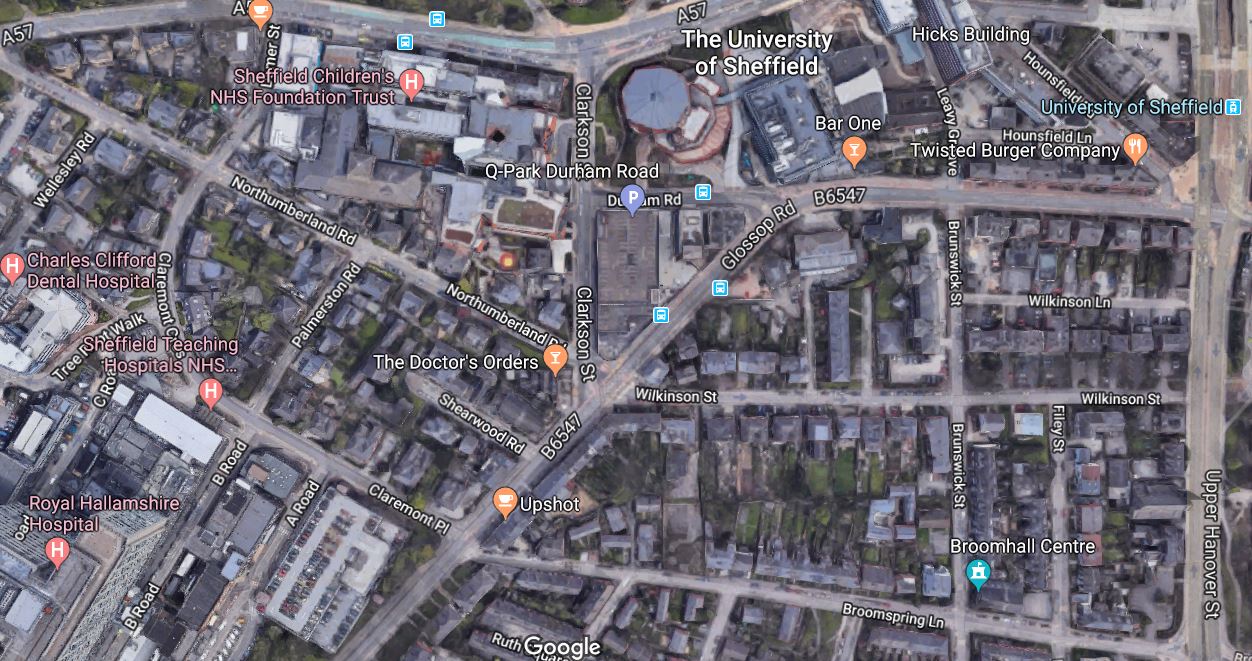
Note.
- The University tram stop is in the North-East corner of the map and is marked by a blue dot, marked with University of Sheffield.
- The Royal Hallamshire Hospital is in the South-West corner of the map.
This Google Map shows the University of Sheffield tram stop and how the tram route turns East to go to and from the city centre.
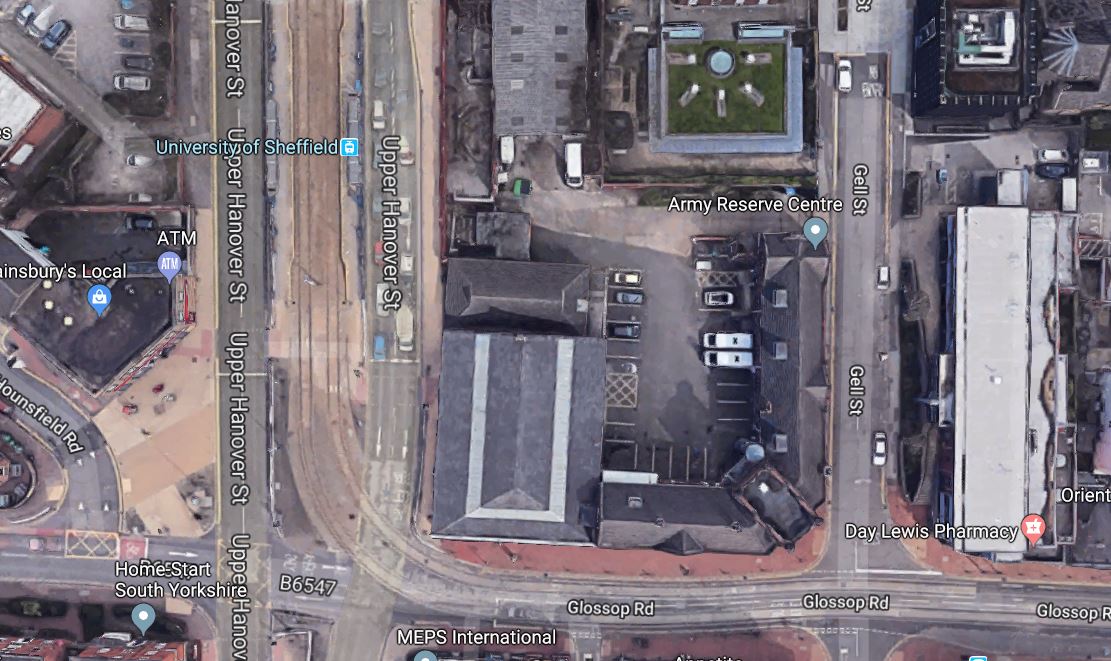
If the terrain allows it, a short extension might be possible to be built to the West along Glossop Road.
- As in Birmingham City Centre, the tram-trains could run on batteries, without any overhead wires.
- Charging could be provided at the terminal station which could be a few minutes walk to the hospital.
- The hospital and the university could be a good terminus for tram-trains from Rotherham and the East.
This is a typical extension, that is made easier and more affordable by the use of trams with a battery capability.
Connecting The Supertram To Heavy Rail
The Sheffield Supertram was designed before tram-trains existed, but even so there would seem to be several places, where the two systems could be connected.
The design of the Class 399 train-trams also makes the connections easier to design and build.
- The tram-trains can take tight turns.
- There are various innovative solutions, that allow the pantograph to ride from one electrification system to the other.
- If the tram-trains have batteries, this helps the electrification system changeover.
As more tram-train systems are installed, the library of solutions will get larger. As Electrification specialist ; Furrer and Frey have their UK subsidiary based in Nottingham, Sheffield could play a big part in the evolution of tram-train systems.
Tram-Train To Doncaster
There is a two trains per hour (tph) Northern service that goes between Sheffield and Doncaster, stopping at Meadowhall, Rotherham Central, Swinton, Mexborough and Conisbrough.
- One train continues to Hull and the other to Adwick.
- The service takes forty minutes from Doncaster to Sheffield.
- The service goes past the Rotherham Parkgate tram-train stop.
- The service takes about twenty minutes to go from Rotherham Parkgate to Doncaster, which is a distance of around 11.5 miles.
There is surely scope to extend the tram-train service to Doncaster to improve links between Sheffield, Rotherham and Doncaster.
This Google Map shows the Rotherham Parkgate tram-train stop.
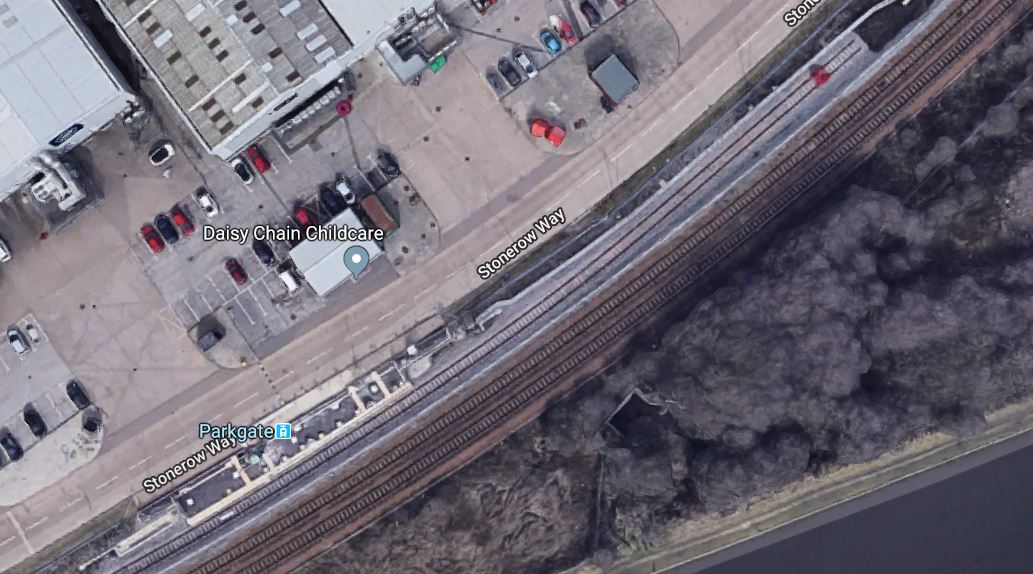
Note how the tram-train stop is effectively a siding alongside the double-track Dearne Valley Line, that links Rotherham Central with Leeds and York. It also has a link to Doncaster via the short Swinton-Doncaster Line.
Space would appear to have been left to convert the line through the tram-train stop to a loop. With an additional cross-over at the Eastern end of the stop, it would be possible to extend the tram-train service beyond its current terminal.
I have a map, which shows that the routes to Doncaster and along the Dearne Valley Line to where it crosses the Leeds-Doncaster Line could be electrified in the early 2020s.
If this electrification is carried out, then the tram-train service could easily be extended to Doncaster.
On the other hand, as Rochester Parkgate to Doncaster is around 11.5 miles and the route will have 25 KVAC overhead electrification at both ends, would it be possible for a tram-train with batteries to bridge the gap in the electrification?
Comparing a three-section Class 399 tram-train with a two-car battery/electric Class 230 train shows that the two vehicles have similar lengths, weight and passenger capacities.
As Vivarail have managed to fit 400 kWh of batteries under a Class 230 train, I wouldn’t be surprised to see at least 200 kWh of batteries squeezed under a Class 399 tram-train.
So would 200 kWh of battery power be sufficient to take a Class 399 tram-train between Rotherham Parkgate and Doncaster?
It should be noted that the total power of a Class 399 tram-train is 870 kW, so it wouldn’t be possible if the tram-train was on full power all the time.
But.
- The route is along the River Don and appears to be not very challenging.
- Regenerative braking can be used at the three stops and any other stops due to red signals.
- The initial acceleration at both ends could be accomplished under a short length of electrification.
- The tram-trains will probably have been designed to use the lowest level of energy possible.
- The tram-train could run in a low energy mode, when under battery power.
Stadler also know that handling a route like this on battery power would be an important sales feature all round the world.
Tram-Train To Dore & Totley
Running a tram-train service to Dore & Totley station in the South West of Sheffield seems to keep being mentioned.
When it was planned that HS2 was going to Meadowhall, this document was published. This was said about connecting Dore & Totley station to HS2.
Improved rail access to Meadowhall from south-west Sheffield could also be considered – for
example, a frequent service between Dore & Totley and Meadowhall could be included.Proposed future transport schemes include the tram-train project; if successful, this could be extended to allow further interchange possibilities at the HS2 station.
But HS2 is now going to the main Sheffield station.
This will probably mean.
- The route between Sheffield and Chesterfield will be upgraded and electrified, with I suspect extra tracks.
- The electrified lines will pass through Dore & Totley station.
- HS2 will need frequent connecting services from all over South Yorkshire into Sheffield station.
Dore & Totley and the stations on the Hope Valley service have a truly inadequate erratic hourly service to both Sheffield and Manchester.
There are two compatible solutions.
- A four tph regional solution of a train between perhaps Hull and Manchester stopping at Doncaster, Rotherham Central, Sheffield and a few stations on the Hope Valley Line.
- A higher frequency Sheffield solution of a train between perhaps Doncaster and the stations near to Sheffield on the Hope Valley Line.
The first service would be an advanced bi-mode train, whilst a tram-train with batteries could be ideal for the second
.Consider using a tram-train with batteries on the second service.
- It could use batteries on the Hope Valley Line to avoid electrification.
- It would serve Sheffield and Meadowhall stations.
- It could use heavy rail or tram routes in between the two major stations.
- It could provide a high frequency service between the two major stations.
There are a lot of possibilities and the transport planners will know the best things to do, with respect to traffic.
Tram-Train To Penistone
In Riding The Penistone Line, I described a trip on the Penistone Line.
This was my conclusion.
Tram-trains like the Class 399 tram-train could easily climb the hill to Penistone to provide a perhaps two trains per hour service to Sheffield.
But the line would need to be electrified or hybrid diesel tram-trains, as in Chemnitz will need to be used.
So perhaps Northern‘s plan for the Northern Connect service, which would use more powerful Class 195 diesel multiple units, might be better suited to the Penistone Line.
I think the heavy rail solution will be used.
Conclusion
I think that tram-trains with batteries will find a few worthwhile uses in the wider Sheffield area.
Flirt Akku Battery Multiple-Unit Unveiled
The title of this post is the same as that of this article in Railway Gazette International.
This is the first paragraph.
Stadler has officially unveiled the prototype Flirt Akku, a version of its Flirt family of electric multiple-units which is equipped with a battery to permit operation on non-electrified or partly-electrified routes.
So it looks like another train with batteries, that joins the following, that have been announced in recent months.
- Angel Trains’ Class 165 Hydrive, that I wrote about in Class 165 Trains To Go Hybrid.
- Bombardier Talent 3, that I wrote about in Bombardier Introduces Talent 3 Battery-Operated Train.
- Class 230 train, that I wrote about in Battery Class 230 Train Demonstration At Bo’ness And Kinneil Railway.
- Porterbrook Class 350/2 Battery/FLEX, that I wrote about in Porterbrook Makes Case For Battery/Electric Bi-Mode Conversion.
There are also several projects using MTU Hybrid Power Packs.
What new projects will emerge in the next couple of years?
Charging A Battery-Powered Class 230 Train
In Issue 864 of Rail Magazine there is an article about the Class 230 train demonstration in Scotland, that I wrote about in Battery Class 230 Train Demonstration At Bo’ness And Kinneil Railway.
This was said about charging a battery-powered Class 230 train.
A prototype rapid charging facility at its Long Marston base would use short sections of third-rail to quickly recharge a Class 230’s batteries. He said that the third-rail shoegear fitted t the trains in their London Underground service could handle higher currents than simply plugging a cable into the train.
The rapid charging concept consists of a shipping container of batteries that are trickle charged from a mains supply. When a Class 230 sits over the short sections of third-rail, electricity can be quickly transferred to the train’s batteries. When the train is away, the power rails are earthed to ensure they pose no risk The concept provides for charging a Class 230 as it pauses at a terminus before making its return journey.
What surprises me, is the claim, that third-rail is a very effective way of charging the batteries.
But Vivarail’s charging method using third-rail must open up affordable charging in stations and depots with poor-quality or low-capacity electricity supply.
Further Development
The design is very much capable of further development.
- The charging system could be used with any train, which has a third-rail capability.
- It could be made to work in both terminal and through platforms.
- The operation could be totally automatic .
- The system would switch on when the train stops over top and it completes the electrical circuit to allow charging.
- When the train moves away and breaks the circuit, the system would switch off and earth the third-rail.
- The batteries in the charging system could be charged by solar- or wind-power, instead of mains power.
I believe we’ll see some very ingenious charging systems for battery/electric trains.
 The Anonymous Widower