Biggleswade Wind Farm
The Biggleswade Wind Farm is a small wind farm on the East side of the East Coast Main Line, to the South of Biggleswade.
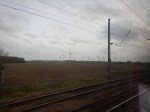
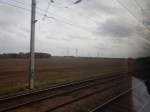


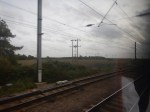
I took the pictures as I went North to Doncaster yesterday.
- The wind farm generates 20 MW.
- There are ten turbines.
I was sitting backwards in one of LNER’s Azuma trains.
It was in some ways an experiment to get a general wind farm picture.
Centrica Partners With Hull-Based HiiRoc For Hydrogen Fuel Switch Trial At Humber Power Plant
The title of this post, is the same as that on this article on Business Live.
This is a paragraph.
It comes as the owner of British Gas has also increased its shareholding in the three-year-old business to five per cent. Last November it was one of several investors to pump £28 million into HiiRoc alongside Melrose Industries, HydrogenOne, Cemex, Hyundai and Kia, who joined existing strategic investors Wintershall Dea and VNG.
This could be sensational.
The reason I said that was that I used to share an office at ICI Mond Division, with Peter, who was putting instruments on a plant called the Badische. It was a new process to create acetylene. If I remember correctly, the process was as follows.
Ethylene was burned and then quenched in naptha.
The trouble was that the process produced a lot of carbon, which clogged the burners, and masses of black smoke, which upset everybody in Runcorn, especially on washing day!
Someone was worried that the plant might go into explosive limits, so Peter had devised a clever infra-red instrument to read the composition of the off-gas from the burner. It was found to be in explosive limits and ICI shut it down. BASF said ICI were wrong and there was no way to measure the composition of the off-gas anyway. A few months later BASF’s plant exploded and buried itself in a hillside in Southern Germany. Upon hearing this news, ICI shut the Badische for ever. ICI were annoyed in that they had to spend £200,000 on a flameless cutter to dismantle the plant.
I do wonder, if HiiROC have tamed BASF’s beast to do something useful, like produce hydrogen and carbon black!
Ocergy Floaters Selected For 100 MW Project Off Scotland
The title of this post, is the same as that of this article on Splash247.com.
These two paragraphs outline Ocergy’s OCG-Wind foundation technology.
The Salamander floating offshore wind project, a joint venture between Simply Blue Group, Ørsted and Subsea 7, has awarded the pre-FEED (front-end engineering design) deal to Ocergy for its OCG-Wind foundation technology.
The US-based Ocergy has developed a novel semisub floater called OCG-Wind, to support turbines larger than 10 MW, designed for the development of large-scale wind farms. It is targeting a levelised cost of energy (LCOE) that can start to drive reductions in floating offshore wind farms to eventually be competitive with fixed offshore wind farms.
Note.
- There is a picture showing two turbines on OCG-Wind floats.
- Salamander is intended to be an INTOG project of 100 MW.
- The floaters are expected to be fabricated at Global Energy Group’s Port of Nigg.
- ERM’s Dolphyn electrolysis, desalination and hydrogen production concept is also planned for the project.
The Salamander project is certainly going for a lot of innovation.
BP To Open Offshore Wind Office In Germany, Starts Recruitment Drive
The title of this post, is the same as that of this article on offshoreWIND.biz.
This is the first paragraph, which adds a bit more information.
Global energy major bp plans to open an office in Hamburg, Germany dedicated to the development of offshore wind projects and is in the process of seeking employees for the new office.
These are other points from the article.
- The topic of wind power is being promoted particularly in Hamburg.
- BP said that the company has already achieved a number of milestones in the field of wind energy.
- In cooperation with EnBW, bp is currently developing several wind farms in the Irish and Scottish Seas.
- Similar plans already exist for the Netherlands.
- The energy major would also like to supply charging stations for electric vehicles with green electricity.
- In Germany, wind and solar energy should account for 80 per cent of electricity generation by 2030, compared to today’s 42 per cent.
- Offshore wind energy is planned to grow seven times by 2045.
I believe that BP’s project expertise and management, backed by billions of German euros could be a complimentary dream team.
Offshore And Nearshore Survey Work Complete For 2 GW Scottish Wind Project
The title of this post, is the same as that of this article on offshoreWIND.biz.
This is the first paragraph.
The developers of the West of Orkney Windfarm have completed its 2022 offshore and nearshore surveys for the project area, located around 25 kilometres off the Sutherland coast in Scotland.
Note.
- Surveys were on time and on budget.
- Consent applications are expected next year.
- Both fixed and floating turbines are being considered.
The West of Orkney wind farm has its own web site, with this proud mission statement.
Designed For Delivery, Driven By Scale
The West of Orkney Windfarm has the potential to power more than two million homes and deliver long-term economic benefits to communities across the north of Scotland.
The web site says that the target for first power generation is 2029.
In How Long Does It Take To Build An Offshore Wind Farm?, I said that it typically takes between six and eight years to for consent to commissioning for an offshore wind farm.
So with consent in 2023, commissioning in 2029 could be possible.
Metocean Measurement Campaign To Start At 1 GW Scottish Floating Wind Farm Site
The title of this post, is the same as that of this article on offshoreWIND.biz.
This is the introductory paragraph.
Partrac will soon deploy a floating LiDAR Buoy at the site of the Buchan floating wind project offshore Scotland, which is being developed by Floating Energy Allyance (FEA), a consortium comprising BW Ideol, Elicio, and BayWa r.e.
It appears, that the Buchan floating wind farm is the first of the floating Scotwind Leasing round of projects to get going in a meaningful way.
The article details some of the design details of the wind farm.
- The site is located some 75 kilometres to the northeast of Fraserburgh on the Aberdeenshire coast,
- The Floating Energy Allyance consortium plans to build a floating offshore wind farm with a capacity of approximately 1 GW, whose wind turbines will be installed on BW Ideol’s Damping Pool floating foundations.
- This page on the BW Ideol web site describes their Damping Pool technology.
- The patented square barge-like floats can be used for offshore wind turbines, substations and hydrogen electrolysers.
BW Ideol appear to be a French company with projects in France, Japan, Taiwan and now Scotland.
The home page of the BW Ideol web site opens with a promotional and explanatory video of their technology.
Cummins Is Charging Towards Green
If ten years ago, you’d asked any green activist to name companies, that would be ruined by or fail to adjust to global warming by decarbonising their product line, I’m sure most big diesel engine manufacturers, like Cummins, would have been on their list.
But Cummins have successfully moved on as their latest press releases about their technology show.
- October 13th – Cummins Drives Gigawatt Electrolyzer Manufacturing Plant Forward in Spain, Expanding Its Global Clean Energy Footprint.
- October 10th – Cummins Drives Domestic Green Hydrogen Economy Forward With First U.S. Electrolyzer Manufacturing Facility.
- October 6th – Atura Power Selects Cummins To Design, Manufacture 20 MW Electrolyzer System For Niagara Hydrogen Centre.
- October 5th – Cummins’ Second Largest Solar Farm Goes Live at Rocky Mount Engine Plant.
- September 22nd – Destination IAA: Cummins Unveils New Technology For Zero-Emissions Power Solutions.
- September 20th – Cummins QSK95 Engine Proven Fully Compatible With Renewable Diesel.
- September 15th – Cummins Advocating for Racial Equity (CARE) Supports Mobile Grocery Markets in Communities Across the U.S.
- September 15th – Destination IAA: Cummins Debuting Electrified Meritor Powertrains For The First Time Since Acquisition.
- September 8th – Cummins Advocating for Racial Equity (CARE) Invests in a Sustainable Future Through Private Equity Partnership.
- September 8th – Cummins Scaling Belgium Electrolyzer Manufacturing Capacity To 1 Gigawatt Through IPCEI Support.
- September 7th – Werner Enterprises Signs Letter of Intent Planning to Secure 500 X15H Engines from Cummins.
- August 31st – Transport Enterprise Leasing Planning to Integrate Cummins’ X15H into Heavy Duty Truck Fleets.
These can be summarised as follows.
- Green Solutions – 4
- Electrolysers for green hydrogen – 3
- Decarbonisation of diesel engines – 3
- Community Support – 2
- Electric Powertrains – 1
- Solar Power – 1
According to Google, the Cummins share price has risen thirty percent in the last five years.
They must have done something right!
Knoydart Renewables – The Power of Knoydart
The BBC has been showing a film all day about the Knoydart area of the Scottish Highlands and their community-owned hydroelectric power system.
The title of this post, is the same as that of this page on the Knoydart Foundation web site.
This paragraph introduces the system.
Knoydart is not connected to the National Grid and generates all of its own electricity. Other than some small run-of-burn micro-schemes in outlying hamlets, by far and away the the main producer and distributer of electricity on Knoydart is Knoydart Renewables Ltd. that supplies electricity around Inverie Bay.
Note.
- The system is based on a 280 kW turbine and generator.
- The turbine is fed over a kilometer by steel and plastic pipe from a man-made loch with an estimated storage capacity of at least 74 MWh.
- There is a back-up diesel generator.
- 120 residents in 90 properties are supplied with electricity.
It sounds like a very professional system for a community with a convenient hill and water supply.
The system is being expanded and connected to the grid.
The whole page is a must read for anyone, who wants to put in a small hydroelectric power station for their house, castle or community.
X1 Wind – Disrupting Offshore Wind
The X1 Wind web site talks about disrupting offshore wind.
On the home page, they have this statement.
Oceans Contain The Largest Energy Resource On The Planet, Which Remains Untapped
They back it up with this reference.
We estimate the total global technical potential of offshore wind as 71 TW (World Bank, 2021), of which 70% is in deep waters, suited to floating wind.
The home page also has a continuous video of their floating wind turbine, which they call a PivotBuoy.
- The wind turbine is mounted on a triangular float.
- The turbine nacelle is supported on a tripod.
- The turbine faces downwind.
- The float is held in place by a single point mooring.
The float and the turbine automatically align with the wind.
This article on offshoreWIND.biz is entitled X1 Wind Installs Downwind Floating Prototype and gives more details of the turbine.
It’s certainly different.

