The British Mini Nuclear Fusion Reactor That Actually Works
The title of this post, is the same as that as this article in The Times.
This is the sub-heading.
The only functional model in the world is so small it fits on a table and is set to help diagnose and cure cancer
These are the first two paragraphs, which add more details.
There are a few things that mark this nuclear fusion reactor out as unusual. For one, it is rather small: it could fit on a table top. For another, this research model currently has a little more gaffer tape than you might expect of the energy technology of the future.
But the biggest difference between it and its competitors is that this nuclear fusion reactor, in a warehouse north of Bristol, is actually working. And it is on the cusp of doing something more unusual still: making money.
It almost makes you think, that it should be filed under Too Good To Be True!
In the late 1960s, I shared an office at ICI Mond Division in Runcorn, with a guy, who was working on a process to make acetylene by a revolutionary route.
The process never worked, but now it has turned up being used by a company called HiiROC to make hydrogen.
They are also backed by some big names like Centrica, Hyundai, Kia and others.
I wonder how many other old ideas are finally ripe for developing, due to improvements in manufacturing and systems to control them.
Offshore Solar Farm Ready For Tow Out To Hollandse Kust Noord Wind Project
The title of this post, is the same as that of this article on offshoreWIND.biz.
This is the sub-heading.
What is described as the “world’s first” offshore solar farm integrated within a wind farm has completed assembly at the Port of Amsterdam and is ready for deployment at the Hollandse Kust Noord (HKN) offshore wind farm in the North Sea.
These two paragraphs give more details about the project.
Dutch company Oceans of Energy assembled the floating solar farm in three days. The system will be towed 18.5 kilometres offshore this summer to be installed at the HKN site, operated by CrossWind, a joint venture (JV) between Shell and Eneco.
According to Oceans of Energy, the project uses prefabricated floating solar units designed for offshore conditions and is seen as a step toward scaling hybrid wind-solar developments.
There are several ways to generate renewable energy.
As wind, solar, tidal and wave power are often out of phase with each other, if you are using two together in a hybrid setup, then it is probably not a bad idea to add a BESS or other form of storage to the mix.
In Oceans of Energy To Build Offshore Solar Array At Hollandse Kust Noord Offshore Wind Park, I said that the Dutch were putting batteries in the design of Hollanse Kust Noord offshore wind farm.
Japanese Company Takes Part In Spain’s Floating Wind Demonstration Project
The title of this post, is the same as that of this article on offshoreWIND.biz.
This is the sub-heading.
Japan’s Electric Power Development, also known as J-Power, has joined the WHEEL floating offshore wind demonstration project in Spain.
These three paragraphs add more details.
The WHEEL demonstration project is led by the Madrid-headquartered company Esteyco. WHEEL will feature one turbine installed three kilometres off the eastern coast of Gran Canaria, Spain.
Through this project, J-Power aims to acquire knowledge in the manufacturing, assembly, installation, and operation of floating offshore wind power, contributing to the development of floating offshore wind projects in Japan and abroad, the company said.
A floating offshore wind turbine, with a capacity of 6.17 MW, will be constructed and tested using WHEEL, which combines the advantages of barge-type foundations and spar-type foundations.
There is a visualisation of the WHEEL project in the linked article.
Conclusion
I like the concept of WHEEL.
In Norwegians Developing Monopile Foundation For 100-Metre Depths, I write about my involvement with a company called Balaena Structures in the 1970s, who were trying to develop a reusable oil and gas platform. I have a feeling, that WHEEL and the Balaena have dynamic and floating properties in common.
National Grid Pioneers UK-First Trial Of 3D Printed Technology For Low-Carbon Substations
The title of this post, is the same as that of this press release from National Grid.
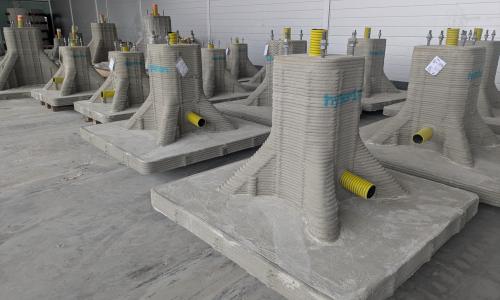
These three bullet points act as sub-headings.
- Collaboration with Hyperion Robotics and the University of Sheffield will trial low-carbon 3D-printed concrete foundations including at National Grid’s Deeside Centre for Innovation in North Wales
- Innovation could reduce waste, carbon emissions and costs to consumers of network construction
- If rolled out across National Grid substations the technology could save up to 705 tons of concrete and 323 tons of CO2 and deliver £1.7 million in consumer savings versus traditional methods over a 10-year period
These two paragraphs give more details.
National Grid is working with Hyperion Robotics and the University of Sheffield on a UK-first trial to manufacture, install and test 3D-printed substation foundations, which have the potential to reduce construction-driven carbon emissions and reduce costs to consumers of network construction. This is part of National Grid’s commitment to leverage innovation to future-proof the network.
If the project is successful and the technology is rolled out across all National Grid substations, it is estimated it could save up to 705 tons of concrete and 323 tons of CO2 over a 10-year period, and deliver £1.7 million in consumer savings versus traditional methods.
The foundation design will deliver significant savings across the entire value chain.
- 70% reduction in concrete usage
- 80% less soil displacement
- 65% decrease in embodied carbon emissions
- 70% weight reduction compared to typical foundations
- 50% reduction in site operative hours, streamlining production
The foundations will be designed and produced in Finland by Hyperion Robotics, and tested at full-scale by the University of Sheffield. Further field testing will then be carried out at National Grid’s state-of-the-art testing facility, the Deeside Centre for Innovation in North Wales, later in 2025.
Conclusion
I like this technology and I suspect there are many other applications of 3D Concrete Printing.
Project To Demonstrate 15+ MW Turbine On Ocergy’s Floating Platform Kicks Off
The title of this post, is the same as that of this article on offshoreWIND.biz.
This is the sub-heading.
The Reduced Commercial Risks with Demo of 15+ MW (RECORD15) joint industry project, which aims to install a latest generation turbine with a rated power over 15 MW on Ocergy’s floating platform in 2028, has been launched
The visualisation of the 15 MW turbine on its float in the article is impressive.
These two paragraphs add more details.
The Front-End Engineering Design (FEED) contract for this pilot project was recently signed between Ocergy and three offshore wind developers: EnBW Energie Baden-Württemberg AG, Kyuden Mirai Energy, and TEPCO Renewable Power.
Ocergy’s platform, the turbine agnostic OCG-Wind, is a modular design supporting an optimised assembly process from pre-fabricated steel sub-assemblies, allowing serial production using today’s existing supply chain and infrastructure, said the company.
Note.
- The average size of onshore wind turbine in the UK is 1.6 MW.
- Whitelee wind farm in Scotland, which is the largest onshore wind farm in the UK, uses 215 x 2.5 MW turbines.
- The Dogger Bank wind farm used 13 and 14 MW turbines on fixed foundations.
A 15+ MW turbine on a floating foundation will surely give Ocergy’s technology a very good test.
But it will be needed.
This is the overview of the Bowdun wind farm in Scotland, taken from the project’s web site.
The Bowdun Offshore Wind Farm will be located in the E3 leasing zone, which lies 44km off the coast of Aberdeenshire.
The zone, awarded to TWP under the ScotWind leasing round in January 2022, covers an area of 187km.
With water depths below 70m, it is highly suitable for fixed-foundation turbines, which will most likely sit on jacket foundations.
TWP plans to develop a 1GW offshore wind farm at the site. The base case is that the farm will number between 40-60 turbines, using ‘next-generation’ models with a capacity
between 18 MW and 25 MW. Construction is anticipated to commence in 2029 with commissioning planned for 2032-2033.This project base case will evolve as we gain knowledge from our site investigations and conduct technology research.
If turbines between 18 MW and 25 MW are to be used on fixed foundations, I can see a need to develop floats that will handle them.
Equinor, EDF-ESB Joint Venture Secure 1.5 GW Sites In UK Floating Wind Leasing Round
The title of this post, is the same as that of this article on offshoreWIND.biz.
This is the sub-heading.
The Crown Estate has selected Equinor and Gwynt Glas, a joint venture between EDF Renewables UK and ESB, as preferred bidders in the seabed leasing round for floating wind projects in the Celtic Sea.
These two paragraphs give more details.
Selected on 12 June, each of the two developers was awarded 1.5 GW of capacity in their respective project development area (PDA) for an annual option fee of GBP 350/MW (approximately EUR 410/MW).
The Crown Estate launched the floating wind leasing round (Offshore Wind Leasing Round 5) in February 2024, offering three areas off the coasts of Wales and South West England for a total of up to 4.5 GW of installed capacity.
Note.
- It looks like the Crown Estate are working to get a contract for the third site.
- The ports of Bristol and Port Talbot could be handling the assembly of the floating turbines.
- The Crown Estate has also established a new strategic approach with the National Energy System Operator (NESO).
Given the problems some wind and solar farms have had to get connected, the Crown Estate’s link up with NESO could be attractive to developers?
Conclusion
This looks a good bit of business by the Crown Estate in the Celtic Sea.
Did they get NESO to be helpful, by asking senior people for tea with Charles and Camilla at Highgrove?
E.ON Invests £4 million In Allume Energy To Boost Solar Rollout For Flats
The title of this post, is the same as that of this article on Solar Power Portal.
These three paragraphs explain the deal and say a small amount about Alume’s SolShare system.
Energy supplier E.ON UK has today (17 June) announced that it has signed a strategic investment agreement with Australian firm Allume Energy to help the firm expand into the UK.
E.ON UK has invested £4 million into Allume Energy to enable Allume to expand the reach of its SolShare technology within the UK market. SolShare allows solar energy from a single rooftop solar PV installation to be fairly shared amongst multiple homes in the same building in order to allow residents of flats to access solar PV energy.
Residents are supplied their energy when they are using by a pre-determined allocation, allowing them to lower their energy bills. Many blocks of flats that do have solar panels fitted currently only use this energy to power the common areas of the building while residents still pay their full electricity bill. According to Allume, a shared rooftop solar PV system can reduce resident energy bills by between 30% and 60%.
I must say, that when I read this article, it had something of the too-good-to-be-true about it.
But.
- My solar installation on a fair-sized roof cost me about £6,000 and I am constantly surprised at how much electricity it provides.
- If you have fifty flats, they all won’t do their weekly washing at the same time each week.
- I wouldn’t be surprised to see a big battery somewhere or a small battery in each flat.
- The batteries could soak up any excess electricity or charge on cheap-rate overnight electricity.
- Do Allume’s engineers go through every flat and make suggestions about saving energy?
- Is the pattern of electricity usage in a block of flats predictable from past usage and factors like weather, the time of the year and what’s on television?
- I wouldn’t be surprised that Allume have performed extensive mathematical modelling on blocks of flats.
I think this deal could be a winner foe E.ON, Allume and their customers.
I have some ideas about the use of the system.
Would It Work On A Small Housing Estate?
A small housing estate would be a number of solar roofs feeding a number of houses, whereas with flats it will be one roof feeding a number of dwellings.
I suspect that with a well-designed sharing and pooling system, a lot of features of the flat-powering system could be used to power houses.
How Does The System Handle Electric Vehicles?
The system could use these to store electricity, so that they are always charged at the cheapest rate.
And when there is a shortage of electricity, the electricity could be borrowed by the Allume system.
Conclusion
If you have community sharing their own source of electricity, you can probably make ideas work, that wouldn’t in a single application.
My nose says Allume’s idea has legs.
Newport To Swindon Via Gloucester – 14th June 2025
Because of engineering works, we came home from Newport via a diversion through Gloucester.
I took these pictures.
















































Note.
- I had sat on the right side of the train facing forward.
- We were accompanied my the thud, thud, thud of an underfloor diesel engine, as most of the route is not electrified.
- Newport and Gloucester is 44.8 miles.
- Gloucester and Swindon is 36.7 miles.
- Newport and Swindon is 81.5 miles.
- Newport and Swindon are fully-electrified stations.
- The first four pictures show Trains for Wales Premier Service.
- The Gloucester and Newport Line joins the South Wales Main Line at Severn Tunnel Junction station.
- As you travel towards Gloucester, the bridges over the Severn and the Wye can be clearly seen.
- There are two former nuclear power stations ;Berkeley and Oldbury, on the far bank of the River Severn.
- The large white wind turbine is close to Berkeley.
- Oldbury is further down the river.
As yesterday, the route is commonly used as a diversion route, when engineering works close the electrified main line through the Severn Tunnel.
I have some further thoughts.
Electrification Of Newport And Swindon
The distances involved are as follows.
- Newport and Gloucester is 44.8 miles.
- Gloucester and Swindon is 36.7 miles.
- Newport and Swindon is 81.5 miles.
As Hitachi’s Intercity Battery Trains are likely to have a range of around a hundred miles, they should be able to handle the diversion.
A short length of electrification could be erected in Gloucester station to charge any battery-electric trains, that needed a boost.
I believe full electrification is not needed.
Flotation, Vargronn Complete NorthConnect Deal
The title of this post, is the same as that of this article on Renews.biz.
This is the sub-heading.
1.4GW Cenos floater backers seal ‘productive partnership’ with interconnector acquisition
These three paragraphs add more details to the deal.
Flotation Energy and Vargronn have closed their acquisition of the NorthConnect interconnector project between Scotland and Norway.
The developers said the deal had followed close collaboration on shared transmission infrastructure and a common grid connection point for the interconnector and the proposed 1.4GW Cenos floating wind farm off east Scotland.
NorthConnect already has consent for an offshore and onshore cable route to a substation near Boddam, Aberdeenshire, that will link to SSEN’s Peterhead substation.
This looks like a clever use of the permissions for the interconnector to connect the Cenos wind farm to the grid.
Underground Hydrogen Storage Pilot Gets Funding Boost
The title of this post is the same as that of this article on Energy Live News.
This is the sub-heading.
New hydrogen storage tech could boost grid resilience and emissions cuts
These first three paragraphs add some details.
National Gas and Gravitricity have secured £500,000 from Ofgem to develop a new type of underground hydrogen storage.
The H2FlexiStore system, designed by Edinburgh-based energy storage firm Gravitricity, aims to store up to 100 tonnes of green hydrogen in lined geological shafts.
The technology, which could see a demonstrator built in 2026, is intended to offer a flexible, resilient solution to future hydrogen network needs.
The article also has an excellent graphic.
Note that it takes 55.2 MWh of electricity to generate a tonne of hydrogen, so a hundred tonnes of hydrogen would store 5.52 GWh of electricity as hydrogen.
 The Anonymous Widower