Climate Change: Y Bryn Wind Farm Aids Net Zero Aim – Developer
The title of this post, is the same as that of this article on the BBC.
This is the sub-heading.
A new onshore wind farm could help Wales move towards its net zero target by 2050, say developers.
These two paragraphs outline the scheme.
But some local people called the Y Bryn plan between Port Talbot and Maesteg a “blight on the landscape”.
The plan, first proposed in 2021, now includes 18 turbines up to 250m (820ft), rather than the original 26.
I feel that we need to develop renewable energy all round the UK.
This project, is obviously felt by the developers to be a serious proposition, judging by the very professional web site.
Some places like the Midlands and the South of England are a long way from large offshore wind and nuclear developments, but Port Talbot and Maesteg may be close enough to planned offshore wind farms, that this wind farm may need not to be developed.
I shall be following this development.
UK Offshore Wind Pipeline Now At 98 GW, Second Only To China – Report
The title of this post, is the same as that of this article on offshoreWIND.biz.
This is the sub-heading.
The UK’s pipeline of offshore wind projects has reached 97,944 MW, up from 91,287 MW a year ago, while the global pipeline topped 1.23 TWh, an increase of nearly 400 GW in the last year, according to RenewableUK’s latest EnergyPulse market intelligence data report.
These are the first two paragraphs.
The pipeline includes projects at every stage of development, including operational, under construction, consented, or planned.
The UK total pipeline was second globally at 98 GW, second only to China with 157 GW, followed by the USA in third place with 82 GW, Sweden is fourth with 75 MW, and Brazil fifth with 63 GW.
These is also a pie-chart saying in which part of the UK, wind energy is being developed.
- North Sea (Scotland) – 41,977 MW
- North Sea (England) – 33,845 MW
- Irish Sea – 8,659 MW
- North Atlantic Ocean – 7,435 MW
- Celtic Sea – 4,428 MW
- English Channel – 1,600 MW
As Cilla would say. “What a lorra, lorra lot of wind!”
Shine On – Centrica Opens Its First UK Solar Farm
The title of this post is the same as that of this press release from Centrica.
These are the bullet points.
- 18MW Codford Solar Farm in Wiltshire is Centrica’s first major solar asset
- Part of plans to build a material portfolio of low carbon assets
- Vodafone supports development with long term Power Purchase Agreement for 50% of the output over 10 years
- Additional renewable power supports the UK government’s ‘green grid’ ambitions
I have some thoughts.
Centrica’s First Major Solar Asset
These two paragraphs from the press release outline the project and indicate where it fits in Centrica’s overall philosophy.
Construction began at the site in Wiltshire in April 2022, after the consent was acquired by Centrica Business Solutions in 2021. Made up of 33,000 panels, the project has a total capacity of 18MW and should produce 19GWh of green electricity every year, enough to power some 4,850 homes.
The deal not only brings additional renewable power provision to the UK grid but supports the UK government’s ambition to focus on home-grown renewable energy to boost long-term energy independence and security.
My only reservation is at 18 MW it isn’t that large and the sun doesn’t always shine in the UK.
Centrica’s Portfolio Of Low Carbon Assets
This paragraph from the press release talks about the portfolio.
In late 2021, Centrica announced ambitions to deliver 900MW of low carbon assets by 2026. The company is currently building battery storage projects at former gas peaking plants at Brigg, Lincolnshire, Knapton, North Yorkshire, and Ostend in Belgium, and has developed a multi GW pipeline of projects.
Note that former gas power plants, usually have a very handy connection to the electricity grid.
900 MW would also rate at around the output of two typical gas-fired power stations.
Vodafone’s Power Purchase Agreement
Big companies like Vodafone seem to be increasingly signing Power Purchase Agreements for their renewable electricity. These must give advantages all round.
- The developer can take the purchaser’s deal to a bank and use it to raise capital for the project.
- The purchaser, in this case Vodafone can say that they use at least some zero-carbon electricity, which must help marketing.
- The bank knows that so long as the sun shines, there will be money flowing to the developer.
- The developer doesn’t have to deal with thousands of customers.
These three paragraphs from the press release outline Vodafone’s deal.
Vodafone will purchase half of the electricity output from the solar farm, helping to support its development and bringing additional renewable power provision to the UK Grid. Combined with agreements already in place, around 47% of the company’s annual energy requirement will come from UK-based renewable power sources by 2025.
The long-term Power Purchase Agreement (PPA) will see approximately 9GWh of green electricity dedicated to Vodafone UK. The remainder will be sold into the national grid through Centrica’s Energy Marketing & Trading business.
The deal is the third PPA signed by Vodafone and Centrica Energy Marketing & Trading over the last year. In May 2022, Vodafone and Centrica announced a long-term PPA with MYTILINEOS S.A for the output from three solar farms in the UK. And, in February 2023, Vodafone committed to take a significant proportion of the output from a further five solar farms in one of the largest corporate solar PPAs to date.
It looks like, when Vodafone’s other solar farms are connected, they will be able to advertise as a zero-carbon company running on renewable electricity.
That sort of green advertising hasn’t hurt Lumo’s trains between London and Edinburgh.
Connecting Codford Solar Farm To The National Grid
This Google Map shows the location of the Codford Solar Farm.
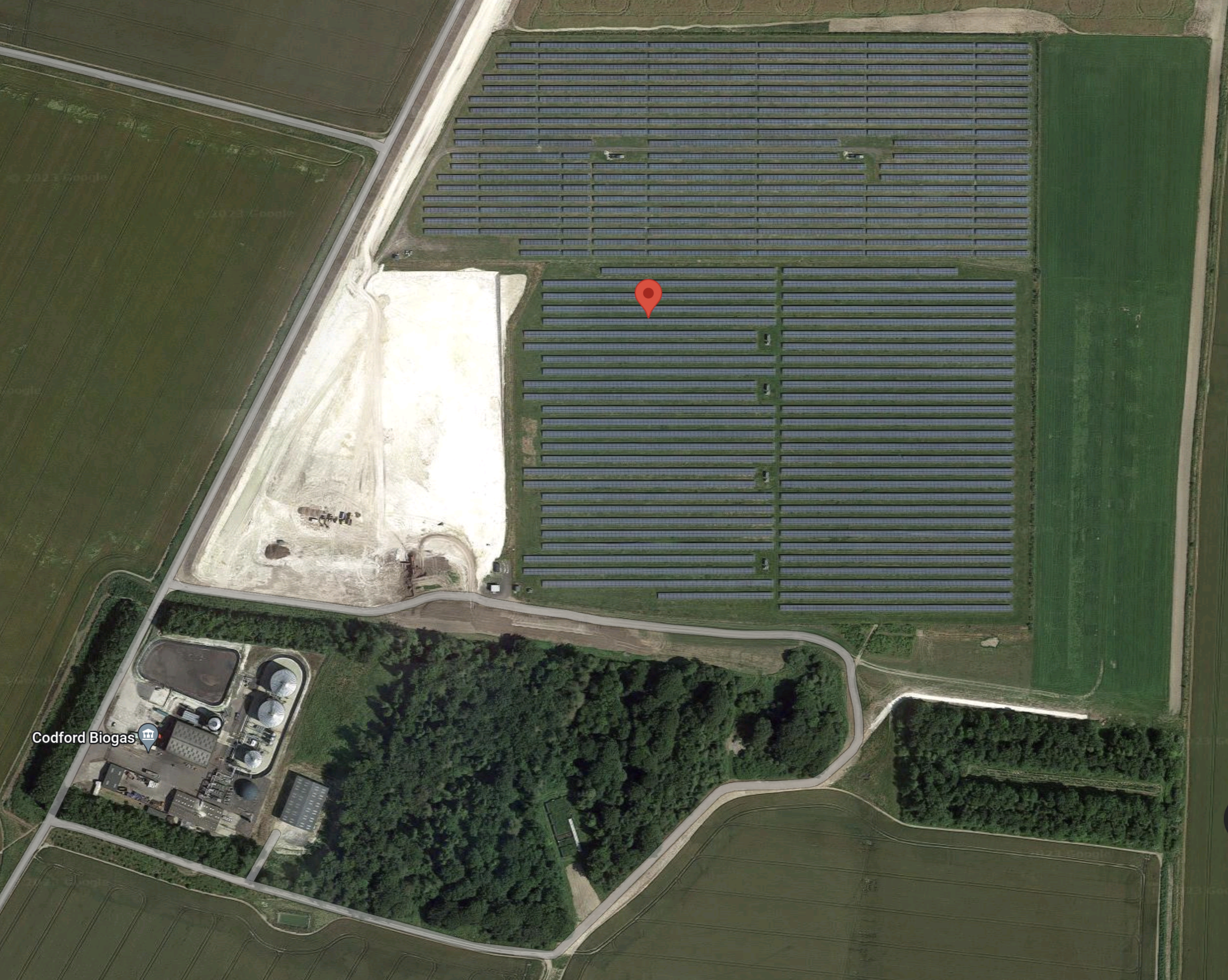
Note.
- The solar panels marked with the red arrow.
- Codford Biogas in the South-West corner of the map.
- The site is surrounded with the fields of a large arable farm, that grows wheat, barley and oilseed rape.
- The site is also shielded by trees.
This second Google Map shows Codford Biogas.
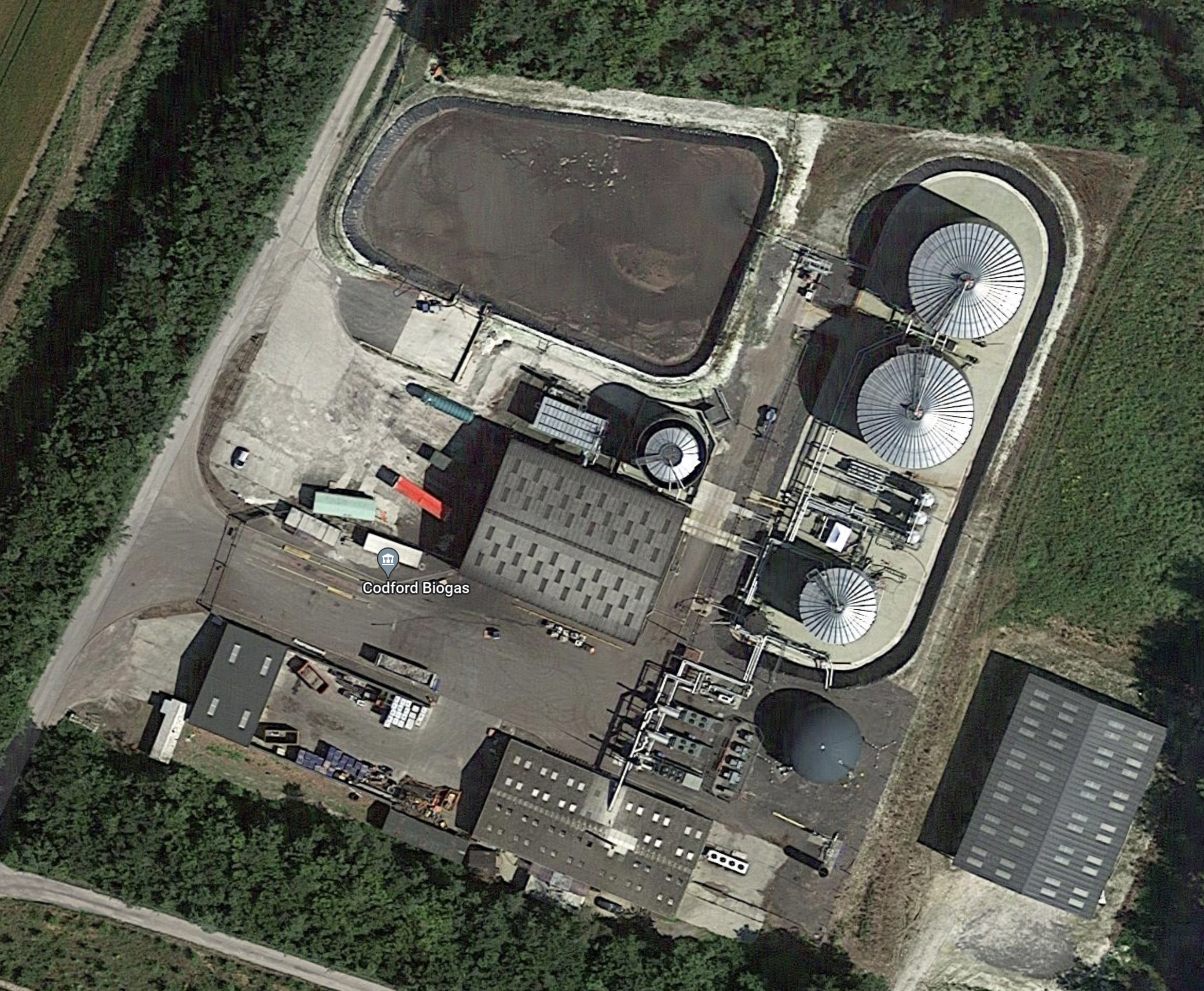
According to their web site, Codford Biogas accept the widest range of food waste in southern England.
The home page describes waste collection, secure disposal and carbon reduction.
Their method of disposal uses anaerobic digestion, which is a complex biological process involving the breakdown of organic matter in the absence of air in large, sealed and insulated vessels with controlled heating and mixing.
The Wikipedia entry for anaerobic digestion describes the process in detail.
On their web site, there is a page, which is entitled What Is AD?, which has an interactive graphic describing the process at Codford.
Main products from the site include.
- 3.6 MW of electricity, which can be fed to the grid.
- Fertiliser, which can be spread directly on the surrounding arable land.
- Waste heat, which will be developed for businesses that need it.
Obviously, the electricity export will need a grid connection, which I suspect will also be used by the new solar farm.
Conclusion
It looks like Centrica have piggy-backed their solar farm on to an existing grid connection.
But it does look like connecting your solar farm to the grid through a power station that can operate continuously, helps to give a more continuous output.
I think we’ll see more of this!
Run Larger, Multi-Site Offshore Wind Tenders, French Energy Commission Recommends To Gov’t
The title of this post, is the same as that of this article on offshoreWIND.biz.
This is the sub-heading.
The French Energy Regulatory Commission (CRE) has recommended that the government conducts larger offshore wind tenders, inviting bids for several sites. This is according to the latest update from CRE, which has now published specifications for the country’s AO5 tender for a floating wind farm in southern Brittany.
Looking at the building of large numbers of wind turbines and their fixed or floating foundations, I am drawn to the conclusion, that it might be better if all were as identical as possible.
I should also note, that we were very successful selling Artemis project management systems in France. Our manager in the country, said it was because all the country’s top managers had been to the same schools and universities and passed the best solutions around themselves.
So perhaps a standard solution appeals to the French psyche?
In the UK, BP are currently designing and planning these fixed foundation wind farms.
- Mona – 1500 MW – 35 m. depth – 30 km. offshore
- Morgan – 1500 MW – 35 m. depth – 30 km. offshore
- Morven – 2907 MW – 65-75 m. depth – 60 km. offshore
Given that Mona and Morgan are in the Irish Sea and Morven is North-East of Aberdeen, I wouldn’t be surprised to find that BP treat these three projects as two separate 3 GW projects, which could share the same turbine design and fixed foundation designs, that were very similar.
I’m sure BP would save money, if they used a similar design philosophy on all three projects.
Stackable Floating Wind Platform Gets DNV Approval
The title of this post, is the same as that of this article on offshoreWIND.biz.
This is the sub-heading.
DNV has awarded Bassoe Technology an Approval in Principle (AiP) for a 17 MW D-Floater floating wind foundation, designed to withstand extreme 50-year typhoon conditions in the South China Sea.
I wrote about this technology in An Elegant Solution.
This visualisation shows five D-floaters being transported on a ship.
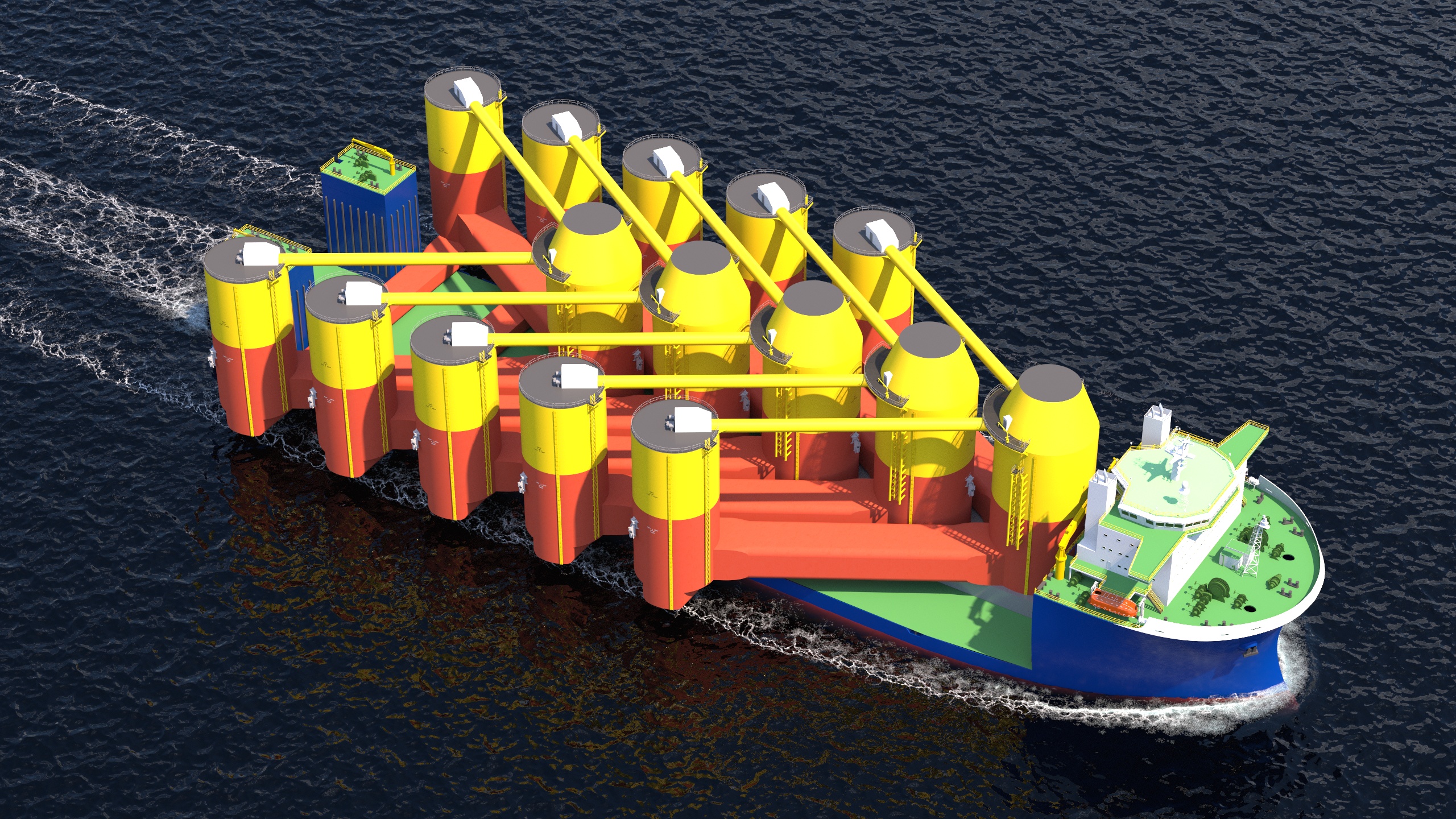
DNV Approval makes it more likely that the design will be deployed in the near future.
Ofgem’s New Net-Zero Mandate To Speed Up ‘Glacial Pace’ Of Realising Grid Connections
The title of this post, is the same as that of this article on offshoreWIND.biz.
This is the sub-heading.
The UK government will amend the Energy Security Bill to include a statutory net-zero duty for Ofgem, which the British energy regulator will be required to apply and document in decision-making. According to RenewableUK, this will speed up the realisation of grid connections and help unlock at least GBP 15 billion of investment in offshore wind alone by the end of the decade.
I feel, that this must be a good thing.
Did I See The UK’s Hydrogen-Powered Future In Hull Today?
I went from London to Hull today on Hull Trains for £50.80 return (with my Senior Railcard) to see SSE’s presentation for their Aldbrough Pathfinder Hydrogen project, which will feature a 35 MW green hydrogen electrolyser and 320 GWh of hydrogen storage in the thick layers of salt under East Yorkshire.
- Green electricity would come mainly from the part-SSE owned 8 GW Dogger Bank wind farm complex.
- According to their web site, Meld Energy are planning a 100 MW electrolyser, which would produce 13,400 tonnes of hydrogen per year.
Every large helps!
- It should be noted that the thick layers of salt stretch all the way to Germany, and as drilling and storage technology improves, the amount of hydrogen storage available will increase.
- I was also impressed by the ambition, competence and enthusiasm, of the SSE engineers that I met.
- As has been pointed out, HiiROC, who have backing from Centrica, Hyundai, Kia and others, are also in Hull!
I believe, that I saw our hydrogen-powered future in Hull today!
We need more hydrogen mega-projects like these! Perhaps in Aberdeen, Clydeside, Freeport East, Isle of Grain, Merseyside, Milford Haven and Teesside?
DOE Announces 7 Awards To Cut Heliostat Costs
The title of this post, is the same as that of this article on Solar Paces.
I haven’t talked about heliostats much before and can only find these two posts; one about Australia and one about Spainspain
- ‘Unique’ Solar-Storage Solution Providers Plot 300MW / 3.6GWh Australia Project
- Spanish Govt Approves Energy Storage Strategy, Sees 20 GW In 2030
I feel it is good that the Americans are backing this technology.
These are a summary of the projects.
- SunRing: Advanced Manufacturing and Field Deployment: This project by Solar Dynamics LLC and partners will develop processes to maximize cost-competitiveness, performance, and reliability of Solar Dynamics’ existing SunRing heliostat design.
- HELIOCOMM: A Resilient Wireless Heliostats Communication System: This components-and-controls project by the University of New Mexico will model a resilient wireless communication system based on the principles of integrated access and backhaul (IAB) technology, entropy-based routing, dynamic spectrum management, and interference mitigation.
- An Educational Program on Concentrating Solar Power and Heliostats for Power Generation and Industrial Process: This project by Northeastern University will develop an educational program focused on concentrating solar power (CSP) and heliostats for power generation and industrial processes.
- Demonstration of a Heliostat Solar Field Wireless Control System: Solar Dynamics LLC, with partners Remcom and Vanteon Corporation, will carry out a project aimed at demonstrating the reliable operation of a wireless heliostat solar field control system using commercially available products and developing analytical tools to de-risk the large-scale deployment of the wireless technology to solar fields with tens of thousands of heliostats.
- Twisting Heliostats With Closed-Loop Tracking: This project will design, manufacture, and test a new type of heliostat and study its application for high-concentration CSP.
- Digital Twin and Industry 4.0 in Support of Heliostat Technology Advancement: The Tietronix project aims to leverage technologies from the Fourth Industrial Revolution (Industry 4.0) to enhance the CSP industry and achieve the cost reduction experienced by other industries that have already adopted such advancements.
- Robotic-Assisted Facet Installation (RA-FI): Sarcos Technology and Robotics Corp., in collaboration with Heliogen, will investigate the feasibility of a novel mobile robotic system capable of supporting the installation of mirror facets onto a heliostat.
Governments and institutions and individuals with money should support this sort of research and development.
Denmark And Germany Sign Bornholm Energy Island Agreement, First Legally Binding Cooperation On Joint Offshore Renewable Energy Project In EU
The title of this post, is the same as that of this article on offshoreWIND.biz.
This is the sub-heading.
German Federal Minister for Economic Affairs and Climate Action, Robert Habeck, and Danish Minister for Climate, Energy and Utilities, Lars Aagaard, have signed an agreement for the Bornholm Energy Island in the Baltic Sea. This is the first legally binding cooperation agreement in Europe on a joint offshore energy project under the EU Renewable Energy Directive.
Bornholm is a Danish island between Denmark, Germany and Sweden, as this map shows.

Note.
- Malmo is in Sweden.
- Copenhagen is in Denmark.
- Germany is in the South-West corner of the map.
Bornholm is the island in the North-East corner of the map.
This paragraph gives the bare details of the generation and transmission capacities.
Bornholm Energy Island, located in the Danish sector of the Baltic Sea, will facilitate connecting at least 3 GW of offshore wind generation capacity to the grid by the early 2030s. The electricity will then be transported via new grid connections to Germany (2 GW ) and to the Danish mainland (1.2 GW).
The great advantage of an energy island, is that the electricity can be sent both ways according to where it is needed.
Some of the energy islands that have been proposed also include energy storage and/or hydrogen production.
This web site gives more details of the Bornholm Energy Island.
Under a heading of Why Build Energy Islands?, these reasons are given.
- Environment and climate
- Energy security in Europe
- Inspiration for the world
Under a heading of What is an Energy Island?, this is said.
An energy island makes it possible to establish large wind farms at sea far from the coast. The energy produced by the wind turbines is sent via cables to the energy island, from where it is sent out to consumers. On Bornholm, a high-voltage facility must therefore be established on the island which can receive and distribute the electricity. After that, green power can be sent from Bornholm to millions of consumers in Denmark and Germany. Bornholm’s Regional Municipality is working hard to seize the energy island’s potential for job creation and local business growth, and in turning Bornholm into the green business beacon and transport hub for green fuels in the Baltic Sea.
I suppose it could be argued that in the UK, Orkney and Shetland are already energy islands and will become more so in years to come.
Energy islands, whether real or man paid certainly seems to be a concept that is growing in populatity, with several being developed.
Close-Up: New Scour Protection Solution That Has Potential To Cut Costs By 70 Pct Inspired By Turtles
The title of this post, is the same as that of this article on offshoreWIND.biz.
This is the sub-heading.
At the beginning of May, Balmoral presented a scour protection solution that could replace rock dumping and is set to potentially cut costs by up to 70 per cent when compared to this conventional method. In an interview with offshoreWIND.biz, the company revealed that the initial concept behind its new HexDefence system was aimed at a solution for the oil and gas industry but was further developed with the offshore wind industry in mind and that its design was inspired by – turtles.
These first two paragraphs outline HexDefence.
As reported last month, the Scotland-based engineering company introduced HexDefence saying the solution could drastically reduce scour phenomena around fixed offshore wind turbines that cause seabed erosion and a reduction in foundation strength and stiffness.
The structure provides a non-invasive approach to protecting the monopile and the immediate surrounding area and eliminates the need for rock installation which can cost up to 70 per cent more when compared to this new solution, according to Balmoral.
HexDefence has its own section of the Balmoral web site.
In my long career, I have dealt with a lot of fluid flow and I like what Balmoral are doing.
 The Anonymous Widower