Airbus To Trial In-flight Auxiliary Power Entirely Generated By Hydrogen
The title of this post, is the same as that of this press release from Airbus.
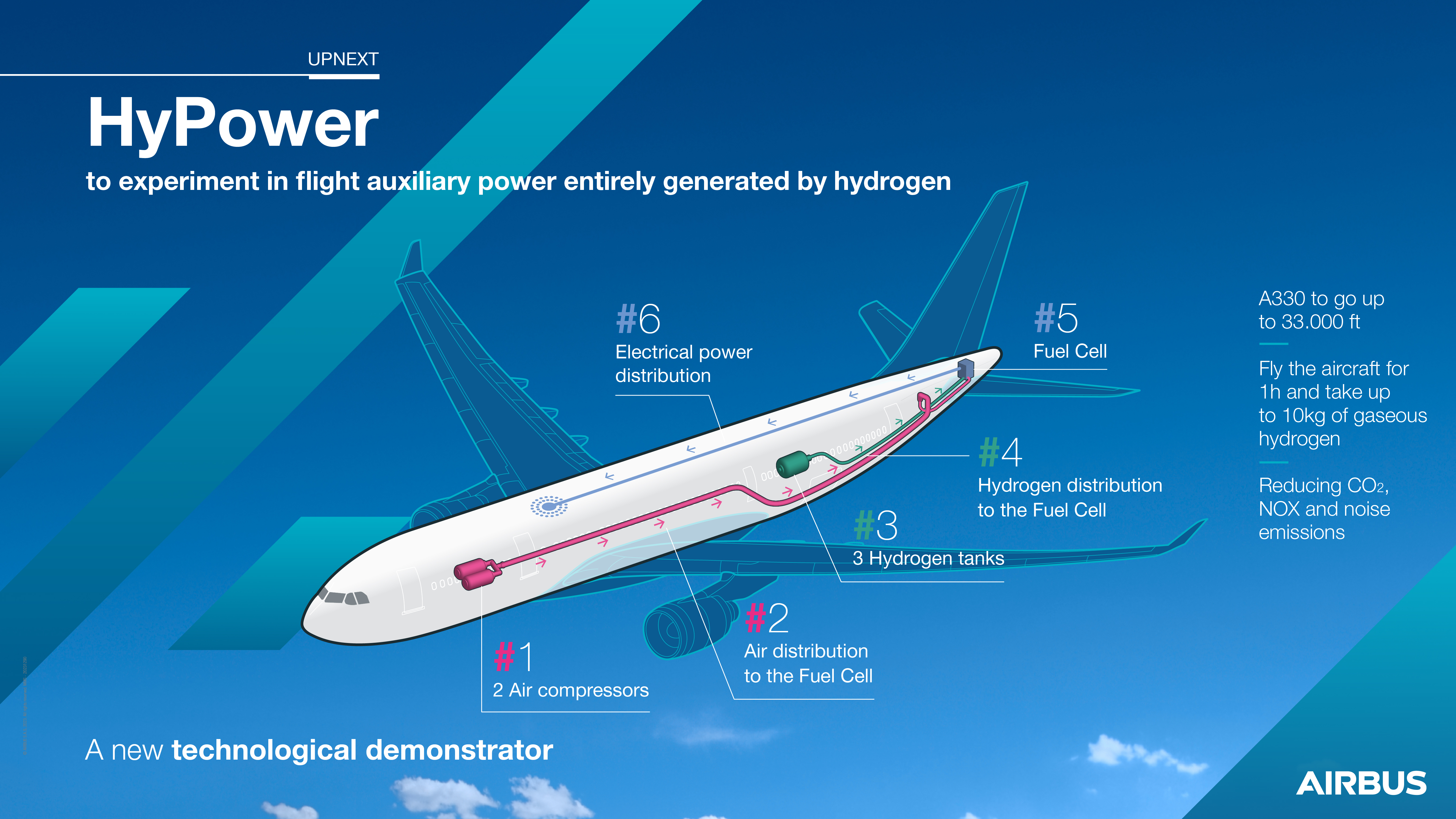
Airbus UpNext has launched a new demonstrator programme to explore, on the ground and in flight, a new architecture for the generation of non propulsive energy through the use of hydrogen fuel cells.
On conventional airliners, the APU (Auxiliary Power Unit), a small additional engine that runs on traditional jet fuel, provides together with the engines the energy required to power a number of non-propulsive aircraft functions, such as air conditioning, onboard lighting and electric power for avionics. With this new technology demonstrator, led from its facilities in Spain, Airbus UpNext will replace the actual APU of an A330 with a hydrogen fuel cell system that will generate electricity. Known as HyPower, the hydrogen fuel cell demonstrator also aims to reduce the emissions of CO2, nitrogen oxides (NOx) and noise levels associated with a traditional APU.
New design features and integration techniques will also contribute to maturing the safety and operations of future hydrogen-powered aircraft and will demonstrate the stable operation of a fuel cell in-flight, including its restart.
This Airbus infographic describes the system.
This looks to be a well-thought out project and I suspect Airbus will learn a lot about hydrogen and how to use it.
I have some thoughts.
The Noise Factor
Reduction of noise is mentioned in both the text and the infographic, so it must be important.
Years ago, I remember a take-off from St. Lucia, where on the previous day, there had been an engine failure on the flight from London. This meant we were treated to the view of a rare site of a five-engined Jumbo Jet, as the next day’s flight brought in a spare engine on the spare mounting under the wing. Engineers then worked all night to put this engine on the previous day’s stricken plane, whilst we had an extra night in the Carribean.
When it eventually came to leaving, we were on the absolutely crammed-full rescue plane, which was an almost new 747-300.
I remember the plane being positioned at the very Western end of the runway and we waited a long time before take-off. From our position towards the rear of the plane, I couldn’t see if they topped up the fuel tanks but they may have done. The pilot then gave us the good news, that we would be going to Heathrow without the usual intermediate stop at Barbados to take on fuel.
We had no problems, but I suspect the airport’s neighbours on the island didn’t like the screaming noise of the APU (Auxiliary Power Unit) disturbing the peace, whilst we waited for take-off.
A hydrogen fuel cell-powered APU could have advantages in some take-offs from perhaps smaller airports. The plane would be towed into position for take-off by a battery-electric aircraft tug, with all aircraft systems running on the hydrogen-powered APU. When everything was ready, the first engine would be started by the power from the APU and then after all engines were started and everything was ready, the plane would take off.
It looks to me, that a hydrogen-powered APU and a zero-carbon aircraft tug, could work together to reduce pre-take off pollution, carbon-dioxide emissions and noise at airports.
The Inflight Restart
Two air incidents, illustrate the need for an inflight restart of the APU.
The Wikipedia entry for the flight describes the crash like this.
British Airways Flight 38 was a scheduled international passenger flight from Beijing Capital International Airport in Beijing, China, to London Heathrow Airport in London, United Kingdom, an 8,100-kilometre (4,400 nmi; 5,000 mi) trip. On 17 January 2008, the Boeing 777-200ER aircraft operating the flight crashed just short of the runway while landing at Heathrow. No fatalities occurred; of the 152 people on board, 47 sustained injuries, one serious. It was the first time in the aircraft type’s history that a Boeing 777 was declared a hull loss, and subsequently written off.
Wikipedia gives this as the cause of the accident.
Ice crystals in the jet fuel were blamed as the cause of the accident, clogging the fuel/oil heat exchanger (FOHE) of each engine. This restricted fuel flow to the engines when thrust was demanded during the final approach to Heathrow.
Suppose this problem had occurred earlier and shut the engines down in the middle of Russia. At the 40,000 feet, they were flying, they could have probably been able to glide into the nearest suitable airport and land without main engine power. But the APU would have been needed to power the aircraft’s systems like instruments and air-conditioning.
One of my favourite books is All Four Engines Have Failed by Betty Toothill, who was a passenger on BA 009 on the 24th June 1982.
The Wikipedia entry of the flight starts like this.
British Airways Flight 009, sometimes referred to by its callsign Speedbird 9 or as the Jakarta incident, was a scheduled British Airways flight from London Heathrow to Auckland, with stops in Bombay, Kuala Lumpur, Perth, and Melbourne.
On 24 June 1982, the route was flown by the City of Edinburgh, a Boeing 747-200 registered as G-BDXH. The aircraft flew into a cloud of volcanic ash thrown up by the eruption of Mount Galunggung around 110 miles (180 km) south-east of Jakarta, Indonesia, resulting in the failure of all four engines. Partly because the event occurred at night, obscuring the cloud, the reason for the failure was not immediately apparent to the crew or air traffic control. The aircraft was diverted to Jakarta in the hope that enough engines could be restarted to allow it to land there. The aircraft glided out of the ash cloud, and all engines were restarted (although one failed again soon after), allowing the aircraft to land safely at the Halim Perdanakusuma Airport in Jakarta.
In this incident, the APU would have been needed to start the engines.
These incidents show how important the APU is to safe flying.
Some might even argue that a hydrogen fuel cell-powered APU running on its own independent hydrogen supply would be preferable than an APU based on a small gas turbine using the same fuel as the main engines.
Riveting Television
I’ve just watched an episode of Fred Dibnah’s Made In Britain, which was entitled Mechanics and Riveters.
It was fascinating stuff, but how do you decarbonise an industry like the making of rivets without using hydrogen?
Why Should I Pay For The ULEZ Scrappage Scheme?
The Mayor’s pet anti-pollution project the ULEZ scheme is controversial to say the least.
This article on the BBC is entitled ULEZ: Labour MPs In London Call For ULEZ Scrappage Scheme Review.
So even MPs in his own party don’t agree with the current policy!
Consider.
- I am a non-driver after a stroke ruined my eyesight.
- The only possible benefit, that I might get, is slightly less pollution around where I live.
- But the jury is out on that and the current evidence is dubious, as the Mayor has paid for it to be collected.
- In 2021, the population of London had the chance to remove Sadiq Khan, but decided to re-elect him, despite his ULEZ policy.
- So I have no sympathy for those, who have to rely on a non-compliant car or van to go about their daily business.
- They knew they had to either get a compliant vehicle, pay the £12.50 per day or move to somewhere with a friendlier transport policy.
- If the Mayor wanted to cut pollution in London, he could at least have a hydrogen policy, which allowed large trucks based in London to use this clean fuel.
We have another Mayoral election in 2024!
I shall not be voting for any candidate, who proposes to use London taxpayers’ hard-earned money for a scrappage scheme or who doesn’t have a feasible hydrogen policy.
Rolls-Royce Considering Switching From BEV To Hydrogen For Future Models
The title of this post, is the same as that of this article on INSIDEEVs.
This is the sub-heading
The luxury carmaker’s CEO rules out hydrogen combustion, but fuel cells are on the table.
This is the first paragraph.
Rolls-Royce is considering ditching all-electric powertrains in favor of fuel cell technology for its future zero-emissions models once the technology is mature enough and can be scaled to meet its demands, according to Autocar, quoting the luxury car brand’s CEO, Torsten Müller-Ötvös.
As the Rolls-Royce Spectre has a kerb weight of almost three tonnes, I suspect that the handling might make someone like Alec Issigonis, Colin Chapman or Stirling Moss have a good laugh.
But the smaller battery that the fuel cell technology would require, might give a better balance between acceleration, handling and performance.
It would be good fun to model the dynamics of such a heavy car.
I do think though that it is these dynamics, that have suggested a move to hydrogen.
Or Torsten Müller-Ötvös, may have made the statement to find out, what the sort of people, who would buy this car, might think!
Hydrogen Trains Are To Roll Between Stade And Bremervörde
The title of this post is the same as part of the title of this article on Hydrogen Central.
The original title mentions Switzerland, but Bremervörde is in Germany to the North-West of Hamburg.
This map from OpenRailwayMap shows the route.

Note.
- Stade is in the North-East corner of the map and marked with a blue arrow.
- Stade station is on the Hamburg S-Bahn and has an hourly fast train between Hamburg and Cuxhaven.
- Bremervörde is in the South-West corner of the map, where the various routes converge.
- Bremervörde station is on the Buxtehude-Cuxhaven Line which is run by the hydrogen-powered Alstom Coradia iLint trains.
- Bremervörde appears to be, where the hydrogen-powered trains are serviced and refuelled.
- Currently, there are no passenger trains between Stade and Bremervörde, except at the weekends, when a heritage service called the Moor Express runs between Bremen Hauptbahnhof and Stade via Bremervörde.
- Freight trains also operate between Stade and Bremervörde.
At first sight it looks like the Stade and Bremervörde route, could be an ideal one to run with hydrogen-powered iLint trains.
- Servicing and refuelling of the trains could be shared with the existing Buxtehude-Cuxhaven service.
- The new service would probably need a few extra identical trains.
- The track is already in use, so probably wouldn’t need too much work.
- As some of the stations are in use by the Moor Express, there may not need to be too much work to bring them up to the required standard.
This re-opening, illustrates the advantage of having a fully-certified, independently-powered train, that can be deployed on non-electrified lines.
A Cute Refuse Truck
I took these pictures on Moorgate.




Note.
- This truck was built on a DAF LF chassis.
- It normally has a Cummins B-series diesel engine.
- It looks like it was registered in late 2022.
Some DAF LF chassis have a hybrid transmission.
I have a few thoughts.
Cummins B Series Engine
The Wikipedia entry for the Cummins B Series engine starts like this.
The Cummins B Series is a family of diesel engines produced by American manufacturer Cummins. In production since 1984, the B series engine family is intended for multiple applications on and off-highway, light-duty, and medium-duty. In the automotive industry, it is best known for its use in school buses, public service buses (most commonly the Dennis Dart and the Alexander Dennis Enviro400) in the United Kingdom, and Dodge/Ram pickup trucks.
Since its introduction, three generations of the B series engine have been produced, offered in both inline-four and inline-six configurations in multiple displacements.
Note.
- It is a very versatile engine.
- When I did some data analysis work for Cummins about twenty years ago, they told me, that they are happy to create a new configuration of their engines for a new application.
- Engines for the UK are made in Darlington.
- A version of the B series engine is used in London’s New Routemaster buses.
Cummins have made a lot of these engines.
Cummins And Hydrogen
Cummins realise they have a lot to lose, as the world decarbonises and doesn’t need diesel engines anymore.
Cummins have adopted the hydrogen route to zero-carbon with a large degree of enthusiasm.
- In 2019, they took a majority stake in hydrogen company; Hydrogenics.
- In Cummins Fuel Cell Technology Powers Coradia iLint Fleet In Germany, I described how Cummins supply the fuel cells for Alstom’s hydrogen trains in Germany.
- In Electrolyser System To Linde For Green Hydrogen Production In Niagara Falls, New York, I describe how Cummins are providing a 35 MW hydrogen electrolyser .
- In Cummins Shows Hydrogen Internal Combustion-Engined Concept Truck At IAA Transportation Exhibition, I describe how Cummins have developed and released a powerful hydrogen internal combustion engine based on the B series.
I believe that in Ricardo Supports Industry Leaders To Develop Innovative Dedicated Hydrogen Engine, I talk about the most significant development involving Cummins and hydrogen.
This is how I started the post.
The title of this post, is the same as that of this press release from Ricardo.
This is the sub-heading.
Ricardo, a global strategic, environmental, and engineering consulting company, has delivered a hydrogen-fuelled research engine to global engine specialist Cummins and automotive supplier BorgWarner, as part of Project BRUNEL part funded by the Advanced Propulsion Centre (APC)
These four paragraphs outline the project.
Cummins is a global specialist in diesel and alternative fuel engines and generators, and related components and technology. BorgWarner is an automotive tier 1 supplier and specialist in the design and manufacture of systems for electrified and conventional propulsion types, that includes injection equipment for conventional and renewable fuels. BorgWarner recently announced the intention to spin off its Fuel Systems segment. The intended company name is PHINIA Inc. PHINIA is expected to be a product leader in fuel systems, starters, alternators and aftermarket distribution.
The project aims to support internal combustion engine (ICE) sub-system suppliers to increase their use of hydrogen as an alternative zero-emissions fuel solution across the light commercial vehicle market.
The engine is specifically designed to burn only hydrogen – with no supporting fuels that could give rise to any carbonaceous, or excessive air quality emissions.
Experts in hydrogen technology and integration, Ricardo has provided an engine based upon its world-renowned series of single cylinder research units, which can help the research teams evaluate a wide variety of fuels. The engine is designed to help engineers evaluate a variety of injector types and will support increased fuel efficiency, reduced air quality emissions and the move towards carbon-free heavy-duty propulsion.
Reports of the death of the internal combustion engine are greatly exaggerated.
Cummins already have larger sizes of the B series engine that will run on hydrogen, so are BorgWarner, Cummins and Ricardo going to fill the gap in the range?
Are the companies going to develop B series hydrogen engines for the DAF LF trucks, Dodge RAM pickups and the New Routemaster buses?
Polish Hydrogen Locomotive Becomes First In World To Get Approval
The title of this post is the same as that of this article on TVP World.
This is the sub-heading.
The Polish company PESA has received approval to operate its first hydrogen locomotive. As the company boasts, this is the first such approval in the world.
These three paragraphs describe the design and performance of the locomotive.
The approved locomotive is equipped with a zero-emission hydrogen drive. PESA Bydgoszcz SA has been working on such a vehicle for a few recent years.
It is powered by four engines with a power of 180 kW each. Energy for them is provided by two hydrogen cells, with a power of 85 kW, manufactured by Ballard.This is a system that generates electrical voltage through a chemical reaction between hydrogen and oxygen from the atmosphere.
The hydrogen itself is drawn from tanks with a total capacity of 175kg. One refueling is sufficient for 24 hours of continuous operation.
It sounds a very useful locomotive.
Key Mainline Testing Undertaken In Bi Modal Hydrogen Train Project
The title of this post, is the same as that of this article on Rail Technology Magazine.
This is a key paragraph.
In the test, lithium-titanate batteries and the hydrogen fuel cells have been retro-fitted to a CAF Civia Class 463 commuter electric unit train. This then has the ability to create a hybrid powertrain which can run on electrified lines alongside standard lines.
This paragraph describes some of the testing.
The new power system has been integrated into the existing vehicle’s traction system and the current tests on the mainline follow closed track testing and static testing at CAF’s plant in Zaragoza. The mainline testing has taken place across lines in Zaragoza, Madrid and Galicia but the crucial test run for the new unit was on the Zaragoza-Canfranc line where it ran in both electric mode on the electrified line before switching to hybrid mode, combining the fuel from hydrogen fuel cells and batteries where needed.
It sounds like this is a better specified hydrogen-powered train than Alstom’s iLint.
Did I See The UK’s Hydrogen-Powered Future In Hull Today?
I went from London to Hull today on Hull Trains for £50.80 return (with my Senior Railcard) to see SSE’s presentation for their Aldbrough Pathfinder Hydrogen project, which will feature a 35 MW green hydrogen electrolyser and 320 GWh of hydrogen storage in the thick layers of salt under East Yorkshire.
- Green electricity would come mainly from the part-SSE owned 8 GW Dogger Bank wind farm complex.
- According to their web site, Meld Energy are planning a 100 MW electrolyser, which would produce 13,400 tonnes of hydrogen per year.
Every large helps!
- It should be noted that the thick layers of salt stretch all the way to Germany, and as drilling and storage technology improves, the amount of hydrogen storage available will increase.
- I was also impressed by the ambition, competence and enthusiasm, of the SSE engineers that I met.
- As has been pointed out, HiiROC, who have backing from Centrica, Hyundai, Kia and others, are also in Hull!
I believe, that I saw our hydrogen-powered future in Hull today!
We need more hydrogen mega-projects like these! Perhaps in Aberdeen, Clydeside, Freeport East, Isle of Grain, Merseyside, Milford Haven and Teesside?
Subsea 7 To Explore Pairing Floating Offshore Hydrogen With Floating Wind Farm Off Scotland
The title of this post, is the same as that of this article on offshoreWIND.biz.
This is the sub-heading.
Subsea 7, in collaboration with OneSea Energy, has secured GBP 150,000 (around USD 187,000) in funding from the Scottish government to investigate pairing a large-scale floating hydrogen production system with a floating wind farm offshore Scotland.
Looking at the home page of the OneSea Energy web site, these statements can be read.
- Large scale floating green hydrogen solutions
- OneSea build, lease and operate floating hydrogen production solutions.
- OneSea developed concepts to produce floating green hydrogen in shallow and deep waters.
- These concepts integrate decades of experience in designing, delivering and operating offshore energy production units worldwide.
- OneSea provides full turnkey floating hydrogen production solutions.
- The OneSea business model de-risks client’s financial exposure and offers a fixed rate solution that guarantees the delivery of the committed product output.
- The fast-track and plug-and-play nature of our design allows quick deployment of the units with minimum impact to an existing offshore energy generation project.
- OneSea appear to be a company based in the Netherlands.
Note.
- I like the build, lease and operate concept.
- Pictures indicate that their production units are based on ships.
- There appear to be three different sizes of production units.
Their production units seem to serve a similar purpose as a floating production storage and offloading (FPSO) unit does in the offshore oil and gas industry.
OneSea seems to have thought deeply about how to satisfy the offshore hydrogen production market as widely as possibly.
I could see this concept being employed in several places around the UK.
 The Anonymous Widower