Are Grand Central Going To Order Some Hitachi Intercity Battery Hybrid Trains?
I ask this question because I’ve just looked at the Hitachi infographic for the Hitachi Intercity Battery Hybrid Train, that I wrote about in Hitachi Rail And Angel Trains To Create Intercity Battery Hybrid Train On TransPennine Express
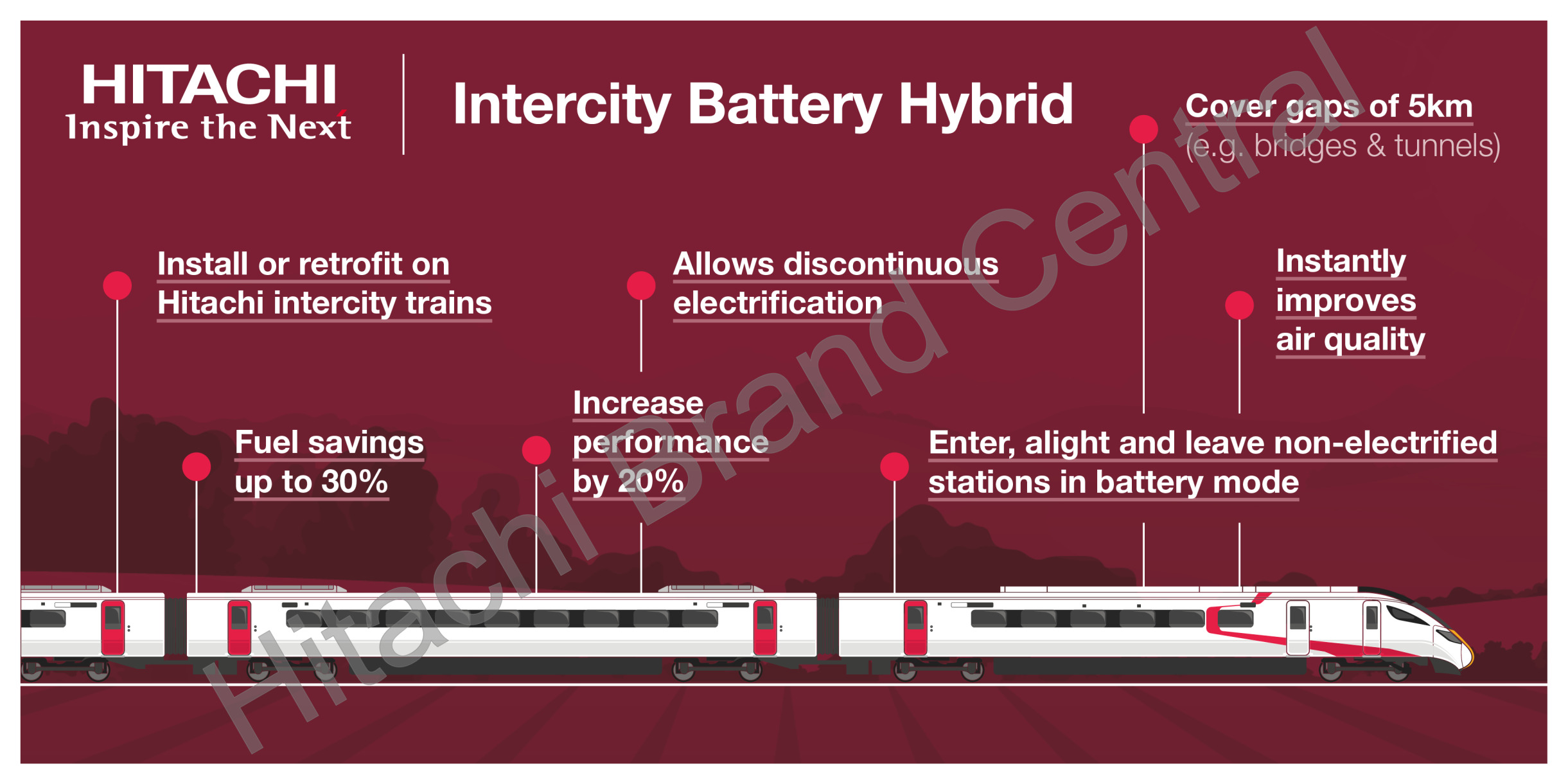
Note that in the background of the image Hitachi Grand Central can be seen.
Looking at Grand Central‘s routes I can say the following.
- The Sunderland service uses the fully-electrified East Coast Main Line to the South of Northallerton.
- The Bradford service uses the East Coast Main Line to the South of Shaftholme Junction.
- The Sunderland service runs for 47.4 miles on lines without electrification.
- The Bradford service runs for 47.8 miles on lines without electrification.
- The trains run at 125 mph on East Coast Main Line.
- Each service has around half-a-dozen stops, most of which are on lines without electrification.
Grand Central run the services using Class 180 diesel trains.
I think there are two possibilities for new trains.
Hitachi Intercity Battery Hybrid Train
This train would be similar to the Hitachi Intercity Battery Hybrid Train shown in the infographic.
- It would be designed to run efficiently on diesel.
- The train could run at 140 mph on electricity and with a signalling update.
- The claimed extra performance could speed up the services.
- Batteries would be used in stations.
There would be a worthwhile saving in fuel and less carbon emissions.
Hitachi Intercity Battery Hybrid Train With A Larger Battery
This would be similar to the standard train, but with a larger battery.
- Battery range would be sufficient to cover the lines without electrification.
- Charging would need to be installed at Bradford Interchange and Sunderland stations.
- The other two diesel engines might be replaced with batteries.
- No diesel would be used.
- The train could run at 140 mph on electricity and with a signalling update.
- The claimed extra performance could speed up the services.
- Batteries would be used in stations.
There would be no fuel costs and zero emissions.
In Grand Central Opts For Split And Join, I wrote about Grand Central’s application to run more services that had been reported in the April 2018 Edition of Modern Railways in an article that is entitled Grand Central Applies For Extra Services.
If Grand Central are still interested in expanding and splitting and joining, then the Hitachi trains, which have a proven ability in this area would fit the requirement.
In
Hitachi Rail And Angel Trains To Create Intercity Battery Hybrid Train On TransPennine Express
The title of this post, is the same as that of this Press Release from Hitachi Rail.
The press release starts with these three points.
- Hitachi Rail, Angel Trains and TransPeninne Express (TPE) agree to trial retrofitting battery on intercity train
- Trial, starting next year, can cut fuel usage by at least 20% and reduce emissions on Transpennine network from 2022 onwards
- Tri-mode service can cut noise pollution in urban areas and improve air quality.
Hitachi also point to this infographic.
This very much looks to be a step forward from the Intercity Tri-Mode Battery Train that was announced in December 2020 in this press release from Hitachi which is entitled Hitachi And Eversholt Rail To Develop GWR Intercity Battery Hybrid Train – Offering Fuel Savings Of More Than 20%.
The Intercity Tri-Mode Battery Train is described in this Hitachi infographic.

The specifications are very similar, except for the following.
- The battery range is given as five kilometres.
- Fuel savings are up to 30% instead of at least 20%.
- A performance increase of 30 % is claimed.
- The upgrade appears to be able to be fitted to Hitachi intercity trains, as opposed to a straight replacement of one engine by batteries.
It looks to me, that Hitachi have been working hard to improve their design.
I think this paragraph of the press release is key.
The trial will see a diesel engine replaced by batteries to help power a five-carriage train, along with the two remaining engines. The power provided by the batteries will help to reduce the amount of fuel required to operate the train.
Hitachi don’t say, but I suspect the trains and their batteries have a lot of energy saving features.
- Regenerative braking is already used to power some services like lighting and air-conditioning on the trains.
- But I suspect regenerative braking will also be used to recharge the batteries.
- A sophisticated computer system will drive the train in the most optimal manner.
- Hopefully, diesel will only be used as a last resort.
Features like these and others will enable the trains to jump gaps in the electrification. As more and more tricks are added and batteries hold more charge, the gaps the trains will be able to cross will get larger.
Five kilometres might not sound much, but I think it could be surprisingly useful.
I will use an example from the Midland Main Line to illustrate how the trains and discontinuous electrification might work.
In Discontinuous Electrification Through Leicester Station, I described the problems at Leicester station and how discontinuous electrification could solve the problem.
The following is a modified extract from that post.
This Google Map shows the bridge and the Southern end of the station.
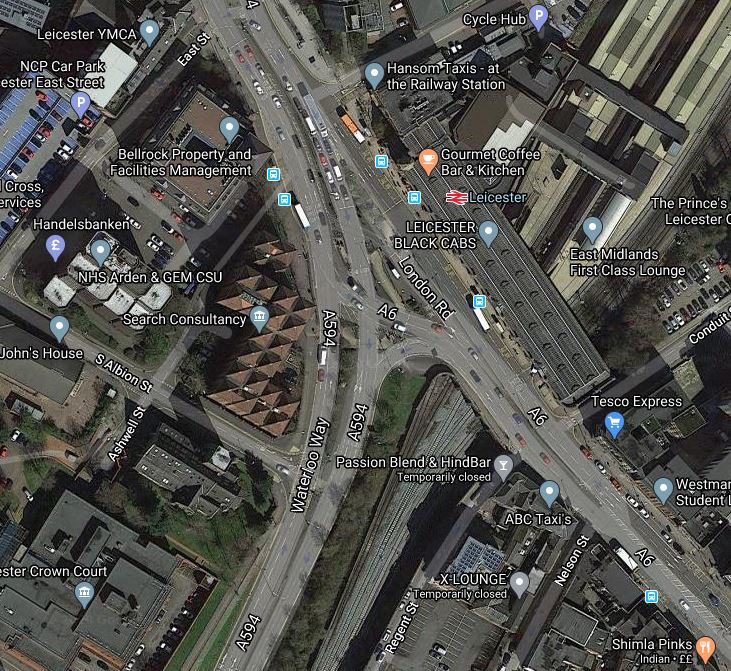
It looks to me, that Leicester station and the road, would have to be closed to traffic for some time, if the bridge were to be rebuilt, to allow the erection of electrification through the area. Leicester and all train passengers would love that!
A solution could be discontinuous electrification.
- The electrification from the South, would finish on the South side of bridge.
- The electrification from the North, would finish at a convenient point in Leicester station or just to the North.
- Electric trains would cover the gap of up to five kilometres on battery power.
Note.
Pantographs could be raised and lowered, where the wires exist.
Trains would probably use a stopping profile in Leicester station, that ensured they stopped with full batteries.
This would mean they had enough electricity to get back up to speed and reconnect to the electrification on the other side of the station.
To get an idea at how long five kilometres is in the Centre of Leicester, this Google Map shows the Leicester station.

Note that the platforms are around three hundred metres long.
In other words the electrification can be kept well away from the station and its troublesome bridge.
How much money would be saved and disruption avoided?
Application To The TransPennine Express Routes
These are the various routes, where Class 802 trains could be used.
Liverpool Lime Street And Edinburgh, Newcastle, Scarborough Or York
Sections are as follows.
- Liverpool Lime Street and Manchester Victoria – 31.7 miles – Electrified
- Manchester Victoria and Stalybridge – 8 miles – Electrified probably by 2024
- Stalybridge and Huddersfield – 18 miles – Diesel
- Huddersfield and Dewsbury – 8 miles – Electrified probably by 2024
- Dewsbury and Leeds – 9.2 miles – Diesel
- Leeds and York – 25.6 miles – Electrified probably by 2024
- York and Newcastle – 80.2 miles – Electrified
Note.
- All services take a common route between Liverpool Lime Street and York.
- A surprising amount is electrified.
- A further 42 miles are being electrified.
- The 3 km Morley Tunnel between Dewsbury and Leeds might not be electrified.
- The 5 km Standedge Tunnel between Huddersfield and Stalybridge might not be electrified.
It looks to me that the 5 km battery range will avoid electrification of two long Victorian tunnels.
Manchester Airport And Newcastle Or Redcar Central
Sections are as follows.
- Manchester Airport and Manchester Victoria – 13.2 miles – Electrified
- Manchester Victoria and Stalybridge – 8 miles – Electrified probably by 2024
- Stalybridge and Huddersfield – 18 miles – Diesel
- Huddersfield and Dewsbury – 8 miles – Electrified probably by 2024
- Dewsbury and Leeds – 9.2 miles – Diesel
- Leeds and York – 25.6 miles – Electrified probably by 2024
- York and Newcastle – 80.2 miles – Electrified
- Northallerton and Redcar Central – 29 miles – Diesel
The route goes through the Morley and Standedge tunnels.
Manchester Piccadilly And Hull
Sections are as follows.
- Manchester Piccadilly and Stalybridge – 7.5 miles – Electrified probably by 2024
- Stalybridge and Huddersfield – 18 miles – Diesel
- Huddersfield and Dewsbury – 8 miles – Electrified probably by 2024
- Dewsbury and Leeds – 9.2 miles – Diesel
- Leeds and Selby – 21 miles – Diesel
- Selby and Hull – 31miles – Diesel
The route goes through the Morley and Standedge tunnels.
Manchester Piccadilly And Huddersfield
The route goes through the Standedge tunnel.
Huddersfield And Leeds
The route goes through the Morley tunnel.
Manchester Airport And Cleethorpes
The Hope Valley Line which is part of this route has three tunnels.
Perhaps they will use a bit of diesel to get through Totley.
The Future
This paragraph sums up what Hitachi and Angel Trains could see as a possible future direction.
Once complete, the trial provides a pathway for Hitachi Rail, the train builder and maintainer, and Angel Trains, the train’s owner to develop plans to retrofit batteries to the wider fleet.
These plans will probably go in the directions like decarbonisation, more efficient operation and better standards for passengers.
Conclusion
This looks like a solution that has been helped by real ale in an appropriate hostelry.
- The battery range has been chosen so Network Rail don’t necessarily have to electrify the tunnels.
- Full electrification can be used either side of the tunnels.
- Will any stations not be electrified. After all if the trains are using battery power in stations do they need electrification?
- It might be useful to have some more bi-mode freight locomotives, that could traverse the tunnels on diesel or batteries.
Hitachi and Network Rail certainly seem to be cooking up a solution.
London’s Newest Property Hotspot Has Been Revealed — And It’s On The NLE Tube Line
The title of this post, is the same as that of this article on the Metro.
This doesn’t surprise me one bit.
Any new train or tram line, whether it is under or over the ground always creates a property hot spot.
That’s why London needs to develop the West London Orbital Railway, Crossrail to Ebbsfleet and New Bermondsey station as soon as possible, as the areas they serve need a lift.
On a wider view, it is also why reopening rail lines is such a good policy. Some might object to property hot-spots, but most residents of the UK, like it when property prices rise!
Carbon Emissions Cut With The New Trains In East Anglia
The title of this post, is the same as that of this article on Rail Advent.
The article explains the various ways Greater Anglia’s new trains cut carbon emissions.
The picture shows a PowerPack car of a Class 755 train.

The article indicates that these cars are more intelligent than I thought.
- Regenerative braking can be used to power the trains systems.
- The trains have a coast mode to cut emissions.
- The article also confirms, that with time some diesel engines will be replaced with batteries.
It will be interesting to see how much carbon emissions are saved, when the trains have batteries and software developments are complete.
The picture sh
Northumberland Line: Railway ‘Could Create Economic Powerhouse’
The title of this post, is the same as that of this article on the BBC.
This is the first paragraph.
An “east coast economic powerhouse” stretching from Edinburgh to Leeds could be created if the Northumberland Line rail scheme goes ahead, a public inquiry has been told.
The article also explains why a public inquiry is needed.
The article also says that about thirty objections have been raised.
Wright Electric Announces Plans For 100-Seater Electric Aircraft
The title of this post, is the same as that of this article on Electrive.
It is an article well worth a read about Wright’s plans to convert BAe 146 airliners into electric airlines.
Hydrogen-Powered Aircraft Offer Fresh Perspective For Sustainable Travel
The title of this post, is the same as that of this article on The Engineer.
The article puts forward the view of Jenny Kavanagh, Chief Strategy Officer, Cranfield Aerospace Solutions.
They are developing Project Fresson, which appears to have switched from electric to hydrogen propulsion. In the article Jenny Kavanagh says it is showing more promise and in the Wikipedia entry for Project Fresson, there is a section on hydrogen power, which details the switch.
As the article in The Engineer and the Wikipedia entry for Project Fresson seem to agree, I would assume that that the Wikipedia entry is being updated.
Public Inquiry Into Northumberland Line Due To Open This Week
The title of this post, is the same as that of this article on the News Post Leader.
It is also a good summary of where the various councils are with the reopening of the Northumberland Line.
The article says that work should start next summer and trains will run in 2024.
London Gets A New Bus Route
During the Bank Station Upgrade in the New Year, London will gain a new bus route.
It is described like this on New Civil Engineer.
A temporary new bus route, the 733 from Oval into the City (Finsbury Square), will also be introduced on weekdays. It will run every 7-8 minutes to help affected customers reach their destinations.
I use the to-be-closed section of the Northern Line regularly and not just on weekdays.
Yet again, the good citizens of East London have been ignored or short-changed by transport planners in City Hall.
We have endured no Waterloo and City Line for months. Although, that does seem to be opening, as I wrote in Waterloo & City line To Operate All Day By The End Of November.
Shocks Away! RAF To Fly Electric Planes
The title of this post is the same as that of this article on The Times.
The RAF is evaluating the Slovenian-built Pipistrel Velis Electro for use as a training aircraft. I learned to fly in a Cessna 150 and the Pipistrel Velis Electro seems to be a modern reincanation of that and similar classic designs.
- It seats two normal people side-by-side.
- It has a high wing.
- It has a fixed tricycle undercarriage.
- It is built from composites, whereas the Cessna was aluminium.
- It seems to have been carefully designed.
- It has full certification.
I would love to have a flight in one.
As the Danish Air Force are already using the aircraft for pilot training, I suspect that it might suit the RAF.
But then there are quite a lot of battery-electric under development and there may be a better one.
But there is no denying that the Pipistrel Velis Electro is a good aircraft to start the procurement process.
 The Anonymous Widower