Finsbury Square Car Park Becomes British Land Hub For Delivery Drivers
The title of this post, is the same as that of this article on The Times.
It is a surprising headline or is it a logical development given some of the projects in the rail freight business.
In A Freight Shuttle For Liverpool Street Station Planned. I talked about Rail Operations Group and their plans to run a freight shuttle between London Gateway and Liverpool Street station.
- Trains will be Class 769 bi-mode trains.
- The trains will be fitted with roller doors, roller cages and strengthened floors.
- Three services will leave Thames Gateway at 0029, 1208 and 1856.
- They will return from Liverpool Street at 0242, 1421 and 2100.
- Services will use Platforms 9 and 10 in Liverpool Street station.
- Goods would be delivered to the customer by e-bikes or electric vans.
This a very detailed plan.
But would it be better, if it had a logistics hub close to or even in the station?
These pictures show the Old Cab Road at Liverpool Street station.
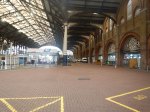


This would probably be the only area in the station, that can be used. But it is not very large. Although it does have an access road at the back of the station.
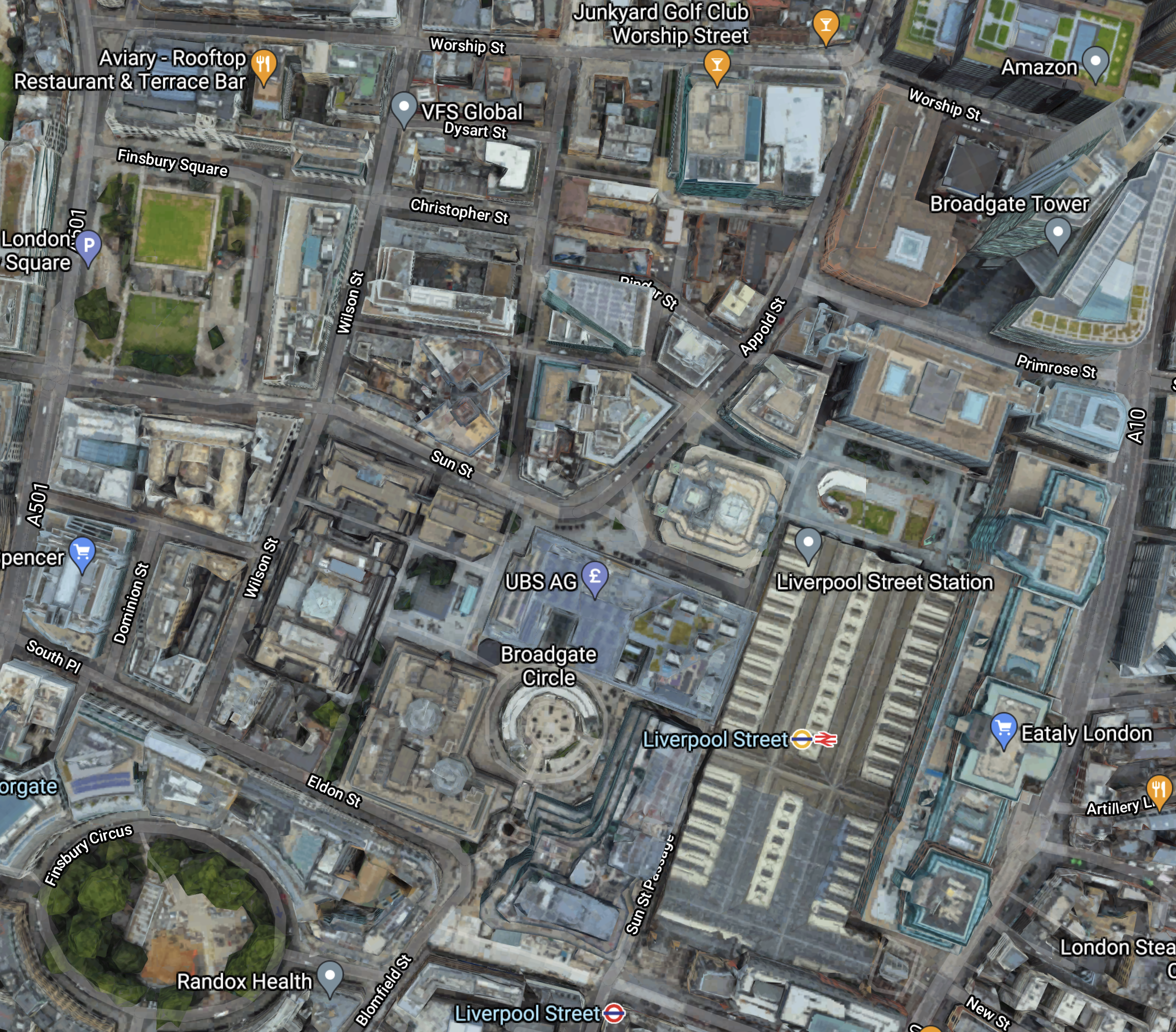
This Google Map shows the area between Finsbury Square and Liverpool Street station.
Note.
- Finsbury Square is in the North West corner of the map.
- Liverpool Street station is in the South East corner of the map.
- There is an entrance to the Old Cab Road Liverpool Street station on Primrose Street.
- Amazon UK’s corporate office is in the North East corner of the msp.
Could roller cages be rolled into electric vans and taken to Finsbury Square for sorting and onward distribution?
- The car park has a height limit of 1.98 metres.
- It has 258 parking spaces.
- Could it be expanded downwards?
- How many e-bikes would it hold?
It think that this could be the reason for the purchase.
But I would be very surprised if a siding was dug that connected to the nearby Northern City Line that runs into Moorgate station.
Alstom’s Coradia iLint Hydrogen Train Makes Its Swedish Debut
The title of this post, is the same as that of this article on Global Railway Review.
This picture shows a hydrogen-powered Alstom Coradia iLint train near Hamburg

If you’re ever in Hamburg, take a ride to Buxtehude and take a ride to Cuxhaven.
These trains are now in service in Germany and have been ordered in quantity in Germany and have been demonstrated in Austria, Italy and The Netherlands.
Dwell Time On High Speed Two Trains
This document on the Government web site is the Train Technical Specification for High Speed Two trains.
There is a Section 7.15.6, which is entitled Dwell Time
This is said.
The Unit shall deliver 95% confidence of achieving a Dwell Time of 2 minutes at intermediate stations, calculated in accordance with the Static Dwell Time Model in Appendix I using the 1SL.
The rationale is also given.
Achievement of a two-minute Dwell Time is key to achievement of HS2 railway capacity and journey times.
The Static Dwell Time Model evaluates the key architectural elements of the interior layout that impact the Passenger exchange part of Dwell Time.
Dwell time is mentioned many times in the Technical Specification.
There is a Section 9.7.3.4, which is entitled Train Captain Changeover Time
This is said.
The Unit shall facilitate a changeover of Train Captains within a two-minute Dwell Time.
In this time period there shall be time for the exiting Train Captain to:
-
- Release and opening doors.
- Log out of the Cab
- Exit the Cab and Unit.
In this time period there shall be time for the entering Train Captain to:
-
- Enter the Unit and Cab
- Log in to the Cab
- Adjust Cab setting to the Train Captain’s personal preferences
- Fulfil the Train Captain’s role in closing doors, which does not include checking the PTI.
Note how all these actions must be performed in a two-minute dwell time.
The Technical Specification is certainly very detailed.
ATO Stop and Safe Location On High Speed Two Classic-Compatible Trains
This document on the Government web site is the Train Technical Specification for High Speed Two trains.
There is a Section 8.6.2, which is entitled ATO Stop and Safe Location
This is said.
ATO Stop is an additional function compared to the ATO over ETCS SRS. The purpose of
this function is to enable the Train Captain to command the Train to stop at the next Safe
Location. A Safe Location is a pre-defined location on the HS2 Network where Trains can
wait safely, and evacuation can be carried out if necessary. If it is not necessary to make an
emergency brake application, this enables more control of where Trains make un-planned
stops.
Perhaps all vehicles on motorways need to be fitted with a similar system.
The Cross-Section Of A High Speed Two Classic-Compatible Train
This document on the Government web site is the Train Technical Specification for High Speed Two trains.
There is a Section 7.14.3, which is entitled Maximum Cross Section
This is said.
The Unit shall have a maximum cross-section of 11m².
The rationale is also given.
HS2 interface – This maximum cross-section has been used in the design of the tunnels.
HS2’s gauging analysis has shown that a Vehicle compatible with the CRN infrastructure will probably
have a cross-section closer to 10m²
A Class 800 train is 2.70 metres wide, so if a High Speed Two Classic-Compatible train is the same width, the height based on the 10m² figure will be around 3.7 metres or about the same as an Electrostar.
The next section 7.14.4 gives an interesting piece of information.
Tunnels on the HS2 Network include porous tunnel portals in the infrastructure design to mitigate the adverse effects of micro-pressure waves. Therefore it will not be necessary to include micro-pressure wave mitigation features in the Unit design.
Interesting that they are tackling what is best described as tunnel-plop in the design of the tunnels, rather than catering for it on the train. I wrote about this in HS2 Way Out In Front In Tunnel Design For High-Speed Rail.
Improving The Cross Country Route
The Cross Country Route is one of the UK’s forgotten railway lines.
- It runs between York and Bristol Temple Meads.
- Intermediate stations include Leeds, Wakefield Westgate, Rotherham Central, Meadowhall, Sheffield, Chesterfield, Derby, Burton-on-Trent, Tamworth, Birmingham New Street, University, Bromsgrove, Worcestershire Parkway, Cheltenham Spa and Bristol Parkway.
- At the Northern end trains can swap to the electrified East Coast Main Line and can extend services to Edinburgh and Aberdeen.
- At the Southern end trains can swap to the Great Western Main Line and extend services to Taunton, Exeter, Plymouth and Penzance.
- Trains can also swap to the South Wales Main Line in the Bristol area, to serve Cardiff and South Wales.
- Operating speeds are generally around 100 mph, but there are sections of 125 mph running.
- Some sections of the route have 25 KVAC overhead electrification.
I very much believe that it is a route that is ripe for improvement.
These are my thoughts.
Extra And Rebuilt Stations
Recently, Worcestershire Parkway station has been opened on the route.
Bromsgrove station was rebuilt and reopened in 2016.
Derby station was remodelled in 2018.
In addition, there are aspirations for other mew stations and station improvements on the route.
- University station is being rebuilt for the 2022 Commonwealth Games.
- Sheffield Region are proposing a station at Barnsley Dearne Valley. I wrote about this in Sheffield Region Transport Plan 2019 – A New Station At Barnsley Dearne Valley.
- Sheffield Region may be creating a new station in Rotherham.
I can see more station improvements and additions on the Cross Country Route.
New Trains
Most services are run by CrossCountry, who only use diesel trains.
Their core services are as follows.
Plymouth And Edinburgh uses the route between York and Bristol Temple Meads. The service runs under wires North of Leeds and at Bristol Parkway and at Birmingham New Street.
Southampton Central And Newcastle uses the route between York and Birmingham New Street. The service runs under wires North of Leeds and at Reading and at Birmingham New Street.
Bournemouth and Manchester Piccadilly uses the route at Birmingham New Street. The service runs under wires North of Birmingham New Street.
Bristol Temple Meads and Manchester Piccadilly uses the route between Bristol Temple Meads and Birmingham New Street. The service runs under wires at Bristol Parkway and North of Birmingham New Street.
Cardiff Central and Nottingham uses the route between Gloucester and Derby. The service runs under the wires West of Bristol Parkway and at Birmingham New Street.
Birmingham New Street and Nottingham uses the route between Birmingham New Street and Derby. The service runs under the wires at Birmingham New Street.
Birmingham New Street and Stansted Airport does not use the route. The service runs under the wires at Birmingham New Street and around Cambridge and Peterborough.
Birmingham New Street and Leicester does not use the route. The service runs under the wires at Birmingham New Street.
Note.
- Several services run under wires for sufficient time to charge a battery-electric train.
- Several services turn in stations for sufficient time to charge a battery-electric train.
- At least six or possibly seven of the services run for at least fifty miles on tracks that can handle 125 mph running. Some of this track will be upgraded to 140 mph with digital signalling.
This Hitachi infographic shows the Hitachi Intercity Tri-Mode Battery Train.

I believe that Hitachi could produce a version of this train, that would partially meet CrossCountry’s need for a new fleet to reduce their carbon footprint.
For the purpose of this analysis, I will assume this about the trains.
- Battery power will always be used in stations.
- The trains have a battery range of around forty miles at 100 mph.
- Running at 125 mph will need 25 KVAC overhead electrification.
This table shows the current electrification status of the Cross Country Route.
- York and South Kirby junction- 45.4 miles – Electrified
- South Kirby junction and Birmingham New Street – 96.6 miles – Not Electrified
- Birmingham New Street and Bromsgrove – 16 miles – Electrified
- Bromsgrove and Bristol Parkway – 69.8 miles – Not Electrified
- Bristol Parkway and Bristol Temple Meads – 4.8 miles- Not Electrified
The trains would appear to still need to use diesel on some parts of the route.
Or Hitachi ABB Power Grids could install short lengths of 25 KVAC overhead electrification to top up the trains’ batteries in appropriate places.
I believe CrossCountry could decarbonise this route using battery-electric trains and discontinuous electrification.
This would surely refresh the line and attract passengers, but would the trains speed up the service?
- Birmingham New Street and Leeds is 116.4 miles and currently takes just under two hours at an average speed of 59.3 mph in a Class 221 train.
- Several sections of line between Birmingham New Street and Leeds can sustain 125 mph running.
- London Liverpool Street and Norwich is 114.5 miles and has regularly been achieved by British Rail-era electric trains in ninety minutes on a 100 mph line, which is an average speed of 76 mph.
- Averaging 76 mph between Birmingham New Street and Leeds would give a time of 92 minutes.
For these and other reasons, I am fairly sure that a battery-electric train capable of running at 125 mph with fast acceleration could run between Birmingham New Street and Leeds in under ninety minutes, with the addition of some discontinuous electrification.
- There is currently one tph between Birmingham New Street and Leeds, which also serves Sheffield.
- There is also one tph between Birmingham New Street and Sheffield by a different route.
- There is two tph between Birmingham New Street and Nottingham.
- My calculations indicate that the Nottingham and Sheffield services would take under an hour to and from Birmingham New Street, with the Leeds service taking thirty minutes longer.
In normal circumstances no diesel would be used.
Track Improvements And Discontinuous Electrification
This table shows the current electrification status of the Cross Country Route.
- York and South Kirby junction- 45.4 miles – Electrified
- South Kirby junction and Birmingham New Street – 96.6 miles – Not Electrified
- Birmingham New Street and Bromsgrove – 16 miles – Electrified
- Bromsgrove and Bristol Parkway – 69.8 miles – Not Electrified
- Bristol Parkway and Bristol Temple Meads – 4.8 miles – Not Electrified
Solutions will have to be found to decarbonise a lot of the route.
I have flown my virtual helicopter from Tamworth to Sheffield and this part of the route seems to the sort of route that could be upgraded to a full 125 mph line, as it is fairly straight and some sections already allow trains to travel at this speed.
As the 15.5 miles between Clay Cross North Junction and Sheffield will be updated and electrified for High Speed Two’s spur into Sheffield sometime in the future, I would feel that as updating this section benefits High Speed Two, the Midland Main Line, the Cross Country Route and the Hope Valley Line, that this section should be rebuilt as necessary and electrified, as soon as is practically possible.
I believe that Clay Cross North Junction and Sheffield is one of the most important routes in the country to be electrified, if not the most important.
This table shows the electrification status of the Cross Country Route after electrification of Clay Cross North Junction and Sheffield.
- York and South Kirby junction- 45.4 miles – Electrified
- South Kirby junction and Sheffield – 18.8 miles – Not Electrified
- Sheffield and Clay Cross North junction – 15.5 miles – Electrified
- Clay Cross North junction and Birmingham New Street – 62.1 miles – Not Electrified
- Birmingham New Street and Bromsgrove – 16 miles – Electrified
- Bromsgrove and Bristol Parkway – 69.8 miles – Not Electrified
- Bristol Parkway and Bristol Temple Meads – 4.8 miles – Not Electrified
It looks that by electrifying the 15.5 miles between Sheffield and Clay Cross North junction, the gap of 18.8 miles between South Kirby junction and Sheffield could be easily bridged by a battery-electric train.
The section between Clay Cross North junction and Birmingham New Street can be split into three.
- Clay Cross North junction and Derby – 20.9 miles
- Derby and Tamworth – 23.9 miles
- Tamworth and Birmingham New Street – 17.3 miles
If Hitachi ABB Power Grids installed discontinuous electrification at Derby and Tamworth, this should bridge the gap to the electrification at Birmingham.
As some of this section can sustain 125 mph running, it may be better to fully electrify part of the route.
This table shows the electrification status of the route would become
- York and South Kirby junction- 45.4 miles – Electrified
- South Kirby junction and Sheffield – 18.8 miles – Not Electrified
- Sheffield and Clay Cross North junction – 15.5 miles – Electrified
- Clay Cross North junction and Derby – 20.9 miles – Not Electrified
- Derby and Tamworth – 23.9 miles – Not Electrified
- Tamworth and Birmingham New Street – 17.3 miles – Not Electrified
- Birmingham New Street and Bromsgrove – 16 miles – Electrified
- Bromsgrove and Bristol Parkway – 69.8 miles – Not Electrified
- Bristol Parkway and Bristol Temple Meads – 4.8 miles – Not Electrified
I have also flown my virtual helicopter from Bromsgrove to Westerleigh junction, where the Cross Country Route joins the electrified Great Western Main Line, about 4.5 miles East of Bristol Parkway station.
It looks to me that this Southern short section of electrified line would be able to charge a battery-electric train so that it could reach Bristol Temple Meads station.
But the sixty-plus miles of route without electrification between Bromsgrove and Westerleigh junction would be too far to travel without some electrification.
This could either be full electrification or discontinuous using the methods proposed by Hitachi ABB Power Grids.
It certainly looks to me, that Hitachi’s technology or similar, that I talked about in Solving The Electrification Conundrum could be used to run battery-electric trains between York and Bristol Temple Meads on the Cross Country Route.
Digital Signalling
I would assume this will be installed on the route, to give more precise control of trains on the more complicated sections of the route.
East Coast Main Line Improvements
There are several improvements to the North of York, that will reduce journey times on all services using the East Coast Main Line.
These could contribute time saving of up to ten minutes, according to High Speed Two’s Journey Planner and current timetables.
Comparison With The Proposed Eastern Leg Of High Speed Two
With all the talk about possible cancellation of the Eastern Leg of High Speed Two could an improved Cross Country Route be used in the interim?
I will look at a few timings from Birmingham.
Birmingham And Leeds
A fully-developed High Speed Two is claiming forty-nine minutes, as against the one hour and fifty-eight minutes today.
I have stated that ninety minutes is an attainable time on a 116.4 mile journey, where a good proportion of 125 mph running will be possible, sustained by electrification.
But with full electrification, more 125 mph running and even some 140 mph running under the control of digital signalling, I suspect that ninety minutes is only an upper limit to the journey time between Birmingham and Leeds.
High Speed Two are saying they will run two tph between Birmingham and Leeds, which is twice the current frequency.
I could see that an improved frequency on the Cross Country Route could be very convenient, if it increased the frequency between the two cities to four tph.
Is it going to annoy passengers, that services will leave from two different stations in Birmingham and if you go to the wrong one, you’ll have to wait thirty minutes for the next train?
Birmingham And Middlesbrough
Times between Birmingham and Middlesbrough will be determined by adding a Leeds and Middlesbrough time to the Birmingham and Leeds times.
The best time between Leeds and Middlesbrough today is one hour and 23 minutes, which I suspect will lose a few minutes due to East Coast Main Line improvements North of York.
This gives using High Speed Two to Leeds a time of two hours and eight minutes, as against two hours and forty-nine minutes using an improved Cross Country Route.
Birmingham And Newcastle
A fully-developed High Speed Two is claiming one hour and fifty-seven minutes, as against the three hours and twenty-six minutes today.
Based on the current and possible times between Birmingham at Leeds using CrossCountry, I feel times to stations North of Leeds will be reduced by at least twenty-eight minutes, putting the Birmingham and Newcastle time a few minutes under three hours.
Birmingham And Nottingham
A fully-developed High Speed Two is claiming twenty minutes to East Midlands Hub, which when adding in the tram to Nottingham City Centre will be thirty-five minutes..
,Current services are one hour and ten minutes today.
On an improved Cross Country Route, with with battery-electric trains and some 125 mph running, I can see this time shrink to under an hour, even with the reverse at Derby.
Midlands Connect are also proposing a high speed service between Birmingham Curzon Street and Nottingham station, which will take thirty-three minutes.
High Speed Two are saying they will run three tph between Birmingham and East Midlands Hub, which compares with two tph using the Cross Country Route.
Birmingham And Sheffield
A fully-developed High Speed Two is claiming fifty-seven minutes, as against the one hour and fifteen minutes today.
I have stated that an hour is an attainable time on this route, with battery-electric trains and some 125 mph running.
A time of an hour would be very competitive with the Eastern Leg of High Speed Two.
High Speed Two are saying they will run two tph between Birmingham and Sheffield with a change at East Midlands Hub, which compares with two tph using the Cross Country Route.
Conclusion
A fully developed East Coast Main Line will give High Speed Two a good run for its money on services between London and Yorkshire, North East England and Scotland. I indicated my thoughts and conclusions in What Is Possible On The East Coast Main Line?.
I also believe that an improved Cross Country Route could give the Eastern Leg of High Speed Two a very good run for its money.
Perhaps, we should safeguard the route of Eastern Leg of High Speed Two for building later to increase capacity when it is needed, but in the interim we should upgrade the following routes.
- Cross Country Route
- East Coast Main Line
- Midland Main Line
- Northern Powerhouse Rail
- West Coast Main Line
These routes should have at least these minimum standards.
- All passenger trains electric or battery-electric.
- All freight locomotives electric, battery-electric or hydrogen-electric.
- Where possible all lines should allow 125 mph running.
- Universal in-cab digital signalling
- There should be sections of 140 mph running, where possible.
We will need the Eastern Leg of High Speed Two in the future, but we don’t need it in the next few years.
Thoughts On The Eastern Leg Of High Speed Two
These are a few thoughts on the Eastern Leg of High Speed Two.
Serving The North-East Quarter Of England From London
In Anxiety Over HS2 Eastern Leg Future, I gave a table of timings from London to towns and cities in the North-East quarter of England from Lincoln and Nottingham Northwards.
I’ll repeat it here.
- Bradford – Will not be served by High Speed Two – One hour and fifty-four minutes
- Cleethorpes – Will not be served by High Speed Two – Two hours and fifty-one minutes
- Darlington – One hour and forty-nine minutes – One hour and forty-nine minutes
- Doncaster – Will not be served by High Speed Two – One hour
- Edinburgh – Three hours and forty minutes via Western Leg – Three hours and thirty minutes.
- Grimsby – Will not be served by High Speed Two – Two hours and thirty-six minutes
- Harrogate – Will not be served by High Speed Two – One hour and fifty-two minutes
- Huddersfield – Will not served by High Speed Two – Two hours and eight minutes
- Hull – Will not be served by High Speed Two – One hour and fifty minutes
- Leeds – One hour and twenty-one minutes – One hour and thirty minutes
- Lincoln – Will not be served by High Speed Two – One hour and fifty-one minutes
- Middlesbrough – Will not be served by High Speed Two – Two hours and twenty minutes
- Newcastle – Two hours and seventeen minutes – Two hours and sixteen minutes
- Nottingham – One hour and seven minutes – One hour and fifty minutes
- Scarborough – Will not be served by High Speed Two – Two hours and fifty-seven minutes
- Sheffield – One hour and twenty-seven minutes – One hour and twenty-seven minutes
- Skipton – Will not be served by High Speed Two – Two hours and seven minutes
- Sunderland – Will not be served by High Speed Two – Two hours and thirty minutes
- York – One hour and twenty-four minutes – One hour and twenty-four minutes
Note.
- I have included all destinations served by Grand Central, Hull Trains and LNER.
- I have included Nottingham and Sheffield for completeness and in case whilst electrification is installed on the Midland Main Line, LNER run services to the two cities.
- I suspect LNER services to Bradford, Harrogate, Huddersfield and Skipton will split and join at Leeds.
There are a total of nineteen destination in this table.
- Twelve are not served by High Speed Two.
- Six are not more than fifteen minutes slower by the East Coast Main Line.
Only Nottingham is substantially quicker by High Speed Two.
Serving The North-East Quarter Of England From Birmingham
Fenland Scouser felt the above table might be interesting to and from Birmingham with or without the Eastern Leg of High Speed Two.
I think, I can give more information than that and it should be possible to give for each destination the following.
- Whether of not the route exists on High Speed Two.
- Time on High Speed Two from Birmingham.
- Time on High Speed Two and Northern Powerhouse Rail from Birmingham via Manchester
- Time by current trains from Birmingham
In the following table, the fields are in the order of the previous table.
- Bradford – No direct route – No time – One hour and three minutes – Two hours and twenty-seven minutes
- Cleethorpes – No direct route – No time – Three hours and eight minutes – Three hours and eighteen minutes
- Darlington – Route Exists – One hour and twenty-three minutes – One hour and forty minutes – Two hours and fifty-five minutes
- Doncaster – No direct route – No time – One hour and thirty-six minutes – Two hours and nineteen minutes
- Edinburgh- Route Exists – Three hours and fourteen minutes – Four hours – Four hours and thirteen minutes
- Grimsby – No direct route – No time – Two hours and fifty-three minutes – Three hours and three minutes
- Harrogate – No direct route – No time – One hour and twenty-eight minutes – Three hours
- Huddersfield – No direct route – No time – Fifty-six minutes – Two hours and eleven minutes
- Hull – No direct route – No time – One hour and forty-four minutes – Three hours and two minutes
- Leeds – Route Exists – Forty-nine minutes – One hour and six minutes – One hour and fifty-nine minutes
- Lincoln – No direct route – No time – Two hours and fifty-three minutes – Two hours and thirteen minutes
- Middlesbrough – No direct route – No time – Two hours and twenty-nine minutes – Three hours and thirty-two minutes
- Newcastle – No direct route – No time – Two hours and four minutes – Three hours and twenty-six minutes
- Nottingham – Route Exists – Fifty-seven minutes – Two hours and fifty-five minutes – One hour and ten minutes
- Sheffield – Route Exists – Thirty-five minutes – One hour and thirty-four minutes – One hour and fifteen minutes
- Skipton – No direct route – No time – One hour and forty-three minutes – Two hours and fifty-two minutes
- Sunderland – No direct route – No time – Two hours and fifty-nine minutes – Three hours and fifty-eight minutes
- York – Route Exists – Fifty-seven minutes – One hour and twenty-eight minutes – Two hours and twenty-seven minutes
Note.
- No time means just that!
- One of the crucial times is that Birmingham Curzon Street and Leeds is just an hour and six minutes via High Speed Two and Northern Powerhouse Rail. This time gives good times to all destinations served from Leeds.
- Nottingham and Sheffield are both around an hour and fifteen minutes from Birmingham New Street, by the current trains.
I’ll now look at some routes in detail.
Birmingham And Leeds
The time of one hour and six minutes is derived from the following.
- Birmingham Curzon Street and Manchester Piccadilly by High Speed Two – Forty-one minutes
- Manchester Piccadilly and Leeds by Northern Powerhouse Rail – Twenty-five minutes
It would be seventeen minutes slower than the direct time of forty-nine minutes.
But it is quicker than the current time of one hour and fifty-nine minutes
Note.
- As Manchester Piccadilly will have a time to and from London of one hour and eleven minutes, Leeds will have a time of one hour and twenty-six minutes to London via Northern Powerhouse Rail and Manchester.
- If the Eastern Leg is built, The London and Leeds time will be one hour and twenty-one minutes.
- The Eastern Leg would therefore save just five minutes.
The Northern Powerhouse route could probably mean that Huddersfield, Bradford and Hull would be served by High Speed Two from London.
Manchester Airport, Manchester Piccadilly and Leeds would be connected by a tunnel deep under the Pennines.
- Manchester Piccadilly, Huddersfield and Bradford could be underground platforms added to existing stations.
- Piccadilly and Leeds would have a journey time of under 25 minutes and six trains per hour (tph).
- The tunnel would also carry freight.
- It would be modelled on the Gotthard Base Tunnel in Switzerland.
I wrote full details in Will HS2 And Northern Powerhouse Rail Go For The Big Bore?
Birmingham And Nottingham
The time of two hours and fifty-five minutes is derived from the following.
- Birmingham Curzon Street and Manchester Piccadilly by High Speed Two – Forty-one minutes
- Manchester Piccadilly and Leeds by Northern Powerhouse Rail – Twenty-five minutes
- Leeds and Nottingham – One hour and forty-nine minutes
It would be one hour and fifty-eight minutes slower than the direct time of fifty-nine minutes.
The current time of one hour and ten minutes is much quicker.
Birmingham And Sheffield
The time of two hours and thirty-four minutes is derived from the following.
- Birmingham Curzon Street and Manchester Piccadilly by High Speed Two – Forty-one minutes
- Manchester Piccadilly and Leeds by Northern Powerhouse Rail – Twenty-five minutes
- Leeds and Sheffield – One hour and twenty-eight minutes
It would be one hour and fifty-nine minutes slower than the direct time of thirty-five minutes.
The current time of one hour and fifteen minutes is much quicker.
Conclusions On The Timings
I am led to the following conclusions on the timings.
The building of the Eastern Leg of High Speed Two gives the fastest times between Birmingham and Leeds, Nottingham and Sheffield.
But if the Eastern Leg of High Speed Two is not built, then the following is true, if Northern Powerhouse Rail is created between Manchester and Leeds.
The time of an hour and six minutes between Birmingham Curzon Street and Leeds is probably an acceptable time.
This time probably enables acceptable times between Birmingham Curzon Street and destinations North of Leeds.
But with Nottingham and Sheffield the current CrossCountry service is faster than the route via Manchester.
The speed of the CrossCountry services surprised me, but then there is a section of 125 mph running between Derby and Birmingham, which is used by CrossCountry services between Birmingham New Street and Leeds, Nottingham and Sheffield.
This table gives details of these services.
- Birmingham New Street and Leeds – 116,4 miles – One hour and 58 minutes – 59.3 mph
- Birmingham New Street and Nottingham – 57.2 miles – One hour and 14 minutes – 46.4 mph
- Birmingham New Street and Sheffield – 77.6 miles – One hour and 18 minutes – 59.7 mph
Note.
- The Leeds and Sheffield services are run by 125 mph Class 220 trains.
- The Notting service is run by 100 mph Class 170 trains.
- All trains are diesel-powered.
As there is 125 mph running between Derby and Birmingham, the train performance probably accounts for the slower average speed of the Nottingham service.
CrossCountry And Decarbonisation
Consider.
- CrossCountry has an all-diesel fleet.
- All train companies in the UK are planning on decarbonising.
- Some of CrossCountry’s routes are partially electrified and have sections where 125 mph running is possible.
The only standard train that is built in the UK that would fit CrossCountry’s requirements, would appear to be one of Hitachi’s 125 mph trains like a bi-mode Class 802 train.
- These trains are available in various lengths
- Hitachi will be testing battery packs in the trains in the next year, with the aim of entering service in 2023.
- Hitachi have formed a company with ABB, which is called Hitachi ABB Power Grids to develop and install discontinuous electrification.
When CrossCountry do replace their fleet and run 125 mph trains on these services several stations will be connected to Birmingham for High Speed Two.
The route between Leeds and Birmingham via Sheffield is part of the Cross Country Route, for which electrification appears to have planned in the 1960s according to a section in Wikipedia called Abortive British Rail Proposals For Complete Electrification,
I suspect that the following times could be achieved with a frequency of two tph
- Birmingham New Street and Leeds – 90 minutes
- Birmingham New Street and Nottingham – 60 minutes
- Birmingham New Street and Sheffield – 60 minutes
It is not the Eastern Leg of High Speed Two, but it could do in the interim.
Electrification Of The Midland Main Line
I don’t believe that the Midland Main Line needs full electrification to speed up services to Derby, Nottingham and Sheffield, but I believe that by fitting batteries to Hitachi’s Class 810 trains, that will soon be running on the line and using the Hitachi ABB Power Grids system of discontinuous electrification, that the route can be decarbonised.
I would also apply full digital in-cab signalling to the Midland Main Line.
Conclusion
We will need the Eastern Leg of High Speed Two at some time in the future, but if we do the following we can do more than cope.
- Create Northern Powerhouse Rail between Manchester and Leeds, so that High Speed Two can serve Leeds and Hull via Manchester.
- Decarbonise CrossCountry with some 125 mph battery-electric trains.
- Electrify the Midland Main Line.
I would also deliver as much as possible before Phase 1 and 2a of High Speed Two opens.
Installation Of OLE Begins In The Valleys
The title of this post, is the same as that of a short article in the September 2021 Edition of Modern Railways.
This is the first paragraph.
Construction of Core Valley Lines (CVL) overhead electrification equipment commenced on 26 July, when the first piles for masts were installed on the Aberdare branch.
The article appears has several small stories buried in the text.
Was This Good Project Management?
This is a paragraph.
The work, between Penrhiwceiber and Mountain Ash took place a year later than Transport for Wales had aimed for prior to the Covid-19 pandemic. However, TfW does not expect significant delays to completion, because the CVL transformation has been rescheduled and revised.
It certainly sounds like it to me that good Project Management has brought the electrification back on track.
I have seen this happen many times over past decades.
Yesterday, at Whitechapel station, I asked one of Crossrail’s Senior Managers, who in the past had used Artemis, if good project management was bringing Crossrail under control. He gave a knowing smile and said that there’s still a lot to do with the trains and gave me the official First Half Of Next Year answer.
But I do wonder, if we’ll get a surprise!
Battery Power To The Rescue
This is a paragraph.
Less overhead line electrification will be needed than was expected when the plans were announced in 2018. Improvements in battery technology enable the battery/electric dock to run further without OLE than had been assumed.
There must be an optimal point, where the extra expense of battery/electric trains are paid for by the savings and disruption of not installing overhead line equipment.
Using The Pandemic To Advantage
This is a paragraph.
TfW also accelerated preparatory works between Radyr and Pontypridd with a three-week blockade last winter taking advantage of low passenger numbers during the second Covid-19 lockdown.
It sounds like another case of good Project Management.
Dealing With A Level Crossing
This is a paragraph.
A crossing on the Rhondda Line will be permanently closed as a result of TfW purchasing the only building accessed by it! Deputy Climate Change Minister Lee Waters said it was more cost-effective for TfW to acquire the former army barracks at Pentre than spend an estimated £450,000 to bring the nearby crossing up to the requisite safety standards.
This Google Map shows the site.

It strikes me, that Transport for Wales will have to be very innovative to find a sensible use for a site hemmed in by the railway on one side and the River Rhondda on the other.
Conclusion
As we do more electrification in the UK, hopefully we’ll get better at it.
Could Services To The North On High Speed Two Reverse At Birmingham Curzon Street?
When I first went to Nice by TGV, which I wrote about in Cambridge to Nice by Train, the train reversed in Marseille. They still do!
So would it be possible to run services between London and the North of England and Scotland via Birmingham Curzon Street?
- Birmingham Curzon Street can handle trains to and from London Euston, Leeds, Liverpool, Manchester and Scotland.
- It could offer timetabling advantages.
- It might be possible to use London Euston station more efficiently.
- There will be plenty of capacity between Birmingham Curzon Street and Manchester and Leeds, if the Eastern Leg is built.
Drivers would probably step-up to perform a fast stop at Birmingham Curzon Street.
I could envisage a service, that went between London Euston and Hull.
- It would call at Birmingham Curzon Street, Manchester, Huddersfield, Bradford and Leeds.
- There might be a stop at Crewe for interchange to other services on the West Coast Main Line.
- The train would reverse in Birmingham Curzon Street.
- The service could be an extension of the core London and Birmingham Curzon Street service.
- It could have a frequency of two trains per hour (tph)
Note.
- If Northern Powerhouse Rail were to be upgraded to handle High Speed Two’s Full-Size trains, these could be used on the route.
- The service would make better use of the underused section of High Speed Two between Birmingham and Manchester.
- This service would reduce the urgency to build the Eastern Leg of High Speed Two.
- Hull gets a High Speed Two service from London Euston and Birmingham Curzon Street.
Scottish and other services could also reverse at Birmingham Curzon Street.
How Long Would A Reverse At Birmingham Curzon Street Take?
Consider
- CrossCountry services take about ten minutes to reverse at Reading.
- Typical stops of Southeastern Highspeed services at Ebbsfleet take less than two minutes.
- Most stops with Hitachi 80x trains appear to take about a minute.
- Better operating procedures and automation could make the reverse faster.
- It looks like High Speed Two trains are designed for speedy boarding.
I suspect that the reverse can be achieved in perhaps two or three minutes.
Update – In Dwell Time On High Speed Two Trains, I found out the dwell time is two minutes.
London Euston and Manchester Piccadilly With A Reverse At Birmingham Curzon Street
If I look at London Euston and Manchester Piccadilly, I get the following times.
- London Euston and Birmingham Curzon Street – Forty-five minutes
- Reverse at Birmingham Curzon Street – two minutes,
- Birmingham Curzon Street Could See Six tph – Forty-one minutes
That would be eighty-eight minutes, which compares with seventy-one minutes by going direct.
Current proposals give the following frequencies between the three stations.
- London Euston and Birmingham Curzon Street – 3 tph
- Birmingham Curzon Street and Manchester Piccadilly – 2 tph
- London Euston and Manchester Piccadilly – 3 tph
There would be six tph running to and from London Euston.
But the pattern could be.
- London Euston and Birmingham Curzon Street – 2 tph
- London Euston and Manchester Piccadilly – 2 tph
- London Euston and Manchester Piccadilly via Birmingham Curzon Street – 2 tph
in addition one of each pair of services would call at Birmingham Interchange.
Note.
- There would still be six tph running to and from London Euston.
- Birmingham Curzon Street, Manchester Airport and Manchester Piccadilly get four tph to and from London Euston.
- Birmingham Interchange still has two tph to and from Birmingham Curzon Street.
- Birmingham Interchange now has two tph to and from Manchester.Airport and Manchester Piccadilly.
It could be a worthwhile improvement for passengers and train operators.
Reversing in Birmingham Curzon Street Could Increase Frequency To And From London Euston
I showed in the previous section, that with a reverse in Birmingham Curzon Street, it is possible to increase services between London Euston and Birmingham Curzon Street, Manchester Airport and Manchester Piccadilly from three to four tph.
Suppose, one of each of the two Liverpool and Glasgow/Edinburgh services were to reverse in Birmingham Curzon Street, this would increase the frequency of trains between London Euston and Birmingham Curzon Street to six tph or a train every ten minutes.
Now that would be a Turn-Up-And-Go service. Especially, if customer-friendly contactless ticketing were to be used.
Conclusion
Reversing services at Birmingham Curzon Street has possibilities.
ScotRail Offers 1st Class For £3 As Luxury Travel Reintroduced
The title of this post, is the same as that of this article on Rail Advent.
To encourage passengers back after the pandemic, Scotrail have introduced a three pound onboard upgrade to First Class on services on Inter7City and Class 385 train services.
This sounds like a good idea!
 The Anonymous Widower