United Airlines To Buy 100, 19-seat Electric Planes from Heart Aerospace
The title of this post, is the same as that of this article on Reuters.
This is the first paragraph.
United Airlines said on Tuesday it would buy 100 19-seat ES-19 electric planes from Swedish start-up Heart Aerospace, as the U.S. carrier eyes battery-powered aircraft for regional routes.

It looks fairly conventional, except that you don’t find many four-engined propeller driven aircraft these days.
This page on the Heart Aerospace web site, gives more details of the company and its plane.
I suggest you read the FAQ, as the last five sections give details on the use of the planes, as short-haul airliners and island hoppers.
What’s A Typical Route That The ES-19 Will Fly In 2026?
In answer to this question, the FAQ says this.
Our early adopter market will be very short flights where there is high demand. This will include island-hopping and flying over mountainous terrain, where the flight distance is significantly less than the road routes available.
I can certainly see these planes and other 19-seaters island hopping and on cross-country routes all over the British Isles.
Other 19-seater Aircraft You May Have Flown
I have only flow in one and that was an Embraer Bandeirante from Norwich to Stavanger.
Others will have flown in a De Havilland Canada Twin Otter or the Britten-Norman Trilander.
Conclusion
This well-backed Swedish design could be a very widely-used airliner, if it meets the ambitious in-service date of 2026.
There are other designs being developed including the more unusual Faradair Aerospace BEHA.

Unlike the ES-19 it is not fully electric, but is powered by a small Honeywell gas turbine running on sustainable aviation fuel.
But the ES-19 looks the best yet!
N
Crossrail’s New Opening Plan
This article on the excellent and well-informed IanVisits is entitled Crossrail Changes Its Staged Opening Plans.
Ian states that Crossrail will be split into two routes.
- Shenfield and Paddington
- Abbey Wood and Heathrow/Reading
Frequencies will be reduced, but Ian states there could be two positive benefits.
- Abbey Wood and Paddington could open earlier in 2022.
- The full integrated service could be brought forward six months.
Why is this possible?
These are my thoughts.
The Covid-19 Pandemic
The current TfL Rail service between Shenfield and Liverpool Street stations coped well before the pandemic and now with reduced passenger numbers it is able to handle current passenger loads without a problem.
I have used Crossrail from Paddington to Heathrow and Reading during the pandemic and Crossrail’s nine-car trains are handling passenger numbers with ease.
It would appear to me, that by using two platforms at Liverpool Street and Paddington stations, the benefits of Crossrail have been delivered to the East and West of the massive Greater London conurbation.
Stratford Station
Stratford station is more or less complete with respect to Crossrail.
- It can handle ten-car trains, if they run in the future.
- The two dedicated platforms for Crossrail, can probably handle the maximum frequency of trains, the line will ever carry.
But Stratford’s biggest advantage is the connections to the Central and Jubilee Lines, and the North London Line of the London Overground, which between them give access to most of Central and North London.
Ealing Broadway Station
A few weeks ago, a fully step-free Ealing Broadway station opened, as I wrote about in Ealing Broadway Station – 31st May 2021.
As with Stratford station, Ealing Broadway station is ready for any future Crossrail service.
It also has connections to the Central and District Lines to give access to most of Central London.
Can The Underground Cope In Central London?
All Lines except the Northern and Piccadilly Lines have seen improvement to signalling and/or trains in recent years and in my meandering around London, they seem to be coping well with the current passenger levels.
Liverpool Street Station
I use Liverpool Street station regularly and changes are happening at the station.
- Platforms have been lengthened so that ten-car Crossrail trains can be handled.
- The main entrance to the Underground was updated a few years ago and has a very wide gateline.
- A wider gateline is being installed for Crossrail and other suburban services on the East side of Liverpool Street station.
- A new entrance to Crossrail has been completed in front of Broadgate and appears ready to open, as I observed in Crossrail’s First Inclined Lift Is Now Available To View!.
A second high capacity step-free entrance has opened on Moorgate. When Crossrail opens through Liverpool Street station opens it will enable the following.
Passengers will be able to walk underground between Liverpool Street and Moorgate, with a substantial section of the route up and down escalators. I described the route in detail in London’s First Underground Roller Coaster.
The Crossrail entrance inside the Underground station at Liverpool Street station is now visible.

Note.
- Crossrail is behind the two pairs of massive stainless-steel doors.
- Peeping through the window, construction appeared to be almost at completion.
- If you turn right here, you take the escalator down to the Central Line.
Eventually, Liverpool Street and Moorgate stations could even be considered a single station with a massive escalator connection between the two original stations.
Liverpool Street And Stratford Stations Together Give Crossrail A Comprehensive Under/Overground Connection
These Under/Overground lines connect to either or both stations.
- Central Line – Connects to both stations, but at Stratford it’s a cross-platform interchange with Crossrail. Ideal for Oxford Street, the City of London and St. Paul’s.
- Circle Line – Connects to Liverpool Street. Ideal for Euston, Kings Cross, Paddington, St. Pancras, Victoria and large parts of South Central and West London.
- Hammersmith And City Line – Connects to Liverpool Street. Ideal for Euston, Kings Cross, Paddington, St. Pancras and large parts of West London.
- Jubilee Line – Connects to Stratford. Ideal for Bond Street, Canary Wharf, London Bridge, Waterloo and Westminster.
- Lea Valley Lines – These Overground Lines connect to Liverpool Street. Ideal for Enfield, Hackney, Haringey, Waltham Forest and North East London and South East Hertfordshire.
- Metropolitan Line – Connects to Liverpool Street. Ideal for Euston, Kings Cross, Paddington and St. Pancras, Wembley Stadium and North-West London.
- North London Line – This Overground Line connects to Stratford. Ideal for Acton, Brent, Dalston, Hackney, Hampstead and a large proportion of North and West London.
Liverpool Street and Stratford certainly have comprehensive connections to the Underground and Overground.
Liverpool Street And Shenfield Is Signalled With TPWS
TPWS is the only signalling system used on the section of Crossrail between Liverpool Street And Shenfield stations.
It offers these benefits, as opposed to the ETCS used in Crossrail’s core tunnel.
- It eased the replacement of the original Class 315 trains with new Class 345 trains.
- It allows Crossrail’s trains to share tracks with other trains not fitted with ETCS.
- Drivers only have to handle one signalling system on the route.
The single signalling system must make commissioning and operating the service between Liverpool Street And Shenfield stations easier.
Liverpool Street Station Gives Crossrail Flexibility In The East
The distance between the two current Crossrail platforms at Liverpool Street station and the steel doors will probably be no more than a couple of minutes walk with just a couple of steps down into the Underground station, which can be by-passed by a lift.
Currently, the service between Liverpool Street and Shenfield station has a frequency of eight trains per hour (tph)
- These trains are currently nine-cars long.
- The two Crossrail platforms at Liverpool Street have been lengthened to handle ten-car trains.
- The gateline for the Crossrail platforms is being improved to handle a higher volume of passengers.
If overcrowding should become a problem between Liverpool Street and Shenfield, then there is a quick fix of adding a tenth car to the trains, which would increase capacity by eleven percent.
The extra cars would be borrowed from Crossrail trains sitting in sidings, that are not needed because of the reduced train frequencies.
When Crossrail opens between Abbey Wood and Paddington stations, passengers needing to go between say Ilford and Paddington will be able to take the short walk between both pairs of Crossrail platforms at Liverpool Street station.
But the big advantage comes, when Crossrail starts running between Shenfield and Paddington.
Trains can be gradually swapped between Liverpool Street and Paddington as a terminus.
If there is a problem in Crossrail’s central tunnel, then services can be swapped back to Crossrail’s two current platforms in the National Rail station.
It looks to be a well-designed system.
Could The Pedestrian Route Between Liverpool Street And Moorgate Stations Be Opened Early?
This article on IanVisits is entitled Northern Line Bank Branch To Close For 4 Months Next Year.
The Northern Line will be closed between Moorgate and Kennington stations from the 15th January to mid-May.
Extra buses will obviously be run between Moorgate and Kennington to help during the closure.
- Finsbury Square is already used to turn buses and could be used as a Northern terminal.
- London Bridge has a bus station and could be used to turn buses.
- In his article Ian talks of buses between Oval and the City.
- The 21 and 141 bus routes run between Moorgate and London Bridge.
Would opening the pedestrian link help a lot of people by providing an easier route between Bank and Moorgate stations, by using the Central Line to Liverpool Street and then the tunnel?
- It would be fully step-free.
- Passengers from say St. Paul’s or Chancery Lane stations on the Central Line needing to get to say Angel station might find it an easier route.
- The weather isn’t always good enough for a walk.
It would be an escalator connection par excellence.
I suspect that this pedestrian route could open before January 15th.
- It will obviously need to be open when Crossrail opens between Abbey Wood and Paddington.
- As a pedestrian route, it will improve connectivity at both Liverpool Street and Moorgate stations.
- The Crossrail station at Liverpool Street, has been handed over to Transport for London.
- It could allow the opening up of the step-free tunnel from the Northern and Northern City Lines to the new entrance at Moorgate station.
Could the last point be the most significant, as it would make the Northern Line platforms at Moorgate station fully step-free in time for the blockade between Moorgate and Kennington stations?
As Transport for London have accepted Liverpool Street station, opening of the pedestrian route is surely their sole decision.
Could The Pedestrian Route Between The Bakerloo Line And Crossrail Be Opened Early?
Access to the Bakerloo Line at Paddington is being transformed by two projects.
- The addition of a step-free pedestrian tunnel, which will be around eighty metres long, that will link the Bakerloo Line and Crossrail.
- A new step-free entrance and booking hall for the Bakerloo Line,that will replace the current Praed Street entrance.
This page on the Transport for London web site, which is entitled Paddington Bakerloo Ticket Hall, gives more details of the new entrance.
Transport for London indicate that the second project will be completed by mid-2022.
But I do wonder, if after Paddington station is handed over to Transport for London, if this tunnel could be opened to give interim step-free access to the Bakerloo Line, until either Crossrail or the new entrance opens.
When Crossrail and these two projects are completed, will this mean that the Bakerloo Line will see a lot more passengers?
Abbey Wood And Paddington
Crossrail between Abbey Wood And Paddington has the following characteristics.
- It is a new twin-track railway, that it doesn’t share with other trains.
- Most of the route is in tunnel, with just three sections on the surface.
- The route is signalled with ETCS.
- All new underground stations will have platform-edge doors.
It is very much a railway designed to the highest modern standards.
The Surface Section At Abbey Wood
The surface section at Abbey Wood has these purposes.
- To provide an interchange station with the North Kent Line.
- To turn back trains towards the West.
- To provide stabling for trains and service trains to enable a smooth operation of the Abbey Wood and Paddington section of Crossrail.
This map from cartometro shows the track layout to the East of Plumstead station.
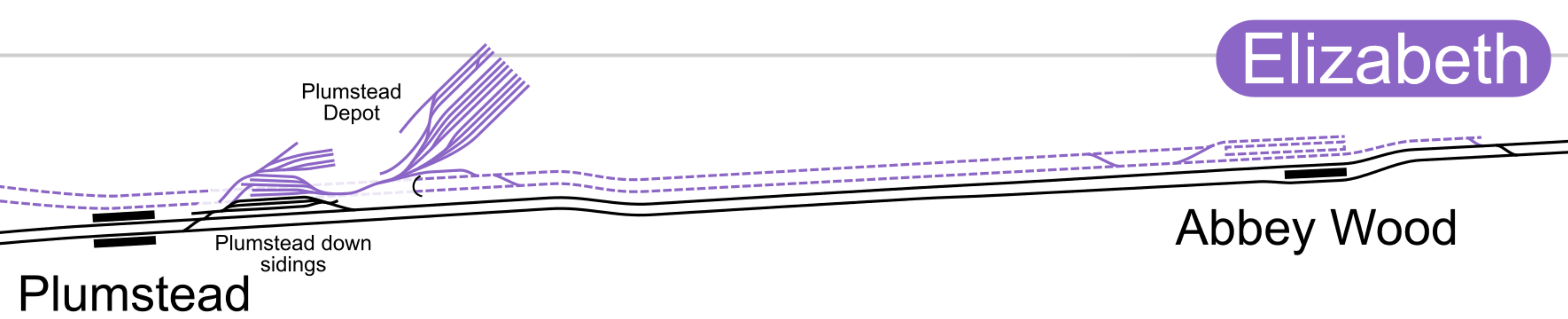
Note.
- Crossrail is shown in purple.
- Abbey Wood station has two platforms for Crossrail and two for the North Kent Line.
- The platforms appear to be numbered one to four from the South.
- There appears to be a turnback for Crossrail trains in Platform 3, which also appears to have crossovers to connect to the North Kent Line.
- Crossovers to the West of Abbey Wood station allow trains to use either Crossrail platform.
- These crossovers also allow access to the sidings at Plumstead.
- The Plumstead tunnel portal can be seen below Plumstead Depot.
If Abbey Wood station follows the two National Rail platforms at Liverpool Street in handling a total of 8 tph, then initially Abbey Wood could handle this frequency of trains.
Ian says this in the first article about the frequencies of Crossrail during testing.
Before the blockade, Crossrail was testing the line with an 8 trains per hour (8tph) service, but this week they are going to be ramping that up to 12tph, which will mirror the timetabled service that the line will offer when it opens early next year.
Note that 12 tph will require Abbey Wood station to handle 6 tph on each platform.
Transport for London also intend to simulate 24 tph through the central section, which will be the Peak frequency when the line fully opens.
The Surface Section At Custom House
This map from cartometro shows the track layout around Custom House station.
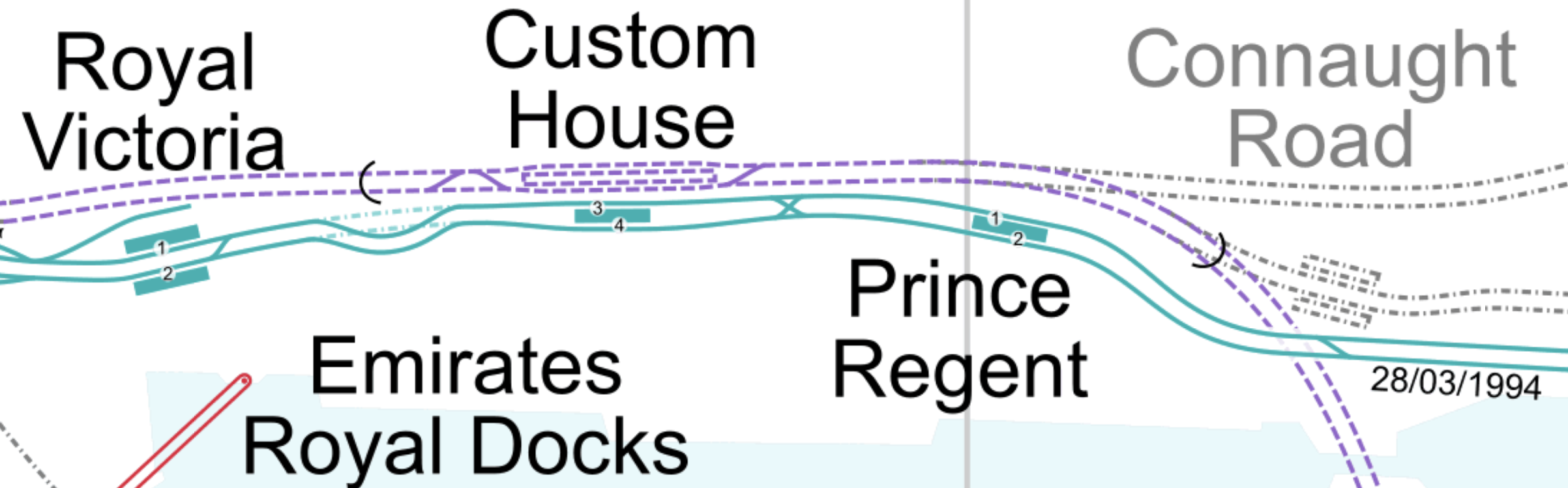
Note.
- Crossrail is shown in purple.
- The DLR is shown in light green.
- The tunnel portal for the central Crossrail tunnel is to the West of Custom House station.
- The tunnel portal for the Connaught tunnel is in the area of the former Connaught Road station.
- Between the other end of the Connaught tunnel and Woolwich station, some of the route is in a cutting.
- There are crossovers either side of Custom House station.
I suspect a lot of the complications are because an old route was reused.
The Surface Section At Paddington
This map from cartometro shows the track layout around Paddington station.
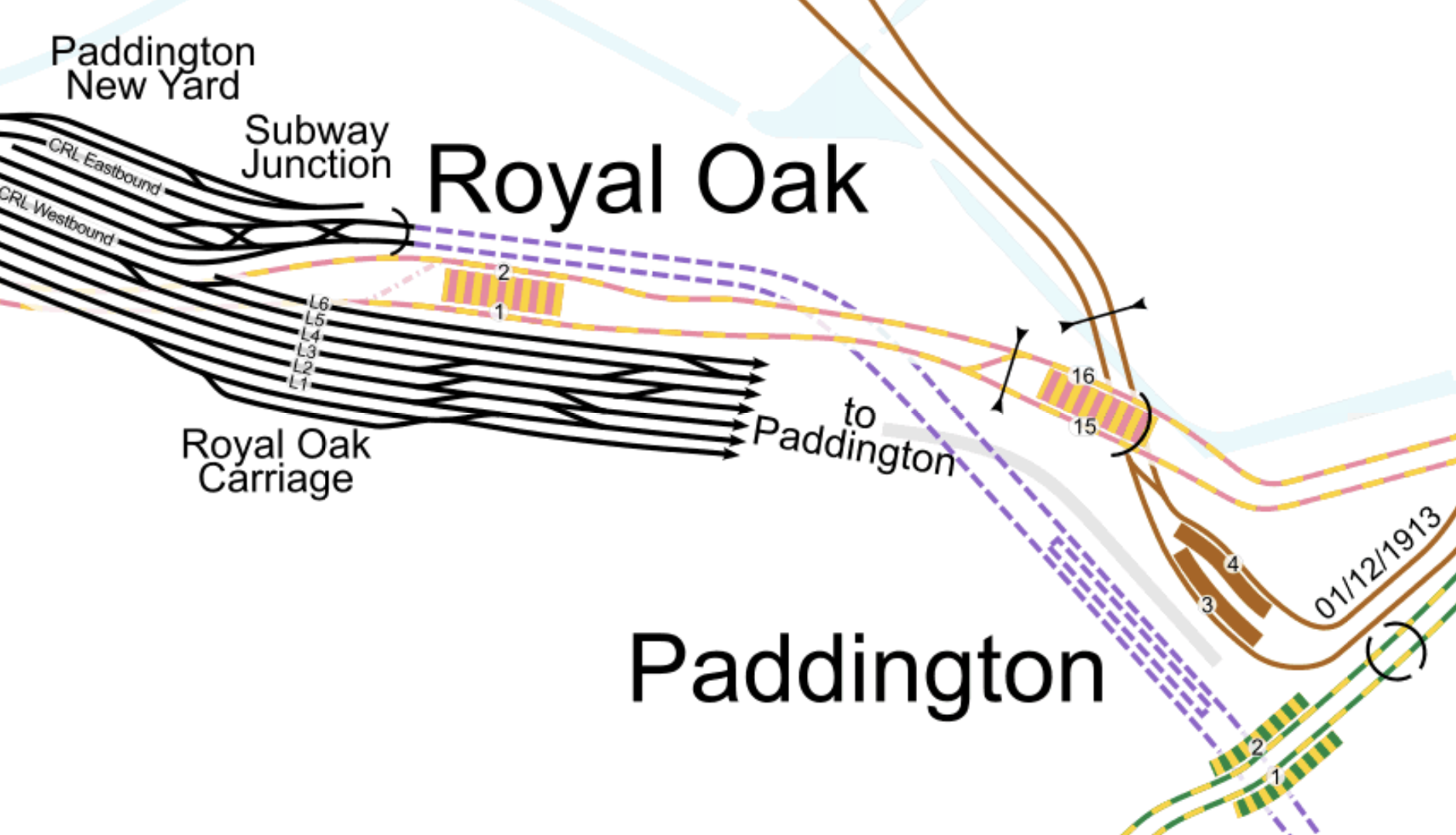
Note.
- The Crossrail station at Paddington is a straight-through two platform station.
- The Royal Oak portal, where Crossrail comes to the surface is just to the West of Royal Oak Underground station.
- Two lines are labelled CRL Eastbound and CRL Westbound are connected to the Crossrail lines.
- Between and around these lines is Paddington New Yard
- There are two full crossovers between Paddington New Yard and the Royal Oak portal.
To reverse at Paddington, trains proceed to Paddington New Yard, where the driver changes ends and then returns to Paddington, when needed.
Trains for Reading and Heathrow use the CRL Eastbound and CRL Westbound lines to connect to Crossrail’s Western surface tracks and the Central core tunnel.
It all looks well-designed to my untrained eye.
Platform Edge Doors
This page on the Crossrail web describes the platform edge doors.
This is the first paragraph.
Crossrail has installed floor-to-ceiling platforms screen doors at each of the eight new underground stations on the Elizabeth line – that’s roughly 4 kilometers of platform edge screens in total.
The new stations between Abbey Wood and Paddington are,
- Paddington
- Bond Street
- Tottenham Court Road
- Farringdon
- Liverpool Street
- Whitechapel
- Canary Wharf
- Custom House
- Woolwich
This is eight underground stations and one surface station; Custom House.
So does it mean that Custom House station doesn’t have platform edge doors?
I took these pictures of Custom House station today.

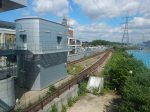
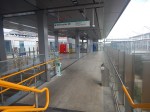
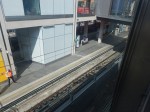
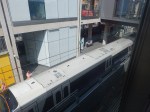


Note.
- The Crossrail trains were running at a frequency of 8 tph.
- , The pictures don’t show any platform edge doors or structures capable of supporting platform edge doors.
Could the regulations allow a surface station like Custom House to be built without doors, or were they left out to save money?
Safety is assured by being able to shut off all entrances to the platforms.
But it does appear that between Custom House and Paddington stations, passengers and trains are separated by platform edge doors.
- Platform edge doors are controlled by the signalling, so with the correct interlocking a lot of things are possible.
- Suppose, a station is not ready for passengers, then by locking the doors closed, trains can still pass through.
- Does this mean that at stations like Liverpool Street, where passengers might need to walk between the Moorgate and Liverpool Street ends of the station to change trains, that these pedestrian routes could be opened? I think it does?
It does appear to me, that platform edge doors are the key to opening a partially-completed railway.
When Could Abbey Wood And Paddington Open?
It strikes me that the following conditions must be met.
- Paddington station must be handed over to Transport for London.
- Platform edge doors at all stations must work reliably.
- The trains must work reliably with the signalling.
It looks like Bond Street, Paddington and Whitechapel stations, are the only stations that have not been handed over to Transport for London.
- I suspect, as Paddington is a terminal station, it must be handed over.
- Crossrail have said they could live with Bond Street opening later.
- Whitechapel appears to have been a difficult station to build, so perhaps it could open later.
Could Crossrail open partially, earlier than anyone thinks?
Perhaps this post called Your First Crossrail Service May Arrive In Time For Christmas, was based on fact and not rumour in the Sunday Times.
Eridge Station – 12th July 2021
It’s been over a year, since I went to Eridge station, so I thought I’d go again.
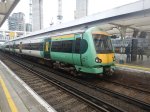
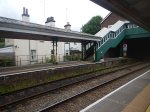
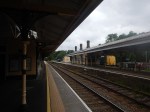
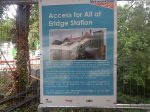
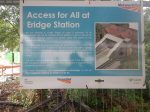
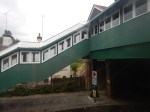
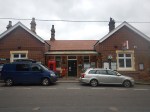
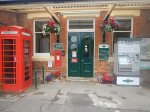
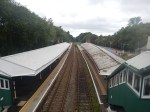
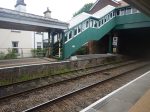
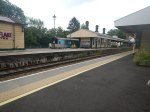
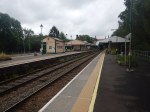
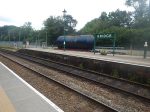
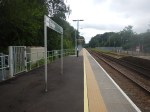
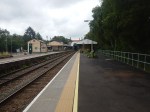
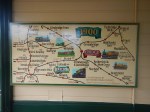
Note.
- The station seems to have moved on.
- The steps have had a makeover.
- It appears that some painting has been done.
- All Southern trains call in Platform 1, which is in the Western side of the tracks.
A lift will be installed on that side, with a slope on the heritage line side.
I’m fairly certain if they get the marketing right, families will pay to go to Eridge station for a day on the Spa Heritage Railway.
Will Zero-Carbon Freight Trains Be Powered By Battery, Electric Or Hydrogen Locomotives?
These are a few initial thoughts.
We Will Not Have A One-Size-Fits-All Solution
If you consider the various freight and other duties, where diesel locomotives are used, you get a long list.
- Light freight, where perhaps a Class 66 locomotive moves a few wagons full of stone to support track maintenance.
- Intermodal freight, where a Class 66 locomotive moves a long train of containers across the country.
- Stone trains, where a Class 59 or Class 70 locomotive moves a very heavy train of aggregate across the country.
- Empty stock movements, where a diesel locomotive moves an electrical multiple unit.
- Supporting Network Rail with trains like the New Measurement Train, which is hauled by two diesel Class 43 power cars.
- Passenger trains at up to and over 100 mph.
I can see a need for several types of zero-carbon locomotive.
- A light freight locomotive.
- A medium freight locomotive, that is capable of hauling many intermodal trains across the country and would also be capable of hauling passenger services.
- A heavy freight locomotive, capable of hauling the heaviest freight trains.
- A Class 43 power car replacement, which would probably be a conversion of the existing power cars. Everybody loves InterCity 125s and there are over a hundred power cars in regular service on railways in the UK.
There are probably others.
The UK Hydrogen Network Is Growing
Regularly, there are news items about companies in the UK, who will be providing green hydrogen to fuel cars, vans, buses, trucks and trains.
Hydrogen is becoming a fuel with a much higher availability.
The UK Electricity Network Is Growing And Getting More Resilient
We are seeing more wind and solar farms and energy storage being added to the UK electricity network.
The ability to support large numbers of battery-electric buses, cars, trucks and trains in a reliable manner, is getting more resilient and much more comprehensive.
There Will Be More Railway Electrification
This will happen and installation will be more innovative. But predicting where electrification will be installed, will be very difficult.
Hydrogen Fuel Cells Now Have Rivals
Hydrogen fuel cells are normally used to convert hydrogen gas to electricity.
But over the last few years, alternative technology has evolved, which may offer better methods of generating electricity from hydrogen.
- Rolls Royce have developed a beer keg-sized 2.5 MW generator, that could run on hydrogen, which I wrote about in Our Sustainability Journey.
- Honeywell are possibly going the same route, which I wrote about in Honeywell Introduces Power Source For Hybrid-Electric Aircraft.
- JCB have converted diesel engines to run on hydrogen, which I wrote about in JCB Finds Cheap Way To Run Digger Using Hydrogen.
- Caterpiller, Cummins and Rolls-Royce mtu are showing signs of taking a similar route to JCB.
Fuel cells will not be having it all their own way.
Batteries Are Improving Their Energy Density
This is inevitable. and you are starting to see improvements in the fabrication of the battery packs to get more kWh into the space available.
In Wrightbus Presents Their First Battery-Electric Bus, I said this about the Forsee batteries used in the new buses from Wrightbus.
The Forsee brochure for the ZEN SLIM batteries gives an energy density of 166 Wh per Kg. This means that the weight of the 454 kWh battery is around 3.7 tonnes.
A one-tonne battery would have a capacity of 166 kWh.
- It is the highest value I’ve so far found.
- Technology is likely to improve.
- Other battery manufacturers will be striving to match it.
For these reasons, in the rest of this post, I will use this figure.
Some Example Locomotives
In this section, I shall look at some possible locomotives.
Conversion Of A Class 43 Power Car
There are two Class 43 power cars in each InterCity 125 train.
- The diesel engine is rated at 1678 kW.
- The transmission is fully electric.
- These days, they generally don’t haul more than five or six intermediate Mark 3 coaches.
I would see that the biggest problem in converting to battery power being providing the means to charge the batteries.
I suspect that these power cars would be converted to hydrogen, if they are converted to zero-carbon.
- I would estimate that there is space for hydrogen tanks and a small gas-turbine generator in the back of the power car.
- Much of the existing transmission could be retained.
- A zero-carbon power car would certainly fit their main use in Scotland and the South-West of England.
- I doubt hydrogen refuelling would be a problem.
They may even attract other operators to use the locomotives.
A Battery-Electric Locomotive Based on A Stadler Class 88 Locomotive
I am using this Class 88 locomotive as a starting point, as the locomotive is powerful, reliable and was built specifically for UK railways. There are also ten already in service in the UK.
In Thoughts On A Battery Electric Class 88 Locomotive On TransPennine Routes, I started the article like this.
In Issue 864 of Rail Magazine, there is an article, which is entitled Johnson Targets A Bi-Mode Future.
As someone, who has examined the mathematics of battery-powered trains for several years, I wonder if the Age of the Hybrid Battery/Electric Locomotive is closer than we think.
A Battery/Electric Class 88 Locomotive
After reading Dual Mode Delight (RM Issue 863), it would appear that a Class 88 locomotive is a powerful and reliable locomotive.
-
- It is a Bo-Bo locomotive with a weight of 86.1 tonnes and an axle load of 21.5 tonnes.
- It has a rating on electricity of 4,000 kW.
- It is a genuine 100 mph locomotive when working from 25 KVAC overhead electrification.
- The locomotive has regenerative braking, when working using electrification.
- It would appear the weight of the diesel engine is around seven tonnes
- The closely-related Class 68 locomotive has a 5,600 litre fuel tank and full of diesel would weight nearly five tonnes.
The locomotive would appear to be carrying between 7 and 12 tonnes of diesel-related gubbins.
Suppose that the diesel-related gubbins of the Class 88 locomotive were to be replaced with a ten tonne battery.
Using the Forsee figures, that I quoted earlier, this battery would hold 1660 kWh.
At the power level of the 700 kW of the Caterpillar C27 diesel engine in the Class 88 locomotive, that would give more than two hours power.
It looks to me, that a battery-electric Class 88 locomotive could be a very useful locomotive.
It might even be able to haul freight trains in and out of the Port of Felixstowe, which would be a big advantage in decarbonising the port.
Certainly, methods to charge battery trains on the move, are being developed like the system from Hitachi ABB Power Grids, that put up short sections of 25 KVAC overhead electrification, which would be driven by a containerised power system.
These systems and others like them, may enable some battery-electric freight trains to work routes like.
- Felixstowe and Ipswich.
- Ipswich and Peterborough
- Peterborough and Nuneaton.
- Peterborough and Doncaster via Lincoln
- Birmingham and Oxford
None of these routes are fully-electrified.
But because of the power limit imposed by the batteries, these locomotives will need to be recharged at points on the route.
This Google Map shows the Ipswich and Peterborough route crossing the Fen Line at Ely station.
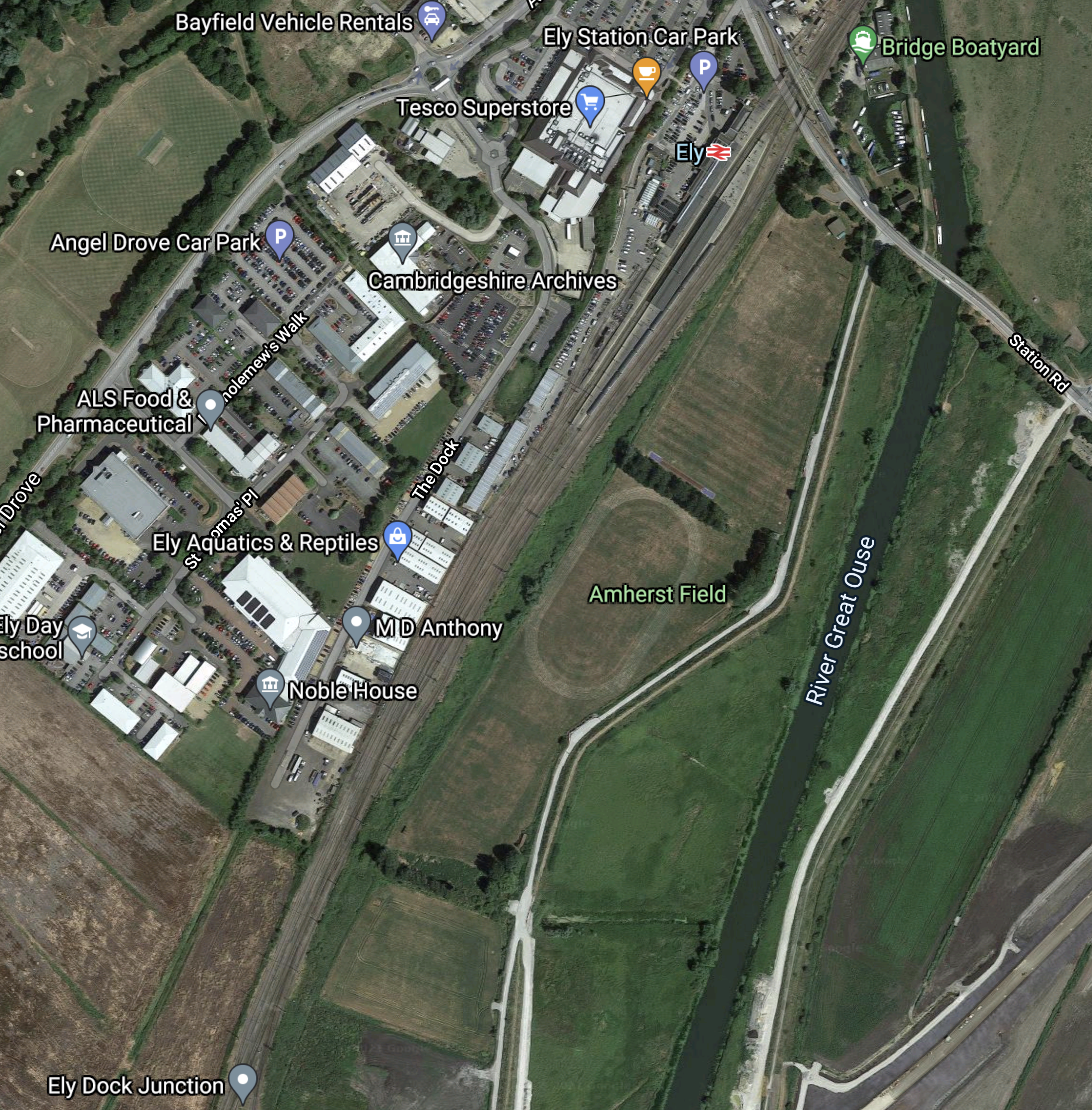
Note.
- Ely Dock junction in the South-West corner, where the line from Ipswich and Bury St. Edmunds joins the lines through Ely.
- Ely station towards the North-East corner of the map.
- Passenger trains run through the station.
But freight trains can take a route on the Eastern side of the station, which is not electrified.
At Ely station, a loop like this can be electrified using the existing electrification power supply, but at other places, systems like that from Hitachi ABB Power Grids can be used to electrify the loop or an appropriate section of the route.
These short sections of electrification will allow the train to progress on either electric or battery power.
A Hydrogen-Electric Locomotive Based on A Stadler Class 88 Locomotive
In The Mathematics Of A Hydrogen-Powered Freight Locomotive, I looked at creating a hydrogen-powered locomotive from a Class 68 locomotive.
I decided it was totally feasible to use readily available technology from companies like Rolls-Royce and Cummins to create a powerful hydrogen-powered locomotive.
The Class 68 locomotive is the diesel-only cousin of the electro-diesel Class 88 locomotive and they share a lot of components including the body-shell, the bogies and the traction system.
I suspect Stadler could create a Class 88 locomotive with these characteristics.
- 4 MW using electric power
- At least 2.5 MW using hydrogen power.
- Hydrogen power could come from Rolls-Royce’s 2.5 MW generator based on a small gas-turbine engine.
- 100 mph on both electricity and hydrogen.
- It would have power output on hydrogen roughly equal to a Class 66 locomotive on diesel.
- It would have a range comparable to a Class 68 locomotive on diesel.
This locomotive would be a zero-carbon Class 66 locomotive replacement for all duties.
A Larger And More Powerful Hydrogen-Electric Locomotive
I feel that for the largest intermodal and stone trains, that a larger hydrogen-electric locomotive will be needed.
With the way Wabtec are going in the United States, I wouldn’t be surprised to see a suitable locomotive cross the pond.
Conclusion
In the title of this post, I asked if freight locomotives of the future would be battery, electric or hydrogen.
I am sure of one thing, which is that all freight locomotives must be able to use electrification and if possible, that means both 25 KVAC overhead and 750 VDC third rail. Electrification will only increase in the future, making it necessary for most if not all locomotives in the future to be able to use it.
I feel there will be both battery-electric and hydrogen-electric locomotives, with the battery-electric locomotives towards the less powerful end.
Hydrogen-electric will certainly dominate at the heavy end.
London Underground’s Northern Line Extension Starts Trial Operations
The title of this post, is the same as that of this article on Ian Visits.
These are the first two paragraphs.
The Northern line extension between Kennington and Battersea has entered the final trial operations stage ahead of its opening later this year.
Four trains per hour are currently being run through the extension at weekends as part of trial operations. Throughout this trial period, operations and maintenance staff are testing all the systems required to keep the extension running, and existing Northern line train drivers will complete familiarisation training on the route.
As ever, Ian seems to have researched his facts and he is predicting the following.
- The extension will open in September.
- Mill Hill East will get direct services from Central London, which will eliminate the need to change at Finchley Central
- The initial Peak hour service will be six trains per hour (tph)
- The initial Off Peak service will be five tph.
I’m certainly looking forward to opening of the extension.
East-West Rail ‘Must Use Electric Trains’ – Layla Moran MP
The title of this post, is the same as that of this article on the BBC.
These are the first three paragraphs.
It is of “paramount importance” that a £5bn direct rail line between Oxford and Cambridge uses electric trains, an MP has said.
The East West Rail project aims to connect the university cities by the end of the decade, but its electrification is yet to be confirmed.
MP Layla Moran said: “We’re in a climate emergency. No rail line should be designed for diesel by default.”
All trains need to be electric, but that doesn’t mean the lines need to be fully-electrified.
And if you design a railway for 100 mph diesel trains, you’ve also designed it for 100 mph electric trains.
In Solving The Electrification Conundrum, I explained how Hitachi Rail and Hitachi ABB Power Grids, have developed a practical solution to running battery-electric trains on railways without full electrification.
Their system would be ideal for the East-West Rail Link and fulfil Ms. Moran’s wish of electric trains.
There just wouldn’t be large numbers of electrification gantries marching all over the countryside.
Was This The Most Significant Statement On Freight Locomotives Last Week?
This press release from Freightliner, is entitled Freightliner Secures Government Funding For Dual-Fuel Project.
The dual-fuel project is important and will cut carbon emissions in the short term.
But it is only a quick fix, made possible by good technology.
It is also not zero-carbon.
This sixth paragraph from the press release is very significant.
This sustainable solution will support a programme to decarbonise freight operating companies’ diesel fleets in a cost-efficient manner that does not require significant short-term investment and facilitates operational learning in support of a longer-term fleet replacement programme, potentially using 100% hydrogen fuel.
I believe the paragraph indicates, that Freightliner and possibly the other companies involved in the building and operation of heavy freight locomotives have concluded, that the technology is now such, that a zero-carbon rail locomotive powered by 100 % hydrogen is now possible.
- Rolls-Royce and possibly other gas-turbine companies have the technology to build small gas-turbine powered generators that can produce several megawatts of reliable electrical zero-carbon power, when fuelled by hydrogen.
- We are seeing companies developing strategies for the safe supply of hydrogen in large industrial quantities.
- Hydrogen has been successfully deployed on buses, trains and other large vehicles.
- The technology has been proven that will allow dual-mode hydrogen-electric locomotives, that can use electrification, where it exists.
- Some big companies like Cummins, JCB and Shell are backing hydrogen.
There are thousands of large diesel-powered locomotives all over the world and locomotive builders that can successfully replace these with hydrogen-powered locomotives will not go financially unrewarded!
Crossrail: Report Finds Not Enough Money To Finish Project
The title of this post, is the same as that of this article on the BBC.
These are the first two paragraphs.
The cost of completing Crossrail exceeds available funding, the government spending watchdog has found.
The National Audit Office (NAO) estimates the cost of the new rail link will be between £30m and £218m above the current funding.
After such a good start with the tunneling and surface line going well, how did we get here?
My main business for nearly forty years was writing project management software and that gave me a deep insight into the dynamics and mathematics of large projects.
The software, I created in the 1970s; Artemis was deeply involved in the most important project of the time; North Sea Oil.
But then more by luck, than any judgement on my part, it was well suited to solving the management problems of North Sea Oil.
The software ran on a small Hewlett-Packard mini-computer with an attached display and a printer, whose footprint, gave Artemis an advantage over competitors who needed a mainframe, for which there was no office space in Aberdeen.
I had first got involved in scheduling resources at ICI about five years earlier and because from previous experience I knew resources would be critical, I gave the program extensive resource aggregation and scheduling capabilities.
I have been told that the latter proved invaluable in successfully developing North Sea Oil. People may have been flattering me, but I do know that Shell used to ensure that all their suppliers used Artemis, so they could check easily if they were being told the truth.
I suspect that Shell and others used the aggregation capability to see that they weren’t overloading the pool of available labour.
Artemis definitely proved itself capable of handling the various projects in the North Sea.
We have now moved on forty years, but has project management moved on to cope with the advances in technology of the modern world?
As with North Sea Oil in Aberdeen, in the 1970s, Crossrail and other large projects like Berlin’s new Brandenburg Airport will always have a need for large numbers of resources, be they men, materiel or machines.
I have some questions.
- Do all contractors working on Crossrail use the same software?
- Does Crossrail have the right to inspect the contractors project management systems?
- Is the upward reporting what it needs to be?
- Does the software the contractors use, have an aggregation capability?
- Do Crossrail track and predict the resources needed?
Someone I respect told me, that a lot of modern project management software doesn’t even have an aggregation capability- Enough said!
I must admit, aggregation and scheduling software is difficult to write, so it might be easier to cut it out and let your clients muddle through!
But The Tunnels Were Built On Time And On Budget!
It all started so well, with the first part of the project, which was the boring of the tunnels being completed on time and on budget.
Observing the project, as I did and picking up information from engineers working on the tunnels and various magazines and television programs, I have to come to the conclusion, that the credit for the on time and budget completion must be down to excellent planning.
- I don’t remember any delays or problems reported in the tunneling. Was that good planning and surveying or luck?
- There were few if any articles on the BBC or in the Standard complaining about the problems the tunneling was inflicting on Londoners.
- The planners realised there could be a shortage of workers qualified to work underground, so they built the Tunnelling and Underground Construction Academy at Ilford, which I wrote about in Open House – TUCA.
Certainly, St Barbara, who is the patron saint of tunnellers looked after the project and its builders.
Worsening The Resource Problem
Crossrail, the Greater London Authority and the Boroughs should have been monitoring this growing resource problem, but I doubt they were in anything other than a perfunctory way!
Instead the politicians were giving planning permission to anybody with money, who wanted to build a shiny new development close to a station.
These projects would need more men, materiel or machines.
As many of these new developments are backed by companies or funds with bottomless pockets to get their developments finished they were prepared to pay more for their labour.
So labour has been deserting Crossrail in droves, thus further delaying the project.
Senior politicians in the Greater London Authority and the boroughs should accept some responsibility for Crossrail’s delay.
They didn’t need to withhold the planning permission, just say that construction of the other projects couldn’t commence until an appropriate phase of Crossrail was open.
In some parts of the world, brown envelopes will have changed hands, but it would be nice to know how many mayors and senior politicians have had holidays in places, they would not normally visit.
Senior project managers tell me, that they would not be surprised if developments along Crossrail had delayed the project.
The Covid Problem
No-one saw Covid coming, except possibly the Chinese.
But good project management is all about negotiating the slings and arrows of outrageous fortune.
There is the story of the miniMetro production line.
The first body shells coming out of the automated welder were crooked and it turned out that the machine had hit a motorway bridge in Germany. But by good project management using Artemis, British Leyland engineers were able to get the second line working correctly before the first and the car was launched on time.
With Covid, the Mayor shut construction, and it was some months before it restarted again.
I am certain, that with good project management we could have done better.
Covid is also a good excuse for lateness.
On the other hand good project management got the vaccines developed, manufactured and delivered into arms.
Covid also blew a big hole in Transport for London’s finances.
But then so did Sadiq Khan’s Fare Freeze, that brought him to office.
Could Crossrail Have Part-Opened Earlier?
I often ponder this and others ask me if it would be possible.
The Victoria Line was built with crossovers and it was able to open in phases.
Crossrail has crossovers in the following places.
- Either side of Custom House station
- To the West of Whitechapel station
- Between Farringdon and Tottenham Court Road stations
Note.
- It doesn’t appear to have been built for part opening.
- From media reports, it appears Whitechapel station is the basket case in the East.
The answer is probably that Crossrail can’t be part-opened, but there are good reasons, why it should be opened earlier.
- To generate a small amount of revenue.
- To give travellers and Londoners in general a lift.
The only practical service would be a few trains turning at Farringdon.
Conclusion
I blame politicians for Crossrail being late and over budget.
ORR’s Policy On Third Rail DC Electrification Systems
The title of this post is the same as that of a document I downloaded from this page on the Office of Rail and Road web site.
It is one of the most boring legal documents, that I have ever read and I have read a few in my time.
As I read it, effectively it says that new third-rail electrification is banned because of Health and Safety issues, which take precedence.
But only once in the document is new technology mentioned, that might make third-rail safer and that is a reference to the Docklands Light Railway, where the third rail is shielded.
I am an Electrical Engineer and I was designing safety systems for heavy industrial guillotines at fifteen as a vacation job in a non-ferrous metals factory.
One design of an ideal electric railway would have battery-electric trains, that were charged in stations by third-rail. The third-rail would only be energised, when a train was over the top and needed to be charged. In effect the train would act as an all-enclosing guard to the conductor rail.
Electrification Of The West Of England Main Line
The West of England Main Line runs between Basingstoke and Exeter via Salisbury. It is one of the longest, if not the longest main lines in England, that is not electrified.
It would probably need to be electrified with 750 VDC third-rail electrification, as that standard is used between London Waterloo and Basingstoke.
In Solving The Electrification Conundrum, I described a system being developed by Hitachi, that would use battery-electric trains that were charged by short sections of electrified line every fifty miles or so. For reasons of ease of installation and overall costs, these short sections of electrification could be third-rail, that was electrically dead unless a train was connected and needed charging. These electrified sections could also be in stations, where entry on to the railway is a bit more restricted.
Conclusion
The Office of Rail and Road needs to employ a few more engineers with good technical brains, rather than ultra-conservative risk-averse lawyers.
As a sad footnote, I live in East London, where trespassers are regularly electrocuted on the railway. But usually, it is when idiots are travelling on top of container trains and inadvertently come into contact with the overhead electrification.
Will Hitachi ABB Power Grids Technology Be Used At Headbolt Lane Station?
Today, I was sent a link to the North Cheshire Rail User Group’s Newsletter for Spring 2021.
Current Progress on Merseyrail’s Class 777 Trains
This is said in the newsletter about the progress of the new Class 777 trains.
At a recent meeting of the Liverpool City Region rail user groups hosted by Liam Robinson, Chair of
Merseytravel, a short presentation was given detailing progress in bringing the new Class 777 Stadler fleet into
operation. NCRUG has been keeping a keen watch on the introduction of this new fleet; later model Class 777’s
have the ability to leave the 3rd rail and operate under battery power for 20 miles or more with a full load thus
permitting expansion of the Merseyrail network beyond its current limits.Particularly of interest in our patch is the Ellesmere Port to Helsby line, although at one point in the meeting I
did raise the concept of ultimately having a complete Merseyrail service circling the Mersey Estuary on a metro
styled basis Ambitious certainly, but unrealistic as a long-term goal? There would be considerable work required
at Liverpool south Parkway to connect the Merseyrail line to the network, however the terrain is suitably flat and
the trains will be capable. This obvious evolution of the network did seem to take the meeting by surprise.Unfortunately the much anticipated introduction of the Class 777’s has been delayed for a number of factors,
not least of all the pandemic but border issues and storage also play a part. Trails are taking place on the Kirby
and Ormskirk lines, and full introduction might not be until as late as next year. The Liverpool City Region has a
clearly defined set of (deliverable) objectives for development of the rail network and the expansion has been
prioritised with a line to Skelmersdale being top of the list and the first step of that being a new station at Headbolt
Lane, Kirby – plans are already well developed for this. It is expected to be this line where proof of concept trails
will be conducted for the battery powered 777’s, although Merseyrail does have authorisation to use Ellesmere
Port–Helsby on account of the low traffic movements on that line! Network expansion is being considered to
Widnes via Hunts Cross and possibly as far as Warrington, but when the question of Ellesmere Port–Helsby
was raised, the route, although under consideration, was not high on the priority list. I suspect it will be at least
several years away and I’m sure the delayed introduction of the type will not only come as a disappointment for
NCRUG but also the Community Rail Partnership and CWaC Council, who have funded a basic feasibility study
into possible demand. Therefore we are left with the Northern Trains service for the foreseeable future – 3 return
trains daily on the current schedule.
After reading this extract, I am puzzled. The original priority was to use the battery capabilities of the new Class 777 trains to extend the Ellesmere Port service to Helsby.
- Ellesmere Port and Helsby stations are 5.2 miles apart.
- Ellesmere Port has a two trains per hour (tph) service to Birkenhead and Liverpool.
- Ellesmere Port and Helsby stations are linked by a three trains per day (tpd) service.
Helsby station has comprehensive connections to Chester, Leeds, Liverpool, Manchester and Warrington Bank Quay station.
Two tph between Ellesmere Port and Helsby stations would certainly improve train services in the area and probably explains the disappointment shown by the writer of the newsletter.
So why have Merseyrail switched the emphasis to battery trains to Headbolt Lane and Skelmersdale from Ellesmere Port and Helsby?
Headbolt Lane Station
Headbolt Lane station is a station of an unusual design, which I wrote about in Headbolt Lane Station Fly-Through.
- Two platforms appear to face West towards Liverpool.
- One platform appears to face East towards Wigan and Manchester.
- The platforms meet head-on and a walkway runs between them to allow passengers to access all platforms.
- There appears to be provision for a fourth platform to serve Skelmersdale. which is to the East of Headbolt Lane.
I think the design means that access to all platforms is level, passengers can enter from both sides of the railway and the station doesn’t need an expensive bridge.
Between Kirkby And Headbolt Lane Stations
Headbolt Lane and Kirkby stations are a couple of miles apart at most. So were Merseyrail hoping to extend the third-rail electrification to Headbolt Lane station, but the Office of Rail and Road has more or less said that no more third-rail electrification is allowed. See ORR’s Policy On Third Rail DC Electrification Systems.
So are Merseyrail having to use battery power between Kirkby and Headbolt Lane stations?
If they are then they have the trains.
As according to the extract from the Cheshire Rail User Group’s Newsletter, the Class 777 trains have a range of twenty miles on battery power, then this should be no problem.
The Skelmersdale Shuttle
The design of Headbolt Lane station does mean that there will be no through running between Liverpool and Skelmersdale.
So it looks to me, that to allow full step-free access to all platforms, the Skelmersdale service will be a battery-electric shuttle train.
- It could also be the only train on a single-track between Headbolt Lane and Skelmersdale, which would simplify signalling and operation.
- Two tph could be possible with a single train.
- The train would be charged in either termini using an appropriate charging system.
How many other simple branch lines could be run that way or built new?
Headbolt Lane And Manchester Victoria Via Wigan Wallgate
Consider.
- The distance between Headbolt Lane and Manchester Victoria stations is just under thirty miles, which is well within range of the average battery-electric trains currently under development.
- As the current Kirkby and Manchester Victoria stations is run by Northern Trains and they are likely to be acquiring some Class 331 trains with a battery capability, these will surely be an ideal train.
- The train would be charged in the East-facing platform at Headbolt Lane station using an appropriate charging system.
Headbolt Lane station would be a diesel-free station. As incidentally, so would Kirkby and Skelmersdale stations.
Charging Trains At Headbolt Lane Station
It would appear that both East-facing platforms at Headbolt Lane station will need to charge these trains.
- A Class 777 train with a third-rail capability and the ability in the future to access overhead electrification.
- A Class 331 train with no third-rail capability and the ability to access overhead electrification.
Class 777 trains from Liverpool would hopefully have enough power in their batteries to return to Kirkby.
It would appear that a short length of 25 KVAC overhead electrification in both platforms would be ideal for charging trains to and from Manchester and Skelmersdale.
If one of Hitachi ABB Power Grids’s containerised overhead electrification power systems could handle both platforms, it would surely be ideal.
A crossover to allow Manchester and Skelmersdale trains to use either East-facing platform, might be desirable, as it could improve reliability.
Conclusion
It looks like Hitachi ABB Power Grids can provide a sensible solution to handling battery-electric trains at Headbolt Lane station. Or for that matter at any station, where battery-electric trains interface with the UK rail network.
 The Anonymous Widower