Could Some of Hitachi’s Existing Trains In The UK Be Converted To Battery-Electric Trains?
The last five fleets of AT-300 trains ordered for the UK have been.
- Avanti West Coast – Bi-Mode, 13 x five-car, unknown number of diesel engines, that could be replaced by batteries.
- Avanti West Coast – Electric, 10 x seven-car, no diesel engines or batteries
- East Midlands Railway – Bi-Mode, 33 x five-car, Class 810 train with four diesel engines and 125 mph on diesel.
- East Coast Trains – Electric, 5 x five-car, Class 803 train with battery for emergency hotel power.
- Hull Trains – Bi-Mode, 5 x five-car, Standard Class 802 train with three diesel engines.
Each fleet seems to be tailored to the needs of the individual operator, which is surely as it should be.
I can make some observations.
Fast Electric Trains
Both all-electric fleets on the list, will run on routes, where speed will be important.
- The Avanti West Coast Class 807 trains on the West Coast Main Line, will have to be able to keep up keep with the Class 390 trains, that have the advantage of tilt for more speed.
- The East Coast Trains Class 803 trains on the East Coast Main Line, will have to work hard to maintain a demanding schedule, as I outlined in Thoughts On East Coast Trains.
Any reduction in weight will improve the acceleration.
- The seven tonne MTU 12V 1600 R80L diesel engines can be removed to reduce the weight.
- As a five-car Class 800 train with three diesel engine weighs 243 tonnes, this could save nearly 9 % of the train’s weight.
- East Coast Trains feel they need an appropriately-sized battery for emergency hotel power. Could this be because the catenary is not as good on the East Coast Main Line as on the West?
- Perhaps, Avanti West Coast feel a battery is not needed, but they could obviously fit one later. Especially, if there was already a ready-wired position underneath the train.
The extra acceleration given by 100% electric operation, must make all the difference in obtaining the required performance for the two routes.
Why Four Diesel Engines In A Class 810 Train?
The Class 810 trains are an update of the current Class 800/Class 802 trains. Wikipedia described the differences like this.
The Class 810 is an evolution of the Class 802s with a revised nose profile and facelifted end headlight clusters, giving the units a slightly different appearance. Additionally, there will be four diesel engines per five-carriage train (versus three on the 800s and 802s), and the carriages will be 2 metres (6.6 ft) shorter due to platform length constraints at London St Pancras.
Additionally, in this article in the October 2019 Edition of Modern Railways, which is entitled EMR Kicks Off New Era, this is said.
The EMR bi-modes will be able to run at 125 mph in diesel mode, matching Meridian performance in a step-up from the capabilities of the existing Class 80x units in service with other franchises.
The four diesel engines would appear to be for more power, so that these trains will be able to run at 125 mph on diesel.
In How Much Power Is Needed To Run A Train At 125 mph?, I calculated that a Class 801 train, which is all-electric, consumes 3.42 kWh per vehicle mile.
- At 125 mph a train will in an hour travel 125 miles.
- In that hour the train will need 125 x 5 x 3.42 = 2137.5 kWh
- This means that the total power of the four diesel engines must be 2137.5,
- Divide 2137.5 by four and each diesel must be rated at 534.4 kW to provide the power needed.
The MTU 12V 1600 R80L diesel engine is described in this datasheet on the MTU web site.
Note on the datasheet, there is a smaller variant of the same engine called a 12V 1600 R70, which has a power output of 565 kW, as compared to the 700 kW of the 12V 1600 R80L.
The mass of the engines are probably at the limits of the range given on the datasheet.
- Dry – 4500-6500 Kg
- Wet – 4700-6750 Kg
It would appear that the less-powerful 12V 100 R70 is about two tonnes lighter.
So where will four engines be placed in a Class 810 train?
- The five-car Class 800 and Class 802 trains have diesel-engines in cars 2, 3 and 4.
- The nine-car Class 800 and Class 802 trains have diesel-engines in cars 2,3, 5, 7 and 8.
- It appears that diesel-engines aren’t placed under the driver cars.
- Five-car AT-300 trains generally have a formation of DPTS+MS+MS+MC+DPTF.
- The car length in the Class 810 trains are two metres shorter than those in other trains.
Could it be that the intermediate cars on Class 810 trains will be an MC car, which has both First and Standard Class seating and two identical MS cars both with two smaller diesel engines?
- The two smaller diesel engines will be about 2.6 tonnes heavier, than a single larger engine.
- Only one fuel tank and other gubbins will be needed.
- The shorter car will be lighter in weight.
- MTU may have designed a special diesel engine to power the train.
I would suspect that a twin-engined MS car is possible.
Could The Battery And The Diesel Engine Be Plug-Compatible?
I found this document on the Hitachi Rail web site, which is entitled Development of Class 800/801 High-Speed Rolling Stock For UK Intercity Express Programme.
The document may date from 2014, but it gives a deep insight into the design of Hitachi’s trains.
I will take a detailed look at the traction system as described in the document.
This schematic of the traction system is shown.

Note BC is described as battery charger.
This is said in the text, where GU is an abbreviation for generator unit.
The system can select the appropriate power source from either the main transformer or the GUs. Also, the size and weight of the system were minimized by designing the power supply converter to be able to work with both power sources. To ensure that the Class 800 and 801 are able to adapt to future changes in operating practices, they both have the same traction system and the rolling stock can be operated as either class by simply adding or removing GUs. On the Class 800, which is intended to run on both electrified and non-electrified track, each traction system has its own GU. On the other hand, the Class 801 is designed only for electrified lines and has one or two GUs depending on the length of the trainset (one GU for trainsets of five to nine cars, two GUs for trainsets of 10 to 12 cars). These GUs supply emergency traction power and auxiliary power in the event of a power outage on the catenary, and as an auxiliary power supply on non-electrified lines where the Class 801 is in service and pulled by a locomotive. This allows the Class 801 to operate on lines it would otherwise not be able to use and provides a backup in the event of a catenary power outage or other problem on the ground systems as well as non-electrified routes in loco-hauled mode.
This is all very comprehensive.
Note that the extract says, that both the Class 800 trains and Class 801 trains have the same traction control system. A section called Operation in the Wikipedia entry for the Class 802 train, outlines the differences between a Class 802 train and a Class 800 train.
The Class 802s are broadly identical to the Class 800 bi-mode trains used in the Intercity Express Programme, and are used in a similar way; they run as electric trains where possible, and are equipped with the same diesel generator engines as the Class 800. However, they utilise higher engine operating power – 700 kW (940 hp) per engine as opposed to 560 kW (750 hp) – and are fitted with larger fuel tanks to cope with the gradients and extended running in diesel mode expected on the long unelectrified stretches they will operate on.
I would assume that the differences are small enough, so that a Class 802 train, can use the same traction control system, as the other two train classes.
The Hitachi document also describes the Train Management and Control System (TCMS), the function of which is described as.
Assists the work of the train crew; a data communication function that aids maintenance work; and a traction drive system that is powered by the overhead lines (catenaries) and GUs.
Several trains have been described as computers on wheels. That could certainly be said about these trains.
There would appear to be a powerful Automatic Train Identification Function.
To simplify the rearrangement and management of train configurations, functions are provided for identifying the train (Class 800/801), for automatically determining the cars in the trainset and its total length, and for coupling and uncoupling up to 12 cars in normal and 24 cars in rescue or emergency mode.
Now that would be a sight – One nine-car train rescuing another!
I would assume that this Automatic Train Identification Function has already been updated to add the Class 802 trains and it would appear to me, as a very experienced computer programmer, that in future it could be further updated to cater for the following.
- New classes of trains like the future Class 803 and Class 810 trains.
- The fitting of batteries instead of diesel engines.
Could the Function even be future-proofed for hydrogen power?
There are two main ways for trains to operate when the diesel engine in a car has been replaced by a battery.
- A plug-compatible battery module is designed, that in terms of function looks exactly like a diesel engine to the TCMS and through that the train crew.
- The car with a battery becomes a new type of car and the TCMS is updated to control it, in an appropriate manner.
Both methods are equally valid.
I would favour the first method, as I have come across numerous instances in computer programming, engineering and automation, where the method has been used successfully.
The method used would be Hitachi’s choice.
What Size Of Battery Could Be Fitted In Place Of The Diesel Engine?
Consider.
- The wet mass of an MTU 16V 1600 R80L diesel engine commonly fitted to AT-300 trains of different types is 6750 Kg or nearly seven tonnes.
- My engineering knowledge would suggest, that it would be possible to replace the diesel engine with an inert lump of the same mass and not affect the dynamics of the train.
So could it be that a plug-compatible battery module can be fitted, so long as it doesn’t exceed the mass of the diesel engine it replaces?
For an existing Class 800 or Class 802 train, that limit could be seven tonnes.
But for East Coast Train’s Class 803 train, that size would probably be decided by the required train performance.
How much power would a one tonne battery hold?
This page on the Clean Energy institute at the University of Washington is entitled Lithium-Ion Battery.
This is a sentence from the page.
Compared to the other high-quality rechargeable battery technologies (nickel-cadmium or nickel-metal-hydride), Li-ion batteries have a number of advantages. They have one of the highest energy densities of any battery technology today (100-265 Wh/kg or 250-670 Wh/L).
Using these figures, a one-tonne battery would be between 100 and 265 kWh in capacity, depending on the energy density.
This table can be calculated of battery weight, low capacity and high capacity.
- 1 tonne – 100 kWh – 265 kWh
- 2 tonne – 200 kWh – 530 kWh
- 3 tonne – 300 kWh – 895 kWh
- 4 tonne – 400 kWh – 1060 kWh
- 5 tonne – 500 kWh – 1325 kWh
- 6 tonne – 600 kWh – 1590 kWh
- 7 tonne – 700 kWh – 1855 kWh
As energy densities are only going to improve, the high capacity figures are only going to get larger.
If you look at the design of the Class 803 trains, which could have three positions for diesel engines or batteries, the designers of the train and East Coast Trains can choose the battery size as appropriate for the following.
- Maximum performance.
- Power needs when halted in stations.
- Power needs for emergency power, when the wires come tumbling down.
I suspect, they will fit only one battery, that is as small as possible to minimise mass and increase acceleration, but large enough to provide sufficient power, when needed.
Conversion Of A Five-Car Class 800/Class 802 Train To Battery-Electric Operation
If Hitachi get their design right, this could be as simple as the following.
- Any of the three MTU 12V 1600 R80L diesel engines is removed, from the train.
- Will the other diesel related gubbins, like the fuel tank be removed? They might be left in place, in case the reverse conversion should be needed.
- The new battery-module is put in the diesel engine’s slot.
- The train’s computer system is updated.
- The train is tested.
It should be no more difficult than attaching a new device to your personal computer. Except that it’s a lot heavier.
As there are three diesel engines, one, two or three could be replaced with batteries.
Trains would probably be able to have a mixture of diesel engines and battery modules.
A Class 802 train with one diesel engine and two five-tonne batteries would have the following power sources.
- 25 KVAC overhead electrification.
- A 700 kW diesel engine.
- Two five-tonne batteries of between 500 kWh and 1325 kWh.
With intelligent software controlling the various power sources, this train could have a useful range, away from the electrification.
Conversion Of A Five-Car Class 810 Train To Battery-Electric Operation
The process would be similar to that of a Class 800/Class 802 Train, except there would be more possibilities with four engines.
It would also need to have sufficient range to bridge the gaps in the electrification.
Perhaps each train would have the following power sources.
- 25 KVAC overhead electrification.
- Two 565 kW diesel engines.
- Two four-tonne batteries of between 400 kWh and 1060 kWh.
- Batteries might also be placed under the third intermediate car.
I estimate that with 400 kWh batteries, a train like this would have a battery range of sixty-five miles.
Conclusion
The permutations and combinations would allow trains to be tailored to the best compromise for a train operating company.
Boris Johnson Backs Station Opening Which Could See Metro Link To County Durham
The title of this post, is the same as that of this article on the Sunderland Echo.
The article has this sub-title.
The Prime Minister has backed calls for a new railway station in County Durham which could also be linked to the Tyne and Wear Metro.
This all came out in Prime Minister’s Questions on Wednesday, where Boris said it was his ambition to see a line opened to the former Ferryhill station, which is nine miles South of Durham.
There has been talk of reopening the Leamside Line, as both a route for the Tyne and Wear Metro and as a diversion for the East Coast Main Line (ECML).
New Rolling Stock For The Tyne And Wear Metro
Stadler are building new rolling stock for the Tyne and Wear Metro, which will be dual-voltage.
- Able to work on the Metro’s 1500 VDC.
- Able to work on the national 25 KVAC.
- In addition like Merseyrail’s closely-related Class 777 trains, they could have a battery capability.
Pelaw And The Leamside Line
The Leamside Line leaves the Durham Coast Line near to Pelaw station on the Metro.
This Google Map shows Pelaw station and the rail lines in the area.
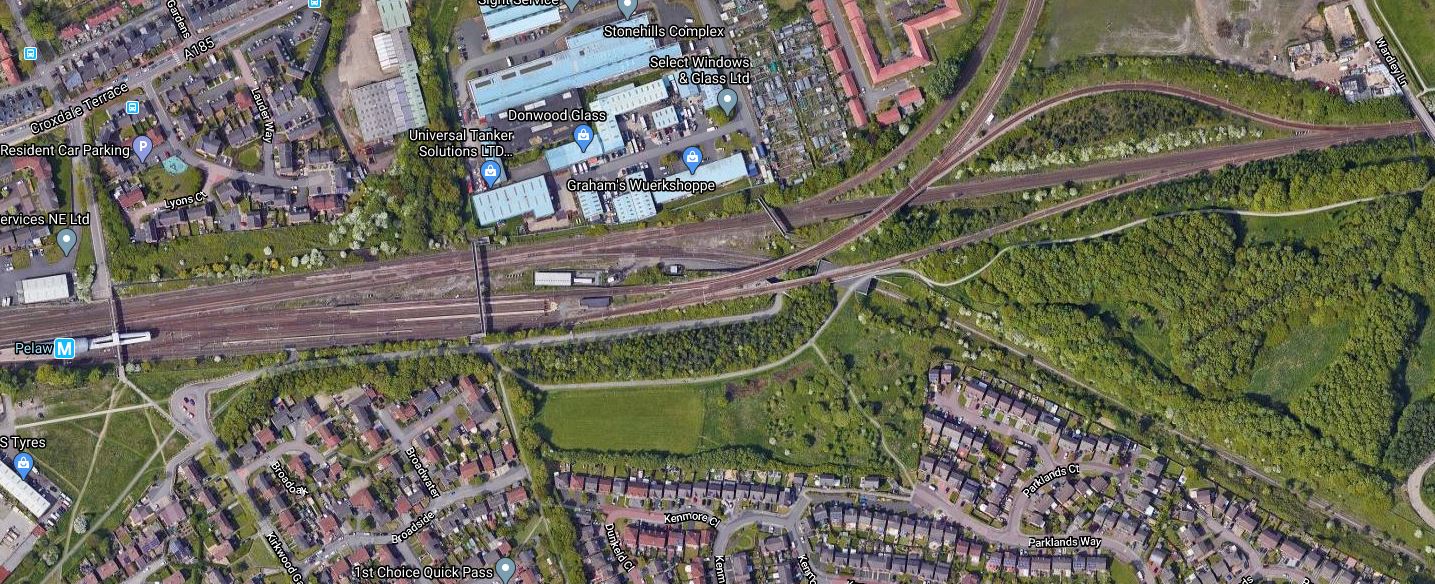
Note.
- Pelaw station on the Western edge of the map marked by a blue M.
- The Durham Coast Line running East-West across the map.
- The tracks going North from the junction in the middle of the map are the Tyne and Wear Metro to South Shields station and a freight line to Jarrow.
- At the Eastern edge of the map, Pelaw Metro Junction can be seen, where the Metro and the Durham Coast Line join to continue through Sunderland to their respective terminals.
- The Leamside Line can be picked out running from the major junction in the middle to the South East corner of the map.
This second Google Map shows an enlarged view of the Pelaw Metro Junction.
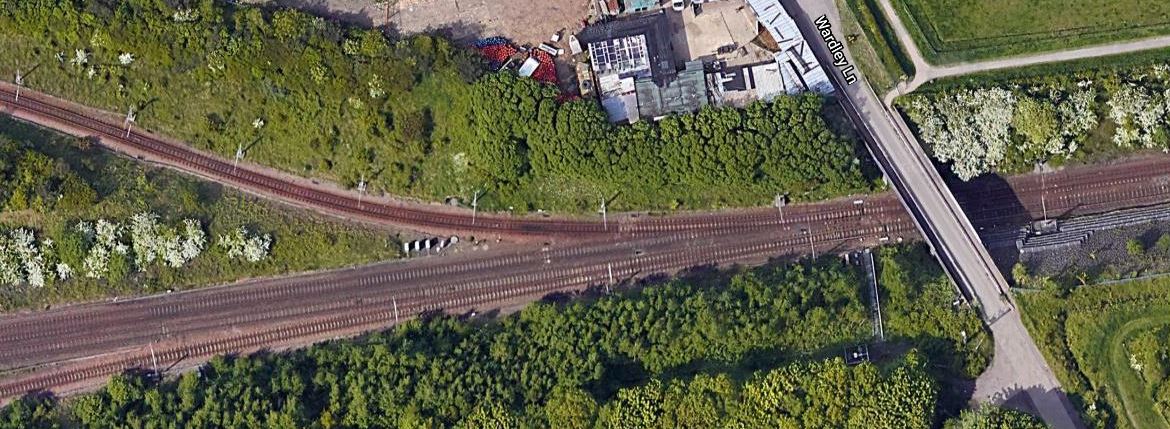
It appears to be a flying junction of the highest class, despite being built in the days of cash-strapped British Rail. Note the two outside Metro lines with their electrification merging with the central Durham Coast Lines, that have no electrification.
- The route is electrified using the Metro’s 1500 VDC overhead system from here until the Metro branches off to South Hylton station.
- The Metro and the other trains through the area, use a version of the Karlsruhe model for the signalling, so effectively, the Metro is running as a tram-train.
When the Metro has received the new Stadler trains, it will be possible to electrify the Durham Coast Line at 25 KVAC, which would allow the following.
- Metro trains could run all the way to Middlesbrough, using their dual-voltage capability.
- Metro trains could also run directly into Newcastle station, using the Durham Coast Line.
Voltage changeover would take place in Pelaw station.
Pelaw And Washington
The route of the Leamside Line South from Pelaw to Washington is more or less intact, although it does look in need of tender loving case.
This Google Map shows the section through Follingsby, where there used to be a Freightliner terminal.
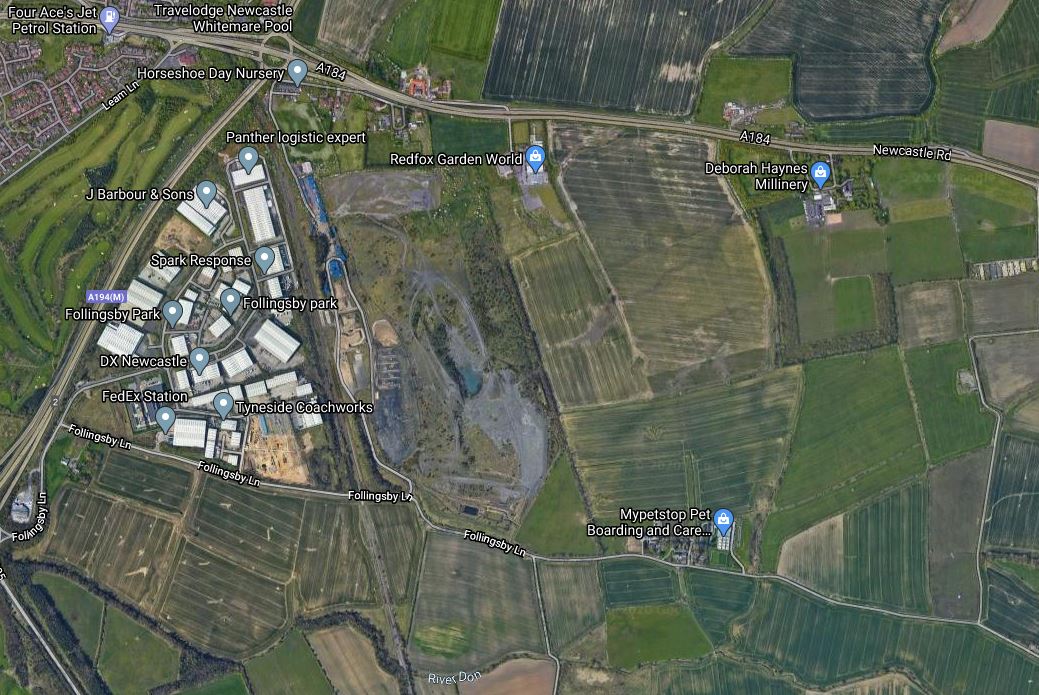
Note.
- The whole area, including a former opencast coal time, is being developed.
- Amazon are building a fulfilment centre on the site of the Freightliner terminal.
- The Leamside Line runs North-South through the complex road junction at the top of the map.
This second Google Map shows the area South of the previous one and shows the Leamside Line as it passes to the West of the Nissan plant at Sunderland.
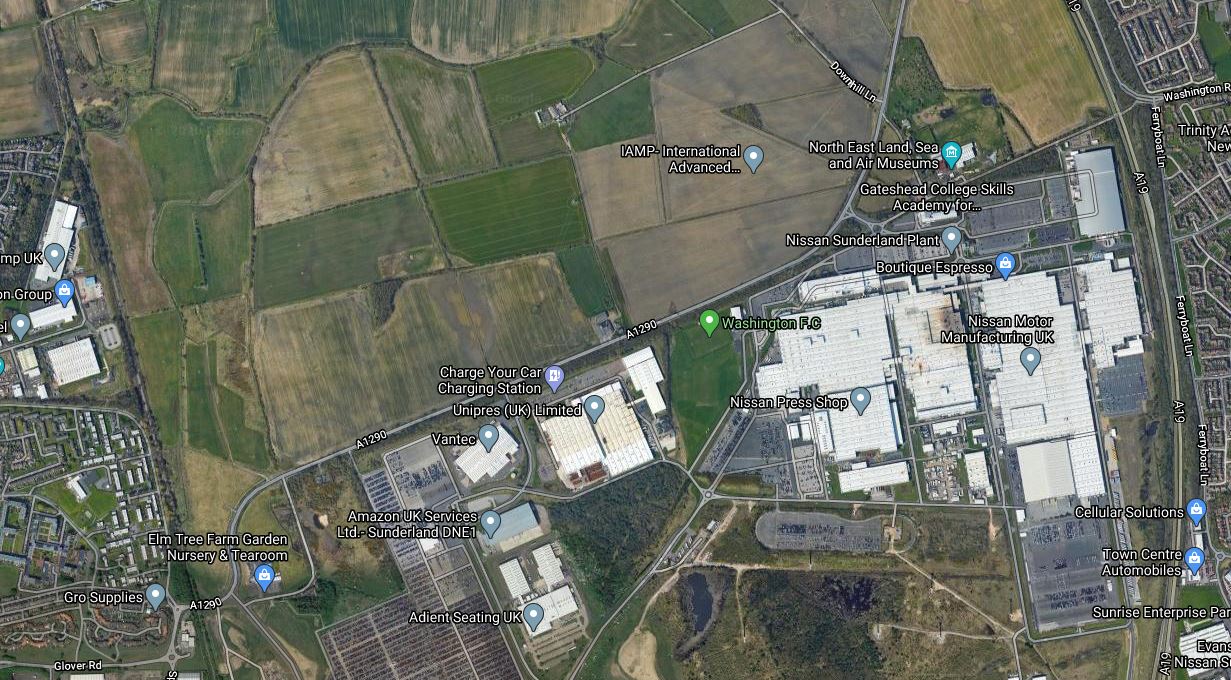
Note.
- The Leamside Line runs down the Western side of the map.
- The Nissan plant to the East, with a sausage =shaped feature in the South-West corner of the site.
- North of the Nissan plant an area has been earmarked for the International Advanced Manufacturing Park, which is currently the site of the NHS Nightingale Hospital NE.
It would appear discussions are underway to connect the Advanced Manufacturing Park to the Metro. But surely, with all the development alongside the line, there must be a need for perhaps three stations between Nissan and Prlaw.
This third Google Map shows Washington and its position with respect to the Nissan plant.
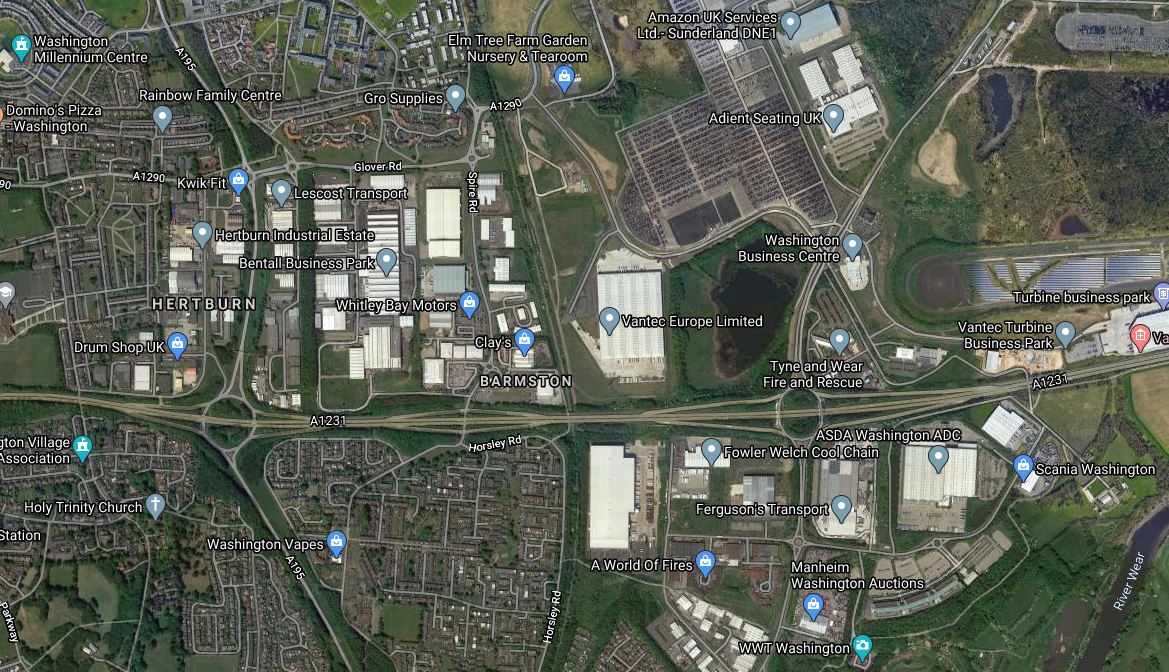
Note.
- The Nissan plant is to the North-East of this map and the sausage-shaped feature can just be seen.
- The Leamside Line goes North-South through the area and crosses the A1231 road, midway between the two complex junctions.
- The housing of the town of Washington in the South-West corner of the map.
There will surely be scope to put more than one station in the town of Washington, if the Leamside Line were to be reopened to passenger trains.
South From Washington
I will now continue South from Washington
The Victoria Viaduct
Going South from Washington, the Leamside Line has to cross the River Wear and it does that in spectacular fashion over the Grade II* Listed Victoria Viaduct.
This Google Map shows the crossing.
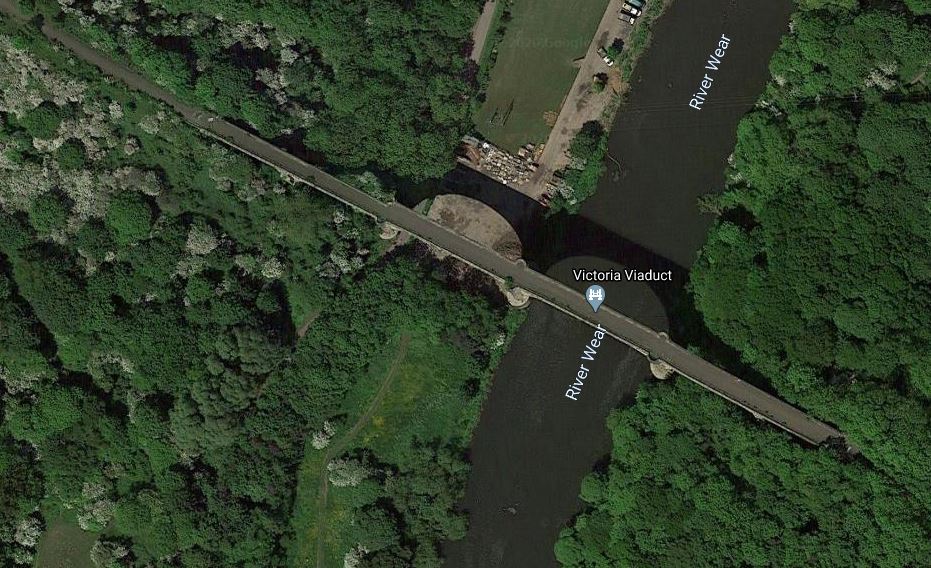
Note.
- Network Rail have maintained the viaduct since it was mothballed in 1991.
- It used to carry a double-track railway.
- The viaduct must have handled an occasional InterCity125.
I would be very surprised if a restored Victoria Viaduct couldn’t handle a five-car Class 800 train or similar.
Penshaw Station
The first station on the Leamside Line to the South of the viaduct, used to be Penshaw station.
This Google Map shows the village of Penshaw.
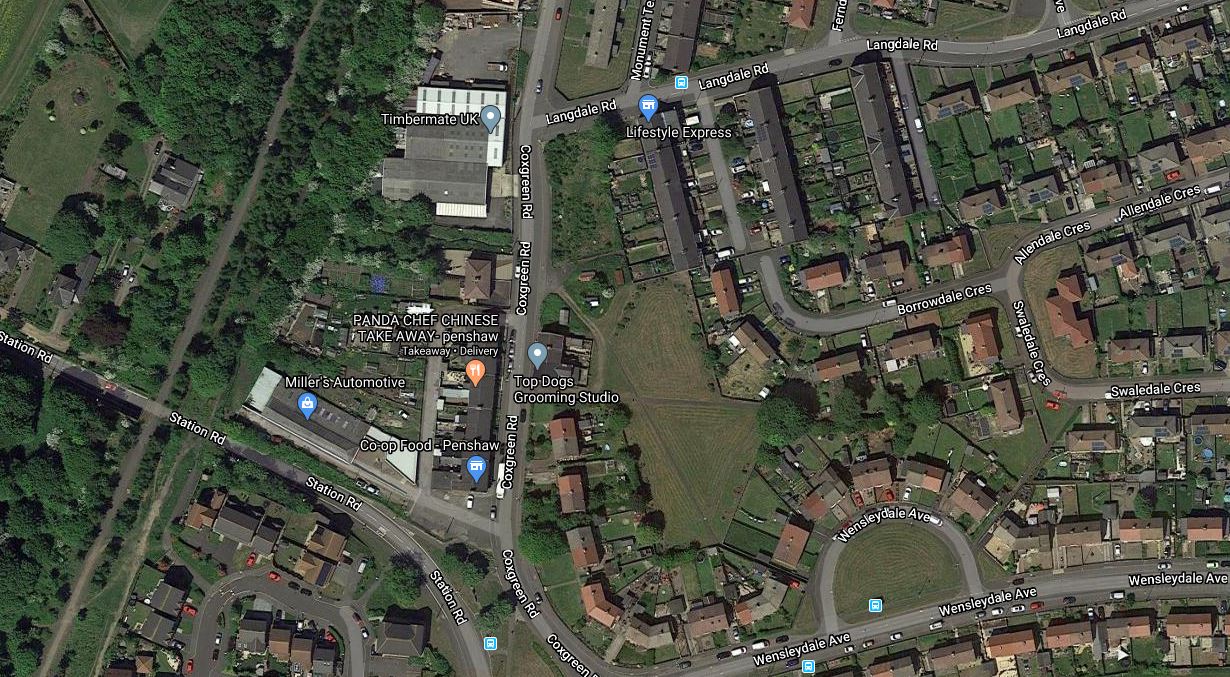
Note.
- Station Road curving around the South-West corner of the map.
- The Leamside Line crossing this road and running North-South.
I would expect a station could be built there, without too much difficulty.
Fencehouses Station
The next station to the South was Fencehouses station.
This Google Map shows the location of the station.
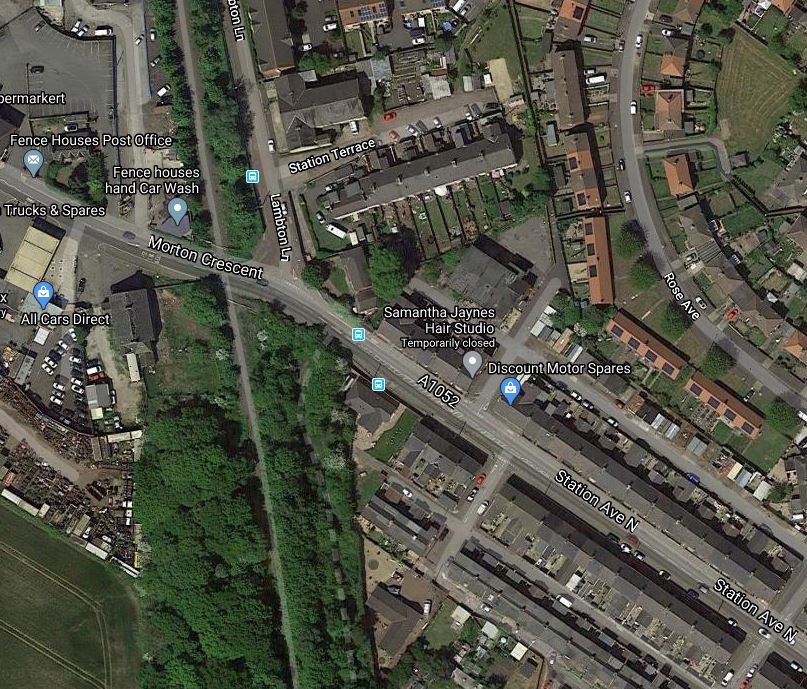
Note.
- The A1052 Road named Station Avenue North passing through the village.
- The former track of the railway passing North-South.
- According to Wikipedia, there used to be a level crossing at the station.
As with Penshaw station, I suspect a station could be built here fairly easily.
Leamside Station
The next station was Leamside station, which served the villages of Leamside and West Rainton.
This Google Map shows the station.
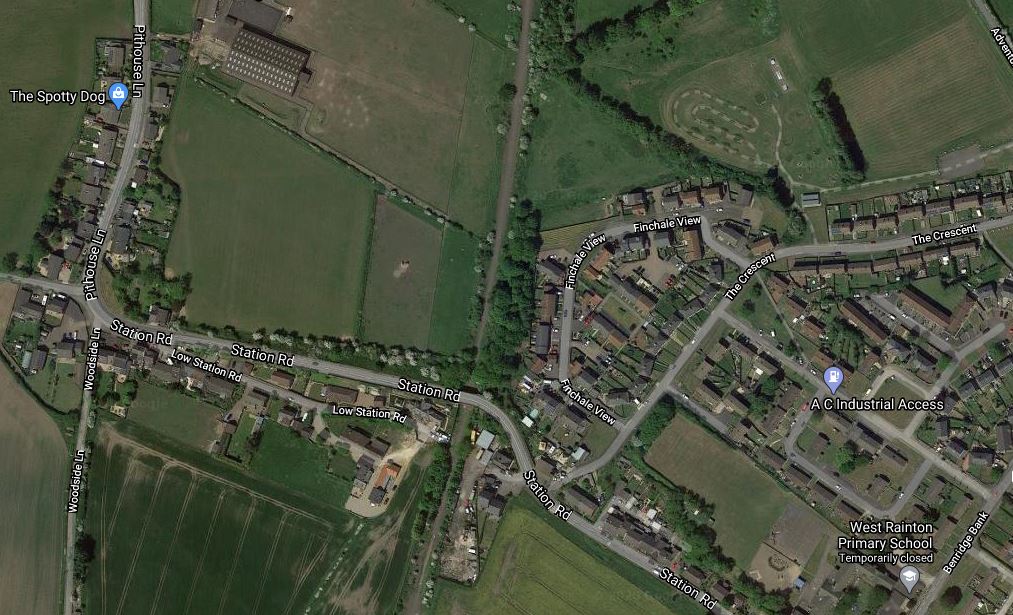
Note.
- The Leamside Line runs North-South in the middle of the map.
- Station Road can be picked out crossing the railway.
- Leamside is to the West of the Leamside Line.
- West Rainton is to the East of the Leamside Line.
It looks to be another station, that can be rebuilt without difficulty.
A Choice Of Routes At Belmont
The next station coming South on the Leamside Line used to be Belmont station.
This Google Map shows the site of the original station.
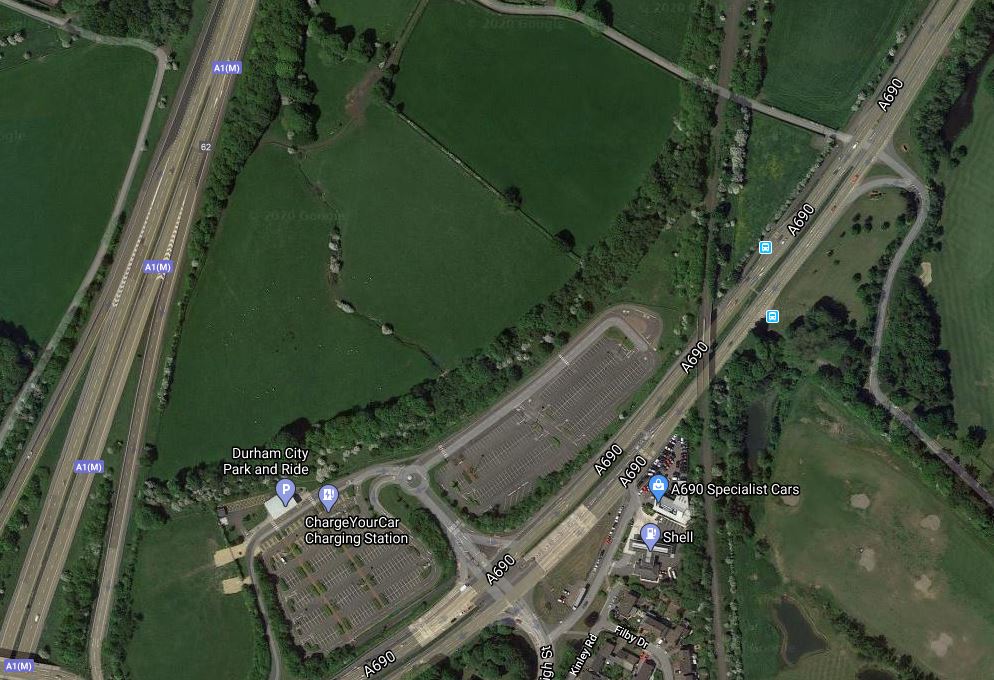
Note.
- The area is dominated by the two major roads; the A1(M) and the A690.
- In the vee of the roads, the Belmont Park-and-Ride site for Durham City is situated.
- The Leamside Line passes to the East of the Park-and-Ride.
- It appears that there is already a bridge to carry the Leamside Line over the A690.
There used to be a direct line between Belmont and Durham Gilesgate stations and the remains of the track-bed can be picked out, as it passes to the North of the Park-and-Ride.
There must surely be possibilities for some innovative thinking to connect Belmont, Durham, Newcastle and Washington.
But a simple station at the Park-And-Ride could be the best!
- Travellers living along the Leamside Line could use the buses at the Park-and-Ride to get to Durham City.
- The station would become a Parkway station for travellers going to Gateshead, Newcastle, Sunderland, Washington and anywhere on the Tyne and Wear Metro.
There would appear to be space for more parking, if that were to be needed.
An Alternative Direct Route Between the Leamside Line and the East Coast Main Line.
This Google Map shows the Leamside Line to the North of Belmont and the area to the West of the Line.
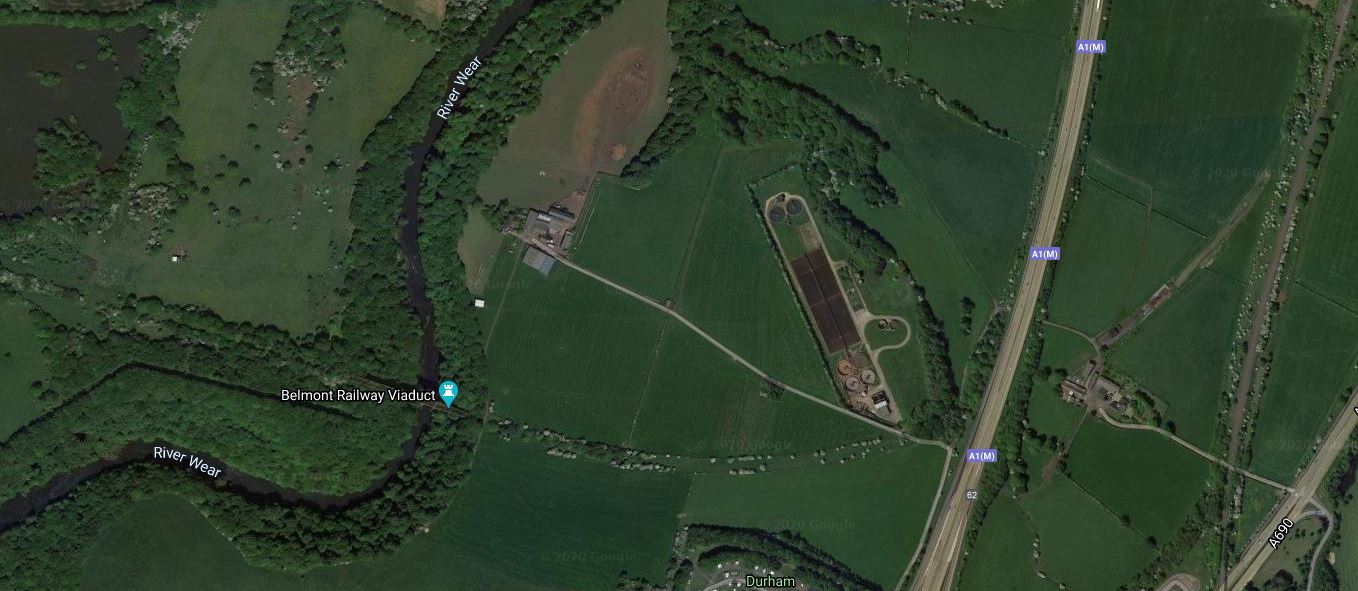
Note.
- The A1 (M) running North-South.
- The Leamside Line running North-South to the East of the motorway.
- The Grade II Listed Belmont Railway Viaduct marked by a blue arrow crossing the River Wear.
The remains of the trackbed of a railway can be picked out between the Leamside Line and the Belmont Railway Viaduct.
This second Google Map shows the area between the Belmont Railway Viaduct and the ECML.
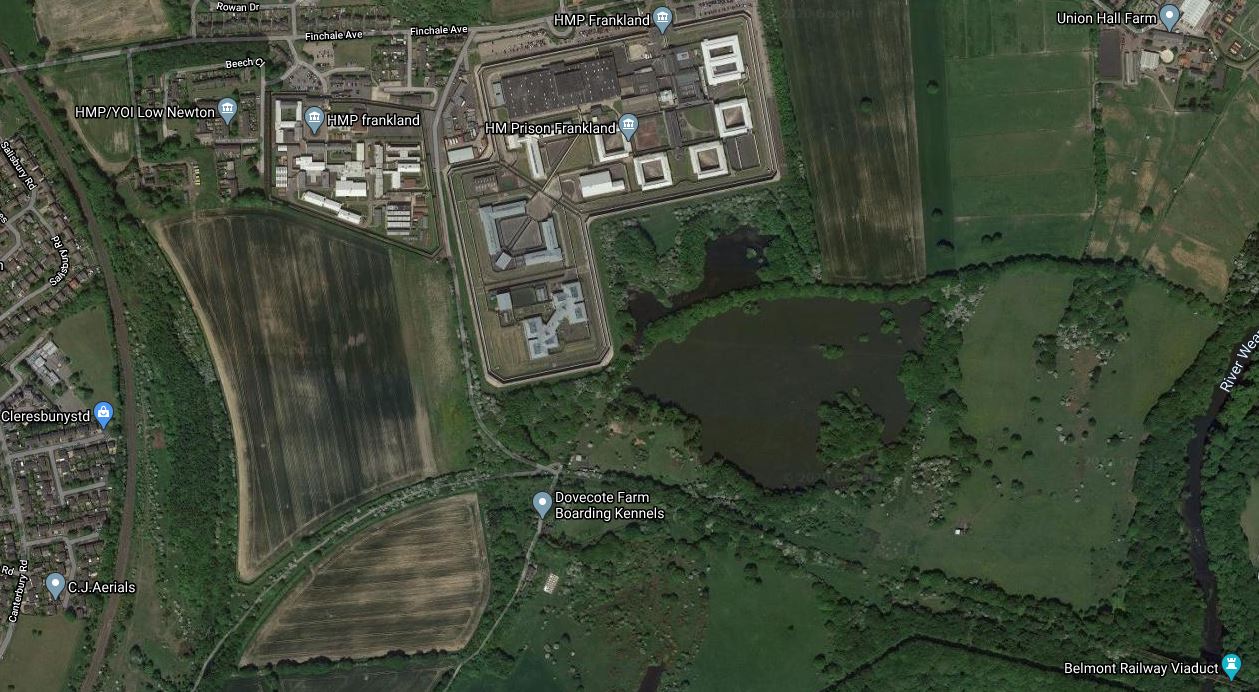
Note.
- HM Prison Frankland at the top of the map.
- The ECML running down the West side of the map.
- The Belmont Railway Viaduct in the South-East corner of the map.
The trackbed between the ECML and the railway viaduct can be picked out.
Could The Line Over The Belmont Railway Viaduct Be Rebuilt To Create A Route Between Durham And Newcastle?
- Looking, where the railway would need to cross the A1 (M), if appears that no provision was made for a underpass or bridge, when the motorway was built, so building one would be expensive and very disruptive.
- Creating a flying junction to connect the new line to the ECML would be another expensive and disruptive project.
- What is the condition of the Belmont Railway Viaduct?
- Would it be better to build an interchange station at the Belmont Park-And-Ride?
I feel that it would be unlikely that this route will be rebuilt.
South From Belmont
I will now continue South from Belmont station.
Shincliffe Station
The next station going South was Shincliffe station.
This Google Map shows the village of Shincliffe.

Note.
- The A177 road running NW-SE across the map.
- The Leamside Line running SW-NE across the map.
- The original station was where was road and railway crossed.
The Leamside Line continues South to Tursdale Junction, where it joins the ECML.
This Google Map shows Tursdale Junction.
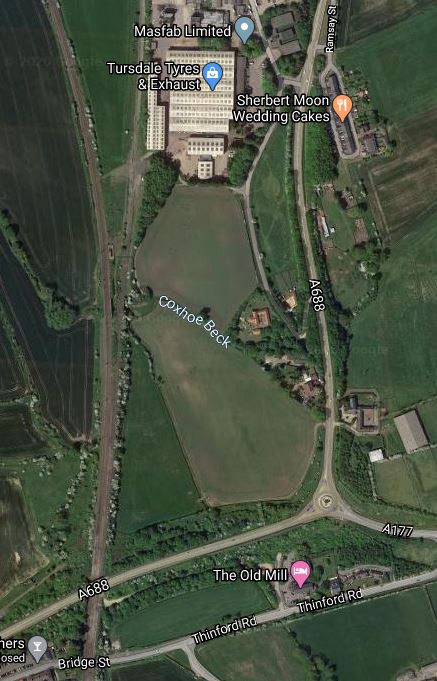
Note.
- Ferryhll is to the South.
- The ECML runs North to Durham and Newcastle in a slightly North-Westerly direction.
- The Leamside Line goes to Washington in a Northerly direction.
This second Google Map shows the ECML through Ferryhill.
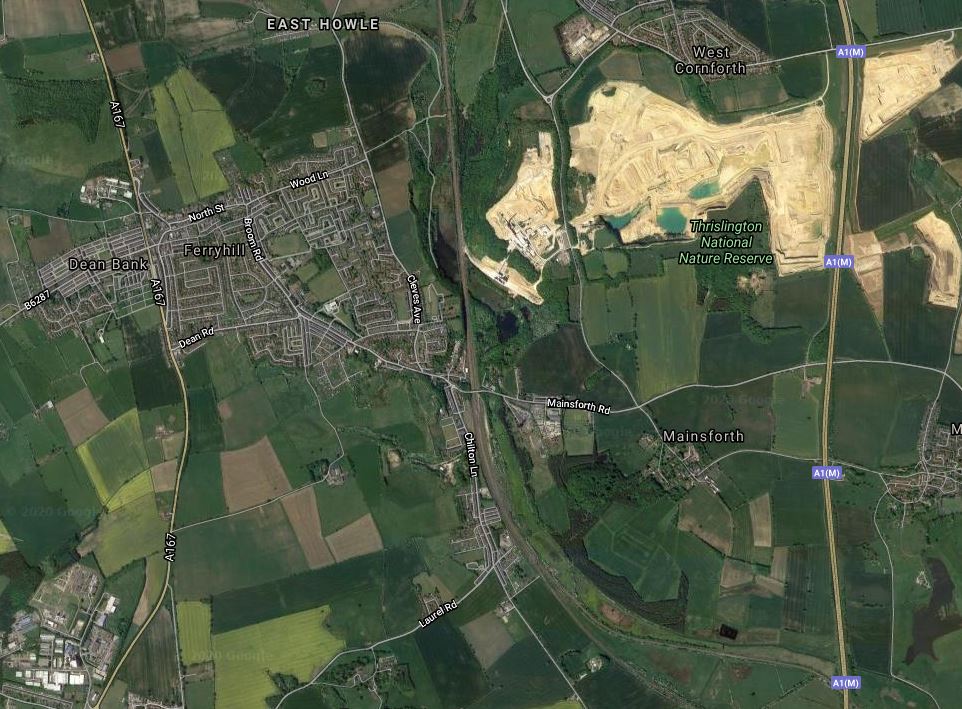
Note.
- The sand quarries opposite the village, that are planned to be used for landfill.
- The ECML runs North-South between the village and the quarries.
- There are two railways going South from Ferryhill.
- The ECML goes South to Darlington, York and beyond.
- The Stillington Railway goes South-East to Stockton and Hartlepool.
The Campaign for Better Transport have given a high priority for reopening passenger services between Ferryhill and Stockton.
Thoughts On The Reopening Of Ferryhill Station
The closing of routes linking to Ferryhill station seems to have been almost a continuous process.
- Coxhoe – 1902
- Byers Green Branch beyond Spennymoor – 1939
- Leamside Line – 1941
- Spennymoor – 1952
- Stockton – 1952
- Harlepool – 1952
Beeching finally put the station out of its misery in 1963
But things are different now!
- We need to build lots of new houses all over the country. And they need transport connections!
- We need to cut our carbon emissions.
- Roads are getting more crowded and we need to provide alternative reliable public transport.
- We need to load our weapons against COVID-19.
I feel with detailed planning, a well-designed station at Ferryhill could be an asset to the North East.
These are a few thoughts.
The Leamside Line Will Be An Important Route
The route between Pelaw and Ferryhill stations will be just over twenty miles long.
- It could be easily be run with the new Metro trains.
- Trains could stop at perhaps seven or eight intermediate stations.
- I estimate a journey could take about an hour.
- South Hylton station supports at least four trains per hour (tph)
- Four tph would need eight trains.
- Trains could stop at Belmont Park-and-Ride for a frequent bus service to Durham City.
- Washington might be able to support two stations.
It would certainly be a service that would fit in with the philosophy of the Metro.
Would The Leamside Line Be Electrified?
Unless the Metro trains were to be fitted with batteries, it would need to be electrified.
Either 1500 VDC or 25 KVAC could be used!
If the Durham Coast Line and the Leamside Line were to both be electrified with 25 KVAC, the following would be possible.
- Metro trains could go to Newcastle station.
- Other electric trains could use the Leamside Line as a diversion.
- Electric freight trains could use the Leamside Line.
On the other hand, the Leamside Line would be ideal for partial electrification.
- Merseyrail’s Class 777 trains are to be fitted with batteries and these trains are closely-related to the Tyne and Wear Metro’s new trains.
- Relaying new track on the existing track bed, is not going to be the expensive part of the project.
- Electrification between Pelaw and Washington would be easy, using the 1500 VDC overhead system of the Metro.
- There may be problems from the Heritage lobby, about electrification on the Victoria Viaduct.
- Ferryhill station would be electrified as it is on the ECML.
Trains could run the sixteen or so miles between Washington and Ferryhill stations on battery power.
The Ferryhill And Hartlepool Line Could Be A Useful Passenger Route
The route between Ferryhill and Hartlepool stations will be around twenty miles long.
- There could be new stations at Sedgefield, Stillington and Stockton.
- The route is double-track throughout.
- The route joins the Durham Coast Line at Billingham.
- It must open up possibilities for business and leisure travel.
The Government and local politicians must see a future for the railways in the area, as Horden station, which is next to Hartlepool station, is reopening.
Perhaps, there are plans for a train to leave Newcastle and take this route.
- Newcastle to Ferryhill via the Leamside Line.
- Ferryhill to Hartlepool.
- Hartlepool to Newcastle via the Durham Coast Line.
Running hourly, it would connect a lot of towns with unemployment to those, where jobs are being created.
Would The Ferryhill and Hartlepool Line Be Electrified?
This route would surely only be electrified, when other lines in the area were similarly enhanced.
Electrification would not be a bad idea.
- It would allow the new Tyne and Wear Metro trains to invade Teesside.
- A Teesside Metro could be developed, that was electric-hauled, which would use the same trains as the Tyne and Wear Metro.
- Some of the many freight trains starting or finishing in the area could be electric-hauled.
- LNER and TransPennine Express could use their bi-mode trains in electric mode to Teesside.
There could be a zero-carbon alternative, as plans for hydrogen trains on Teesside seem well advanced, as I wrote about in Fuelling The Change On Teesside Rails.
Also in Northern’s Hydrogen Plans, I published this extract from an article in the March 2020 Edition of Modern Railways.
Northern has submitted planning documents, with the preferred site for a maintenance and fuelling facility understood to be at Lackenby. As hydrogen units would have a more limited operating range than DMUs (around 600 miles), they would likely need to return to the depot every night. Northern believes the routes radiating from Middlesbrough to Nunthorpe, Bishop Auckland and Saltburn are ideal candidates for the operation, as they are unlikely to be electrified and can be operated as a self contained network using hydrogen trains. A fleet of around a dozen Breeze units is planned, with the possibility they could also operate services to Whitby and on the Durham Coast Line to Newcastle. Planning documentation suggested the first hydrogen train would be ready for testing in June 2021, but this was based on construction of the depot facility beginning in January this year.
If they were to use these trains to Ferryhill, some extra stations would be needed.
Will Trains On The East Coast Main Line Stop At Ferryhill Station?
I can’t see why not!
Services between York and Newcastle call at the following stations.
- CrossCountry – Plymouth and Edinburgh calls at York, Darlington, Durham and Newcastle
- CrossCountry – Reading and Newcastle calls at York, Darlington, Durham and Newcastle
- LNER – London and Edinburgh calls at York, Darlington and Newcastle
- LNER – London and Edinburgh calls at York, Northallerton, Darlington, Durham and Newcastle
- TransPennine Express – Liverpool and Edinburgh calls at York, Darlington, Durham and Newcastle
- TransPennine Express – Manchester Airport and Newcastle calls at York, Northallerton, Darlington, Durham, Chester-le-Street and Newcastle
I suspect that with a small amount of adjustment two tph could call at Ferryhill
- If train 3 stopped, this would give a connection to London and Edinburgh
- If train 6 stopped, this would give a connection to Manchester Airport
For many stations, which could connect to Ferryhill station in the future, the station might offer the quickest and most convenient route for travellers.
Could Some Of The Old Branches From Ferryhill Be Reopened?
There were a lot of branches from the Ferryhill area to neighbouring villages, because of all the coal mines in the area.
So could some of these branches be reopened, if say there were housing or commercial developments.
This Google Map shows the ECL about a mile North of the site of Ferryhill station.
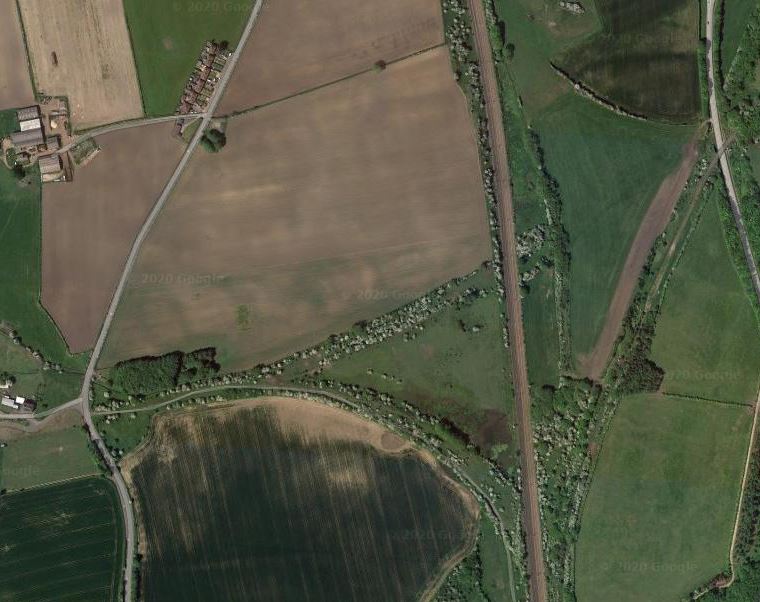
Note.
- The ECML going North-South just to the East of the centre of the map.
- Ferryhill station is to the South.
- On the Western side of the map, there is the remains of a triangular junction, which used to connect Byers Green and Spennymoor stations on the Byers Green Branch to Ferryhill.
- On the Eastern side of the map, there is a scar, which was the trackbed to Cuxhoe station.
Both branches can be picked out on Google Maps. As can roads like Railway Terrace and Station Road!
Whether any of these branches are worth reopening, is one for the planners armed with future knowledge of developments and various statistics.
Did Boris Know More Than He Said?
I have listened to Prime Ministers Questions off and on, since the time of Mrs. Thatcher.
Not often, does any Prime Minister make a substantial statement in PMQs, as they rarely have all the facts at their fingertips and don’t want to be called to account later.
In response to a direct question from a local MP, about the opening of Ferryhill station, Boris after usual PMQ waffle, said this.
I will make sure that I add to that an ambition to come and see Ferryhill station launched with him.
As decisions on the Leamside Line and hydrogen trains for Teesside have been delayed for months or possibly years, I wondered, if the decision has recently been made.
- If the plan had been discussed in Cabinet, Boris would surely have known more.
- A government minister was also seen on the BBC News at Horden station having a look, last week.
- The tone of the Sunderland Echo article is also very positive.
All that prompted me to write this post.
Conclusion
After looking at the Leamside Line and other railways in the North East, I think there is a lot that can be done to create a world-class local railway in the area.
Universities Study Options For Battery Traction To Replace Diesel
The title of this post, is the same as that as this article on Railway Gazette.
This is the introductory paragraph.
A three-month study of the extent to which battery-powered trains could replace diesel traction in Germany is being undertaken through a collaboration between rolling stock financing company Rock Rail, Technische Universität Dresden and the UK’s University of Birmingham.
In some ways, two Universities and one rolling stock leasing company are strange bedfellows for a study of trains in Germany.
But then Rock Rail are a very successful and surprisingly innovative company, who appear to know their trains. This sentence, is taken from the home page of their web site.
Rock Rail works closely with the franchise train operators and manufacturers to ensure a collaborative approach to design, manufacture and acceptance of the new state of the art trains on time and to budget.
They have certainly been involved in several large fleet orders in the last few years.
I have a feeling that this study will lead to sensible and workable conclusions, that may well have lessons for the UK.
Alstom And Snam To Develop Hydrogen Trains In Italy
The title of this post, is the same as that of this article on H2 View.
This paragraph sums up the agreement.
As part of the agreement, Alstom will manufacture and maintain newly built or converted hydrogen trains, while Snam will develop the infrastructures for production, transport and refuelling.
It does appear that Alstom is setting up similar deals across Europe, with now Germany, the Netherlands, the UK and Austria being prepared for hydrogen trains, manufactured or converted by Alstom.
The only recent reference, that I can find to the Alstom Breeze for the UK, is this article in Electric And Hybrid Vehicle Technology International, which is entitled Is Post-Covid The Perfect Time To Start A Hydrogen Transportation Revolution?
There is just a new visualisation pf the train to illustrate an article.
A Timeline Of Hitachi’s Statements And News About Battery Trains
These are posts on this blog, that reference articles about Hitachi and battery trains.
21st November 2018 – Hitachi’s Thoughts On Battery Trains – Modern Railways Modern Railways January 2018 – Candid interview with Nick Hughes of Hitachi.
21st March 2019 – Trains Ordered For 2021 Launch Of ‘High-Quality, Low Fare’ London – Edinburgh Service – Railway Gazette – Announcement of service, but no mention of batteries, diesel or bi-mode.
26th March 2019 – Hitachi Plans To Run ScotRail Class 385 EMUs Beyond The Wires – Rail Engineer – Batteries for Class 385 trains.
1st January 2020 – Hitachi Trains For Avanti – Modern Railway January 2020 – The Hitachi trains for Avanti West Coast can be fitted with batteries, if required.
16th February 2020 – Sparking A Revolution – Rail Magazine Issue 898 – Informative interview with Andrew Barr of Hitachi.
16th April 2020 – First of Five FirstGroup Class 803s Arrives In UK – Rail Magazine Issue 903 – Disclosure that the Class 803 trains will use a battery instead of diesel power for on-board services, but not traction power.
Hitachi seem to have opened up gradually with more information.
‘Chernobyl’ Fears Dismissed As Herne Bay Hydrogen Plant Bid Approved
The title of this post, is the same as that of this article on Kent Online.
it would appear that Kent Online got their prediction right. that I wrote about in Hydrogen Power Plant Bid In Herne Bay Set For Green Light From Canterbury City Council.
Thoughts On East Coast Trains
According to an article and a picture, the second new Class 803 train for Open Access Operator; East Coast Trains, has arrived in the UK to be fitted out at Newton Aycliffe.
These are my thoughts on the service.
The Trains
The Class 803 trains are similar to the other Hitachi A-trains running in the UK, but with two big differences.
- They will have a one class interior and they will be fitted with a battery, instead of a diesel engine.
- The battery is not for traction and is to provide hotel power in stations and in the event of a dewiring. The latter has been surprisingly common on the East Coast Main Line in recent years.
Normally, these five-car trains are fitted with a single MTU 12V 1600 R80L diesel engine, which is described in this datasheet on the MTU web site.
The mass of the engine is given as 6750 Kg, when it is ready to run.
It would seem logical to replace the diesel engine with a battery of the same weight. I’ll use seven tonnes, as the fuel tank won’t be needed either.
This page on the Clean Energy institute at the University of Washington is entitled Lithium-Ion Battery.
This is a sentence from the page.
Compared to the other high-quality rechargeable battery technologies (nickel-cadmium or nickel-metal-hydride), Li-ion batteries have a number of advantages. They have one of the highest energy densities of any battery technology today (100-265 Wh/kg or 250-670 Wh/L).
Using these figures, a seven-tonne battery would be between 700 and 1855 kWh in capacity.
Incidentally, the power output of an MTU 12V 1600 R80L is 700 kW.
In Sparking A Revolution I gave Hitachi’s possible specification of a battery-electric train.
- Range – 55-65 miles
- Performance – 90-100 mph
- Recharge – 10 minutes when static
- Routes – Suburban near electrified lines
- Battery Life – 8-10 years
These figures are credited to Hitachi.
Doing a quick calculation, it would appear that.
- A 700 kWh battery could supply the same power as the diesel engine for an hour.
- A 1855 kWh battery could supply the same power as the diesel engine for two hours and thirty-nine minutes.
I am drawn to the conclusion, that although Hitachi say the battery is not for traction purposes in a Class 803 train, that a battery the same weight as the current diesel engine, would be a very adequate replacement.
If say, you put a 300-500 kWh battery in a Class 803 train, it would probable give enough hotel power until the train was able to move again. but it would also reduce the weight of the train and thus improve the acceleration in normal running.
A Battery Module
I wouldn’t be surprised if Hitachi are developing a battery module, that can replace the MTU 12V 1600 R80L diesel engine.
- The module would be used for both traction and hotel services on the train.
- It would be charged from the electrification or by regenerative braking.
- It would act as emergency power.
- To the driver and the train’s computer, it would have similar performance to the diesel engine.
The diesel engine and the battery module would be plug-compatible and could be exchanged as required.
I can do a quick calculation for a 1000 kWh battery, which would weigh under four tonnes.
- A 1000 kWh battery would provide 700 kW for 86 minutes.
- At 90 mph, the train would travel for 129 miles.
- At 100 mph, the train would travel for 143 miles.
That would be a very handy extended range.
As East Coast Trains will only run on a fully-electrified route, they have no need for the traction capability.
- But it would fit well with the routes of Avanti West Coast, East Midlands Railway, Great Western Railway, Hull Trains, LNER and TransPennine Express.
- All except East Midlands Railway and LNER, share part or full ownership with East Coast Trains.
It does look to me, that Hitachi is using East Coast Trains and their fully electrified route to give the battery module for the trains, a thorough work-out, on a route, where it will not normally be needed.
The Proposed Service
From various sources we know the following.
- There will be five trains per day in both directions between London Kings Cross and Edinburgh. – See Wikipedia
- East Coast Trains have ordered five trains. – See Wikipedia.
- There will be stops at Stevenage, Durham, Newcastle and Morpeth. – See Wikipedia
- The first Northbound service will arrive in Edinburgh before 10:00. – See Rail Advent.
- Fares will be low-cost at around £25 – See Wikipedia.
It is also likely that East Coast Trains will want a journey time of under four hours, which is being planned for the route anyway under the L2E4 project.
As the record time between London and Edinburgh was set in 1991 by an InterCity 225 train at a minute under three-and-a-half hours, could a time of around three hours and forty-five minutes be possible, including the turnaround of the train?
10:00 Arrival In Edinburgh
This is obviously a good idea, but with a four hour journey time, it would mean leaving London before six.
- Perhaps to make the most of clear tracks in the morning the train would leave early.
- Currently, the first two trains from Kings Cross are the 06:15 to Edinburgh, which arrives at 11:08 and the 06:33 to Leeds.
- How early could the train leave?
I suspect that the first train to Edinburgh would leave Kings Cross around 05:30 and arrive in Edinburgh and be ready to return before 10:00.
10:00 Arrival In London
If arriving in Edinburgh before ten is a good idea, then surely arriving in London by the same time is worthwhile.
- Currently, the first train from Edinburgh to London is the 05:48, which arrives at 10:40.
As with the Northbound service, I suspect the first train to Kings Cross would leave Edinburgh around 05:30 and arrive in Kings Cross and be ready to return before 10:00.
Five Services Per Day
If the first Edinburgh and Kings Cross services left at 05:30 and after unloading and loading, were ready to return before 10:00, that would be the first service.
The simplest way to handle the rest of the day would be to split the time into four and run the trains continuously.
Suppose, the last train got to its destination at one in the morning, that would mean that fifteen hours were available for four trains or three hours and forty-five minutes for each trip between London and Edinburgh and the turnaround.
The train starting from Kings Cross would run the following services.
- Kings Cross to Edinburgh – Leaves 05:30 – Arrives before 10:00
- Edinburgh to Kings Cross – Leaves 10:00
- Kings Cross to Edinburgh – Leaves 13:45
- Edinburgh to Kings Cross- Leaves 17:30
- Kings Cross to Edinburgh – Leaves 21:15 – Arrives 01:00 on the next day.
The train starting from Edinburgh would run the following services.
- Edinburgh to Kings Cross – Leaves 05:30 – Arrives before 10:00
- Kings Cross to Edinburgh – Leaves 10:00
- Edinburgh to Kings Cross – Leaves 13:45
- Kings Cross to Edinburgh – Leaves 17:30
- Edinburgh to Kings Cross – Leaves 21:15 – Arrives 01:00 on the next day.
There would be two very tired trains at the end of every day, that would be looking forward to some well-deserved tender loving care.
This has been my best guess at what the timetable will be! But!
- Travellers can catch an early train, do a full days work in the other capital and return at the end of the day.
- There are three services during the day; one each in the morning, the afternoon and the early evening, for those who want affordable, slightly less frenetic travelling.
- I suspect the intermediate stops have been chosen with care.
- Improvements at Stevenage station could make the station, the preferred interchange for many between East Coast, LNER and local services for Cambridgeshire, Hertfordshire and North London. Car parking is probably easier than Kings Cross!
- Is Durham station an alternative station on the other side of the Tyne from Newcastle, with better parking?
- Could Durham City Centre be the terminal of a Leamside Line extension of the Tyne and Wear Metro?
- Newcastle station is very well-connected to all over the North East.
- Morpeth station could attract a large number of travellers from over the Border. It also looks to have space to expand the parking!
It looks a well-designed route and timetable.
How Many Trains Would Be Needed?
Consider.
- Each train could be two five-car trains working together as a ten-car train.
- This would maximise the use of paths on the East Coast Main Line.
- Four trains would be needed for the full five trains per day ten-car service.
As there is going to be a fleet of five trains, the fifth train would either be in maintenance or waiting to enter the action as a substitute.
Improving Efficiency
It looks to me, that the efficiency of this service could be improved by good old-fashioned time and motion study.
- Will drivers use stepping-up to speed the reverse of trains?
- Would cleaning teams board at Morpeth and Stevenage stations and clean the train on the last leg?
- Will the buffet be designed for fast replenishment?
- Will drivers be given all possible aids to go faster?
Every little will help!
Conclusion
I like this system and the competition will keep LNER on its toes!
Would a similar system work on the West Coast Main Line?
- Grand Union have proposed a service between Euston and Stirling stations.
- There will be stops at Milton Keynes Central, Nuneaton, Crewe, Preston, Carlisle, Lockerbie, Motherwell, Whifflet, Greenfaulds and Larbert.
- Trains will be InterCity 225s.
The service could start in 2021.
Wabtec Launches BlueFilter Air Filters For Trains
The title of this post, is the same as that of this article on Railway Gazette.
This is the introductory paragraphs.
Wabtec Corp has launched BlueFilter, a filter designed to be retrofitted to current passenger train HVAC systems to ensure the provision of clean air on board.
The company says it can remove contaminants that are .01 to 1 000 μm size, smaller than current standard filters and including bacteria, dust and viruses.
Does viruses include COVID-19?
This Press Release on Wabtec’s web site gives more details.
BlueFilter’s design removes contaminants that are .01 to 1,000 micrometers in size. That includes allergens, bacteria, various dusts and viruses. By comparison, today’s standard filters typically only remove particles that are between 10 to 1,000 micrometers in size, which only includes contaminants such as pollen, most dusts and some bacteria.
It certainly gets down to the nitty-gritty.
Crossrail Trains Cleared To Use The Heathrow Tunnel
This title of this post, is the same as that of this article on Ian Visits.
These are the first four paragraphs.
Last month, a significant achievement took place on the Crossrail project, which is far more important than the headlines make it seem to be.
At a basic level, the Office of Rail Regulation approved the use of the new Class 345 trains that will be used on the Elizabeth line to carry passengers into the Heathrow tunnels.
The practical implication being that TfL Rail will in the next few weeks be able to run from Paddington to Heathrow direct, as they were supposed to start doing back in May 2018.
The delay has been caused by the bane and saviour of modern railways, the signalling system.
Ian then goes on to give a full and understandable explanation of the complex nature of modern rail signalling.
Ian finishes by giving a detailed description of the Class 345 trains‘ Auto-Reverse feature.
Around half of westbound trains will terminate at Paddington, but to head back eastwards, once all the passengers are off, they carry on westwards to Westbourne Park, then return back to Paddington on the eastbound line.
Normally that means the train driver would drive to Westbourne Park, stop, walk through the train to the other end, then drive back. But with “auto-reverse”, as soon as the train leaves Paddington, the driver switches to automatic and starts walking through the train to the other end. By the time the train arrives at Westbourne Park sidings, the driver will be sitting in the drivers cab at the other end of the train ready to head back into Central London.
I feel we need more automation on trains.
Possible Uses Of Automation
These are some possibilities.
Reversing In Services
Several services, require the driver to change ends and then drive the train from the other end, when calling at a station.
- Some Nottingham and Skegness services, reverse in Grantham station.
- Maidenhead and Marlow services, reverse in Bourne End station.
- Norwich and Sheringham services, reverse in Cromer station.
I could envisage an automatic system, that took the train from A to B to C etc. under the control of the driver.
- They might just touch a screen or button to move to the next station, as drivers have done on the Victoria Line.
- Both cabs would have a remote video screen showing the view from the other end of the train.
- The driver could drive the train from either cab.
- Arriving at a station, the automation would stop the train in the correct position.
- As on a Victoria Line train, the driver would monitor the system at all times and take control and drive manually, if required.
- The driver might also have a sophisticated remote control, so that if he needed to walk through the train to change cabs, he would still be in full control.
The guard might also have a remote control, for use in the very rare case of driver incapacitation, where he would need to halt the train.
Shuttle Services
There are services in the UK, where a single train shuttles between two stations.
- Brockenhurst and Limington Pier – 11 minutes
- Grove Park and Bromley North stations – 5 mins
- St. Erth and St. Ives stations – 10 mins
- Slough and Windsor & Eton Central – 6 mins
- Sudbury and Marks Tey – 19 mins
- Twyford and Henley stations – 12 mins
- Watford Junction and St. Albans Abbey – 16 minutes
Note.
- The time shown is the time for a single journey.
- All these services use a single train, where the driver changes ends before each journey.
- The services use a dedicated platform at both terminals.
- There is a dedicated track between the terminals.
- Some of these services may need a more frequent service.
If the driver doesn’t change ends, would the time saved allow more trains per hour (tph)?
I think the following improvements are possible.
- Grove Park and Bromley North – three tph to four
- Slough and Windsor & Eton Central – three tph to four
- Watford Junction and St. Albans Abbey – If the journey time could be reduced to fourteen minutes or less, there is a chance that the service could be doubled to two tph.
It looks that if the driver change ends, then it appears the following frequencies are possible, with these journey times.
- Less than six-and-a-half minutes – four tph
- Less than nine minutes – three tph
- Less than fourteen minutes – two tph
I do wonder if an automated shuttle on the Abbey Line could run at the required two tph, with only minimal infrastructure works.
 The Anonymous Widower