ORR: Open Access Services Given Green Light Between London And Stirling
The title of this post is the same as that of this press release from the Office of Rail and Road.
This is the sub-heading.
The latest access decision by the Office of Rail and Road (ORR) provides more services for rail passengers travelling between London and central Scotland.
These five paragraphs detail the ORR’s decision.
ORR has today (7 March) given the go-ahead for Grand Union Trains, an open access operator, to start a new train service between London and the city of Stirling, from June 2025. ORR’s decision will offer more choice to passengers, bring private sector investment to the railway and increase competition.
Grand Union Trains will introduce four new return services per day between London Euston and Stirling stations. These services will also call at Milton Keynes Central, Nuneaton, Crewe (subject to agreement between Grand Union Trains and Network Rail), Preston, Carlisle, Lockerbie, Motherwell, Whifflet, Greenfaulds and Larbert. Larbert, Greenfaulds and Whifflet will receive their first direct services to London.
ORR found that the proposed services would increase choice for passengers, significantly increasing direct journey opportunities to and from London and central and southern Scotland, while making use of existing capacity on the network.
The new services will be the first run by an open access operator on the West Coast Mainline. Open access operators run services independently of government funding as they do not have a franchise agreement with government.
Following ORR’s decision to approve new Grand Union Trains services between Carmarthen in south Wales and London Paddington in 2022, ORR has now approved open access services on three of Britain’s major routes.
Note.
- The Grand Union service appears to be running into London Euston. Earlier plans had it terminating at Queen’s Park station.
- Larbert, Greenfaulds and Whifflet will receive their first direct services to London.
- London Euston and Stirling is electrified all the way.
- The third open access service, that the ORR has approved is the Lumo service between King’s Cross and Edinburgh via the East Coast Main Line.
I have a few thoughts.
Stirling Is An Ideal Place To Explore Central Scotland By Train
In Stirling, I give the reasons, why I spent a couple of days in Stirling, when I wanted to visit several places in Central Scotland.
Note.
- Stirling has direct services to Aberdeen, Dundee, Edinburgh, Glasgow, Inverness and Perth.
- Aberdeen is one hour and 15 minutes away.
- Dundee is just 63 minutes away.
- Edinburgh is just 48 minutes away.
- Glasgow is just 39 minutes away.
- Inverness is two hours and 46 minutes away.
Stirling has about a dozen affordable hotels and guest houses within walking distance of the station, as this map shows.
Stirling would appear to have got Central Scotland covered.
Could The Train Serve Gleneagles?
Gleneagles is about twenty minutes North of Stirling and is served by the Caledonian Sleeper from London.
This Google Map shows the area around Gleneagles station.
Note.
- Gleneagles station is at the bottom of the map.
- The red arrow indicates the famous Gleneagles hotel.
- The pink dots are other hotels.
- Airbnb lists several very splendid properties in the varea.
Not everybody, who goes to the Gleneagles area will be exceedingly rich and I could see the Gleneagles area generating substantial business for Grand Union Trains. I suspect the best way to serve Gleneagles would be a zero-emission coach from Stirling.
Along The Motherwell And Cumbernauld Line
Between Motherwell and Stirling, a lot of the route used is on the Motherwell and Cumbernauld Line.
- The line is fully-electrified.
- It is only 28.9 miles between Motherwell and Stirling.
- \cumbernaukd and Motherwell takes 20 minutes.
I do wonder, if extra stops might be worthwhile.
Motherwell Has Good Connections To Edinburgh And Glasgow
As well as Stirling, Motherwell has good connections to both Edinburgh and Glasgow, so some passengers might find their most convenient route involves a change at Motherwell.
Nuneaton And Scotland Would Get A New Service
Nuneaton has been named by Avanti West Coast, as a place that needs more trains, as it connects with the service between Birmingham and Stansted Airport, via Coleshill Parkway, Leicester, Peterborough, March, Ely and Cambridge.
I suspect that, Nuneaton will become an interchange, between East Anglia and, the North West and West Scotland.
Milton Keynes And Scotland Should Get An Improved Service
Consider.
- It appears that all Avanti West Coast services between Milton Keynes and Scotland, go via Birmingham.
- I suspect that Grand Union’s route using the Trent Valley Line could be faster with similar trains.
- Creating a new route between Milton Keynes and Stirling could be a good move, as it gives one-change access to much of Central Scotland.
- Milton Keynes has good local connections to places like Northampton, Rugby, Tring and Watford Junction.
- Milton Keynes will be a stop on the new East-West Railway.
- From many stations, it will be quicker to go via Milton Keynes rather than Euston.
I suspect Milton Keynes could be a nice little earner.
Will Grand Union’s Trains Be Fitted With Digital Signalling?
Consider.
- At some point in the next ten years the West Coast Main Line will be fitted with digital signalling, to enable trains to run at 140 mph on selected parts of the route.

- Digital signalling will allow extra services between London Euston and Motherwell.
- Motherwell and London Euston is 388 miles.
I suspect, that Grand Union’s Trains will need to be fitted with digital signalling, so they can save time on services and possibly add in a few more.
It will add costs, although the faster speed will surely attract passengers.
Will Grand Union’s Trains Be Electric?
There are these train services going between England and Scotland.
- Avanti West Coast – London Euston to Edinburgh Waverley via Birmingham New Street – 7 tpd – Class 390 – Electric
- Avanti West Coast – London Euston to Glasgow Central via Birmingham New Street – 5 tpd – Class 390 – Electric
- Avanti West Coast – London Euston to Glasgow Central via Trent Valley – 1 tph – Class 390 – Electric
- CrossCountry – Plymouth to Edinburgh Waverley – 1 tph – Class 220/221 – Diesel – Uses diesel all the time
- LNER – London King’s Cross/Leeds to Aberdeen – 4 tpd – Class 800 – Bi-mode – Uses diesel North of Edinburgh
- LNER – London King’s Cross to Inverness – 1 tpd – Class 800 – Bi-mode – Uses diesel North of Stirling
- LNER – London King’s Cross to Edinburgh Waverley – 3p2h – Class 800 – Bi-mode or Class 801 – Electric
- LNER – London King’s Cross to Glasgow Central – 1 tpd – Class 801 – Electric
- LNER – London King’s Cross to Stirling – 1 tpd – Class 801 – Electric
- Lumo – London King’s Cross to Edinburgh – 5 tpd – Class 803 – Electric
- TransPennine Express – Newcastle to Edinburgh Waverley – 7 tpd – Class 802 – Bi-mode
- TransPennine Express – Liverpool Lime Street to Glasgow Central – 2 tpd – Class 397 – Electric
- TransPennine Express – Manchester Airport to Edinburgh Waverly – 1 tp2h – Class 397 – Electric
- TransPennine Express – Manchester Airport to Glasgow Central – 1 tp2h – Class 397 – Electric
Note.
- tpd is trains per day.
- tph is trains per hour.
- tp2h is trains per two hours.
- LNER services to Glasgow and Stirling are likely to be dropped.
- Some Lumo services are likely to be extended from Edinburgh to Glasgow.
- Many services South from Stirling to Edinburgh Waverley and Glasgow Queen Street are electric.
The current two tpd direct trains to Stirling are electric and if you change at Edinburgh Waverley or Glasgow, it is likely to be an all-electric service.
For marketing reasons, I would recommend, that Grand Union Trains ran electric trains between London Euston and Stirling, as they are competing against an all-electric service.
Although to meet service dates it might be necessary to run something like a diesel Class 222 train to get the service started.
What Trains Will Grand Union Use?
The Wikipedia entry for Grand Union Trains, says this for their London Euston and Stirling service.
In 2023 Grand Union revised its proposal changing its planned rolling stock to Class 22x units, at the same time the start date for this service was changed to June 2025.
I would suspect they will put in the order for new electric trains fairly sharpish.
The new trains could be.
- A variant of Hitachi’s Class 800 trains.
- A variant of CAF’s Class 397 trains.
Would they have an emergency battery un case of overhead line failure?
How Long Will A Service Take?
The service can be divided into two sections.
- London Euston and Motherwell – 388 miles.
- Motherwell and Stirling – 28.9 miles.
Note.
- The 08:30 train from Euston to Motherwell takes 4 hours and 17 minutes with six stops via Nuneaton.
- The Grand Union Trains service will also have six stops and go via Nuneaton.
I would expect with today’s signalling and electric trains, that Euston and Motherwell would take a maximum of 4 hours and 17 minutes.
- The twenty minute time to Cumbernauld could be added.
- The twenty-five minute time between Cumbernauld and Stirling could be added.
It looks the time would be just over five hours.
I doubt there would be much scope for increasing speed North of Motherwell, but could there be savings made to the South of Motherwell?
Consider.
- London Euston and Motherwell is 388 miles.
- Four hours and 17 minutes is 257 minutes.
- Motherwell is on the main London Euston and Glasgow Central route.
This is an average speed between London Euston and Motherwell of 90.6 mph.
By comparison.
- London King’s Cross and Edinburgh is 392.6 miles.
- Journeys can take four hours and 20 minutes or 260 minutes.
This is an average speed between London King’s Cross and Edinburgh of 90.6 mph.
In the next decade, there will be improvements on both the East and West Coast Main Lines.
- King’s Cross and Edinburgh is currently being digitally signalled.
- London Euston and Glasgow Central is likely to be an early priority for digital signalling after London King’s Cross and Edinburgh is completed.
- When High Speed Two opens to Birmingham and Lichfield, High Speed Two trains between London Euston and Glasgow Central will use the West Coast Main Line to the North of Lichfield.
- I wouldn’t be surprised to see some track realignment and modifications to improve speeds on the West Coast Main Line to the North of Lichfield.
I can build a table of times between London Euston and Motherwell against average speed.
- 90 mph – 4 hours 19 minutes
- 100 mph – 3 hours 53 minutes
- 110 mph – 3 hours 32 minutes
- 120 mph – 3 hours 14 minutes
- 125 mph – 3 hours 6 minutes
- 130 mph – 2 hours 59 minutes
Note.
- Adding 15 minutes gives a London Euston and Glasgow Central time.
- Adding 45 minutes gives a London Euston and Stirling time.
- Averaging 120 mph would give London Euston and Glasgow Central or Stirling times of under four hours.
It strikes me, that to improve Anglo-Scottish relations and to make rail a better alternative to flying, a priority for all West Coast services is to improve the West Coast Main Line and install digital signalling, so that a 120 mph average is possible between London Euston and Motherwell.
What Difference Will High Speed Two Make?
High Speed Two is claiming it will knock thirty minutes off times between London Euston and Glasgow Central, when it opens to Birmingham and Lichfield.
But Grand Union Trains are not expected to use the new line between London Euston and Lichfield, as High Speed Two will, as it will make calling at Milton Keynes and Nuneaton impossible, as they are bypassed by High Speed Two.
Conclusion
This train service is going to be good for Milton Keynes, Nuneaton and Stirling and all the towns in Central Scotland.
But they must make full use of the available electrification.
Scrap Rail Caused Train Derailment – Network Rail
The title of this post, is the same as that of this article on the BBC.
These three paragraphs introduce the story.
Scrap rail left on tracks following engineering works was the cause of a derailment in Surrey, according to Network Rail.
The company said a train hit the object at about 05:50 GMT on Monday in a 90mph area near Walton-on-Thames.
A Network Rail Wessex safety bulletin said it was the first train on the fast line following the weekend works.
I wrote about this incident before in Woking: Train Derailed On 90mph Line After Hitting Object On Track.
Someone is going to get their knuckles rapped or posterior spanked after this serious incident.
Meet The British ‘Space Inspectors’ Working For A Safe Blast-Off
The title of this post, is the same as that of this article on the Daily Telegraph.
This is the sub-heading.
A small band of professionals is keeping Britain’s £65 billion space economy in good working order
The article talks about how the Civil Aviation Authority will make sure we boldly go, with a high degree of safety, starting with these three paragraphs.
With Britain’s first vertical launch expected to lift off from Shetland this year, the UK could soon become the go-to European destination for space missions.
But behind the scenes, an army of ‘space inspectors’ is ensuring that, despite reaching for the stars, companies have their feet planted firmly on the ground.
It is the job of the Civil Aviation Authority (CAA) to make sure that things go off with a bang – but only at the right time.
Having lived through all the excitement of space exploration from Sputnik 1 in 1957 onwards.
A few decades ago, when I was in Florida, I saw a launch of the Space Shuttle.
Hopefully, I’ll be lucky enough to get to Shetland or Cornwall to see a space launch from the UK.
The Daily Telegraph article also has this paragraph.
There are more than 2,200 companies working in Britain’s £65 billion space economy from satellite manufacturers to spaceports, from software to observation. The industry has grown significantly in recent years, and is aiming to capture 10 per cent of the global space market by 2030.
I don’t think, the ten-year-old boy, that my father woke in 1957 to tell about Sputnik 1, really ever thought ever thought there would be a chance that he’d see a space launch from the UK.
But now it appears to be happening! Fingers crossed!
Cummins Inc. Selected By The UK Department Of Transport For Its High-Horsepower Methanol Vessel Retrofit Project
The title of this post, is the same as that of this press release from Cummins.
This is sub-heading.
One of Only 10 Flagship Projects Chosen in the Multi-Million-Pound ZEVI Competition Enabling Decarbonization of the UK’s Maritime Sector
These three paragraphs outline the project.
Today, Cummins Inc. (NYSE: CMI) announced the selection of its proposal to jointly develop a Methanol Kit for its QSK60 engine as part of the Zero Emission Vessels and Infrastructure (ZEVI) competition, funded by the UK Government and delivered in partnership with Innovate UK. To be chosen as one of the top 10 projects, Cummins delivered a proposal to collaborate with a major UK port and operators to develop, deploy and operate clean maritime technology solutions on the path to decarbonization and reduction to the overall greenhouse gas footprint.
The £4.4M in total funding will be leveraged by Cummins and its fellow project stakeholders — Ocean Infinity, the Aberdeen Harbour Board, and Proman AG — in the deployment of a UK-designed and built methanol conversion kit for a high-horsepower marine internal combustion engine, offering the UK an important foothold in enabling the transition to cleaner maritime fuels.
Upon completion in the second quarter of 2025, the project targets a reduction in CO2 emissions of 50 percent for offshore operations of the vessel with NOx, SOx and PM at levels considerably below those emitted by conventional fuel. Furthermore, all retrofitted dual-fuel engines will achieve compliance with IMO Tier III emission standards.
They certainly aim to get a move on to complete by mid-2025.
I have some thoughts.
Methanol Fuel
The Wikipedia entry for methanol fuel, starts with this sentence.
Methanol fuel is an alternative biofuel for internal combustion and other engines, either in combination with gasoline or independently. Methanol (CH3OH) is less expensive to produce sustainably than ethanol fuel, although it produces more toxic effects than ethanol and has lower energy density than gasoline. Methanol is safer for the environment than gasoline, is an anti-freeze agent, prevents dirt and grime buildup within the engine, has a higher flashpoint in case of fire, and produces horsepower equivalent to that of super high-octane gasoline.
Methanol certainly seems to be an environmentally-friendly fuel, when compared to alternatives.
Production Of Green Methanol
This paragraph from the Wikipedia entry for methanol fuel, explains some of the routes to make green methanol.
Bio-methanol, also known as green-methanol, may be produced by gasification of organic materials to synthesis gas followed by conventional methanol synthesis. This route can offer renewable methanol production from biomass at efficiencies up to 75%. Widespread production by this route has a proposed potential to offer methanol fuel at a low cost and with benefits to the environment. Increasingly, methanol fuel has been produced using renewable energy and carbon dioxide as a feedstock. Carbon Recycling International, an Icelandic-American company, completed the first commercial scale renewable methanol plant in 2011. As of 2018, Enerkem has been producing biomethanol through the conversion and gasification of municipal solid waste at its Edmonton facility. As of July 2023, construction for the $1 billion Varennes Carbon Recycling Plant, which will produce biofuel such as methanol through non-recyclable and timber waste, is 30 percent complete.
Surely, if the C in CH3OH, which is the chemical formula for methanol, comes from captured carbon dioxide from the atmosphere or say a gas-fired power station, methanol can be a truly green fuel.
Third Rail Or Batteries Could Replace Southern Diesel Trains
The title of this post, is the same as that of this article on Railway Gazette International.
I first wrote about the Uckfield Branch eight years ago, in Future-Proofing The Uckfield Branch.
Since then I have written about this branch several times and I have also read several articles in the railway press.
These are some of my posts.
- Discontinuous Electrification Using IPEMUs – April 30th, 2016
- Will Innovative Electrification Be Used On The Uckfield Line? – August 24th, 1917
- Battery Trains On The Uckfield Branch – August 26th, 2018
- Battery Electrostars And The Uckfield Branch – September 30th, 2019
- Alstom Hydrogen Aventras And The Uckfield Branch – November 12th, 2021
- Electroflex Battery EMU Plan To End Southern Diesel Operation – January 22nd, 2020
- Uckfield Third Rail Is NR Priority – May 2nd, 2022
- Southeastern Keen On Battery EMUs – August 12th. 2023
It is an utter disgrace that no decision has been made in eight years about how to decarbonise to Uckfield.
The Railway Gazette article says this about third-rail electrification.
GTR is one of two operators participating in a Rail Safety & Standards Board project reviewing the safety, legal and regulatory issues around third rail electrification infill projects. This is looking at whole transport system safety, project and economic risks.
Bi-monthly South of England Diesel Replacement Programme meetings are held by DfT, Network Rail and GTR to review progress and options for third rail electrification of the Uckfield line or battery train trials. This includes reviewing the lessons learned from the use of bi-mode trains by GWR and LNER, and the failed attempt to deploy tri-mode Class 769 units on GWR’s North Downs services.
Could it just be that there is such fear that there will be a major incident, where several people are killed, that third-rail electrification is always turned down, by the Office of Road and Rail?
The Railway Gazette article also says this about battery trains, under a heading of Batteries Viable.
In the absence of electrification, GTR says battery powered trains are also a viable option for its diesel routes. Batteries can be charged while trains are running on electrified lines or through a rapid recharging facility at a terminus, although additional infrastructure and electrical upgrades may be needed.
I suspect that after a few teething troubles, Merseyrail would agree.
Hydrogen is also dismissed with this paragraph.
GTR has considered hydrogen but says it can only be considered a net zero-compliant fuel if it is produced from low or zero-carbon energy sources. It is also relatively inefficient with studies indicating an efficiency rate of around 35% to 40%.
It looks to me, that battery-electric trains are a viable solution.
So would it not be a good idea to take the decision to create a battery-electric prototype from a four-car Electrostar or a Class 350 train, so that the final decision can be taken after everybody on the committee has have a ride first?
Better still, why not stage a competition, where manufacturers, leasing companies or remanufacturers can build a four-car train and enter.
Allow the public to ride in them and then see what is best against a range of criteria.
The King could even get involved, as he’s probably one of the few people left, who rode the original British Rail BEMU between Aberdeen and Ballater, to get to Balmoral.
First Look Inside £2.2bn Silvertown Tunnel
The title of this post, is the same as that of this article on the BBC.
These are the first five paragraphs.
For the first time, Transport for London has invited journalists inside what is one of the most controversial infrastructure projects in the capital.
The Silvertown Tunnel is 1.4km (just under one mile) long and stretches from Silvertown in Newham to the Greenwich Peninsula.
Inside the tunnel, it is extremely wide. A lot bigger than other tunnels like the supersewer or Crossrail. Boring was finished a few weeks ago.
Transport for London (TfL) says the scheme will address queues at the Blackwall Tunnel and reduce pollution. But it has faced fierce opposition from those who think it will do the total opposite and increase pollution and congestion.
And the big question is – even with mitigation – can a road tunnel ever be green?
Note.
- There is a good picture, showing the width of the tunnel.
- It is very wide and can’t be much narrower than the four-lane Queensway Tunnel, which was opened under Mersey in 1934.
These are my thoughts.
I Am Against The Tunnel Being Built
My main reason I am against the Silvertown Tunnel is that Transport for London’s mathematical modelling of and rerouting of buses past my house has been some of the worst I’ve seen. I talk about the bus problems I now have in Is The Nightmare On The Buses Going To Get Worse?
So until the two tunnels; Blackwall and Silvertown are complete and open with tolling, I won’t trust any of Transport for London’s pronouncements.
I also feel that as the Silvertown Tunnel will allow trucks to pass though, there will be times, when they will cut through the East End to get to the Motorways going North.
But now, it’s more or less finished, we will probably need to use it.
How Is The Tunnel Being Paid For?
The Wikipedia entry for the Silvertown Tunnel has a section called Costs, where this is said.
In 2012, the cost was stated to be £600m. A consultation in 2015 stated that the cost of construction was estimated to be £1bn. In March 2020, the cost was increased again, to £1.2 billion. Operation, maintenance and financial costs of the tunnel over 25 years is expected to cost another £1bn.
The £2.2 billion will be repaid by tolls on both tunnels. Effectively, it’s a Private Finance Initiative or PFI.
Can A Road Tunnel Ever Be Green?
This is the question the BBC asked in the last paragraph of my extract.
Although, I am very much against this tunnel, I do believe this tunnel can be green.
- Suppose, the tunnels were made free for zero-carbon vehicles, that were powered by batteries, hydrogen or possibly ammonia.
- This might nudge vehicle owners and operations to go zero-carbon.
This extra number of zero-carbon vehicles would help to clean up London’s air.
I wonder which will be the preferred route for trucks associated with construction to go to and from sites in Central London?
- These trucks are major polluters in Central London.
- There are sensible moves to make construction sites zero-carbon.
If the Silvertown Tunnel didn’t have tolls for zero-carbon trucks, then surely this would nudge, this sizeable group of trucks to go zero-carbon to the benefit of everyone in Central London.
The only problem with making zero-carbon vehicles toll-free, is that it probably ruins the finances of the tunnels, from the point of view of the investors.
Conclusion
I can see lots of conflict starting over the operation of this tunnel.
Woking: Train Derailed On 90mph Line After Hitting Object On Track
The title of this post, is the same as that of this article on the BBC.
This is the sub-heading.
Disruption has hit a rail operator’s entire network after a train hit an object on a 90mph track in Surrey.
These three paragraphs describe the derailment.
The incident initially closed four tracks between Woking and Surbiton before disruption spread across the South Western Railway (SWR) network.
Network Rail said the train hit the object at about 05:50 GMT in a 90mph area near Walton-on-Thames in Surrey.
SWR said services were impacted between London, Exeter St David’s, Portsmouth Harbour and Weymouth.
It appears that no-one was hurt.
But derailments like this have happened before.
This article from The Mail is entitled Furness Passengers Able To Walk Away From Major Rail Accident.
These paragraphs detail the story.
Furness rail passengers were woken from their slumbers 50 years ago as the carriages of an express train heading for Barrow came off the rails at 80mph.
Half-dressed and dazed sleeper-car travellers from London were led to safety up a grass embankment near Warrington in 1967.
Amazingly, not one of the passengers was killed or badly injured in what could easily have been a major disaster
The Mail on Friday, September 15, in 1967 noted: “Furness and West Cumberland passengers hung on for their lives when 11 coaches of the London-Barrow express hurtled off the rails at 80mph near Warrington today.
“The coaches bounced and zig-zagged for nearly a quarter of a mile, tearing up the permanent way and completely blocking the main London-Glasgow line.
“Miraculously, only one of the 60 passengers, who included many people from Furness and West Cumberland, was injured.
“He was Rohan Kanhai, the West Indian test cricketer, who was on his way to Blackpool.
“He was taken to Warrington Infirmary with an arm injury. After receiving treatment he was allowed to continue his journey.
I remember the story for two reasons.
- Obviously, because a well-known sportsman was involved.
- But also because British Rail put the low injuries down to new couplings between the coaches, which kept the train together.
Could it be that over fifty years after the Warrington derailment, no injuries occurred because the improved design of the train kept it all in one piece and most of the damage was to the infrastructure?
Lumo In Discussions To Operate Glasgow Services
The title of this post, is the same as that of this press release from FirstGroup.
These four paragraphs give more details.
FirstGroup, the leading private sector transport operator, today announces that its popular open access rail service Lumo is in discussions with Transport Scotland and Network Rail to extend some of its London-Edinburgh trains to and from Glasgow.
Having identified opportunities to extend a number of daily journeys to and from Glasgow in the timetables for 2025 and beyond, work will now continue with Transport Scotland and track infrastructure manager Network Rail to agree final route options and timings ahead of an application for access rights to the Office of Rail and Road (‘ORR’), the industry regulator.
If successful, the new services could be in operation from next summer.
Lumo’s proposed new offering will improve links for customers travelling between Newcastle and Glasgow, giving people a choice of services without needing to change trains. In addition, a significant number of users of Lumo’s current London-Edinburgh trains go on to travel through to Glasgow via other connections, and through this move, Lumo aims to offer a direct through service for these customers.
I have a few thoughts.
There Appears To Be A Need For An Affordable London And Glasgow Service
This is the last sentence of my extract from the press release.
In addition, a significant number of users of Lumo’s current London-Edinburgh trains go on to travel through to Glasgow via other connections, and through this move, Lumo aims to offer a direct through service for these customers.
This looks to be a service, that has been suggested by an analysis of passengers’ tickets.
Which Station Will Lumo Use In Glasgow?
Consider.
- The current LNER service between London King’s Cross and Glasgow, uses Glasgow Central station and it takes 66 minutes between Edinburgh and Glasgow Central stations.
- LNER’s service also calls at Haymarket and Motherwell.
- ScotRail services between Edinburgh and Glasgow Queen Street take about 49-50 minutes.
I suspect, that Lumo will take the faster route.

Newcastle And Glasgow Is A New Route
Currently, all passengers between Glasgow and Newcastle have to change at Edinburgh.
This will be the first direct train in my memory, except for LNER’s single daily service between London and Glasgow Central, which stops at Newcastle.
What About The Football?
Glasgow is very much about football.
Would it be possible to use Lumo to see a match starting at 15:00 on a Saturday afternoon, if you lived in London?
- The 05:48 train from King’s Cross on a Saturday arrives in Edinburgh at 10:07.
- Trains between Edinburgh and Glasgow take fifty minutes, so I feel it would be reasonable to be able to get to Glasgow by 10:57.
This time would be more than early enough to have a few swift halves and see the match if it started at 15:00.
But would it be possible to get back to London after the match?
- The last train leaves Edinburgh at 17:55 and arrives in King’s Cross at 22:26.
- Applying the fifty minute journey time between Edinburgh and Glasgow means it will leave at 17:05.
- It appears that from Ibrox and Celtic Park to Glasgow Central or Glasgow Queen Street station is about twenty minutes.
On the current timetable, it would appear to be possible, but tight.
One alternative would be to take the Caledonian Sleeper back to London. But it doesn’t appear to run on a Saturday night.
Coaches do run and an overnight coach costs around twenty pounds.
It looks like if Lumo ran a service about 18:00 on a Saturday to London, it wouldn’t run empty.
Will Lumo Need More Trains?
In the press release, FirstGroup plc Chief Executive Officer Graham Sutherland, is quoted as saying.
Once preferred route options and timings have been agreed, discussions will continue with Network Rail and the ORR to secure the required approvals. The journeys would be operated within the existing Lumo fleet of all-electric trains and it is anticipated that the additional services could begin in summer 2025.
That looks to me, that they will not be obtaining more trains before next summer.
In Ten-Car Hull Trains, I noted that some of Hull Trains services were now running as ten-car trains.
If the passenger demand is there for ten-car trains to Hull, which is almost exactly half the distance of Edinburgh, I would expect that in the future, Lumo will be running some services as ten-car trains.
In Extra Luggage Racks For Lumo, which is based on an article in the November 2023 Edition of Modern Railways, an alternative view on more trains is taken.
The Modern Railways article finishes with this paragraph.
Lumo celebrated its second birthday in late October and was also set to mark the carriage of its two-millionth passenger. It is understood Lumo is interested in augmenting its fleet, such has been the success of the service; while many operators favour bi-mode units, Lumo is proud of its all-electric credentials so straight EMUs are still preferred, although the possibilities of including batteries which could power the trains may be pursued (the ‘803s’ have on-board batteries, but only to provide power to on-board systems if the electricity supply fails).
I find this development very interesting.
As London King’s Cross and Edinburgh and Glasgow are all electric routes, in normal service batteries should not be needed, but sometimes trains have to use the diversion via Lincoln, which I have estimated is 86.5 miles.
As an electrical engineer, I’ve always believed that the emergency batteries in the Class 803 trains are very similar to the traction batteries that Hitachi are developing for the Class 802 trains.
A traction battery, that was capable of handling the diversion would stop Lumo having to cancel occasional services.
Conclusion
An extension to Glasgow looks like it could be a simple and profitable way to extend the current Lumo service.
But it might need some extra trains in the future.
A Lumo service to Glasgow, might be helped by a seven-day service on the Caledonian Sleeper, so passenger could go North on Lumo and South on the Sleeper to get a full day in Glasgow.
London Overground Train Makes Rare Diversion To London Bridge Station
The title of this post, is the same as that of this article on Ian Visits.
This is the sub-heading.
On Sunday morning, a London Overground train paid a visit to London Bridge station — a station that the Overground doesn’t usually visit.
These were the first two paragraphs.
It was here for a test run ahead of a special service that will run on Easter Sunday, and the test was needed to ensure that what worked on paper also worked in practice.
The reason for the Easter Sunday special is weekend engineering works elsewhere which would mean no Southern trains between Victoria and London Bridge, while at the same time, the London Overground south of the river can’t go north.
Note.
- Judging by Ian’s pictures, it was a very thorough test of clearances and ramp functions.
- According to Real Time Trains, the two services used platform 5 at Crystal Palace and Platform 13 at London Bridge.
- The distance was 7.5 miles.

- Services took 23 minutes to London Bridge and 19 minutes for the return.
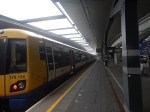
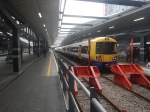
This image shows a London Overground train in Platform 5 at Crystal Palace station.
In Overground To London Bridge Under Consideration, I talked about how Transport for London were thinking about creating a new Overground service between London Bridge and Crystal Palace.
Sunday’s test also shows that if the paths are available, London Overground can run a service between London Bridge and Crystal Palace.
Given that the times for the out and return trips were 23 and 19 minutes on Sunday, it appears to me, that the following is possible.
- One train could run an hourly service.
- Two trains could run a two trains per hour (tph) service.
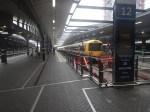
Trains could terminate in platform 3, which is on the right in the image and only has two trains per day.
There would be the following trains to London from Crystal Palace.
- London Overground – Four tph to Canada Water, Whitechapel and Highbury and Islington.
- London Overground – Two tph to London Bridge
- Southern – Two tph to London Bridge
- Southern – Four tph to London Victoria
These would total to.
- Canada Water – four tph for Jubilee Line
- Highbury & Islington – four tph for Victoria and North London Lines
- London Bridge – four tph for Thameslink, Jubilee and Northern Lines
- London Victoria – four tph for Victoria, Circle and District Lines
- Whitechapel – four tph for Elizabeth, Victoria, Circle, District and Hammersmith & City Lines
Note.
- The two extra tph to London Bridge even everything up to four tph.
- The London Bridge and Crystal Palace service could be run by any suitable train and I suspect it could be eight cars. What about using some of the spare Class 379 trains?
The London Bridge and Crystal Palace service wouldn’t need trains with a tunnel evacuation capability, so could use Class 378, 379, 387 or 710 trains.