Schneider Electric: Vertical Farming – The Next Yield In Data Centre Sustainability
The title of this post, is the same as that of this article on Intelligent Data Centres.
This is the sub-heading.
David Abrahams, Key Client Manager, Cloud and Service Partners at Schneider Electric UK and Ireland, discusses vertical farming and the next yield in data centre sustainability. He outlines new data centre sustainability strategies, vertical farming solutions and how data centres can apply already existent models which will allow plants and crops to thrive in unique Growth Towers.
These are the first two paragraphs.
As data centres begin to reach their physical sustainability limits without redefining the laws of physics, vertical farming could provide a new solution to the decarbonisation challenge, creating a symbiotic environment for both data and nature to benefit one another.
Coined by some as the fourth revolution in agriculture, vertical farms today provide closed conditions which deliver major sustainability benefits including limited or zero use of pesticides, while ensuring the farm is safe from extreme weather-related events such as high temperatures, humidity, floods and fires.
The last section is called Making The Concept A Reality, where these are the first three paragraphs.
Equinix has already taken the leap and has become the first global operator to develop a fully functioning vertical farm at its PA10 Paris data centre, creating a 4600 sq.ft greenhouse which is surrounded by 61,000 sq.ft of garden space.
The vertical farm is kept at an ideal growing temperature, using heat exchangers linked to the data centre’s chilled water-cooling system with sensors that monitor internal and external temperatures and humidity levels. With such available technology, farmers will be able to make real-time changes to their growing conditions to achieve higher yields at lower energy. This could be a game changer considering the greater strain on the global food supply chain and the general cost of energy.
With increased demands for efficiency and sustainability, both data centre and agricultural sectors are under the greatest scrutiny. The idea of data centre and farming worlds collaborating to create a circular economy to help futureproof both industries is not only exciting but unveils a world of new decarbonisation opportunities.
It strikes me that combining a data centre and a vertical farm could be a marriage made in eco-heaven.
I suggest you read all the original article.
High Speed Yorkshire
In December 2019, I wrote Could High Speed Two Be A One-Nation Project?, which I started like this.
As currently envisioned, High Speed Two is very much an English project, with the following routes
- London and Birmingham
- London and Liverpool via Birmingham
- London and Manchester Airport/Manchester via Birmingham and Crewe
- London and Sheffield via Birmingham and the East Midlands Hub
- London and Leeds via Birmingham and the East Midlands Hub
There are large numbers of mid-sized towns and cities that it won’t serve directly.
This is what I said about the East Coast Main Line in the post.
The East Coast Main Line serves the following routes.
- London and Bradford
- London and Cambridge
- London and Edinburgh via Doncaster, York and Newcastle
- London and Harrogate via Leeds
- London and Hull
- London and Kings Lynn via Cambridge
- London and Lincoln via Newark.
- London and Leeds via Doncaster
- London and Middlesbrough
- London and Skipton via Leeds
- London and Sunderland
The East Coast Main Line could become another high speed line.
Extra services could be added.
- London and Norwich via Cambridge
- London and Nottingham
- London and Grimsby and Cleethorpes via Lincoln.
- London and Sheffield via Retford.
Add the East Coast Main Line and High Speed Two together and there could be a wider range of towns and cities served.
- Peterborough and Doncaster could play the same role in the East as Birmingham and Crewe will play in the West.
- The East Coast Main Line between London and Doncaster will be upgraded to in-cab ERTMS signalling in a few years time, which will allow 140 mph running on several sections of the route.
- Improvements are either under way or being planned to reduce bottlenecks on the East Coast Main Line.
- If High Speed Two can handle eighteen trains per hour (tph), then surely the East Coast Main Line, which has a lot of quadruple track, can handle upwards of twelve 140 mph trains per hour between London and Doncaster, after the improvements to track and signalling.
- I estimate that 140 mph running between London and Doncaster could save as much as twenty minutes.
- I feel that Barnsley, Doncaster, Hull, Leeds, Sheffield and York could all be reached in under two hours from London using the existing Azuma trains.
- This morning the 0700 from Kings Cross is timetabled to reach York at 0852. Would it be possible for London and York to be around just ninety minutes?
- Savings would also apply to trains between London and Leeds, Middlesbrough, Newcastle, Scotland and Sunderland.
- Sub-four hour journeys between London and Edinburgh would be commonplace.
Note that the Internet gives a driving time of nearly three and a half hours between London and Leeds. Surely, two hours or less on High Speed Yorkshire would be much preferable.
I would add this infrastructure.
- There might be a good case to create electrified routes to Hull and Sheffield and between Sheffield and Leeds, but they wouldn’t be needed to start the service or obtain the time savings. But they would ease operation, cut carbon emissions and save a few more minutes.
- A station at Doncaster-Sheffield Airport.
- A parkway station at Barnsley on the Dearne Valley Line with direct services to Doncaster, Leeds, London and Sheffield.
The two latter improvements have been proposed in Sheffield Region’s transport plans.
High Speed Yorkshire should be finished as soon as possible. A completion date of 2024 is not unreasonable.
This was the first time I used the term High Speed Yorkshire.
Benefits Of Digital Signalling On The East Coast Main Line
The obvious benefit is there will be 140 mph running on several stretches of the East Coast Main Line.
But as a Control Engineer, I believe that the digital signalling can be used to eliminate two major bottlenecks on the route.
- The Digswell Viaduct, which I wrote about in Is There An ERTMS-based Solution To The Digswell Viaduct?.
- The Newark Flat Crossing, which I wrote about in Could ERTMS And ETCS Solve The Newark Crossing Problem?.
Digital Signalling will also offer techniques to run more trains per hour on the route.
LNER Orders CAF Tri-Mode Sets
The title of this section, is the same as this article in the December 2023 Edition of Modern Railways, which has this paragraph.
Modern Railways understands the new fleet will be maintained at Neville Hill depot in Leeds and, like the ‘225’ sets, will be used predominantly on services between London and Yorkshire, although unlike the ‘225s’ the tri-modes, with their self-power capability, will be able to serve destinations away from the electrified network such as Harrogate and Hull.
Note.
- This surprised me, as I’d always expected the Yorkshire routes will be served by Hitachi battery-electric trains.
- But it does look that both Harrogate and Hull stations, have long enough platforms to hold a ten-car train.
- With their tri-mode technology, it also looks like the CAF trains won’t be needed to be charged before returning to London.
The last point would enable them to try out new routes.
But it does look like LNER are planning to strengthen their Yorkshire routes.
- Does Azuma Test Train Takes To The Tracks As LNER Trials Possible New Route, also mean that they’re looking at a service to Cleethorpes?
- The curtailment of High Speed Two was hard on Yorkshire.
- The Government has had time to get a verdict from experts on TransPennine Express.
It could just be that, it’s easier to sell rail tickets to Yorkshire folk, than Lancashire folk.
FirstGroup Applies To Run New London To Sheffield Rail Service
The title of this section, is the same as that of this press release from First Group.
These two paragraphs outline FirstGroup’s initial plans.
FirstGroup plc, the leading private sector transport operator, has today submitted the first phase of an application for a new open access rail service between London and Sheffield to the Office of Rail and Road (ORR).
FirstGroup plans to expand its open access rail operations as part of its award-winning Hull Trains business, building on their successful existing service which has transformed long-distance connectivity between Hull and London.
Note.
- FirstGroup want to run two trains per day (tpd) between London King’s Cross and Sheffield stations via Retford.
- Services will be non-stop between London King’s Cross and Retford.
- The service will be run by Hull Trains.
- I suspect that Hull Trains will use a fleet of identical Hitachi trains for both services.
- Hull Trains could decarbonise the services by using battery-electric trains.
- I believe a time of 82 minutes will be possible between London King’s Cross and Sheffield.
- High Speed Two were promising a time of 87 minutes for their route from London Euston via Birmingham and Nottingham.
I believe there could be up to seven tpd to both Hull and Sheffield.
Timings On High Speed Yorkshire
In FirstGroup Applies To Run New London To Sheffield Rail Service, I felt the following is possible, between London King’s Cross and Sheffield.
- After the digital signalling is completed between King’s Cross and Retford, I suspect that a 135 mph average speed can be maintained between Woolmer Green and Retford. This would mean that a King’s Cross and Retford time of 68 minutes would be possible.
- If Network Rail improve the track between Retford and Sheffield, I believe that a 70 mph average could be achieved on the Retford and Sheffield section. This would mean that a Retford and Sheffield time of 20 minutes would be possible.
- I would expect at least six minutes would be saved by missing stops.
This gives a time of 82 minutes between London King’s Cross and Sheffield.
I will use these timings to calculate other possible times.
- Current time between London King’s Cross and Retford – 82 minutes
- Digitally signalled average speed between Woolmer Green and Retford – 135 mph
- Digitally signalled time between London King’s Cross and Retford – 68 minutes
- Digitally signaled time between London King’s Cross and Sheffield – 82 minutes
These are my estimated timings from London King’s Cross.
Barnetby via Newark Northgate and Lincoln
Operator: LNER
Served by High Speed Two: No
Time to/from London King’s Cross: 114 minutes
Barnetby via Peterborough and Lincoln
Operator: LNER
Served by High Speed Two: No
Time to/from London King’s Cross: 128 minutes
Barnsley via Sheffield
Operator: Hull Trains
Served by High Speed Two: No
Time to/from London King’s Cross: 112 minutes
Note: Uses Penistone Line and Hull Trains times to Sheffield
Beverley
Operator: Hull Trains
Served by High Speed Two: No
Time to/from London King’s Cross: 101 minutes
Note: Uses Hull Trains times from Doncaster
Bradford Foster Square via Leeds
Operator: LNER
Served by High Speed Two: No
Time to/from London King’s Cross: 146 minutes
Note: Uses LNER times from Leeds
Bradford Interchange via Doncaster
Operator: Grand Central
Served by High Speed Two: No
Time to/from London King’s Cross: 166 minutes
Note: Uses Grand Central times from Doncaster
Brighouse via Doncaster
Operator: Grand Central
Served by High Speed Two: No
Time to/from London King’s Cross: 143 minutes
Note: Uses Grand Central times from Doncaster
Brough
Operator: Hull Trains
Served by High Speed Two: No
Time to/from London King’s Cross: 101 minutes
Note: Uses Hull Trains times from Doncaster
Cleethorpes via Newark Northgate and Lincoln
Operator: LNER
Served by High Speed Two: No
Time to/from London King’s Cross: 141 minutes
Cleethorpes via Peterborough and Lincoln
Operator: LNER
Served by High Speed Two: No
Time to/from London King’s Cross: 155 minutes
Darlington
Operator: LNER
Served by High Speed Two: Yes
High Speed Two time to/from London Euston: 116 minutes
Time to/from London King’s Cross: 127 minutes
Doncaster
Operator: Grand Cenreal, Hull Trains, LNER
Served by High Speed Two: No
Time to/from London King’s Cross: 76 minutes
Durham
Operator: LNER
Served by High Speed Two: Yes
High Speed Two time to/from London Euston: 136 minutes
Time to/from London King’s Cross: 160 minutes
Eaglescliffe
Operator: Grand Central
Served by High Speed Two: No
Time to/from London King’s Cross: 155 minutes
Note: Uses Grand Central times from Northallerton
Edinburgh
Operator: LNER
Served by High Speed Two: Yes
High Speed Two time to/from London Euston: 220 minutes
Time to/from London King’s Cross: 234 minutes
Grantham
Operator: LNER
Served by High Speed Two: No
Time to/from London King’s Cross: 53 minutes
Grimsby Town via Newark Northgate and Lincoln
Operator: LNER
Served by High Speed Two: No
Time to/from London King’s Cross: 134 minutes
Grimsby Town via Peterborough and Lincoln
Operator: LNER
Served by High Speed Two: No
Time to/from London King’s Cross: 148 minutes
Halifax via Doncaster
Operator: Grand Central
Served by High Speed Two: No
Time to/from London King’s Cross: 153 minutes
Note: Uses Grand Central times from Doncaster
Harrogate
Operator: LNER
Served by High Speed Two: No
Time to/from London King’s Cross: 147 minutes
Note: Uses LNER times from Leeds
Hartlepool
Operator: Grand Central
Served by High Speed Two: No
Time to/from London King’s Cross: 175 minutes
Note: Uses Grand Central times from Northallerton
Horsforth
Operator: LNER
Served by High Speed Two: No
Time to/from London King’s Cross: 124 minutes
Note: Uses LNER times from Leeds
Huddersfield via Leeds
Operator: LNER
Served by High Speed Two: No
Time to/from London King’s Cross: 161 minutes
Note: Uses LNER times from Leeds
Huddersfield via Sheffield
Operator: Hull Trains
Served by High Speed Two: No
Time to/from London King’s Cross: 140 minutes
Note: Uses Penistone Line and Hull Trains times to Sheffield
Hull
Operator: Hull Trains
Served by High Speed Two: No
Time to/from London King’s Cross: 114 minutes
Note: Uses Hull Trains times from Doncaster
Keighley via Leeds
Operator: LNER
Served by High Speed Two: No
Time to/from London King’s Cross: 178 minutes
Note: Uses LNER times from Leeds
Leeds
Operator: LNER
Served by High Speed Two: Yes
High Speed Two time to/from London Euston: 81 minutes
Time to/from London King’s Cross: 116 minutes
Lincoln via Newark Northgate
Operator: LNER
Served by High Speed Two: No
Time to/from London King’s Cross: 85 minutes
Lincoln via Peterborough
Operator: LNER
Served by High Speed Two: No
Time to/from London King’s Cross: 99 minutes
Market Rasen via Newark Northgate and Lincoln
Operator: LNER
Served by High Speed Two: No
Time to/from London King’s Cross: 101 minutes
Market Rasen via Peterborough and Lincoln
Operator: LNER
Served by High Speed Two: No
Time to/from London King’s Cross: 115 minutes
Meadowhall via Sheffield
Operator: Hull Trains
Served by High Speed Two: No
Time to/from London King’s Cross: 90 minutes
Note: Uses Penistone Line and Hull Trains times to Sheffield
Middlesbrough
Operator: LNER
Served by High Speed Two: No
Time to/from London King’s Cross: 155 minutes
Mirfield via Doncaster
Operator: Grand Ccentral
Served by High Speed Two: No
Time to/from London King’s Cross: 136 minutes
Note: Uses Grand Central times from Doncaster
Newark Northgate
Operator: LNER
Served by High Speed Two: No
Time to/from London King’s Cross: 60 minutes
Newcastle
Operator: LNER
Served by High Speed Two: Yes
High Speed Two time to/from London Euston: 137 minutes
Time to/from London King’s Cross: 145 minutes
Northallerton
Operator: Grand Central, LNER
Served by High Speed Two: No
Time to/from London King’s Cross: 126 minutes
Peterborough
Operator: Grand Central, LNER
Served by High Speed Two: No
Time to/from London King’s Cross: 40 minutes
Pontefract Monkhill
Operator: Grand Central
Served by High Speed Two: No
Time to/from London King’s Cross: 103 minutes
Note: Uses Grand Central times from Doncaster
Retford
Operator: LNER
Served by High Speed Two: No
Time to/from London King’s Cross: 68 minutes
Selby
Operator: Hull Trains
Served by High Speed Two: No
Time to/from London King’s Cross: 92 minutes
Note: Uses Hull Trains times from Doncaster
Sheffield
Operator: Hull Trains
Served by High Speed Two: Yes
High Speed Two time to/from London Euston: 87 minutes
Time to/from London King’s Cross: 82 minutes
Shipley via Leeds
Operator: LNER
Served by High Speed Two: No
Time to/from London King’s Cross: 168 minutes
Note: Uses LNER times from Leeds
Skipton via Leeds
Operator: LNER
Served by High Speed Two: No
Time to/from London King’s Cross: 191 minutes
Note: Uses LNER times from Leeds
Sleaford
Operator: LNER
Served by High Speed Two: No
Time to/from London King’s Cross: 83 minutes
Spalding
Operator: LNER
Served by High Speed Two: No
Time to/from London King’s Cross: 61 minutes
Sunderland
Operator: Grand Central
Served by High Speed Two: No
Time to/from London King’s Cross: 194 minutes
Note: Uses Grand Central times from Northallerton
Thirsk
Operator: Grand Central
Served by High Speed Two: No
Time to/from London King’s Cross: 116 minutes
Note: Uses Grand Central times from Northallerton
Thornaby
Operator: LNER
Served by High Speed Two: No
Time to/from London King’s Cross: 146 minutes
Wakefield Kirkgate
Operator: Grand Central
Served by High Speed Two: No
Time to/from London King’s Cross: 118 minutes
Note: Uses Grand Central times from Doncaster
Wakefield Westgate
Operator: LNER
Served by High Speed Two: No
Time to/from London King’s Cross: 95 minutes
Worksop
Operator: Hull Trains
Served by High Speed Two: No
Time to/from London King’s Cross: 81 minutes
York
Operator: LNER
Served by High Speed Two: Yes
High Speed Two time to/from London Euston: 84 minutes
Time to/from London King’s Cross: 98 minutes
Note.
- Times have improved because of the digital signalling.
- As the digital signalling goes further North timings will will come down further.
- Unelectrified branches like those to Beverley, Cleethorpes, Grimsby, Harrogate, Huddersfield, Hull, Lincoln, Middlesbrough and Sheffield will be improved and further bring down times.
Sheffield could be as low as 80 minutes, with York at 91 minutes.
Google Starts Building £790m Site In Hertfordshire
The title of this post, is the same as that of this article on the BBC.
This is the sub-heading.
Google has invested $1bn (£790m) to build its first UK data centre
These are the first four paragraphs.
The tech giant said construction had started at a 33-acre site in Waltham Cross, Hertfordshire, and hoped it would be completed by 2025.
Google stressed it was too early to say how many jobs would be created but it would need engineers, project managers, data centre technicians, electricians, catering and security personnel.
The prime minister said it showed the UK had “huge potential for growth”.
The project marked the latest investment by a major US tech firm in Britain, after Microsoft announced it would invest £2.5bn to expand data centres for artificial intelligence (AI) across the UK.
Note.
- By “completed by 2025” do they mean completed before 2025 or completed by the end of 2025. Judging by the time they took to build their London HQ, its the latter.
- Rishi is right about the UK having a huge potential for growth! Especially, if the nihilists of the United States vote in the Big Orange!
- Judging by the total spend of £2.5 billion on data centres and the £790 million for this one, this looks to be the first of three.
But where is this data centre going to be built?
This article on EssexLive is entitled Google To Move Into Waltham Cross With £788m Data Centre To Support ‘AI Innovation’, where this is said.
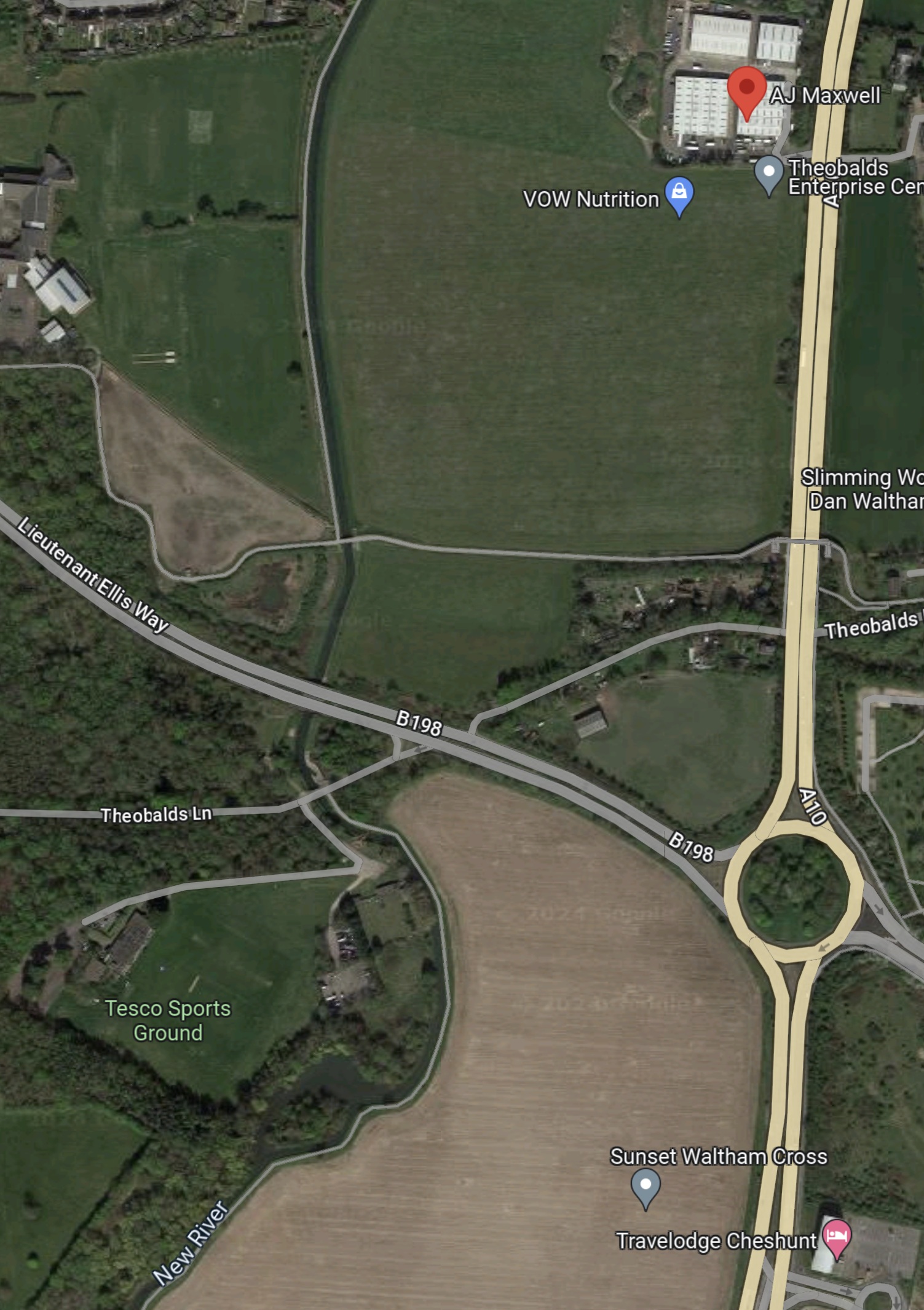
The new data centre will go on land at Maxwell’s Farm, next to the A10 Great Cambridge Road and around one mile from the M25 junction 25. Debbie Weinstein, Google vice president and managing director in the UK and Ireland, set out the decision in a blog post on Thursday, January 18 – the fourth day of the World Economic Forum’s Davos 2024 in Switzerland.
This is a Goggle Map of that area, when I searched for Maxwell’s Farm.
Note.
- The red arrow indicates the result of my search, which Google interpreted as A.J. Maxwell.
- The dual-carriageway road running down the East side of the map is the A10 between London and Cambridge.
- The A10 road joins the M25 at Junction 25.
- The arrow to the South-West of the roundabout indicates the new studios; Sunset Waltham Cross, which is being built.
- At the other side of the studio site, there is a label saying New River and this important piece of London’s water infrastructure can be traced to the top of the map.
- The other dual-carriageway road is the B198 or Lieutenant Ellis Way.
- A quick calculation shows that 33 acres is roughly a 365 metre square.
I would suspect that the data centre will lie somewhere between the A10, the B198 and the New River.
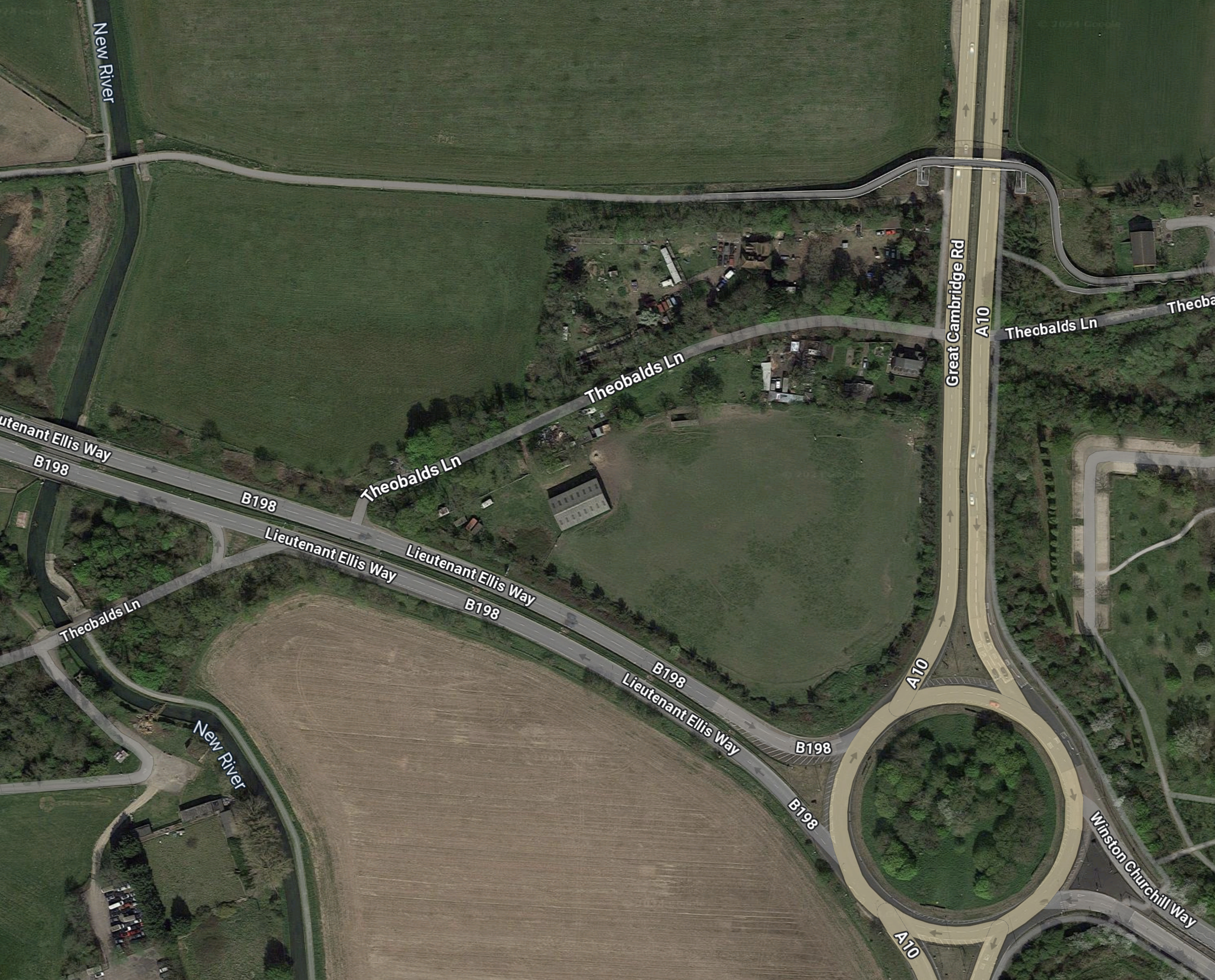
This Google Map shows the South-East corner of the site.
Note.
- There appears to be a lane running East-West, that crosses over both the A10 and the New River.
- Theobalds Lane appears to have some housing and possibly a farm.
- The smaller field by the roundabout appears to have some animals using it as grazing.
- The field between the East-West lane and Theobalds Lane appears to have a good crop of cereal.
The East-West lane would appear to be a possible Southern border of the site.
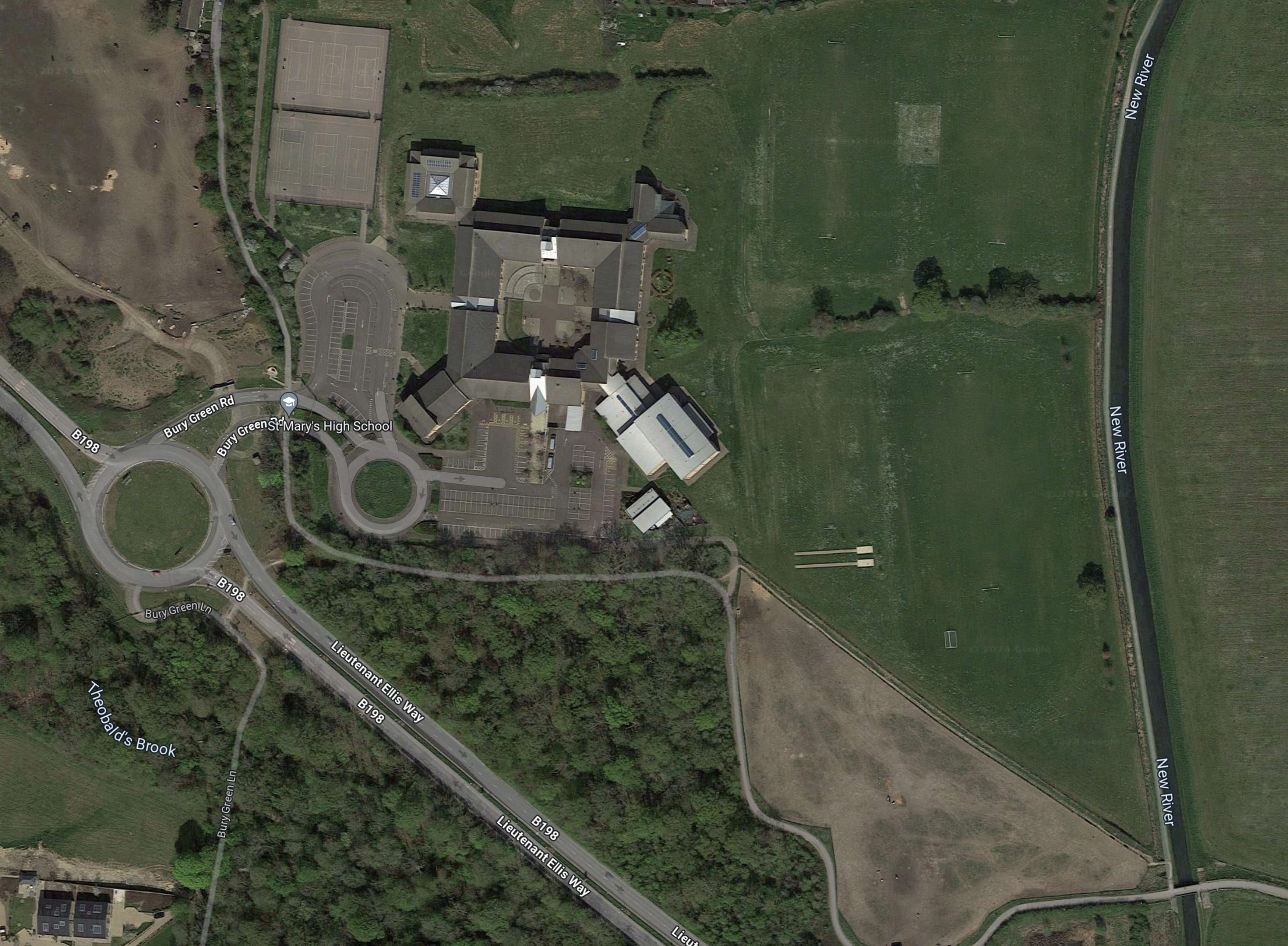
This Google Map shows where the East-West lane goes.
Note.
- The lane leads to Queen Mary’s High School.
- The school also has access from Lieutenant Ellis Way.
- The New River appears to form, the Eastern boundary of the school site.
- There are sports pitches between the New River and the school.
The New River looks to be the Western boundary of the Google site.
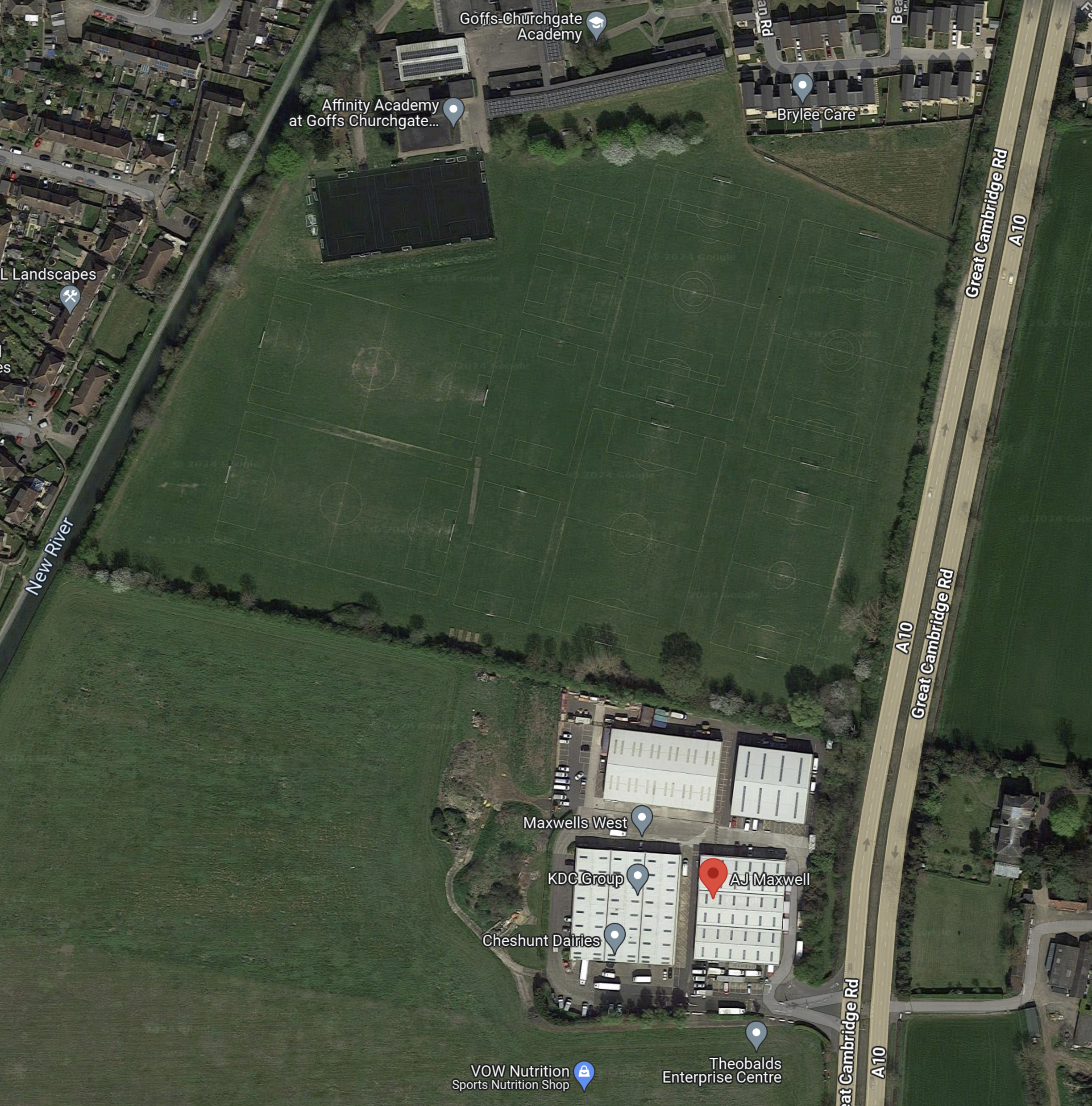
This Google Map shows around the red arrow from the Google search that led me to this area.
Note.
- A.J. Maxwell is identified by the red arrow in the Theobalds Enterprise Centre.
- The New River can be seen at the West of the map.
- A hedge runs roughly East-West to the North of the Enterprise Centre.
- North of the hedge are a number of football pitches, which appear to belong to the Affinity Academy at Goffs Churchgate.
The hedge could be the Northern boundary of the Google site.
This Google Map shows the area between the South of the Enterprise Centre and the East-West lane I picked out earlier.
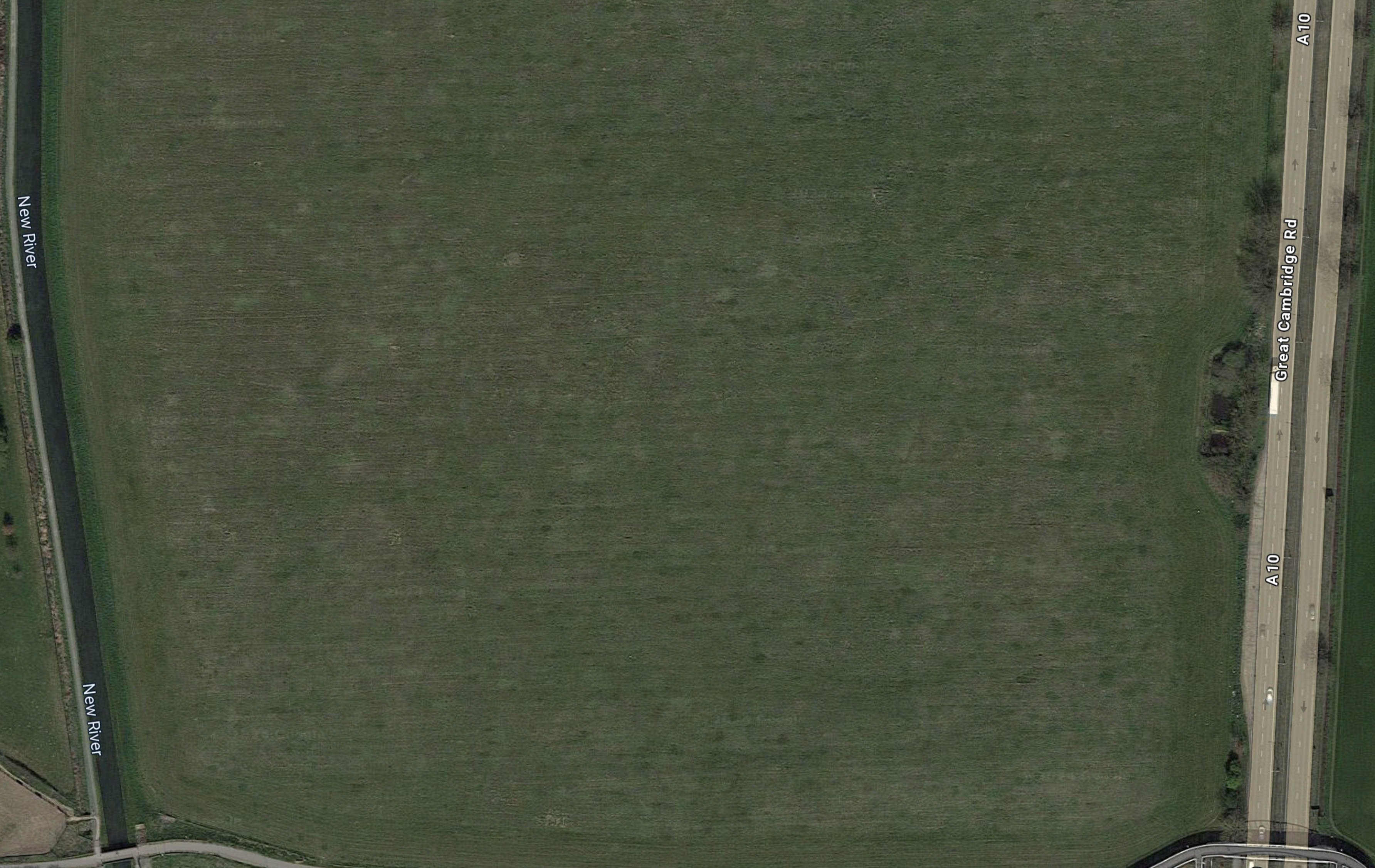
A crude measurement indicates it could be around 33 acres or slightly more.
This picture is used in nearly all the news reports about the Data Centre.

Note.
- Could that be the gentle curve of the New River on the left?
- With the high fence, the New River forms an almost-mediaeval defence against trespassers.
- There looks to be a dual-carriageway road running down the other side of the site, which would be the A10.
- Between the A10 and the site, there appears to be loots of dark areas, which I take to be car parks.
- Are the car-parking spaces in the front of the picture marked for those, who are disabled? There certainly appear to be chargers on some spaces.
I have a few thoughts.
The Relative Locations Of Google’s Data Centre And Sunset Studios?
This Google Map shows the two sites to the West of the A10.

Note.
- St. Mary’s High School is in the North-West corner of the map.
- Cheshunt Football Club is in the North-East corner of the map.
- The dual-carriageway A10 runs North-South on the map.
- I believe that Google’s Waltham Cross Data Centre will be located in the field to the West of the A10, at the top of the map.
- The A10 connects to the M25 at Junction 25, which is in the centre at the bottom of the map.
- In The Location Of Sunset Studios In Broxbourne, Sunset Studios are placed to the North West of the Junction 25 roundabout.
- Just as the A10 forms the Eastern boundary of both sites, the New River forms the Western boundary.
The two sites are close together between the A10 and the New River, separated by the dual-carriageway Lieutenant Ellis Way.
Will Google’s Data Centre Be Storing Data For Sunset Studios?
I’ve never worked in the production of films, but these days with digital electronic cameras, CGI, motion capture and other techniques, producing a film must need huge amounts of data storage.
- So have Sunset Studios outsourced their data storage needs to Google?
- Perhaps too, Sunset Studios found the local authority welcoming and this attitude was recommended to Google.
- Both sites will need local services like electricity, gas, sewage and water.
I suspect that there would be cost savings in construction and operation, if the two sites shared the utilities.
Providing Electricity And Heat For Both Sites
Consider.
- I estimate from information given in the Wikipedia entry for Google Data Centres, that a data centre needs between 10 and 12 MW.
- There is no obvious power source like offshore wind or a nuclear power station nearby.
- There is the 715 MW Rye House gas-fired power station, which is a few miles away.
- In Google Buys Scottish Offshore Wind Power, I talked about how Google had signed a Corporate Power Purchase Agreement to buy 100 MW from the Moray West offshore wind farm.
Google and Sunset Studios would also want an electrical and heat supply that is at least 100 % reliable.
Liverpool University had the same problem on their hundred acre campus in the centre of Liverpool.
- The University decided to build their own 4 MW Combined Heat and Power Unit (CHP), which is described in this data sheet.
- It is fired by natural gas.
- On their web site, Liverpool University state that their CHP can be adapted to different fuel blends. I take this includes zero-carbon fuels like hydrogen and carbon-neutral fuels like biomethane.
But given their location in Waltham Cross close to the Lea Valley, CHP units may have a use for their carbon dioxide.
This Google Map shows between Junction 15 of the M25 and Tomworld.

Note.
- Junction 25 of the M25, where it joins the A10 is in the South-West corner of the map.
- The sites of Google’s Data Centre and Sunset Studios can be picked out with reference to the previous map.
- Tomworld is in the North-East corner of the map.
- So why should Tomworld need a lot of carbon-dioxide?
This Google Map shows Tomworld.
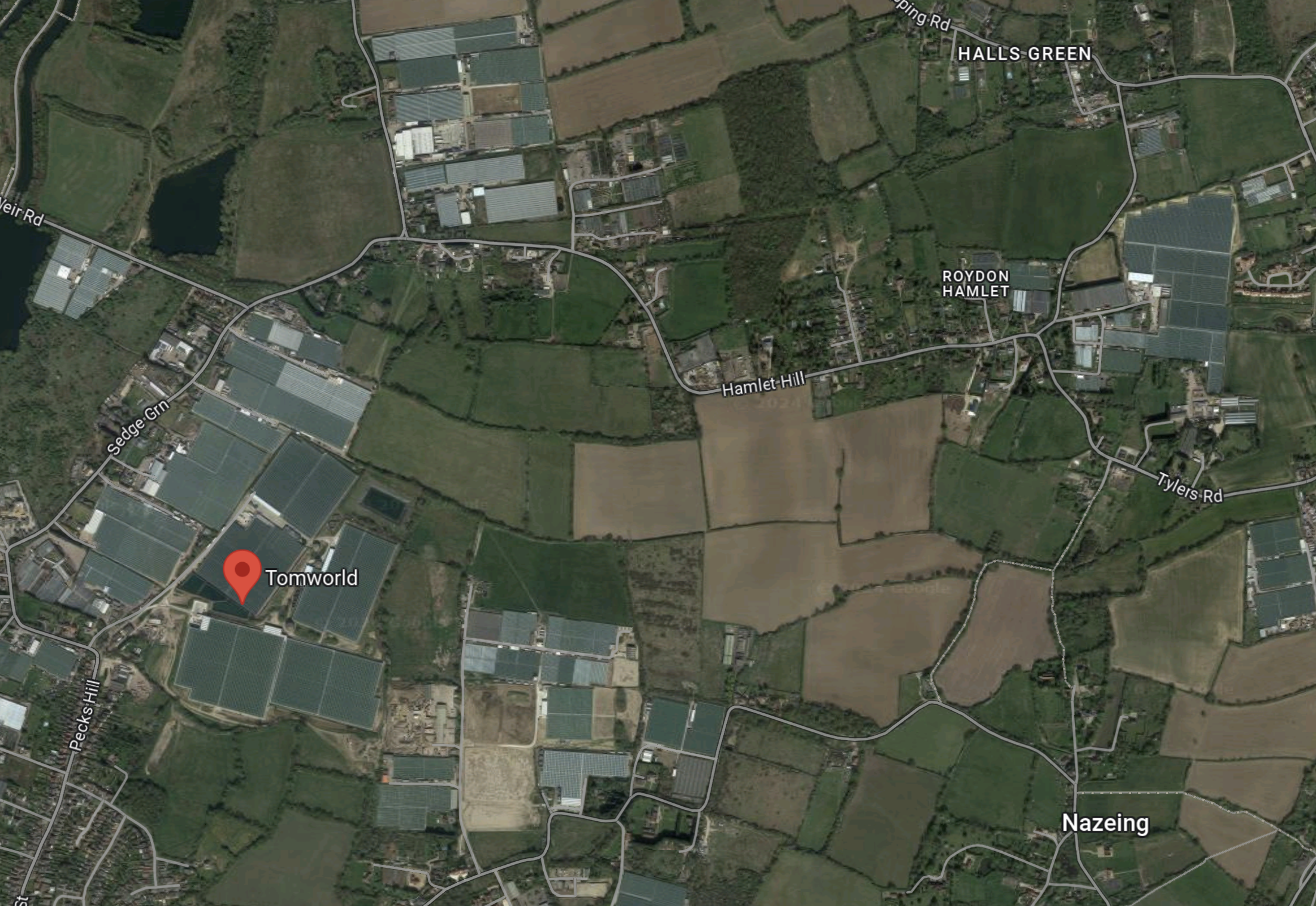
Note.
- This web page indicates what Tomworld do.
- They have 44 acres of glass growing tomatoes, about five miles to the North-East of Google’s Data Centre.
- The map has lots of other greenhouses.
I know of a guy, who has a large greenhouse, that grows tomatoes for the supermarkets.
- He heats the greenhouse with a gas-fired Combined Heat and Power Unit (CHP).
- The electricity produced runs his business.
- Any surplus electricity is fed into the grid.
- The carbon dioxide is fed to the plants in the greenhouse, which helps them grow quality tomatoes.
I just wonder, if carbon dioxide from CHP units at Google’s Data Centre and Sunset Studios could be used by the multitude of greenhouses in the Lea Valley.
Could A Carbon Dioxide Pipeline Be Built Along The M25?
This Google Map shows the Northern section of the M25, South of Waltham Cross.
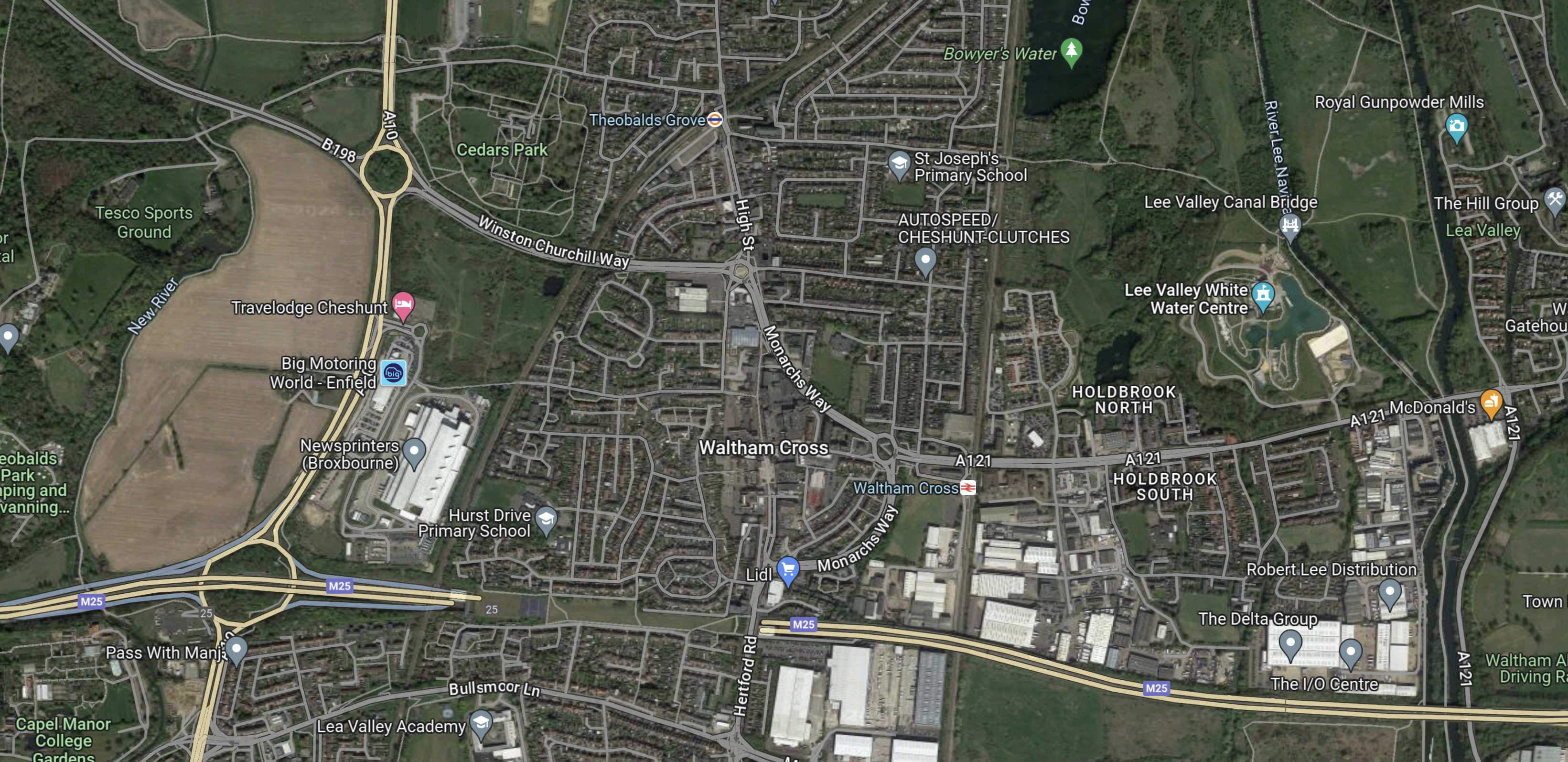
Note.
- The M25 running East-West across the bottom of the map.
- Junction 25 of the M25 in the South-West corner of the map.
- The A10 running North-South at the West of the map.
- Google’s data centre and Sunset Studio are to the West of the A10.
- The River Lee, which has numerous water courses is at the East of the map.
I wonder, if a carbon dioxide pipeline could be built along the M25 to connect the producers to those who could use it?
- It would not be a dangerous pipeline as carbon dioxide is a fire extinguisher.
- It wouldn’t be a huge pipe.
I think it would be possible.
Google’s Commitment To Being Zero-Carbon
This blog post on the Google web site is entitled Our $1 Billion Investment In A New UK Data Centre, has a section, which has a sub-title of 24/7 Carbon-Free Energy By 2030, where this is a paragraph.
Additionally, we’re also exploring new and innovative ways to use the heat generated by data centres, and this new facility will also have provisions for off-site heat recovery. Off-site heat recovery presents an opportunity for energy conservation that benefits the local community, as it allows us to capture the heat generated by the data centre so that it can be used by nearby homes and businesses. The data centre is also set to deploy an air-based cooling system.
If they are using off-site heat recovery, it would be logical to use waste carbon dioxide from CHPs to provide carbon dioxide for the local horticultural businesses.
Will Google Be Building A Vertical Farm Nearby?
In Schneider Electric: Vertical Farming – The Next Yield In Data Centre Sustainability, I noted that some data centres are paired with vertical farms to increase their sustainability.
Could Google be doing that in Waltham Cross?
- They will have a lot of waste heat.
- They will have a fair bit of carbon dioxide, which could be used to help plants grow.
- The local workforce probably contains a lot of experience of market gardening.
I like the idea of pairing a data centre and a vertical farm.
Public Transport Access
Consider.
- Increasingly, the cost of electric vehicles, medical problems and the UK economic situation are causing people to adopt a car-free lifestyle.
- After my stroke, my eyesight deteriorated such, that I am no longer allowed to drive.
- Others may live in one-car families and it may not be their’s to use every day.
- Or your car may just break down on the way to work.
For these and probably lots of other reasons, any large site employing a lot of employees, must have a valid way of getting there by public transport.
The nearest rail station to Google’s Data Centre and Sunset Studios is Theobalds Grove station.
This Google Map shows the roads between the sites and the station.
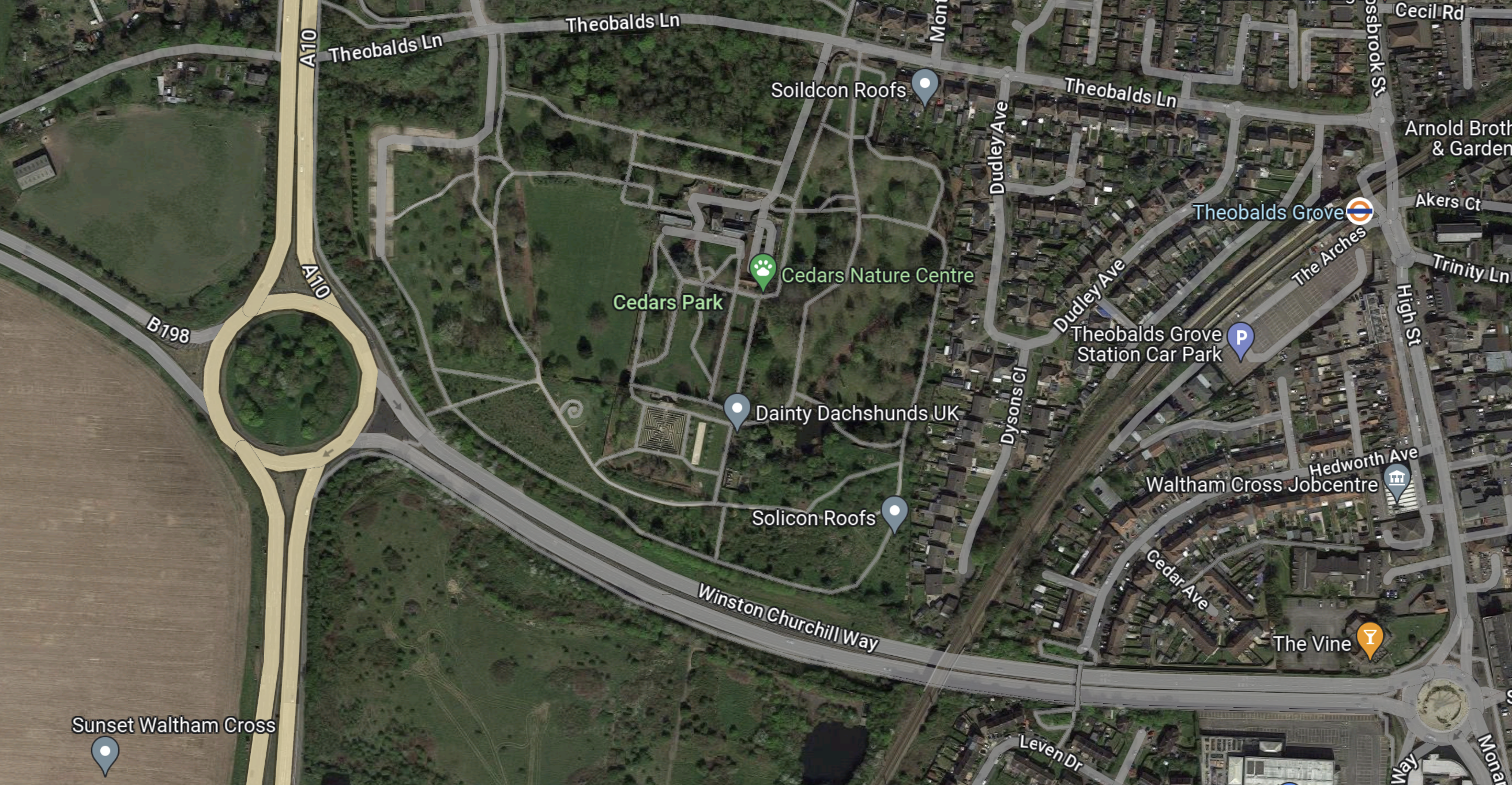
Note.
- The Sunset Waltham Cross label in the South West corner.
- Google’s Data Centre will be just off the map to the West of the A10.
- Theobalds Grove station is marked by the TfL roundel in the North-East corner of the map.
- There would appear to be no bus stops on Winston Churchill Way or the A10.
I walked South from the station to Winston Churchill Way, where I took these pictures.





Note.
- At that point, I gave up because of the cold and pollution.
- It was also a Saturday morning about midday.
The route I took is certainly not an alternative route to get to Google’s Data Centre or Sunset Studios.
A Possible Station At Park Plaza North
This article on the BBC is entitled Broxbourne: Two New Stations Planned.
This is the sub-heading.
Two new train stations could be built in Hertfordshire if plans to tighten planning policies are adopted.
This is the first paragraph.
Broxbourne Borough Council said stops at Park Plaza North – between Turkey Street and Theobalds Grove London Overground stations – and Turnford on the London to Bishop’s Stortford route would be subject to a consultation.
Later the BBC say that Park Plaza North station will be South of the A121 Winston Churchill Way near Waltham Cross
This Google Map shows the area South-East of the roundabout, where Winston Churchill Way meets the A10.
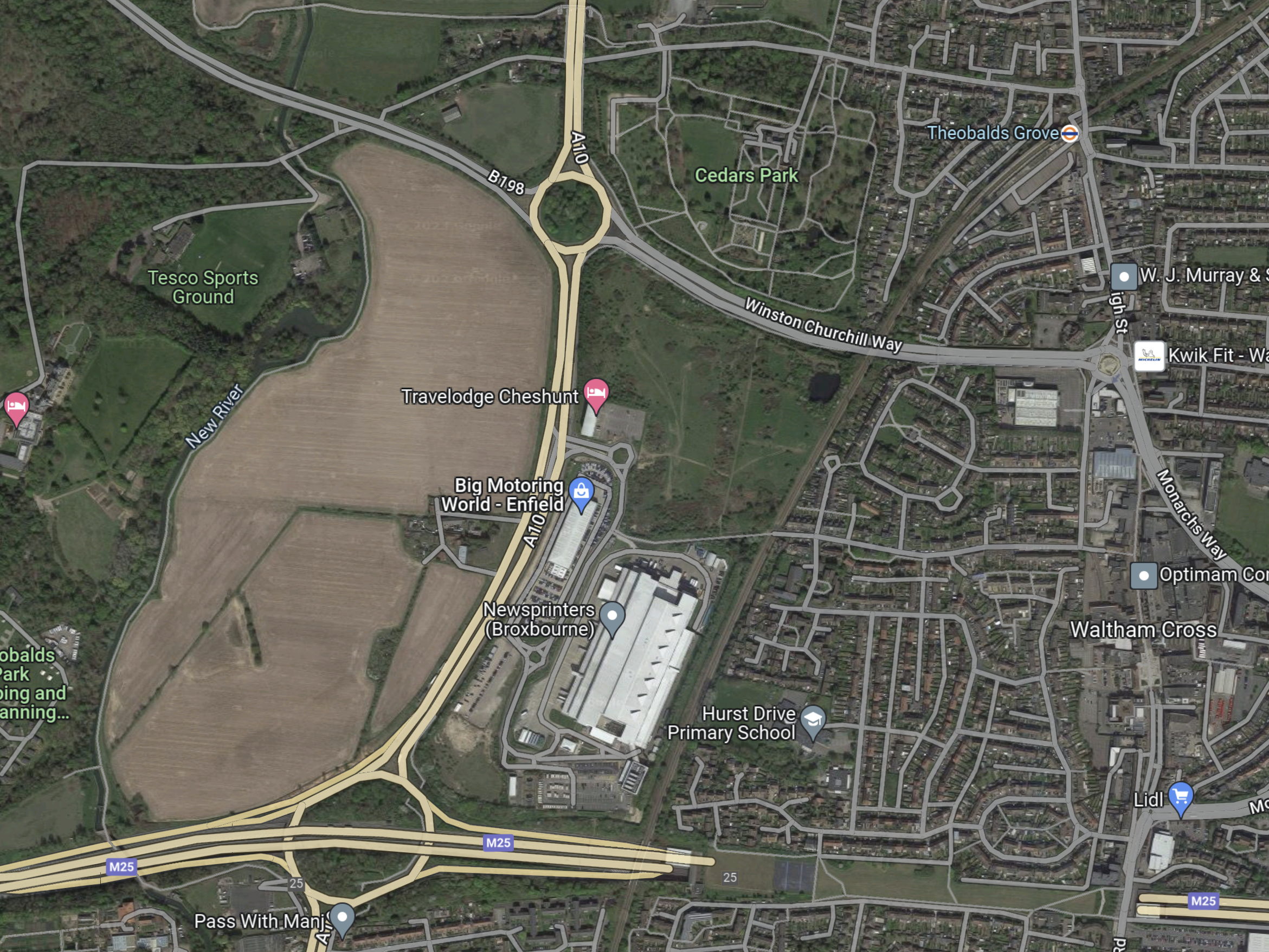
Note.
- The green patch of land to the South-East of the roundabout where Winston Churchill Way meets the A10 appears to be ripe for development.
- Looking at the green patch with a higher resolution, the land is little more than high class scrub beloved of newts.
- The London Overground line to Cheshunt runs down the East side of the site.
- To the North, the London Overground crosses Winston Churchill Way to get to Theobalds Grove station.
- To the South, the London Overground crosses the M25 to get to Turkey Street station.
- There is a lane running East-West along the South edge of the site, which crosses the railway in a level crossing.
This picture clipped from Google StreetView shows the level crossing.
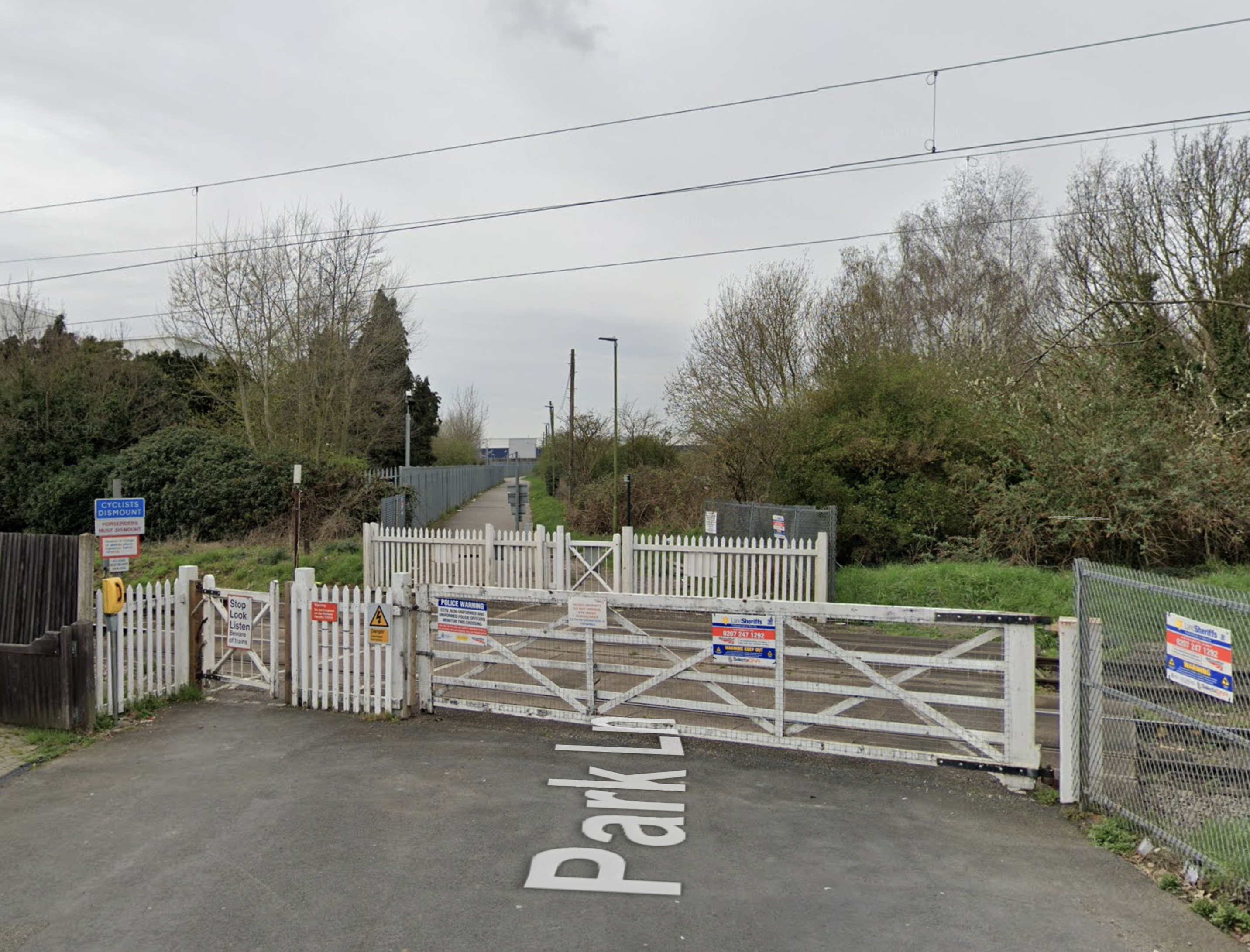
This is certainly one, that drivers dread.
This GoogleMap shows the level crossing and a stretch of the London Overground.
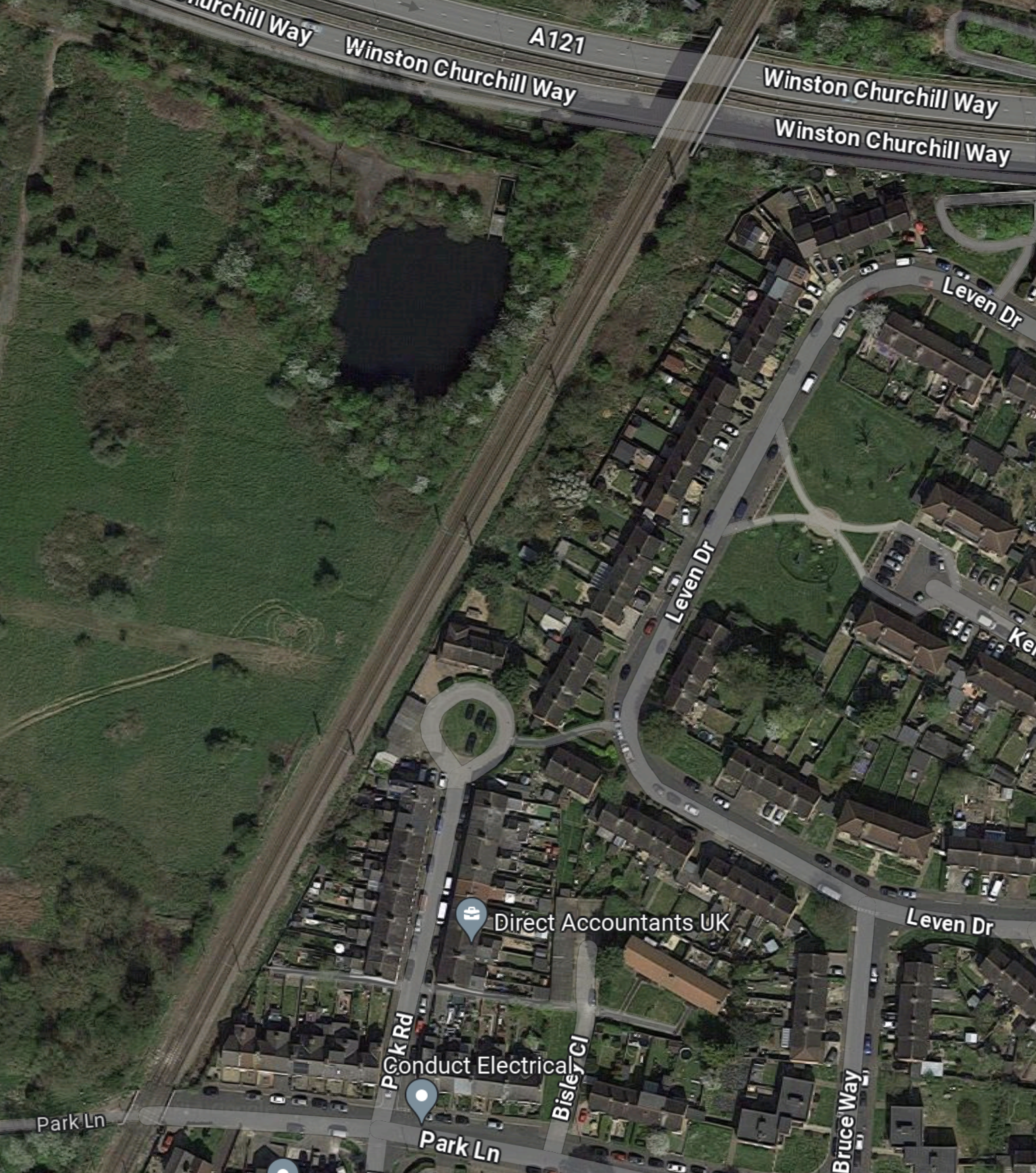
Note.
- The level crossing is in the South-East corner of the map.
- There isn’t much space to put a London-bound platform on the East side of the tracks, South of the Park Road circle.
- There is plenty of space to put a Cheshunt-bound platform on the West side of the tracks.
- North of the Park Road circle, there would appear to be space for two platforms.
It will need a lot of ingenuity to provide a safe and efficient solution to the problems of the level crossing and fitting a station in this limited space.
The first thing I’d do, would be to dig an underpass for pedestrians and cyclists to connect the two halves of Park Lane.
The Moths Have Eaten My Long Johns
When I took the pictures in A Sleigh Ride, and at probably most of the other posts from my trip to Poland in Winter, I was wearing an expensive pair of Merino long johns.
I have tried to wear them in this cold snap, but they have been eaten by the f**king moths.
Still at least I don’t feel the cold badly.
That’s probably because I was brought up in Cockfosters, which is the coldest place in London.
Northumberland Line ‘Phased Reopening’ By Summer
The title of this post, is the same as that as this article on the BBC.
These are the first three paragraphs.
The Northumberland Line will partially reopen this summer days after it was announced it would not be in service until the end of 2024.
Conservative county council leader Glen Sanderson said there had been “challenges” with the project, but when fully reopened the rail line would be a “game changer” for travellers.
The stations due to be open in the summer are Seaton Delaval, Ashington and Newsham.
In my lifetime, the Victoria, Jubilee and Elizabeth Lines in London, have opened on a phased manner.
So why shouldn’t the Northumberland Line?
In fact given the route, it could be opened with a shuttle between Ashington and Newcastle stations, to train drivers and test the concept.
- The intermediate stations could be added over a couple of years.
- I would add a station with lots of parking early.
- If the views live up to the pictures, a lot of passengers will have a day out for the views.
- I’m sure enthusiasts and locals, especially with their kids will be exploring this short railway in droves.
To me, this is definitely a line, that will suffer from London Overground Syndrome.
This OpenRailwayMap shows the railways to the North of Newcastle.
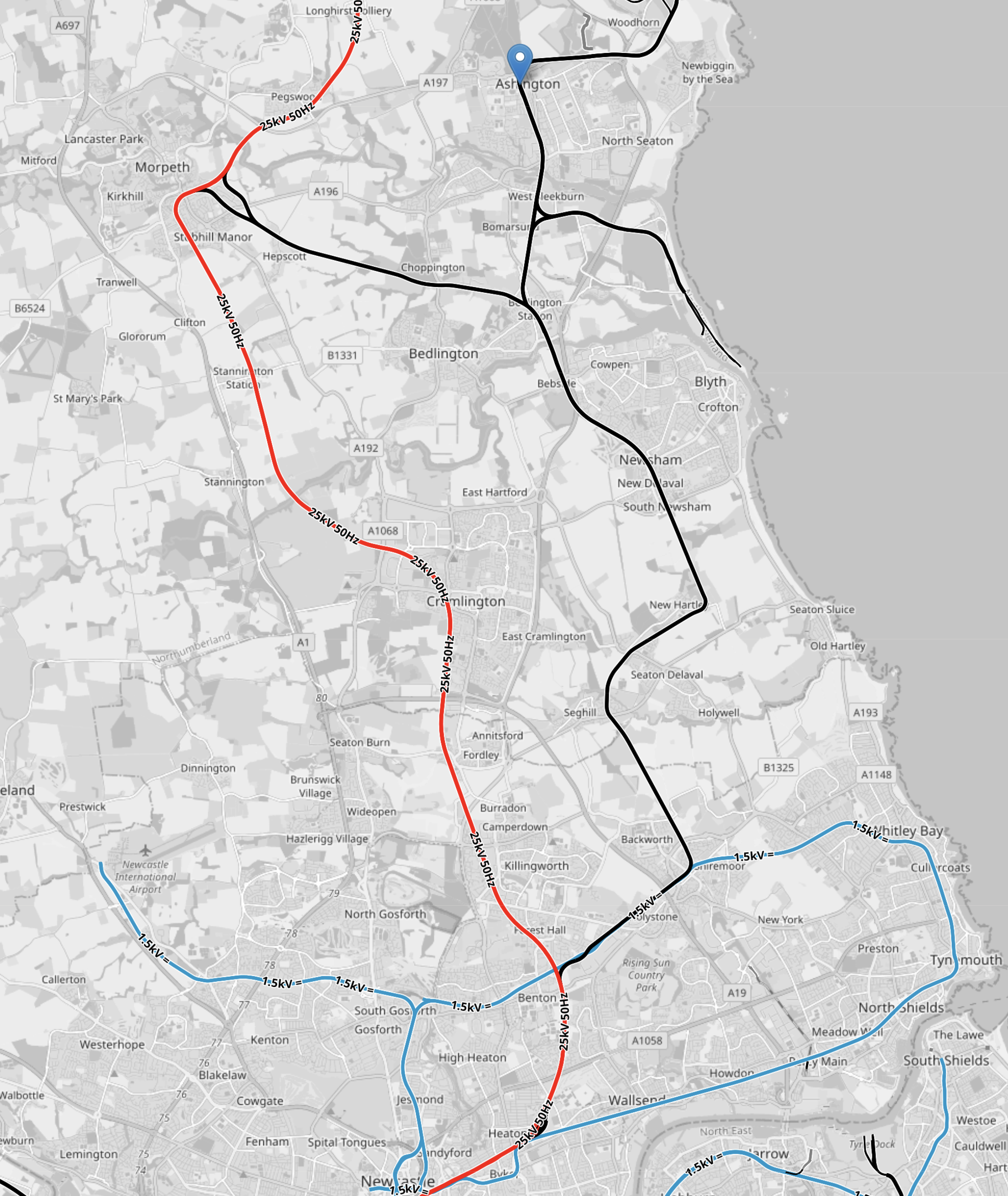
Note.
- The red track is the electrified East Coast Main Line.
- Ashington station is at the top of the map and is marked by a blue arrow.
- The blue track is the Tyne and Wear Metro.
- Newcastle station is where the Metro crosses the East Coast Main Line at the bottom of the map.
- The black trackrunning North-South to the East of the East Coast Main Line is the Northumberland Line.
This OpenRailwayMap shows the railways to the North of Ashington.
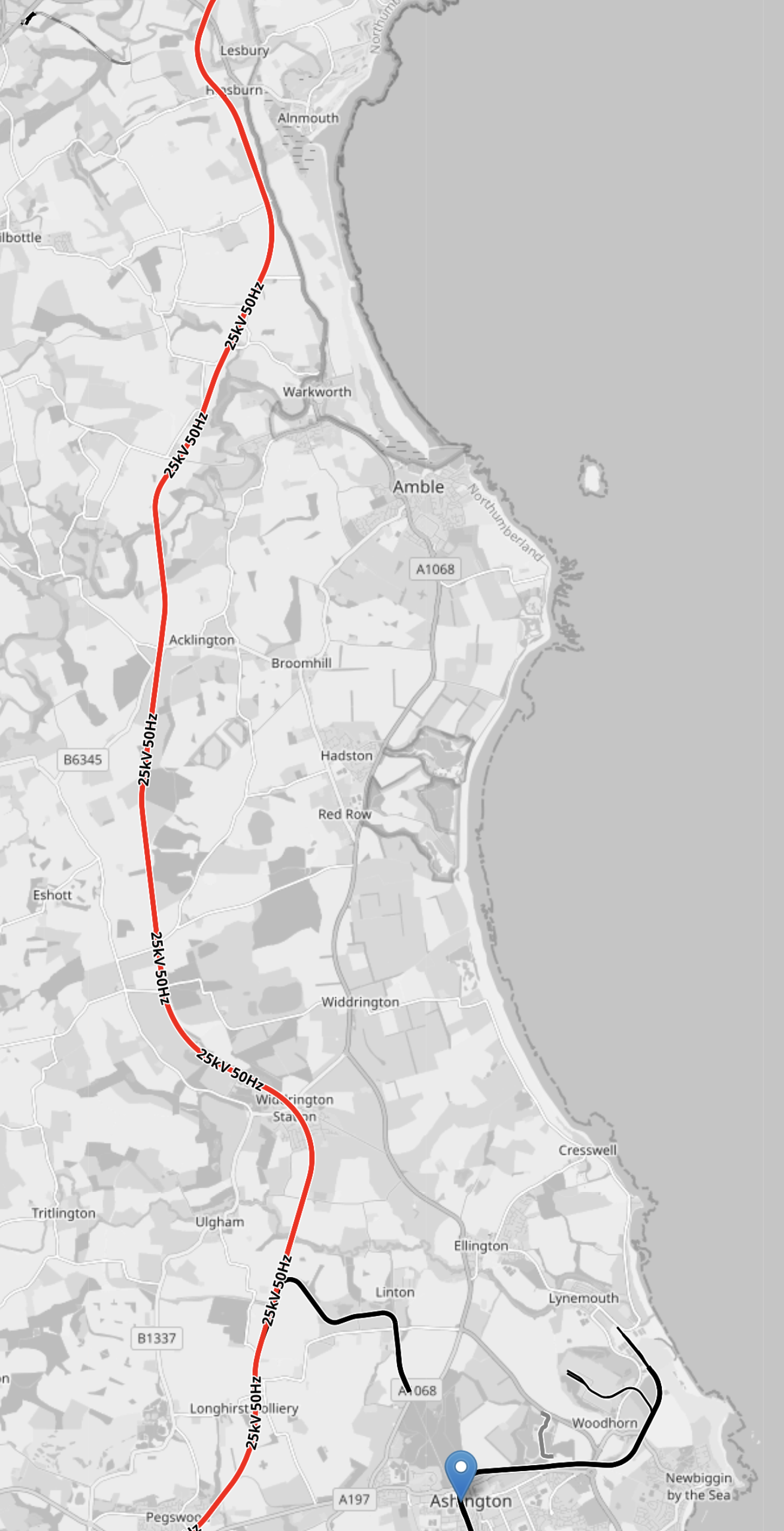
Note.
- The red track is the electrifed East Coast Main Line.
- Ashington station is at the bottom of the map and is marked by a blue arrow.
- There are a few disused colliery lines to the North of Ashington.
I believe that these railways to the North of Newcastle could and should be developed.
The East Coast Main Line Is Congested
Consider.
- The East Coast Main Line has only two tracks.
- It is one of only two rail routes between England and Scotland.
- It carries local services as well as long distance express services.
- In recent years more services have been added by Lumo and TransPennine Express.
It is my belief that applying digital signalling between Newcastle and Edinburgh via Berwick, should be a high priority project to increase the capacity of the East Coast Main Line.
Local Services Can Be Extended
The Northumberland Line opens up possibilities for extension, where track already exists..
- From Ashington to Newbiggin-on-Sea and Lynemouth.
- From Bedlington to Morpeth and the East Coast Main Line.
- From Bedlington to North Blyth.
It would appear that it might be possible to run a new line North from Ashington to connect with the East Coast Main Line.
Distances Are Short
Consider.
- Ashington and Newcastle is 20.6 miles
- Newcastle and Morpeth is 16.6 miles
- Newcastle and Berwick is electrified.
- In The Data Sheet For Hitachi Battery Electric Trains, I stated that Hitachi’s battery-electric express trains have a range of 43.5 miles on one battery. A slower commuter train would certainly achieve this distance.
I have a feeling that a passenger-friendly network of battery-electric trains can be developed along and around the Northumberland Line and the East Coast Main Line.
Hull Trains Sees Biggest Timetable Transformation In Its 23 Year History
The title of this post, is the same as that of this press release from Hull Trains.
These are the first two paragraphs.
Hull Trains has announced it is now running extended 10 carriage trains on a number of its services from Wednesday to Sunday due to growing passenger numbers, bringing an extra 4,000 available seats per week for customers.
Introducing this extra capacity, especially on a Sunday, has been an aspiration of the operator for some time now and it is delighted to finally be able to launch these longer train services. The change will bring additional seats and offers to Hull Trains’ services for customers.
These two paragraphs talks about their performance.
A report released in late 2023 by the Office of Road and Rail (ORR), showed that Hull Trains have led the way for long-distance train operators, reporting a 34% growth in journeys compared to the previous year.
This provided further evidence of Hull Trains’ stability and strength with the local open-access operator now delivering 28% more journeys than it was before the pandemic.
So why have they outperformed other operators?
A Local Presence And Name Must Help
So if you’re going to London, you’re probably more likely to use a local train company. It’s also easy to market.
Hull Has One Of The Best Bus/Train Interchanges In The Country
Recently, I went to an SSE presentation about their Hydrogen Pathfinder Project at Aldbrough. This was given at Horden about twenty miles from Hull and the buses to and from the station were just a hundred metres from the platform at Hull station.
They were also reasonable frequent.
At some stations like Leeds, Manchester Piccadilly and Newcastle the bus/train interchange is bad and require a walk halfway across the City Centre.
Money is Tight At The Moment
I suspect that bus and train is cheaper than going by car to the station.
As in many households there are at often two cars, I wouldn’t be surprised that if one partner can manage without a car, a lot of families have reduced the number of cars they have.
This would be difficult in some places as public transport, isn’t good enough to rely on.
So Hull’s excellent bus/train interchange would benefit train operators.
Interestingly, Doncaster has a co-located bus station.
Sheffield Also Is A Good Bus/Train Interchange
Hull Trains proposed new route is London and Sheffield, which I wrote about in FirstGroup Applies To Run New London To Sheffield Rail Service.
Conclusion
Hull trains are certainly getting it right, but I do think the buses in Hull help.
Centrica Business Solutions Delivers Significant Energy Savings For The Pirbright Institute
The title of this post, is the same as that of this press release from Centrica.
These three paragraphs outline the project.
Centrica Business Solutions has partnered with The Pirbright Institute to deliver sustainable on-site technology that will help reduce its net energy use by more than 10 per cent by 2026.
Centrica installed a new Combined Heat and Power Plant (CHP), which will provide around 75 per cent of Pirbright’s future power needs. The CHP uses natural gas to generate electricity and hot water at the site, with its exhaust gases also used to feed into a heat recovery generator to provide steam. It means CHP technology is over twice as efficient as conventional power sources and can lower organisational reliance on the Grid.
The Institute, which is dedicated to the study of infectious diseases of farm animals, has already devised an energy plan which has introduced energy-saving upgrades across the Surrey campus, including the closure of energy-inefficient buildings, the introduction of efficient lighting and a programme to raise staff awareness of energy consumption.
The system is still powered by natural gas.
Liverpool University
I was an undergraduate at Liverpool University and according to this page on their web site, which is entitled Sustainability, they seem to be following a similar route to the Pirbright Institute.
With a heading of Energy And Carbon, this is the mission statement.
The University’s ambition is to be a climate-resilient campus, that has minimal negative and maximum positive environmental impact, achieving net zero carbon by 2035. We monitor energy and carbon across the entire University as part of the Climate plan and in support of the Sustainability Strategy and Strategy2026 net zero carbon targets.
One section of the page has a title of The Green Recovery with Clarke Energy at the University’s Energy Centre, where this is said.
The University of Liverpool generates up to 90% of its campuses electricity needs on site in the Energy Centre, through CHP. Clarke Energy help the University operate CHP in the most efficient way, keeping us on track with technological developments, such as how the CHP can be adapted to take different fuel blends.
Although there is a nod to different fuel blends, I suspect that the system, like that at Pirbright, is currently powered by natural gas.
Clarke Energy, is headquartered in Liverpool and is a division of Kohler.
Centrica And HiiROC
CHP systems are becoming more common and like these two systems, they are generally powered by natural gas.
In Plans Submitted For Hydrogen Pilot Plant At Humber Power Station, I describe how Hull-based start-up; HiiROC are going to help fuel a gas-fired power station with a hydrogen blend.
This is a paragraph from this article on Business Live, which describes Centrica’s relationship with HiiROC.
It comes as the owner of British Gas has also increased its shareholding in the three-year-old business to five per cent. Last November it was one of several investors to pump £28 million into HiiRoc alongside Melrose Industries, HydrogenOne, Cemex, Hyundai and Kia, who joined existing strategic investors Wintershall Dea and VNG.
HiiROC’s system can take any hydrocarbon gas from biomethane, through chemical plant waste gas to natural gas and convert it to hydrogen and carbon black.
Carbon black has a large number of manufacturing uses and can also be used in agriculture to improve soil.
It looks to me, that HiiROC’s systems will be a simple way to convert natural gas-powered CHPs to zero carbon.
Moorgate Station’s Soldiers Are Now Painted
The City of London’s soldiers outside Moorgate station have now been painted.
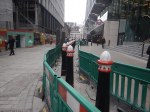


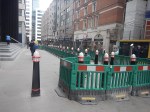
But the plastic barriers haven’t been removed yet.
It looks like the station entrance could be finished soon.
If you want a bollard like this for your drive ATG Access make and sell them.
ORR Gives Approval For University Station, Birmingham, To Open
The title of this post, is the same as that of this article on RailUK.
These three paragraphs outline the opening of the rebuilt station.
The Office of Rail and Road (ORR) has authorised two new station buildings and other significant enhancements at University railway station in Birmingham, allowing them to enter into service.
This is a key milestone on the way to getting the station open in the next few weeks.
Linking the two new station buildings is an accessible rail link bridge, and there are new signage, lighting, CCTV and other systems throughout.
No opening date, other than next few weeks, has been given.
EDF Receives Green Light For Solar Farm At The Macallan Estate
The title of this post, is the same as that of this article on Solar Power Portal.
These three paragraphs outline the story.
Energy company EDF Renewables UK has been granted the green light to develop a 4MW solar farm to decarbonise the production of The Macallan’s single malt Scotch whisky in Craigellachie.
Located at The Macallan Estate in north-east Scotland, the distillery company alongside EDF Renewables will integrate ground-mounted solar panels to deliver up to 50% of the daytime electricity needs at peak output. In doing so, this could provide 30% of the site’s yearly electricity demand.
A key aspect of the project is biodiversity and local community engagement – aspects of solar projects which regular readers of Solar Power Portal will be aware of across a number of different schemes.
This Google Map shows the Macallan Estate about sixty miles to the North-West of Aberdeen.
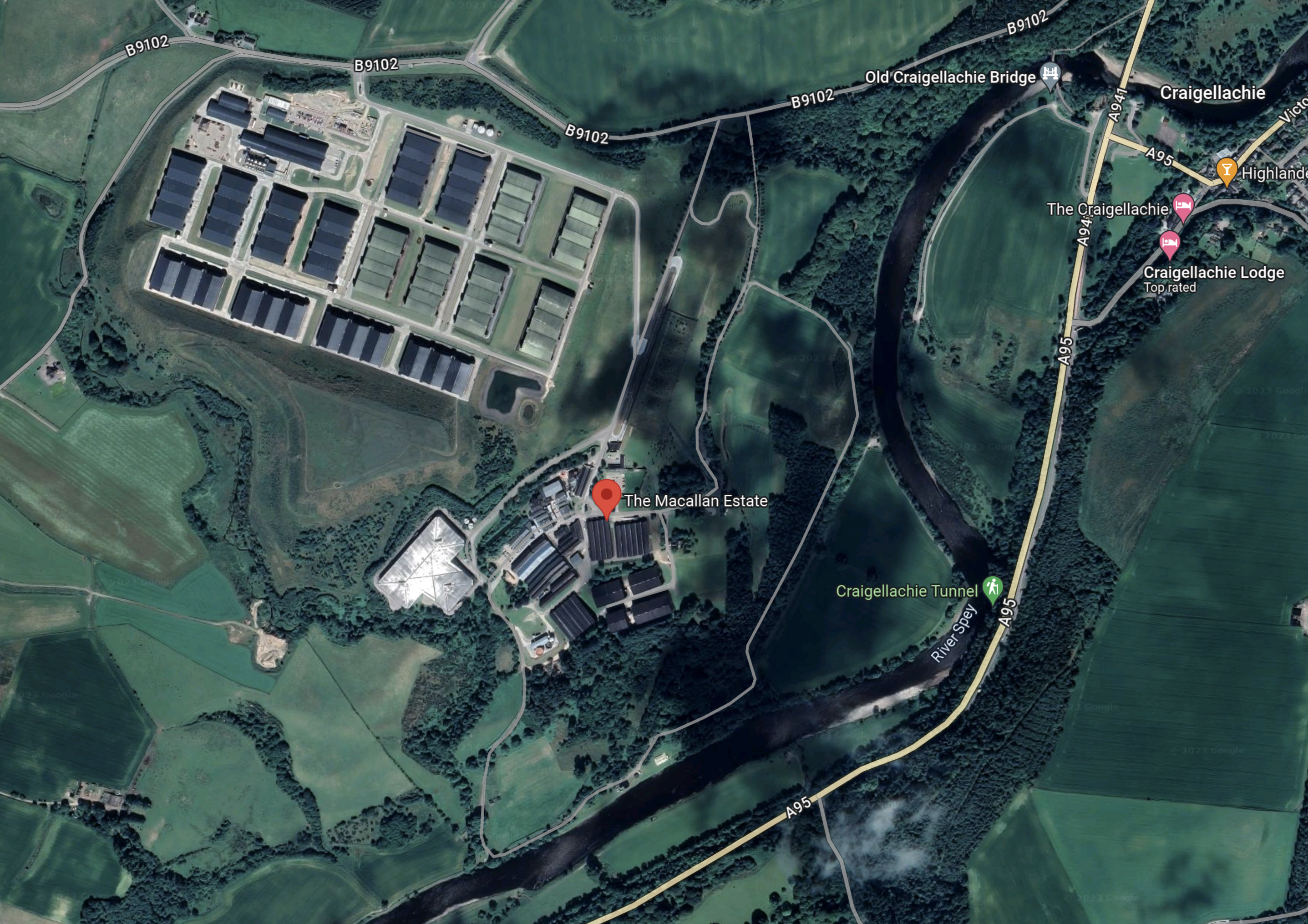
This page on the Macallan Estate web site gives details about the company, its whisky and principles.
As the estate is 485 acres, they’ve certainly got enough space for 4 MW of solar panels.
I do wonder though if low- or zero-carbon whisky and other spirits is the way the industry is going.
Searching the Internet for “Zero-Carbon Whisky” gives some worthwhile results.
- NC’NEAN is organic Scotch Whisky distilled in a net-zero distillery in the Western Highlands of Scotland.
- Cooper King is the is the very first whisky in England to be distilled using net zero energy.
- Diageo opens its first carbon neutral whiskey distillery in North America
- The Scotch Whisky Association will achieve Net Zero emissions by 2040 in our own operations.
- Scotch Whisky Heads To Zero Emissions With Wind & …
Scotland seems to be moving to make whisky at least carbon neutral.
There are also two hydrogen projects aimed at distilleries under development.
This is a paragraph from the home page of the Cromarty Hydrogen Project.
The Cromarty Hydrogen Project is the first project in the Scotland Hydrogen Programme. It originated from a collaboration between the Port of Cromarty Firth, ScottishPower, Glenmorangie, Whyte & Mackay and Diageo and the project originator, Storegga during the feasibility stage. This project is looking to develop a green hydrogen production hub in the Cromarty Firth region and revolves around the local distilleries forming the baseload demand for early phases of the project, which would enable them to decarbonise in line with their own ambitions and sector targets.
This project appears to be backed by three companies, who produce Scotch whisky.
In Major Boost For Hydrogen As UK Unlocks New Investment And Jobs, I said this.
I have just looked at the InchDairnie Distillery web site.
- It looks a high class product.
- The company is best described as Scotch Whisky Reimagined.
- The company is based in Fife near Glenrothes.
- They appear to have just launched a rye whisky, which they are aiming to export to Canada, Japan and Taiwan.
The press release says this about InchDairnie.
InchDairnie Distillery in Scotland, who plan to run a boiler on 100% hydrogen for use in their distilling process.
That would fit nicely with the image of the distillery.
I suspect the hydrogen will be brought in by truck.
Would a zero-carbon whisky be a hit at Extinction Rebellion and Just Stop Oil parties?
Diageo
This page on the Diageo web site is entitled Accelerating To A Low Carbon World.
It would probably help if more companies thought like Diageo.
Conclusion
Macallan are certainly going in the right direction.
 The Anonymous Widower