Q4 2023 Sees Largest Quarterly Increase In Battery Energy Storage
The title of this post, is the same as that of this article on Solar Power Portal.
These three paragraphs outline the story.
Energy research consultancy Modo Energy has confirmed that Q4 2023 saw 420MW of new battery energy storage capacity become commercially operational.
This new capacity represents a 13% increase on the previous quarter and, in doing so, becomes the largest ever quarterly increase in operating battery capacity in GB. The previous record was set in Q2 2023 when 413MW was added.
It is worth noting that the additional capacity now means that GB’s operational grid-scale battery energy storage capacity has now reached 4.6GWh. Modo also confirmed that 1.5GW of battery storage was added across 2023 – a record for a one-year period.
Note.
- Modo Energy has a web site.
- Hinckley Point C has a nameplate capacity 3.26 GW.
- The article also says that the average duration of battery storage in GB is now 1.3 hours.
Strangely, this gives a BESS total storage capacity of 4.55 GWh, which is half the capacity of Electric Mountain.
Exagen Given Green light for new 500MW / 1GWh Battery Storage Project In Leicestershire
The title of this post is the same as that of this article on PV Magazine.
This is the outline of the project, which will be called the Normanton Energy Reserve.
The new 500MW / 1GWh battery site will be capable of powering 235,000 homes for two hours, equivalent to 80% of the homes in Leicestershire.
Approximately 45% of the 19-acre site will be set aside to improve biodiversity by extending Normanton Millennium Wood and creating wildflower meadows. The project will deliver more than 25% biodiversity net gain.
Exagen will establish a circa £4M community fund to spend on improvements in the local area, with residents consulted on how the fund is used.
Note.
- A 500MW / 1GWh battery is not small.
- The size probably makes it a good backup for Leicestershire.
- Nineteen acres is a 277 metre square.
- Any biodiversity net gain is worthwhile.
- A £4M community fund is not to be sneezed at.
It all sounds very good.
Normanton Wood has a web site, where this is said on the home page.
Normanton Wood is one of The Woodland Trust’s ‘Woods on Your Doorstep’ woodlands created to commemorate the Millennium. It lies near Earl Shilton Leicestershire and was planted by members of the local community.
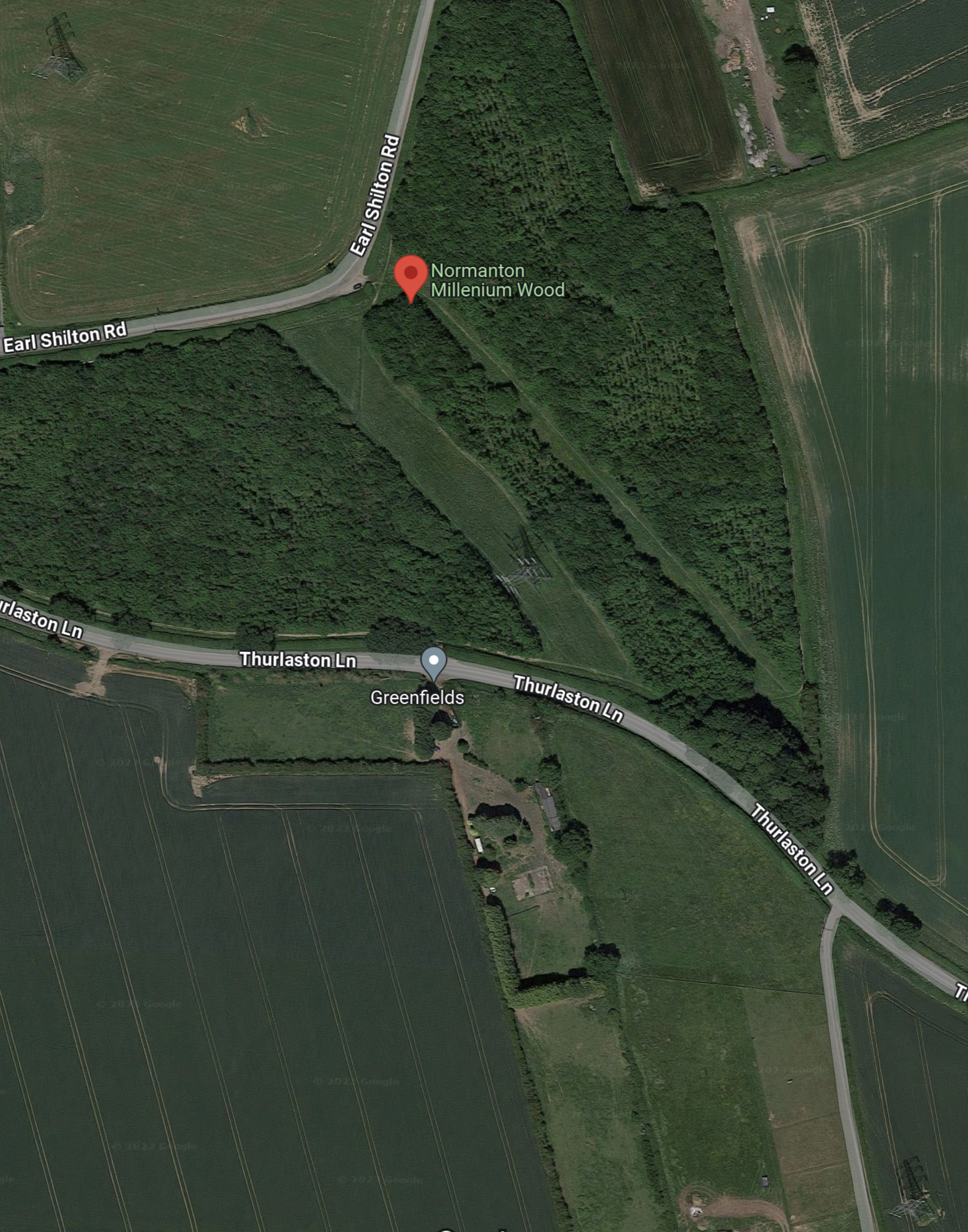
This Google map shows the wood.
Note.
- The red arrow indicates Normanton Millennium Wood.
- I suspect that cleared space in the woodland leading South-East from the red arrow is about 300 metres long and 15 metres wide, which is about 1.1 acres
- As Normanton Millennium Wood is 16.75 acres, I suspect it includes all the woodland to the East of the red arrow, up to the cultivated farmland.
- If you look carefully, you can see a large electricity pylon in the wider cleared area, to the South of the red arrow.
- When I created this map, I clipped it so that the next pylons to the North-West and South-East were in the respective corners of the map.
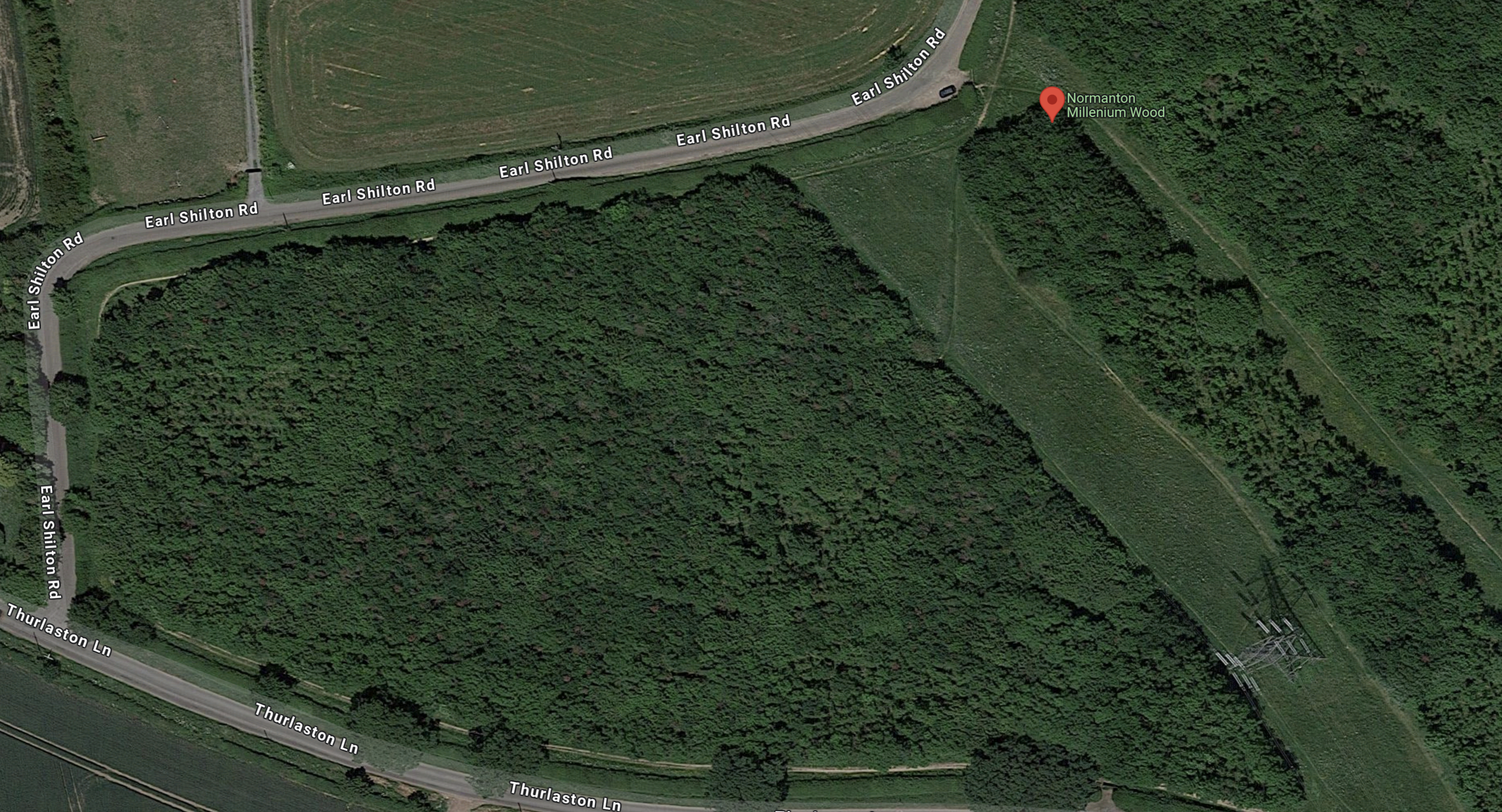
This second map shows the land to the West of the red arrow, which is enclosed by the roads.
Note.
- As before the red arrow indicates Normanton Millennium Wood.
- The electricity pylon is clearly visible on the cleared strip.
- The land to the East of the cleared strip looks like its been planted with trees in the last decade or so.
- The land to the West of the cleared strip looks more like scrub, that has grown up after years of neglect.
- I estimate that the area of the cleared strip and the scrub, is around nineteen acres.
- This news story from Exagen, is entitled Woodland Planting At Normanton Energy Reserve – Becca Leake is a must-read as it outlines how woodland will be planted at the site.
As there is no local substation, it looks to me, that a new substation will be built close to the electricity pylon, with the battery to its West.
Conclusion
It seems a good design for a large battery site, which will be shielded from neighbours by a large area of woodland.
I am also sure, that this battery and the one talked about in New Octopus Energy Makes First Investment To Develop UK’s Largest Battery, are the same battery.
All the numbers in both articles are identical.
Slow Tourism Train Operator Launches First Service
Tyhe title of this post, is the same as that of this article on Railway Gazette.
These are the first two paragraphs.
FS Group’s recently formed tourist train business FS Treni Turistici Italiani has launched its first service.
Branded Espresso Cadore, the overnight service between Roma Termini and Calalzo-Pieve di Cadore-Cortina will run every Friday night until mid-February. On arrival, a connecting bus takes passengers to Cortina d’Ampezzo in 45 min. The return train departs on Sundays, arriving at Roma Termini on Monday morning.
It is surely an interesting concept and I believe it could work on several routes in the UK.
- Settle and Carlisle would be an obvious route.
- Cumbrian Coast Line.
- Bristol and Oxford, which I wrote about in Leisure Market Boom? GWR’s Vision For Direct Bristol-Oxford Services.
There must also be a couple of routes in Scotland and Wales.
As the three routes, I named are electrified at both ends, there is a possibility that they could be run by quiet battery-electric trains.
World’s First Floating Wind Farm To Undergo First Major Maintenance Campaign, Turbines To Be Towed To Norwegian Port
The title of this post, is the same as that of this article on offshoreWIND.biz.
This is the sub-heading.
The world’s first commercial-scale floating wind farm, the 30 MW Hywind Scotland, officially entered the operations and maintenance (O&M) phase in October 2017. After a little over six years of operation, the wind farm’s Siemens Gamesa wind turbines are now due for some major maintenance work.
And this is the first paragraph.
While offshore wind farms undergo turbine maintenance work more than once during their lifespans and tasks such as major component exchange are nothing uncommon, this is the first time a campaign of this kind will be done on a floating farm.
Hywind Scotland has a web site, where this is said on the home page.
The world’s first floating wind farm, the 30 MW Hywind Scotland pilot park, has been in operation since 2017, demonstrating the feasibility of floating wind farms that could be ten times larger.
Equinor and partner Masdar invested NOK 2 billion to realise Hywind Scotland, achieving a 60-70% cost reduction compared with the Hywind Demo project in Norway. Hywind Scotland started producing electricity in October 2017.
Each year since Hywind Scotland started production the floating wind farm has achieved the highest average capacity factor of all UK offshore windfarms, proving the potential of floating offshore wind farms.
This news item from Equinor is entitled Equinor Marks 5 Years Of Operations At World’s First Floating Wind Farm, says this about the capacity factor of Hywind Scotland.
Hywind Scotland, located off the coast of Peterhead, Scotland, is the world’s first floating offshore wind farm and the world’s best-performing offshore wind farm, achieving a capacity factor of 54% over its five years of operations. Importantly, Hywind Scotland has run to high safety standards, marking five years of no loss time injuries during its operation.
Any capacity factor over 50 % is excellent and is to be welcomed.
Maintaining A Floating Wind Farm
One of the supposed advantages of floating wind farms, is that the turbines can be towed into port for maintenance.
This first major maintenance of a floating wind farm, will test that theory and hopefully provide some spectacular pictures.
Wales Puts Another Pumped Storage Hydroelectric Power Station Into Play
This page on World Energy is entitled Fortune Hydro AG and Voith Acquire 450 MW Dorothea Lakes Pump Storage.
This paragraph introduced the article.
Fortune Hydro AG, in collaboration with Voith Small Hydro, has acquired the 450 MW Dorothea Lakes Pump Storage project as part of an £800 million (US$1 billion) strategic investment in renewable energy in the UK.
It looks to me that this was a good buy in July 2023, as after last week, when I wrote Price Framework Paves Way For Vast Electricity Storage Scheme, in response to a UK Government announcement about funding pumped storage hydroelectricity.
These two paragraphs give more details of the project.
Located in Snowdonia, Northern Wales, this green storage facility presents a unique opportunity to integrate wind, solar and hydroelectric power, Fortune Hydro said. The Dorothea Lakes site was one of the largest slate quarries in Europe and the largest in North Wales.
Electricity produced by solar and wind during low demand can be stored until demand is there. This storage allows balancing of the production cycle in the large solar and wind farms in the north against the demand cycle of consumers and businesses in central and southern UK. It will generate up to 600 jobs and bring economic development and new business opportunities to the local community, the company said.
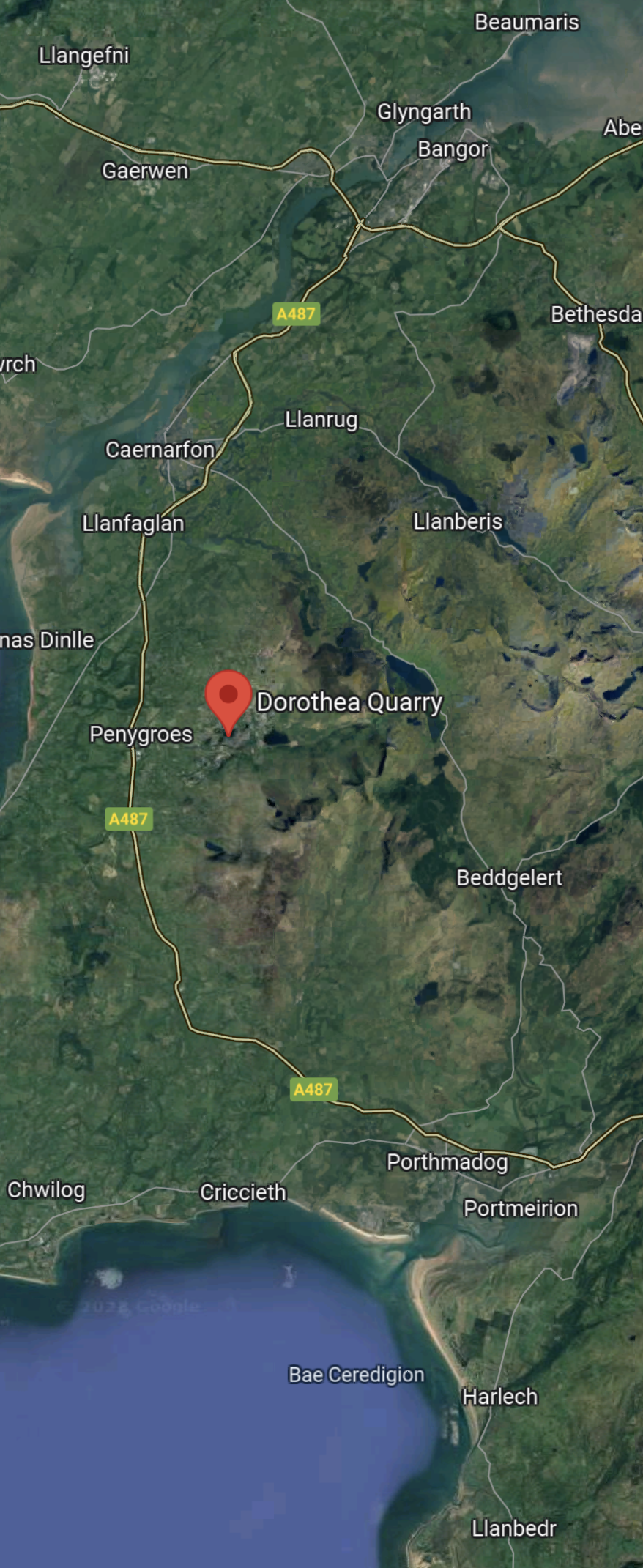
This map shows the location of Dorothea Lakes.
Note.
- Dorothea Lakes is indicated by the red arrow.
- The Menai Strait between Bangor and Caernarfon is at the top of the map.
- It is certainly in a convenient place, with all the wind farms off the North Wales Coast.
At 450 MW, it’s about a third the size of Electric Mountain, so I suspect it could hold about 3 GWh of electricity.
Leisure Market Boom? GWR’s Vision For Direct Bristol-Oxford Services
The title of this post, is the same as that of this article on Rail Magazine.
This is the first paragraph.
Great Western Railway has hopes on running direct services between Bristol Temple Meads and Oxford from September 14, subject to approval of its new trial proposal by the Department for Transport and Network Rail. The move is a test of growth in demand for leisure travel by train.
It is an interesting idea.
These are some points about the service, given in the article.
- The route will be via Swindon, Chippenham and Bath Spa.
- Fastest journey time would be 71 minutes.
- The route will be aimed at the leisure market.
- There will be two trains per day (tpd) in each direction on Saturdays.
This is GWR’s handy route map.

These are my thoughts.
Will The Trains Call At Didcot Parkway?
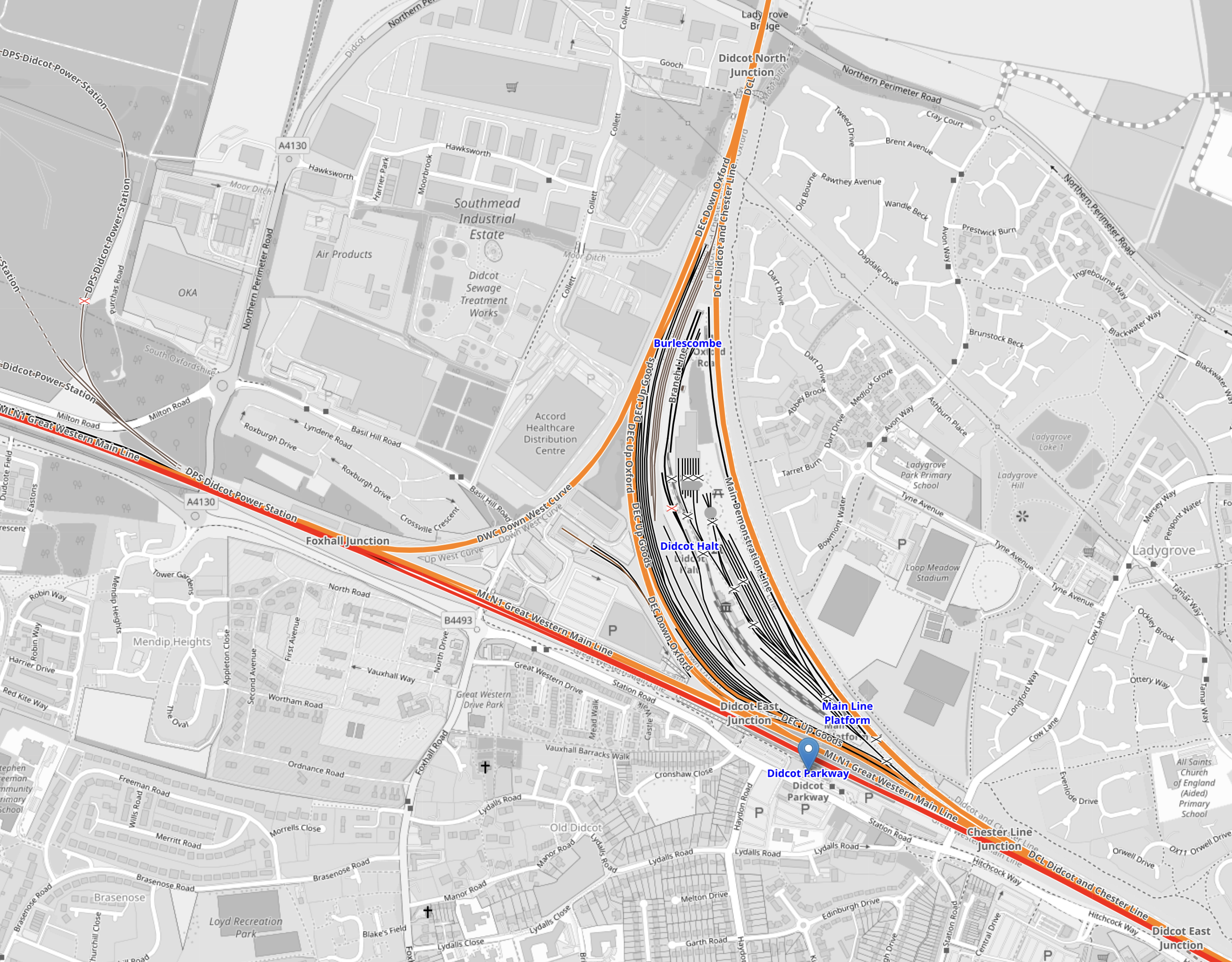
This OpenRailwayMap shows Didcot Parkway station and the large triangular junction, that connects Oxford to the Great Western Main Line.
Note.
- The red tracks are the Great Western Main Line.
- The blue arrow indicates Didcot Parkway station.
- Oxford station is about ten miles to the North.
- Chords in the junction allow trains to go between Oxford and Paddington and Oxford and Swindon, with or without a stop at Didcot Parkway station.
The article says that GWR has asked to run the following services.
- 1018 Bristol Temple Meads-Oxford – Would arrive at Oxford at 1129.
- 1155 Oxford-Bristol Temple Meads (via Didcot) – Would arrive at Bristol Temple Meads at 1306.
- 1518 Bristol Temple Meads-Oxford – Would arrive at Oxford at 1629.
- 1712 Oxford-Bristol Temple Meads – Would arrive at Bristol Temple Meads at 1823.
Note.
- I suspect that the 1155 will reverse at Didcot Parkway station.
- There is a two train per hour (tph) service between Didcot Parkway and London Paddington stations.
- It looks like the four services could be run by a single train shuttling up the Great Western Main Line.
Would it be sensible if all Oxford and Bristol trains called at Didcot Parkway station, so that travellers could use the London service to their advantage?
But, calling at Didcot Parkway station would slow the service as there would need to be a reverse.
What Class Of Train Would Be Used?
Consider.
- A Bristol and Didcot Parkway via Bath Spa service takes 55 minutes.
- This is an average speed of 71.1 mph over a distance of 65.2 miles.
- 24.4 miles at the Bristol end of the route is not electrified.
- 10.3 miles at the Oxford end of the route is not electrified.
- The four services can be run by a single train shuttling up the Great Western Main Line.
It looks to me, that a bi-mode train with good performance is needed.
So I suspect that a five-car Class 800 or Class 802 train will be used.
Will The Train Be Battery-Electric Powered?
This is an interesting possibility.
- An ideal route for a battery electric train, is surely one with a long electrified section in the middle, which can be used to fully charge the train’s batteries.
- The train would have to run for 48.8 miles on its own power at the Bristol end of the route.
- The train would have to run for 20.6 miles on its own power at the Oxford end of the route.
The data sheet for a battery-electric Class 800/802 train can be downloaded from this page on the Hitachi web site.
In a section on the page, which is entitled Intercity Battery Trains, this is said.
A quick and easy application of battery technology is to install it on existing or future Hitachi intercity trains. Adding just one battery reduces emissions by more than 20% and offers cost savings of 20-30%.
Our intercity battery powered trains can cover 70km on non-electrified routes, operating at intercity speeds at the same or increased performance. Hitachi Rail’s modular design means this can be done without the need to re-engineer or rebuild the train and return them to service as quickly as possible for passengers.
The range of 70 km is 43.5 miles, which would appear to be a little bit short to go from the end of the electrification at Chippenham to Bristol Temple Meads and back.
But various measures could be taken to make sure the train can handle the route.
- The regenerative braking strategy could be used to conserve battery power.
- A second battery could be added to the train.
- Methods to charge the train at Bristol Temple Meads could be installed.
As London Paddington and Bristol Temple Meads is an important route, I suspect that Hitachi and Great Western Railway have a strategy to handle trains from Chippenham and sending them back.
Could This Route Be A Trial Route For Battery-Electric Trains?
Consider.
- Hitachi and Great Western Railway wouldn’t want to introduce an unreliable train without full full testing.
- Trains can probably limp to either Stoke Gifford or Reading depots, after a battery failure.
- Great Western Railway could test a new route.
- A full test only needs one train.
- Passenger reaction to a battery-electric train can be assessed.
- Staff need to be trained.
- The route can be run by a standard bi-mode if required.
- It could be the world’s first high-speed battery-electric train.
- Enthusiasts would flock to have a ride.
Could this be a trial service to make sure everything goes right?
UK Offshore Wind In 2030
With the election coming up in the next year, I thought I’d add how much offshore wind will be available in the next few years.
In October 2023, according to this Wikipedia entry, there were offshore wind farms consisting of 2,695 turbines with a combined capacity of 14,703 megawatts.
These wind farms are due to be commissioned between now and the end of 2030.
- Dogger Bank A – 1235 MW – 2023
- Neart Na Gaoithe – 450 MW – 2024
- Dogger Bank B – 1235 MW – 2024
- Forthwind – 12 MW – 2024
- Moray West – 882 MW – 2025
- Dogger Bank C – 1218 MW – 2025
- Sofia Offshore Wind Farm – 1400 MW – 2026
- East Anglia 3 – 1372 MW – 2026
- East Anglia One North – 800 MW – 2026
- East Anglia Two – 900 MW – 2026
- Pentland – 100 MW – 2026 – Floating
- Hornsea Three – 2852 MW – 2027
- Norfolk Boreas, Phase 1 – 1380 MW – 2027
- Llŷr 1 – 100 MW – 2027 – Floating
- Llŷr 2 – 100 MW – 2027 – Floating
- Whitecross – 100 MW – 2027 – Floating
- Morecambe – 480 MW – 2028
- Bellrock – 1200 MW – 2028 – Floating
- Mona – 1500 MW – 2029
- Morgan – 1500 MW – 2029
- West of Orkney – 2000 MW – 2029
- Rampion 2 Extension – 1200 MW – 2030
- Norfolk Vanguard East – 1380 MW – 2030
- Morven – 2907 MW – 2030
- Norfolk Vanguard West – 1380 MW – 2030
- Berwick Bank – 4100 MW – 2030
- Outer Dowsing – 1500 MW – 2030
- Broadshore – 900 MW – 2028 – Floating
- Caledonia – 2000 MW – 2030
- Stromar – 1000 MW – 2028 – Floating
- N3 Project – 495 MW – 2030
- Muir Mhòr – 798 MW – 2030 – Floating
- North Falls – 504 MW – 2030
- Spiorad na Mara – 840 MW – 2031
- Bowdun – 1008 MW – 2033
- Ayre – 1008 MW – 2033 – Floating
- Buchan – 960 MW – 2033 – Floating
These can give these totals for the next few years.
- 2023 – 14.70 GW
- 2024 – 17.64 GW
- 2025 19.74 GW
- 2026 – 24.31 GW
- 2027 – 28.81 GW
- 2028 – 32.39 GW
- 2029 – 37.39 GW
- 2030 – 53.65 GW
- 2031 – 54.50 GW
- 2032 – 54.50 GW
- 2033 – 57.47 GW
Note.
- The Government’s 50 GW target of offshore wind power by 2030 has been achieved.
- A total of 7.27 GW of floating wind power has been installed.
- The Government’s target of 5 GW of floating offshore wind power by 2030 has also been achieved.
Currently, the UK is generating 37.49 GW of electricity.
Chiltern Railways Seeks Fleet Proposals
The title of this post, is the same as that of this article on Rail Business UK.
These are the first two paragraphs.
Chiltern Railways has invited proposals from established rolling stock owners for the lease and maintenance of between 25 and 70 existing vehicles to operate inter-city and regional services on the Chiltern Main Line between London Marylebone and Birmingham.
The operator is seeking either ‘self-powered’ multiple units or locomotive-hauled coaches, which can operate at 160 km/h in fixed formations of five or six passenger vehicles.
It does appear that only existing vehicles will be allowed.
These are my thoughts.
A Very Tight Timescale
The Rail Business UK article, says this about entry into service.
Requests to participate are required by February 2. Driver training is planned for 2024, and entry to passenger service for early 2025.
This requirement probably means that new trains are not allowed, as I doubt any manufacturer could deliver them by early 2025.
Although, I could envisage a proposal, where a couple of trains are delivered early for driver training and the other trains are delivered, as soon as they are refurbished or perhaps even built.
100 mph Trains With At Least Five Cars
The second paragraph from the Rail Business UK article is very definite about speed and the length of trains.
The operator is seeking either ‘self-powered’ multiple units or locomotive-hauled coaches, which can operate at 160 km/h in fixed formations of five or six passenger vehicles.
It does appear, that this paragraph, rules out multiple units, with less than five coaches. Unless it counts a two-car Class 175 train and a three-car Class 175 train working together as a five-car fixed formation. They would though be 100 mph trains.
Noise Restrictions
This noise restriction must be met according to the Rail Business UK article.
The trains must also offer a reduction in ambient noise compared to Chiltern’s existing MkIII coaches hauled by a Class 68 diesel locomotive.
This could be a difficult condition to meet for some trains and probably rules out diesel locomotives.
What Fuels Can Be Used?
This is the only restriction in the Rail Business UK article.
Any diesel-powered trains should be compatible with use of alternative fuels, such as HVO, from the service introduction date.
Chiltern have experience of this fuel.
‘Self-Powered’ Multiple Units Or Locomotive-Hauled Coaches
i am tending towards the former for the following reasons.
- I was told by someone, that between London and Norwich, ‘self-powered’ multiple units are faster than locomotive-hauled coaches.
- Without the locomotive and the driving van trailer, you may get more passengers in a shorter train. This might avoid some platform lengthening.
- The Chiltern route to Birmingham has around a dozen stops and the lighter ‘self-powered’ multiple units may save time.
- Battery-electric ‘self-powered’ multiple units can be very quiet.
- Chiltern have had complaints about noise from diesel locomotives.
The last two points probably clinch it.
The Operating Speed Of The Chiltern Main Line
I have followed the Chiltern Main Line on OpenRailwayMap and virtually all of it is faster than 75 mph, with several sections of 90-100 mph running.
Hence the need for 100 mph trains!
What Distances Are Involved
The route can be split into sections.
- London Marylebone and High Wycombe – 28.1 miles
- High Wycombe and Banbury – 41 miles
- Banbury and Warwick – 21.8 miles
- Warwick and Birmingham Moor Street – 20.8 miles
Note.
- The total distance is 111.7 miles.
- High Wycombe and Warwick are 62.8 miles apart.
No sections are too challenging.
Could A Battery-Electric Train Handle The Route?
In The Data Sheet For Hitachi Battery Electric Trains, these were my conclusions for the performance.
- The battery pack has a capacity of 750 kWh.
- A five-car train needs three battery-packs to travel 100 miles.
- A nine-car train needs five battery-packs to travel 100 miles.
- The maximum range of a five-car train with three batteries is 117 miles.
- The maximum range of a nine-car train with five batteries is 121 miles.
It would appear that a five-car train with three batteries could handle the route, but there would need to be some form of charging at both ends of the route. This might not be too easy to arrange, as all three terminal stations are not the most spacious.
Could A Tri-Mode Train Handle The Route?
LNER have taken the tri-mode route with their new trains, which I wrote about in First Tri-Mode Long Distance Trains For The East Coast Main Line.
These trains could be a possibility, especially if they used battery power in stations where there have been complaints of noise.
I suspect CAF’s tri-mode trains could also be run on HVO, as it is likely they’ll have Rolls-Royce mtu engines, which can use the fuel.
As Hitachi’s Class 802 trains also use Rolls-Royce mtu engines and Hitachi are developing a tri-mode version, these trains are also a possibility.
Although tri-mode trains are a possibility, I doubt that delivery would be easy by the beginning of 2025.
Unless, the Government has tipped off CAF and/or Hitachi and they are already building some trains that can be completed as tri-modes.
After all, CrossCountry, Grand Central, South Western Railway and TransPennine may need tri-mode trains for their routes.
What About Hydrogen?
I don’t think, there is a hydrogen train, that would be suitable and could start driver training this year.
So, unless someone like Stadler says they have a train, hydrogen looks to be a non-starter.
An Unusual Solution
As I said on the previous section about hydrogen, the time-scale is tight and this probably cuts out totally new trains.
But we may have an unusual solution, that surprised everyone.
Consider.
- I have stated that I believe that a five-car Class 802 train with three battery packs has a range of 117 miles.
- The range would be enough to go between London Marylebone and Birmingham.
- So why not put in short lengths of overhead electrification at High Wycombe, Banbury and Warwick, where the train can have a quick splash and dash?
I am certain, that a unusual strategy like this can be made to work.
Conclusion
I suspect we’ll see an innovative solution, that gives ISquared what they want.
Chiltern Railways 2030 Vision
The title of this post, is the same as that of this page on the Chiltern Railways web site.
It looks a positive vision and must have been written with input and/or approval from Chiltern Railways’s new American owners.
This is an extract from the page.
It covers how investing in our fleet is:
- The Right Route for people by driving forward improvements in punctuality, level of crowding, frequency and seating capacity.
- The Right Route for connections by making it easier for people to travel by train to the places they need to go, and bring people and businesses closer together through a stronger network.
- The Right Route for our environment by reducing carbon emissions and helping customers to use their cars less across our route.
- The Right Route for innovation by helping create jobs and economic activity across our route and the national supply chain.
- The Right Route for the future of our communities by helping reach communities reach their full potential as more people move to towns, villages and cities across the route.
We plan to work closely with the Department for Transport to agree the scope and funding for new trains between London and Aylesbury soon.
I talk about the new Aylesbury trains in Chiltern Railways New Trains For Aylesbury.
Chiltern Railways New Trains For Aylesbury
This page on the Chiltern Railways web site, is entitled Chiltern Railways 2030 Vision.
This is an extract from the page.
It covers how investing in our fleet is:
- The Right Route for people by driving forward improvements in punctuality, level of crowding, frequency and seating capacity.
- The Right Route for connections by making it easier for people to travel by train to the places they need to go, and bring people and businesses closer together through a stronger network.
- The Right Route for our environment by reducing carbon emissions and helping customers to use their cars less across our route.
- The Right Route for innovation by helping create jobs and economic activity across our route and the national supply chain.
- The Right Route for the future of our communities by helping reach communities reach their full potential as more people move to towns, villages and cities across the route.
We plan to work closely with the Department for Transport to agree the scope and funding for new trains between London and Aylesbury soon.
These trains run to Aylesbury and/or Aylesbury Vale Parkway stations.
- London Marylebone and Aylesbury via High Wycombe – 43.5 miles (70 km.) – 17 stops
- London Marylebone and Aylesbury via Amersham – 38.8 miles (62.4 km.) – 10 stops
- London Marylebone and Aylesbury Vale Parkway via Amersham – 41.2 miles (66.3.) – 11 stops
- Princes Risborough and Aylesbury – 7.2 miles (11.6 km.) – 2 stops
Note.
- The longest round trip is under 150 km.
- Trains terminating at Aylesbury Vale Parkway take around twenty minutes to go from Aylesbury to Aylesbury Vale Parkway and back to Aylesbury, which is more than enough time to charge a battery-electric train.
- It is mainly single-track between Aylesbury Vale Parkway and Aylesbury stations.
- Princes Risborough shuttles seem to wait be at Aylesbury station for about ten minutes, which is more than enough time to charge a battery-electric train, for the short route.
- Direct Marylebone services via Amersham 80 miles (appear to be at Aylesbury long enough to charge a battery-electric train.
It looks to me that if Aylesbury and Aylesbury Vale Parkway stations and the track between the two stations were to be electrified, that a battery-electric train with a range in excess of 87 miles (140 km.) can run all services to Aylesbury and Aylesbury Vale Parkway stations.
Is there a battery-electric train with a range of say 150 km?
This page on the Hitachi Rail website is called Battery Commuter Trains.
If you download the fact sheet, it says that their four-car battery-electric train has a range of 150 km.
I suspect that other manufacturers can also produce a four-car battery-electric train has a range of 150 km, that would suit Chiltern’s needs.
Electrification At Aylesbury
I estimate that only about four miles of single-track electrification will be needed at Aylesbury.
The cost of this can surely be bundled in with the cost of the new trains.
Conclusion
It looks to me, that with a few miles of electrification at Aylesbury, Hitachi can deliver trains, that will electrify services to both Aylesbury stations.
 The Anonymous Widower