Carew Castle Express Unveiled In Carmarthen
The title of this post, is the same as that of this article on Rail UK.
These are the first two paragraphs.
The ‘Carew Castle Express’ has been unveiled to mark the introduction of brand-new Transport for Wales (TfW) trains between Swansea and Carmarthen.
Named as part of TfW’s Magnificent Train Journey competition, the name ‘Carew Castle Express’ was chosen by year 5 pupil Rhys Protheroe from Johnstown Primary School in Carmarthen.
But perhaps, this extract is the most significant statement in the article.
Soon every service west of Carmarthen will be on one of the brand-new trains.
Alexia Course, chief commercial officer for TfW, said: “We’re excited to be running our brand-new trains in West Wales and we’re adding more to our network every few weeks.
CAF and TfW don’t seem to be hanging about in getting these new trains into service.
But then, I suspect some of the trains they replace, will be going to the scrapyard in Newport.
How Will These Trains Be Decarbonised?
My one worry is that these Class 197 trains and the similar Class 195 trains at Northern and the Class 196 trains at West Midlands Trains are diesel powered.
Nothing has been said about how these 141 trains will be decarbonised.
But all three fleets have the same Rolls-Royce mtu 6H 1800 R85L engines, so at least one solution will fit all!
A Thought About LNER’s New Trains
These trains appear to have been delivered quickly.
Did this influence the decision of LNER to buy CAF trains for their fleet expansion?
RheEnergise And Colbún Sign MoU For Long Duration Energy Storage Projects In Chile
The title of this post is the same as that of this article on Water Power and Dam Construction.
These are the first two paragraphs.
Colbún, Chile’s third-largest power generation company and a prominent hydropower operator, has entered into a partnership with RheEnergise, a UK-based clean technology firm, to investigate the viability of deploying RheEnergise’s innovative long-duration hydro-energy storage solution, High-Density Hydro® (HD Hydro), in Chile. The agreement marks RheEnergise’s first entry into South America’s energy market.
Colbún and RheEnergise will jointly assess the feasibility of constructing a 10MW, 10-hour HD Hydro system in Chile. This initiative is seen as a valuable addition to Colbún’s diverse portfolio of hydro, wind, and solar projects, offering a novel technology to address the intermittency challenges associated with renewable energy sources. RheEnergise will conduct thorough investigations and technical studies to identify potential sites for its HD Hydro system, while Colbún will contribute local market expertise, guidance on planning and permitting, and insights into utility.
Note.
- Colbún has a Wikipedia entry and seems to be a fairly large company.
- The proposed system appears to be a 10 MW/100 MWh system, which could be ideal to back up a small wind or solar farm of about 50 MW capacity.
- Colbún seem to have the expertise to be a good partner for RheEnergise.
This last paragraph gives a snapshot of the Chilean market.
“Chile is a very attractive market for RheEnergise’s HD Hydro,” added Sophie Orme, Commercial Director at RheEnergise. “The Chilean Government is leading the way in Latin America, having dedicated US$2 billion for energy storage auctions from 2024, and set a renewables target of 70% by 2030 and carbon neutral by 2050. We are delighted to partner with Colbún, drawing on their first-hand experience of the market, in particular hydro and solar and to help them achieve their plan to add 4GW of renewable assets by 2030.”
I certainly wish both companies a successful future with this MoU.
Octopus Energy Creates GBP 3 Billion Offshore Wind Fund
The title of this post, is the same as that of this article on offshoreWIND.biz.
This is the sub-heading.
Octopus Energy’s generation arm has launched a dedicated fund with Japan’s Tokyo Gas to invest GBP 3 billion (approximately EUR 3.5 billion) in offshore wind globally by 2030.
This is the first paragraph.
The fund, set up with a GBP 190 million (about EUR 217 million) cornerstone investment from Tokyo Gas, will invest in the development, construction, and operational stage offshore wind farms, as well as companies creating new offshore wind, with a focus on Europe, said Octopus Energy.
It’s almost as if Octopus Energy are planning to do for offshore wind power, what Gore Street and Gresham House Energy Storage Funds have done for battery storage.
It strikes me that a detailed purpose-built financial model, as I have built several times could give a lot of insight into the wind farms and their financing.
There is also a lot of technology coming on stream, that will help this sort of wind fund.
- In-farm energy storage will happen and this will be the obvious place to use energy storage to smooth out the power from offshore wind farms.
- Floating wind farms are becoming mature technology and appear to offering higher capacity factors.
- Floating wind farms may offer lower maintenance costs.
- Multi-Purpose Interconnectors are starting to be installed and will allow power to be sent to more than one destination in different countries.
- Wind farms are increasingly being linked to battery storage to smooth out the power from offshore wind farms.
- Electrolysers are being built offshore.
- Data analysis is playing its part in improving operational efficiency.
Now could be the time to take the plunge and build that offshore wind farm.
Is This Better News For Offshore Wind Farm Developers?
Two months ago this article on offshoreWIND.biz was published, which was entitled Offshore Wind Developers Take A Pass On UK’s Fifth CfD Round As Maximum Bid Price Was Too Low.
This was the sub-heading.
The UK government has awarded 3.7 GW of renewable energy projects with Contracts for Difference (CfDs) in its fifth allocation round. Among the 95 new projects that secured CfDs are onshore wind, solar and tidal energy developments – and not a single megawatt of offshore wind.
These are the first three paragraphs of the article.
According to the government, the global rise in inflation and the impact on supply chains presented challenges for projects participating in this round. The government also noted that similar results have been seen in countries such as Germany and Spain.
The industry does not disagree, however, multiple players have voiced their disappointment that the government had not taken these pressures into account for this round and emphasised that the UK’s goal of having 50 GW of offshore wind and 5 GW of floating wind could now be jeopardised.
Last year, the UK awarded CfDs to 7 GW of offshore wind projects alone.
Today, articles with these titles and sub-headings were published on offshoreWIND.biz.
- 50 Developers Express Interest To Build Wind Farms Offshore Portugal
Fifty entities, including individual companies and consortia, from more than ten countries have submitted their expressions of interest to develop offshore wind projects in Portugal as the country prepares for its first auction.
2. Fugro To Survey Site For Lithuania’s First Offshore Wind Farm
Ignitis Renewables has awarded Fugro a contract to conduct a geophysical survey at Lithuania’s first offshore wind farm site.
3. Norway’s Offshore Wind Tender Attracts Seven Applications
Norway’s Ministry of Petroleum and Energy has received seven applications to participate in the tender for the Southern North Sea II offshore wind project area.
4. Project To Retrofit CTV With Hydrogen Fuel Cells Kicks Off
A project to retrofit a crew transfer vessel (CTV) with hydrogen fuel cells, to cut CO2 and NOx emissions while servicing offshore wind farms, has kicked off.
5.Terna Energy Secures Survey Permit for Wind Farm Sites Offshore Greece
Terna Energy has been granted one out of the two first exploration and survey licences issued for pilot offshore wind projects in Greece.
6. UK Increases Offshore Wind Strike Price Ahead Of Next Auction
The government of the United Kingdom has increased the maximum strike price for offshore wind projects in the next Contracts for Difference (CfD) auction by 66 per cent for fixed-bottom and by 52 per cent for floating wind projects.
All would appear to be positive stories.
- Story 1 is about success in Portugal. What are the Portuguese doing right?
- Stories 2 and 5 are about offshore wind development in new countries; Lithuania and Greece.
- Story 3 may not appear significant, but Terje Aasland, who is Norway’s Minister of Petroleum and Energy seemed pleased in the article.
- Story 4 is about development of new technology, which wouldn’t be done if the market was non-existent.
- Story 6 is surely good news for wind farm developers in the UK.
I did leave out three stories, one of which was negative and two were rather boring. But six out of nine isn’t bad.
Is it Getting Better All The Time, as The Beatles once sang?
Could The New Northumberland Line Be Used As A Diversion For The East Coast Main Line?
This question was asked by a friend, so I thought I’d investigate.
This OpenRailwayMap shows the Southern end of the Northumberland Line.
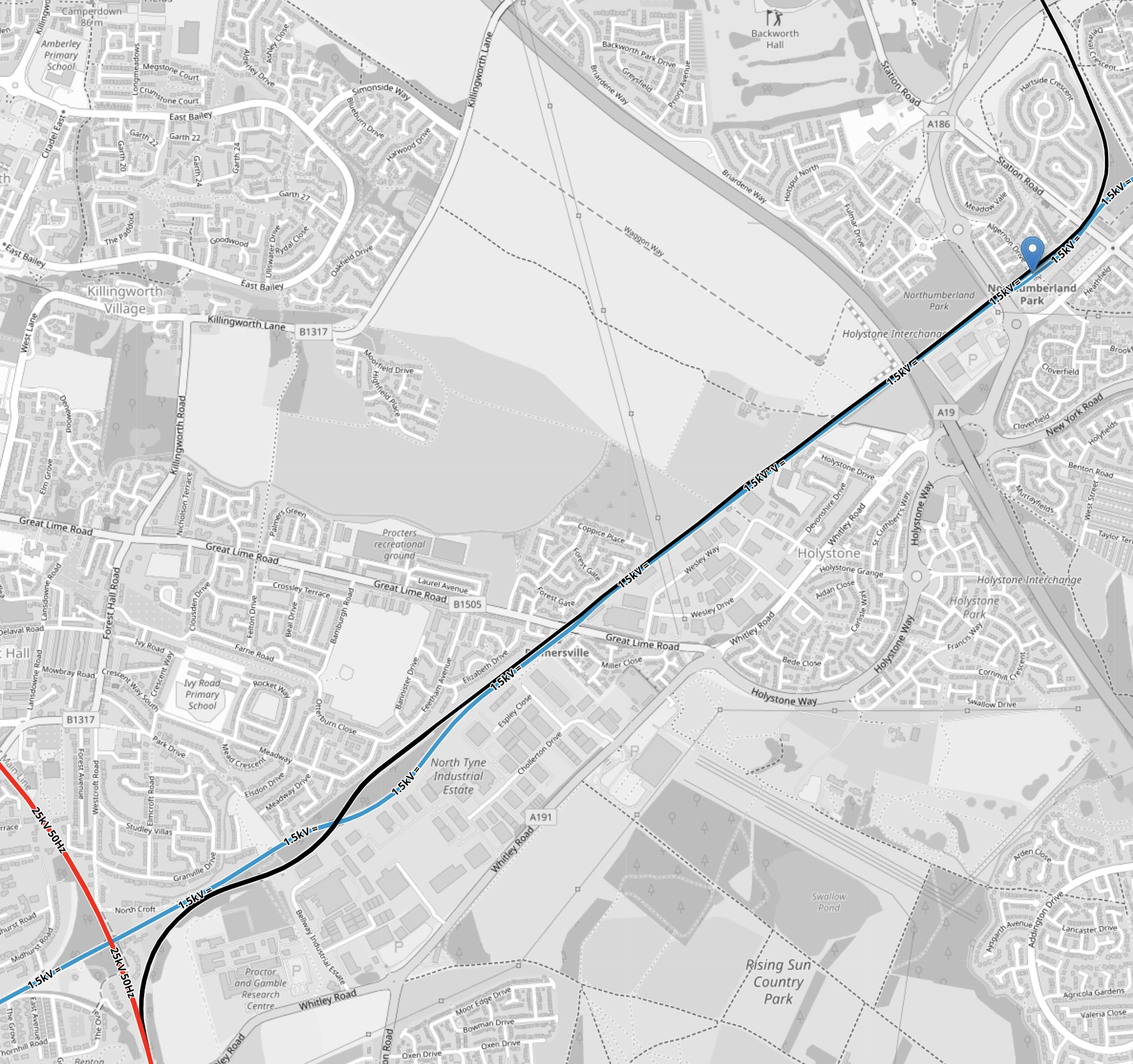
Note.
- Tracks in red are the 25 KVAC overhead electrified East Coast Main Line.
- Tracks in blue are the 1.5 kV overhead electrified Tyne and Wear Metro.
- The track in black running alongside the Metro and then turning North is the Northumberland Line.
- The Northumberland Line is mainly double track, with some single-track sections.
- The blue arrow indicates Northumberland Park station.
At Benton Junction junction in the South-West corner of the map, trains can be handled in the following directions.
- Trains going North on the East Coast Main Line can go North on the Northumberland Line.
- Trains going South on the Northumberland Line can go South on the East Coast Main Line.
Currently, only the occasional freight train uses the junction.
When the Northumberland Line opens, there will be two trains per hour (tph) in each direction.
This second OpenRailwayMap shows the Northern end of the Northumberland Line.
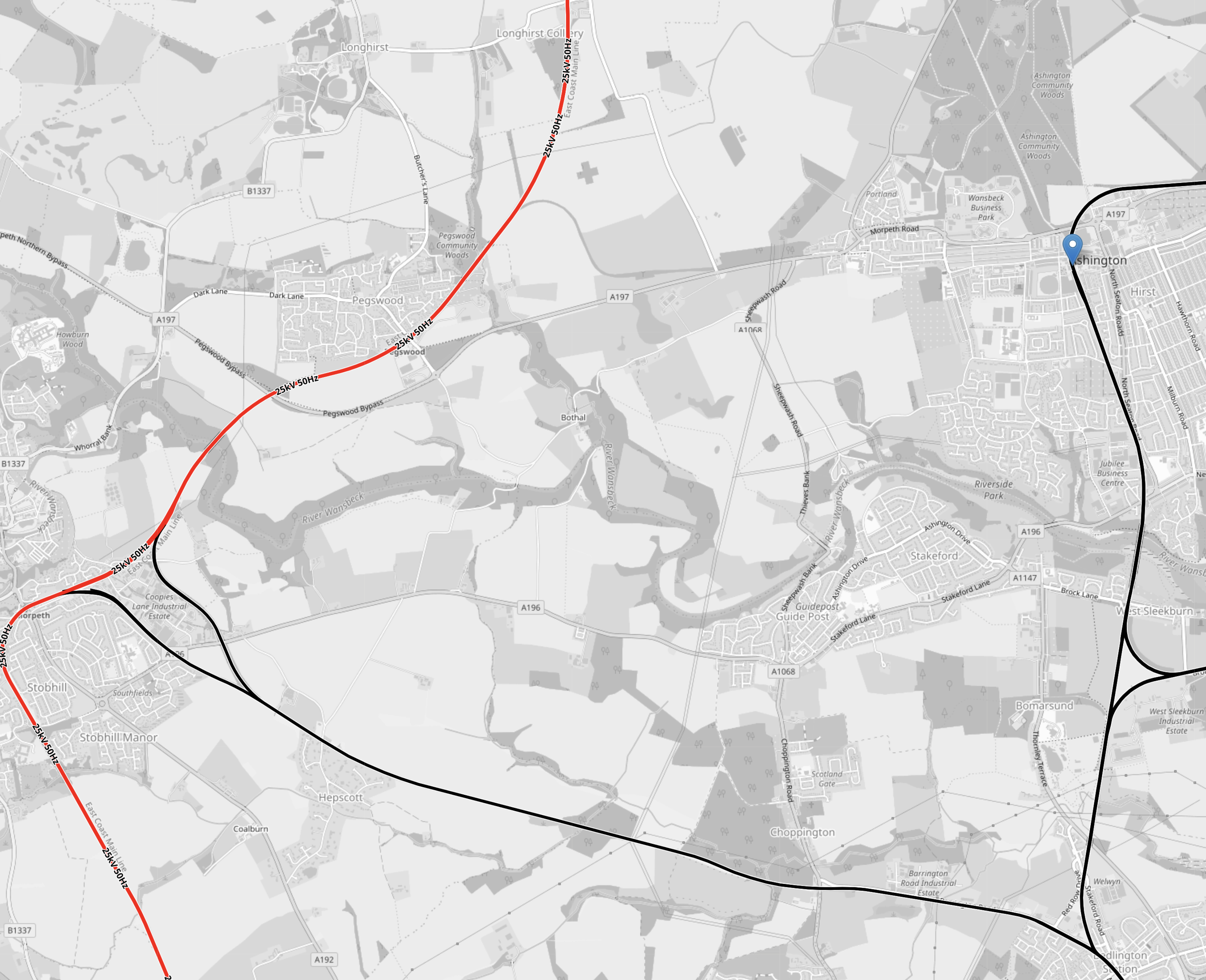
Note.
- Tracks in red are the 25 KVAC overhead electrified East Coast Main Line.
- The blue arrow indicates the Ashington station, which will be the Northern terminus of Northumberland Line services.
- The Northumberland Line runs down the Eastern side of the map.
- The village of Bedlington, which will have a station on the Northumberland Line is in the South-East corner of the map.
- A second track connects Bedlington on the Northumberland Line to the East Coast Main Line, where trains can go North or South.
It does appear that because of the track layout at both ends of the Northumberland Line, the following is possible.
A train going in either direction on the East Coast Main Line can use the Northumberland Line as a diversion.
Passenger services between Newcastle and Morpeth could use the Northumberland Line.
Passenger services between Newcastle and North of Morpeth could use the Northumberland Line.
Note.
- Although High Speed Two through Newcastle is probably dead, there is still a need to increase capacity through the area.
- I suspect diversions could be useful, when there were problems between Newcastle and Morpeth.
- Could the Northumberland Line be used for freight trains to increase capacity through Newcastle?
- We shouldn’t ignored the possibilities offered by a reopened Leamside Line.
But I suspect that as housing and other developments get proposed in Northumberland, that more passenger services will be developed.
Conclusion
The Northumberland Line will have limited use for diversions, but could general other services.
My First Ride In A Class 397 Train – 15th November 2023
I took these pictures during my first ride in a Class 397 train, between Wigan North Western and Liverpool Lime Street stations.





















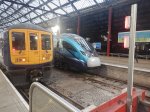
Note.
- Reading the plates, the total weight of the train is 188.4 tonnes.
- There are 268 seats.
- The ride wasn’t bad at all.
- Seats were comfortable.
Build quality was about the same as a Hitachi train.
The Data Sheet For Hitachi Battery Electric Trains
Was I just slow to spot this data sheet or has it only just been released?
You can download a copy from this page on the Hitachi web site.
In a section on the page, which is entitled Intercity Battery Trains, this is said.
A quick and easy application of battery technology is to install it on existing or future Hitachi intercity trains. Adding just one battery reduces emissions by more than 20% and offers cost savings of 20-30%.
Our intercity battery powered trains can cover 70km on non-electrified routes, operating at intercity speeds at the same or increased performance. Hitachi Rail’s modular design means this can be done without the need to re-engineer or rebuild the train and return them to service as quickly as possible for passengers.
These are my initial thoughts.
Plug-and-Play
It looks like the train is plug-and-play.
A diesel engine will be swapped for a battery-pack and the train’s computer controls the power sources accordingly.
Hitachi’s Battery Philosophy Explained
This is said on the data sheet.
Battery technology has the potential to play a significant role in the future of sustainable rail mobility, setting
the rail industry on the path to full intercity decarbonisation by 2050.
Installing batteries on intercity trains can complement electrification and provide a low emission alternative
to domestic air travel.Our retrofit solution for intercity trains offers phased replacement of diesel engines at the time that they would
have been due for their regular heavy maintenance overhaul, replacing each engine in turn until trains are fully battery electric. The solution delivers fuel cost savings and lowers CO2 emissions by at least 20% for every engine replaced, and a 20% reduction in whole life maintenance costs – well within the battery’s life span of 8-10 years.
Performance On Battery Power
The data sheet gives these bullet points.
- 750kW peak power
- Weight neutral.
- At least 20% lower CO2 emissions
- 70km on non-electrified routes
- 20% reduction in whole life maintenance costs
- Up to 30% fuel cost savings
- Zero emissions in and out of stations
- Charge on the move
- 10 year life span
Note.
- 750 kW peak power, is around the power of the diesel-engine, that will be replaced.
- I wouldn’t be surprised that powerwise, the battery pack looks like a diesel engine.
- Weight neutral means that acceleration, performance and handling will be unchanged.
- Batteries are easier to maintain than diesels.
- It is stated that a train can be fully-decarbonised.
I have a feeling these trains are no ordinary battery-electric trains.
Seventy Kilometre Range On Battery
Seventy kilometres is 43.5 miles.
This may not seem much, but the data sheet says this.
Our battery hybrid trains can cover 70km on non-electrified routes, operating at intercity speeds at the same
or increased performance. By identifying the routes with short non-electrified sections of 70km or less, we could
see the replacement of existing diesel trains with fully battery-operated trains on those routes within a year.
And, using battery power to avoid electrifying the hardest and most expensive areas, such as tunnels and bridges,
enables flexibility on electrification, minimising passenger disruption during upgrades.
Note.
- It looks like the trains can operate at 125 mph on battery power, where the track allows it. But then the rolling restistance of steel wheel on steel rail, is much lower, than that of rubber tyres on tarmac.
- Hitachi seem to have developed a philosophy on how the trains will be used.
- Hitachi’s pantographs, go up and down with all the alacrity of a whore’s drawers. They will be ideal for a short length of electrification.
I think these LNER routes could be immediately decarbonised.
- LNER – London and Harrogate , where only 18.3 miles is unelectrified. Trains may not need charging, as a full battery could handle both ways.
- LNER – London and Hull, where 36.1 miles is unelectrified. A short length of electrification to charge trains would be needed at Hull.
- LNER – London and Lincoln, where only 16.7 miles is unelectrified. Trains would not need charging, as a full battery could handle both ways.
- LNER – London and Middlesbrough, where only 20.3 miles is unelectrified. Trains would not need charging, as a full battery could handle both ways.
Note.
- It looks like some services could start fairly soon, once batteries are available.
- Hull Trains could use the 70 km batteries and charging at Hull, as it passed through. This would decarbonise Hull Trains passenger operations.
- Services to Aberdeen, Cleethorpes and Inverness would be out of range of the initial Hitachi trains.
Could the last point, partially explain the purchase of the CAF tri-mode trains, which I wrote about in First Tri-Mode Long Distance Trains For The East Coast Main Line?
We shall see what we shall see.
But having a choice of battery-electric or tri-mode trains will enable route development and decarbonisation.
What Is The Size Of The Battery Pack?
In How Much Power Is Needed To Run A Train At 125 Or 100 mph?, I estimated that to maintain 125 mph, a Class 801 train has a usage figure of 3.42 kWh per vehicle mile.
If a five-car Class 800 can run 70 km or 43.5 miles at 125 mph, as indicated by Hitachi, then the battery size can be calculated.
3.42 * 5 * 43.5 = 743.85 kWh
As the battery pack can supply 750 kW according to the data sheet, this looks like this will run the train for an hour.
Is that coincidence or a design criteria?
What Battery Capacity Would Be Needed For A Hundred Miles?
For a five-car train, this is the energy needed for a hundred miles.
3.42 *5 * 100 = 1710 kWh or three batteries.
For a nine-car train, this is the energy needed for a hundred miles.
3.42 *9 * 100 = 3078 kWh or five batteries.
It looks like all diesel engines will be replaced by batteries.
Will Class 801 Trains Swap Their Single Diesel Engine For a Battery Power Pack?
Consider.
- Class 801 trains have a single diesel engine for emergency power.
- Lumo’s Class 803 trains, are all-electric with a battery-pack for emergency hotel power only.
- Hitachi must have full details on the performance of Lumo’s trains.
- The East Coast Main Line is notorious for the wires to come tumbling down.
- The diesel engine and the battery pack appear to weigh the same.
- Batteries cost less to maintain than diesels.
I can’t see why the single diesel engine can’t be replaced by a standard battery pack, without loosing any functionality.
What Would Be The Range Of A Fully Battery-Electric Train?
This is a paragraph from a data sheet.
Our retrofit solution for intercity trains offers phased replacement of diesel engines at the time that they would
have been due for their regular heavy maintenance overhaul, replacing each engine in turn until trains are fully battery electric. The solution delivers fuel cost savings and lowers CO2 emissions by at least 20% for every engine replaced, and a 20% reduction in whole life maintenance costs – well within the battery’s life span of 8-10 years.
Note.
- It looks like Hitachi are expecting operators to replace engines in turn.
- Replacing engines with batteries saves the operators money.
As a five-car Class 800 train has three diesel engines and a nine-car train has five engines, does this mean that the range of fully-batteried Class 800 train is 70 km or 210 km?
- A fully-batteried Class 800 train will weigh the same as the current diesel.
- One battery can drive the train for 70 km at 125 mph according to Hitachi.
- There are no branches of electrified lines that are 125 mph lines without electrification.
- I would assume that the train can use regenerative braking to recharge the batteries.
- 210 kilometres is 130 miles.
I don’t know much about the electrical systems of Hitachi’s trains, but it is likely that there will be an electrical bus to distribute power from one end of the train to the other.
So a five-car Class 800 train with three fully-charged battery packs could have over 2 MWh of electricity on board, that could be used for traction.
- Applying the usage figure of 3.42 kWh per vehicle mile, gives a range for the five-car train of at least 117 miles.
- The equivalent figure for a nine-car train will be at least 121 miles.
These distances would open up routes like these on the East Coast Main Line.
- LNER – London King’s Cross and Aberdeen – 91.4 miles – Charge before return.
- LNER/Hull Trains – London King’s Cross and Beverley via Temple Hirst junction – 44.3 miles – No Charging needed before return.
- Grand Central – London King’s Cross and Bradford Interchange via Shaftholme junction – 47.8 miles – No Charging needed before return.
- LNER – London King’s Cross and Cleethorpes via Newark and Lincoln – 63.9 miles – Charge before return.
- LNER – London King’s Cross and Harrogate via Leeds – 18.3 miles – No Charging needed before return.
- LNER – London King’s Cross and Inverness– 146.2 miles – Charge before return.
- LNER/Hull Trains – London King’s Cross and Hull via Temple Hirst junction – 36.1 miles – No Charging needed before return.
- LNER – London King’s Cross and Middlesbrough via Northallerton – 20.3 miles – No Charging needed before return.
- LNER – London King’s Cross and Scarborough via York – 42.1 miles – No Charging needed before return.
- LNER/Grand Central – London King’s Cross and Sunderland via Northallerton – 47.4 miles – No Charging needed before return.
Note.
- The miles are the longest continuous distance without electrification.
- Only Aberdeen, Cleethorpes and Inverness would need to charge trains before return.
- Inverness may be too far. But is it in range of LNER’s new CAF tri-mode trains?
The battery range would also allow LNER to use the Lincoln diversion on the Joint Line.
Why Didn’t LNER Buy More Azumas?
This puzzles me and I suspect it puzzles other people too.
Surely, an all Azuma fleet will be easier to manage.
But in this article on Modern Railways, which is entitled LNER Orders CAF Tri-mode Sets, this is said.
Modern Railways understands the new fleet will be maintained at Neville Hill depot in Leeds and, like the ‘225’ sets, will be used predominantly on services between London and Yorkshire, although unlike the ‘225s’ the tri-modes, with their self-power capability, will be able to serve destinations away from the electrified network such as Harrogate and Hull.
Note.
- Hull would possibly need work to provide some form of charging for battery-electric Azumas, but Harrogate is close enough to be served by a one-battery Azuma.
- The CAF Tri-mode sets would certainly handle routes like Cleethorpes, Middlesbrough and Sunderland, but would they really need a ten-car train.
- Ten-car trains would also be busy on the Leeds route.
- The UK is going to need more 125 mph trains for Cross Country, Grand Central, Grand Union, TransPennine Express and possibly other train companies.
- Has Hitachi got the capacity to build the trains in the UK?
So has the Government given the order to CAF to create a level of competition?
Conclusions
These are my conclusions about Hitachi’s battery packs for Class 80x trains, which were written in November 2023.
- The battery pack has a capacity of 750 kWh.
- A five-car train needs three battery-packs to travel 100 miles.
- A nine-car train needs five battery-packs to travel 100 miles.
- The maximum range of a five-car train with three batteries is 117 miles.
- The maximum range of a nine-car train with five batteries is 121 miles.
As battery technology gets better, these distances will increase.
Hitachi have seen my figures.
They also told me, that they were in line with their figures, but new and better batteries would increase range.
In July 2025, I wrote Batteries Ordered For Grand Central Inter-City Trains, which mentions the following.
- Grand Central’s trains will be electric-diesel-battery hybrid inter-city trainsets.
- The trains will have lithium ion phosphate batteries.
- The trains will be delivered in 2028.
- The batteries will be smaller and more powerful, than current batteries.
This is also said about safety, hazards and cybersecurity.
The Safety Integrity Level 2 and IEC 61508 compliant battery management system will detect and mitigate hazards and meet the IEC 62243 cybersecurity standard.
These batteries would appear to give Hitachi and Grand Central Trains everything they want and need.
It looks like the new battery chemistry, will give Hitachi extra range.
Rolls-Royce Announces Successful Run Of UltraFan Technology Demonstrator To Maximum Power
The title of this post, is the same as that of this press release from Rolls-Royce.
This is the sub-heading.
Rolls-Royce today announces it has successfully run its UltraFan® technology demonstrator to maximum power at its facility in Derby, UK. The initial stage of the test was conducted using 100% Sustainable Aviation Fuel (SAF).
These are the first four paragraphs.
This is an important milestone for the UltraFan demonstrator, which was successfully tested for the first time earlier this year. Since then, the UltraFan team has been gradually increasing the power as part of the rigorous testing regime and the demonstrator has performed in line with our expectations. The results of the test will provide us with valuable learning and data, which our teams will now take away and continue to analyse.
This achievement reinforces our confidence in the suite of technologies that has been developed as part of the UltraFan programme. Confirming this capability is a big step towards improving the efficiency of current and future aero-engines as UltraFan delivers a 10% efficiency improvement over our Trent XWB, which is already the world’s most efficient large aero-engine in service. In total that’s a 25% efficiency gain since the launch of the first Trent engine.
UltraFan’s scalable technology from ~25,000-110,000lb thrust also offers the potential to power the new narrowbody and widebody aircraft anticipated in the 2030s.
As part of the UltraFan development programme we have identified a number of technologies that are potentially transferable to our current Trent engines, which will provide our customers with even greater availability, reliability and efficiency.
These are my thoughts.
What Is UltraFan?
UltraFan has a section in the Wikipedia entry for the Rolls-Royce Trent engine, where these are the two opening paragraphs.
After the Advance comes the UltraFan, initially aimed to be ready for service from 2025. A geared turbofan with a variable pitch fan system that promises at least 25% improvement in fuel burn, the UltraFan aims for a 15:1 bypass ratio and 70:1 overall pressure ratio.
The Ultrafan keeps the Advance core, but also contains a geared turbofan architecture with variable-pitch fan blades. As the fan will vary pitch to be optimised for each flight phase, it won’t need a thrust reverser. Rolls-Royce will use carbon composite fan blades instead of its usual hollow titanium blades, and along with new material adoption will save 340 kg (750 lb) per engine.
This is a bit different from previous engines.
Variable-Pitch Fan Blades
Variable Pitch Fan has its own Wikipedia entry, where these are the two opening paragraphs.
A variable pitch fan is similar in concept to that of a variable-pitch propeller and involves progressively reducing the pitch (or blade angle) of the fan on a turbofan as the engine is throttled. Although variable pitch fans are used in some industrial applications, the focus of this article is on their use in turbofan engines. No production engine uses such a feature; however, it will likely be required on at least some of the next generation of high bypass ratio turbofans.
One of the methods used to reduce Thrust-specific fuel consumption is to improve Propulsive Efficiency. This involves reducing the effective jet velocity of the engine by reducing specific thrust. This, in turn, reduces the optimum fan pressure ratio required and consequently the cold nozzle pressure ratio. At cruise flight speeds the nozzle is choked and the fan working line is fairly steep and linear. However, at low flight speeds the ram pressure rise in the air intake is so low the nozzle is well un-choked. Consequently, the fan working line is highly curved and well to the left of the cruise flight speed working line, potentially reducing the fan surge margin to a dangerous level, particularly at lower throttle settings. Readers unfamiliar with surge lines, working lines, etc. should read the Wikipedia article on Compressor map.
The extract says that no production engine uses this feature. So will UltraFan be the first?
Variable pitch fan blades seem to offer two advantages; better efficiency and lower weight. If the reliability is acceptable, then that must be a winner.
No Thrust Reverser
This sentence is also in the Wikipedia entry for Variable Pitch Fan.
One advantage of the variable fan option is that varying the fan pitch offers the possibility of reversing engine thrust without the need for heavy blocker doors, cascades, etc.
It does look like the UltraFan will be a lighter engine, than its predecessor.
Composite Fan Blades
Composite Fan Blades were tried in the 1960s for the Rolls-Royce RB211 engine.
But they failed and were replaced by titanium blades.
At the time, I was at Liverpool University and John Wilkinson was a fellow student.
John’s father was the manager of a Tesco store in Derby.
That Tesco store had a nice line in selling out-of-date chickens and turkeys to Rolls-Royce to test the engines for bird strikes.
Improving The Engine’s Efficiency
This is the second paragraph of the press release.
This achievement reinforces our confidence in the suite of technologies that has been developed as part of the UltraFan programme. Confirming this capability is a big step towards improving the efficiency of current and future aero-engines as UltraFan delivers a 10% efficiency improvement over our Trent XWB, which is already the world’s most efficient large aero-engine in service. In total that’s a 25% efficiency gain since the launch of the first Trent engine.
Note.
- The Trent engine was first run in 1990 and has improved 25 % since.
- The Trent XWB engine was first run in 2010 and has improved 10 % since.
The increase in efficiency appears to be linear.
A Saleable Design
This is the third paragraph of the press release.
UltraFan’s scalable technology from ~25,000-110,000lb thrust also offers the potential to power the new narrowbody and widebody aircraft anticipated in the 2030s.
If that means that an UltraFan can power an aircraft as small as an A320, then that is sensational, as it will give Rolls-Royce access to the A320/Boeing 737 market, where they have virtually no sales.
UltraFan Is About A Suite Of Technologies
This is from the second paragraph of the extract.
This achievement reinforces our confidence in the suite of technologies that has been developed as part of the UltraFan programme.
And this is the fourth paragraph.
As part of the UltraFan development programme we have identified a number of technologies that are potentially transferable to our current Trent engines, which will provide our customers with even greater availability, reliability and efficiency.
As you learn more about your future project, why not apply that knowledge to current projects.
Running On SAF Is Part Of The Testing
I’m reassured that testing of the technology using Sustainable Aviation Fuel has started early in the program.
This is surely going to be the fuel, that aircraft will use until hydrogen becomes available.
Conclusion
It looks like Rolls-Royce are redefining, what a standard aero engine looks like.
- It will give a 10 % fuel saving over their latest engines launched thirteen years ago.
- The UltraFan engines will save weight and hopefully more fuel.
- It will allow Rolls-Royce to compete in the A320/737 market, where they have no engine at present.
I would watch the share price
Octopus Energy Forays Into German Offshore Wind Market With Butendiek Acquisition
The title of this post, is the same as that of this article on offshoreWIND.biz.
This is the sub-heading.
Octopus Energy’s generation arm has made its first offshore wind investment in Germany with the acquisition of a 5 per cent stake in the 288 MW Butendiek offshore wind farm from Ewz, the Zurich Municipal Electric Utility.
This paragraph introduces the wind farm.
Located 32 kilometres west of Sylt Island in the North Sea, the Butendiek offshore wind farm features 80 3.6 MW Siemens Gamesa wind turbines. The project has been operational since 2015, generating enough clean power for 370,000 homes.
It appears to be a mature smaller wind farm. As it has been operating for eight years, the electricity generates and any costs associated with the farm, will be well defined.
If someone made an investment, the return could probably be fairly accurately predicted.
These paragraphs outline Octopus’s strategy for investing in wind farms.
According to Octopus Energy, the deal marks the next step in the company’s global offshore wind strategy and follows its decision to channel more than EUR 1 billion of investment into green energy infrastructure in Germany by 2030.
Since entering the market last year, the company invested in four onshore wind farms with a combined capacity of 100 MW.
Octopus Energy plans to unleash USD 20 billion in offshore wind investment globally.
Besides Germany, the company invested in offshore wind farms in the UK and the Netherlands, as well as in developers of new offshore wind projects including Norway, Sweden, and South Korea.
In World’s Largest Wind Farm Attracts Huge Backing From Insurance Giant, I explain how Aviva invest in wind farms to get a return to back up their pension and insurance businesses.
As Octopus probably understand wind farms as well as, if not better than Aviva, what better place is there for the company to invest their spare cash and customers’ balances?
Octopus and Aviva are almost showing how wind farms can be used as deposit accounts, that generate a predicable return.
I suspect that other assets like energy storage, interconnectors and solar farms, where there is a history of electricity flows and maintenance costs, can also be run as deposit accounts for investors.
I can also see individuals being able to put their money into a bank account backed by renewable assets.
Note.
Rolls-Royce Successfully Completes 100% Sustainable Aviation Fuel Test Programme
The title of this post, is the same as that of this press release from Rolls-Royce.
This is the sub-heading.
Rolls-Royce today announces that it has successfully completed compatibility testing of 100% Sustainable Aviation Fuel (SAF) on all its in-production civil aero engine types.
These are the first three paragraphs.
This fulfils a commitment, made in 2021, to demonstrate there are no engine technology barriers to the use of 100% SAF.
A ground test on a BR710 business jet engine at the company’s facility in Canada, completed the test regime. Other engines tested as part of the programme were: Trent 700, Trent 800, Trent 900, Trent 1000, Trent XWB-84, Trent XWB-97, Trent 7000, BR725, Pearl 700, Pearl 15 and Pearl 10X.
Testing has involved a variety of ground and flight tests to replicate in-service conditions. All the tests confirmed the use of 100% SAF does not affect engine performance.
That would appear to be very comprehensive.
Conclusion
Rolls-Royce look like they are prepared for sustainable aviation fuel!
But are operators, airlines, airports and aircraft manufacturers?
 The Anonymous Widower