Posh Adverts At Bond Street Station
The new Hanover Square entrance to the Lizzie Line is built to a high specification.
Today, when I went through, they even had posh adverts.












De Beers do have a shop close to the station at 46-50 Old Bond St, London W1S 4QT.
Hywind Tampen
In Equinor Sets Sights On Gigawatt-Scale Floating Offshore Wind Projects In Celtic Sea, I said this about Hywind Tampen.
Equinor is also currently constructing the 88 MW Hywind Tampen project in Norway, which will be the largest floating offshore wind farm in the world when completed in 2023.
This page on the Equinor web site gives more details of Hywind Tampen.
- Hywind Tampen is a floating wind farm under construction that will provide electricity for the Snorre and Gullfaks oil and gas fields in the Norwegian North Sea.
- It will be the world’s first renewable power for offshore oil and gas.
- With a system capacity of 88 MW it will also be the world’s largest floating offshore wind farm.
- The wind farm will consist of eleven 8 MW turbines.
When Hywind Tampen is operational, Equinor will operate nearly half (47 percent) of the world’s floating wind capacity.
This paragraph from the Equinor web page is significant.
The wind farm is estimated to meet about 35% of the annual electricity power demand of the five Snorre A and B, and Gullfaks A, B and C platforms. In periods of higher wind speed this percentage will be significantly higher.
I take this to mean that the gas turbines that currently supply the five platforms will be left in place and that their output will be replaced by wind power, when it is available.
The INTOG Program
I described this in What Is INTOG?, and it is the UK’s program, that includes electrification of rigs and platforms.
The first leases under INTOG would appear to be expected in March 2023.
Decarbonisation Of Offshore Operations Around The World
I’m sure that if Hywind Tampen and/or INTOG is successful, that the technology will be used where possible around the world.
Equinor Sets Sights On Gigawatt-Scale Floating Offshore Wind Projects In Celtic Sea
The title of this post, is the same as that of this article on offshoreWIND.biz.
This is the opening paragraph of the article.
Equinor has disclosed its interest in developing gigawatt-scale floating offshore wind in the Celtic Sea, with the upcoming Celtic Sea floating wind seabed leasing round in view.
These are some other points from the article.
- The Crown Estate is planning a seabed leasing round in the Celtic Sea in 2023.
- As the developer and soon-to-be operator of two of the world’s first floating offshore wind farms, Equinor said it views new floating opportunities in the Celtic Sea with great interest.
- Project development areas are being prepared by The Crown Estate for the development of gigawatt-scale floating offshore wind projects.
Equinor could move into the Celtic Sea in a big way.
On the Projects page of the Blue Gem website, this is said about floating wind in the Celtic Sea.
Floating wind is set to become a key technology in the fight against climate change with over 80% of the worlds wind resource in water deeper than 60 metres. Independent studies have suggested there could be as much as 50GW of electricity capacity available in the Celtic Sea waters of the UK and Ireland. This renewable energy resource could play a key role in the UK meeting the 2050 Net-Zero target required to mitigate climate change. Floating wind will provide new low carbon supply chain opportunities, support coastal communities and create long-term benefits for the region.
How much of this possible 50 GW of offshore wind in the Celtic Sea will be leased by the Crown Estate in 2023?
Research And Development Agreement Signed For Hydrogen Combustion Trains In US
The title of this post, is the same as that of this article on H2-View.
This is the opening paragraph.
Hydrogen combustion engine-powered trains are set to be at the centre of a collaborative research and development agreement between Argonne and Oak Ridge National Laboratories and Wabtec in a bid to decarbonise US rail.
The US is certainly calling up the heavy brigade in Argonne National Laboratory, Oak Ridge National Laboratories and Wabtec.
This appears to be the main objective.
It is hoped the team will be able to design train engines that will deliver the same power, range, and cost-effectiveness as current diesel technology.
The article states that there are 25,000 diesel locomotives in the United States, but because of exports to large parts of the world, including the UK, this research could clean up a lot more than just the United States.
The omens are good, in that both Cummins and Rolls-Royce mtu, who are two of the world’s big diesel engine manufacturers have successfully launched hydrogen combustion engines.
Consortium To Develop Low-Cost Operations To Revive France’s Local Lines
The title of this post, is the same as that of this article on Railway Gazette.
This was the first paragraph.
Thales has joined forces with a group of companies and the Nouvelle-Aquitaine Regional Council to develop innovative digital signalling and operations with a view to cutting the cost of running trains on lightly-used rural lines.
When I first read this article, I immediately thought, that the French problem is similar to problems we have in the UK, and I’ve also seen in other countries in Europe like Germany and The Netherlands.
The French consortium are looking at these technologies.
- Platform-agnostic, autonomous train positioning and odometry without trackside infrastructure.
- Cyber-secured data transmission via public telecommunications networks.
- High-density digital terrain mapping.
- Formal methods of generating safety data.
- A tablet-based supervision and operations interface for drivers.
- Integrated surveillance of level crossings.
- Network surveillance using sensors mounted on rail vehicles.
Thales says that the technology ‘will be fully interoperable with the core network and promises to reduce investment and operating costs by more than 30%’. Apart from reviving rural railways, it will improve safety, ‘especially at level crossings’, the company said.
As someone, who was designing and installing automation on heavy machinery nearly sixty years ago, I feel the French are on the right track.
I have a few thoughts.
Could Drone And/Or Missile Guidance Technology Be Used?
It should be noted that Thales Air Defence are a company who manufacture several successful missiles including the NLAW. They are also a subsidiary pf Thales Group, who are leading the French rural rail consortium.
I wouldn’t be surprised to find, that Thales have access to loads of applicable technology.
Could Drivers Use A Tablet To Drive The Train?
I don’t see why not!
The Elizabeth Line has been designed to use auto-reverse to speed up operations at Paddington, which I wrote about in Crossrail Trains Will Have Auto-Reverse.
I suspect that the driver has a simple controller to monitor the reversing train and stop it in an emergency.
Integrated Surveillance Of Level Crossings
Whoever solves this tricky problem will do the railways of the world a big service.
Network Surveillance Using Sensors Mounted On Rail Vehicles
This is starting to happen all over the world.
Conclusion
I think that the results of this French study will be felt worldwide.
Ireland Releases Offshore Wind Auction Rules, Expects To Secure 2.5 GW In Capacity
The title of this post, is the same as that of this article on offshoreWIND.biz.
This is the sub-heading for the article.
The Irish Government has approved terms and conditions for the country’s first auction to supply electricity from offshore wind under the Renewable Electricity Support Scheme (ORESS 1) which is expected to secure up to 2.5 GW of offshore wind capacity.
Pre-qualification will start soon, with contract awards in 2023.
The Wikipedia entry for Wind Power In Ireland, starts like this.
As of 2021 The island of Ireland has 5,585 megawatt and the Republic of Ireland has 4,309 MW of installed wind power nameplate capacity, the third highest per capita in the world. In 2020 wind turbines generated 36.3% of Ireland’s electrical demand, one of the highest wind power penetrations in the world.
Ireland certainly seems to be serious about building a lot of wind farms; both onshore and offshore.
Odfjell Oceanwind and Source Galileo Norge Forge Floating Offshore Wind Alliance
The title of this post, is the same as that of this article on offshoreWIND.biz.
The first highlighted paragraph outlines the possible deal.
Odfjell Oceanwind and renewable energy developer Source Galileo’s Norwegian branch, Source Galileo Norge, have signed a memorandum of understanding (MoU) to cooperate on developing floating offshore wind farms using Odfjell Oceanwind’s technology.
Note.
- Odfjell is a Norwegian shipping company, with this web site.
- Odfjell Oceanwind has a web site, with a mission statement of We are shaping the future of floating offshore wind power.
- Source Galileo style themselves as a Developer of Large-Scale Renewable Projects on their web site.
These three paragraph outline the cooperation’s plans.
- The cooperation will target wind farms for the electrification of oil and gas installations, the Utsira Nord seabed development, and selected floating wind parks in Europe.
- According to the partners, they also plan to apply for a seabed lease on Utsira Nord where the project, named UtsiraVIND, will use Odfjell Oceanwind’s proprietary solutions for cost-competitive, industrial production of floating offshore wind units.
- Odfjell Oceanwind is developing the Deepsea Semi floating wind foundation design which could be used in floating wind farms and for off-grid applications including temporary electrification of oil and gas installations in harsh environments.
They seem to have large ambitions, but then the money is available to fulfil the ones that work in Norway.
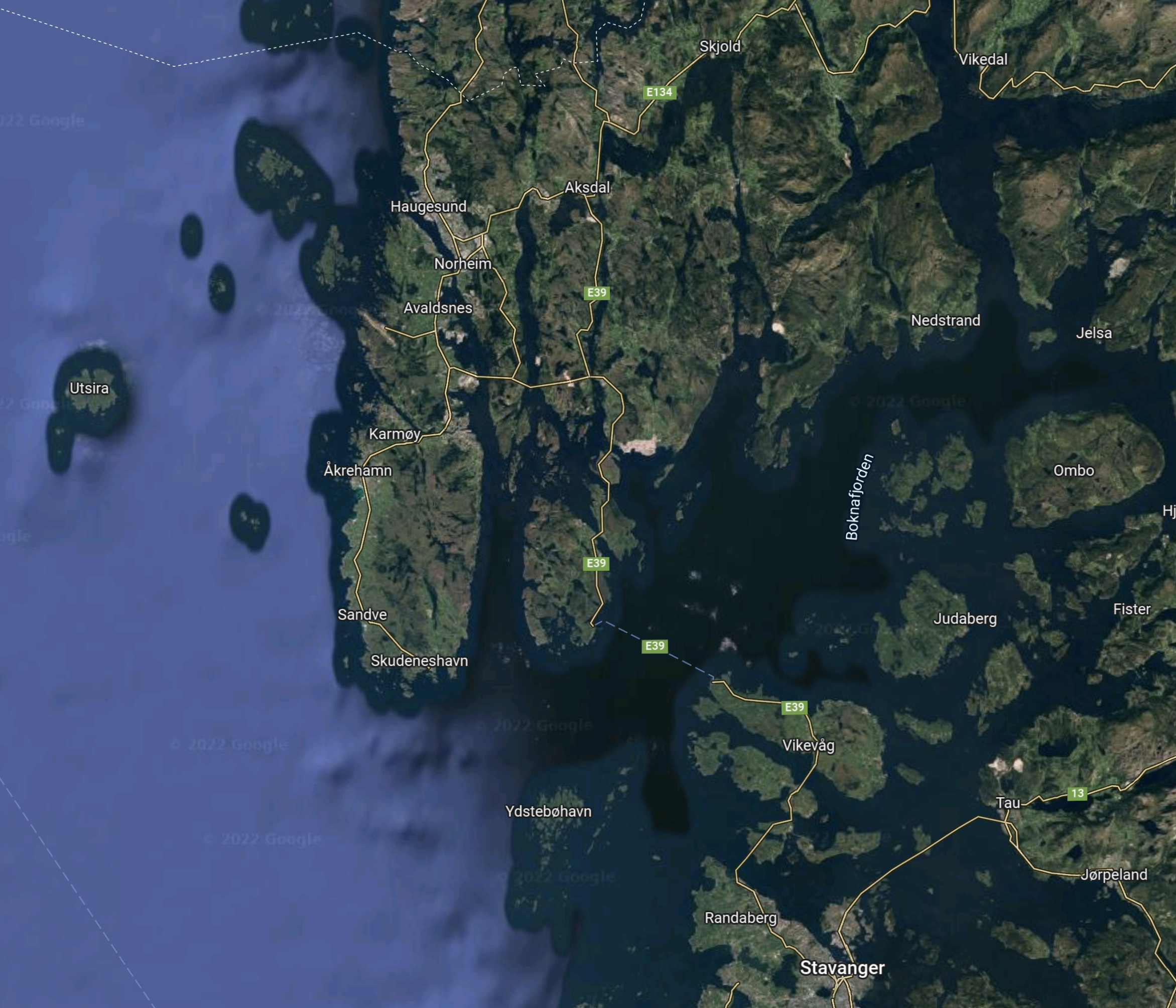
This Google Map shows area of Norway, that includes Utsira, Haugesund and Stavanger.
Note.
- Utsira is the largest island at the West of the map.
- Haugesund is on the coast to the North-East of Utsira.
- Stavanger is the fourth largest city in Norway and is at the bottom of the map.
There would appear to be plenty of space to place floating wind turbines between all the islands and the coast.
These are some other points from the article.
- Odfjell Oceanwind floats appear to be able to handle 15 MW turbines.
- In May, Norway initiated an investment plan to reach 30 GW of offshore capacity by 2040.
- Work has started to prepare Norway for floating offshore wind.
- Norway’s next offshore wind auction is in 2025.
Norway’s going large for wind!
Rescued By A B12 Injection
Last week, I wasn’t feeling too well, as I wrote in The Hour Change Has Completely Knocked Me Out.
I had a whole raft of symptoms.
- Not being able to get dressed.
- Sleeping all the time.
- Poor hand-eye co-ordination.
- Dizziness, which got me to hospital.
Then on Tuesday, this week, I had my three-monthly B12 injection.
And all the symptoms disappeared.
Is Hydrogen The Fuel Of The Future?
The title of this post, is the same as that as this article on Engineering and Technology Magazine.
The article is a must read about hydrogen.
The Vivarail Fast Charge System At West Ealing – 7th November 2022
I went to West Ealing station today and took these pictures.
















At last, it seems something is happening.
Note the concrete pads on the other side of the track for the bay platform. There appear to be eight pads, which could be to support the containers that will hold the Vivarail Fast Charge System.

