The Proposed Mid-Cornwall Metro
In the January 2022 Edition of Modern Railways, there is this description of the Mid-Cornwall Metro.
This would see an hourly service shuttling between the north and south coasts of the county and linking the main population centres at Newquay, St Austell, Truro and Falmouth. This would become the main service on the Newquay branch, and it would take over one of the twice-hourly services on the Falmouth branch, with the other service being a Truro to Falmouth shuttle as now.
Facilitating the Metro idea will be the latest phase of the modernisation of signalling in Cornwall, which will see the upgrade of a level crossing near Truro. Other infrastructure work required is a new passing loop on the Newquay branch at Tregoss Moor and restoration of a second platform face at the terminus at Newquay.
A business case was due to be submitted to the Department for Transport before Christmas 2021.
These are a few thoughts.
The Current Timings
If you look at the distances and timings of the various sections they are as follows.
- Newquay and Par – Five stops – 20.8 miles – 49-52 minutes
- Par and Truro – One stop – 19 miles – 22 minutes
- Truro and Falmouth Docks – Four stops – 11.8 miles – 24 minutes
Note.
- It appears that the Newquay to Par service is three minutes quicker than the other way.
- There will be a reverse at Par, which could take three minutes.
- The Par and Truro times were either GWR Castles or Class 802 trains.
The total time is 98-101 minutes and the total distance is 51.6 miles
Possible Timing
Consider.
- For the ease of timetabling and operation, it is probably best that a round trip between the two Newquay and Falmouth Docks takes an exact number of hours.
- The operating speed between Par and Truro is 75 mph and it is only 50 mph elsewhere.
- Turnround time at Newquay is five minutes.
- Turnround time at Falmouth Docks is 4-6 minutes
For these reasons, I doubt that much improvement could be made on the fastest time of 98 minutes. Certainly, a round trip of three hours would appear impossible.
But a round trip time of four hours would be very sensible.
However, there would be a turnround time of between 19-22 minutes at each end of the route.
This time might seem overly long, but it would be ideal for charging a battery-electric train.
How Many Trains Would Be Needed?
As the round trip will be four hours and an hourly service is needed, there will be a need for four trains to run the service, with the addition of probably two extra trains to allow for one in maintenance and one covering for any breakdowns.
Could The Mid-Cornwall Metro Use Battery-Electric Trains?
This Hitachi infographic shows the specification of the Hitachi Regional Battery Train.

Note
- The range of ninety kilometres is fifty-six miles and a longer distance than Newquay and Falmouth Docks.
- The operating speed of 90-100 mph is ideal.
- The time needed for a full charge at either end is within the timetable, I calculated earlier.
Hitachi Regional Battery Trains would be ideal for working the Mid-Cornwall Metro with a full charge at both ends of the route.
I have used my virtual helicopter to explore the Cornish Main Line between Par and Truro.
If it was decided to electrify the Cornish Main Line between Truro and Par, this could be an alternative way to charge the trains.
- The Mid-Cornish Metro trains should be able to do a return trip to Newquay and Falmouth Docks from the main line without charging at the two terminal stations.
- The electrification would be able to charge battery-electric Class 802 trains between Plymouth and Penzance.
But the extra infrastructure works to raise nine road bridges and several footbridges might blow the budget.
Where Would The Trains Be Serviced?
Great Western Railway has depots at both Penzance and Plymouth and with perhaps a charger at Truro and/or Par stations, the trains should be able to get to either depot at the end of the day.
Trains To Newquay
Wikipedia says this about the services to Newquay station.
The service is irregular with typically one train around every two hours.
As well as the local service, the station handles a number of long-distance trains in the summer. These services include Great Western Railway trains from London Paddington and CrossCountry trains from the North of England and the Scottish Lowlands, which do not stop at intermediate stations between Par and Newquay. On Sundays, there are some local trains and a small number of intercity services. As well as the weekend through trains, in peak summer months there is also a Monday-Friday through Great Western Railway intercity service to and from London, but local trains continue on these days too. Traditionally, there was no Sunday service in the winter, even in the ‘golden age’ between both of the 20th century’s world wars, but the line has a service of three trains each way on Sundays from 11 December 2011.
The Mid-Cornwall Metro will at least come with an hourly service.
But this will mean, that to run other services to the station with the hourly Metro will mean that a second platform will be needed.
I discuss the improvements needed in Beeching Reversal – Transforming The Newquay Line.
This is a quirky video, which describes an architect’s plans for the station.
It is the sort of simple solution, that I like.
Conclusion
I believe that a small fleet of Hitachi Regional Battery Trains could create an iconic Metro for Cornwall, that would appeal to both visitors and tourists alike.
CargoBeamer Operates Lane Between Kaldenkirchen And Perpignan
The title of this post, is the same as that of this press release from CargoBeamer.
It has this sub-title.
New Route Starting In January 2022
These two paragraphs form the body of the release.
The logistics service provider CargoBeamer is expanding its intermodal network from the beginning of next year. Between Kaldenkirchen in Germany and Perpignan near the French-Spanish border, goods will be transported environmentally friendly by rail from January 10, 2022. The patented CargoBeamer system enables all kinds of semitrailers, containers, P400 trailers, refrigerated and tank trailers, and other types of goods to be transported by train without requiring any additional conversions for forwarders.
At the start in January, initially three trains will run weekly in each direction. From mid-February, the frequency will increase permanently to five round trips per week. CargoBeamer will collaborate with DB Cargo France (formerly Euro Cargo Rail) as its traction partner. The new Franco-German route is the company’s sixth connection overall, with five of the six lines having been added to the network in the past six months.
They certainly seem to be adding routes frequently.
How Do Trailers Get Between Ashford And Calais?
They obviously go through the Channel Tunnel, but what happens on each side of the Channel?
Is the trailer fixed to a tractor unit at the Ashford and Calais terminals and then driven onto the freight shuttle?
This video contains an interview with Nicolas Albrecht from CargoBeamer
What Happens When The Wind Doesn’t Blow?
In Future Offshore Wind Power Capacity In The UK, I analysed future offshore wind power development in the waters around the UK and came to this conclusion.
It looks like we’ll be able to reap the wind. And possibly 50 GW of it!
The unpredictable nature of wind and solar power means that it needs to be backed up with storage or some other method.
In The Power Of Solar With A Large Battery, I describe how a Highview Power CRYObattery with a capacity of 500 MWh is used to back up a large solar power station in the Atacama desert in Chile.
But to backup 50 GW is going to need a lot of energy storage.
The largest energy storage system in the UK is Electric Mountain or Dinorwig power station in Wales.
- It has an output of 1.8 GW, which means that we’d need up to nearly thirty Electric Mountains to replace the 50 GW.
- It has a storage capacity of 9.1 GWh, so at 1.8 GW, it can provide that output for five hours.
- To make matters worse, Electric Mountain cost £425 million in 1974, which would be over £4 billion today, if you could fine a place to build one.
But it is not as bad as it looks.
- Battery technology is improving all the time and so is the modelling of power networks.
- We are now seeing large numbers of lithium-ion batteries being added to the UK power network to improve the quality of the network.
- The first Highview Power CRYObattery with an output of 50 MW and a capacity of 250 MWh is being built at Carrington in Manchester.
- If this full size trial is successful, I could see dozens of CRYOBatteries being installed at weak points in the UK power network.
- Other battery technology is being developed, that might be suitable for application in the UK.
Put this all together and I suspect that it will be possible to cover on days where the wind doesn’t blow.
But it certainly will need a lot of energy storage.
Gas-Fired Power Stations As A Back Up To Renewable Power
Last summer when the wind didn’t blow, gas-fired power stations were started up to fill the gap in the electricity needed.
Gas-fired power-stations normally use gas turbines similar to those used in airliners, which have a very fast startup response, so power can be increased quickly.
If you look at the specification of proposed gas-fired power stations like Keadby2, they have two features not found in current stations.
- The ability to be fitted in the future with carbon-capture technology.
- The ability to be fuelled by hydrogen.
Both features would allow a gas-fired power-station to generate power in a zero-carbon mode.
Carbon Capture And Storage
I am not in favour of Carbon Capture And Storage, as I believe Carbon Capture and Use is much better and increasingly engineers, researchers and technologists are finding ways of using carbon-dioxide.
- Feeding to tomatoes, salad vegetables, soft fruits and flowers in greenhouses.
- Producing meat substitutes like Quorn.
- Producing sustainable aviation fuel.
- An Australian company called Mineral Decarbonation International can convert carbon dioxide into building products like blocks and plasterboard.
This list will grow.
Using or storing the carbon-dioxide produced from a gas-fired power station running on natural gas, will allow the fuel to be used, as a backup, when the wind isn’t blowing.
Use Of Hydrogen
Hydrogen will have the following core uses in the future.
- Steelmaking
- Smelting of metal ores like copper and zinc
- As a chemical feedstock
- Natural gas replacement in the mains.
- Transport
Note that the first four uses could need large quantities of hydrogen, so they would probably need an extensive storage system, so that all users had good access to the hydrogen.
If we assume that the hydrogen is green and probably produced by electrolysis, the obvious place to store it would be in a redundant gas field that is convenient. Hence my belief of placing the electrolyser offshore on perhaps a redundant gas platform.
If there is high hydrogen availability, then using a gas-fired power-station running on hydrogen, is an ideal way to make up the shortfall in power caused by the low wind.
Conclusion
Batteries and gas-fired power stations can handle the shortfall in power.
Foot Crossing Obstacle Detection Using AI
The title of this post, is the same as that as this article on the Railway Gazette.
This is the introductory paragraph.
Seibu Railway is to start testing a newly-developed AI-assisted warning system for detecting obstacles on foot crossings at two stations on the Ikebukuro Line in the suburbs of Tokyo.
The article is a detailed description of how the Japanese are using technology to make foot crossing a lot safer.
I can see applications for this technology not just on the rail system, but in other situations as well.
Green Ships Ahoy Along Vital Corridors
The title of this post, is the same as that of this article on 7 News Australia.
These are the first two paragraphs.
Australia’s biggest miners are preparing for a day of reckoning.
Shipping accounts for two to three per cent of global greenhouse gas emissions so manufacturers and retailers are no longer just considering what appears in national targets.
The article then goes on to explain how the big mining companies are cutting their emissions.
This paragraph illustrates how important mining and shipping is to Australia.
Resources and energy earnings passed $300 billion for the first time in 2020-21 and will surge towards $400 billion in 2021-22, according to December figures.
Hence the big need for ships fuelled by lower carbon fuels.
Future Offshore Wind Power Capacity In The UK
I am building this table, so that I can get a feel for the electricity needs of the UK.
According to Wikipedia, on February 2020, there were thirty six offshore wind farms consisting of 2180 turbines with a combined capacity of 8113 megawatts or 8.113 gigawatts.
Currently, these offshore wind farms are under construction, proposed or are in an exploratory phase.
- Triton Knoll – 857 MW – 2021 – Under Construction
- Hornsea Two – 1386 MW – 2022 – Under Construction
- Moray East – 960 MW – 2022 – Under Construction
- Neart Na Gaoithe – 450 MW – 2023 – Under Construction
- Seagreen Phase 1 – 1075 MW – 2023 – Under Construction
- Dogger Bank A – 1200 MW – 2023/24 – Proposed
- Dogger Bank B – 1200 MW – 2024/25 – Proposed
- Dogger Bank C – 1200 MW – 2024/25 – Proposed
- Moray West – 1200 MW – 2024/25 – Exploratory
- Hornsea Three – 2400 MW – 2025 – Proposed
- East Anglia One North 800 MW – 2026 – Exploratory
- East Anglia Two – 900 MW – 2026 – Exploratory
- East Anglia Three – 1400 MW – 2026 – Exploratory
- Sofia Offshore Wind Farm Phase 1 – 1400 MW – 2023/2026 – Under Construction
- Hornsea Four – 1000 MW (?) – 2027 – Exploratory
- Rampion Two Extension – 1200 MW – Exploratory
- Norfolk Vanguard – 1800 MW – Exploratory
- Norfolk Boreas – 1800 MW – Exploratory
Note.
- The date is the possible final commissioning date.
- I have no commissioning dates for the last three wind farms.
- Wikipedia says that the Hornsea Four capacity is unknown by Ørsted due to the ever increasing size of available wind turbines for the project.
I can total up these wind farms by commissioning date.
- 2021 – 857 MW
- 2022 – 2346 MW
- 2023 – 1525 MW
- 2024 – 1200 MW
- 2025 – 6000 MW
- 2026 – 4500 MW
- Others – 5800 MW
I can draw these conclusions.
- Total wind farm capacity commissioned each year is increasing.
- It looks like there will be a capacity to install up to 5000 or 6000 MW every year from about 2025.
- If we add my figures for 2021-2026 to the 8113 MW currently installed we get 24541 MW.
- Adding in 6000 MW for each of the four years from 2027-2030 gives a total of 48541 MW or 48.5 GW.
As I write this on a Sunday afternoon, wind power (onshore and offshore) is supplying 13 GW or forty-four percent of our electricity needs.
I have further thoughts.
Parallels With North Sea Oil And Gas
I was very much involved in the development of North Sea oil and gas, as my software was used on a large number of the projects. I had many discussions with those managing these projects and what was crucial in shortening project times was the increasing availability of bigger rigs, platforms and equipment.
Big certainly was better.
I believe that as we get more experienced, we’ll see bigger and better equipment speeding the building of offshore wind farms.
Reuse of Redundant North Sea Oil And Gas Platforms
Don’t underestimate the ability of engineers to repurpose redundant oil and gas platforms for use with windfarms.
Electrolysers on the platforms can convert the electricity into hydrogen and use redundant gas pipes to bring it ashore.
Some processes like steelmaking could use a lot of hydrogen.
Platforms can be used as sub-stations to collect electricity from windfarms and distribute it to the various countries around the North Sea.
Hydrogen
Some processes like steelmaking could use a lot of hydrogen. And I don’t think steelmakers would be happy, if the supply was intermittent.
So why not produce it with giant electrolysers on redundant oil and gas platforms and store it in redundant gas fields under the sea?
A large store of hydrogen under the sea could have the following uses.
- Steelmaking.
- Feedstock for chemical manufacture.
- Transport
- Power generation in a gas-fired power station, that can run on hydrogen.
It would just need a large enough hydrogen store.
Energy Storage
This large amount of wind power will need a large amount of energy storage to cover for when the wind doesn’t blow.
Some of this storage may even be provided by using hydrogen, as I indicated previously.
But ideas for energy storage are coming thick and fast.
The North Sea Link To Norway
The North Sea Link is much more important than an interconnector between Blyth in Northumberland and Norway.
- At the Norwegian end the link is connected to a vast pumped storage energy system in the mountains of Norway.
- This pumped storage system is filled in two ways; Norwegian rain and snow and UK wind power through the interconnector.
- In times of need, we can draw electricity through the interconnector from Norway.
- It has a capacity of 1.4 GW.
- It was delivered on time for a cost of around €2 billion.
It can almost be thought of as an international bank of electricity and is probably one of the most significant pieces of European infrastructure built in recent years.
There are also plans to build NorthConnect, that would connect Peterhead in Scotland to Norway.
Conclusion
It looks like we’ll be able to reap the wind. And possibly 50 GW of it!
More Train Companies Are Advertising Now
At the end of October, I posted Hull Trains Are Mounting A Big Advertising Campaign.
Today LNER are also advertising in The Times and these follow other companies like Avanti West Coast, East Midlands Railway, Grand Central and Great Western Railway.
It looks like the Hull Trains campaign must have been successful.
The Time I Said No To Joan Collins
I’m watching Joan Collins In her programme On BBC 2.
It reminds me of the time I met her.
It must have been between 1985 and 1987, as she was with her fourth husband; Peter Holm, who is exactly two months younger than I am.
We had all travelled from Los Angeles to London on British Airways and we were queuing for passport checks. Joan was to my right and Peter was looking very disinterested.
Then out of the blue, she asked me, if I had a light for her cigarette.
I replied that I was sorry, but I didn’t smoke.
She just smiled and put the cigarette away!
Structural Engineering At Work!
I took this picture of the new block on top of the Moorgate entrance to Liverpool Street Crossrail station.
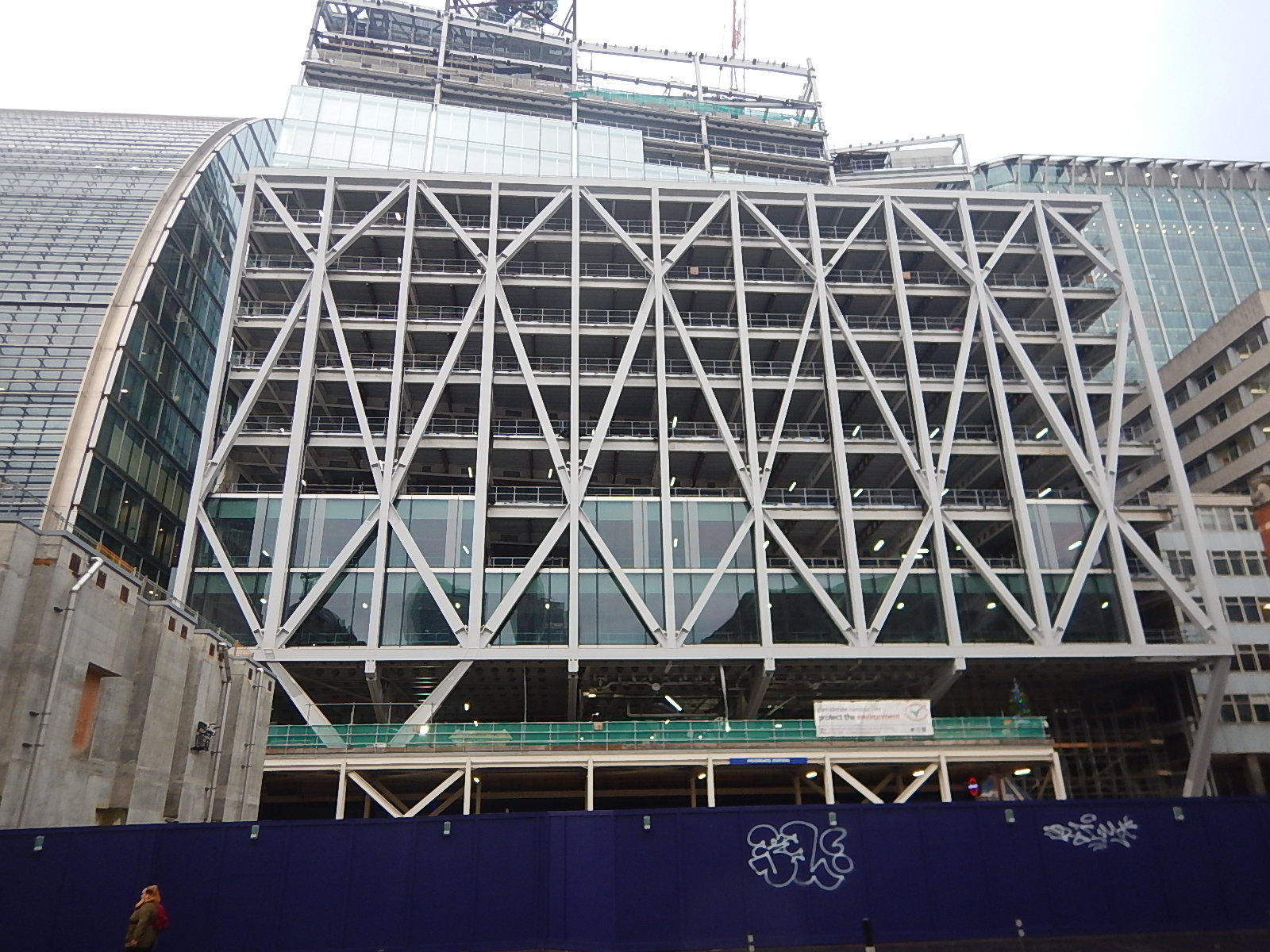
I like structures and this could turn out to be a good example of their use.
24/7 Bingo? You Can’t Be Serious?
Yesterday, I went to Dunelm for the first time and came away with a cushion, which I needed for an experiment.
I took these pictures as I walked back to the station to come home.





24/7 Bingo? Have you ever heard of anything so sad?
 The Anonymous Widower