Harmony Energy Income Trust Eyes IPO To Develop 213.5MW Of Tesla Battery Storage
The title of this post, is the same as that of this article on Solar Power Portal.
The article is a very detailed look at Harmony and their development of energy storage, using Tesla hardware and software.
It also has things to say about the energy storage market in general.
This is a paragraph.
Paul Mason, managing director of the Investment Adviser, said battery energy storage offers exciting growth potential, with an expected requirement of up to 43GW by 2050 from just 1.2GW now.
It is certainly looking that companies like Harmony Energy Income Trust will be important in funding this extreme growth of energy storage.
‘Unique’ Solar-Storage Solution Providers Plot 300MW / 3.6GWh Australia Project
The title of this post, is the same as that of this article on Energy Storage News.
The first two paragraphs outline the system.
A 1,200 hectare site in South Australia has been secured by a developer hoping to use it to build a 300MW solar power site with 3.6GWh of energy storage, based on a novel technology solution.
Europe-headquartered renewables company Photon Energy is working to roll out the technology created by Australian company RayGen. It combines a kind of concentrating solar power (CSP) + solar photovoltaics (PV) hybrid that RayGen calls ‘PV Ultra’, paired to a long-duration energy storage tech dubbed ‘thermal hydro’.
Thermal hydro appears to be an interesting concept, which uses hot and cold water reservoirs to store energy. Electricity is retrieved using a Rankin cycle engine and the claimed roundtrip efficiency is seventy percent.
This power plant might seem to be very futuristic, but a 4MW solar with 3MW / 50MWh of energy storage project is already under construction and should go on-line in the middle of next year.
The developer; Photon Energy hopes to get the giga-plant ready-to-build by the end of 2023.
This concept could be a very useful one, where there is enough sun for concentrating solar power.
TfL Considering Extending DLR As Far As Abbey Wood
The title of this post, is the same as that of this article on New Civil Engineer,
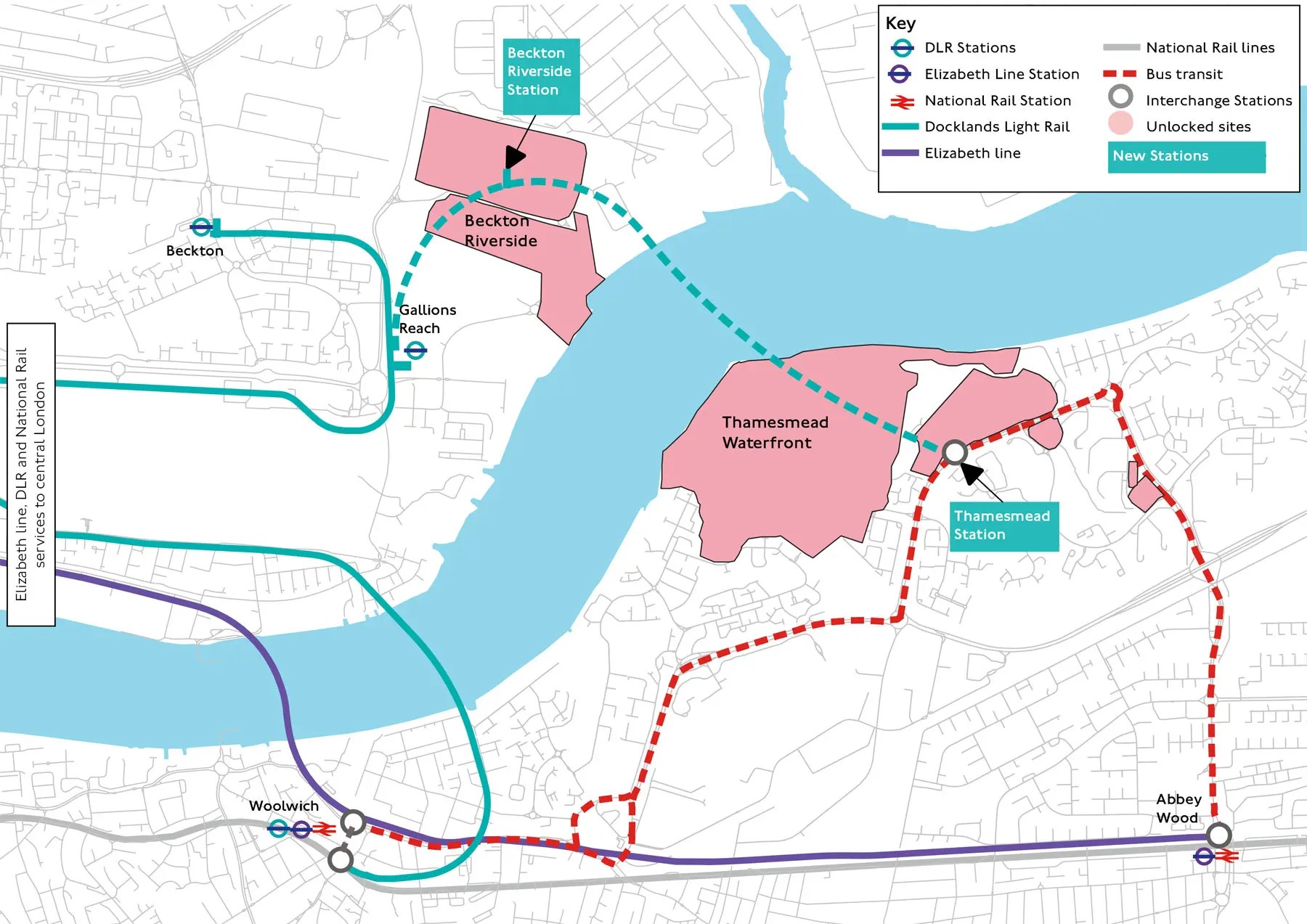
I am ambivalent about whether the Docklands Light Railway is extended from Beckton to Thamesmead or Abbey Wood.
This map from Ian Visits shows the area.
I’ve always preferred a high bridge from Barking Riverside to Thamesmead.
In There’s A Lot Happening Around Tilbury And Gravesend, I said this.
My personal preference for another connection would be to build a bridge between Barking Riverside and Thamesmead, to take the Gospel Oak to Barking Line over rather than under the Thames, if this was possible. I would use tram-trains on the railway, that if required did a walkabout around the estates as trams on both sides of the river. The bridge would also be open to cyclists and pedestrians.
Properly designed, the bridge could be a visitor attraction in its own right!
But could the bridge taking the DLR over the river become an attraction?
Fortescue Future Industries Acquires Xergy Assets To Develop Hydrogen Tech Company
The title of this post, is the same as that of this article on Stockhead.
These are the first two paragraphs.
Andrew Forrest’s Fortescue Future Industries (FFI) has made yet another bold move in the ‘green-energy’ space with the acquisition of Xergy Inc and Xergy One Ltd’s commercial assets to form a new, wholly owned subsidiary called FFI Ionix Inc.
Poised to operate in the United States, FFI Ionix will function as a technology development company focused on the global commercialisation of hydrogen technologies such as ion exchange membranes for water electrolysis, electrochemical compression, water transmission and fuel cells.
It certainly appears that Andrew Forrest is building a company to handle all aspects of the production and use of green hydrogen.
He has signed deals with Argentina, JCB and Jordan.
He has been at COP26.
He is advertising on London’s taxis and at least one bus!
He has been interviewed by The Times.
I await Mr. Forrest’s next green hydrogen deal with interest.
Blue Hydrogen Is Not Clean Energy, Says Mining Tycoon
The title of this post, is the same as that of this article on The Times.
This is the first paragraph.
Producing “blue hydrogen” from natural gas is not a clean energy source and is being wrongly promoted as one by the oil and gas industry, a billionaire mining mogul has claimed.
The mining mogul is Andrew Forrest, who is the second richest person in Australia.
I feel he is only partly right, as there are processes coming through that use a catalyst to split the hydrogen from the carbon.
But like the taxi in the picture at the top of the article with Mr. Forrest, his words are all good publicity.
Incidentally, I do believe that in a few years, we’ll have the technology to use so much carbon dioxide efficiently, that we may see gas-fired power stations used to create both energy and carbon dioxide.
Hydrophilic Polymers: The Key To A Green Future
The title of this post, is the same as that of this article on Tech Xplore.
This is the first paragraph.
Researchers from the University of Surrey and the University of Bristol are working on innovative devices to tame and store carbon-free renewable energy from unpredictable sources such as wind and solar.
That got me interested and I read the whole article.
This abstract on SpringerLink gives a definition of hydrophilic polymers.
Hydrophilic polymers are those polymers which dissolve in, or are swollen by, water. Many compounds of major technical and economic importance fall within this definition, including many polymers of natural origin. Many foodstuffs—containing substantial amounts of carbohydrate and protein— can be classified as hydrophilic polymers, and some have important technical and industrial uses, apart from their nutritional value. For example, although over 95% of the starches produced from corn (maize), wheat, potato, tapioca, and other vegetable sources are used as foods (human or animal), the remaining quantity represents an important part of the technical polymer market. In fact, more than two-thirds of hydrophilic or water-soluble polymers used in industry are derived from polymers of natural origin, so coming from renewable resources (harvested crops, trees, waste animal products and so on), rather than petrochemical sources of finite availability.
This paragraph from the Tech Xplore article describes the research.
The Chemistry Department at Surrey is working with collaborators at Bristol, Professors Ian Hamerton and David Fermin, and Superdielectrics Ltd., an innovative British Research Company located at the Surrey Research Park to transform simple hydrophilic polymers which were originally developed for use as contact lenses, to realize a second critical energy storage process.
This could lead to the next generation of supercapacitors.
Conclusion
This is fascinating technology and it could save the world.
Insulate Britain Roadblock Stops Lorry Carrying Insulation
The title of this post, is the same as that of this article on The Times.
Make of that what you will!
Canadian National Buys Battery Locomotive
The title of this post, is the same as that of this article on Railway Gazette.
This is the first paragraph.
Canadian National’s Bessemer & Lake Erie Railroad has purchased a Wabtec FLXdrive battery-electric freight locomotive, with financial support from the Pennsylvania Department of Environmental Protection’s Marine & Rail Freight Movers grant programme.
The locomotive is intended to work in multiple with diesel locomotives and this cuts fuel consumption, pollution and noise.
I described the locomotive in FLXdrive ‘Electrifies’ Pittsburgh and the more I learn about this locomotive the more I like it.
The locomotive numbered 3000, which appears in all Wabtec pictures is an example an ES44AC from the GE Evolution Series and was converted from a standard locomotive, that was in the test fleet.
Interestingly, Canadian National own several hundred of these locomotives, so they won’t be short of one to convert.
The diesel version would appear to be a 3.3 MW diesel locomotive.
In addition, this page on the Wabtec web site gives some details of the battery-electric locomotive.
- The locomotive is powered by lithium-ion batteries.
- There are around 20,000 battery cells
- The batteries have their own air-conditioning
- There is a sophisticated battery-management system.
- The total battery size is 2.4 MWh
- Power output is 4400 HP or 3.24 MW
- Locomotive will run for 30-40 minutes at full power.
- The locomotive has regenerative braking.
- Operating speed is 75 mph
Note that running at 75 mph for 40 minutes would cover fifty miles.
It does look as if, the diesel-electric and the battery-electric conversion have similar power outputs. Could this be, as the traction system on both locomotives are identical? It’s just that one uses a diesel generator and the other uses batteries.
Although there must be differences in the traction systems, as the battery-electric locomotive has regenerative braking.
The battery-electric locomotive is designed to work in conjunction with one or two diesel locomotives, where a sophisticated computer system decides which engines power the train.
- Wabtec are claiming a thirty percent reduction in fuel and emissions compared to an all-diesel setup.
- Electric power will also be used in depots and sensitive areas.
I do think though, that this is a pragmatic solution to cut the carbon footprint of heavy-freight in North America.
But it could be a half-way solution, as Wabtec have hinted that they are working on hydrogen-powered locomotives.
I also feel it might be possible to convert some of the UK’s Class 66 locomotives into battery-electric locomotives for lighter freight duties or working in a pair with a Class 66 locomotive to reduce fuel consumption and emissions.
I discuss this in Could Class 66 Locomotives Be Converted Into Battery-Electric Locomotives?
Have CN Bought The Prototype?
There is also this article on the Green Car Congress, which is entitled CN Purchases Wabtec’s Battery-Electric Locomotive.
The article seems fairly certain they have.
So perhaps, they want to get on with the job and see what the locomotive can do?
Grab-Handles In London Underground Train Entrances
I have been taking pictures of the grab-handles in the doors of London Underground trains.
Bakerloo Line
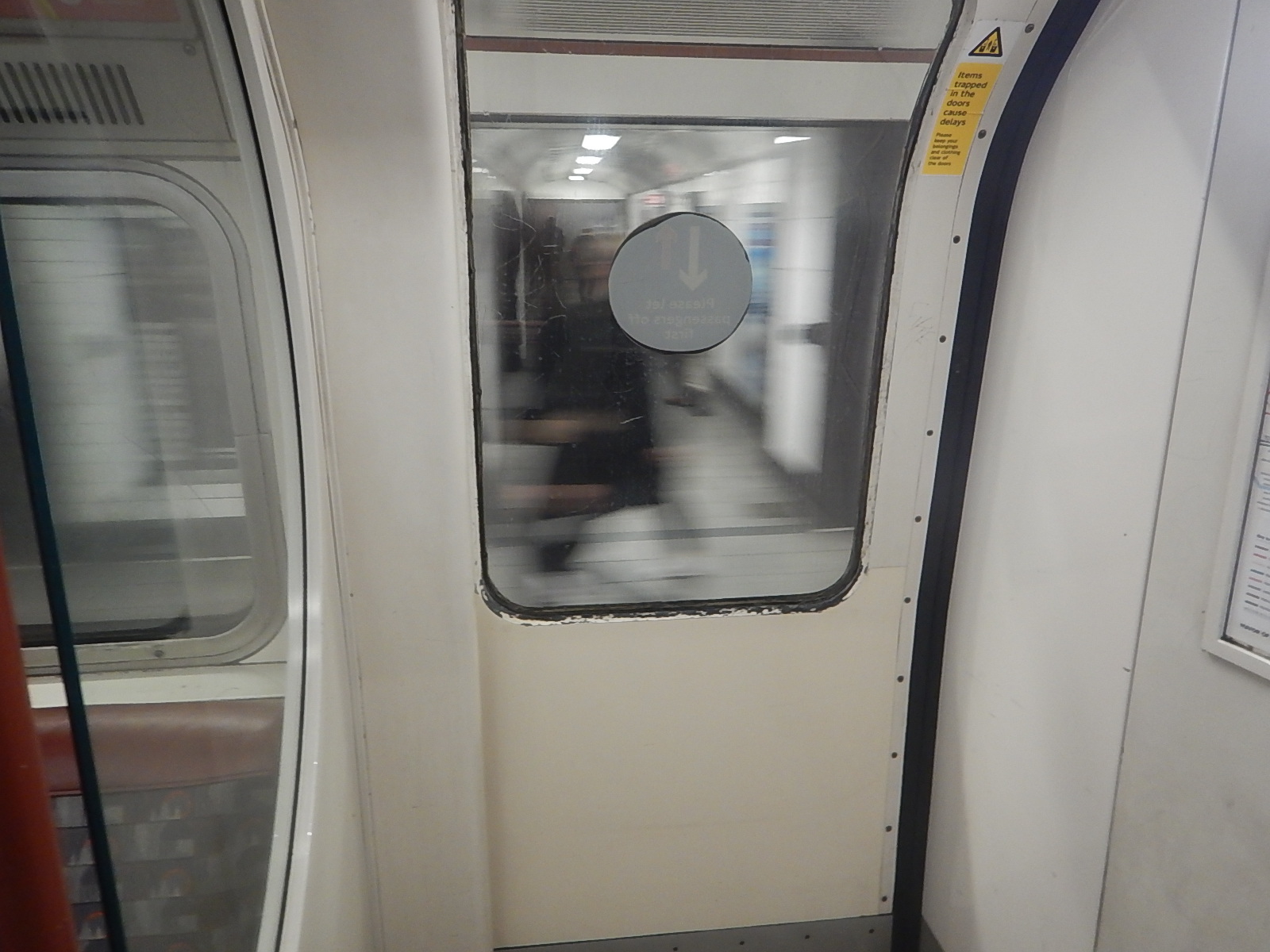
There are no grab-handles.
Central Line




The Central Line trains, which were built in 1991-4, probably set the original standard.
Hammersmith & City Line




These are probably similar to Circle, District and Metropolitan Line trains.
Jubilee Line




Note the long grab-handles tucked behind the doors.
Northern Line




Note the long grab-handles tucked behind the doors.
There is also a cheeky one behind the wheelchair space. Although you would get into a Northern Line train in a wheelchair is another matter.
Piccadilly Line



Despite their age, there is a full set of grab-handles.
Victoria Line




Note the long grab-handles tucked behind the doors.
Conclusion
I do find it strange that all the other Underground trains have vertical handles just inside the door, but the Bakerloo Line trains don’t have this valuable safety feature.
I think this could be dangerous.
I have a damaged left arm because the school bully broke my humerus. It can do most things, but some things are painful.
So when I get on a train, in case there is a step-up into the train, I position myself towards the right of the door. Then if there is a step-up, I reach forward and grab the handle and pull myself into the train.
Recently, I boarded a train on the Bakerloo Line platform at Waterloo. On finding there was no grab-handle I slipped slightly as I pulled back.
In the end I climbed into the train by holding on to the rubber edge of the door and got a very dirty hand.
Could this lack of grab-handles have contributed to a recent death at the station, that I wrote about in Death Of A Commuter At Waterloo?
I very much feel that grab-handles should be fitted to the doors on Bakerloo Line trains.
 The Anonymous Widower