JCB Hydrogen Excavators Approved For UK Roads
The title of this post, is the same as that of this article on Construction Kenya.
This is the sub-heading.
The government’s move supports the UK’s broader net-zero goals.
These are the first two paragraphs.
JCB has celebrated a landmark decision by the UK government allowing hydrogen-powered construction and agricultural machinery on public roads, effective from April 29.
This change enables hydrogen-fuelled diggers, tractors, and other machinery to operate between sites and farms, reducing carbon emissions in two highly polluting industries.
JCB celebrated by driving a hydrogen-powered excavator through London to meet the Minister.
I would have thought that this event would have had more coverage in the news.
But then hydrogen is a taboo subject to many politicians and the media, as the Hindenburg got the anti-hydrogen publicity right.
Is Wigan North Western Station Ready For High Speed Two?
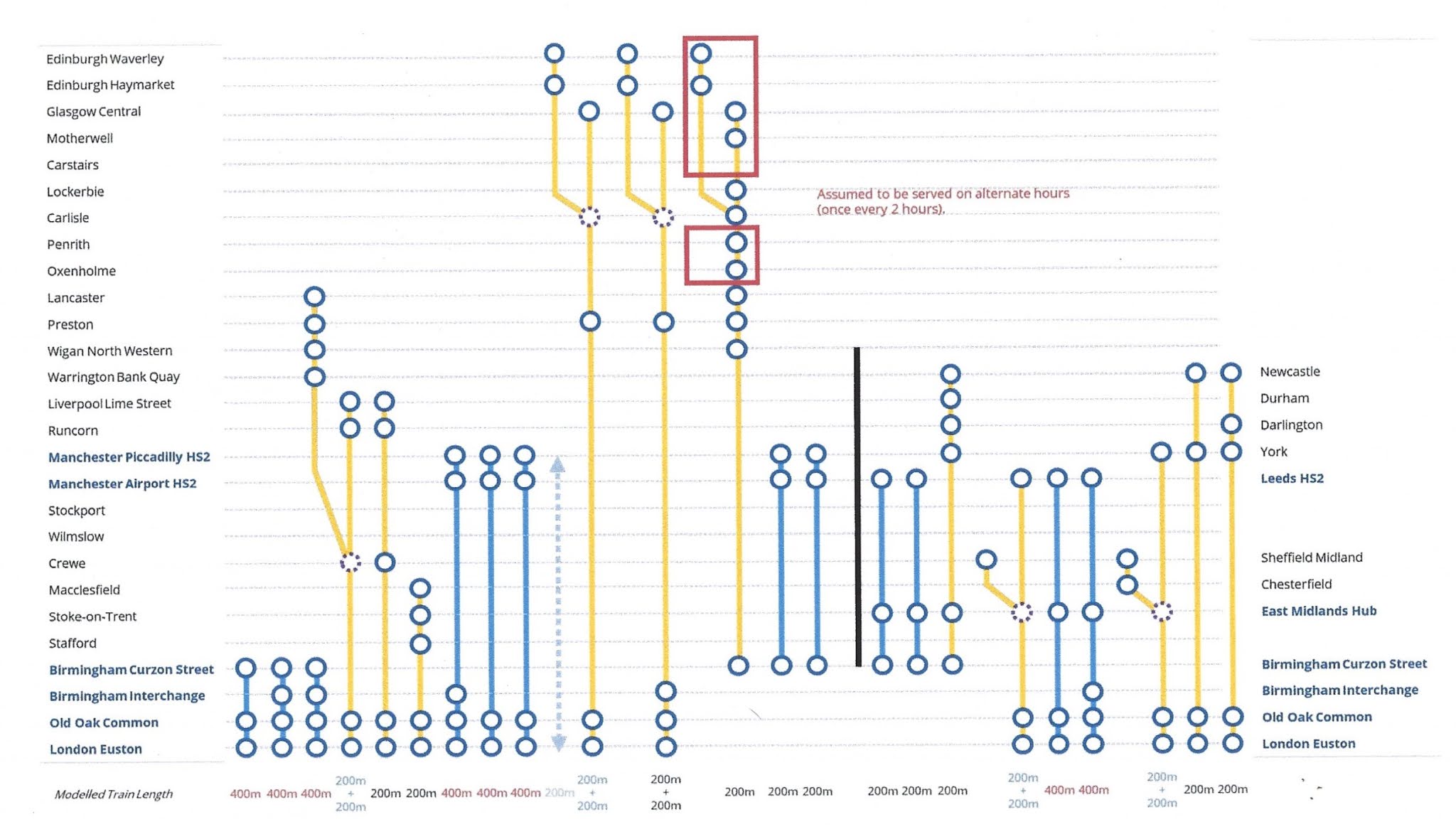
This diagram shows High Speed Two services, as they were originally envisaged before Phase 2 was discontinued.
Note.
- Trains to the left of the vertical black line are Phase 1 and those to the right are Phase 2.
- Full-Size trains are shown in blue.
- Classic-Compatible trains are shown in yellow.
- Blue circles are shown, where trains stop.
- The dotted circles are where trains split and join.
- In the red boxes routes alternate every hour.
- Was Lancaster chosen as it’s close to the new Eden Project Morecambe?
Click on the diagram to enlarge it.
It would appear if High Speed Two sticks to this original pattern of services, then the following trains will go through Wigan North Western station.
- 200 metre single train – London Euston and Lancaster, which stops at Old Oak Common, Crewe, Warrington Bank Quay, Wigan North Western and Preston.
- 400 metre pair of trains – London Euston and Edinburgh Haymarket/Edinburgh Waverley/Glasgow Central, which stops at Old Oak Common, Preston, Carlisle.
- 400 metre pair of trains – London Euston and Edinburgh Haymarket/Edinburgh Waverley/Glasgow Central, which stops at Old Oak Common, Birmingham Interchange, Preston, Carlisle.
- 200 metre single train – Birmingham Curzon Street and Edinburgh Haymarket/Edinburgh Waverley or Motherwell/Glasgow Central, which stops at Wigan North Western, Preston, Lancaster, Carlisle and Lockerby and every two hours at Oxenholme and Penrith.
Note.
- Only single High Speed Two classic-compatible trains, stop in Wigan North Western station and they are only two hundred metres long.
- One train per hour (tph) terminates at Lancaster and a second tph terminates alternatively at Edinburgh Haymarket/Edinburgh Waverley or Glasgow Central.
- Four hundred metre long pairs of trains go through North Western station without stopping.
Currently Wigan North Western has 14 trains per day (tpd) stopping at the station, eleven of which go to Scotland and three to Blackpool.
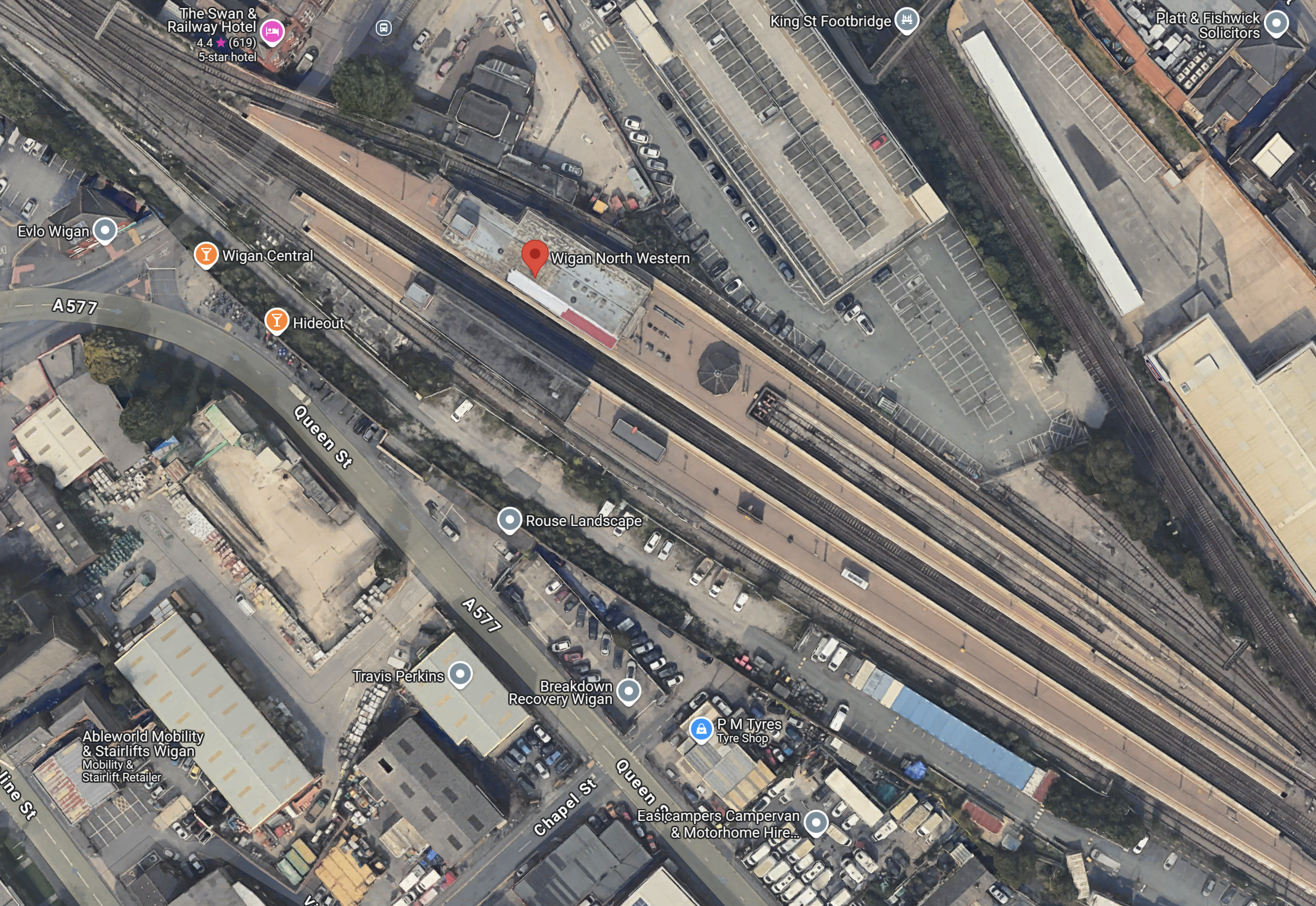
This Google Map shows Wigan North Western station.
Note.
- The two long platforms in the middle of the station, where the Avanti trains stop.
- A long platform on the Southern side of the station used by local services to and from Liverpool and Blackpool.
- Three bay platforms on the Northern side of the station, one of which is unused, that handle local services to Manchester and beyond.
As the 265.3 metre long Class 390 trains can use the central platforms, High Speed Two classic-compatible trains will be able to use these platforms.
On my brief visit to the station yesterday, I took these pictures.
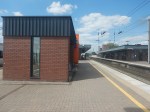
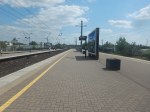
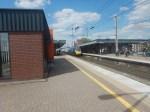
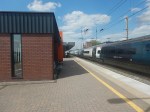
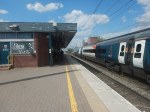

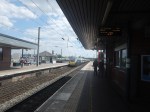
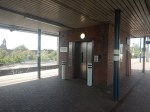

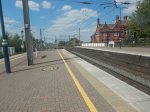

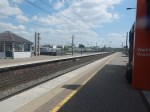
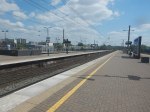
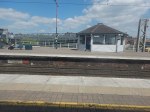

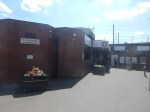


Note.
- All Class 390 trains are longer than High Speed Two classic-compatible trains, so the train in the pictures indicates that the High Speed Two trains will be able to stop at Wigan North Western station.
- The platforms are long and wide.
- The station is well-equipped with lifts, cafes, waiting rooms and some of the best toilets in a station in the North of England.
- Wigan Wallgate station is only a short walk away, with a selection of local services to Blackburn, Headbolt Lane, Manchester, Southport and a large proportion of Lancashire.
- The last two pictures were taken looking at the two stations from halfway.
- The shops between the two stations are a good selection and include a Morrisons Local.
I had been intending to go on to Preston, Lancaster and Morecambe, but a points failure at Preston meant that no trains were running.
Conclusion
The two Wigan stations and the buses that serve them, could be a good interchange for passengers to catch High Speed Two.
I feel that most of the work needed to be done at Wigan North Western to get the station ready for High Speed Two will mainly be cosmetic or technical upgrades like signalling. I can’t see any expensive or disruptive upgrades like platform lengthening being needed.
Arriving In Liverpool Lime Street Station – 10th May 2025
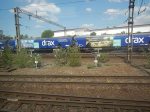
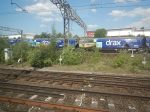
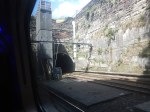
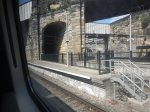
Liverpool Lime Street station has one of the more spectacular approaches of British railway stations, as these pictures show.

















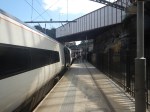
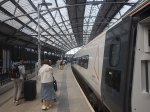

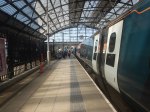


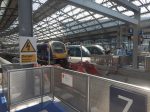
These sections describe the approach.
Crossing The Mersey
You cross the Mersey at Runcorn on the Ethelfreda or Britannia Bridge, which is described in this Wikipedia entry.
It was completed in 1868 and hopefully in a few years, it will be carrying High Speed Two trains between London and Liverpool.
On your right as you cross the Mersey to Liverpool is the Silver Jubilee road bridge, which is a through arch bridge that opened in 1961 to replace a historic transporter bridge. I am just a little bit too young to have seen the transporter bridge.
Further to your right, you can see the Mersey Gateway Bridge, which is a cable-stayed bridge, that opened in 2017 and is described in this Wikipedia entry.
Drax’s Biomass
As you approach Lime Street station, you pass through Edge Hill, where there are the GB Railfreight sidings, where the biomass trains for Drax power station are marshalled for their journey across the Pennines. These Drax trains seem to be one of the few freight trains in the UK, that carry advertising. Tesco trains also do, but their’s is just big letters.
In Do Cummins And Stadler Have a Cunning Plan?, I talked about the possible conversion at some date in the future of GB Railfreight’s new electro-diesel Class 99 locomotives to electro-hydrogen locomotives. These locomotives will surely be ideal for hauling Drax’s biomass trains across the Pennines.
I do believe that these Class 99 locomotives are the future of heavy freight trains in the UK. In Iarnród Éireann Looks At Diesel Loco Replacement Options, I write about speculation, that Stadler may build a version for the Irish.
Through The Edge Hill Cutting
From Edge Hill a deep cutting through the sandstone takes you into Lime Street station.
It looked good in the sun, but the first time I arrived in the city to start my studies at Liverpool University, it was chucking it down and the cutting was very dark and wet.
It was a very different welcome to that, which I got yesterday.
My Train Arrived In Platform 10
Liverpool Lime Street has two cast iron train sheds.
- The Western shed has platform 1 to 5 and generally handles trains from the East.
- The Eastern shed has platform 6 to 10 and generally handles trains from the South.
Note.
- Changing between trains is just a step-free walk across the station concourse.
- Both sections have their own taxi rank and full-size clock.
- The Ticket Office is in the Western train shed.
I just walked from my train to the Ticket Office, bought a Lancashire Day Ranger ticket and then walked fifty metres to my next train.
How many stations have such an easy change of trains?
Is Liverpool Lime Street Station Ready For High Speed Two?
Consider.
- I travelled North in an 11-car Class 390 train, which is 265.3 metres long and can carry 607 passengers.
- As the last pictures show, the train fitted easily into platform 10.
- High Speed Two plans to send 200 metre classic-compatible trains to Liverpool Lime Street, with each having a capacity of up to 528.
It looks to me, that these High Speed Two classic-compatible trains will fit into Liverpool Lime Street station, at any platform that currently accepts an eleven-car Class 390 train.
Looking on Real Time trains over the last few days, I’ve found eleven-car Class 390 trains using platforms 9, 10 and 6.
It seems that Network Rail’s engineers have done a superb job to turn the Grade II Listed station, into one of the best operationally.
New Routemasters As Advertising Hoardings
Increasingly, New Routemasters are appearing as advertising hoardings.










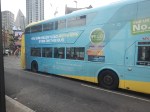
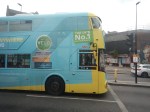
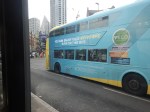

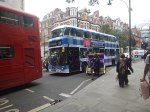

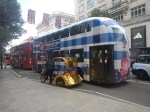





























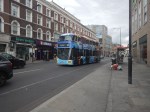
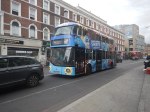




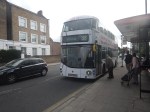



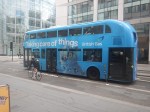
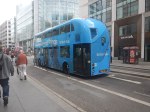
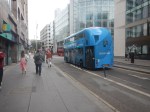










Note.
- I am unsure if some of the products should be advertised so prominently.
- The last picture is of a naked bus to fill the space.
- I shall be adding to this gallery.
In Could London’s New Routemaster Buses Be Converted To Hydrogen Power?, I came to this conclusion.
I believe from my knowledge of Cummins and the way they work, that they will come up with a hydrogen-based solution, that will replace the Cummins diesel in these buses with a zero-carbon engine.
If Cummins don’t then someone else will.
Whoever solves the problem of converting London’s new Routemasters to hydrogen will have one of the best adverts for their product, there has ever been.
After converting London’s thousand Routemasters, the engineers could move on to anything powered by a Cummins engine.
It would be a quick, easy and affordable way to create a thousand zero-carbon buses.
An Annoying Day
My plan was simple on Saturday May the 10th.
I intended to go to Liverpool Lime Street on a Day Return ticket.
I would then buy a Lancashire Day Ranger ticket and visit Wigan North Western, Preston and Lancaster stations, to see how ready, they are for High Speed Two services.
I also intended to go to Morecambe to see how the Eden Project Morecambe was getting on.
I did get to Wigan North Western station and later wrote Is Wigan North Western Station Ready For High Speed Two?
But then there was a points failure at Preston and after waiting at the station for over an hour for tranport to Preston, I changed plan.
I decided to go back to Liverpool by way of Wigan Wallgate and Headbolt Lane stations.
On return home, I wrote Wigan Wallgate To Headbolt Lane – 10th May 2025.
A Quick Run Back To London
At Lime Street station, I walked into the Wetherspoons pub at the station, with the intension of buying a bottle of my favourite brew, which all of the chain stock. But not this one!
So I got an early train back to London.
The Most Expensive Taxi Back From Euston
I paid over thirty pounds, when under twenty is the norm, not because I was being ripped off, but by the number of roadworks, that slowed our journey.
Does Your Car Have A Large Capacity, Dash Mounted Refrigerator?
I suspect not, but Wrightbus’s new Contour Coach will have one for the driver and the lucky soul, who sits in the other front seat.
Wrightbus have now put the specification of the Contour coach on a page that is entitled Experience The Contour Difference.
This is the introduction.
Introducing the Wright Contour Diesel Coach, where luxury, innovation, and performance come together. Since 1946, Wright has been at the forefront of transportation innovation, shaping the future with its unwavering commitment to excellence. Today, as UK’s No.1 zero-emission bus manufacturer and one of Europe’s fastest growing brands, Wright is making a bold return to the luxury coach market with the all-new Contour Diesel Coach (available in UK and Europe). In the 1980s, Wright revolutionised the luxury coach industry with its innovative, high-end Contour models, setting new standards in design and comfort. On 5th March 2025, Wright makes a bold return to the coach market with the all-new Contour Diesel Coach, redefining performance, style, and efficiency, offering spacious interiors, advanced safety features, and a high-performance Cummins X11 Euro 6 engine delivering 400hp. With competitive pricing, reduced lead times, and full service support to ‘complete Vehicle OEM and operator support’ from Wright’s All Service One Network, the Contour is built to exceed expectations. Plus, with a 2-year or 200,000km warranty backed fully by Wright, it ensures reliability and peace of mind.
I asked Google AI if the Cummins X11 engine can be converted to hydrogen and was told this.
Yes, while not inherently designed for hydrogen from the factory, the Cummins X11 engine, like many Cummins diesel engines, can be converted to run on hydrogen fuel. This involves modifications, including changing the cylinder head and fuel system.
As I discussed in Wrightbus StreetDeck Ultroliner Next-Gen To Get Cummins Power, it appears Wrightbus are going the Cummins route, to open up the possibility of converting the vehicles to hydrogen at some point in the future.
Cummins have certainly seen a green vision. on the Road to Net Zero, which seems to go via their Darlington factory.
The coach specification includes.
- Premium reclining seats for all passengers.
- Adjustable armrests, and USB ports at every seat.
- Safety features like 3-point seat belts and ‘buckle up’ alerts.
- Powered doors to the lockers underneath.
- Reversing and rear-door cameras.
Wrightbus are also promising reduced lead times, which in my experience as a part-owner of a leasing company, that financed a large number of coaches, is very much to be welcomed.
Hydrogen Fuel Cell-Powered Coaches
Two trips convinced me, that hydrogen fuel cell coaches are the way to go.
In Riding Rail Air Between Reading Station And Heathrow Terminal 5, I did what it says in the title.
I was very disappointed.
The coach may have been a nearly-new top-of-the-range model, but my journey was to the accompanying thump-thump-thump of the diesel engine. There were also no USB ports, which these days many British Rail-era trains are sporting.
In Sutton Station To Gatwick Airport By Hydrogen-Powered Bus, I also did what it said in the title.
I was very impressed and it convinced me that hydrogen fuel cell-powered coaches could be an interesting proposition.
The power unit was mouse-quiet and the bus had more than adequate performance for the route, through the Surrey Hills.
It would be a very fruitful experiment, if say a twenty-mile route to say an airport, that is currently run by a traditional diesel coach, were to be replaced by a hydrogen fuel cell-powered bus, with a more luggage-friendly interior.
- Would passenger numbers increase?
- Would the number of airport workers using the service increase?
I believe that in a few years diesel coaches will be filed under Betamax.
Is There A Market For A Wrightbus Hydroliner FCEV-based Hybrid Coach?
A few years ago, there was a plan, to improve public transport to Heathrow, that would have seen the Elizabeth Line to Terminal 5 extended to Staines. I went to Staines and discussed this with one of the staff at the station.
He was all for this, as it would have given staff at the airport and in the airlines, an easy route to and from work, which would mean, they didn’t have to pay to take their car, especially, when they were working difficult shifts.
A Wrightbus Hydroliner FCEV, with a hybrid interior geared to both passengers with heavy luggage and passengers and airport and airline workers with just a carry-on size bag, might appeal to some operators.
Especially for some of the night bus routes operating to Heathrow.
DESNZ Launches Call For Evidence For Solar Carports In The UK
The title of this post is the same as this article on Solar Power Portal.
These three paragraphs introduce the article.
The UK Department for Energy Security and Net Zero (DESNZ) has launched a call for evidence to help increase the number of solar-powered carports in England, Wales, and Northern Ireland.
The likely result of this will be a mandate that car parks have a solar PV installation, as has been the case in France for some time.
Mandating solar on car parks has multiple benefits, which DESNZ is keen to emphasise. It says that a mandate would be a “better deal for motorists and businesses”
I may not be a fan of electric cars, but I’m certainly no fan of spreading solar panels over large areas of quality farmland.
There are some interesting statements.
Take this one.
DESNZ cites estimates that supermarkets, retail parks and offices could save up to £28,000 annually by installing solar carports (this figure calculated for an 80-space car park—the size that France mandates must be covered by solar PV) if all of the electricity generated by the solar array was used onsite.
£28,000 a year is not to be sneezed at!
And this one.
Earlier this year, Norwich-based RenEnergy, a solar carport provider, revealed that installing solar carports in more than half a million suitable parking spaces owned by UK businesses could generate 1.57GW of solar energy.
They do suggest that this figure only scratches the surface.
And then there’s this story from Bentley.
In 2019, Bentley Motors installed a solar car park at its headquarters in Crewe. The site’s 10,000 solar PV modules have a capacity of 2.7MW and cover an area of 16,426m². Along with other installed solar arrays and 6.6MW of battery energy storage, the car park enables all of Bentley’s manufacturing operations to be powered by solar or certified green energy.
How many other businesses could do that?
This Google Map shows the Bentley Motors site at Crewe.

Note.
- It appears to be a large site.
- Bentley employs over 4,000 employees at Crewe.
- In 2023, Bentley delivered 13, 560 cars.
- The solar car ports appear to be at the Western end of the site.
- There would appear to be a lot of scope to add more solar car ports at the Eastern end of the site.
Running along the Southern edge of the site is the North Wales Coast Line, which runs between Crewe and Chester and then on to North Wales.
I would have thought, that a case could be made out to have a station at the Bentley site for employees and visitors.
There also doesn’t seem to be the infrastructure, so that cars to some destinations can be delivered by train, like these from Toyota, which I photographed at Denmark Hill station, which were on the way to Europe, through the Channel Tunnel.

Perhaps sending luxury cars to their future owners by train is the wrong image.
Forty Years On
Tuesday was almost exactly forty years to the day since we sold Artemis.

Remarkably, as my son observed, we’re all still here. Perhaps, a bit battered maybe!
Moorgate Has Now Got A New Light-Controlled Crossing
The new light-controlled crossing on Moorgate is now open and I took these pictures yesterday after I shopped at Marks & Spencer and walked back to the bus.
































This short shopping street has all I need for daily living and the odd bit of shopping.
- Boots
- Elizabeth Line station
- Hotel Chocolat
- Leon
- Marks and Spencers
- Timpsons
I generally visit every day.
Ørsted Pulls Plug On 2.4 GW Hornsea 4 Offshore Wind Project In UK
The title of this post, is the same as that of this article on offshoreWIND.biz.
This is the sub-heading.
Ørsted has discontinued the development of the UK’s Hornsea 4 offshore wind farm in its current form. The developer said the 2.4 GW project has faced rising supply chain costs, higher interest rates, and increased construction and delivery risks since the Contract for Difference (CfD) award in Allocation Round 6 (AR6) in September 2024.
This introductory paragraph adds more detail.
In combination, these developments have increased the execution risk and deteriorated the value creation of the project, which led to Ørsted stopping further spending on the project at this time and terminating the project’s supply chain contracts, according to the Danish company. This means that the firm will not deliver Hornsea 4 under the CfD awarded in AR6.
Consider.
- Hornsea 4 will be connected to the grid at a new Wanless Beck substation, which will also include a battery and solar farm, which will be South West of the current Creyke Beck substation. Are Ørsted frightened of opposition from the Nimbies to their plans?
- I also wonder if political uncertainty in the UK, and the possibility of a Reform UK government, led by Nigel Farage is worrying companies like Ørsted.
So will factors like these prompt companies like Ørsted to move investment to countries, where they welcome wind turbines like Denmark, Germany and The Netherlands.
Could Ørsted Be Looking At An Alternative?
This is a map of wind farms in the North Sea in the Dogger Bank and Hornsea wind farms, that I clipped from Wikipedia..
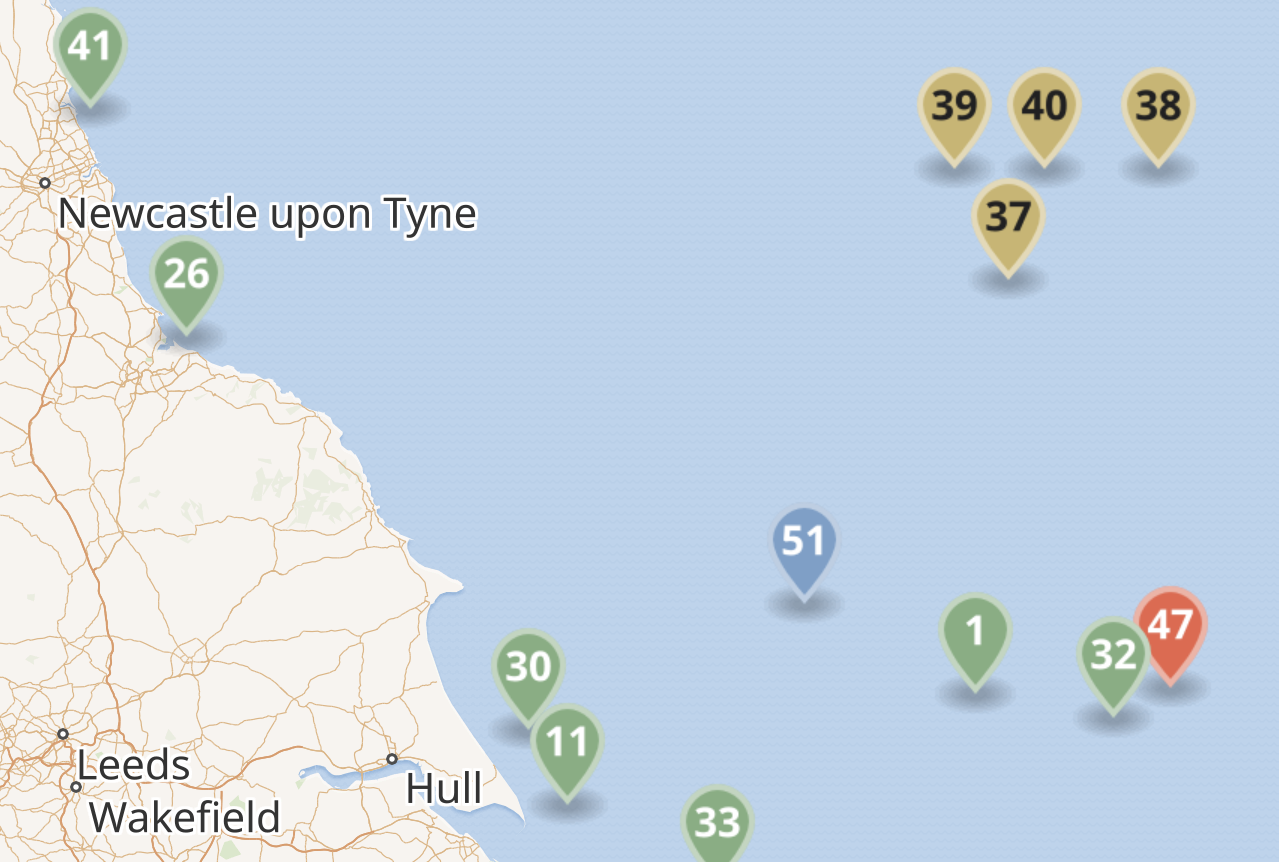
These are the Dogger Bank and Hornsea wind farms and their developers and size
- 37 – Dogger Bank A – SSE Renewables/Equinor – 1,235 MW
- 39 – Dogger Bank B – SSE Renewables/Equinor – 1,235 MW
- 38 – Dogger Bank C – SSE Renewables/Equinor – 1,218 MW
- 40 – Sofia – RWE – 1,400 MW
- 1 – Hornsea 1 – Ørsted/Global Infrstructure Partners – 1,218 MW
- 32 – Hornsea 2 – Ørsted/Global Infrstructure Partners – 1,386 MW
- 47 – Hornsea 3 – Ørsted – 2,852 MW
- 51 – Hornsea 4 – Ørsted – 2,400 MW
Note.
- That is a total of 12, 944 MW, which is probably enough electricity to power all of England and a large part of Wales.
- Wikipedia’s List of offshore wind farms in the United Kingdom, also lists a 3,000 MW wind farm, that is being developed by German company ; RWE called Dogger Bank South,
- The Dogger Bank South wind farm is not shown on the map, but would surely be South of wind farms 37 to 40 and East of 51.
- The Dogger Bank South wind farm will raise the total of electricity in the Dogger Bank and Hornsea wind farms to just short of 16 GW.
Connecting 16 GW of new electricity into the grid, carrying it away to where it is needed and backing it up, so that power is provided, when the wind doesn’t blow, will not be a nightmare, it will be impossible.
An alternative plan is needed!
AquaVentus To The Rescue!
AquaVentus is a German plan to bring 10 GW of green hydrogen to the German mainland from the North Sea, so they can decarbonise German industry and retire their coal-fired power stations.
- I introduce AquaVentus in AquaVentus, which I suggest you read.
- AquaVentus is being developed by RWE.
- AquaVentus connects to a German hydrogen network called H2ercules to actually distribute the hydrogen.
This video shows the structure of AquaVentus.
I clipped this map from the video.

Note.
- The thick white line running North-West/South-East is the spine of AquaVentus, that will deliver hydrogen to Germany.
- There is a link to Esbjerg in Denmark, that is marked DK.
- There appears to be an undeveloped link to Norway, which goes North,
- There appears to be an undeveloped link to Peterhead in Scotland, that is marked UK.
- There appears to be a link to just North of the Humber in England, that is marked UK.
- Just North of the Humber are the two massive gas storage sites of Aldbrough owned by SSE and Brough owned by Centrica.
- Aldbrough and Rough gas storage sites are being converted into two of the largest hydrogen storage sites in the world!
- There appear to be small ships sailing up and down the East Coast of the UK. Are these small coastal tankers, that are distributing the hydrogen to where it is needed?
When it is completed, AquaVentus will be a very comprehensive hydrogen network.
I believe that offshore electrolysers could be built in the area of the Hornsea 4 and Dogger Bank South wind farms and the hydrogen generated would be taken by AquaVentus to either Germany or the UK.
- Both countries get the hydrogen they need.
- Excess hydrogen would be stored in Aldbrough and Rough.
- British Steel gets decarbonised.
- A 1.8 GW hydrogen-fired powerstation at Keadby gets the hydrogen it needs to backup the wind farms.
Germany and the UK get security in the supply of hydrogen.
These may be my best guesses, but they are based on published plans.
 The Anonymous Widower